
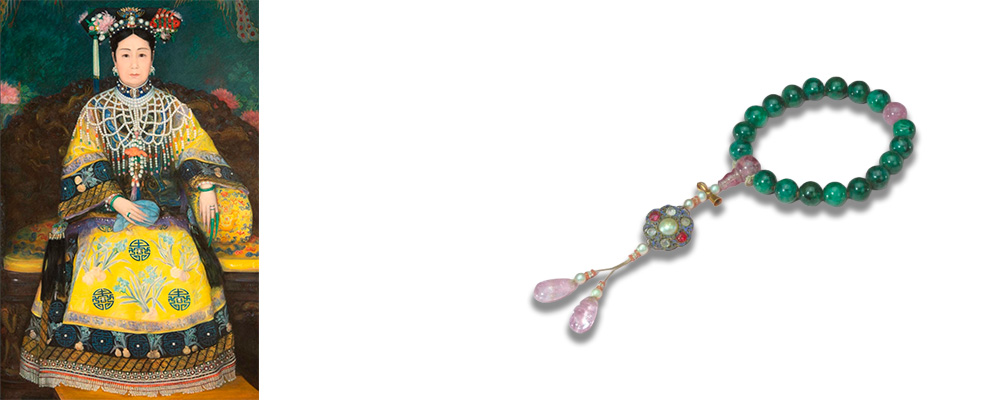
The early history of Burmese fei cui (pyroxene jade) in China has not been examined in detail. However, China’s economic expansion since 1978 has sparked renewed interest, prompting fresh efforts to better understand the history of this important gem. Building on earlier research, this article draws on both established and newly uncovered historical materials to provide a more comprehensive account of Empress Dowager Cixi’s influence on fei cui culture, while also addressing additional questions.
Part I: Introduction
Since China’s reform and opening-up in 1978, rising living standards have led to a steadily increasing consumer demand for Myanmar fei cui. Academic interest in fei cui has consequently grown stronger, and scholars have studied it from a variety of angles—history, culture, mineralogy, collecting, and more. The number of monographs and articles has surged, producing what might be called a “fei cui fever” in both the consumer world and the academy.[1]
Yet several important questions in the history of fei cui in China still urgently need to be resolved—for example: When did fei cui enter China? Is the “cuisheng stone” (翠生石) described by Xu Xiake actually fei cui? When did the term “fei cui” (翡翠) begin to be used specifically for Myanmar fei cui? I will publish my research on these questions separately.[2] This article, instead, discusses the “fei cui fever” that took shape during the period when Empress Dowager Cixi (1835–1908) held supreme power in China (1862–1908). Although fei cui became increasingly popular in the late Qianlong reign (1736–1795) and began to surpass traditional yù (Hetian nephrite) in price, it was Empress Dowager Cixi who truly pushed fei cui to its peak. Cixi was passionately obsessed with fei cui; through various channels she amassed enormous quantities of it, and even after death she was buried with many priceless fei cui ornaments. Cixi’s love of fei cui has been widely known and frequently discussed among scholars, collectors, and the general public. I largely agree with this view, but there remains room for further research, in at least the following respects.
First, although scholars and collectors (especially in the fei cui world) never tire of talking about Cixi’s fondness for fei cui, the academic field still lacks painstaking gleaning of historical sources, and systematic organization and careful analysis of them that would comprehensively demonstrate the extent of fei cui’s popularity during Cixi’s rule and its subsequent influence.
Second, it is certainly correct to emphasize Cixi’s role in popularizing fei cui and making it a mass phenomenon, but few mention how fei cui circulated in China before Cixi and how that earlier history relates to her era. What I wish to stress here is that the “fei cui fever” of the Cixi period did not arise overnight; it rested on the foundation of fei cui’s entry into China over the preceding three hundred years. The “pure green,” “full green,” or “deep green” fei cui (called 'imperial green' outside China) so beloved by Cixi and by people across the country did not originate with Cixi. It had been popular since fei cui first entered China in the fifteenth century, though primarily in Yunnan, where it was a local taste that had not yet been accepted by the Qing court, much less popularized nationwide. According to reliable historical records, fei cui entered Yunnan no later than 1474. Yunnan sources described it as “green yù” (绿玉), “blue-green yù” (碧玉), or “emerald” (祖母绿), which indicates two important points: (1) from the very beginning, people in Yunnan regarded fei cui as “yù”; and (2) they emphasized and valued its “green” color—the “(fei) cui color” ([翡]翠色) in the sources. Thus, Cixi’s era obsession with pure green fei cui represents the promotion of a Yunnan local aesthetic within the Qing court.
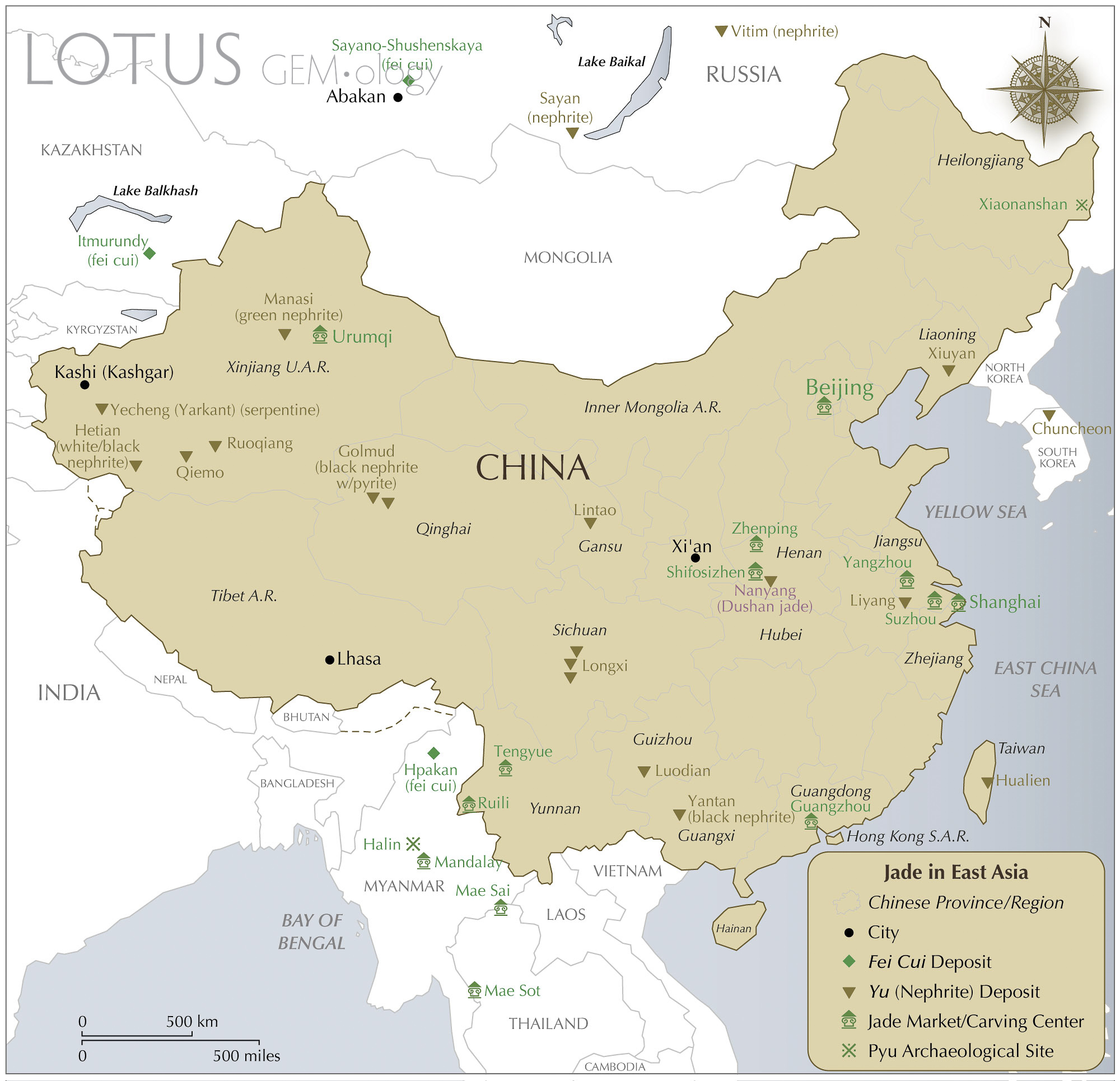 Figure 1. Map of Southeast Asia, showing the fei cui mines in upper Myanmar at Hpakan. Fei cui has been found in archaeological digs at the ancient Pyù site at Halin. Note also the proximitry between Hpakan and the Yunnan (China) city of Tengyue. Map: Richard W. Hughes.
Of course, the Qing court’s acceptance of Yunnan’s taste took a relatively long time. Around the fifteenth century (circa 1474), owing to the greed of Ming eunuchs represented by Qian Neng, fei cui began to appear in China. From 1726–1727, when fei cui first entered the Qing court, until before Cixi’s era (1862–1908), Yunnan people’s preference for green and love of fei cui had not yet influenced court taste. Over the more than one hundred years before Cixi—especially during the Qianlong period (1736–1795)—Hetian yù (nephrite) flourished, and “white yù culture” (white Hetian yù was Qianlong’s favorite) reached an unprecedented peak in China. Under the powerful influence of this magnificent white yù culture, fei cui in the Qing court underwent what I call a process of “white yù-ization” (白玉化): the court judged fei cui by the standard of white yù, so fei cui arriving from Myanmar was mostly white, pale green, or mixed white-and-green, while pure green fei cui was relatively rare and secondary. Beginning in Cixi’s era (starting already in the Xianfeng reign [1851–1861]), however, pure green fei cui gradually gained acceptance at court and began to shine with striking green brilliance. In other words, by the Cixi period, Yunnan’s green-loving fei cui taste had conquered the Qing court and then spread nationwide.[3]
This means that although Cixi’s contributions to the mass popularization of pure green fei cui were immense, her obsession with pure green fei cui was not, to use two Chinese sayings, “a tree without roots” or “water without a source.” Rather, she inherited Yunnan’s preference for pure green fei cui dating back to 1474 and pushed it to its apex. In this sense, she served as a bridge between past and future—building on the past and opening up the future. This is the theme and title of the present article.
Third, there is another question concerning fei cui: did the “fei cui watermelon” (翡翠西瓜) among Cixi’s burial objects actually exist? Many legends and accounts circulate, but they are generally superficial and lack deep research, so the question of authenticity has never been fully resolved. By sorting through a large body of existing materials, this article tends to believe that the fei cui watermelon did indeed exist. Relatedly, this article will compare written records from before and after the Cixi period with surviving objects, using each to illuminate the other, and hoping to use material evidence to demonstrate the credibility of the texts.
This article is part of my planned work A History of Fei Cui in China. By focusing on an important figure in fei cui history—Empress Dowager Cixi—I take a cross-section of Chinese fei cui history to reveal how fei cui flourished in late Qing China and surpassed the traditional Hetian yù with a 10,000-year history to become a treasured object loved by so many Chinese people. In this article, “green yù” (the term the Qing court used in most cases for fei cui), “fei cui,” and Myanmar fei cui are used interchangeably.
A word about the organization of this article. Aside from the introduction and conclusion, the article is divided into two main parts: fei cui fever during Cixi’s lifetime and fei cui among her burial objects after death, in order to show that Cixi drove fei cui consumption trends and laid the groundwork for later nationwide love of fei cui.
Part II: The “Fei Cui Fever” during Cixi’s Rule of Qing China (1862–1908)
Empress Dowager Cixi lived from 1835 to 1908. She entered the palace in 1852 and ruled the Qing from 1862 to 1908. As a woman, her pursuit of ornaments far exceeded that of male emperors, and she therefore pushed Myanmar fei cui to an unprecedented pinnacle, spurring fei cui fever throughout the country. In recent years, some scholars have discussed from a gender perspective how Cixi’s preferences as a female ruler influenced fei cui fashion, offering very interesting viewpoints. For example, Cai Lihui discusses Qing fei cui ornaments by separating male and female usage, pointing out that male ornaments (including court bead necklaces, thumb rings, feather-tube fasteners, belt buckles or hooks) were necessities tied to official rank and rituals, whereas women’s ornaments served the function of adornment, including hair ornaments (pins, hair sticks, tassel-like hairpieces, ear-pick pins, and flat hairpin [bianfang] 扁方), bracelets, rings, earrings, pendants, bead bracelets, and so forth.[4] Building on existing research, this article further integrates and organizes available materials and digs deeper for new sources, aiming to provide a more comprehensive description and discussion of Cixi’s influence on fei cui culture and to address additional questions.
If Qianlong was a yù addict, then Cixi was a fei cui addict. One way she acquired treasures was by ordering the Imperial Household Department’s workshops (the Zaobanchu 造办处) to make fei cui jewelry for her. She also sought treasures through various means (such as holiday celebrations and birthday occasions) to satisfy her intense desire for jewelry and fei cui. It should be noted that the jewelry Cixi favored was diverse and not limited to fei cui. For example, based on firsthand observation, both the palace lady-in-waiting Der Ling (who, together with her sister Yù Rongling, served Cixi in the palace from 1903 to 1905) and the American painter Katherine Carl believed that Cixi’s favorite jewelry was pearls.[5] This view is of course correct, as can be seen from Cixi’s extensive use of pearls during her lifetime and the large amount of pearls among her burial goods.[6] But pearls and fei cui differ greatly: the former is relatively easy to obtain, the latter difficult to procure; the former relatively inexpensive, the latter relatively expensive. Modern fei cui experts point out six “scarcities” of fei cui, at least four of which fit Cixi’s era: limited geographic distribution (only five or six countries produce it worldwide, and only Myanmar yields gem-grade fei cui); rare geological formation conditions (low temperature, high pressure); scarcity of high-quality (gem-grade) fei cui; and demand exceeding supply.[7] fei cui therefore appears even more precious. The palace lady-in-waiting Yù Rongling recalled that Cixi “loved most a fei cui ring, a tourmaline ring, several flowers worn in her hair, and a cape strung with pearls.”[8] Among the gifts presented to Cixi by officials, fei cui most delighted her—hence why Zhang Zhidong’s fei cui earrings and bracelets most moved her (see below).
Cixi obtained treasures in several ways, including having the Imperial Household Department’s workshops produce them. For example, archival records state:
“Respectfully submitting a list of ornaments made in accordance with the drawn patterns for Her Majesty Cixi’s inspection: four pairs of green yù flat hairpins (bianzan 扁簪), three pairs of gold-inlaid flat hairpins, two pairs of agarwood flat hairpins, one pair of tortoiseshell flat hairpins, one pair of green yù long hairpins, three pairs of gold-inlaid long hairpins, two pairs of green yù–inlaid long hairpins, one pair of coral long hairpins, three pairs of agarwood long hairpins, eight pairs of gold-inlaid bracelets, six pairs of coral bracelets, seven pairs of green yù hair clamps (qian 钳), two pairs of green yù–inlaid clamps, three pairs of agarwood-inlaid clamps, three pairs of gold-inlaid clamps, one pair of coral-inlaid clamps, five pairs of tourmaline-inlaid clamps, six pairs of coral bangles (liu溜), six pairs of green yù bracelets (liu), six pairs of green yù rings, five pairs of gold-inlaid bangles (liu), one pair of sandalwood bangles (liu), one pair of agarwood eighteen-bead bracelets (shibazi 十八子), and twenty kinds of agarwood pendants inlaid with various flowers.”[9]
According to the 1864 (Tongzhi 3) Work Archive (Huojidang), the yù craftsman Zhou Wenyù was ordered on three occasions in early April to use “Yun yù 云玉” (meaning 云南来的玉石, yù from Yunnan—actually from Myanmar) to make small fei cui items such as bracelets, thumb rings, belt fittings, and small decorative components for brocade boxes.[10]
Another way was for the Qing court to assign quotas to various regions to obtain treasures for Cixi. But because fei cui rough was difficult to obtain or expensive to produce, places such as the Huai customs and Jiangnan complained bitterly. For example, in a 1874 (Tongzhi 13) communication to the Zaobanchu, the Guangdong Maritime Customs wrote: “Green yù originates in Myanmar; white yù is also not produced in Guangdong. This year, with treaty ports opened and trade flourishing, merchants have scattered to sell goods; not only are items for sale scarce nearby, sources are also few. We can only exert ourselves to search; I fear it will be difficult to complete the quota on time.” In 1875 (Guangxu 1), another report stated: “As for green yù work, we previously dispatched people to Suzhou, Shanghai, Yangzhou, and other places to search for yù material for half a year, yet obtained nothing.” In 1877 (Guangxu 3), the Huai’an customs superintendent Wen Gui received a demand from the Zaobanchu to deliver “three pairs of green yù bamboo-joint bracelets; one small long hairpin in the form of a double-happiness ear-pick spoon; six long hairpins in the same form; and two pairs of double-happiness green yù clamps.” These four categories totaling 17 fei cui ornaments cost 39,994 taels of silver—an average of 2,352.58 taels per item—an astonishing price. In the archival materials for Cixi’s sixtieth birthday celebrations, gifts from Fu Kun and others included five pairs of Hetian “fat yù” ruyi scepters, two “green yù and red agate longevity peach” ornaments, six “yù immortal terraces,” and so on.[11] The Zaobanchu archives still require further examination, but the above suggests that Cixi strove to gather fei cui from across the country, and at times the supply of rough fei cui was difficult.
A third channel was tribute from high officials in Beijing and military-administrative officials across the country, offered on various occasions such as birthdays and festivals, etc. According to Rongling’s recollections, “Whenever Cixi’s birthday came, the provincial governors and viceroys and the princes and high ministers all presented tribute—materials for embroidered robes, antiques, calligraphy and paintings, and some foreign things….” During Lunar New Year, “the princes and ministers and the provincial governors and viceroys likewise presented tribute to Cixi as usual.”[12] In 1894, Cixi’s sixtieth birthday was celebrated on a grand scale, and all parties offered treasures to demonstrate loyalty. The Guangxu Emperor’s tribute included 29 yù display objects and a total of 204 items such as green yù, white yù, coral, tortoiseshell, sandalwood, agarwood, gold and silver hairpins, clamps, bangles (liu), bracelets, rings, and more. The Imperial Household Minister Fu Kun’s tribute included two green yù and red-agate longevity peaches, while the Anhui governor Shen Bingcheng’s tribute included a full-length fei cui statue of Magu presenting longevity (Figure 2).[13] In 1903 (Guangxu 29), Cixi’s seventieth birthday, Ta Kung Pao reported: “For this birthday celebration, both provincial officials—certain palace guardians and the like—and capital officials—certain ministers and the like—have all made offerings; compared with previous birthday celebrations, the tribute objects are ten times as many; rare treasures are gathered in an unprecedented abundance.”[14]
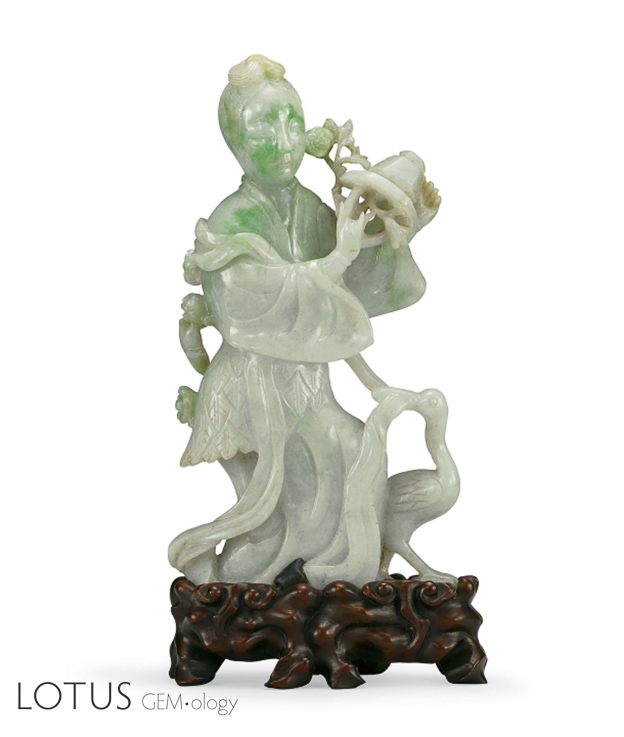 Figure 2. Qing dynasty fei cui statue of Magu presenting longevity gifts. Photo: Yù Jen Co., auction lot no. 36.
The palace lady-in-waiting Der Ling, who served Cixi in the palace for two years, provides the most vivid and lifelike description:
She enjoyed receiving presents as much as a child enjoys receiving toys. And almost every day some precious gift, either of stones or of foreign presents inlaid with stones, came to court. Her treasure-house has been stocked with presents from ministers, viceroys, and foreign diplomats. I doubt if anyone knew the full value of her possessions. Many of her jewels had been paid for from the treasury—in cases where she sent messengers throughout the world to find certain stones she desired—the greater part of them came to her as presents and were thus her own personal property. The amount of this treasure was enormous, especially since it was bad form to give one of anything. If an article of personal adornment were presented, it must be presented in pairs, which meant that the giver must seek far and wide, and spend a great deal of money, to match the gift he wished to make to Her Majesty.
Der Ling then relates that Zhang Zhidong (Chang Chih Tung), governor-general of Huguang (Hubei and Hunan), presented first-class fei cui earrings and a pair of fei cui bracelets to Cixi. The earrings were “of the purest green, carved in the shape of crescents, about an inch in length.” “Her Majesty gasped a little when she saw them. Then she held them to a light: ‘See…they are perfect. There is not a flaw in them anywhere…There is nothing in our collection to equal it.’” Der Ling continues: “She turned her attention then to the rest of Chang Chih Tung’s gift—which [was] a pair of bracelets, apparently from the same piece of yù whence the earrings had come, for it too was utterly flawless. Held up to the light, the four pieces of yù disclosed not the slightest imperfection. One fears to hazard to guess at their value. As yù alone they were worth many thousands of taels; but when one considered all the trouble and expense Chang Chih Tung had been put to procure the yù and have it carved, there was no computing the price with any degree of accuracy. Her Majesty held the brilliant bits in her hands for a long time, seeming to glory in the smooth feel of them against her skin…”[15] Here, “yù” refers to fei cui.
Among Cixi’s personal objects was also a “green yù carved ‘sons-and-grandsons’ pendant,” contributed by Zhang Zhidong.[16]
Thus one may say that Cixi’s treasures filled rooms and piled up. According to the unofficial history Qingbai Leichao, “In the Empress Dowager Xiaoqin’s palace there was a room for storing jewels; it had three-sided wooden racks; from top to bottom, a row of sandalwood boxes stood in the middle, each labeled with its name; there were three thousand boxes, and still more stored elsewhere.”[17] Therefore even the last emperor Puyi (1906–1967; reigned 1909–1911) said, “Qianlong and Cixi were the most extravagant among all the Qing emperors and empresses.”[18]
The American painter Katherine Carl painted Cixi’s portrait in 1903 (Figure 3), leaving later generations the most direct and precious visual evidence. In the portrait Cixi appears dignified, elegant, and radiant. Besides wearing large quantities of pearls and other gemstones, the most eye-catching items are fei cui. In addition to the small fei cui pieces set into her phoenix crown, earrings, and pearl robe, she wears two fei cui bracelets, three fei cui rings, and two long fei cui nail guards on her left hand.
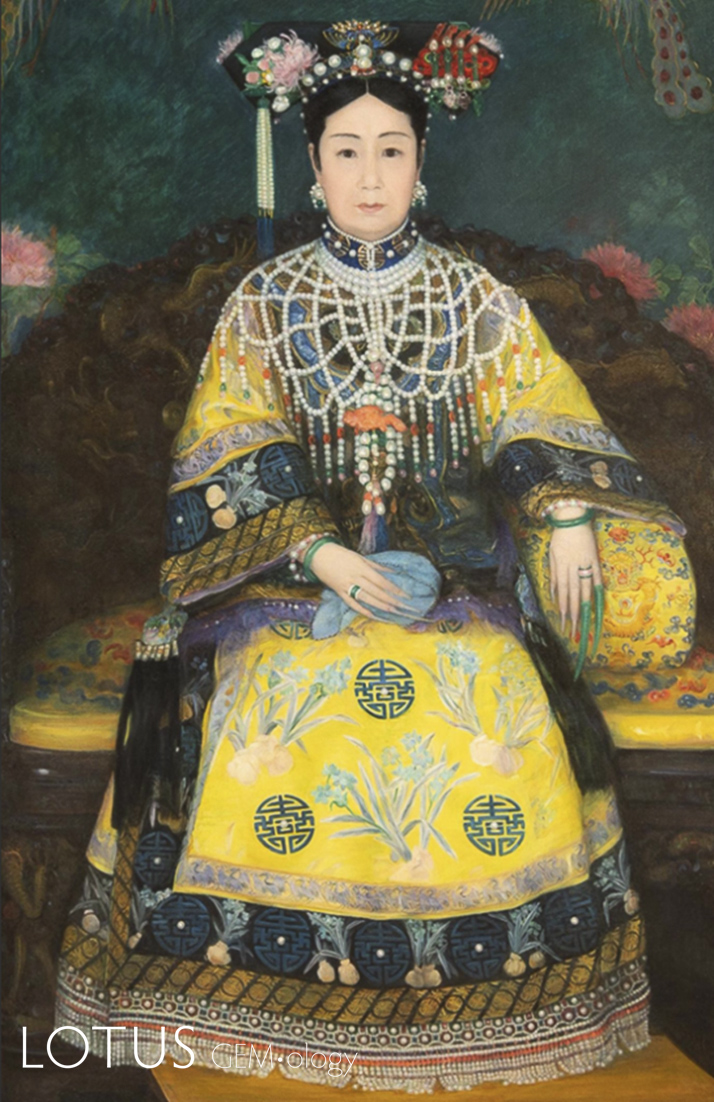 Figure 3. Portrait of Empress Dowager Cixi painted by Katherine Carl. Photo: Smithsonian Institution. [19]
According to Qingbai Leichao, juan 60 (“Extravagance”):
The Empress Dowager Xiaoqin’s usual attire was a yellow satin robe embroidered with large pink peonies. Her hair was filled with jewels; on the left hung pearl strands; in the center was a pink peony, all composed of gemstones. Around her neck was a shawl shaped like a fishnet, adorned with 3,500 real pearls, each as large as a bird’s egg, round and lustrous. There were also beautiful yù tassel ornaments. On her hands she wore one pearl bracelet and one yù bracelet; on the right hand the third and fifth fingers were covered with gold nail guards; on the left hand two fingers were covered with yù nail guards, each three inches long; and she wore several gemstone rings. Even the shoes had pearl strands and were inlaid with various gemstones.[20]
Here, “one pearl bracelet and one yù bracelet…two fingers covered with yù nail guards” correspond to the fei cui bracelets and nail guards in Cixi’s portrait. Carl’s description of the nail guards largely matches Qingbai Leichao: “These nail-protectors were worn on the third and fourth fingers of either hand; those on the left being of brilliant green yù, while those on the right hand were of gold, set with rubies and pearls.”[21]
Most of the fei cui ornaments preserved today in the Palace Museums on both sides of the Taiwan Strait (the Palace Museum in Beijing alone has more than 800 pieces, including a pair of fei cui bracelets [Figure 4]) may well date to Cixi’s era; some may even have been worn and used by her personally.[22] All this deserves further research. To date, unfortunately, no illustrated catalog of all fei cui holdings from both Palace Museums has been published.
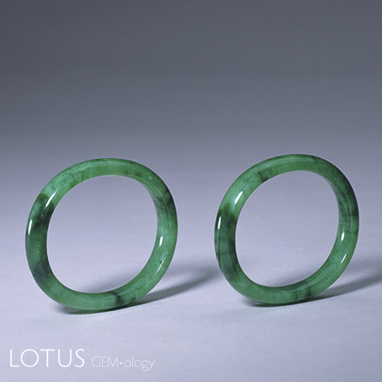 Figure 4. Pair of Qing court fei cui bracelets in Beijing's Palace Museum; outer diameter 7.6 cm, inner diameter 5.6 cm. Photo: Palace Museum, Beijing.
To display imperial favor, cultivate loyalty among officials, and reward military merit, Qing emperors and empresses often bestowed treasures upon princes and nobles, military and civil officials, and even foreign guests. After fei cui became popular in China, it naturally became a common gift. The earliest recorded fei cui bestowal appears in 1795 (Qianlong 60): Fuk’anggan and Hailan received one white yù and one turquoise feather-tube fastener each, and one fei cui thumb ring each, as rewards for their merit in suppressing the Miao uprising.[23] In 1839 (Daoguang 19), the Tibetan religious leader Jebtsundamba Khutuktu (whose status was second only to the Dalai Lama and the Panchen Erdeni) received a yellow khata scarf, an auspicious yù pendant, and a string of fei cui prayer beads.[24] In 1911 (Xuantong 3), the Qing court again bestowed “relics of the former dynasty” upon the Khutuktu, including a tray of coral prayer beads, a sable-lined coat, a white yù snuff bottle, and a fei cui thumb ring.[25]
During the Xianfeng and Tongzhi reigns, when the Qing was suppressing the Taiping Heavenly Kingdom, warfare was frequent, and rewards for military merit appear often in the Qing Veritable Records. In 1853 (Xianfeng 3), because Xiang Rong’s deployment was effective and his subordinates fought with merit, the court rewarded him with one white yù “poetic” thumb ring, one white yù feather-tube fastener, and one green yù (snuff) bottle. His subordinates were also rewarded with eleven feather-tube fasteners, thirty-six thumb rings, and so on. That same year, Sengge Rinchen received one green yù snuff bottle and one white yù “four auspicious” thumb ring. In 1855 (Xianfeng 5), Luo Zenan received one white yù feather-tube fastener and one green yù “four happiness” thumb ring. In 1862 (Tongzhi 1), for merit in retaking Qingyang County in Anhui, the commander Bao Chao received one white yù thumb ring and one blue-green yù snuff bottle, a small knife with a white yù handle, and one white yù pendant.[26] That same year, the imperial commissioner Sheng Bao received one fei cui feather-tube fastener, one white yù snuff bottle, one white yù pendant, and so on. In 1863 (Tongzhi 2), to recognize Sengge Rinchen for his campaigns against the Nian forces in Henan and Anhui, the court bestowed one fei cui feather-tube fastener, one white yù thumb ring, one white yù snuff bottle, and a small knife with a yù handle.[27] Here, “green yù” and “bi yù” should both refer to fei cui.
Cixi also bestowed fei cui ornaments upon trusted ministers and foreign guests, such as a fei cui thumb ring given to the chief eunuch Li Lianying (Figure 5), Ronglu’s fei cui feather-tube fastener (Figures 6 and 7), and other fei cui objects. From Ronglu’s tomb were unearthed a fei cui feather-tube fastener, a fei cui dragon-carved belt hook, a fei cui double-chi dragon snuff bottle, a fei cui carving of twin badgers pendant (4.8 cm long, 3.4 cm wide), and a fei cui lotus-leaf pendant. In addition, the smaller bead necklaces on the court bead necklace worn in Ronglu’s portrait may have been fei cui. At least some of these fei cui ornaments and display pieces were likely bestowed by Cixi, since Ronglu’s loyalty made him a crucial pillar of her regime.[28] Qingbai Leichao’s “Extravagance” section comments on Ronglu’s fei cui feather-tube fastener: “The fei cui feather-tube fastener used was crystal-clear inside and out; from the outside one could see every fine hair of the feather; it was ‘glass-type fei cui’ (玻璃翠), valued at 13,000 taels.” This is the first appearance of “glass-type fei cui” in the literature. After the 1900 Boxer Crisis, Cixi began “Ladies’ Diplomacy,” frequently meeting the wives of foreign envoys. In 1903 she separately presented a pair of fei cui rings to Lady Susan Townley (1868–1953), wife of the British minister, and two fei cui ornaments to the granddaughter of Sarah Pike Conger (1843–1932), wife of the American minister.[29]
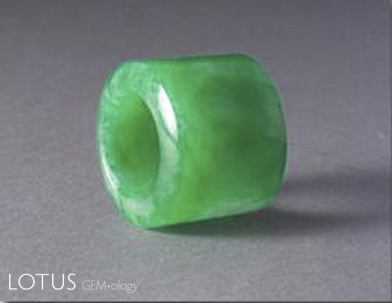 Figure 5. Fei cui thumb ring bestowed by Cixi on Li Lianying; height 2.5 cm, diameter 3 cm. Photo: Beijing Museum.

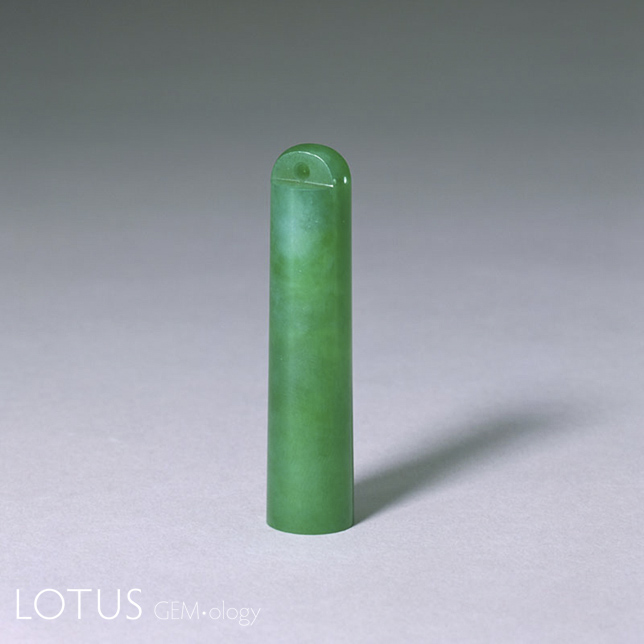 Figure 6. Fei cui feather-tube fastener in the Palace Museum, Beijing; height 7.4 cm, diameter 1.5 cm. Photo: Palace Museum, Beijing.
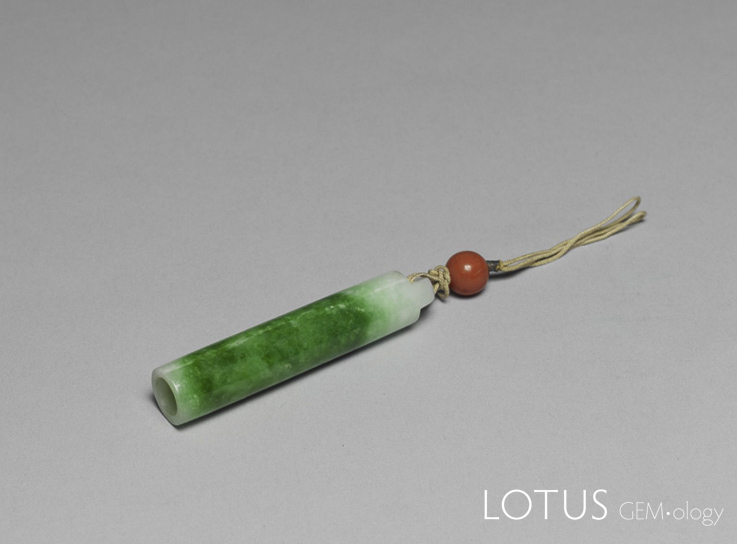 Figure 7. Fei cui feather-tube fastener in the National Palace Museum, Taipei, later modified into a pendant. Photo: National Palace Museum, Taipei.
 The late Qing connoisseur and collector Tang Rongzuo (1841–?) wrote Yù Shuo (About Yù) in 1890, describing in parallel prose the various fei cui ornaments used by the Qing court and Beijing’s elites:
As for objects made from it (fei cui): within the forbidden gardens are displayed fei cui melons; in the imperial kitchens are stored lifelike vegetables. Vases, basins, bowls, and cups adorn spacious banquets; pendants, earrings, hairpins, and rings daily draw close to fragrant beauty. To adorn hats and robes, there are feather-tube fasteners and court bead necklaces; to strengthen the spectacle of pendants and ornaments, there are head-scratching pins and thumb rings. Brush rests and brush pots shine with strange colors in the scholar’s studio; smoking pipes and snuff bottles add luxurious enjoyment. To bind the arm, one boasts of the wealth of paired bracelets, worth over a thousand silver taels; to encircle the waist, one honors a single belt hook, also worth several hundred taels. ‘Eighteen beads’ match the number of arhats, splendid upon the chest (Figures 8 and 9);[30] ‘two-ends-busy’ hairpins gather the coiffure, crowning glory atop the head. As for other items: back pendants and Buddha-head beads for court necklaces; flower centers and butterfly wings inlaid into jewelry—though the objects are tiny, vivid color alone makes them precious; and since the grade is lofty, they are treasures worth a city. This is the unique concentration of a land’s spiritual beauty, becoming today’s luxurious plaything. [31]
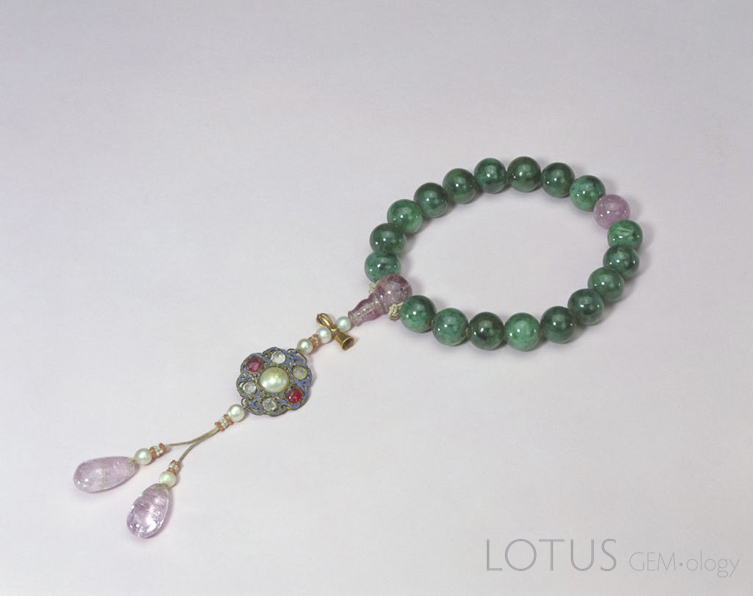 Figure 8. Qing fei cui “eighteen beads” bracelet; circumference 30 cm, bead diameter 1.2 cm. Photo: Palace Museum, Beijing, Inventory No. 故00009720.
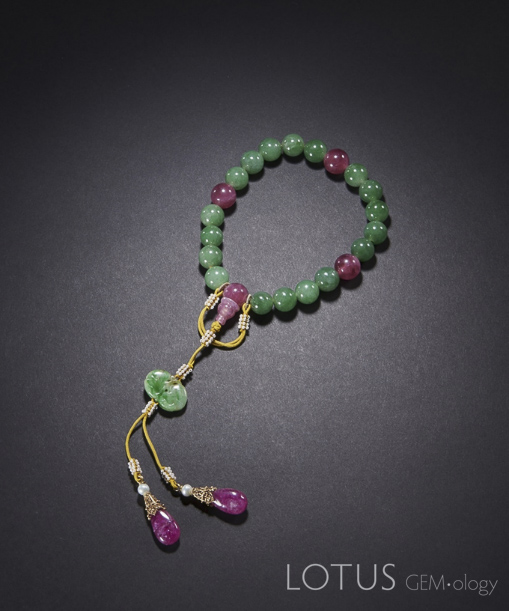 Figure 9. Qing Dynasty fei cui “eighteen beads” bracelet; circumference 30 cm, bead diameter 1.2 cm. Photo: Palace Museum, Beijing, Inventory No. 故00009720.
The “fei cui melons” and “lifelike vegetables” here refer to the fei cui watermelon and fei cui cabbage. As a connoisseur and collector, Tang Rongzuo’s record is factual rather than fabricated. Moreover, because his discussion predates Sun Dianying’s 1928 looting of the Eastern Qing Tombs by 38 years, its credibility is very high and indirectly supports the existence of the fei cui watermelon (see below). More importantly, Tang’s description reflects the widespread use of fei cui among Beijing’s (and even the nation’s) upper society in the late nineteenth century.
Part III: Fei Cui among Cixi’s Burial Goods (1908)
When Cixi died in 1908, her burial goods were recorded differently in official histories and unofficial accounts. Regarding the former, a document from the same year—Account of the Encoffining and Presentation of Burial Garments, Clothing and Other Items Offered for Service at the Imperial Mausoleum of the Empress Dowager Xiaoqin—records at least 39 ornaments made of “green yù” (fei cui), mostly hairpins, pendants, or snuff bottles. These include: one coral-and–green yù bat hairpin; three green yù “monkey grasping a pole” hairpins; one green yù “lotus held at the head” hairpin; one gold-mounted “lotus held at the head” hairpin set with red-and-green tourmaline; one pair of chrysanthemum ornaments of strung green yù beads with red-and-green tourmaline; one gold-and-kingfisher-feather “Buddha’s hand” hairpin; two gold-mounted green yù “Buddha’s hand” hairpins; one gold-and-kingfisher-feather, gold-mounted green yù “Buddha’s hand” hairpin set with small zhen-stones and seed pearls; one carved green yù pestle-shaped “Buddha’s hand” hairpin; two green yù bangles (镏子); one pair of small stirrup-shaped green yù bangles; one green yù “Buddha’s hand” hairpin; two carved green yù orchid “Buddha’s hand” hairpins; two wide green yù bangles (liuzi); four stirrup-shaped green yù bangles (liuzi); one green yù carved “sons-and-grandsons” pendant (Zhang Zhidong);[32] one green yù carved pendant with a Han inscription (Lu Fulin); one green yù carved kui-dragon “ten thousand blessings” pendant (Natong); one green yù carved lingzhi pendant (Zaixun); one green yù snuff bottle in a “backed-flask” form; one green yù carved kui-dragon pendant (Zaize); one green yù carved chi-tiger pendant (Na Yantu); one green yù carved kui-dragon “good fortune and longevity” snuff bottle (Bodisuo); one green yù carved dragon-and-phoenix “ten thousand blessings” pendant (?); one green yù pendant (Shi Xu); one green yù snuff bottle (Zaitao); one “feicui” pendant (Puwei); one green yù snuff bottle (Pulun); one green yù pendant (Shiduo); and one green yù pendant (Shanqi).[33]
These may have been burial objects that Cixi placed in her tomb during her lifetime. Except for one instance using the term “feicui,” all are called “green yù,” which was the Qing court’s usual term for fei cui at the time. Of course, sources in this area still require further excavation and research.
Unofficial histories (including various memoirs) record burial goods such as the “fei cui watermelon,” “fei cui muskmelon,” and “fei cui cabbage,” but for these there have long been many legends and few reliable histories. The last emperor Puyi’s memoir My First Half of Life cites a piece of historical-materials writing:
“Most of Cixi’s burial objects were jewels and emeralds and diamonds. Her phoenix crown was made of very large pearls threaded with gold wire; the quilts were covered with large peonies also entirely piled up with pearls. The bracelets were set with diamonds to form one large chrysanthemum and six small plum blossoms, crystal clear and dazzling. In her hand she held a vajra-pestle about three inches long, made of fei cui. On her feet she wore pearl shoes. In addition, in the coffin were placed seventeen strings of rosaries made of jewels and several pairs of fei cui bracelets.”[34]
This at least shows that Puyi believed there was indeed a great deal of fei cui among Cixi’s burial goods.
Another widely circulated unofficial source is Li Chengwu’s Notes from the Aiyue Studio (Aiyuexuan Biji). Li Chengwu was the nephew of Li Lianying (1848–1911), Cixi’s most favored eunuch; Li Yingzhou was Li Chengwu’s son, i.e., Li Lianying’s grandnephew. Li Chengwu recorded what he said was Li Lianying’s account book of items at the time of Cixi’s encoffining, with estimated values in parentheses added by Li Chengwu in 1909 (Xuantong 1) together with the antique dealer Mr. Ma:
…(Empress Dowager Cixi) wore atop her head a fei cui lotus leaf, weighing 22 taels 5 qian 4 fen (estimated value about 850,000 taels [silver]) [Yingzhou’s note: it is said this was presented by a certain official of the Guangdong circuit; the leaf was full green, and the stem had grown naturally long, not carved. Even at 850,000 taels today, one could not buy even half of it]… Behind she wore a pearl crown, beside which were placed 108 statues of gold Buddhas, fei cui Buddhas, and yù Buddhas. At her left and right feet were placed one watermelon each, two muskmelons, and treasures such as peaches, plums, apricots, and dates… fei cui Buddhas, each weighing 6 taels… 27 in total (about 620,000 taels)… On the sides of her feet left and right, one fei cui watermelon each: green rind, red flesh, white seeds, black strands (about 2,200,000 taels).[35] Four fei cui muskmelons: two with white rind, yellow seeds, pink flesh; two with green rind, white seeds, yellow flesh (estimated 600,000 taels). [Yingzhou’s note: these four muskmelons are called absolute masterpieces; their value today is far more than tens of thousands of taels] Ten fei cui peaches… [Yingzhou’s note: the peaches are green with pink tips]… [It is also heard there were two fei cui cabbages, with green leaves and white hearts; on the heart sat a fully green katydid; beside the leaf were two wasps, yellow in color. But the public account did not list them; perhaps they were offerings from princes and nobles] To the left were three sections of yù lotus root with gray mud stains; from the lotus root grew a green lotus leaf, a pink lotus flower, and a black water chestnut… (estimated 1,000,000 taels) [Yingzhou’s note: this object is even rarer than the fei cui watermelon]… [36]
Adding the conservative estimates here yields at least 5.27 million taels, and these are not the valuations of all fei cui ornaments. These accounts are extremely vivid and specific, yet their credibility has long been debated—some believe them, others doubt them.
Twenty years after Cixi’s death, in 1928, the nationally sensational tomb-robbery case of Sun Dianying (1889–1947) occurred at the Eastern Qing Tombs. Sun was originally a warlord and later served as commander of the 12th Army of the 12th Corps of the 6th Army Group of the National Revolutionary Army. Soon after the case, Liu Yusheng (1876–1952), a veteran of the 1911 Revolution, interviewed in Hankou a company commander who had personally participated in the looting under a division commander named Tan Wenjiang. Liu recorded the following:
He was ordered to dig into the Empress Dowager’s mausoleum. When the coffin lid was lifted, rosy radiance filled the coffin. Each soldier held a large flashlight, yet the light was overwhelmed; all were shocked. Looking down into the coffin, the Empress Dowager’s face looked as if alive; her fingers had white hair more than an inch long. Some soldiers shouted to quickly place guns across the coffin to prevent a startled corpse from rising and injuring people, but nothing else happened. The rosy radiance came from the jewels stored in the coffin. First they removed the four large watermelons placed at the four corners of the coffin. Each melon had a green yù rind and purple yù flesh; it was cut in the middle, with black seeds; the rosy radiance issued from the cut section. A large pearl held in the Empress Dowager’s mouth also emitted white light. A yù pillow more than a foot long emitted green light. Other jewels were piled in the coffin beyond counting. The larger pieces were taken by officers; the smaller pieces were secretly stuffed into soldiers’ pockets. Still unsatisfied, they moved the Empress Dowager’s body, turning it left and right, taking away all the jewels covering the bottom of the coffin. The commanding officer then ordered the dragon robe removed and all close-worn jewels searched out and taken, saying: ‘No need to damage the corpse.’ After the coffin jewels were exhausted, they searched for burial objects throughout the tomb. When the coffin bottom was flipped, a stone cavity appeared; the treasures stored within were also taken. After the search, Sun Dianying distributed the loot; every soldier got something. The valuable large pieces were loaded onto carts and hauled away. As for the digging of Qianlong’s tomb, this company commander did not participate and did not know what happened there.[37]
Liu Yusheng’s writings have high value and have received strong reviews from many various fields. His record of this commander’s oral account of participating in the looting of Cixi’s tomb is credible. Especially telling is the last sentence: he did not participate in the looting of Qianlong’s tomb and thus did not know its details, giving a strong impression of “knowing what one knows and admitting what one does not.” The account mentions “four large watermelons… green yù rind, purple yù flesh… black seeds… rosy radiance issuing from the cut section.”
There is more material on this. Wang Yongsheng, as a subordinate of Sun Dianying, should also be credible. A native of Gaobao Township, Qingfeng County, Puyang City, Henan province, Wang wrote a memoir in 1986 (at age 80), stating at the outset: “I joined Sun Dianying’s forces in 1927, first serving as staff officer at army headquarters, then as battalion commander, regiment commander, division chief of staff, acting division commander, and so on, for more than twenty years. Therefore, regarding Sun Dianying’s looting of the Eastern Qing Tombs, I personally experienced and heard about it. I now briefly describe the situation.” According to his recollection, Cixi’s burial treasures included “one fei cui watermelon, with tender green rind, green leaf, and bluish stem, as if freshly picked from the vine; one fei cui cabbage, with green leaves and white heart, carved with two katydids in a fighting posture, lively and pleasing, lifelike.”[38] Wen Qiang, former head of the Northern District of the Nationalist secret police (Juntong), recalled that Sun Dianying told him in 1943: “Cixi’s pillow was a fei cui watermelon; I asked Yunong (Dai Li) to present it on my behalf to Finance Minister T. V. Soong (Song Ziwen).”[39] These two relatively valuable sources further corroborate the presence of a fei cui watermelon in Cixi’s coffin.
In the very year of the tomb robbery (1928), a book titled The Tomb-Robbery Case (Daoling An) was published. It imitates Sherlock Holmes detective fiction in chaptered-novel form and invents two detective characters, but the author declares in the “General Notes” that “the various facts collected in this novel, besides those published in newspapers, were also inquired from many sides and narrated here to serve as reference for investigating the case… Most of the ‘novel’s’ facts are true. Therefore, except for the two detectives fabricated by the editor and persons unrelated to the case, all names and identities are real, to demonstrate verification.” To obtain more materials, the editors even offered rewards at the front matter, calling on “comrades at home and abroad who know the inside truth of the case or the whereabouts of national treasures to write in with detailed facts; if adopted, payment will be made…” In this sense, the genre resembles today’s documentary or reportage literature. Given this context, the book is not wholly fictional and has some basis and credibility. Regarding the burial goods in Cixi’s tomb, it records: “Inside Cixi’s coffin there was one yù-stone watermelon, carved from a single natural piece of yù. The rind was green; the interior was divided into three layers—white, red, and yellow; the seeds were black; it truly could be called a priceless treasure.” Although the term “fei cui” is not used, it clearly refers to fei cui. The book also quotes in full the original text of Notes from the Aiyue Studio, using terms such as “fei cui Buddha,” “fei cui watermelon,” “fei cui peach,” and “fei cui cabbage.” According to the book, after the robbery some soldiers who sold treasures were caught; the confiscated items were sent to the “Continental Bank” for safekeeping, including some “fei cui.”[40] This suggests that the earlier “yù-stone watermelon” was obtained through investigation rather than copied from Notes from the Aiyue Studio, demonstrating independent sourcing and increasing credibility.
Still more unofficial materials mention fei cui watermelons. The late Qing novelist Li Boyuan (1867–1906) wrote in Nanting Notes: “After Zhongxiang (Zeng Guoquan) broke Nanjing, in the Heavenly King’s palace… he obtained a fei cui watermelon larger than a basket; black spots like seeds, red substance like flesh—bright, moist, and fresh, perhaps unmatched. Those who knew said: ‘This is an object from Yuanming Palace.’”[41] There are also legends that the Tongzhi Emperor bestowed a fei cui watermelon on a consort.[42] These records are not necessarily credible, but they at least show popular fascination with fei cui watermelons. Of course, the strongest evidence remains Tang Rongzuo’s 1890 account, which explicitly mentions the court’s fei cui watermelon and fei cui cabbage.
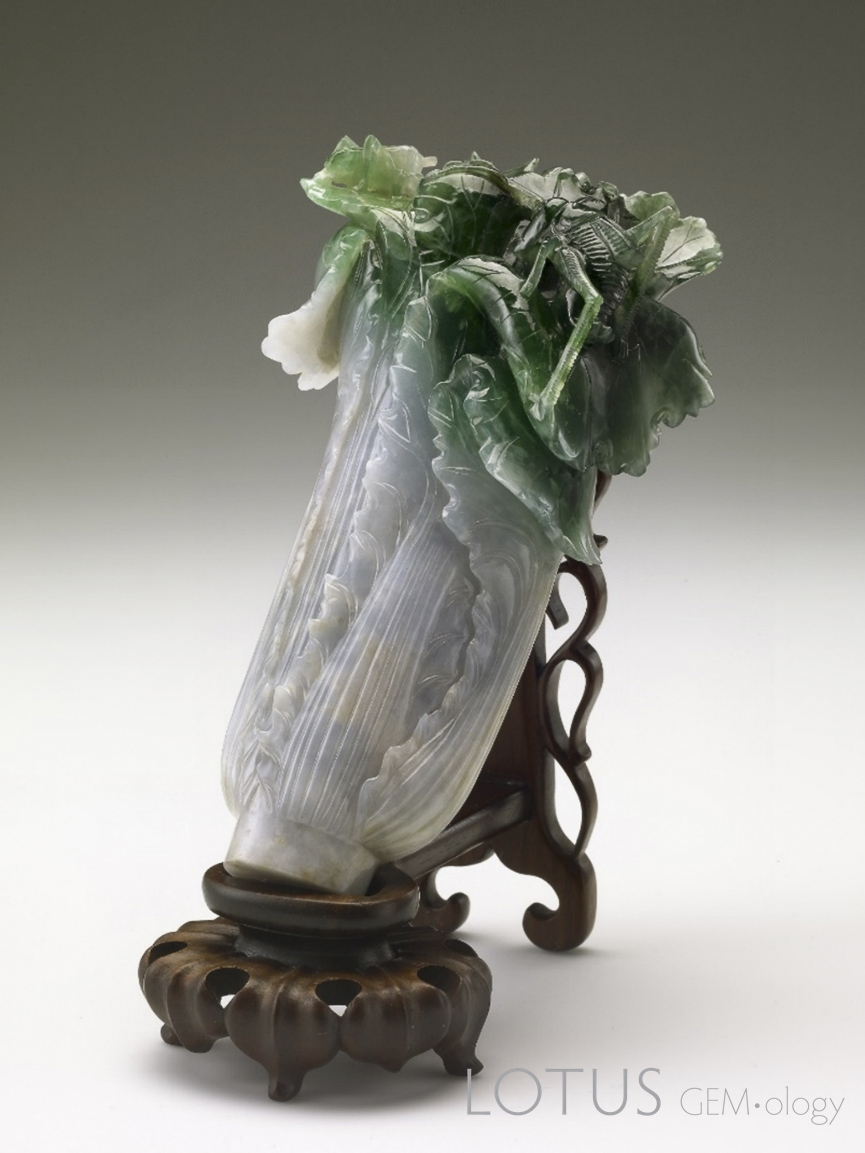 Figure 11. Detail of the Fei Cui cabbage; the upper right is a carved locust. Photo: National Palace Museum, Taipei.
Notes from the Aiyue Studio also mentions fei cui cabbages. Because physical examples survive on both sides of the Taiwan Strait, their existence is beyond doubt. The most famous are the National Palace Museum (Taipei) “Fei Cui Cabbage” (Figures 10 and 11) and the Tianjin Museum “Fei Cui Cabbage with Katydids” (Figures 12 and 13). These carvings are masterpieces: the craftsmanship is astonishing; the cabbage and insects are lifelike. In addition, the National Palace Museum holds a lesser-known “Fei Cui Cabbage Flower Vase Insert” (height 9.9 cm, width 6.7 cm, thickness 5.2 cm; inventory nos. 崑-217-30, 故玉7852) and a “Small Fei Cui Cabbage” (height 13.4 cm, length 8.9 cm, width 8.9 cm; inventory nos. 金-246-32, 故玉2662). It is said that the “Fei Cui Cabbage” was originally placed in Beijing’s Yonghe Palace and may have been part of the dowry of Consort Jin (Guangxu’s consort). The cabbage’s white color symbolizes purity, and the katydid/grasshopper and locust carved on it symbolize many sons and grandsons.[43]
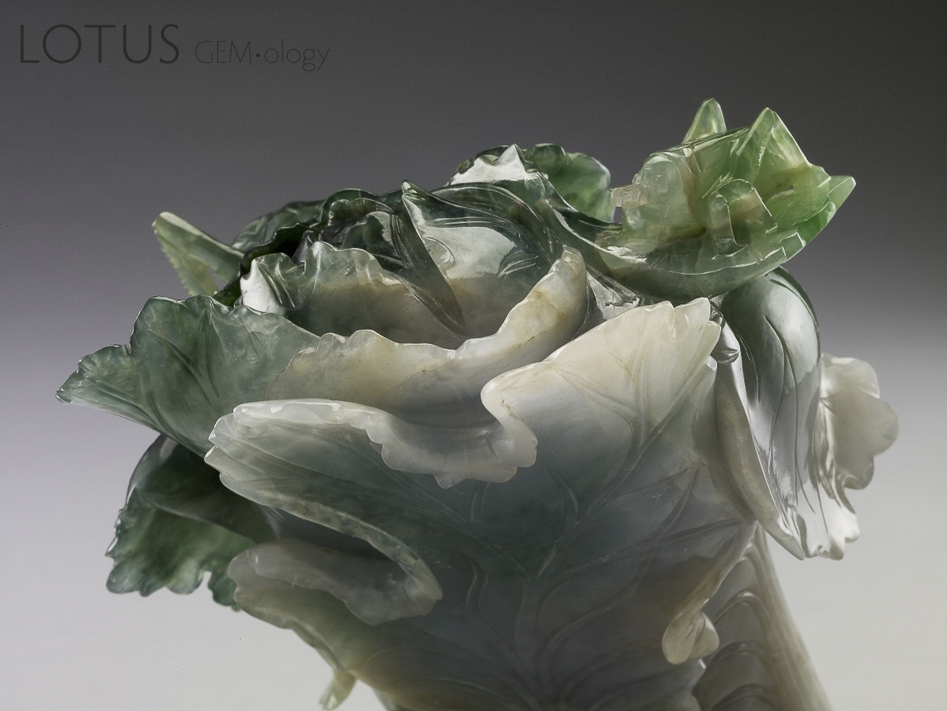 Figure 11. Detail of the Fei Cui Cabbage; the upper right is a carved locust. Photo: National Palace Museum, Taipei.
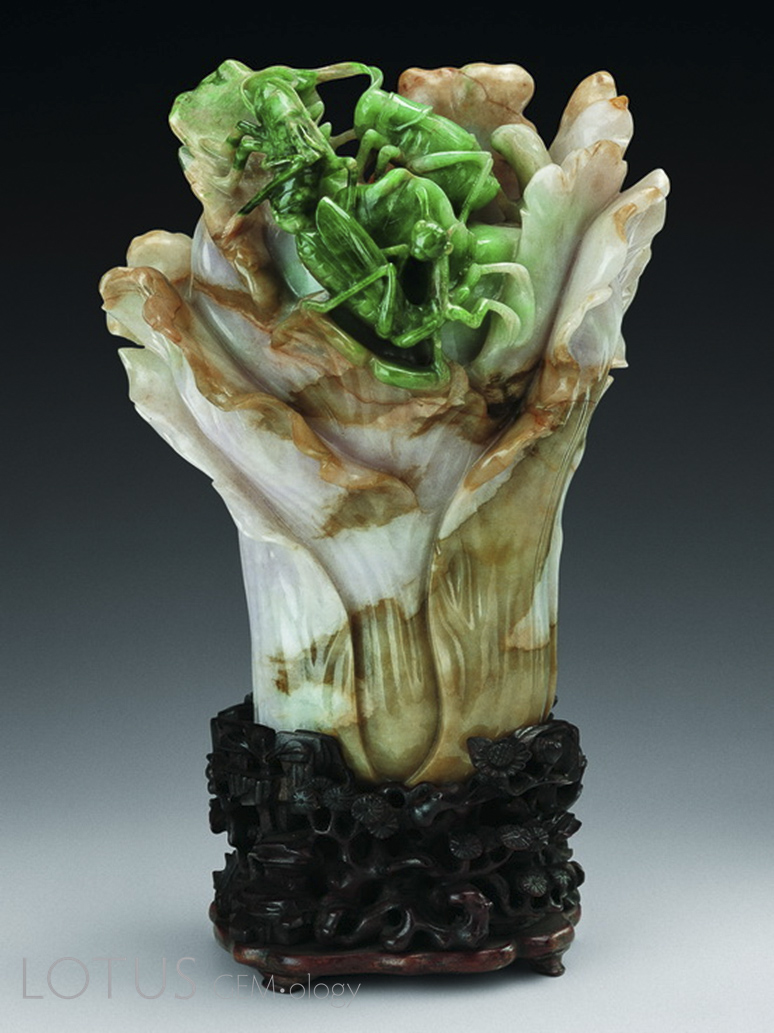 Figure 12. Fei Cui Cabbage with Katydids; height 19.4 cm, width 14 cm, weight about 2 kg. Photo: Tianjim Museum.
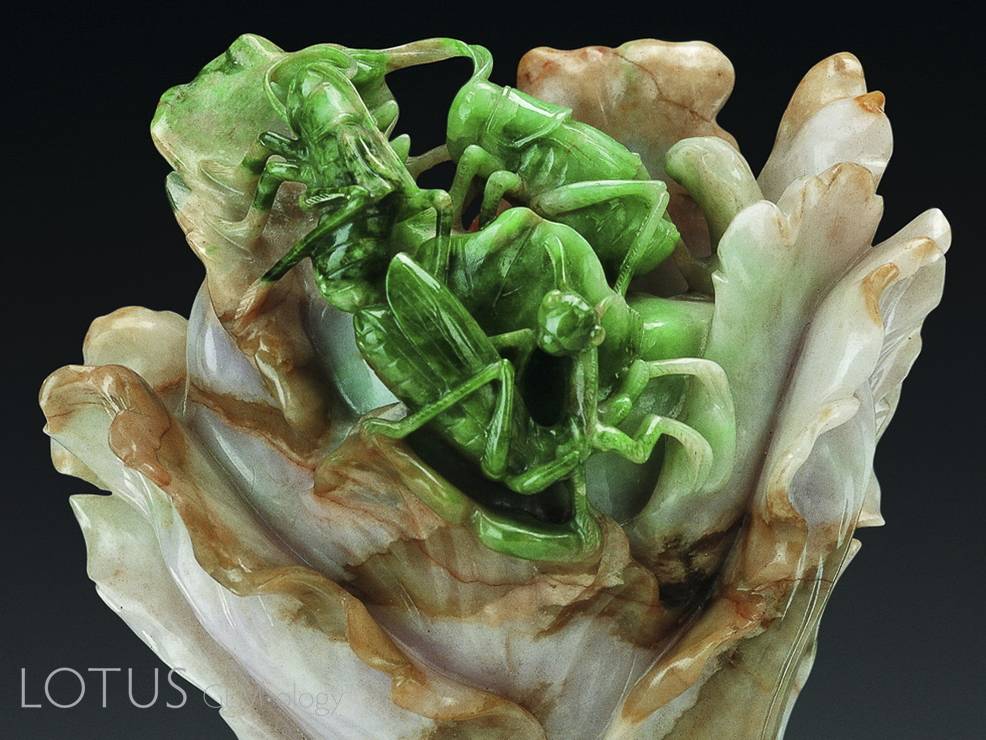 Figure 13. Detail of the Tianjin “Fei cui Cabbage with Katydids," highlighting two large-bellied katydids and a praying mantis. Photo: Tianjin Museum.
It should be noted that Li Chengwu’s Notes from Aiyuexuan Studio describes details of the fei cui cabbage: “green leaves and white heart; on the heart sat a fully green katydid; beside the leaf were two wasps, yellow in color.” According to a Beijing folk legend about the Summer Palace: “The emerald-green leaves are fei cui; the snow-white stalk is white yù; even more eye-catching are two bright green katydids on the leaf. They glare at each other; their antennae, finer than hair, intertwine, as if locked in an intractable fight.”[44] Wang Yongsheng’s description is “green leaves and white heart, carved with two katydids in a fighting posture, lively and pleasing, lifelike.” Though the descriptions differ, all mention katydids; the latter’s “two katydids in a fighting posture” is especially vivid. These descriptions align fairly well with extant fei cui cabbage carvings. The Taipei “Fei Cui Cabbage” has two insects carved on it—one a katydid and one a locust (Figures 10 and 11). The Tianjin “Fei Cui Cabbage with Katydids” has two large-bellied katydids and a praying mantis; in one sense it matches “two katydids in a fighting posture,” and in another it depicts combat between katydids and a mantis (Figures 12 and 13). Late Qing fei cui carvings often took the mantis as a theme and rendered it vividly.[45] In nature, katydids and mantises are indeed deadly enemies; carving them together further suggests that yù craftsmen worked from lived observation, even from real specimens.[46] In addition, all the insects are “full green.”[47]
This broad consistency between written accounts and surviving objects should incline us further to believe that the former (memoirs and unofficial histories) possess at least some degree of reliability. Although no fei cui watermelon object has appeared to date, given fei cui’s multicolor property, carving a fei cui watermelon is entirely plausible. For example, the modern fei cui work “Natural fei cui with Natural Yellow fei cui ‘Abundant Harvest’” uses natural colors巧色 (color zoning) to carve corn kernels in white and green (Figure 14).[48] A fei cui watermelon would likely be carved using a similar technique.
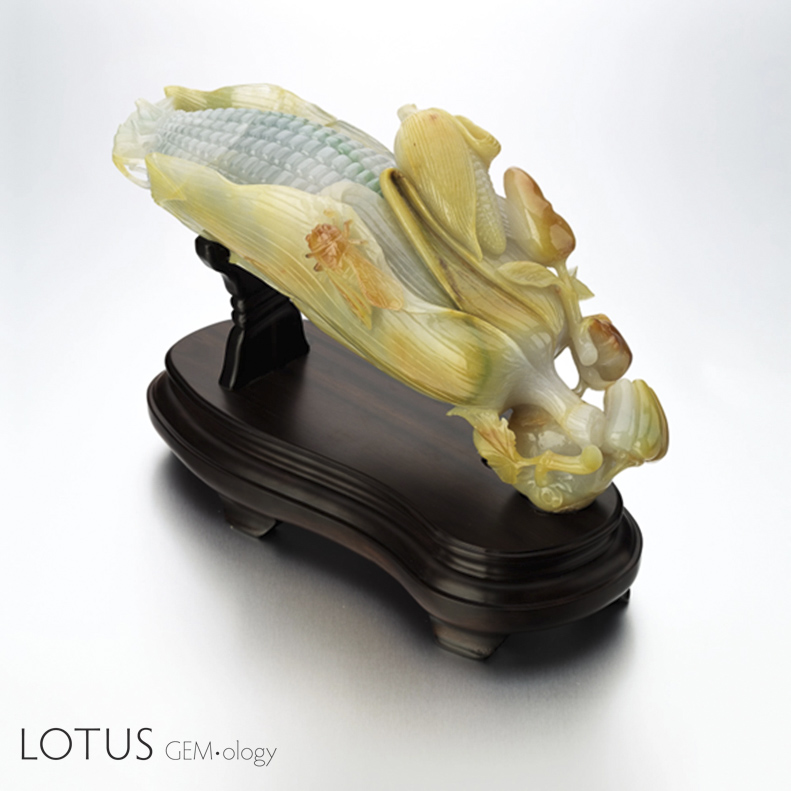 Figure 14. "Bountiful Harvest," a modern fei cui carving with natural yellow color. Photo: Sotheby's.
Some scholars on both sides of the Taiwan Strait argue that the “fei cui watermelon” was actually tourmaline imported from the United States, and this view has circulated widely among the public in mainland China.[49] The main basis is that American tourmaline includes a variety called “watermelon tourmaline,” with red interior and green exterior resembling a watermelon. But this view cannot stand. In fact, the term “watermelon tourmaline” was first used in the United States in 1910—two years after Cixi’s death.[50] More importantly, multiple sources above explicitly say “fei cui watermelon,” clearly referring to Myanmar fei cui; it could not have been tourmaline.
Niu Bingyue, who entered the trade as an apprentice in 1926 and worked in the jewelry industry from the Republican era and after 1949 with extremely rich experience, not only affirms the existence of the fei cui watermelon but comments: “The fei cui watermelon was made from lower-grade material. There is a kind of fei cui rough called ‘melon-rind green’ (瓜皮绿), translucent or opaque, with a bluish green. If the block is large enough, it is perfect for making a watermelon—this must have been the case. It is not that one first imagined making a fei cui watermelon and then searched for suitable material—that would be difficult. Rather, one first had a piece of rough fei cui, studied it, and found that making a watermelon would be most fitting, and then carved it. Even so, having a large block of green fei cui still requires a large block of ‘fei’ (red 翡) material to create both rind and flesh; matching them is not easy. That is why the finished piece was a rare commodity and could sell for a high price.”[51]
Li Chengwu’s Notes from Aiyue Studio also mentions four “fei cui muskmelons” in Cixi’s tomb. “green yù muskmelons” from northern Myanmar already appear in reliable Chinese historical sources in 1474.[52] In 1781–1782, gifts presented by the Henan governor Fullerhun to Qianlong included “one fei cui muskmelon zun 尊 (wine vessel).”[53] This further suggests that the fei cui muskmelons among Cixi’s burial goods were not baseless rumors.
Although the above materials are not all ironclad official history, when considered together—especially alongside the reliable Ming dynasty record of a “green yù muskmelon”—late Qing and early Republican accounts and legends of fei cui watermelons and fei cui muskmelons should not be dismissed lightly. One hopes that more evidence will emerge in the future.
Combining unofficial accounts with official records, we can see that fei cui ornaments occupied an important place among Cixi’s burial goods. Cixi’s burial goods were priceless, rivaling the wealth of a nation. An anonymous 1928 book The Plunder of the Eastern Tombs (Dongling Jie), volume 2, p. 22, comments: “In short, if Cixi’s burial objects were all recovered and used to repay foreign debts, there would still remain several tens of millions; it would be enough to enrich the country.”
Part IV: Conclusion — Cixi’s Bridging Role in the History of Fei Cui in China
To summarize this article, from the time Myanmar fei cui entered China in the fifteenth century, people in Yunnan loved its green or “cui” color. From the beginning they used terms such as “blue-green yù,” “emerald,” or “green yù” to refer to Myanmar fei cui; later they simply used “feicui color” to describe its “pure green,” “full green,” or “deep green”—what foreigners call “imperial green.” Ruan Yuan (1764–1849), who served as governor-general of Yunnan and Guizhou from 1826 to 1835 (Cixi was only born at the end of 1835!), wrote in “Ode to fei cui” that Yunnan people “do not esteem white or blue-green; what they value is only (pure) green “色不尚白青, 所贵惟在绿.”[54] This reflects Yunnan people’s consistent fei cui view since the fifteenth century. But when fei cui began entering the Qing palace in the early eighteenth century, it coincided with Qianlong’s peak white yù culture centered on Hetian yù. Fei cui therefore underwent a “white yù-ization” phase (1726–1860): Chinese appreciation of fei cui took the whiteness of Hetian yù as the standard, resulting in a preference over those hundred-plus years for Myanmar fei cui that was mixed white-and-green or even white. During this period, pure green fei cui did enter the palace, but in very small quantities; the dominant types were mixed white-and-green or all-white fei cui. This situation began to change in Cixi’s era (1862–1908), when pure green began to prevail, the white yù-ization phase slowly ended, and the pure-green period gradually began.
Cixi was passionately obsessed with pure green fei cui. In life she was covered in pearls and fei cui; in death her coffin was filled with them. She unleashed a powerful fei cui whirlwind that drove fei cui’s nationwide spread and popularization from the late Qing into the Republican period (1912–1949). Space does not permit elaboration here, but it must be emphasized that the green-fei cui fashion wave launched by Cixi has continued into the twenty-first century. Looking across more than five hundred years of fei cui history from the fifteenth to the twenty-first centuries, the eunuch Qian Neng of the middle Ming initiated and laid the foundation, and Empress Dowager Cixi of the late Qing completed and topped it off. Setting aside political and moral evaluation, these two figures occupy pivotal positions in the history of fei cui in China. Yunnan people pioneered the fashion, while Cixi served as the bridge between past and future, writing an important chapter in the Chinese history of fei cui.
From the mid-nineteenth century until the fall of the Qing in 1911, China’s national fortunes declined amid crises, and the palace’s traditional yù carving industry—having peaked under Qianlong—slid from stagnation into sharp decline.[55] Yet precisely within this bleak downturn, Myanmar fei cui made a dazzling entrance, cutting through the dark sky and forming a bright scene in the last glow of the Qing empire’s sunset. It moved from subtle to prominent, from few to many, from cheap to dear, and from white to green, gradually surpassing the 8,000-year tradition of Hetian yù to become the Chinese people’s favorite. From emperors and empresses to high officials, from peddlers and laborers to ordinary commoners, men and women, young and old—everyone loved fei cui. “fei cui products at that time (late Qing) were the most fashionable and most precious ornaments, and also something some people longed for day and night.”[56] A stone from a foreign land, ignored by locals, became the Chinese people’s first choice; the green yù mined in the rugged mountains of northern Myanmar became an object of Chinese longing and obsession. While the stone came from Myanmar, it became China's yù soul.

About the Author
Dr. SUN Laichen is a history professor specializing in early modern Southeast Asian (especially Myanmar and Vietnamese) history at California State University, Fullerton (CSUF). His research interest includes the history of Asian gemstones.
Acknowledgments
The author would like to sincerely thank Yang Lilun (Southwest University) and Liu Xufeng (Academia Sinica, Taiwan) for their enthusiastic help in providing materials. The writing of this article benefited mainly from Gu Fang’s (China Culture and Art Development Promotion Association) great advice and assistance, for which I hereby express my special thanks.
Footnotes
[1] For example, Ma Lin, “A review of research on ancient Chinese fei cui,” China Gems 2 (2023): 97–103; Wang Chang, “Research Progress on Myanmar fei cui,” Rock and Mineral Analysis, Vol. 28, no. 5 (2009): 457–461.
[2] I have separate detailed studies: “Eunuchs and fei cui: Qian Neng and the beginnings of Burmese yù in China (1468–1480),” “From gemstones to ‘fei cui’: Changes in Sino–Burmese luxury trade in the Ming and Qing (ca. 1450–1908),” and “The ‘white yù-ization’ phase of fei cui: ca. 1726–1860” (forthcoming).
[3] Both Yang Boda and Xu Lin have touched upon this issue, see Yang Boda, “Tracing the circulation of fei cui in China through documentary records,” Palace Museum Journal , Vol. 2 (2002): pp. 23–24; Yang Boda, “A Brief Account of fei cui objects formerly in the Qing Palace collection,” Palace Museum Journal, Vol. 6 (2006): 42; Xu Lin, “When ‘Cuihua’ meets ‘Yuyi’—fei cui in the Qing Court,” Forbidden City 5 (2018): 81–92. I will discuss this in detail in “The ‘white yù-ization’ phase of fei cui in China: ca. 1726–1860” (forthcoming).
[4] Ye Xiaohong, “The Evolution and Development of Fei Cui Ornaments,” M.A. thesis, China University of Geosciences (Beijing), 2005; Cai Lihui, “An Analysis of Yù Used for Ornamentation in Qing Fei Cui Decorations—Centered on Texts, Types, and Functions,” M.A. thesis, Feng Chia University, 2010, 41–120; Chen Huixia, “Origins and Evolution of Qing Imperial Consorts’ Headdresses,” Ph.D. dissertation, National Chi Nan University, 2017; Song Danni, “Characteristics and Applications of Qing Fei Cui Objects and Jewelry,” M.A. thesis, China University of Geosciences (Beijing), 2019.
[5] Princess Der Ling, Imperial Incense (New York: Dodd, Mead & Company, 1933), 176. Katharine Carl states: “She has an immense number of pearls for the pearl is her favorite precious stone.” According to Qingbai Leichao, “Extravagance” section, “Empress Dowager Xiaoqin’s jeweled ornaments:” “Empress Dowager Xiaoqin had a pair of pearl shoes, set all around with large pearls. They were presented by Yuan Shikai when he was Governor-General of Zhili. The total cost of purchase and palace-gate fees amounted to 700,000 taels of silver.”
[6] Shuai Dequan, “Cixi and pearls,” China Gems & Yù, Vol. 1 (1994): p. 34; Li Chengwu, “Notes from Aiyue studio,” in The Plunder of the Eastern Tombs (published 1928) 2: 19–21.
[7] Ouyang Qiumei and Yan Jun, Practical Fei Cui Studies (Shanghai: Xuelin Publishing House, 2005), 10. See also Xing Yingying, Hao Qi, and Wang Haitao (eds.), An Introduction to Fei Cui (Beijing: China University of Geosciences Press, 2012), 5.
[8] Yù Rongling, Notes from the Qing Palace (Beijing Publishing House, 1957), p. 46.
[9] Tour Guide Knowledge Topics Editorial Group (comp.), Tour Guide Knowledge Topics (Beijing: Tourism Education Press, 2007), 274; Yang Xiaodan, “Treasures of emerald green—fei cui jewelry in the Qing Court,” Forbidden City , Vol. 7 (2016): p. 128.
[10] Qing Palace Imperial Household Department Zaobanchu: Clear Register of Work Completed by Each Workshop, Tongzhi 3rd year, 4th lunar month, 3rd day and 6th day, draft submitted by the Ruyiguan. Cited from Ji Ruoxin, “Southern craftsmen of the Imperial Household Department Zaobanchu in the mid-to-late Qing (1821–1911) and related Issues,” Gugong Academic Quarterly Vol. 32, No. 3 (2015): p. 69.
[11] Yang Boda, “Qing Court yùs,” Palace Museum Journal 1 (1982): 59; Yang Boda, “Tracing the circulation of fei cui in China through documentary records,” Palace Museum Journal, Vol. 2 (2002): 19; Zhang Rong, “Fei cui and Qing imperial life”.
[12] Notes from the Qing Palace, 53–54, 57, 67.
[13] Li Pengnian, “One person’s birthday celebration, a nation’s misfortune—A brief account of Cixi’s ‘sixtieth birthday festivities,’” Palace Museum Journal, Vol. 3 (1984): p. 38.
[14] Qin Lei and Xu Ying, “The last glow of the great Qing—An overview of Cixi relics in the Summer Palace collection,” in Shenyang Palace Museum and Beijing Summer Palace Administrative Office (eds.), Splendors of the Imperial Garden: A Selection of Cixi Relics (Shenyang: Shenyang Publishing House, 2014), p. 3.
[15] Der Ling, Imperial Incense, 188–191. Zhu Jiajin, “Historical Errors in Books Written by Der Ling and Rongling—Yingtai Qixue Ji, Imperial Incense, Two Years in the Forbidden City, Notes from the Qing Palace,” Palace Museum Journal 1982 (04): 25–43, argues that chapters 1–22 of Imperial Incense are “pure fabrication,” while chapters 24–34 “may be read as memoir.” This article cites records on “green yù” (fei cui) from chapters 5 and 27, which should be credible. Der Ling’s other book, Two Years in the Forbidden City (which Zhu also considers “may be read as memoir”), as well as many other sources, likewise support the view that Cixi possessed enormous treasures and was passionately fond of fei cui. Moreover, Zhu’s article does not refute the authenticity of the “green yù” (fei cui) material.
[16] Wang Hebei, “Legendary women and their fei cui affinities,” Forbidden City, Vol. 5 (2019): p. 78.
[17] Qingbai Leichao, juan 60, “Extravagance:” Empress Dowager Xiaoqin’s jeweled ornaments”.
[18] Puyi, My First Half of Life (Beijing: Zhonghua Book Company, 1977), 229.
[19] National Museum of Asian Art Collection, Smithsonian Institution. This is a partial of the original full portrait in order to highlight the fei cui pieces.
[21] Katharine A. Carl, With the Empress Dowager of China (New York: The Century Co., 1907), 8. On Qing nail guards, see “Great Qing Elegance—Exhibition of Qing Women’s Jewelry”.
[22] For introductions to mid-to-late Qing fei cui and images of surviving objects (including pieces in the Palace Museum, Beijing, and auction lots in society), see Yang Boda, “A Brief Account of fei cui Objects Formerly in the Qing Palace Collection,” 40–44; Xu Qixian (chief ed.), Yuan Hongqi and Qin Fengjing (deputy chief eds.), Treasures of Imperial Court (Forbidden City Publishing House, 2004), 18–25 (#14018), 34 (#27), 59 (#52), 74 (#66), 76–78 (#68–70), 94–95 (#84–85), 99 (#89), 104 (#94), 102 (#92), 108–124 (#99–115), 130–132 (#121–123), 142–145 (#134, 136–137; 137.2 worn by Cixi), 148–149 (#140–141), 152–153 (#144–145.1–2), 154–155 (#146–147), 160 (#150), 174 (#158), 219–226 (#194–202), 242–244 (#214–215); “Red and Green fei cui are All at the Palace” (https://www.dpm.org.cn/topic/feihongcuilv.html); Yang Boda, Yang Boda on fei cui (Tianjin: Tianjin Ancient Books Publishing House, 2009), 145–186; Yang Xiaodan, “Treasures of Emerald Green—fei cui Jewelry in the Qing Court,” Forbidden City 7 (2016): 128–143; Jia Xizeng, “Jeweled Hairpins of Gold and fei cui, Skirts Fit for Embroidered Mandarin Ducks: The Art of Chinese fei cui Jewelry,” Forbidden City 5 (2018): 96–113; Zhong Fumiao and Gu Fang (chief eds.), Chinese Old fei cui: Chinese fei cui Art from the 17th to the 20th Century (Cultural Relics Press, 2020), 3 vols. (many bangles: vol. 2, 178–229 [#318–356]; 242–243, earrings and pendants; vol. 3, belt buckles: 82–137 [#427–477]; belt hooks, 138–163 [#478–500]; snuff bottles, 172–188 [#509–522]).
[23] Veritable Records of the Qianlong Emperor (Qing Gaozong Shilu), juan 1484; Guo Fuxiang, “Elegance at the Fingertips—The Making, Collecting, and Bestowal of Qianlong’s Imperial Yù Thumb Rings,” Gugong Journal 1 (2020): 200, #28.
[24] Veritable Records of the Daoguang Reign (Qing Shilu: Daoguang Chao Shilu).
[25] Great Qing Xuantong Political Chronicle, juan 68: Xuantong 3rd year, 11th month, day dinghai.
[26] Li Shubo, Chronological Biography of Bao Chao.
[28] Wang Yan, Beijing’s Sites and Tombs (Beijing Publishing House, 2018), 229; Shiqi Guzhu, “Why Say Ronglu Was Cixi’s Favorite Minister? Look at These Rare Treasures and You’ll Understand!” 2020-05-15 (https://www.sohu.com/a/395454167_736794); Jia Xizeng, “The Art of Chinese fei cui Jewelry,” 105–106; Liu Tong, “On the Function of the Gold Gourd Unearthed from Ronglu’s Tomb and Related Issues,” Collected Papers of the Capital Museum 2020: 255, plate set 4 left, fei cui snuff bottle. On the close political relationship between Ronglu and Cixi, see Zhang Yufen, “Cixi and Ronglu,” Forbidden City 4 (1999): 16–19.
[29] Yù Rongling, Notes from the Qing Palace, 43; Sarah Pike Conger, Letters from China, with Particular Reference to the Empress Dowager and the Women of China (Chicago: A. C. McClurg & Co., 1909), 256–257.
[30] See Figures 8 and 9. For additional images, see images of Qing tourmaline-and-fei cui “eighteen beads” bracelets and fei cui “eighteen beads” bracelets; Xu Qixian (chief ed.), Yuan Hongqi and Qin Fengjing (deputy chief eds.), Treasures of Imperial Court (Beijing: Forbidden City Publishing House, 2004), 149, #141; Jia Xizeng, “The Art of Chinese fei cui Jewelry,” Forbidden City, 108.
[31] “On Yù” (yù shuo), in Sun Yan (ed.), Collected Editions of Studies, Explanations, and Connoisseurship of Ancient Yù (Beijing: Shumu Wenxian Publishing House, 1992), p. 879. For research on editions of Yushuo, see Wang Zhiyuan, “A Brief Account of the British Library Manuscript Copy of Yù Shuo,” Journal of Yancheng Teachers University 39, no. 3 (2019): 6–9. For surviving Qing fei cui prayer beads, thumb rings, feather-tube fasteners, and snuff bottles in private hands, see Zhong Fumiao and Gu Fang (chief eds.), Chinese Old fei cui, vol. 3, 194–197 (#528–530).
[32] The names in parentheses are the presenters of gifts.
[33] A manuscript copy of the 1908 (Guangxu 34) Account of the Encoffining and Presentation of Burial Garments and the Clothing and Other Items Offered for Service at the Imperial Mausoleum of the Empress Dowager Xiaoqin, inner pages, cited from Wang Hebei, “Legendary Women and Their fei cui Affinities,” Forbidden City 5 (2019): 78; “Commemorative List of the Empress Dowager Xiaoqin,” in Political Gazette (Zhengzhi Guanbao), Xuantong 1 (1909), 2nd month, 9th day, no. 478, pp. 4–5. The “green yù” ornaments listed here are compiled from these two sources and are not entirely accurate. A complete commemorative list will require future consultation of the original document cited in Wang Hebei’s article.
[34] Puyi, My First Half of Life, 229–230.
[35] Depending on its form, the black portion in fei cui is called “black spots,” “black threads,” “black nodules,” “black bands,” “black nails,” and so forth. See Zhang Renshan, Fei Cui, Diamonds, and Jewelry (Geology Press, 1983), 10, 29–32.
[36] Cited from Hu Pingsheng, “The Ins and Outs of the 1928 Eastern Tombs Robbery Case,” 213–215, and Li Yingzhou, “Cixi’s Burial Treasures,” published in Beiping Shibao, Republic of China 17, Oct. 1; Anonymous, The Plunder of the Eastern Tombs (published 1928) 2: 19–21. The two sources are largely similar; the quotation here follows the former. As for the “yù lotus root” mentioned here, I suspect it is also fei cui, because the description includes four colors—gray, green, pink, and black. Hetian yù, whose colors are comparatively monotonous, would be hard to fit these requirements; only bright multicolored fei cui could be carved this way. Moreover, Cixi loved fei cui far more than Hetian yù. According to Li Yingzhou’s note, “this object is even rarer than the fei cui watermelon,” making it unlikely to be Hetian yù; only fei cui could fit. This can be seen from the brilliantly colored, exquisitely crafted fei cui works of the “Yingwei Art fei cui Culture Museum” in Taiwan (https://www.soofeen.com.tw/events_detail_11.htm): fei cui material has a dazzling multicolor quality that Hetian yù cannot compete.
[37] Liu Yusheng (auth.), Qian Shifu (annot.), Miscellaneous Recollections from Shizaitang (Beijing: Zhonghua Book Company, 1997), “Record of the Plundering of the Qing Tombs,” 230–232.
[38] Cai Dengshan, “Liu Chengyù and the Complete Edition of Miscellaneous Recollections from Shizaitang,” 2010-07-07.
[39] Wang Yongsheng, “The Beginning-to-End Account of Sun Dianying’s Tomb Robbery,” Puyang Historical Materials 3 (1987): 91.
[40] Nanhai Yinzi, The Tomb-Robbery Case (Beiping: Haohao Fiction Society, 1928), “General Notes,” 19, 33–36, 38–39.
[41] Cited from Niu Bingyue, A Brief History of Fei Cui (Beijing: Forbidden City Publishing House, 1994), 77; Nie Bochun, “On the Palaces of the Celestial Court,” in Commemorative Essays for the 130th Anniversary of the Taiping Heavenly Kingdom’s Establishment of the Capital Tianjing (Guangdong People’s Publishing House, 1983), 394. Kaolao refers to a bamboo- or willow-woven container.
[42] Zheng Yimei, Essays (Shanghai: Zhongfu Book Company, 1934), vol. 2, entry “Watermelon lanterns in the Summer Palace.”
[43] Deng Shuping, “Eternal Ingenuity,” National Palace Museum Monthly of Chinese Art 332 (2010): 59–60; Zhang Liduan, “Distinctive but Not the Only One—The fei cui Cabbage and Others,” National Palace Museum Monthly of Chinese Art 379 (2014): 102–106; Yang Zhengze, “An Extra Chapter on the fei cui Cabbage—Katydids and Locusts,” National Palace Museum Monthly of Chinese Art 251 (2004): 64–66; Hong Zhangfu, “Research on the Insects on the ‘fei cui Cabbage,’” Taiwan Awakening News, 2014/07/15 (https://www.anntw.com/articles/20140716-hkik?fb_comment_id=862267507165473_1766857793373102).
[44] Beijing Folk Literature Series Editorial Office (comp.), Legends of the Summer Palace (China Federation of Literary and Art Circles Publishing Company, 1985), 54–57.
[45] Xie Kun, Miscellaneous Notes of Gold and Yù (Guangxu gengchen [1880] edition), juan 1, 17a–18b, entry “Fei Cui Mantis”: “I have a mantis piece; its head, neck, wings, and claws are a clear, translucent green, only its abdomen is red above and white below. The red part is ‘fei’; the white part is the ‘body.’ Its cleverness is delightful.” The “China Grand Canal Museum” also holds a Qing fei cui mantis display piece; the Hangzhou Museum holds a fei cui mantis-head belt hook. There are also auction lots: a Qing fei cui mantis display piece and a Qing fei cui carved cabbage-and-mantis display piece.
[46] Yang Zhengze, “An extra chapter on the fei cui cabbage,” 64.
[47] Legends of the Summer Palace, 139–143, “The yù cabbage and the Ruin-the-Family Stone.”
[48] “Natural fei cui with natural yellow fei cui ‘Abundant Harvest’”, Sotheby’s auction lot, Feb. 6, 2014. See also Xin Hong (chief ed.), 2015 Antique Auction Yearbook: Jewelry & Fei Cui (Changsha: Hunan Fine Arts Publishing House, 2015), 181.
[49] Deng Shuping, “Continuing the Discussion of fei cui,” National Palace Museum Monthly of Chinese Art 2 (1984): 41; National Palace Museum (comp.), Illustrated Catalog of the Qing Costume Exhibition (Taipei: National Palace Museum, 1986); Wang Chunyun, “Unveiling the Mystery of Cixi’s fei cui Watermelon: The Material May Have Been Pink Tourmaline,” Guangzhou Daily, May 9, 2011.
[50] Staebler, Tourmaline: A Gemstone Spectrum (East Hampton, Connecticut: Lapis International, 2002), 8; “Watermelon Tourmaline”; Douglas B. Sterrett, “Gems and Precious Stones,” in Mineral Resources of the United States (Washington: Government Printing Office, 1911), 778.
[51] Niu Bingyue, A Brief History of Fei Cui, 78.
[52] See my forthcoming article, “Eunuchs and fei cui: Qian Neng and the beginnings of Myanmar fei cui in China (1468–1480).”
[53] First Historical Archives of China and the Art Museum of The Chinese University of Hong Kong (comp.), Comprehensive Collection of Archives of the Qing Palace Imperial Household Department Zaobanchu (People’s Publishing House, 2005), vol. 45, 341. Modern fei cui carving also includes “fei cui pumpkins,” see Yang Boda, Yang Boda on fei cui, 180 (Figure 87; Beijing Boguan International auction, 2007); Tiancheng International auction lot “Natural Purple fei cui ‘Purple In, Not Out’” display piece, Lian Qingyun (“fei cui Pumpkin”).
[55] Yang Boda, “Qing Court Yùs,” 50–61.
[56] Niu Bingyue, A Brief History of Fei Cui, 39.
References
- Deng, S. (2010) Eternal ingenuity [in Chinese]. National Palace Museum Monthly of Chinese Art, Vol. 332, pp. 59–60.
- Ling, D. (1933) Imperial Incense. Binghampton, NY: Dodd, Mead and Co., 267 pp.
- Niu, B. (1994) Feicui jianshi (翡翠简史) [A Brief History of Fei Cui]. [in Chinese], Beijing: Forbidden City Publishing House, 96 pp.
- Ouyang, C.M. and Yan, J. (2005) Practical Fei Cui Studies [實用翡翠學]. [in Chinese], Shanghai: Xuelin Publishing House, revised 2021, 254 pp.
- Puyi, A.-G. (1964, 1965) From Emperor to Citizen: The Autobiography of Aisin-Gioro Pu Yi [我的前半生]. [in Chinese], Translated by Jenner, W.J.F., Beijing: Foreign Languages Press, 2 Vols., 496 pp.
- Staebler, G.A., editor (2008) Tourmaline. extraLapis English, No. 3, Denver: Lithographie, 108 pp.
- Sterrett, D.B. (1911) Precious stones. In Mineral Resources of the United States | Calendar Year 1909, pp. 739–808.
- Xie, K. (1880 (Guangxu gengchen edition)) Jin yu zaji (金玉雜記) [ Miscellaneous Notes on Gold and Yu]. [in Chinese], juan 1, fols. 17a–18b, entry “Fei Cui Tanglang (mantis)” (翡翠螳螂).