
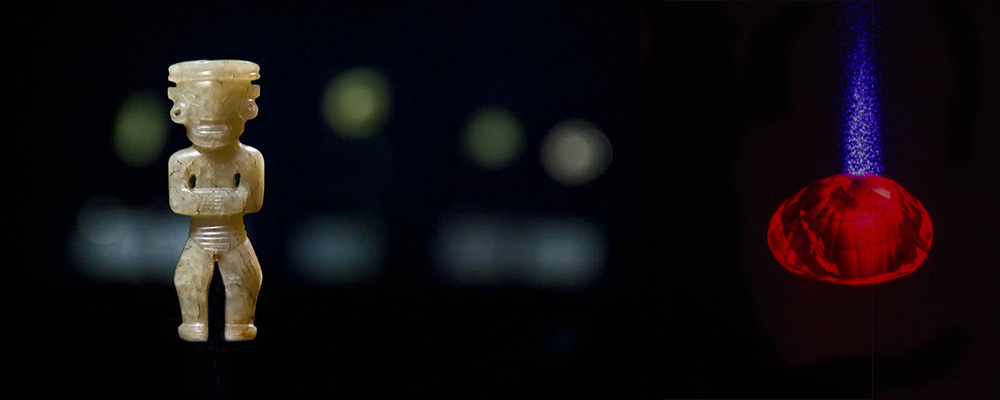
Gemmology in China has existed for many millennia, but has undergone rapid change and development in the past three decades. Today China is training more gemmologists than the rest of the world combined and has become the leader in the field.
If the science of mineralogy, which may generally be considered a rather dry field of research, is capable of contributing to the understanding of the oldest human existence, as has been honestly attributed to it in recent decades, then it also has the task of seizing every opportunity, even seemingly remote ones, as soon as it becomes evident that stones can speak if one learns to understand their language!
Heinrich Fischer
Nephrite and Jadeite, 1875
Gemmology in China
Gemmology is an interdisciplinary applied science that integrates geology, materials science, physics, chemistry, art, and history. It concerns not only the scientific understanding of the Earth’s mineral treasures, but also the expression of human aesthetic sensibilities and the transmission of cultural values. Globally, gemmology is not only an important component of mineral-resource research and advanced manufacturing, but also a core driving force behind the luxury goods and cultural arts industries. In China, the development of this discipline has transcended the realms of technology and commerce, taking on a deeper significance for the times. It serves both as an important vehicle for satisfying “the people’s aspiration for a better life” and as a vital window through which cultural confidence may be strengthened and the unique charm of Chinese civilization displayed. For this reason, the term Jewellery and Jade Science and Engineering better conveys its connotations and historic mission.
China possesses nearly 9,000 years of jade use, giving rise to a unique and profoundly rich jade culture that provides fertile cultural ground for modern jewellery education. However, the transformation of this cultural legacy into a systematic modern jewellery education system began relatively late. It was not until the late 1980s, amid the economic growth and social changes brought about by China’s reform and opening-up policies, that modern gemmological education in China truly embarked upon a path of systematic development. This was a distinctive process of “introduction, digestion, absorption, and innovation.” Beginning with the introduction of internationally recognised educational systems such as FGA and GIA, China went on to establish vocational certification brands with independent intellectual property rights, including GIC and the National Gem Testing Centre (NGTC). From a handful of pilot university programmes, the country developed the world’s most comprehensive academic education system in the field, encompassing secondary vocational, higher vocational, undergraduate, master’s, and doctoral levels. From initially learning Western identification standards, China progressed to conducting in-depth research on the origins, testing methods, and cultural significance of gemstones and jades with Chinese characteristics, such as fei cui, Hetian jade, and turquoise. Within little more than thirty years, Jewellery and Jade Science and Engineering in China achieved remarkable and transformative growth.
Today, China has become one of the world’s most important jewellery consumer markets and manufacturing centres. The prosperity of the industry has placed higher demands on talent cultivation, technological innovation, and cultural creativity. At the same time, the rise of the guochao (“national trend”) movement and the growing emphasis on cultural confidence are driving the jewellery industry to transition from a focus on material value alone toward a high-quality development model that balances material, design, and culture. This transformation presents unprecedented opportunities and challenges for the discipline, affecting academic development, educational models, and theoretical research.
This paper systematically reviews the development of Jewellery and Jade Science and Engineering, summarises its achievements in vocational education, academic education, and scientific research, and explores future directions and pathways for disciplinary development. Such a study is valuable not only as a historical assessment but also as an urgent guide to current practice. Focusing on these key dimensions, the paper seeks to present a comprehensive picture of the evolution of Jewellery and Jade Science and Engineering in China, from its origins to its growing strength. It analyses the distinctive Chinese characteristics represented by jade culture, examines the challenges currently facing disciplinary development, and ultimately offers forward-looking reflections and recommendations to support the transition from “following” to “leading” in the pursuit of high-quality, substantive development.
The construction and development of China’s jewellery education system
Foundations and pioneering work in vocational education
The development of vocational jewellery education in China is a history of innovation that began with the introduction of international standards and progressed toward the creation of independent domestic brands. In 1988, the China University of Geosciences (Wuhan), in cooperation with the Gemmological Association of Great Britain (Gem-A), became the first institution in China to introduce the internationally advanced FGA gemmologist training system. The first FGA class commenced in 1989, and the first graduates completed their studies in 1990, marking the beginning of systematic jewellery education in China.
Building upon this foundation, Chinese jewellery educators did not stop at simple adoption. Instead, they actively promoted localisation and innovation. In 1993, the college officially launched the GIC Gemmologist Certificate Programme, creating China’s own professional jewellery certification system and establishing the GIC brand. This pioneering spirit soon extended to the national regulatory level. In 1997, China launched the first examinations and certification programme for the Certified Gemmologist of China (CGC), establishing an authoritative system for evaluating professional competence within the industry.
As the market became more sophisticated and specialised, the scope of vocational education continued to expand. Between 2016 and 2019, the college introduced eighteen courses in jewellery and luxury-brand management from France, Italy, and other countries, extending education beyond technical identification into advanced fields such as brand management and commercial operations.
Improvement and deepening of academic education
The development of academic jewellery education in China is a pioneering story of progressively extending and refining educational levels, ultimately culminating in the establishment of a nationally recognised first-class discipline.
Its origins can be traced to 1985, when the Wuhan College of Geology became the first institution in China to enrol master’s students in mineralogy with a gemstone specialisation, laying the foundation for high-level talent cultivation. Building on this achievement, the China University of Geosciences (Wuhan) established the nation’s first tertiary-level gemstone programme in 1988, extending education to diploma-level students.
In 1992, the university founded the country’s first School of Jewellery, which subsequently trained a generation of internationally qualified gemmologists. In 1996, it became the first institution to apply for approval to offer an undergraduate programme in Gemstones and Materials Technology. The programme was designated a National Characteristic Specialty in 2009 and became one of China’s first National First-Class Undergraduate Programmes in 2019, continuing to lead similar programmes nationwide.
To meet growing demand for creative design professionals, the university introduced a jewellery design specialisation in 1998. This became a provincial-level characteristic programme in Hubei Province in 2008 and ultimately contributed to the inclusion of the Product Design programme among the National First-Class Undergraduate Programme Construction Sites in 2020.
By 2025, 150 Chinese institutions offered jewellery-related programmes, creating a comprehensive educational system extending from secondary vocational education through doctoral studies. Spanning engineering, art, and management, this interdisciplinary framework has become the most comprehensive jewellery education system in the world.
Distinctive features and achievements of jewellery and jade science and engineering research in China
Standardisation and innovation in jewellery testing technology
China has developed a scientific, rigorous national standards system for jewellery testing that is aligned with international practice. This marks a high degree of industry standardisation and a significant increase in independent technological innovation. At the core of this system are GB/T 16552: Gems — Nomenclature and GB/T 16553: Gems — Testing, which standardise identification terminology and testing methods, ensuring the authority and consistency of test results.
On this basis, China has not only established mandatory standards for precious-metal purity, such as GB 11887, but has also introduced a series of refined grading standards for specific gems and ornamental stones, including diamond (GB/T 16554), fei cui (GB/T 23885), pearl (GB/T 18781), and ruby and sapphire (GB/T 32862/3). These standards have filled several domestic gaps and enabled a technological transition from simple “identification of authenticity” to “quality evaluation.”
At the same time, the establishment of safety standards, such as limits on harmful elements in jewellery products (GB 28480), together with the widespread application of advanced testing methods such as X-ray fluorescence spectrometry (GB/T 18043), demonstrates China’s continuing innovation and far-reaching influence in protecting consumer rights and guiding the healthy development of the industry. This increasingly comprehensive standards system is not only the technical foundation for domestic market supervision, but also a sign of China’s growing voice in international jewellery testing.
Catching up and surpassing in synthetic gem technology
With rapid social progress and constant advances in science and technology, synthetic gem technology has matured globally and achieved major breakthroughs. China has actively caught up in this field and has gradually achieved technological leadership. It has now formed a complete industrial chain integrating research, production, and sales, becoming an important force in the global synthetic gem industry.
China’s synthetic gem industry has evolved from early dependence on imported technology and imitation toward independent innovation. Significant breakthroughs have been achieved in synthesis methods, equipment, processes, and product quality. In key categories such as synthetic diamond [1–2] and corundum [3], large-scale production has been realised, with technical levels matching, and in some areas surpassing, international standards.
Because synthetic gems offer controllable physical and chemical properties, sustainable resource supply, and high cost-performance value, they are increasingly recognised and favoured by consumers. They are used not only in jewellery, but also in advanced manufacturing, optical devices, semiconductors, and other industrial fields. In this process, China has gradually established a standards system covering synthesis and detection technologies, promoting industry regulation, market integrity, and a stronger international voice. China’s synthetic-gem industry now presents itself as a technology-driven, green, and efficient emerging sector with strong innovative vitality and global competitiveness.
Enhancement treatment technology
Natural gemstones are precious, non-renewable mineral resources, and high-quality stones are especially rare. After long-term, large-scale mining, most high-quality gem deposits are approaching depletion. Over the past thirty years, global demand for fine natural gemstones has continued to rise, intensifying the imbalance between supply and demand for medium- and high-grade gems and causing prices to increase substantially.
Against this background, modern enhancement technologies such as high-pressure high-temperature treatment [4], beryllium diffusion , and ion implantation [6] have developed rapidly, reflecting the effective integration of traditional gemstone treatment processes with advanced technology. Such treatments can improve a gemstone’s appearance, making it more closely resemble a fine natural stone, and can significantly increase material durability. However, artificially enhanced gemstones still cannot be equated in value with untreated natural stones. As new varieties of treated gemstones continue to enter the market, challenges in identification technology and disclosure standards have become increasingly prominent, placing greater demands on scientific judgement in gemmology and on industry regulation.
At the technical application level, China has fully mastered traditional processes such as heat treatment of ruby and sapphire and dyeing of quartzite jade, while also achieving breakthroughs in advanced technologies. In particular, high-pressure high-temperature treatment is widely used for colour enhancement and clarity improvement in diamonds, significantly increasing their commercial value and aesthetic appeal [7]. In addition, domestic research and application in advanced technologies such as beryllium diffusion treatment of sapphire [8–9] and surface coating [10] have also reached internationally advanced levels.
Alongside the development of treatment technologies, China has continuously strengthened its jewellery testing and research capacity. In response to a complex market environment and increasingly sophisticated treatment methods, China has established a jewellery testing discipline system of international standard. Authoritative institutions such as the National Gemstone Testing Centre (NGTC) and the Gemmological Institute of China, China University of Geosciences (Wuhan) (GIC), rely on advanced large-scale instruments including laser ablation inductively coupled plasma mass spectrometry (LA-ICP-MS), micro-area X-ray fluorescence spectrometry (μ-XRF), and Fourier-transform infrared spectroscopy (FTIR). These technologies provide systematic and precise criteria for trace-element analysis, inclusion characterisation, and spectroscopic identification.
On this foundation, national and industry standards, including GB/T 16552: Gems — Nomenclature and GB/T 16553: Gems — Testing, provide clear rules for the naming, testing, and market supervision of enhanced gemstones. These standards require commercial entities to disclose gemstone treatments truthfully and strictly prohibit false labelling and consumer fraud, thereby effectively maintaining market order and protecting consumer rights.
China has now formed a complete and coordinated industrial system in the research and development of gemstone enhancement technologies, testing and certification, standards development, and market regulation. It has achieved a positive interaction between technological application and scientific identification, making important contributions to transparency, sustainability, and technological progress in the global gemstone industry.
Provenance studies of precious gems and ornamental stones
Research into the geographic origin of gemstones and ornamental stones in China has developed into a comprehensive system that combines traditional expertise with cutting-edge scientific techniques, yielding internationally recognised achievements. For jade materials of major cultural and economic significance, including fei cui, Hetian jade, and turquoise, researchers have conducted in-depth investigations into deposit genesis models [11–15] and systematically established databases of provenance-specific “fingerprint” characteristics.
Using advanced analytical methods such as laser ablation inductively coupled plasma mass spectrometry (LA-ICP-MS), researchers have carried out precise analyses of trace-element and isotopic compositions. Combined with comparative studies of mineral inclusions, structural features, and textural characteristics at both macroscopic and microscopic scales, these methods have enabled the scientific differentiation of fei cui from Myanmar and Guatemala [16–18], Hetian jade from Xinjiang and Qinghai [19], and turquoise from Xinjiang and Hubei [20].
This rigorous provenance-determination system not only provides critical evidence for gem identification and valuation but also strongly supports market regulation and transparency. It plays an irreplaceable role in combating origin fraud, protecting consumer rights, and preserving jade culture.
The preservation and innovation of craftsmanship
Preservation of traditional craftsmanship
The “Eight Great Crafts of Beijing” (Yanjing Bazue) comprise eight major categories of traditional craftsmanship: cloisonné enamel, jade carving, ivory carving, lacquer carving, gold-lacquer inlay, filigree inlay, imperial carpets, and Beijing embroidery [21]. Drawing extensively upon the finest regional folk traditions, these crafts reached their artistic zenith during the Qing dynasty as imperial arts.
China’s efforts to document, protect, and study the Yanjing Bazue and other traditional gold- and silver-working techniques constitute a systematic cultural project that combines historical research, technical preservation, and innovative development. Measures include the establishment of an intangible cultural heritage protection system, the systematic documentation and living transmission of sophisticated skills such as filigree inlay—centred on techniques of twisting, filling, assembling, and soldering—and the implementation of master-apprentice inheritance mechanisms to ensure continuity. These initiatives have helped alleviate the long-standing danger of techniques disappearing with the passing of individual artisans [22–23].
At the same time, modern scientific methods have been employed for materials analysis and digital preservation. These technologies not only facilitate the accurate restoration and authentication of ancient masterpieces but also encourage the creative integration of traditional techniques with contemporary design and modern aesthetics. As a result, these crafts have successfully evolved from museum artefacts into living art forms applied in high jewellery, state gifts, and cultural-creative products, achieving both a redefinition of their cultural value and sustainable development in the modern era.
Innovation in modern craftsmanship
China is actively introducing advanced technologies such as artificial intelligence-assisted design, three-dimensional printing, and automated carving into traditional manufacturing sectors as a core strategy for industrial upgrading. These technologies have significantly transformed traditional production models and enabled a critical transition from “manufacturing” to “intelligent manufacturing.”
In industries such as arts and crafts, jewellery production, and luxury-goods manufacturing, 3D printing has dramatically shortened product-development cycles through rapid prototyping and digital three-dimensional modelling. It allows complex personalised designs to be realised efficiently and at relatively low cost [24–26]. Automated carving machines, meanwhile, undertake highly intricate carving tasks with exceptional precision and repeatability, improving production efficiency and consistency [27].
The integration of these technologies not only reduces production costs and enhances product quality and added value but has also given rise to new business models such as mass customisation. This transformation is driving traditional industries toward digitisation, flexibility, and intelligent production, ultimately strengthening the competitiveness and innovative capacity of Chinese manufacturing on the global stage.
Comparative studies of Eastern and Western jewellery art
Comparative research on Eastern and Western jewellery art represents an important effort to explore differences and complementarities rooted in cultural traditions, aesthetic philosophies, and craft systems. Its purpose is to transcend cultural barriers and promote the deep integration and innovation of design concepts.
Western jewellery art generally emphasises geometric structure, abstract expression, and the intrinsic brilliance and value of gemstones, reflecting ideals of individualism and visual impact. Traditional Chinese jewellery, by contrast, is deeply rooted in symbolism and natural philosophy. Techniques such as filigree inlay and kingfisher-feather decoration (dian cui) emphasise suggestive imagery, rhythmic line, and extraordinary craftsmanship.
Systematic comparative study not only deconstructs the differing formal, material, and symbolic logics of these traditions but also encourages creative synthesis. Examples include integrating the Chinese symbolism of “abundance in gold and jade” into modern minimalist design, or reinterpreting contemporary abstract forms through traditional filigree techniques. Such research fosters intercultural dialogue and encourages designers to combine Western modern aesthetics with Eastern philosophies of creation and craftsmanship, ultimately producing a new generation of jewellery that possesses both international relevance and profound cultural depth.
Research on jewellery culture
The systematic study and promotion of China’s uninterrupted 9,000-year jade culture seeks to trace its development from the ritual jade traditions of Hongshan and Lingjiatan, through the Confucian ideal of “comparing virtue to jade,” to its role in popular culture as a symbol of integrity, sacrifice, and auspicious meaning. This cultural heritage provides both the historical foundation and distinctive value system underpinning the contemporary guochao movement.
Scholarly research into jade materials, craftsmanship, decorative motifs, and intercultural exchange not only contributes to the construction of a theoretical discourse on Chinese design aesthetics but also extracts from jade culture a design language grounded in collectivism, harmony, perseverance, and restrained elegance. These values distinguish it from the more overtly individualistic aesthetic traditions often associated with Western jewellery.
Such research directly informs contemporary design practice. It encourages designers to combine jade materials with modern jewellery, fashion, and decorative arts, or to incorporate the spirit of jade culture into broader design concepts. The result is the creation of guochao products that possess both strong cultural identity and contemporary appeal, forming a complete cycle from scholarly investigation to innovative application.
Research on jewellery culture thus transcends the superficial appropriation of traditional symbols. It transforms guochao from a simple revival of historical styles into a genuine expression of cultural confidence and cultural value. In doing so, it allows the millennia-old tradition of jade culture once again to nourish the national spirit and shape contemporary aesthetic ideals.
Characteristics, current status, and challenges in the development of gemmology as a discipline in China
Distinctive Chinese characteristics of the discipline
The development of Jewellery and Jade Science and Engineering in China exhibits a distinctive process of localisation, one of whose defining features is the integration of the Western scientific systems of mineralogy and crystallography with China’s profound jade culture and traditional craftsmanship. This has produced a unique academic framework and value orientation.
Whereas Western gemmology has traditionally focused on the aesthetic brilliance and commercial value of gemstones, Chinese Jewellery and Jade Science and Engineering places particular emphasis on the multidimensional study of jade as a unique cultural medium. Theoretically, it explores the philosophical concept of “comparing virtue to jade” (bi de yu yu), linking the qualities of jade—its warmth, restraint, and toughness—to moral virtues admired in Chinese culture, such as benevolence, righteousness, wisdom, and courage. In doing so, jade is endowed with a cultural spirit that transcends its material properties.
In practical terms, the discipline also studies and preserves highly specialised traditional techniques that have been recognised as national intangible cultural heritage, including filigree inlay, gold-and-silver inlay, and skilful utilisation of natural colour variations in jade carving. These techniques are not merely technical processes but represent distinctive aesthetic philosophies and accumulated forms of cultural wisdom.
As a result, jewellery education and professional practice in China aim not only to cultivate skills in gemstone identification and valuation but also to foster an understanding of the historical traditions, philosophical ideas, and aesthetic systems associated with jade and jewellery. The discipline further seeks to employ modern technology to support the innovative development of traditional craftsmanship.
In this way, Jewellery and Jade Science and Engineering in China transcends the boundaries of a purely applied science. It has become a discipline that connects past and present, integrates science and the humanities, strengthens cultural confidence, and serves as an important platform through which China can contribute its own perspectives to the global gemmological community.
Major problems and challenges
Theoretical framework requires further development
China has not yet fully established a comprehensive theoretical framework for Jewellery and Jade Science and Engineering that effectively integrates geology, materials science, design studies, and history. The theoretical foundations of the discipline remain under development, and its principal challenge lies in overcoming disciplinary boundaries in order to construct a truly interdisciplinary and integrated framework.
At present, interaction among the various fields remains limited. Universities with geological backgrounds tend to emphasise the geological origins, physical and chemical properties, and identification technologies of gemstones, drawing primarily upon geology and materials science. Institutions with art and design traditions focus largely on jewellery design and manufacturing techniques. Universities with strengths in management studies often concentrate on jewellery branding, marketing, and business operations.
Although gemstones and jade have played significant roles throughout China’s 9,000-year history, research on their evolving cultural identities, symbolic meanings, trade networks, and functions as ritual objects, ceremonial implements, and works of art remains relatively underdeveloped. The major disciplinary fields often operate independently rather than engaging in meaningful interdisciplinary dialogue and collaboration.
Consequently, the discipline urgently requires greater interdisciplinary cooperation, bringing together scientific analysis, technological investigation, craft reconstruction, historical scholarship, and cultural interpretation. Such integration would make it possible to construct a theoretical system that not only explains the natural properties of gemstones but also provides profound insights into their cultural significance and their role in design innovation. This would establish a distinctive Chinese framework for Jewellery and Jade Science and Engineering and provide a solid foundation for its long-term development and contribution to cultural confidence.
Shortage of high-level talent
As China’s jewellery industry moves toward higher-quality development, it faces a significant shortage of high-level interdisciplinary professionals possessing international perspectives, advanced technical expertise, and deep cultural literacy.
This shortage is evident in two principal areas. First, within research-oriented fields there is a lack of scholars capable of bridging materials science and the humanities. Experts who are equally proficient in modern analytical techniques and genetic geology while also possessing a deep understanding of jade culture, traditional craftsmanship, historical traditions, and philosophical thought remain rare. This shortage constrains the development of original theoretical frameworks and limits advances in scientific archaeology and cultural research.
Second, within creative fields there is a lack of designers and master craftsmen who combine mastery of international design languages and advanced production technologies with the ability to creatively reinterpret Eastern aesthetic traditions and cultural concepts, such as the philosophy embodied in the idea of “comparing virtue to jade.” As a result, many designs remain at the level of superficial symbolic appropriation rather than achieving meaningful cultural integration and value enhancement.
The root of this problem lies partly in the existing educational system, where disciplinary divisions remain pronounced. Geological institutions focus primarily on scientific and technical training; art schools emphasise formal creativity and design; and the systematic cultivation of humanistic literacy and interdisciplinary competence has yet to mature. This imbalance in talent development not only limits scientific innovation and the revitalisation of traditional craftsmanship but also fundamentally restricts the jewellery industry’s ability to move from manufacturing to creation and from following trends to defining them. Consequently, it has become a major constraint on both cultural confidence and the industry’s long-term competitiveness.
Strategies and future directions
Strengthening interdisciplinary integration
Actively promoting Jewellery and Jade Science and Engineering as an independent discipline within the category of interdisciplinary studies represents a strategic measure for overcoming many of the developmental bottlenecks currently facing China’s jewellery sector and for guiding its future direction.
The primary objective is to establish a clear disciplinary identity and overcome the fragmented situation in which research is dispersed among geology, materials science, design, history, and other academic fields. Through the recognition of an independent disciplinary status, it would become possible to systematically integrate knowledge from the natural sciences, engineering, the humanities, the arts, and business management into a coherent framework centred on the interconnected themes of materials, craftsmanship, culture, design, and industry.
Such a development would not only optimise the allocation of academic resources but would also help attract and cultivate the kind of interdisciplinary high-level talent described above—individuals possessing both scientific expertise and humanistic insight. It would further support concentrated efforts in key research areas aligned with national cultural strategies and industrial upgrading, including the scientific analysis of traditional Chinese craftsmanship, advanced intelligent jewellery manufacturing, new-materials development, and culturally informed design innovation.
A clearly defined disciplinary structure would provide a standardised basis for curriculum design, textbook development, laboratory construction, degree programmes, and academic evaluation. In doing so, it would bring an end to the long-standing situation in which the discipline lacks an independent academic identity and remains attached to other fields. Ultimately, it would provide a powerful institutional foundation for sustainable innovation and international competitiveness within the industry and help establish China’s voice within the global jewellery sector.
Deepening collaborative innovation among government, industry, academia, research, and application
Collaborative innovation involving government, industry, academia, research institutions, and end users constitutes a central mechanism for promoting the upgrading of the jewellery industry. Effective operation of this model depends upon the clear positioning and close interaction of all five stakeholders.
Government—typically represented by the administrative authorities of industrial clusters—acts as the architect of overall strategy and the coordinator of resources. It provides policy guidance and financial support, integrates resources across sectors, and ultimately benefits from the economic and social gains generated by industrial prosperity.
Industrial enterprises, including manufacturers and retailers, serve as the initiators of demand. They identify urgent technological challenges and talent requirements, thereby helping to focus educational and research activities on practical needs.
Universities and research institutions form the supply side of the innovation system. Educational institutions concentrate on cultivating the interdisciplinary talent required by industry, while research organisations focus on solving key technological problems. Together they constitute the intellectual engine of innovation.
Finally, end users—including employers and consumers—provide market demand and feedback, completing the innovation value chain.
The close cooperation of these five groups creates an efficient cycle extending from demand identification and resource integration to technological research, talent cultivation, and market application. Together they promote high-quality development within the jewellery sector while contributing to the formation of a distinctly Chinese discourse system. This includes strengthening theoretical innovation, systematising and academicising research on traditional jade culture and craft aesthetics, and presenting China’s theoretical achievements and value standards in Jewellery and Jade Science and Engineering to the world.
The Zhushan Collaborative Turquoise Innovation Base provides a practical example of this model of coordinated development. By integrating all five stakeholders, it has established training systems, online courses, educational travel programmes, and research initiatives. In doing so, it has promoted the high-quality development of jewellery education and offered a practical pathway for addressing persistent industry challenges relating to talent development and technological advancement.
Conclusion
In little more than thirty years, Jewellery and Jade Science and Engineering in China has achieved a remarkable transformation from a nascent field into a mature discipline. It has established a comprehensive system encompassing education, research, and industrial services, while developing distinctive characteristics rooted in jade culture, the scientific study of craftsmanship, and the enhancement of market value.
However, as the discipline enters a new stage of development, its growth model must shift from an emphasis on scale and expansion toward a new path centred on quality, depth, and substantive improvement. Future progress requires strengthening the foundations of the discipline itself; deepening research into the integration of jade culture, traditional craftsmanship, and modern aesthetics; and proactively investing in emerging fields such as synthetic-gem technology, intelligent identification systems, and sustainable materials.
Only through these efforts can China’s Jewellery and Jade Science and Engineering fundamentally transform itself from a follower within the global gem industry into a rule-maker and trendsetter. In doing so, it can contribute not only distinctive Chinese academic paradigms, technical standards, and aesthetic systems to the world, but also provide profound Chinese wisdom and systematic Chinese solutions to the global dialogue on gem and jewellery civilisation.

Note
First published in Chinese in the Journal of Gems & Gemmology in May 2026.
References
-
何珊珊, 祖恩东. 浅析合成钻石及市场发展趋势. 中国集体经济, 2021: 56-57.He S S, Zu E D. Brief analysis of synthetic diamonds and their market development trends. China Collective Economy, 2021: 56–57. (in Chinese)
-
苑执中. 合成钻石与天然钻石市场现状及发展趋势. 中原工学院学报, 2020, 31(4): 1-4, 10.Yuan Z Z. Market status and development trends of synthetic diamonds and natural diamonds. Journal of Zhongyuan University of Technology, 2020, 31(4): 1–4, 10. (in Chinese)
-
姜丹, 雷威, 张昌龙, 等. 合成刚玉宝石技术的发展及展望. 中国科技信息, 2009(2): 122, 125.Jiang D, Lei W, Zhang C L, et al. Development and prospect of synthetic corundum gemstone technology. China Science and Technology Information, 2009(2): 122, 125. (in Chinese)
- Sally R. HPHT-processed natural type Ⅰa Diamond. Gems & Gemmology, 2022, 58 (1): 48–58.
- Emmett J L, Scarratt K, McClure S F, et al. Beryllium diffusion of ruby and sapphire. Gems & Gemology, 2003, 39(2), 84–135.
-
程佑法, 朱红伟, 李建军, 等. 离子注入技术——宝石优化处理的新技术. 宝石和宝石学杂志(中英文), 2014, 16(2): 65–70.Cheng Y F, Zhu H W, Li J J, et al. Ion implantation technology: A new technology for gemstone enhancement and treatment. Journal of Gems & Gemmology, 2014, 16(2): 65–70. (in Chinese)
-
金慧颖, 金英福. 高温高压处理褐色钻石改色机理分析. 岩石矿物学杂志, 2017, 36(1): 124-128.Jin H Y, Jin Y F. Mechanism analysis of color modification for brown diamonds via high-temperature and high-pressure treatment. Acta Petrologica et Mineralogica, 2017, 36(1): 124–128. (in Chinese)
-
剡晓旭, 罗洁. 近年来宝石扩散处理的改色研究进展. 超硬材料工程, 2017, 29(4): 59-63.Shan X X, Luo J. Research progress on color modification of gems by diffusion treatment in recent years. Superhard Material Engineering, 2017, 29(4): 59–63. (in Chinese)
-
帅长春, 薛秦芳. 刚玉的铍扩散处理实验研究. 宝石和宝石学杂志(中英文), 2009, 11(3): 30–33, 58.Shuai C C, Xue Q F. Experimental study on beryllium-diffusion treatment of corundum. Journal of Gems & Gemmology, 2009, 11(3): 30–33, 58. (in Chinese)
-
穆宏赫, 林静韬, 张天琦, 等. 镀膜技术在宝石优化处理中的应用. 超硬材料工程, 2020, 32: 59–65.Mu H H, Lin J T, Zhang T Q, et al. Application of coating technology in gemstone enhancement and treatment. Superhard Material Engineering, 2020, 32: 59–65. (in Chinese)
-
崔文元, 施光海, 杨富绪, 等. 一种新观点——翡翠新的岩浆成因说. 宝石和宝石学杂志(中英文), 2000, 2(3): 16-21, 65.Cui W Y, Shi G H, Yang F X, et al. A new perspective: A new magmatic origin theory for jadeite. Journal of Gems & Gemmology, 2000, 2(3): 16–21, 65. (in Chinese)
-
王礼胜, 王露丝, 王玉珺, 等. 超临界地质流体与翡翠成因. 宝石和宝石学杂志(中英文), 2023, 25: 1–16.Wang L S, Wang L S, Wang Y J, et al. Supercritical geological fluids and the genesis of jadeite. Journal of Gems & Gemmology, 2023, 25: 1-16. (in Chinese)
-
景云涛, 刘琰, 张勇, 等. 中国大理岩型和田玉矿床的成矿时代、形成过程及找矿方向. 岩石矿物学杂志, 2022, 41(3): 651–667.Jing Y T, Liu Y, Zhang Y, et al. Metallogenic age, formation process and prospecting direction of marble-type nephrite deposits in China. Acta Petrologica et Mineralogica, 2022, 41(3): 651–667. (in Chinese)
-
张勇, 魏华, 陆太进, 等. 新疆奥米夏和田玉矿床成因及锆石LA-ICP-MS定年研究. 岩矿测试, 2018, 37(6): 695-704.Zhang Y, Wei H, Lu T J, et al. Genesis of the Aomixia nephrite deposit in Xinjiang and a study on zircon LA-ICP-MS dating. Rock and Mineral Analysis, 2018, 37(6): 695–704. (in Chinese)
-
谢家涛, 韩岭, 徐鹏, 等. 湖北省竹山县观山寺绿松石矿床成因及控矿因素. 矿产勘查, 2022, 13(11): 1 656-1 666.Xie J T, Han L, Xu P, et al. Genesis and ore-controlling factors of the Guanshansi turquoise deposit in Zhushan county, Hubei Province. Mineral Exploration, 2022, 13(11): 1 656–1 666. (in Chinese)
-
邓子旭, 骆郑臣, 丘志力, 等. 高品质危地马拉绿色翡翠岩石矿物学特征及其产地标型. 岩石矿物学杂志, 2025, 44(4): 981-994.Deng Z X, Luo Z C, Qiu Z L, et al. Petrological and mineralogical characteristics of high-quality Guatemalan green jadeite and its geographic typomorphic features. Acta Petrologica et Mineralogica, 2025, 44(4): 981–994. (in Chinese)
-
佟子达, 剡晓旭, 刘喜锋, 等. 缅甸和危地马拉绿色翡翠矿物学和光谱学特征对比研究. 光谱学与光谱分析, 2025, 45(6): 1 687–1 692.Tong Z D, Shan X X, Liu X F, et al. Comparative study on mineralogical and spectroscopic characteristics of green jadeite from Myanmar and Guatemala. Spectroscopy and Spectral Analysis, 2025, 45(6): 1 687-1 692. (in Chinese)
-
邢碧倩, 施光海, 张锦洪, 等. 危地马拉翡翠宝石矿物学特征及其与缅甸翡翠的对比研究. 现代地质, 2021, 35(6): 1 769–1 788.Xing B Q, Shi G H, Zhang J H, et al. Gemmological and mineralogical characteristics of Guatemalan jadeite and a comparative study with Myanmar jadeite. Geoscience Frontiers, 2021, 35(6): 1 769-1 788. (in Chinese)
-
周安丽, 蒋金花, 孙春晓, 等. 基于多元素含量的统计学方法鉴别不同产地和田玉. 光谱学与光谱分析, 2020, 40(10): 3 174–3 178.Zhou A L, Jiang J H, Sun C X, et al. Identification of nephrite from different producing areas based on statistical methods of multi-element content. Spectroscopy and Spectral Analysis, 40(10): 3 174–3 178. (in Chinese)
- Liu L, Yang M X, Li Q Q, et al. Mineralogy and geochemistry of turquoise from Tianhu East, Xinjiang, China. Gems & Gemology, 2024, 60(1): 2–25.
-
耿建扩, 陈元秋, 陈正. 传一段历史承一脉手艺. 光明日报, 2024-12-12(009).Geng J K, Chen Y Q, Chen Z. Inheriting a segment of history, carrying on a tradition of craftsmanship. Guangming Daily, 2024-12-12(009). (in Chinese)
-
李宁. "燕京八绝"技艺的传承与创新探究. 艺术市场, 2025(3): 124–125.Li N. A study on the inheritance and innovation of the "eight unique crafts of Yanjing". Art Market, 2025(3): 124–125. (in Chinese)
-
王剑, 张姣姣, 梁露. 习近平文化思想视野下职业教育对接非遗人才培养的困境与对策——基于"燕京八绝"的实证分析. 职业技术教育, 2023, 44(35): 6-11.Wang J, Zhang J J, Liang L. Dilemmas and countermeasures of vocational education connecting with intangible cultural heritage talent cultivation from the perspective of Xi Jinping thought on culture: An empirical analysis based on the eight unique crafts of Yanjing. Vocational and Technical Education, 2023, 44(35): 6–11. (in Chinese)
-
滕颖, 李妍, 郝亮, 等. 基于3D打印技术的活动结构首饰个性化设计. 宝石和宝石学杂志(中英文), 2020, 22(4): 53–64.Teng Y, Li Y, Hao L, et al. Personalized design of kinetic-structure jewelry based on 3d printing technology. Journal of Gems & Gemmology, 2020, 22(4): 53–64. (in Chinese)
-
叶晓芳. 现代工艺技术与木雕技艺融合发展研究. 艺术市场, 2024(12): 104–105.Ye X F. Study on the integrated development of modern craft technology and wood carving techniques. Art Market, 2024(12): 104–105. (in Chinese)
-
夏妍. 首饰贵金属3D打印技术发展现状研究——评《贵金属珠宝饰品材料学》. 中国有色冶金, 2022, 51(2): 144.Xia Y. Research on the development status of 3D printing technology for precious metal jewelry: A review of materials science of precious metal jewelry and ornaments. China Nonferrous Metallurgy, 2022, 51(2): 144. (in Chinese)
-
孟龑, 耿玉坤, 纳秀溪, 等. 翡翠数控雕刻加工效率与质量研究——以加工坐式弥勒佛为例. 宝石和宝石学杂志(中英文), 2023, 25(1): 72–80.Meng Y, Geng Y K, Na X X, et al. Research on efficiency and quality of jadeite CNC engraving processing — Taking the processing of seated maitreya buddha as an example. Journal of Gems & Gemmology, 2023, 25(1): 72–80. (in Chinese)