
A ruby’s surface-reaching cavity is filled with red oil.
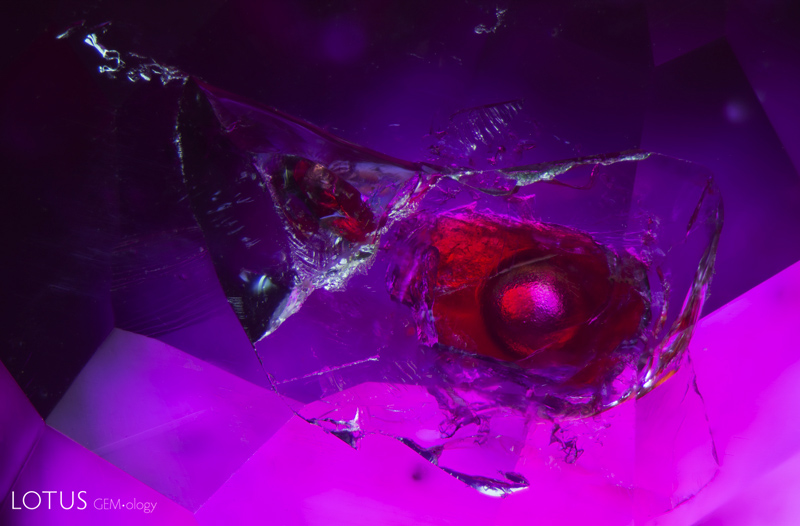 The red color of the oil within the cavity of a ruby displays a remarkable contrast with the bodycolor of the gem. Unlike the flattened bubbles regularly encountered, a rounded bubble attests to the size of the cavity containing the oil.
Photomicrograph by E. Billie Hughes; field of view approximately 2.5 mm.
As laboratory gemologists working in Bangkok, we often encounter gems that have been treated with oil to minimize the appearance of fissures. Most of these stones come from Myanmar, where many vendors consider oiling an accepted standard procedure to enhance their goods, particularly ruby and spinel. Furthermore, red oil is commonly used not only to improve clarity, but also to enhance the color of the stone (in Chanthaburi, Thailand, it is sold under the brand name “King Ruby Red Oil”). Often this treatment can be identified by flattened gas bubbles in the fissures or by droplets of oil seeping out of the fissures on the surface when the stone is gently warmed by microscope light or hot point.
The image above shows a small surface-reaching cavity filled with oil in an unheated 1.75 ct ruby from Myanmar. Unlike other examples we have seen, this remarkable gem contained enough of the filler to easily photograph the striking red color of the oil itself within the cavity. With oblique fiber-optic lighting, a stunning image of this enhancement in situ was made possible, turning even an otherwise commonplace forensic determination into an aesthetic exploration of the micro-world.

About the Author
E. Billie Hughes is Co-Founder and Managing Director of Lotus Gemology. She oversees the company's day-to-day operations while continuing gemological research and laboratory work. After graduating from UCLA in 2011, Billie became a Fellow of the Gemmological Association of Great Britain (FGA) in 2013. Her research focuses on ruby and sapphire, including low-temperature heat treatment, and she has authored and co-authored articles in leading gemological journals. An accomplished field gemologist, she has traveled to gem deposits around the world, including nearly every major ruby and sapphire locality.
Billie is an internationally recognized educator who has lectured for trade organizations, museums, and luxury jewelry houses. She has collaborated extensively with Van Cleef & Arpels on educational programs and lectures. An award-winning photographer and photomicrographer, her images have received honors in the Nikon Small World and Gem-A competitions and have appeared in publications including National Geographic and Forbes. She is also the creator of Hyperion, Lotus Gemology's online inclusion database, reflecting her commitment to making gemological knowledge more accessible.
Billie developed an interest in gemstones from an early age, accompanying her parents on expeditions to mines and gem-producing regions around the world. That lifelong passion for fieldwork, laboratory research, education, and photography continues to shape her work at Lotus Gemology today.
Notes
This article first appeared in Gems & Gemology, Summer 2017, Vol. 53, No. 2.