Tanzanian Spinel Inclusions
Explore Tanzanian spinel inclusions in Hyperion, the Lotus Gemology inclusion database. Hyperion contains photomicrographs of inclusions and internal features in natural spinels from Myanmar (Burma), documented with information on treatment, lighting conditions, field of view, photographer and published references.
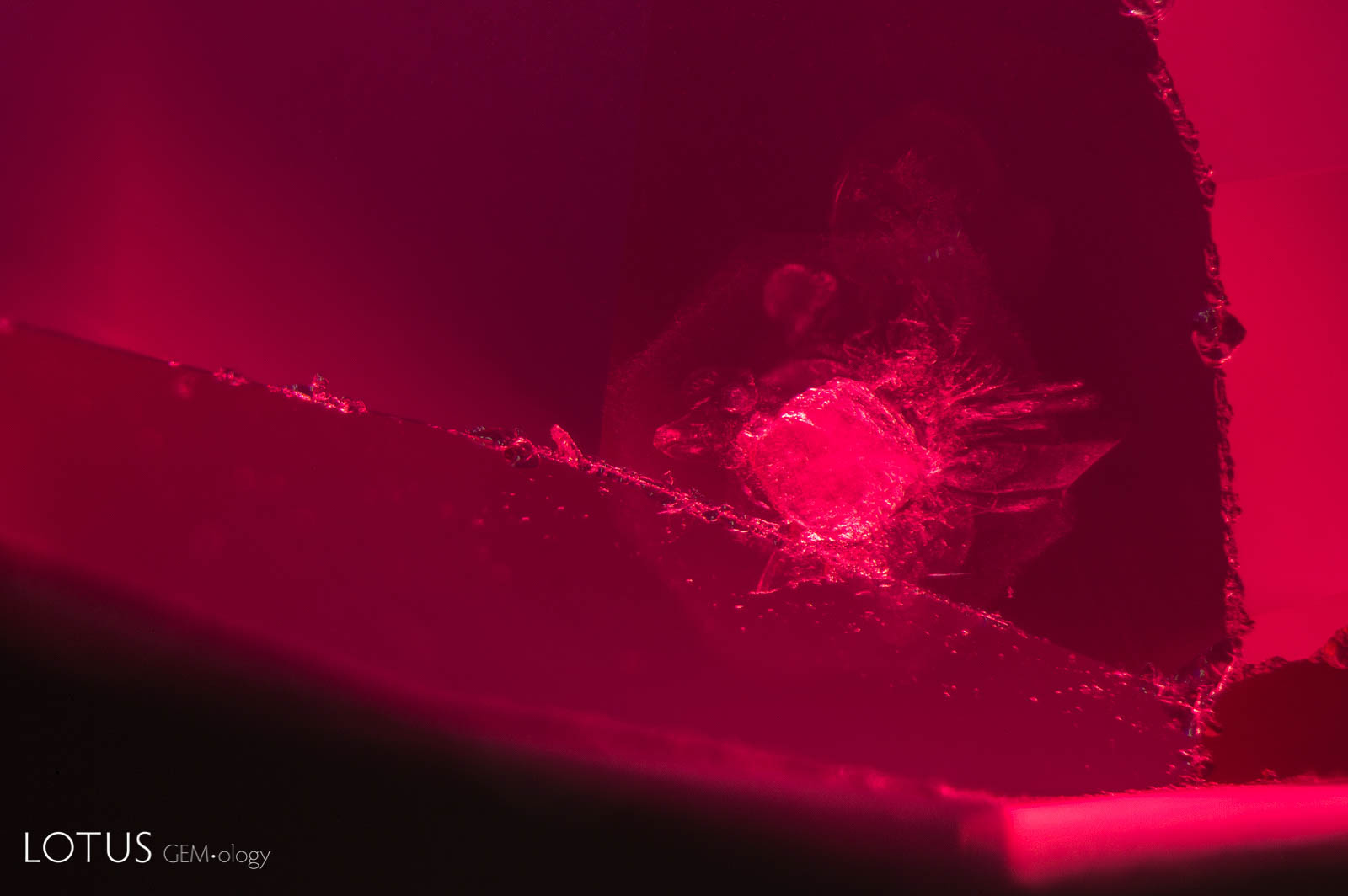
Micro raman revealed that the cluster of crystals on the left is dolomite, and that the hexagonal crystal on the right is phlogopite.
Natural Spinel •
Tanzania; Mahenge •
Enhancements:
None Detected (None) •
Lighting Conditions:
Dark Field
Photographer:
E. Billie Hughes •
Image Number:
A-003-7514-1
• Field of View = 2mm
Hughes, E.B., Koivula, J.I., Manorotkul, W., Renfro, N. and Hughes, R.W. (2019) Spinel inclusions: An exercise in aesthetics. InColor, No. 43, pp. 48–55; RWHL*.
Gübelin, E.J. and Koivula, J.I. (2005) Photoatlas of Inclusions in Gemstones, Volume 2. Basel, Switzerland, Opinio Publishers, 830 pp.; RWHL*.
Spinel fingerprint in a red spinel. These consist of tiny octahedron-shaped negative crystals in a fingerprint pattern.
Natural Spinel •
Tanzania; Mahenge •
Enhancements:
None Detected (None) •
Lighting Conditions:
Fiber Optic: Oblique
Photographer:
Wimon Manorotkul •
Image Number:
A-003-5915-1
• Field of View = 4.2mm
Gübelin, E.J. and Koivula, J.I. (2005) Photoatlas of Inclusions in Gemstones, Volume 2. Basel, Switzerland, Opinio Publishers, 830 pp.; RWHL*.
Eppler, W.F. (1959) The origin of healing fissures in gemstones. Journal of Gemmology, Vol. 7, No. 2, April, pp. 40–66; RWHL*.
Eppler, W.F. (1966) The origin of negative crystals in gemstones. Journal of Gemmology, Vol. 10, No. 2, April, pp. 49–56; RWHL*.
This small inclusion was partially cut through on the surface. It turned out to be phlogopite mica (tested via micro Raman). To the best of our knowledge, this is the first time phlogopite has been reported in Mahenge spinel.
Natural Spinel •
Tanzania; Mahenge •
Enhancements:
None Detected (None) •
Lighting Conditions:
Light Field + Crossed Polars
Photographer:
Richard W. Hughes •
Image Number:
A-003-6284-2
• Field of View = 2mm
Hughes, E.B., Koivula, J.I., Manorotkul, W., Renfro, N. and Hughes, R.W. (2019) Spinel inclusions: An exercise in aesthetics. InColor, No. 43, pp. 48–55; RWHL*.
Gübelin, E.J. and Koivula, J.I. (2005) Photoatlas of Inclusions in Gemstones, Volume 2. Basel, Switzerland, Opinio Publishers, 830 pp.; RWHL*.
This small inclusion was partially cut through on the surface. It turned out to be phlogopite mica (tested via micro Raman). To the best of our knowledge, this is the first time phlogopite has been reported in Mahenge spinel.
Natural Spinel •
Tanzania; Mahenge •
Enhancements:
None Detected (None) •
Lighting Conditions:
Light Field + Crossed Polars
Photographer:
Richard W. Hughes •
Image Number:
A-003-6284-1
• Field of View = 2mm
Hughes, E.B., Koivula, J.I., Manorotkul, W., Renfro, N. and Hughes, R.W. (2019) Spinel inclusions: An exercise in aesthetics. InColor, No. 43, pp. 48–55; RWHL*.
Gübelin, E.J. and Koivula, J.I. (2005) Photoatlas of Inclusions in Gemstones, Volume 2. Basel, Switzerland, Opinio Publishers, 830 pp.; RWHL*.
This red spinel from Tanzania’s Mahenge mines showed an unusual orange coloration surrounding a fingerprint inclusion. But when examined in oblique fiber-optic lighting, the orange area displayed milky bluish clouds. This unmasked the orange color as a function of scattering, the same phenomena that creates a blue sky and orange sunset.
Natural Spinel •
Tanzania; Mahenge •
Enhancements:
Fissure Filling with colorless Oil/resin (FF-O1); No indications of heating (No indications of heating) •
Lighting Conditions:
Fiber Optic: Oblique
Photographer:
Richard W. Hughes •
Image Number:
A-003-3576-1
Gübelin, E.J. and Koivula, J.I. (2005) Photoatlas of Inclusions in Gemstones, Volume 2. Basel, Switzerland, Opinio Publishers, 830 pp.; RWHL*.
This red spinel from Tanzania’s Mahenge mines showed an unusual orange coloration surrounding a fingerprint inclusion. But when examined in oblique fiber-optic lighting, the orange area displayed milky bluish clouds. This unmasked the orange color as a function of scattering, the same phenomena that creates a blue sky and orange sunset.
Natural Spinel •
Tanzania; Mahenge •
Enhancements:
Fissure Filling with colorless Oil/resin (FF-O1); No indications of heating (No indications of heating) •
Lighting Conditions:
Diffuse Light Field + Immersion + Blue Filter
Photographer:
Richard W. Hughes •
Image Number:
A-003-3576-2
Gübelin, E.J. and Koivula, J.I. (2005) Photoatlas of Inclusions in Gemstones, Volume 2. Basel, Switzerland, Opinio Publishers, 830 pp.; RWHL*.
49 Total Images
Results: 25 – 36 | Page 3 of 5 Pages
Tanzanian spinel inclusions may include mineral crystals, healed fissures, fluid inclusions, negative crystals, growth features and other internal features formed during or after crystal growth. Such features are important to gemologists because they can provide evidence useful in identifying spinel and evaluating a possible Tanzanian origin.
Tanzanian Spinel Inclusion Photomicrographs
The Hyperion Tanzanian spinel gallery includes microscopic features documented in spinels from Myanmar (Burma). Each entry is accompanied by descriptive information and, where available, references to the gemological literature.
What Inclusions Can Reveal About Tanzanian Spinel
Inclusions are an important part of geographic origin determination in spinel. Their form, composition and associations can provide evidence that, when considered together with other gemological properties, may support or contradict a Tanzanian origin.
Hyperion combines inclusion photomicrography with supporting gemological information so that individual features can be compared with documented examples from Tanzanian spinels.
About Hyperion
Hyperion is the Lotus Gemology searchable inclusion database. It allows users to browse gemstone inclusions by gem type, geographic origin, treatment and keyword.
Search the Complete Hyperion Database