
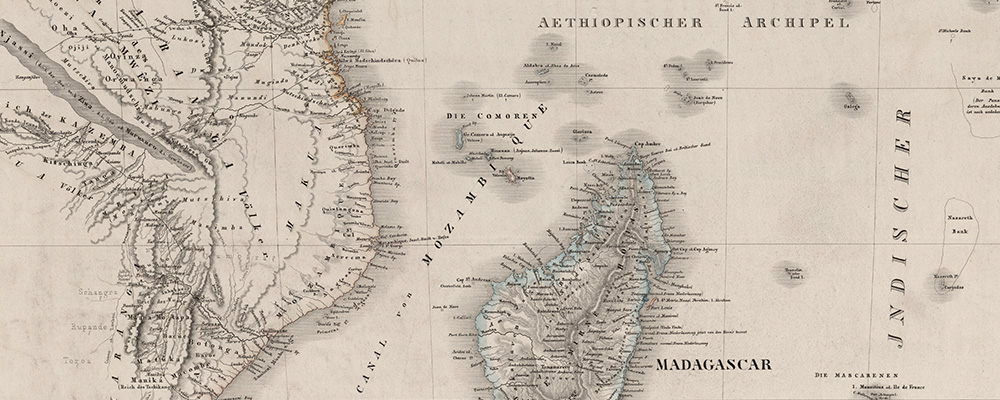
East Africa's Mozambique orogenic belt stretches from Eastern Antarctica through East Africa to the Arabian penninsula. The highly mineralized zone is the source of many rich gem deposits, one of which is detailed in this article.
Reading the Rocks at Kenya's Penny Lane Ruby Mine
Rubies, garnets, tourmaline and other hard transparent colored gemstones have been discovered along “Penny Lane”, a stretch of metamorphic rocks extending more than a hundred kilometers from southeast Kenya into northeast Tanzania.
East Africa's Mozambique orogenic belt stretches from Eastern Antarctica through East Africa to the Arabian penninsula. The highly mineralized zone is the source of many rich gem deposits, one of which is detailed in this article.
Rubies, garnets, tourmaline and other hard transparent colored gemstones have been discovered along “Penny Lane”, a stretch of metamorphic rocks extending more than a hundred kilometers from southeast Kenya into northeast Tanzania.[1] But few of these eighty or more gem occurrences have been mined at a profit, most producing stones that were small, of poor color, or, more critically, insufficiently well crystallized. Almost all the better crystallized gems came from within a band of rocks (metamorphosed sediments) just 5 to 10 kilometers wide.
Transparent gemstones are rare. The conditions for their formation are thus also rare. It is unclear, however, how or in what manner the conditions in Penny Lane were rare or unusual. A way to address such matters was indicated by Robert Boyle as long ago as 1672 in his Essay About The Origine & Virtues Of Gems … and the Subjects wherein their chiefest Virtues reside. According to Boyle:
the best crystals grow in cavities. . . others which grow in restricted spaces are moulds.
Yet Boyle’s observation is difficult to apply to gems that crystallized in rocks under metamorphic conditions of high pressure and high temperature, which is the case on Penny Lane. Actual cavities at depth are not required or expected. A relaxing of constraining pressure may be sufficient. But there is no mechanism that would allow pressure to be substantially relaxed or lowered at the depths in the Earth at which metamorphism occurs.
Instead, however, the temperature might be increased. This would permit minerals to crystallize or to recrystallize higher in the Earth, hence with lower than usual constraining pressure, hence, perhaps, as transparent gems. Yet whereas volcanism and igneous intrusions are common sources of heat, gems are rare. A different source of heat must be implicated.
A source of heat present along Penny Lane (which is located far from the volcanism of the Great Rift Valley) is produced by friction during “thrust-faulting”, a phenomenon commonly associated with continent-to-continent collisions in which older rocks are pushed (“thrust”) across younger rocks over large distances. Spectacular thrust faults have been produced during the ongoing collision of Peninsular India with Continental Asia and the building of the Himalayas. A half-billion years earlier, similar conditions prevailed when East Gondwana collided with West Gondwana, building a Himalaya-type Supermountain that extended from southernmost Israel through East Africa to the Antarctic.[2] Deeply eroded roots of the Supermountain are now exposed in East Africa and include the rocks of Penny Lane.
An informative cross-section from a study in the Himalayas shows that friction across the “Main Central Thrust”, as it is called, has heated rocks nearer the surface to over 800°C and placed them above rocks whose temperature was under 600°C; Figure 1.
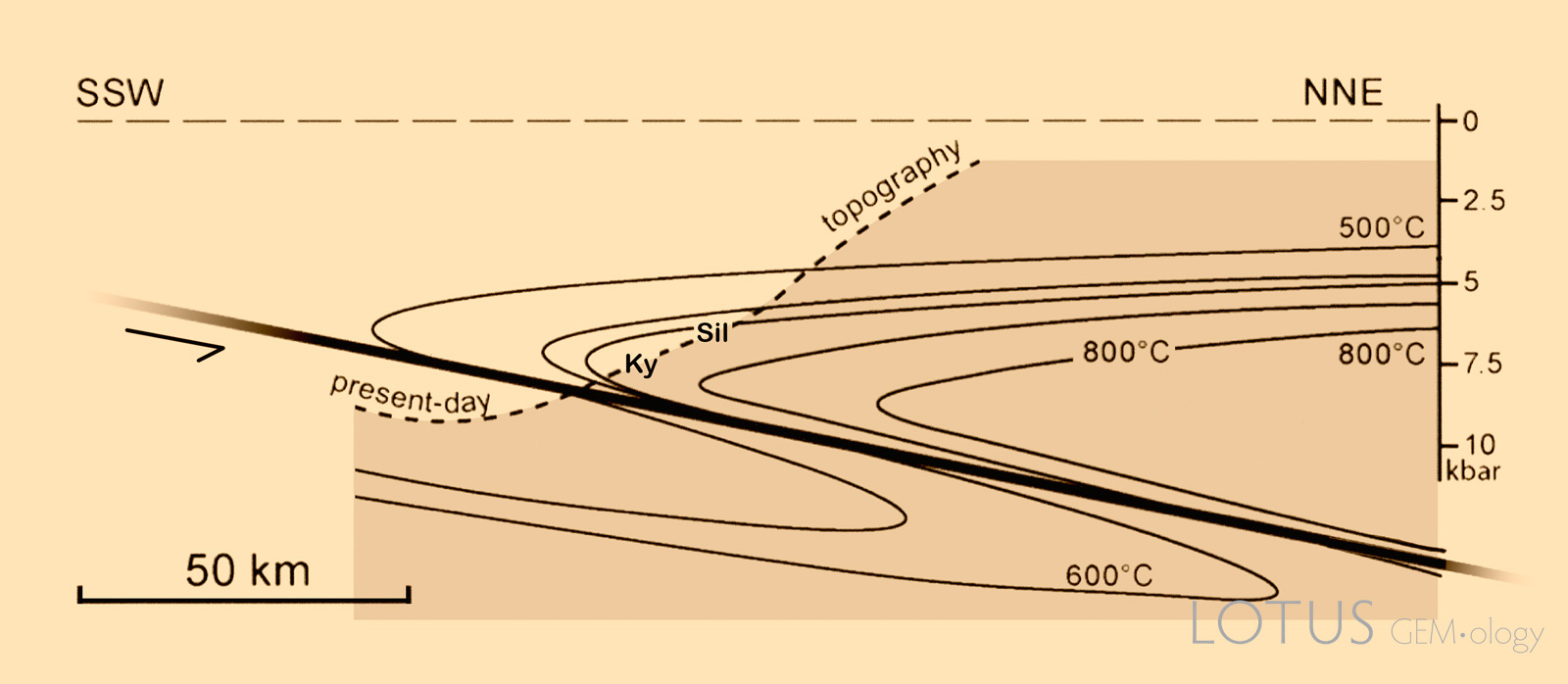 Figure 1. Thermal profile along the Himalayas in central Nepal. Frictional heat along the Main Central Thrust (thick line) caused overlying rocks to be metamorphosed at higher temperatures than those below. This permitted minerals to crystallize higher in the Earth than is usual, hence with less constraining pressure. “Sil” Note the occurrences of the mineral sillimanite ('Sil') and kyanite ('Ky') below it. Under normal conditions, kyanite, would crystallize at a pressure above sillimanite. Adapted from Le Fort (1975).
In such settings the excess heat produced by friction is necessary but not sufficient for the formation of transparent gems. Highly localized contributing factors must also come into play, the presence of fluxes or boudins, for example, or folds with certain geometries, or rough spots over which thrusting produced higher temperatures than elsewhere.
The main occurrences of gem-quality tsavorite-garnet in southeast Kenya plus the two major ruby-producing deposits in the area are confined to rocks designated the “Kurase Tsavorite-bearing metasediments”,[3] i.e., Penny Lane. Figure 2 shows tsavorite localities as compiled by Martelet et al (2017) and Jacob et al. (2018). No modifications were made to these localities in drafting Figure 2 and no gem occurrences were excluded but two deposits were added: the formerly productive deposit of “Savana-yellow” tourmaline and an occurrence of transparent enstatite (Schmetzer and Krupp, 1982) that was never exploited because of its non-commercial yellowish-green tea color.
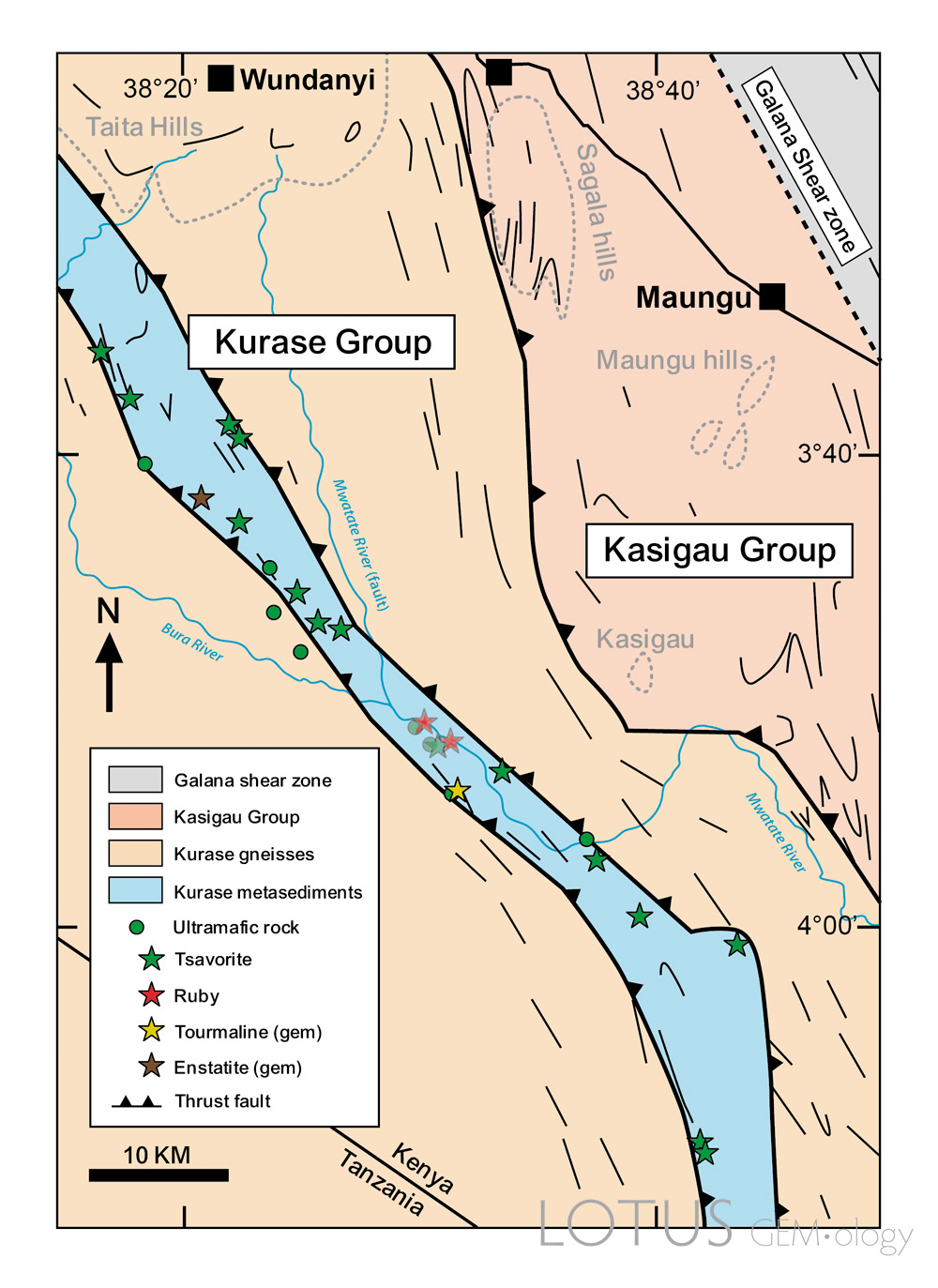 Figure 2. Map showing the locations of hard-rock (primary) gemstone deposits along Penny Lane, southeast Kenya. Alluvial (secondary) deposits and non-economic occurrences (other than the occurrence of tea-colored gem enstatite) are not shown. The two ruby deposits were formed at greater depth than the tsavorites and then “mechanically” emplaced within the sediments (Mercier et al. 1999).
Figure 2 shows that the gem deposits of southeast Kenya are confined in a band of metamorphosed sedimentary rocks, bordered by two thrust faults. It also shows that most of the deposits are situated close to one side of the band—one thrust—or the other but that they are not “contact” deposits formed by chemical exchanges between different types of rock.
The interpretation preferred here is that gem-quality crystallization within the metamorphic rocks of Penny Lane has benefited from the excess heat from two closely spaced thrust faults. This may seem undramatic, but it provides a reply, perhaps partial, to the question why garnet, or tourmaline, or corundum, or other normally opaque minerals occasionally crystallize as transparent gems.

About the Author
Dr. John M. Saul has a Ph.D. in geology from M.I.T. (USA). In Kenya in the 1970s, he discovered what is now known as the John Saul Ruby Mine. He sees geology as an historical science and his research interests include subjects usually classified as historical. Dr Saul’s writings, professional and popular, are focused on questions of origins. These include the origin of gemstones and why they are rare, the origin of large circular patterns dimly visible on the Earth’s surface, and the concurrent origins of complex animals and cancer. Other subjects include the origin of religion as deciphered from the overlapping beliefs of the Bushman of southern Africa and the Hadza hunter-gatherers of Tanzania. Now in his eighties, Dr. Saul lives in Paris and continues to pursue and publish his research.
Footnotes
[1] Martelat et al. (2017); Jacob et al. (2018).
[2] The term “Penny Lane” was in use by early 1974. Later names include “Gemstone Belt of East Africa”, “Pan-African Gems and Graphite Belt”, and “Neoproterozoic Metamorphic Mozambique Belt”. Here “Penny Lane” refers to the metasedimentary rocks of the Kurase Group; elsewhere, especially when alluvial deposits are taken into consideration, it may include the entire area of the Kurase Group..
[3] Squire et al. (2006).
Notes
First published in the Journal of Gems & Gemmology in May 2026.
References
- Boyle, R. (1672) An Essay About the Origine and Virtues of Gems. London: William Godbid, 185 pp.
- Jacob, J.B., Martelat, J.E., Goncalves, P., Giuliani, G., Devidal, J.L., Feneyrol, J., Omito, E. and Ichang'I, D. (2018) New P-T-X conditions for the formation of gem tsavorite garnet in the Voi area (southwestern Kenya). Lithos, Vol. 320–321, pp. 250–264.
- Le Fort, P. (1975) Himalayas: The collided range. Present knowledge of the continental arc. American Journal of Science, Vol. 275-A, pp. 1–44.
- Martelat, J.-E., Paquette, J.-L., Bosse, V., Giuliani, G., Monié, P., Omito, E., Simonet, C., Ohnenstetter, D., Ichang'i, D., Nyamai, C. and Wamunyu, A. (2017) Chronological constraints on tsavorite mineralizations and related metamorphic episodes in southeast Kenya. The Canadian Mineralogist, Vol. 55, No. 5, pp. 845–865.
- Mercier, A., Debat, P. and Saul, J.M. (1999) Exotic origin of the ruby deposits of the Mangari area in SE Kenya. Ore Geology Reviews, Vol. 14, No. 2, No. 83–104.
- Schmetzer, K. and Krupp, H. (1982) Enstatite from Mairimba Hill, Kenya. Journal of Gemmology, Vol. 18, No. 2, April, pp. 118–120.
- Squire, R.J., Campbell, I.H., Allen, C.M. and Wilson, C.J.L. (2006) Did the Transgondwanan Supermountain trigger the explosive radiation of animals on Earth? Earth and Planetary Science Letters, Vol. 250, No. 1, pp. 116–133.