
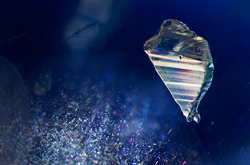
Apatite in Blue Sapphire
An apatite crystal appears to float, suspended over a rutile silk cloud in a star sapphire.
An apatite crystal appears to float, suspended over a rutile silk cloud in a star sapphire.
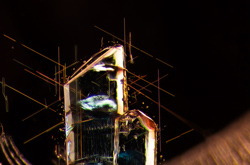
This article examines a blue apatite crystal that was found in a pyrope-spessartine garnet that is said to have come from Tanzania's Lindi Province.
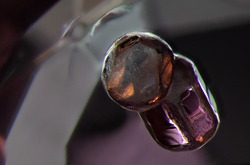
This article discusses the challenges of identifying inclusions based on observation alone. While certain features can help narrow down the possibilities, other methods such as micro Raman help identify inclusions with a greater degree of certainty.
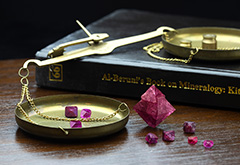
Abū Rayḥān Muḥammad ibn Aḥmad al-Bīrūnī was born in 973 CE, in what is now Uzbekistan. A polymath of the Islamic Golden Age, he distinguished himself in numerous fields, including medicine, astronomy, history, mathematics, physics, mineralogy, gemmology, encyclopedism, geography, philosophy, sociology, and travel. His vast intellectual contributions rank him among the greatest minds of any era. Al-Bīrūnī authored some 145 works, but tragically many of these are now lost. Given the sheer scale and depth of his intellectual legacy, any attempt to comprehensively study al-Bīrūnī’s contributions is inevitably limited and fraught with gaps. However, what we do know demonstrates that this was a remarkable man, on the order of an Aristotle or Einstein. And yet much of the world has never even heard of him. This paper will largely focus on his gemmological work, while also touching on his other accomplishments.
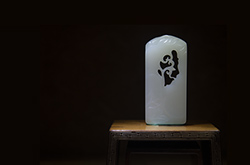
The story of Richard Hughes' four-decade adventure with jade, from Burma's jadeite mines to China's classic mutton-fat nephrite deposit at Hetian, Xinjiang Province. The work of China's modern jade carving masters is also discussed.
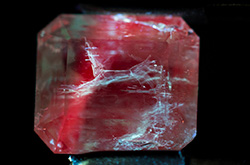
This article discusses the use of handheld long-wave ultraviolet torches with the microscope. It has been found that these have tremendous utility in identifying and characterizing certain oiled gemstones, such as emerald, tourmaline, etc.
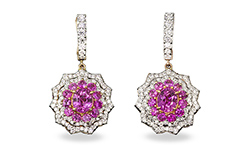
A discussion of DRIFTS vs the Beam Condenser FTIR attachment in the testing of pink sapphire. The DRIFTS accessory is generally much better at unmasking heat treatment in ruby and sapphire.
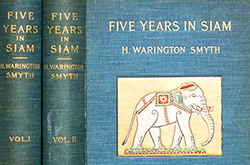
A discussion of the literature of ruby and sapphire (corundum), with particular emphasis on the most collectible books covering ruby and sapphire around the world.
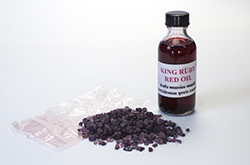
When a red spinel and a tanzanite were submitted for testing, oil was found in the fissures. Removal of the oil resulted in a startling deterioration in clarity.
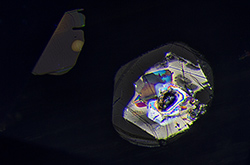
Solid inclusions have been used by gemologists as a means of determining origin. While there is a great deal of overlap from one source to another, there are also important differences. For example, while apatite has been identified in sapphire from Madagascar, Myanmar and Sri Lanka, apatite has never been identified in sapphire from Kashmir. Thus the purpose of this article is to give a full listing of solid inclusions in gem corundums from around the world, with each occurrence fully referenced. This is provided with the goal of making origin determination of ruby and sapphire more accurate.