Gemology Books Bibliography

Gemology Books Bibliography

Explore books on gems, gemology, jewelry and mineralogy in Four Treasures, the Lotus Gemology reference database. This bibliography brings together matching book records from the collection, with publication details, abstracts and cover images where available.

Gemology Book References

The list below matches books concerning gemology and related subjects in the database's searchable fields. Some works cover several branches of gems, jewelry or mineralogy.
3,461–3,480 of 3,502 matching references

Información sobre los tributos que los Indios pagaban a Moctezuma, año de 1554
Information concerning the tribute that the Indians paid to Moctezuma, 1554
Book
Scholes, F.V. and Adams, E.B. (1957) Información sobre los tributos que los Indios pagaban a Moctezuma, año de 1554. [Information concerning the tribute that the Indians paid to Moctezuma, 1554] Mexico City, J. Porrúa, 236 pp.
Record No. 28697  |  Sinkankas/Born No.: NIS/NIB  |  Language: in Spanish  |  not seen
The document published here by Francis V. Scholes and Eleanor B. Adams is the first systematic commentary on the Aztec tribute rolls to emerge from the sixteenth century. It consists of the court testimony of six Tlatelolco principales in 1554 regarding the tribute paid to Moctezuma. The witnesses commented upon an actual tribute roll of the Matrícula de Tributos type, and their observations provide important new evidence for reconstructing the Aztec imperial system and the tribute exacted from subject provinces. The imperial provinces appear in the order found in both the Matrícula de Tributos and the Codex Mendoza. The tribute roll examined by the witnesses evidently contained many more town names than are preserved in either of the two rolls known today, a fact that supports the frequently expressed view that the Matrícula de Tributos and the Codex Mendoza are incomplete. The testimonies record the number of towns in each province, although, except in the case of Petlacalco, where some names are given, the towns themselves are not identified. The editors also offer new interpretations concerning the quantity and nature of the tribute, festival obligations, the frequency of payments, land tenure, succession, and the mid-sixteenth-century value of the tribute formerly paid. The document is an important one, but it is the reviewer’s duty to object to an edition so limited that individual copies are sold at 200 pesos. — Charles Gibson, University of Iowa.

Zur optik und morphologie von synthetischen rubin
On the optics and morphology of synthetic ruby.
Journal Article
Jäger, E. and Huttenlocher, H. (1953) Zur optik und morphologie von synthetischen rubin. [On the optics and morphology of synthetic ruby.] Neues Jahrbuch für Mineralogie, Geologie und Paläontologie, Vol. 12, pp. 265–272.
Record No. 7660  |  Sinkankas/Born No.: NIS/NIB  |  Language: in German  |  not seen
Jäger and Huttenlocher investigate synthetic ruby from the standpoint of crystallographic morphology and optical behavior, examining the relationship between the external form and growth of the synthetic material and the crystallographic structure of corundum. They consider the orientation of the optical and crystallographic axes and the characteristic morphology produced during artificial crystal growth, using optical observations to relate the grown material to natural corundum. Particular attention is given to features arising from the growth process and to the extent to which synthetic ruby retains the fundamental optical and crystallographic properties of natural ruby despite its artificial mode of formation. The study is primarily mineralogical and crystallographic rather than gemological, and represents an early investigation of the structure and growth characteristics of manufactured corundum at a time when synthetic ruby was becoming increasingly important for both jewelry and technical applications.

Schmuck- Und Edelsteinkundliches Taschenbuch
Jewelry and Gemstone Pocket Handbook
Book
Chudoba, K.F. and Gübelin, E.J. (1953) Schmuck- Und Edelsteinkundliches Taschenbuch. [Jewelry and Gemstone Pocket Handbook] Bonner, Verlag Bonner Universitäts-Buchdruckerei, xii + 158 pp.
Record No. 5041  |  Sinkankas/Born No.: NIS/NIB  |  Language: in German  |  not seen
Chudoba and Gübelin provide a compact practical reference to gemology intended both for identifying gemstones and for standardizing the often confusing terminology used in the German gem trade. The principal gemstones and ornamental materials are arranged alphabetically and characterized by their chemical, crystallographic, and physical properties, important localities, trade names, and diagnostic features. Separate sections treat inclusions in natural gemstones, synthetic stones, doublets and triplets; tables of gemological constants; coated stones; synthetic gems and other imitations; the gemological microscope; and practical identification tables. Particular emphasis is placed on simple tests that can be performed with readily available gemological instruments and on microscopic inclusions as a means of distinguishing natural stones from synthetics and assembled or imitation materials. Conceived as a concise working handbook rather than a comprehensive mineralogical treatise, it became the basis for the substantially enlarged second edition of 1966, retitled Edelsteinkundliches Handbuch, and a further expanded third edition in 1974.

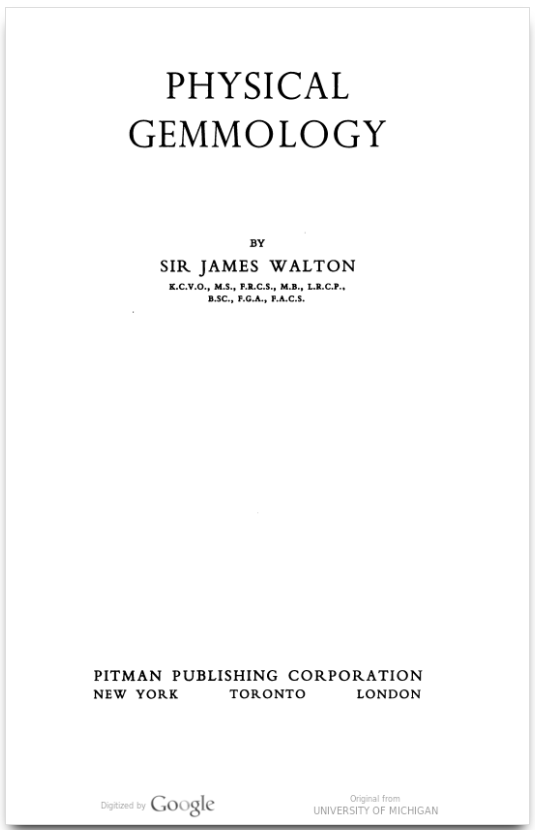
Physical Gemmology

Book
Walton, J. (1952) Physical Gemmology. New York, Pitman Publishing Corporation, 304 pp.
Record No. 28233  |  Sinkankas/Born No.: 6996  |  seen
Sinkankas: No doubt influenced by the lack of explanation in ordinary gemological textbooks, Walton studied physical chemistry and crystallography to bring before other students of gemology a simply-written text on subjects that are ordinarily not broached until college. Topics: nature and properties of atoms, crystal structures and crystallography, geological environments of gemstone deposits (!) but returning to the main theme with discussion of the properties of gem crystals, and ending with a dissertion on lapidary treatments. This last chapter, according to Webster's review in Journal of Gemmology, Vol. 4, No. 1, 1953, pp. 36–37, seems lost" and could have been omitted without loss to the rest of the text. Eric Bruton, The Gemmologist, Vol. 21, 1952, pp. 218–219, puts it well, "not a book for the average jeweller, but it is a book, and a very good one indeed, for the keen gemmologist, who will find in this one column all the up-to-date information on the basic sciences that he would otherwise have to search for in the works of many authorities in different subjects." There are some trivial errors and surprisingly poor crystal drawings."
Ancient American Gold and Jade: An Exhibition

Ancient American Gold and Jade: An Exhibition

Book
Taft Museum (1950) Ancient American Gold and Jade: An Exhibition. Cincinnati, Taft Museum
Record No. 28560  |  Sinkankas/Born No.: NIS/NIB  |  not seen
Lapis lazuli and ultramarine in ancient times
Lapis lazuli and ultramarine in ancient times

Journal Article
Gettens, R.J. (1950) Lapis lazuli and ultramarine in ancient times. Alumni, Vol. 19, pp. 342–357.
Record No. 27138  |  Sinkankas/Born No.: NIS/NIB  |  not seen

Mineralogical Information of al-Biruni
Минералогические сведения Ал-Бируни
Book Section
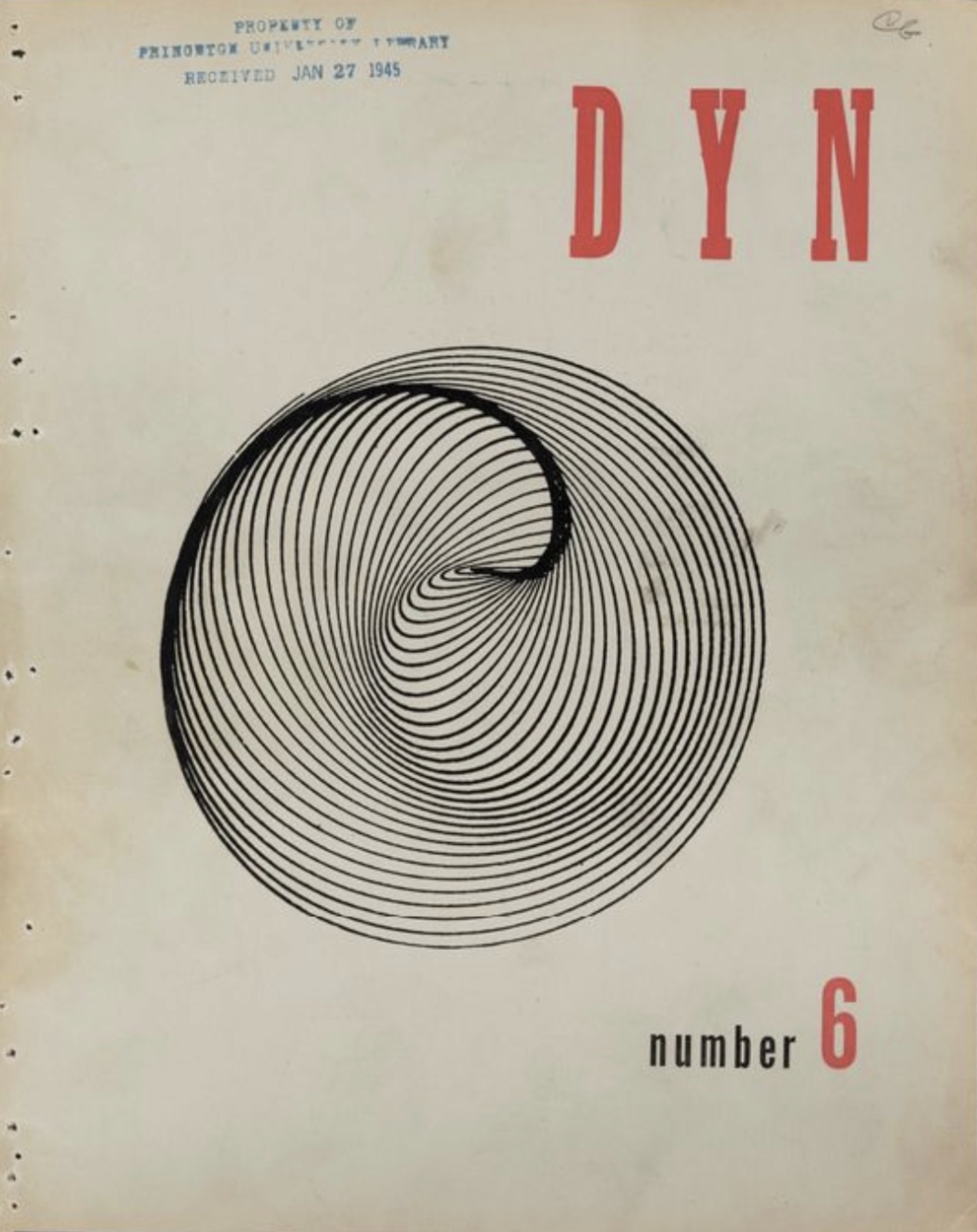
Lemmlein, G.G. (1950) Mineralogical Information of al-Biruni. [Минералогические сведения Ал-Бируни] In: Бируни: Сборник статей [Biruni: Collection of Articles], Moscow-Leningrad: Akademija Nauk SSSR, Academy of Sciences (Akademia Nauk) 2. BS Biriini Sbornik (Moscow-Leningrad, 1950) 3. IAI Istoriko-astronomicheskie Issledovaniya., pp. 106–127.
Record No. 1180  |  Sinkankas/Born No.: NIS/NIB  |  Language: in Russian  |  not seen
Lemmlein examines the mineralogical information contained in al-Bīrūnī’s Kitāb al-Jamāhir fī maʿrifat al-jawāhir, assessing the work from the standpoint of modern mineralogy and the history of science. He considers al-Bīrūnī’s descriptions and identification of gemstones, minerals, metals, and alloys, including their colors, physical characteristics, localities, methods of extraction and working, and commercial uses. Particular attention is given to al-Bīrūnī’s quantitative investigations of specific gravity, which represent an unusually advanced experimental approach for the eleventh century, and to his attempts to distinguish minerals through observable and measurable properties rather than relying solely on traditional lapidary lore. Lemmlein also discusses the difficulties of correlating medieval Arabic mineral names with modern species and emphasizes al-Bīrūnī’s critical use of earlier authorities, craftsmen’s knowledge, and his own observations and experiments. The article presents the Jamāhir as one of the most important medieval contributions to mineralogy and gemology.

La Venta: Colossal Heads and Jaguar Gods

Journal Article
Covarrubias, M. (1946) La Venta: Colossal Heads and Jaguar Gods. Dyn, Vol. 6, pp. 24–33.
Record No. 28557  |  Sinkankas/Born No.: NIS/NIB  |  not seen
The science of gemmology

The science of gemmology

Journal Article
Gübelin, E.J. (1945) The science of gemmology. ?, July, pp. 379–380; August, pp. 439–440; October, pp. 559–561,
Record No. 2028  |  Sinkankas/Born No.: NIS/NIB  |  not seen

The Art of the Northern Nomads

Book
Minns, E.H. (1944) The Art of the Northern Nomads. London, British Academy, 54 pp., 28 plates
Record No. 27247  |  Sinkankas/Born No.: NIS/NIB  |  not seen

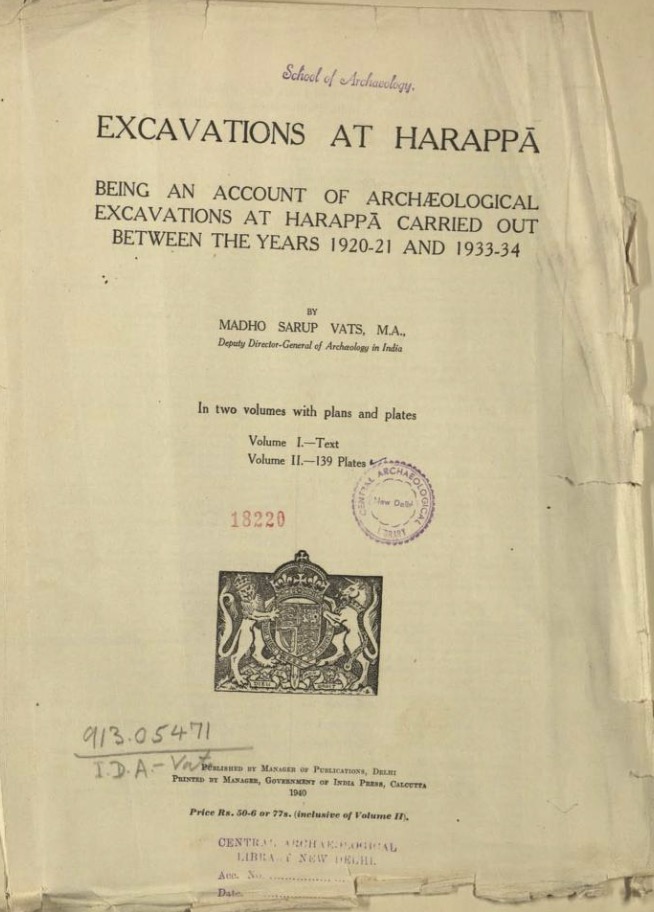
Part I. Report on selected beads from Harappa
Book Section
Beck, H.C. (1940) Part I. Report on selected beads from Harappa. In: Excavations at Harappa: Being an Account of Archaeological Excavations at Harappa Carried Out Between the Years 1920–21 and 1933–34, Delhi: Government of India Press, 2 Vols., Vol. 1 , pp. 392–431.
Record No. 24714  |  Sinkankas/Born No.: NIS/NIB
At the request of Mr. Madho Sarup Vats, Deputy Director General of Archaeology in India, I have undertaken to write a chapter on selected beads from Harappa. The fact that I cannot examine the entire collection has made it difficult to assess the likelihood of foreign importation, but Mr. Vats has been of great assistance in providing details on whether each specimen is unique, rare, or common, as well as information on the stratigraphic layer in which it was found. This data, combined with a close examination of the beads, has revealed some interesting possibilities regarding connections with other civilizations, particularly the Sumerian civilization in Mesopotamia. Since there appears to be little variation among the beads from different layers—many types occurring across several layers—I have chosen to group the beads by material rather than by stratigraphy. Several plates accompany the text for clarification. The first two are diagrammatic and show the beads arranged by shape according to the Beck Method of classification. Plate CXXIX illustrates beads in Group I, those with circular transverse sections, while Plate CXXX shows beads with non-circular transverse sections. Some plates also consist of microphotographs showing internal structure. One especially notable feature of the Harappa beads is the remarkably large number made from steatite. Nowhere else has such a high proportion of beads been found in this material. Moreover, the variety of treatment applied to the steatite is quite exceptional. While some beads are in natural stone, the vast majority have undergone heat treatment that whitens the surface. These are referred to as “burnt” steatite beads. Although I cannot be certain that intense heat was used in every instance, I have adopted the term nonetheless.

Mineral Resources of Southern Tajikistan: Pamir, Badakhshan, Darvaz, Karategin
Полезные ископаемые Южного Таджикистана: Памир, Бадахшан, Дарваз, Каратегин
Book
Popov, V.I. (1936) Mineral Resources of Southern Tajikistan: Pamir, Badakhshan, Darvaz, Karategin. [Полезные ископаемые Южного Таджикистана: Памир, Бадахшан, Дарваз, Каратегин] Leningrad, Tajik-Pamir Expedition, Materials of the Tajik-Pamir Expedition, No. 28 , 470 pp.
Record No. 29140  |  Sinkankas/Born No.: NIS/NIB  |  Language: in Russian  |  not seen
A comprehensive economic-geological survey of the mineral resources of southern Tajikistan, covering the Pamir, Badakhshan, Darvaz, and Karategin and synthesizing the results of the Tajik-Pamir expeditions. Popov relates mineral occurrences to the regional geology and distinguishes the metallogenic character of the principal geological zones. Of particular gemological importance is his treatment of the southern crystalline belt of the Pamir, which he characterized as especially rich in nonmetallic mineral resources, including lapis lazuli, gem spinel, clinohumite, garnet, kyanite, and graphite. He also records pegmatites associated with younger granites carrying mica, beryl, tantalite, and columbite. The work is an important early synthesis of the mineral resources and gem-bearing geology of the Pamir and remains a frequently cited foundation for later studies of the region’s gem deposits.

Siam, das Land der Thai

Siam, the Land of the Thai
Book
Credner, W. (1935) Siam, das Land der Thai. [Siam, the Land of the Thai] Stuttgart, [in German]
Record No. 621  |  Sinkankas/Born No.: NIS/NIB  |  Language: in German  |  not seen
Credner presents a broad geographical account of Siam based on his extensive travels and field investigations, combining physical geography, geology, climate, vegetation, settlement, population, agriculture, communications, and economic development. He describes the major geographical regions of the country and relates their landscapes and patterns of human occupation to underlying geology and relief. Mineral resources and mining form part of the economic-geographical treatment, including Siam’s important tin industry and other mineral occurrences, while the gem-producing districts are considered within the wider discussion of natural resources. The work is particularly valuable as a detailed picture of Thailand in the early 1930s, shortly after the political changes of 1932, and contains numerous photographs, maps, and observations derived from Credner’s own fieldwork. For gemological purposes its importance lies chiefly in the geographical and geological context it provides for Siam’s mineral and gemstone resources rather than in detailed mineralogical descriptions.

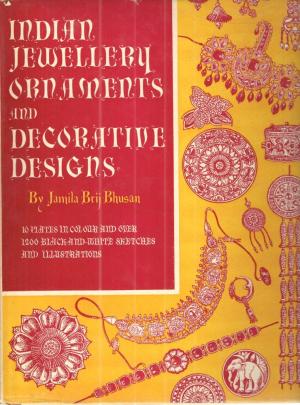
Indian Jewellery, Ornaments and Decorative Designs

Book
Bhushan, J.B. (1935) Indian Jewellery, Ornaments and Decorative Designs. Bombay, D.B. Taraporevala Sons & Co. LTD, 168 pp.
Record No. 465  |  Sinkankas/Born No.: 631  |  not seen
The most recent comprehensive work on the subject, distinguished by its authoritative text and wealth of illustrations. The text discusses the vogue for beads in India, ancient jewelry forms, Muslim jewelry types, modern trends, the craft of the goldsmith, precious stones, and advice for collectors. The chapter on precious stones (pp. 134–150) deals primarily with the traditional lore associated with gems in India, but also includes information on several famous stones, their owners, and elementary gemological data. The volume concludes with a list of Indian ornaments. References are provided at the end of each chapter; however, although the author cites the Journal of Indian Art & Industry for many illustrations, she fails to credit its author, T.H. Hendley (q.v.). The text paper is browned and brittle.
Gemology

Gemology

Book
Halford-Watkins, J.F. (1933) Gemology., 2 Vols.
Record No. 3127  |  Sinkankas/Born No.: NIS/NIB  |  seen
Elegance of Stones [Shí Yǎ]

Elegance of Stones [Shí Yǎ]

石雅
Book
Zhang, H. (1927) Elegance of Stones [Shí Yǎ]. [石雅]
Record No. 16548  |  Sinkankas/Born No.: NIS/NIB  |  Language: in Chinese  |  not seen
Zhang Hongzhao’s Shí Yǎ (石雅, “Elegance of Stones”) is a pioneering attempt to reinterpret the mineral substances recorded in Chinese literature through modern mineralogy. Drawing extensively on classical texts, including the Shan Hai Jing and later historical, literary, pharmacological, and antiquarian sources, Zhang examines traditional names and descriptions and attempts to identify the materials to which they refer. The work is divided into three broad sections: the first concerns yù (玉) and related precious and ornamental stones, including 璆琳, 瓊瑰, and 水精; the second treats stones and mineral substances, including worked jade, decorative stones, and coal; and the third deals with metals. An appendix examines the historical development of China’s Bronze and Iron Ages. Particularly important for gemology is Zhang’s application of contemporary mineralogical knowledge to traditional Chinese gemstones and jade terminology, demonstrating that historical names cannot automatically be equated with single modern mineral species. The work consequently provides an important bridge between traditional Chinese lapidary literature and modern geology, mineralogy, and gemology and remains a major source for the historical study of Chinese stone terminology. The 1927 edition is a reprint, issued by the Central Geological Survey as Memoirs of the Geological Survey of China, Series B [乙種], No. 2; catalogues confirm the December 1927 reissue.

Los Minerales de Colombia

The Minerals of Colombia
Book
Lleras Codazzi, R. (1927) Los Minerales de Colombia. [The Minerals of Colombia] Bogotá, Colombia, Imprenta Nacional, Biblioteca del Museo Nacional, 150 pp.
Record No. 591  |  Sinkankas/Born No.: NIS/NIB  |  Language: in Spanish  |  not seen
Lleras Codazzi provides an early systematic account of the minerals known from Colombia, combining mineralogical descriptions with information on their Colombian occurrences and localities. Produced as part of the Biblioteca del Museo Nacional, a series intended to document the museum’s collections scientifically while making them accessible to a wider readership, the work forms one of the foundational publications of modern Colombian mineralogy. It covers both common and economically significant mineral species and records occurrences of particular interest to mining and economic geology; later geological literature, for example, cites its discussion of pitchblende and other uranium minerals from Norte de Santander. For gemological research the book is particularly relevant because Lleras Codazzi had already studied the mineralogy of Muzo and its emerald deposits in his 1925 Catálogo descriptivo de los minerales de Muzo, and Los minerales de Colombia places such Colombian mineral occurrences within a broader national mineralogical survey.
Mayan jades

Mayan jades

Journal Article
Gann, T.W.F. (1925) Mayan jades. Proceedings of the 21st International Congress of Americanists, Goteborg, 1924, 276–282.
Record No. 28319  |  Sinkankas/Born No.: NIS/NIB  |  not seen

Diamonds: A Study of the Factors that Govern their Value
Book
Wade, F.B. (1916) Diamonds: A Study of the Factors that Govern their Value. New York, G.P. Putnam’s Sons, 150 pp.
Record No. 1952  |  Sinkankas/Born No.: 6944; NIB  |  not seen
Sinkankas: This appears to be the first book-length monograph devoted entirely to the discussion of the factors which influence quality, hence the price of cut diamonds. Wade treats the following factors in a simple, factual manner: color, flaws, and the make" or geometrical proportions of the shape and placement of facets. In addition, he discusses the advantages and disadvantages of repairing damaged stones or recutting same, especially from older styles of cut into modern brilliant forms. Other topics include mounting of stones and buying an engagement ring. While much has now been written to supersede this work it still contains fundamental invaluable advice put into language that retains the freshness of simplicity. In his time, and despite not being a member of the trade, Wade exerted an enormous influence on the conduct of the trade as well as on the study of gemology."

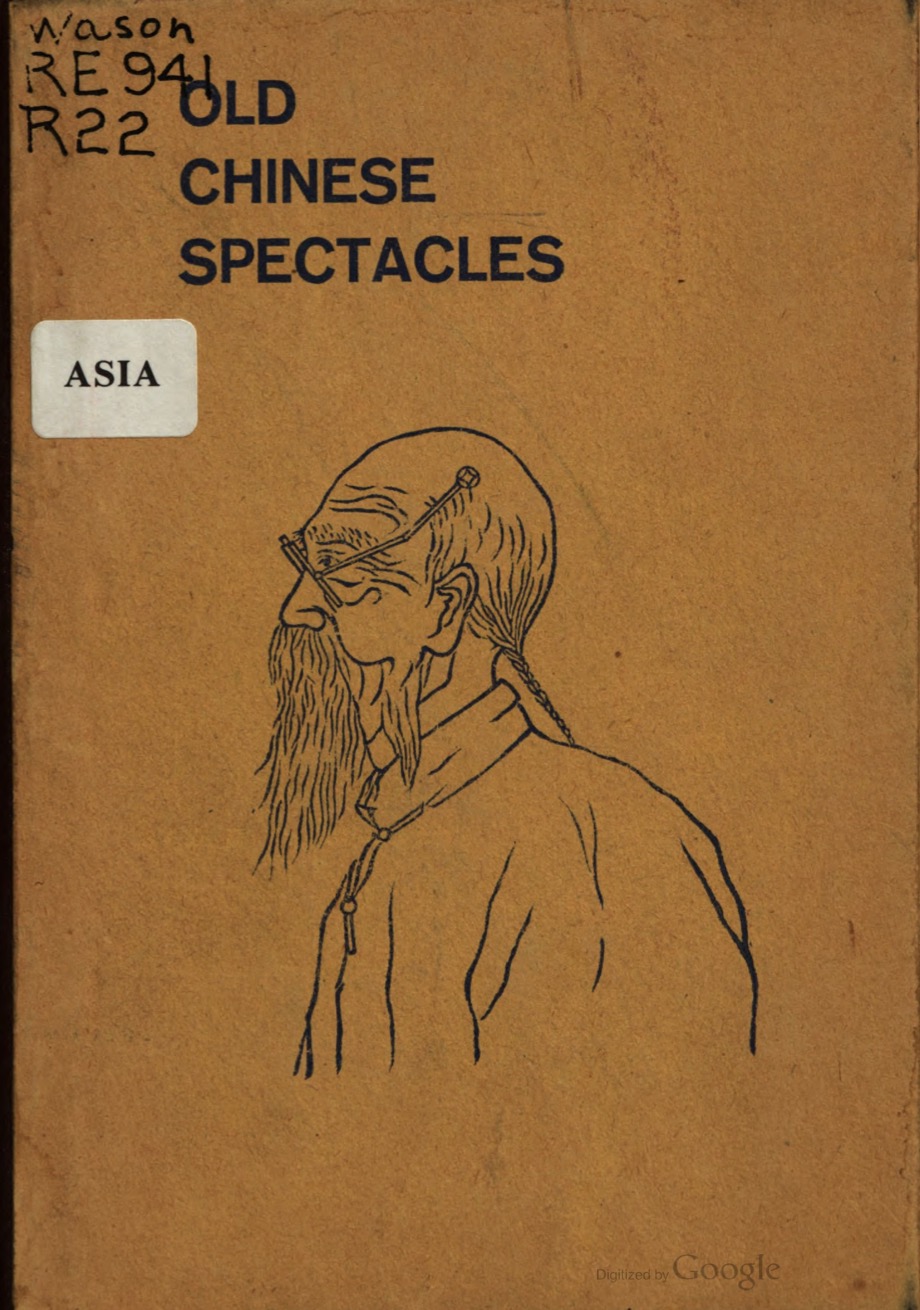
Old Chinese Spectacles

Book
Rasmussen, O.D. (1915) Old Chinese Spectacles. Tientsin, North China Press, 33 pp.
Record No. 28801  |  Sinkankas/Born No.: 5356  |  not seen
Sinkankas: Fascinating account of an optometrist’s study of the development of spectacles in China that were manufactured from transparent quartz varieties and by the same lapidary methods as were used to carve jade. Four of the illustrations show various stages of work while another is a line drawing of a typical lapidary’s lathe-bench employing foot-treadle propulsion. Another valuable feature of this work is an account of the curious lore associated with wear of quartz spectacles and explaining why the Chinese were of the firm conviction that spectacles made from smoky quartz were soothing to the eyes and helped heal diseases of those organs. Very scarce.

Building a Gemological Library

Gemological books range from general identification manuals and textbooks to specialized works on individual gems, mineralogy, jewelry, treatments, synthesis, history and gem-producing regions.

For a curated selection of particularly useful books, read The Gemologist's Core Library — Classic Books on Gemology, Jewelry and Mineralogy.

About Four Treasures

Four Treasures is Lotus Gemology's freely accessible gemological reference database. Use the full database to search by author, title or keyword and explore literature on gemology, mineralogy, jewelry and related fields. Where available, hyperlinks on titles may lead directly to the full publication.

Search the Complete Four Treasures Database