Explore books, articles and historical sources on inclusions in gemstones in Four Treasures, the Lotus Gemology reference database. This bibliography brings together matching records from the collection, with publication details, abstracts and cover images where available.
Gemstone Inclusion References
The list below matches the terms inclusion or inclusions in the database's searchable fields. Some references discuss inclusions as part of a broader subject.
941–960 of 1,165 matching references
Ruby in diamond
Journal Article
Meyer, H.O.A. and Gübelin, E.J. (1981) Ruby in diamond.Gems & Gemology, Vol. 17, No. 3, Fall, pp. 153–156.
The first substantiated identification of corundum (var. ruby) occurring as an inclusion in natural diamond is presented. The ruby is assigned to the eclogitic suite of inclusions in diamond, and the implications of its occurrence are discussed in relation to the genesis of “eclogitic” diamonds. It is concluded that diamond crystallizes from a melt over a long period of time with possible fluctuations in ambient temperature and geochemical environment.
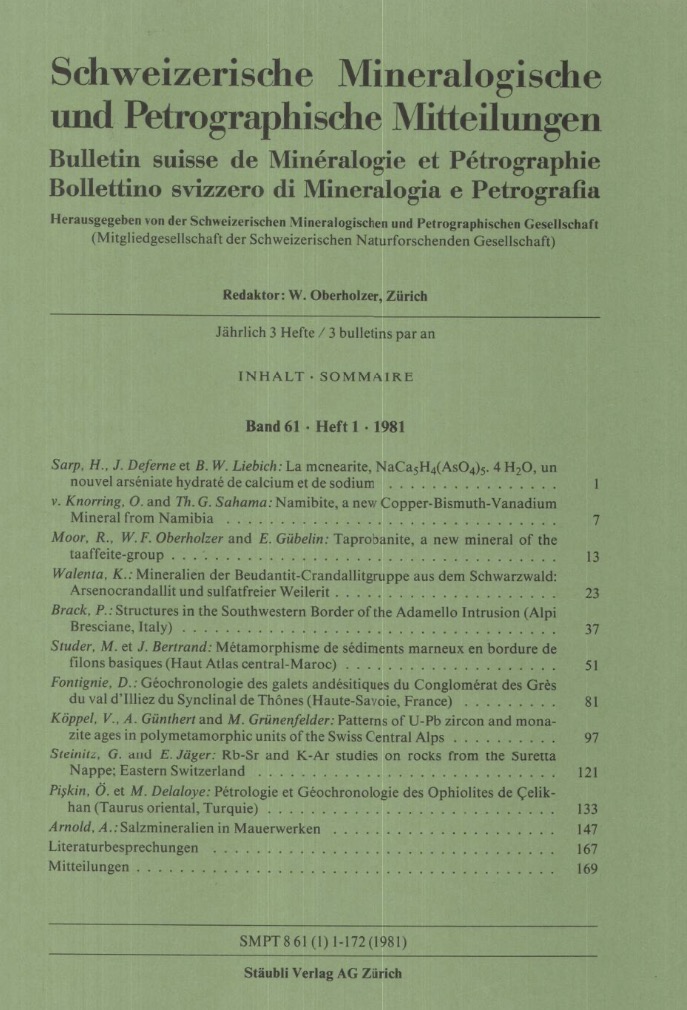
Taprobanite: A new mineral of the taaffeite group
Journal Article
Gübelin, E.J. (1981) Taprobanite: A new mineral of the taaffeite group.Schweizerische Mineralogische und Petrographische Mitteilungen, No. 61, pp. 13–21.
Record No. 2157 | Sinkankas/Born No.: NIS/NIB | Language: in German | RWHL
Reference copied to clipboard!
taaffeite, Sri Lanka, gems
Gübelin describes “taprobanite,” a rare red gemstone from Sri Lanka initially thought to be taaffeite because of its similar appearance and gemological properties. Detailed examination showed it to represent a distinct member of the taaffeite mineral group, characterized by differences in chemical composition, crystallographic properties, and optical behavior. The study discusses its identification, physical and optical constants, absorption characteristics, inclusions, and relationship to taaffeite, emphasizing the difficulty of recognizing such rare stones by conventional gemological testing alone. The name derives from Taprobane, the ancient name for Sri Lanka.
Recent observations on an apparently new internal paragenesis of beryls
Journal Article
Gübelin, E.J. (1981) Recent observations on an apparently new internal paragenesis of beryls.Journal of Gemmology, Vol. 17, No. 8, October, pp. 545–554.
Ultramafic inclusions and host alkali olivine basalts of the sourthern coastal plain of the Red Sea, Saudi Arabia
Report
Ghent, E., Coleman, R.G. and Hadley, D.G. (1980)Ultramafic inclusions and host alkali olivine basalts of the sourthern coastal plain of the Red Sea, Saudi Arabia. US Geological Survey, 37 pp.
Record No. 27294 | Sinkankas/Born No.: NIS/NIB | RWHL
Reference copied to clipboard!
gems, olivine, peridot, Red Sea, Saudi Arabia
A variety of mafic and ultramafic inclusions occur within the pyroclastic components of the Al Birk basalt, erupted on the southern Red Sea coastal plain of Saudi Arabia from Pleistocene time to the present. Depleted harzburgites are the only inclusions contained within the basalts that were erupted through Miocene oceanic crust (15 km thick) in the vicinity of Jizan, whereas to the north in the vicinity of Al Birk, alkali basalts that were erupted through a thicker Precambrian crust (48 km thick) contain mixtures of harzburgites, cumulate gabbro, and websterite inclusions accompanied by large (> 2 cm) megacrysts of glassy alumina-rich clinopyroxene, plagioclase, and spinel. Microprobe analyses of individual minerals from the harzburgites, websterites, and cumulate gabbros reveal variations in composition that can be related to a complex mantle history during the evolution of the alkali basalts. Clinopyroxene and plagioclase megacrysts may represent early phases that crystallized from the alkali olivine basalt magma at depths less than 35 km. Layered websterites and gabbros with cumulate plagioclase and clinopyroxene may represent continuing crystallization of the alkali olivine basalt magma in the lower crust when basaltic magma was not rapidly ascending. It is significant that the megacrysts and cumulate inclusions apparently form only where the magmas have traversed the Precambrian crust, whereas the harzburgite-bearing basalts that penetrated a much thinner Miocene oceanic crust reveal no evidence of mantle fractionation. These alkali olivine basalts and their contained inclusions are related in time to present-day rifting in the Red Sea axial trough. The onshore, deep-seated, undersaturated magmas are separated from the shallow Red Sea rift subalkaline basalts by only 170 km. The contemporaneity of alkaline olivine and subalkaline basalts requires that they must relate directly to the separation of the Arabian plate from the African plate.
Sternsaphir und sternquarz
Star sapphire and star quartz
Journal Article
Weibel, M., Wessicken, R., Woensdregt, C.F. and Wüthrich, A. (1980) Sternsaphir und sternquarz. [Star sapphire and star quartz]Schweizerische mineralogische und petrographische Mitteilungen, Vol. 60, No. 2–3, pp. 133–136.
Record No. 3193 | Sinkankas/Born No.: NIS/NIB | Language: in German | RWHL
Reference copied to clipboard!
corundum, sapphire, star sapphire, inclusions.5, star quartz, gems
Weibel, Wessicken, Woensdregt, and Wüthrich examine the optical mechanism responsible for chatoyancy and asterism, with particular attention to black star sapphire from southeastern Thailand and milky-white star quartz from Ratnapura, Sri Lanka. They explain that each ray of a star results from light scattering by a set of parallel fibrous structures within the crystal, with refraction at the curved cabochon surface also contributing to the observed effect. Contrary to the usual explanation involving rutile silk, electron microscopy revealed no inclusions in the Thai black star sapphire; its fracture surfaces instead show stepped structures with trigonal dislocations, and the authors suggest regular lattice dislocations or twinning as possible causes of the asterism. In the Ratnapura star quartz, electron diffraction identifies the scattering needles as sillimanite, averaging about 0.02 μm thick, rather than rutile; their imperfect orientation accounts for the diffuse and incomplete star.
Gemological Notes: Brief notes on Chatham flux sapphires
Journal Article
Koivula, J.I. (1980) Gemological Notes: Brief notes on Chatham flux sapphires.Gems & Gemology, Vol. 16, No. 12, Winter, pp. 410–411.
Takubo, H. (1979) Characteristics of synthetic hydrothermal emeralds from USA and USSR. [米国およびソ連の水熱合成エメラルドの特徴]Journal of The Gemmological Society of Japan [宝石学会誌], Vol. 6, No. 4, pp. 3–18.
Record No. 2391 | Sinkankas/Born No.: NIS/NIB | Language: in Japanese with English abstract | RWHL
Reference copied to clipboard!
synthetic beryl, emerald, gems
As-grown and faceted crystals of synthetic hydrothermal emeralds from the USA and USSR were compared in terms of morphology, internal features, and physical properties. The USSR emeralds are notably closer to natural emeralds in physical and optical properties, although both types differ from natural stones primarily in their internal features. USA emeralds (SG: 2.67–2.68, RI: ω 1.572–1.574, ε 1.568–1.569) display bright red fluorescence under 365 nm UV, show Chelsea filter reactions (red), and often contain optical strain, “earthworm” cracks, phenacite, and 2- or 3-phase inclusions—often originating from natural beryl seed plates. USSR emeralds (SG: 2.70–2.71, RI: ω 1.583–1.586, ε 1.577–1.579) are slightly softer (H 7–7.5), show weaker UV fluorescence and pleochroism closer to natural emeralds, and lack spikes or strong zonation. Their inclusions include more naturalistic features like “wheat-head” textures, 2- and 3-phase inclusions, and reddish-brown plates. Growth habits differ slightly, with the USSR stones typically showing multiple growth planes ({112̅1} and {112̅0}) and shorter estimated growth times. Overall, USSR hydrothermal emeralds reach ~90% similarity to natural emeralds, versus ~80% for USA stones and 40–60% for flux-grown emeralds.
Tell-tale inclusions in a phenakite from Brazil
Journal Article
Gübelin, E.J. (1979) Tell-tale inclusions in a phenakite from Brazil.Journal of Gemmology, Vol. 16, No. 6, April, pp. 357–362.
The Taiwan Cat's-Eye"is a tremolite cat's-eye. The gem material, cat's-eye tremolite occurs as veins at the contacts of graphite-sericite schist and serpentinite sills in association with nephrite, asbestus, talc and diopside-dominant skarn in the Fengtien area, south of Hualien. It is greenish yellow, pale yellow, honey yellow, green, rarely dark green, dark brown or black in color; translucent to opaque. H. 6-7, G. 3.045. Under the microscope, cat's-eye tremolite is colorless or pale green in color, consisting solely of fine, long sub-parallel fibers of tremolite in contrast to nephrite. Twisting or bending and wavy extinction are common. c∧Z' 0゜-10゜. α 1.613, β 1.626, γ 1.637; γ-α 0.24. The X-ray data are very similar to those of tremolite from St. Gotthard, Switzerland. Four chemical analyses reveal no marked differences in composition between the varieties of different colors, showing about 10% of the ferro-actinolite molecule. Some gemological features are also given. Diopside shows more crystal forms than previously reported, and the occurrence of grossularite is limited to diopside-grossularite veins near the contacts. Minor uvarovite and vesuvianite were first found in Taiwan. The former occuring as minute inclusions in diopside has n l. 778 and a_0 11.87A, corresponding to uvarovite with 10% Cr_2O_3. The latter of small prismatic crystals shows similarity in X-ray data to vesuvianite from Canzoccoli, Italy. The mineralization of the Fengtien nephrite-asbestus deposits may be divided into two stages : skarn formation and ore deposition, which might have taken place during serpentinitization by hydrothermal solutions rich in silica and lime. Cat's-eye tremolite was formed evidently later than nephrite."
The tears of Heliades
Journal Article
Gübelin, E.J. (1978) The tears of Heliades.Gems & Gemology, Vol. 16, No. 3, Fall, pp. 66–76.
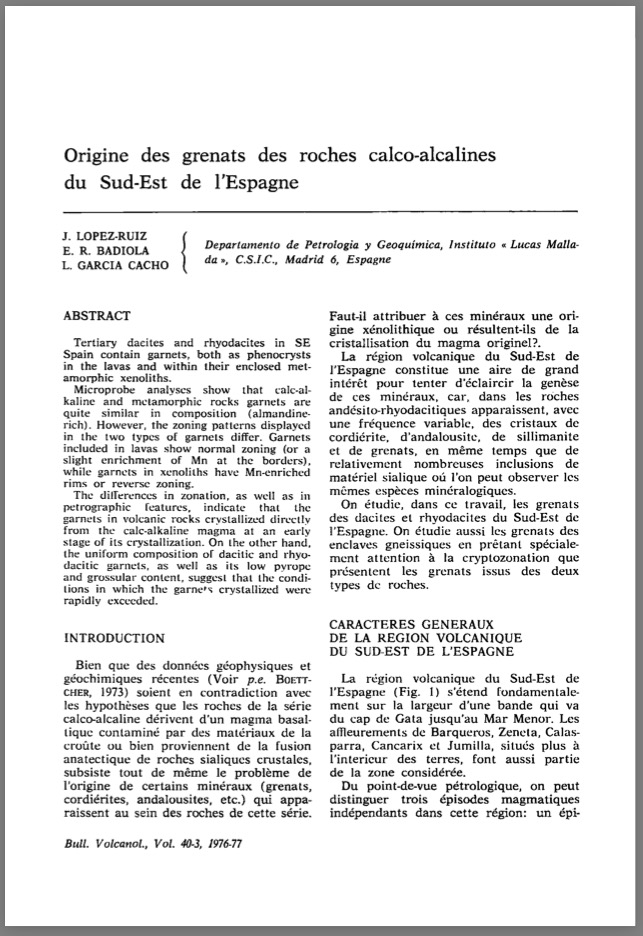
Origine des grenats des roches calco-alcalines du Sud-Est de l’Espagne
Origin of the garnets from the calc-alkaline rocks of southeastern Spain
Journal Article
Lopez-Ruiz, J., Badiola, E.R. and Garca, C.L. (1977) Origine des grenats des roches calco-alcalines du Sud-Est de l’Espagne. [Origin of the garnets from the calc-alkaline rocks of southeastern Spain]Bulletin Volcanologique, Vol. 40, No. 3, pp. 141–152.
Record No. 26803 | Sinkankas/Born No.: NIS/NIB | Language: in French | RWHL
Reference copied to clipboard!
gems, garnet, Spain
Tertiary dacites and rhyodacites in southeastern Spain contain garnets both as phenocrysts within the volcanic lavas and within enclosed metamorphic xenoliths. Microprobe analyses reveal that garnets from both the calc-alkaline lavas and the metamorphic inclusions are compositionally similar, being rich in almandine. However, their zoning patterns differ: garnets in the lavas exhibit normal zoning or slight manganese enrichment at the rims, while those in xenoliths show Mn-enriched edges or reverse zoning. These differences in zoning and petrographic features suggest that the volcanic garnets crystallized early from the calc-alkaline magma, whereas the more uniform composition and low pyrope and grossular content in the dacitic and rhyodacitic garnets imply that the crystallization conditions were only briefly maintained.
Einschlüsse im Fluorit
Inclusions in fluorite
Journal Article
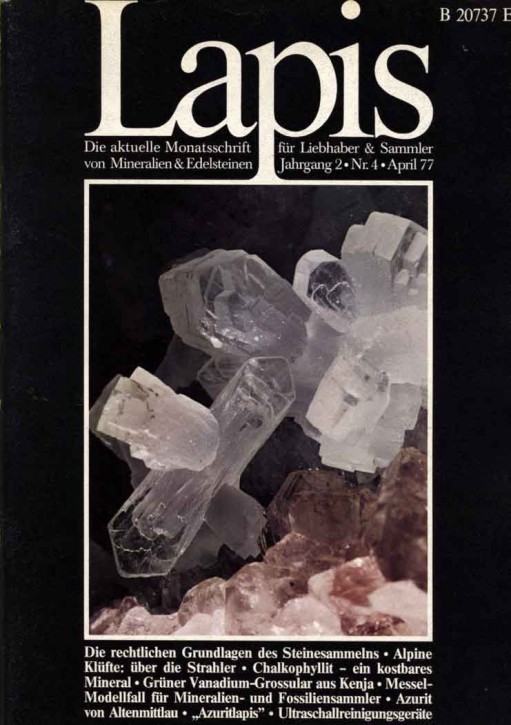
Gübelin, E.J. (1977) Einschlüsse im Fluorit. [Inclusions in fluorite]Lapis, Vol. 2, No. 5, pp. 16–19.
Record No. 16951 | Sinkankas/Born No.: NIS | Language: in German | RWHL
Reference copied to clipboard!
gems, fluorite, inclusions in fluorite
Illustrates characteristic inclusions in fluorite through colour photographs, including green chlorite crystals, secondary liquid inclusions, three-phase inclusions and well-formed pyrite crystals.
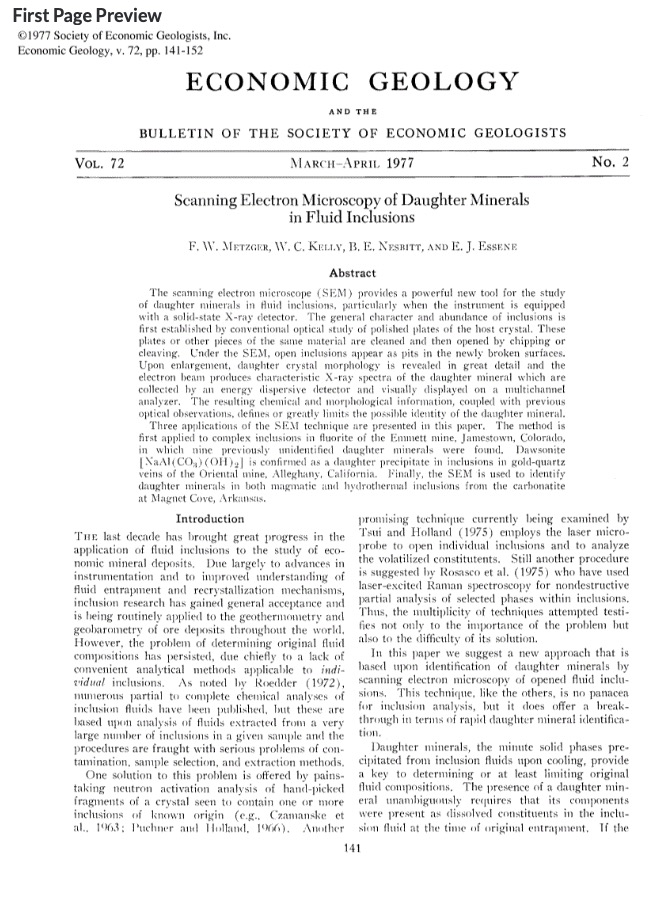
Metzger, F.W., Kelly, W.C., Nesbitt, B.E. and Essene, E.J. (1977) Scanning electron microscopy of daughter minerals in fluid inclusions.Economic Geology, Vol. 72, No. 2, March–April, pp. 141–152.
Record No. 7693 | Sinkankas/Born No.: NIS/NIB | RWHL
Reference copied to clipboard!
corundum, inclusions.5, gems
The scanning electron microscope (SEM) provides a powerful new tool for the study of daughter minerals in fluid inclusions, particularly when the instrument is equipped with a solid-state X-ray detector. The general character and abundance of inclusions is first established by conventional optical study of polished plates of the host crystal. These plates or other pieces of the same material are cleaned and then opened by chipping or cleaving. Under the SEM, open inclusions appear as pits in the newly broken surfaces. Upon enlargement, daughter crystal morphology is revealed in great detail and the electron beam produces characteristic X-ray spectra of the daughter mineral which are collected by an energy dispersive detector and visually displayed on a multichannel analyzer. The resulting chemical and morphological information, coupled with previous optical observations, defines or greatly limits the possible identity of the daughter mineral. Three applications of the SEM technique are presented in this paper. The method is first applied to complex inclusions in fluorite of the Emmett mine, Jamestown, Colorado, in which nine previously unidentified daughter minerals were found. Dawsonite [NaAl(CO₃)(OH)₂] is confirmed as a daughter precipitate in inclusions in gold-quartz veins of the Oriental mine, Alleghany, California. Finally, the SEM is used to identify daughter minerals in both magmatic and hydrothermal inclusions from the carbonatite at Magnet Cove, Arkansas.
Further notes on mono- and bi-phase inclusions in amethyst and topaz
Journal Article
Gübelin, E.J. (1977) Further notes on mono- and bi-phase inclusions in amethyst and topaz.Journal of Gemmology, Vol. 15, No. 6, April, pp. 289–294.
Fujisaki, Y. (1976) Glass made imitation jade and its inclusions.Journal of The Gemmological Society of Japan [宝石学会誌], Vol. 3, No. 3, pp. 99–105.
Record No. 6407 | Sinkankas/Born No.: NIS/NIB | Language: in Japanese with English abstract | RWHL
Reference copied to clipboard!
gems, jade, jade imitations, glass
Imitation jades currently circulating in jewellers market under the name of Syberian jade or Reformed jade were investigated by both non-destructive and destructive methods, with special attention to the inclusions. The imitation jades are made of sophisticatedly produced glass, and are dark green, translucent to opaque with glassy, somewhat greasy, luster, have Mohs' hardness of 5-5.5, sp. gr. 2.67 ± 0.02 at 20℃, refractive index 1.523 ± 0.005, and broad absorption spectrum at 4000-4600Å and 6300-7000Å. They contain characteristic inclusions of the following three types; 1) Needle-like inclusions which are identified to be hydroxyl apatite by optical and X-ray investigations, have hexagonal section, and are uniaxial negative, with no pleochroism, higher refractive index than the matrix. These are grouped into three by their length. 2) Dendrite inclusions with 90° braches are identified to be either vapour or liquid phase inclusions, and have lower refractive index than the matrix. 3) Four other types of inclusions, which are not identified. These imitation jades exhibit psudo-optical anisotropy due to apatite inclusions and are easily identified by their inclusions.
Notes on mono- and bi-phase inclusions in amethyst
Journal Article
Gübelin, E.J. (1976) Notes on mono- and bi-phase inclusions in amethyst.Journal of Gemmology, Vol. 15, No. 4, October, pp. 165–171.
Moreau, M. (1976) Nong Bon ou le rubis de Thailande. [Nong Bon or the ruby of Thailand]Revue de Gemmologie A.F.G., No. 47, Juin, pp. 10–12.
Record No. 1295 | Sinkankas/Born No.: NIS/NIB | Language: in French | RWHL
Reference copied to clipboard!
Thailand.12, Nong Bon, Chanthaburi, gems
Moreau gives a first-hand account of a visit to the Nong Bon ruby mine, about 60 km from Chanthaburi and close to the Cambodian frontier. The deposit was worked by removing roughly 20 m of overburden to reach a gem-bearing alluvial layer about 1 m thick; powerful pumps and water jets broke up the material, after which the lighter fraction was washed away and the heavier gem-bearing concentrate collected and hand-sorted. Daily production was irregular, estimated at 1,000–2,000 carats, but only about 300 carats were considered gem material, including perhaps 2–3 carat stones; associated minerals included black opaque spinels, ilmenite, and black corundum. The rough ruby was generally sold not at the mine but at Bor Rai, where miners and dealers negotiated prices in a busy market. Photographs document the mine, hydraulic working, hand sorting, and trading, while a photomicrograph shows faceted inclusions in a Thai ruby.
Exploring the Literature of Gemstone Inclusions
The literature of gemstone inclusions covers identification, origin determination, treatments, synthesis, mineral inclusions, fluid inclusions and other internal features of natural and synthetic gems.
Four Treasures is Lotus Gemology's freely accessible gemological reference database. Use the full database to search by author, title or keyword and explore literature on gemology, mineralogy, jewelry and related fields. Where available, hyperlinks on titles may lead directly to the full publication.