
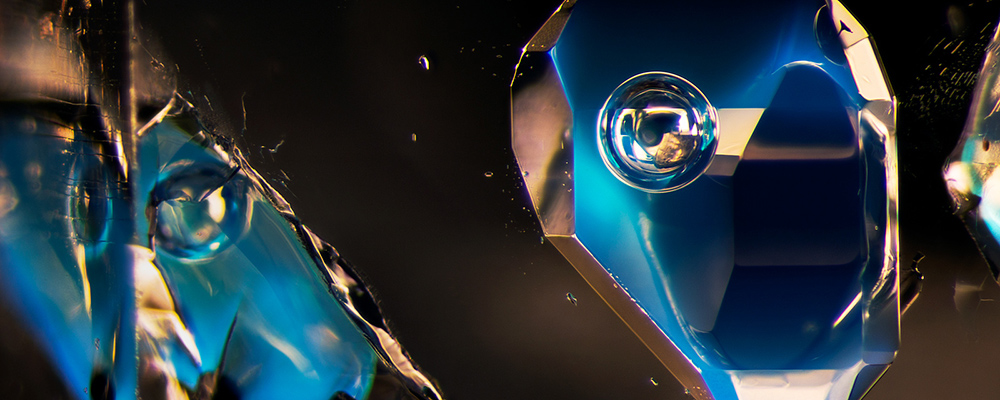
This article discusses the use of handheld long-wave ultraviolet torches with the microscope. It has been found that these have tremendous utility in identifying and characterizing certain oiled gemstones, such as emerald, tourmaline, etc.
Long-Wave Ultraviolet Torches — A Gemologist’s New Best Friend
As laboratory gemologists, we are frequently asked by friends and colleagues for recommendations on lab equipment. Often the focus is based around the most modern and advanced instrumentation, much of which is out of reach for what my grandfather likes to call the “great unwashed.”
One piece of equipment that is often overlooked is the humble ultraviolet (UV) lamp. Although it is an older and relatively affordable tool, it is an essential test in our laboratory, and we examine all submitted stones under UV light. It can be a tremendous help in detecting treatments and synthetics, as well as a capable tool to screen pieces of jewelry with many smaller stones.
One way this can help gemologists is with emeralds. As gemologists are aware, the vast majority of emeralds are filled with oils or resins to mask their fissures. Thankfully, many of these fillers fluoresce to long wave (LW) UV. While a standard UV lamp can unmask this, it’s even better if the fluorescence can be observed under magnification. That leaves gemologists with two choices. Rig up a contraption with a lens attached to the UV light box (Hughes and Emmett, 2005), or buy an expensive fluorescence microscope.
While we have an excellent LW/SW UV microscope setup custom-designed by M&A Instruments, it does not produce strong reactions in LW illumination. Similarly, our standard UV light box’s long wave bulb (a UVP UVLS-26 EL Series UV 365nm, 6-watt model lamp) is reasonably strong, but lacks the magnification that allows us to see the details we get from our microscopes.
Enter the LW UV torch. While many gem dealers have started carrying these portable torches around when they buy and sell stones, we have found them to also be of great use in the lab.
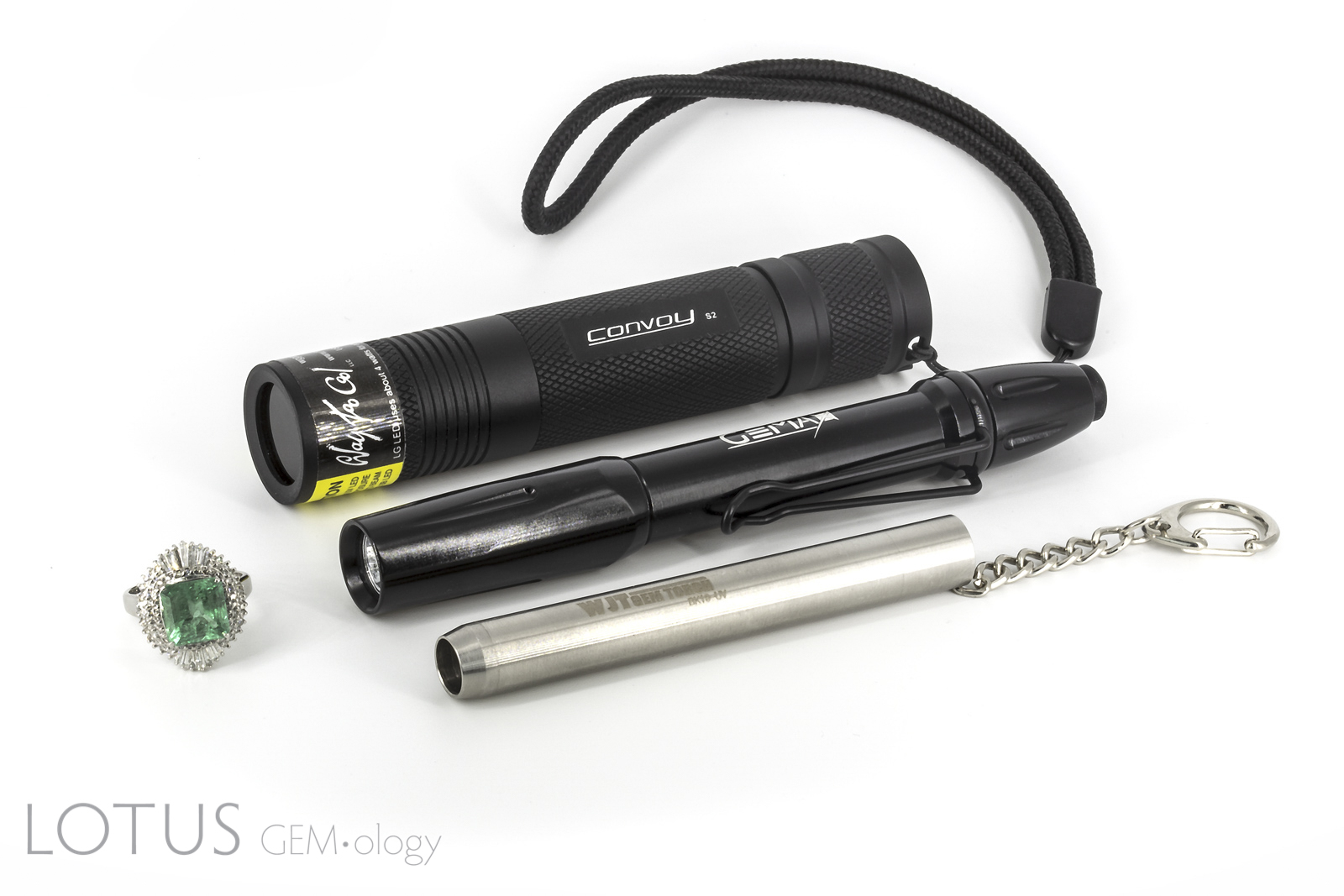 Figure 1. A selection of long-wave ultraviolet fluorescent torches available on the market. From top to bottom: Convoy S2+ 4-watt UV, GEMA UV 365nm, and World Jewelry Tool Gem Torch BK19-UV. Photo: Wimon Manorotkul/ Lotus Gemology
By examining a stone in the microscope and illuminating it with our UV torch, we are able to get the best of both worlds in a simple and affordable manner. This combination provides the advantages of microscope magnification and utility of LW UV illumination, creating a “poor man’s fluorescence microscope” that is even better than the real thing. At about US$50, it is something any gemologist can afford.
One of the strongest of these torches we have seen is the Convoy S2+ 4-watt UV Flashlight (Figure 1). This is produced by Way Too Cool LLC, and made with the mineral community in mind. It produces a significantly stronger reaction than the others we have tested, and is the one we use most often in conjunction with the microscope. They also produce an even stronger 6-watt version, which we have not tested.
One huge benefit is with oiled gemstones. We find more and more gems are being oiled today, particularly those originating from Myanmar (Lotus Gemology, 2015). Not only can you see where oil has penetrated fissures, but with the microscope you can make better judgements about the extent of the treatment (Figure 2).
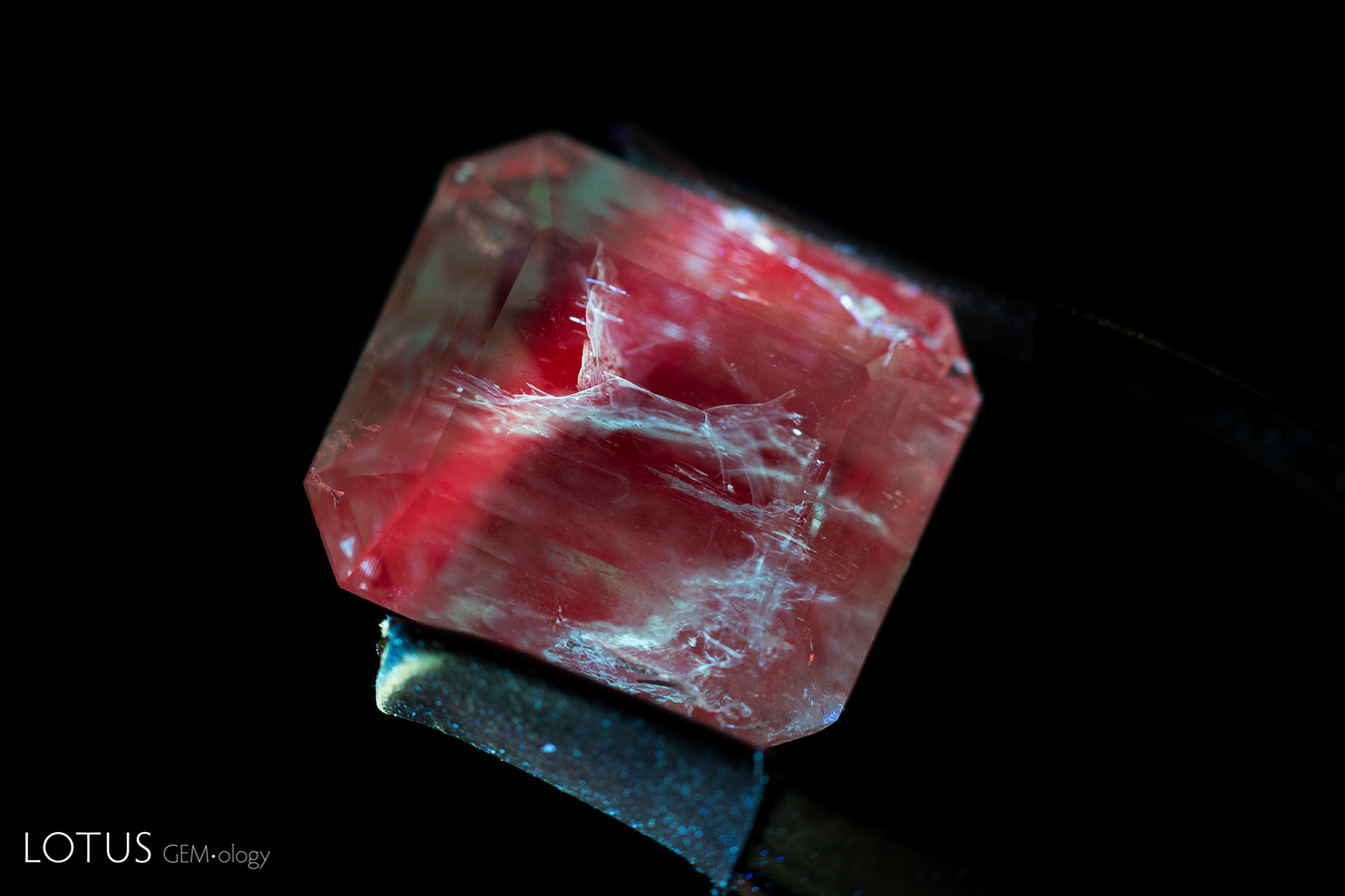 Figure 2. When viewed with the Convoy S2+ torch, this Colombian emerald displays a red fluorescence. However, the fissures display a chalky blue reaction because the filler in the fissures is fluorescing as well. Photo: E. Billie Hughes/ Lotus Gemology
|
Ultraviolet Safety Considerations One should never point these UV torches directly at one’s eyes. To protect one’s eyes while using UV lights, one can easily and affordably purchase UV blocking goggles. These are available for less than US$10. |
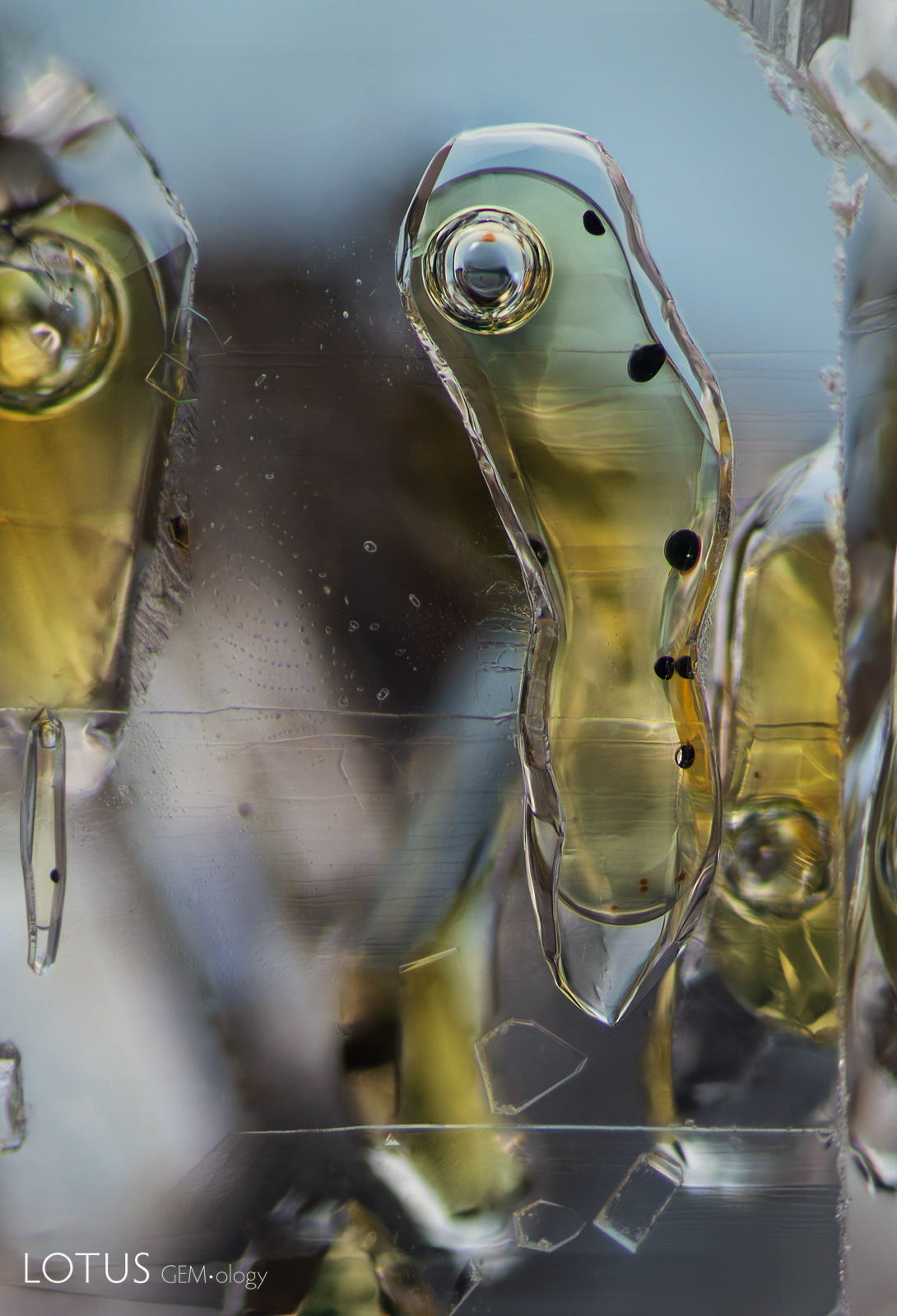
Another interesting use is for photomicrography. When viewing fluorescent inclusions, such as petroleum in quartz, the UV torch can produce spectacular reactions that were previously difficult to capture (see Figure 3).
 |
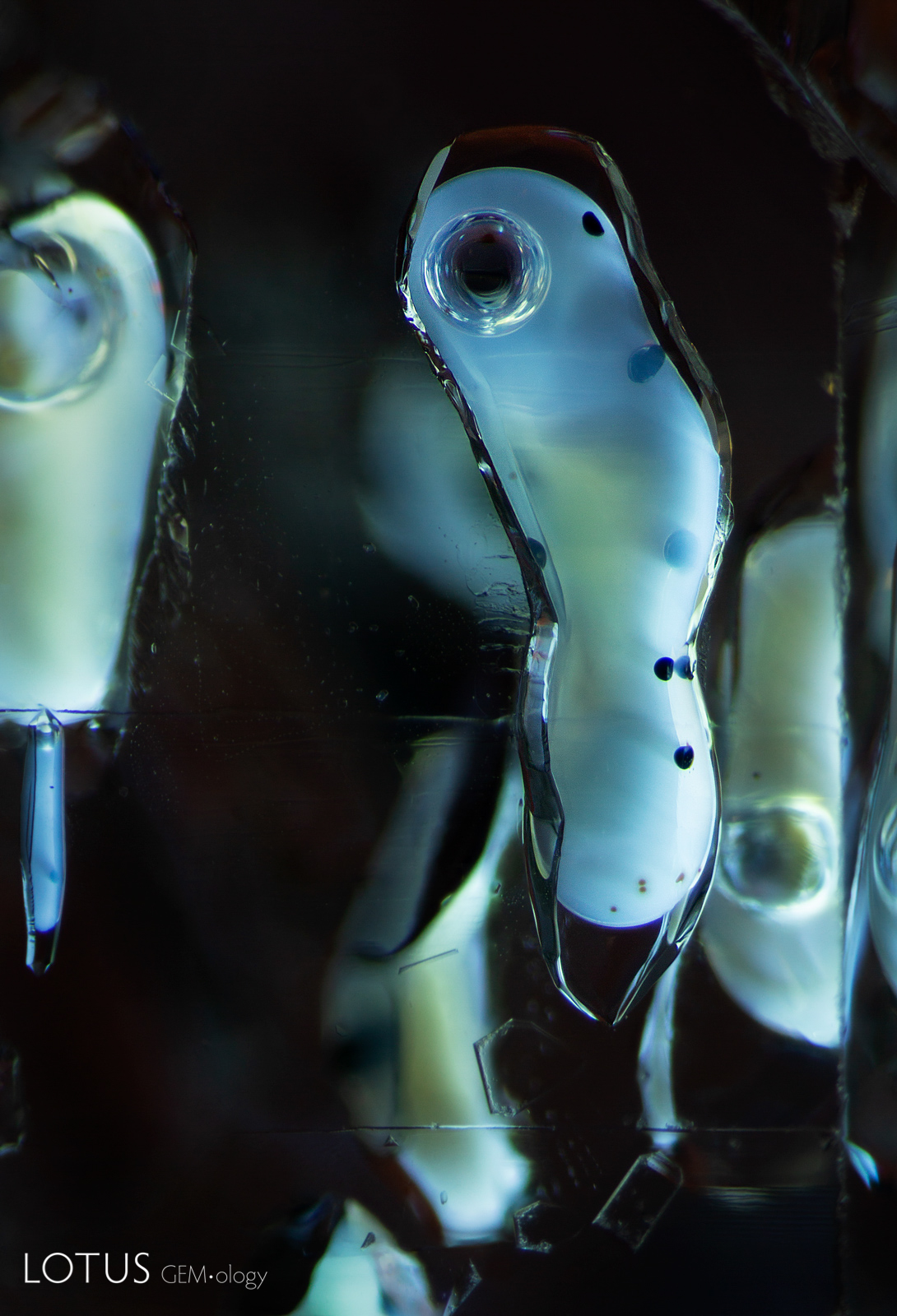 |
| Figure 3. A cavity in quartz filled with petroleum. In light field (left), the petroleum displays a yellow appearance. (Right) When illuminated with the UV torch, in this case with the Convoy S2+, the petroleum fluoresces a chalky yellowish white, creating a totally different look and feel. Photos: E. Billie Hughes/ Lotus Gemology; click on the photos for larger images | |
Conclusion
Whether to help detect treatments or to view other fascinating LW fluorescent reactions, these UV torches are a great addition to any gemologist’s instrument collection, and even better when paired with a microscope. With one of these, the great unwashed can proudly point their noses in the air and say “Ha! I can do that, too.”

About the Author
E. Billie Hughes is Co-Founder and Managing Director of Lotus Gemology, where she oversees the company's day-to-day operations while continuing gemological research and laboratory work. After graduating from UCLA, she became a Fellow of the Gemmological Association of Great Britain (FGA). Her research focuses on ruby and sapphire, including low-temperature heat treatment, and she has authored and co-authored articles in leading gemological journals. She has conducted fieldwork at gem deposits around the world, including nearly every major ruby and sapphire locality.
Billie is an internationally recognized educator who has lectured for trade organizations, museums, and luxury jewelry houses, including extensive educational work with Van Cleef & Arpels. She has also served as a judge on Thailand's The Secret Gems television series. An award-winning photographer and photomicrographer, her images have received honors in the Nikon Small World and Gem-A competitions and have appeared in publications including National Geographic and Forbes. She is also the creator of Hyperion, Lotus Gemology's online inclusion database.
Billie developed an interest in gemstones from an early age, accompanying her parents on expeditions to mines and gem-producing regions around the world. That lifelong passion for fieldwork, laboratory research, education, and photography continues to shape her work at Lotus Gemology today.
Notes
First published in the Journal of the Gemmological Association of Hong Kong, 2020, Vol. 41, pp. 57–59.
References
- Hughes, R.W. and Emmett, J.L. (2005) Heat Seeker: UV fluorescence as a gemological tool. Gem Market News [The Guide], Vol. 24, No. 5, Part 1, Sept.–Oct., pp. 1, 4–7.
- Lotus Gemology (2015) Lotus Gemology lab alert for oiled gems. InColor. Spring, Issue 28, pp. 18–23.