
A mobile bubble floats in a cavity in spinel.
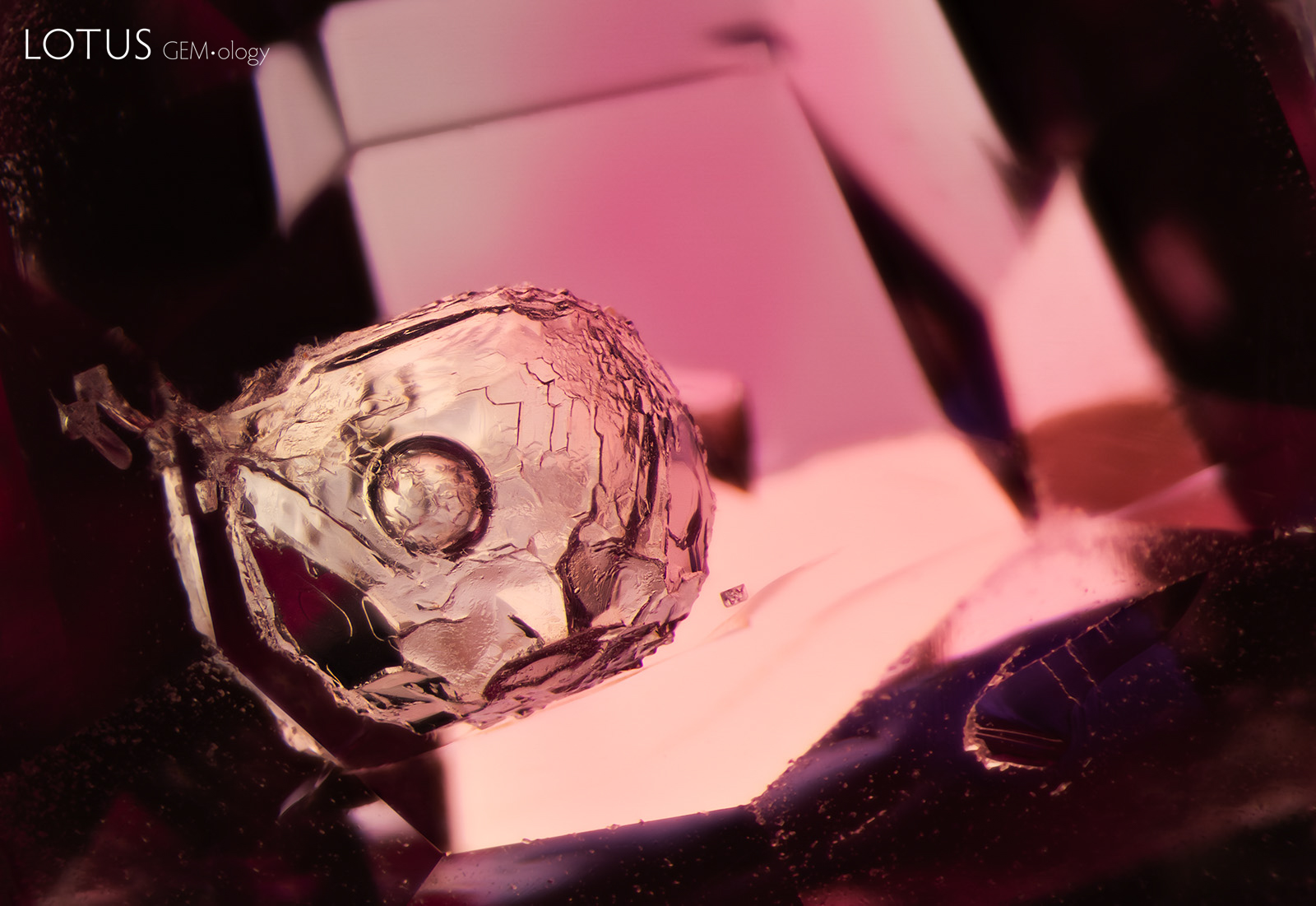 Figure 1. A mobile bubble floating in a cavity in spinel observed under diffused transmitted light. The nature of the substance inside the cavity remains a mystery. Photomicrograph by E. Billie Hughes/Lotus Gemology; field of view ~3.5 mm. Courtesy of Gil Yuda.
Sublimely Superb Spinel Inclusion
Gemology is a forensic science, and often what we don’t know can be as interesting as what we do know. Recently, the authors encountered a fascinating spinel. The owner noted that the stone (reportedly from Myanmar, formerly Burma) contained an inclusion feature with a bubble inside. Closer inspection revealed a negative crystal or cavity that indeed contained a mobile bubble (see above). With gentle heating from the warmth of the microscope’s light bulb, the authors were able to see the bubble expand and contract (see video below).
Both micro-Raman and micro–Fourier-transform infrared spectroscopy were used in attempts to identify the liquid, but the results were inconclusive. The inclusion was inert when exposed to both long-wave (365 nm) and short-wave (254 nm) ultraviolet illumination.
Sulfur-rich fluids have been reported in Burmese spinel (Winter 2017 G&G Micro-World, p. 468). However, the sample did not match sulfur-rich fluids, either in appearance (sulfur-rich fluids tend to have a yellowish color) or in its Raman spectrum. In many cases, cavities in corundum displaying a similar appearance have been found to contain carbon dioxide. However, in the authors’ experience, it is often possible to identify carbon dioxide with Raman spectroscopy, whereas in this case, Raman spectroscopy did not yield a conclusive answer.
Currently, the exact nature of this inclusion remains a mystery.

About the Authors
E. Billie Hughes is Co-Founder and Managing Director of Lotus Gemology, where she oversees the company's day-to-day operations while continuing gemological research and laboratory work. After graduating from UCLA, she became a Fellow of the Gemmological Association of Great Britain (FGA). Her research focuses on ruby and sapphire, including low-temperature heat treatment, and she has authored and co-authored articles in leading gemological journals. She has conducted fieldwork at gem deposits around the world, including nearly every major ruby and sapphire locality.
Billie is an internationally recognized educator who has lectured for trade organizations, museums, and luxury jewelry houses, including extensive educational work with Van Cleef & Arpels. She has also served as a judge on Thailand's The Secret Gems television series. An award-winning photographer and photomicrographer, her images have received honors in the Nikon Small World and Gem-A competitions and have appeared in publications including National Geographic and Forbes. She is also the creator of Hyperion, Lotus Gemology's online inclusion database.
Billie developed an interest in gemstones from an early age, accompanying her parents on expeditions to mines and gem-producing regions around the world. That lifelong passion for fieldwork, laboratory research, education, and photography continues to shape her work at Lotus Gemology today.
Wim Vertriest is manager of field gemology at GIA in Bangkok.
Notes
This article first appeared in Gems & Gemology, Spring 2026, Vol. 62, No.1, p. 83–84.