
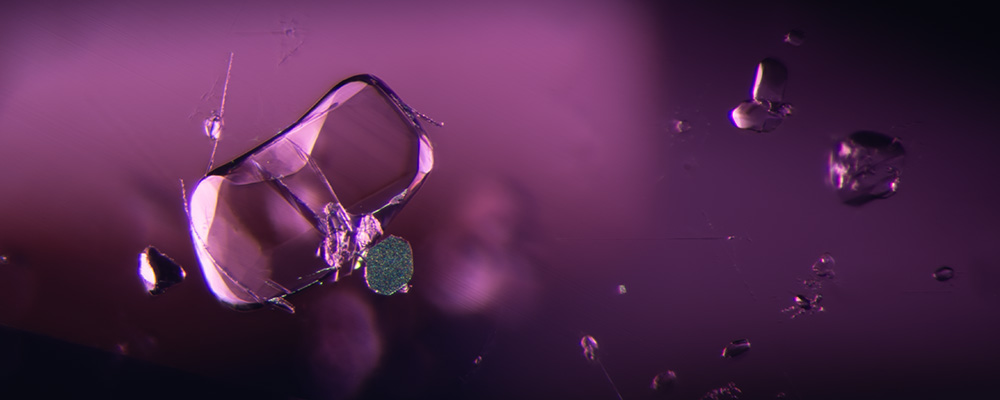
Fluorescent diopside, phlogopite, and edenite inclusions in a spinel reportedly from Tanzania reveal identification clues under short-wave ultraviolet light.
Fluorescent Crystal Inclusions in Spinel: Diopside, Phlogopite & Edenite
The authors examined a 7.01 ct spinel reportedly from Tanzania. Under short-wave (254 nm) ultraviolet light, a small fluorescent spot was observed on the stone’s surface, caused by cut-through crystal inclusions. Micro-Raman analysis identified the inclusions as diopside, phlogopite, and edenite, forming a cluster of transparent crystals associated with a dark, opaque pyrite grain (Figure 1). In reflected light, the inclusions showed luster distinct from the spinel host, with the pyrite exhibiting a golden metallic luster (Figure 2). Under short-wave ultraviolet light, the crystals fluoresced in different colors: white for diopside, yellow for phlogopite, and blue for edenite (Figure 3). Fluorescence from inclusions is often overlooked but can provide important identification clues.
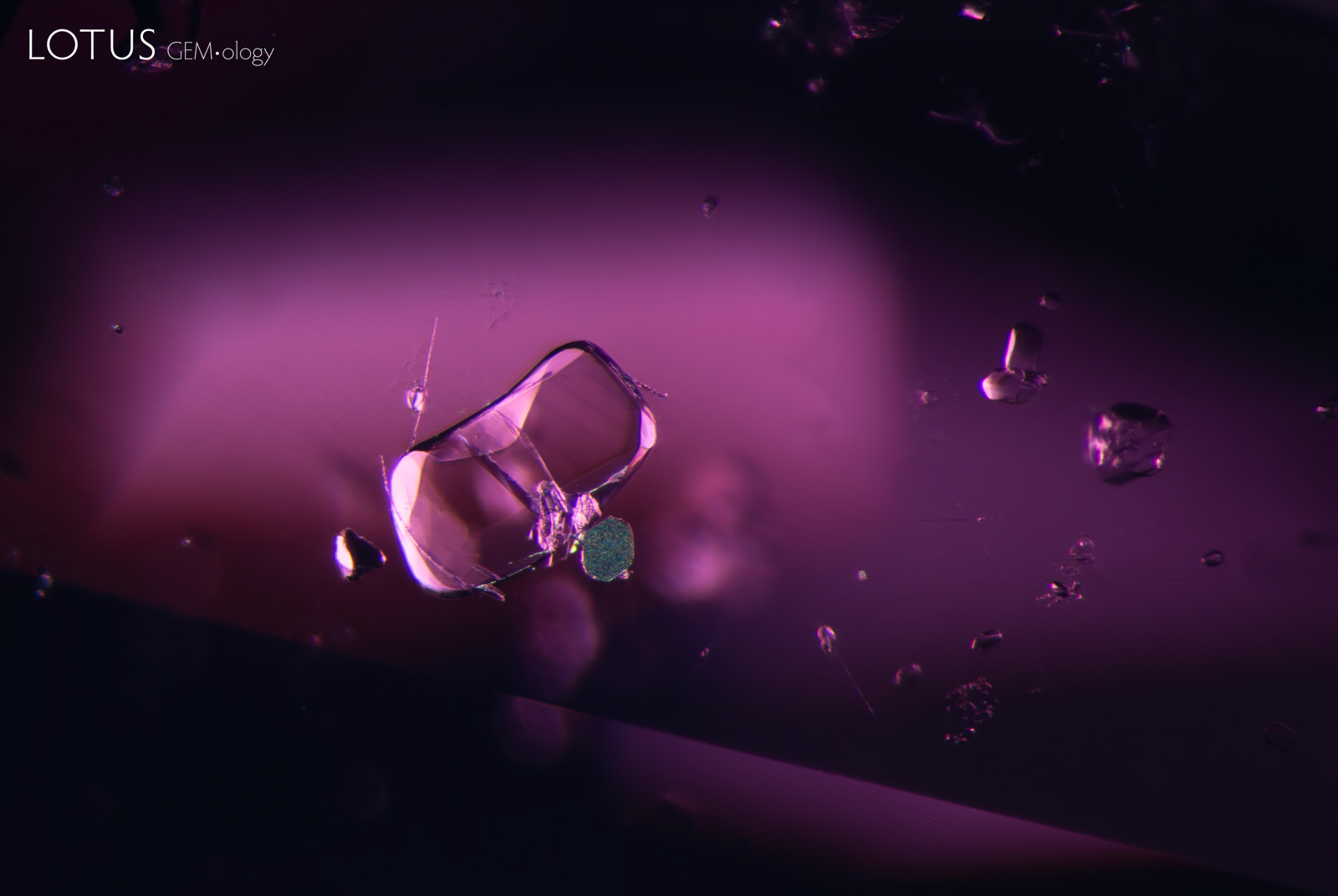 Figure 1. A cluster of diopside, phlogopite, and edenite inclusions in spinel, associated with a dark, opaque pyrite crystal, shown in diffused fiber-optic light. Photo: Natcha Rattana-anan/Lotus Gemology. Field of view: 3.6 mm.
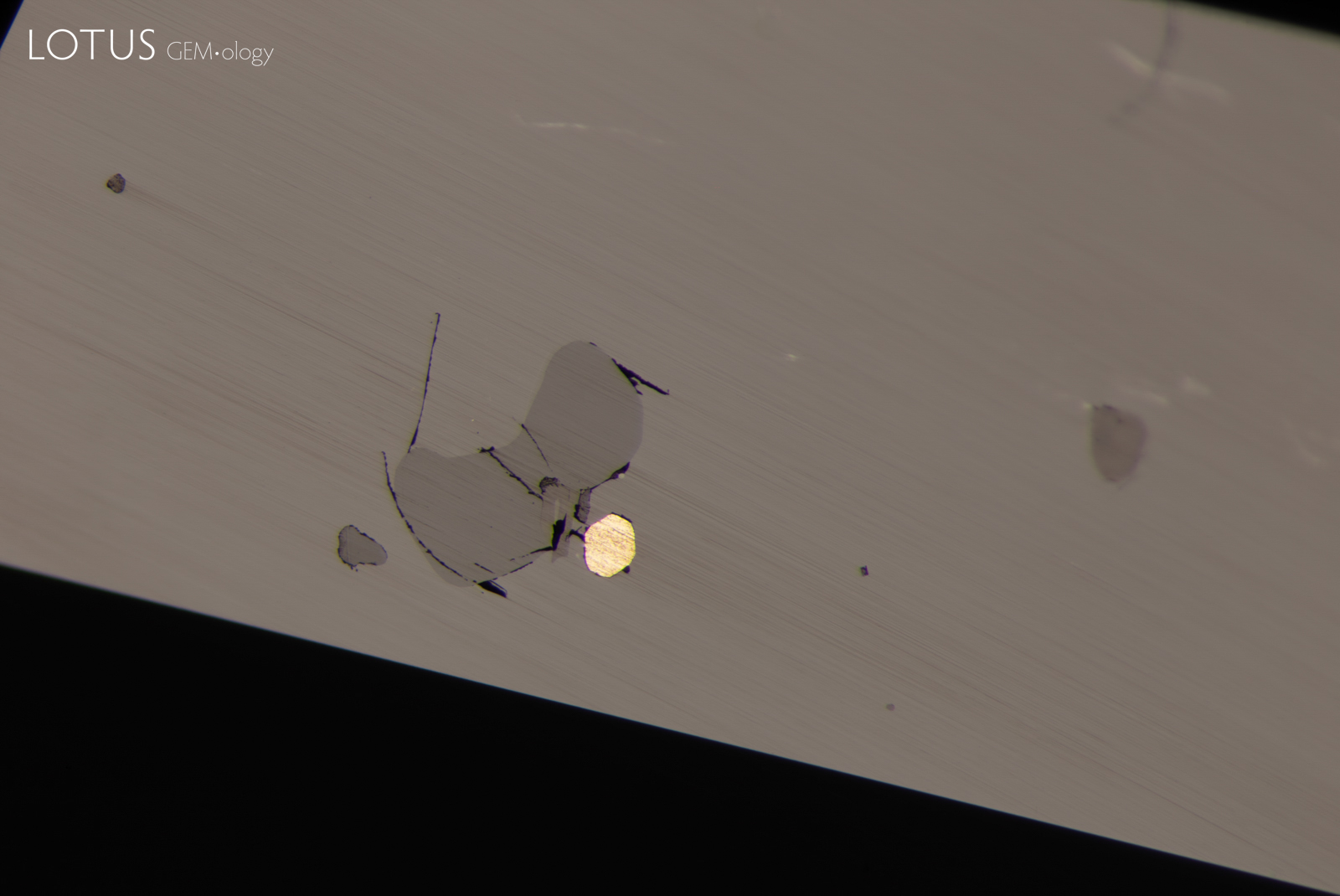 Figure 2. The same inclusions as Figure 1, now shown in reflected light. Note the different lusters, which subtly reveal the refractive indices of the trapped crystals. From left to right: Phlogopite (n=1.56), diopside (n=1.69), pyrite (n=4.5) and edenite (n=1.64). Photo: Natcha Rattana-anan/Lotus Gemology. Field of view: 3.6 mm.
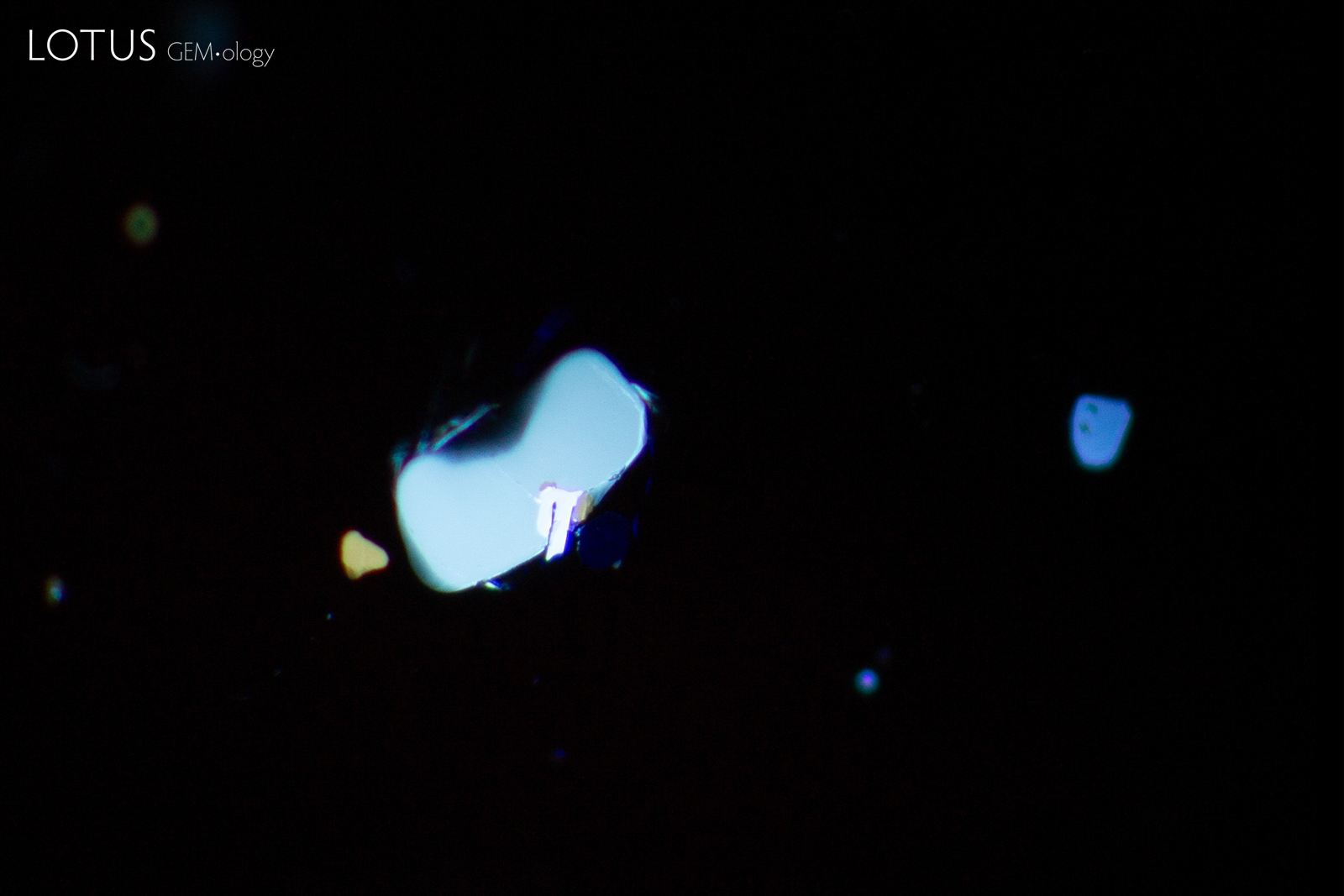 Figure 3. Under short-wave ultraviolet, some of the crystals fluoresced. From left to right: phlogopite (yellow), diopside (pale blue), and edenite (blue). Photo: Natcha Rattana-anan/Lotus Gemology. Field of view: 3.6 mm.

About the Authors
Natcha ('Ing') Rattana-anan has been interested in gems since childhood, which inspired her to study gemology at Chiang Mai University, where she did an award-winning thesis on heat treatment of amethyst. After graduating in 2024, she joined Lotus's gemological team.
E. Billie Hughes is Co-Founder and Managing Director of Lotus Gemology, where she oversees the company's day-to-day operations while continuing gemological research and laboratory work. After graduating from UCLA, she became a Fellow of the Gemmological Association of Great Britain (FGA). Her research focuses on ruby and sapphire, including low-temperature heat treatment, and she has authored and co-authored articles in leading gemological journals. She has conducted fieldwork at gem deposits around the world, including nearly every major ruby and sapphire locality.
Billie is an internationally recognized educator who has lectured for trade organizations, museums, and luxury jewelry houses, including extensive educational work with Van Cleef & Arpels. She has also served as a judge on Thailand's The Secret Gems television series. An award-winning photographer and photomicrographer, her images have received honors in the Nikon Small World and Gem-A competitions and have appeared in publications including National Geographic and Forbes. She is also the creator of Hyperion, Lotus Gemology's online inclusion database.
Billie developed an interest in gemstones from an early age, accompanying her parents on expeditions to mines and gem-producing regions around the world. That lifelong passion for fieldwork, laboratory research, education, and photography continues to shape her work at Lotus Gemology today.
Notes
First published in Gems & Gemology, 2026, Vol. 62, No. 2, Summer, p. 212.