

Hardy, J. (2017) Ruby. Thames & Hudson, New York, 368 pp. ISBN 9780500519417
Ruby begins with a section on spinel, which has been confused with ruby in the past. This is a nice touch, because any historical account of ruby would be incomplete without the mention of spinel. Author Joanna Hardy goes on to describe ruby and its properties. However, it must be emphasized that, by the author’s own admission, this book is not meant to be a gemological text. In fact, the gemological information is brief and in places contains minor errors. For example, the fluorescence in rubies is attributed to different levels of chromium without a clear explanation of how iron content has a strong influence on a ruby’s fluorescence and overall appearance.
Hardy’s strength is in talking about rubies’ historical impact and in explaining the significance of prominent pieces of jewelry, and much of the book is devoted to this. The sections cover a wide range, from older royal collections to modern pieces worn by 20th century celebrities such as Grace Kelly and Marlene Dietrich. They provide a wonderful overview of how rubies became a symbol of power and influence. There are numerous illustrations both of the jewels, such as the legendary Nga Mauk ruby, and the people who owned these storied pieces.
Following this topic, the book covers some of the techniques used by jewelry designers from the classic houses of Cartier and Van Cleef & Arpels to more contemporary designers like Wallace Chan. Again the author plays to her strengths, sharing insights from her experience as a jewelry expert.
In the final sections Ms. Hardy provides a charming travelogue of her own visits to the world’s most important ruby mines, which she took in preparation for writing this book. I particularly enjoyed following the journey of a ruby crystal sourced from artisanal miners in Mogok, Myanmar (formerly Burma) from rough into a piece of finished jewelry.
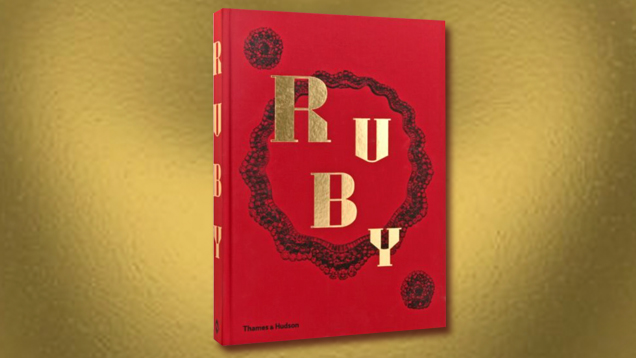 With its deep crimson color and bold gold lettering, Ruby stands out on a bookshelf, much as a piece of fine jewelry catches attention in a room. This eye for design continues inside the beautifully laid-out volume, with plenty of examples of important ruby jewelry and the powerful people who have worn them throughout history.
Readers should not expect a gemology textbook when purchasing this volume. Instead, it reads like a gorgeously illustrated art history guide. Although Ruby can be read cover-to-cover, it is presented in sections that can stand alone, making it an ideal coffee table book to pick up and read at leisure. I found myself skipping forward to sections that I was most curious about, which works well with the format.
This luxurious tome will broaden your gemological background, explaining the historical and cultural impact of ruby and how it has earned its title as the king of gems. It would make a wonderful gift for anyone with an interest in ruby, and an especially nice accompaniment to a piece of ruby jewelry.

About the author
E. Billie Hughes is Co-Founder and Managing Director of Lotus Gemology, where she oversees the company's day-to-day operations while continuing gemological research and laboratory work. After graduating from UCLA, she became a Fellow of the Gemmological Association of Great Britain (FGA). Her research focuses on ruby and sapphire, including low-temperature heat treatment, and she has authored and co-authored articles in leading gemological journals. She has conducted fieldwork at gem deposits around the world, including nearly every major ruby and sapphire locality.
Billie is an internationally recognized educator who has lectured for trade organizations, museums, and luxury jewelry houses, including extensive educational work with Van Cleef & Arpels. She has also served as a judge on Thailand's The Secret Gems television series. An award-winning photographer and photomicrographer, her images have received honors in the Nikon Small World and Gem-A competitions and have appeared in publications including National Geographic and Forbes. She is also the creator of Hyperion, Lotus Gemology's online inclusion database.
Billie developed an interest in gemstones from an early age, accompanying her parents on expeditions to mines and gem-producing regions around the world. That lifelong passion for fieldwork, laboratory research, education, and photography continues to shape her work at Lotus Gemology today.
Notes
This review first appeared in Gems & Gemology, Fall 2017, Vol. 53, No. 4.