Colombian Emerald Inclusions
Explore Colombian emerald inclusions in Hyperion, the Lotus Gemology inclusion database. Hyperion contains photomicrographs of inclusions and internal features in natural emeralds from Colombia, documented with information on treatment, lighting conditions, field of view, photographer and published references.
Colombian emeralds crystallize from a saline-based brine, remnants of which can be found as three-phase inclusions featuring jagged-edged liquid-filled pockets containing blocky crystals of halite (sodium chloride—rock salt).
Natural • Beryl • Emerald •
Colombia •
Enhancements:
Fissure Filling with colorless Oil/resin (FF-O2) •
Lighting Conditions:
Dark Field + Diffuse Fiber Optic
Photographer:
E. Billie Hughes •
Image Number:
A-003-5979-1
• Field of View = 2mm
Chalky fluorescence, visible in longwave ultraviolet illumination, unmasks filler in the fissures of this emerald.
Natural • Beryl • Beryl • Emerald •
Colombia •
Enhancements:
Fissure Filling with colorless Oil/resin (FF-O2) •
Lighting Conditions:
Ultraviolet: Longwave
Photographer:
E. Billie Hughes •
Image Number:
A-003-5923-1
Chalky fluorescence, visible in longwave ultraviolet illumination, unmasks filler in the fissures of this emerald.
Natural • Beryl • Beryl • Emerald •
Colombia •
Enhancements:
Fissure Filling with colorless Oil/resin (FF-O2) •
Lighting Conditions:
Ultraviolet: Longwave
Photographer:
E. Billie Hughes •
Image Number:
A-003-5922-1
When viewed in crossed polars, this calcite crystal (identified with micro Raman) displays interference colors and polysynthetic twin planes. This calcite is ensconced in an emerald from Colombia.
Natural • Beryl • Emerald •
Colombia •
Enhancements:
Fissure Filling with colorless Oil/resin (FF-O2) •
Lighting Conditions:
Diffuse Light Field + Crossed Polars + Diffuse Fiber Optic
Photographer:
E. Billie Hughes •
Image Number:
A-004-0028-2
• Field of View = 4.5mm
This crystal, suspended in a Colombian emerald, has sharp angular features. Micro Raman identified it as calcite. Note that twin planes are visible in crossed polars.
Natural • Beryl • Emerald •
Colombia •
Enhancements:
Fissure Filling with colorless Oil/resin (FF-O2) •
Lighting Conditions:
Dark Field + Green & White Filters + Diffuse Fiber Optic + Crossed Polars
Photographer:
E. Billie Hughes •
Image Number:
A-004-0028-1
• Field of View = 3mm
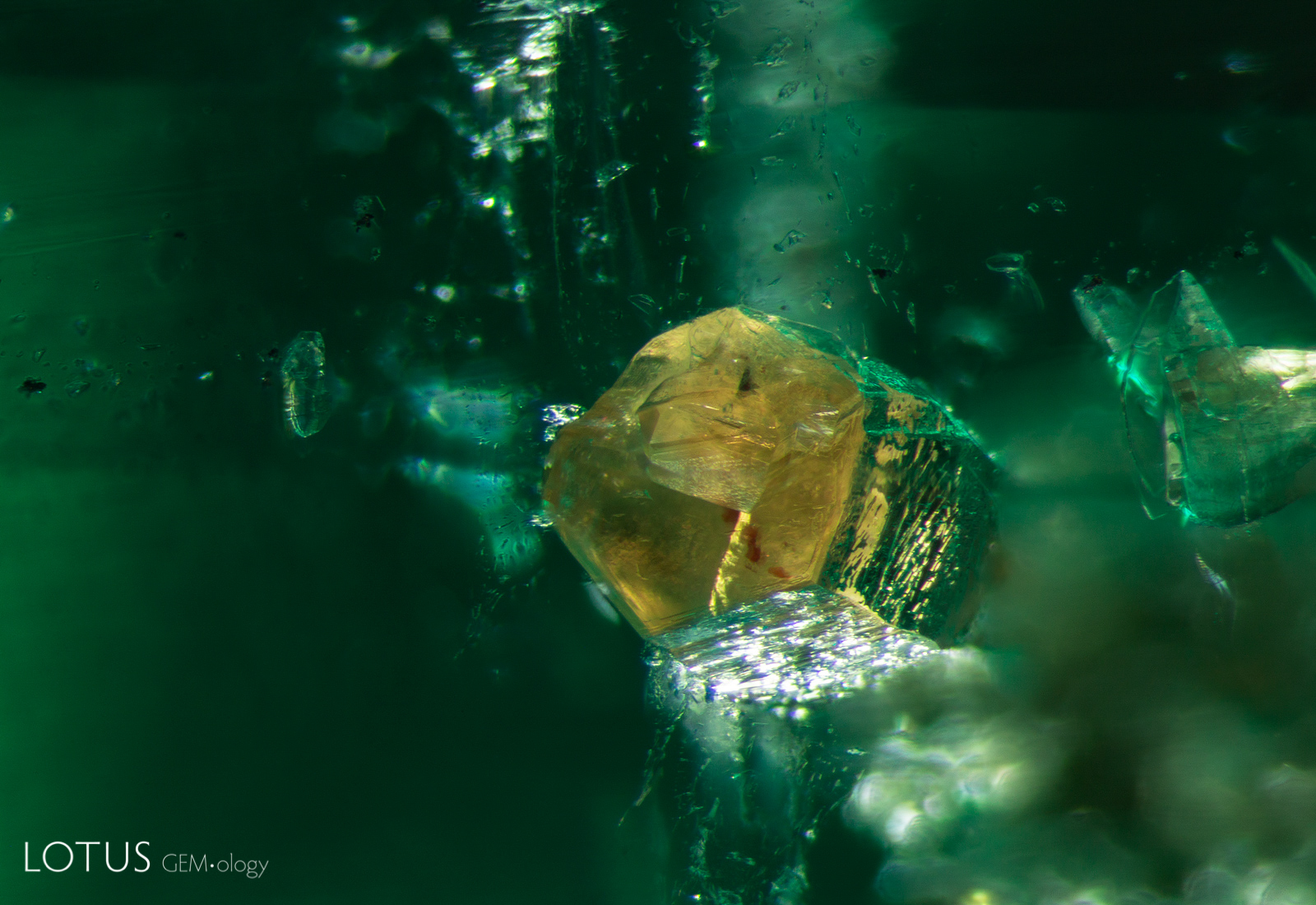
This angular yellow stood out immediately when we examined this ermerald. Analysis with micro Raman revealed that it is parisite.
Natural • Beryl • Emerald •
Colombia •
Enhancements:
None Detected (None) •
Lighting Conditions:
Fiber Optic: Diffuse Oblique
Photographer:
E. Billie Hughes •
Image Number:
A-003-8646-1
• Field of View = 3mm
Upon close examination of this emerald, we can see tiny bubbles in areas that contain filler.
Natural • Beryl • Beryl • Emerald •
Colombia •
Enhancements:
Fissure Filling with colorless Oil/resin (FF-O2) •
Lighting Conditions:
Dark Field
Photographer:
E. Billie Hughes •
Image Number:
A-003-7644-2
• Field of View = 4mm
This emerald contained filler to help improve the appearance of fissures in the stone. It can be hard to see this with just dark field illumination, but by shining a longwave UV torch on the stone, the filled areas become immediately apparent with a chalky appearance. We can also see many small bubbles in the area with filler.
Natural • Beryl • Beryl • Emerald •
Colombia •
Enhancements:
Fissure Filling with colorless Oil/resin (FF-O2) •
Lighting Conditions:
Ultraviolet: Longwave
Photographer:
E. Billie Hughes •
Image Number:
A-003-7644-1
• Field of View = 4mm
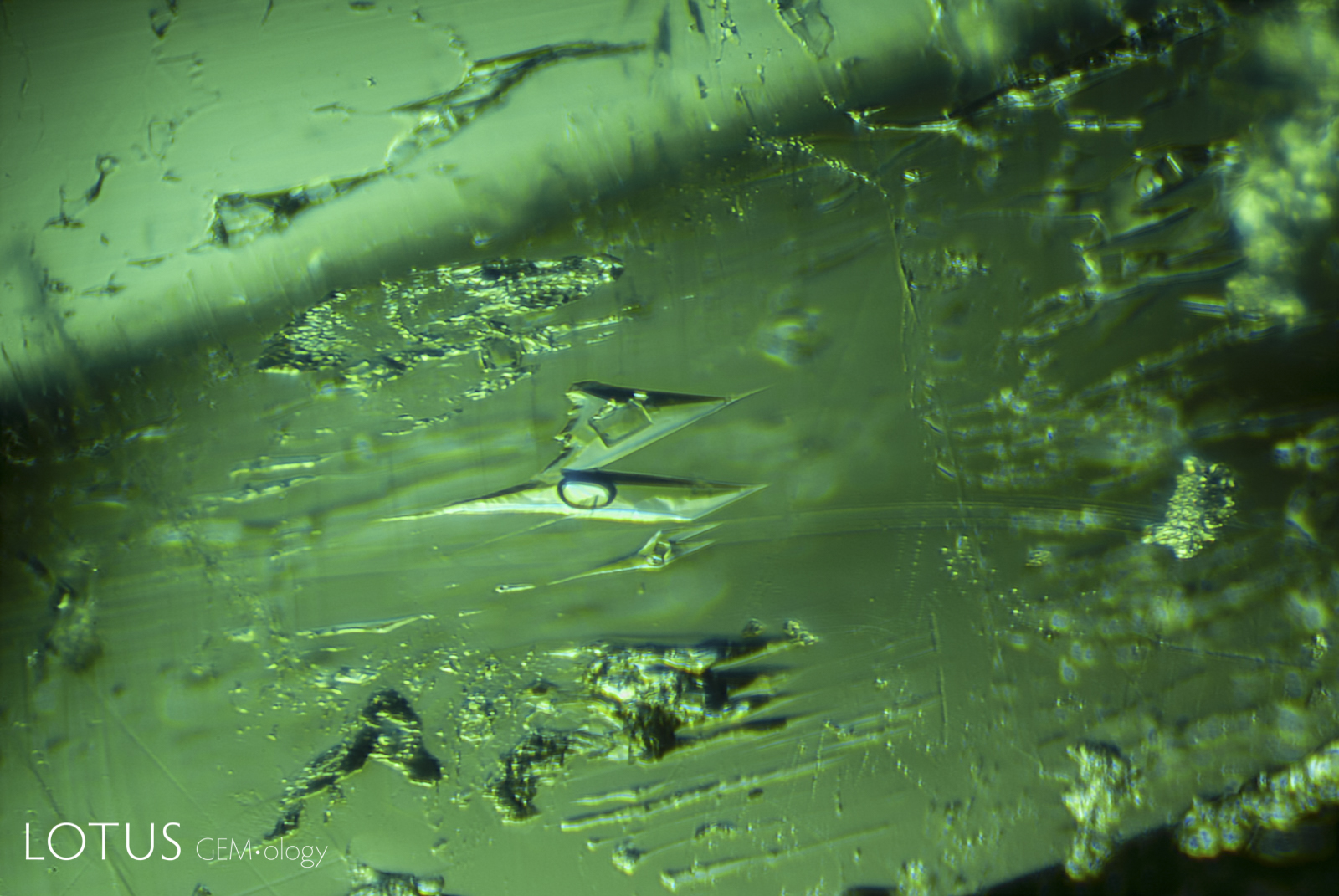
The three-phase inclusion featuring a jagged-edged cavity enclosing a saline solution with a gas bubble and halite (rock salt) crystal is the hallmark of the Colombian emerald. While three-phase inclusions have been found in emeralds from other countries, they are extremely common in Colombian stones.
Natural • Beryl • Emerald •
Colombia •
Enhancements:
None Detected (None) •
Lighting Conditions:
Light Field + Shadowing
Photographer:
Richard W. Hughes •
Image Number:
R-003-6201-2
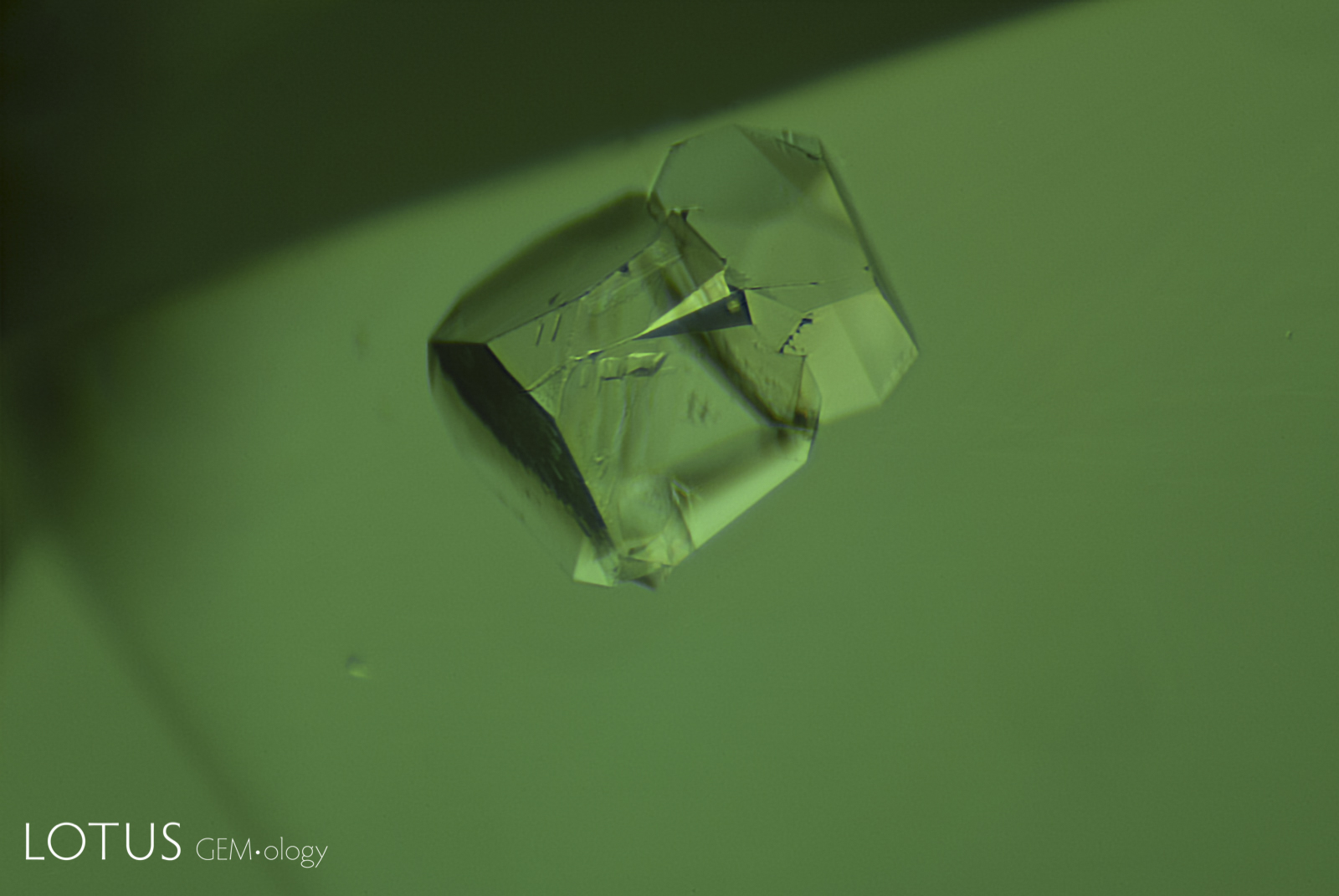
Twinned pyrite crystal in an emerald from Colombia. The formation of pyrite before emerald sucked iron from the hydrothermal fluid, allowing Colombian emeralds to crystallize in an iron-poor environment. This is one factor that contributed to the fine green color of the Colombian stone, when compared with emeralds from other sources.
Natural • Beryl • Emerald •
Colombia •
Enhancements:
None Detected (None) •
Lighting Conditions:
Fiber Optic: Oblique
Photographer:
Richard W. Hughes •
Image Number:
R-003-6201-1
In this resin-filled emerald, an yellow-orange flash can be seen in the filled fracture. This treatment helps to minimize the appearance of fissures.
Natural • Beryl • Emerald •
Colombia •
Enhancements:
Fissure Filling with colorless Oil/resin (FF-O1) •
Lighting Conditions:
Dark Field
Photographer:
E. Billie Hughes •
Image Number:
A-003-3855-1
Colombian emerald inclusions may include mineral crystals, fluid inclusions, multiphase inclusions, healed fissures, growth features and other internal features formed during or after crystal growth. Such features are important to gemologists because they can provide evidence useful in identifying emerald and evaluating a possible Colombian origin.
Colombian Emerald Inclusion Photomicrographs
The Hyperion Colombian emerald gallery includes microscopic features documented in emeralds from Colombia. Each entry is accompanied by descriptive information and, where available, references to the gemological literature.
What Inclusions Can Reveal About Colombian Emerald
Inclusions are an important part of geographic origin determination in emerald. Their form, composition and associations can provide evidence that, when considered together with other gemological properties, may support or contradict a Colombian origin.
Hyperion combines inclusion photomicrography with supporting gemological information so that individual features can be compared with documented examples from Colombian emeralds.
About Hyperion
Hyperion is the Lotus Gemology searchable inclusion database. It allows users to browse gemstone inclusions by gem type, geographic origin, treatment and keyword.