Colombian Emerald Inclusions
Explore Colombian emerald inclusions in Hyperion, the Lotus Gemology inclusion database. Hyperion contains photomicrographs of inclusions and internal features in natural emeralds from Colombia, documented with information on treatment, lighting conditions, field of view, photographer and published references.
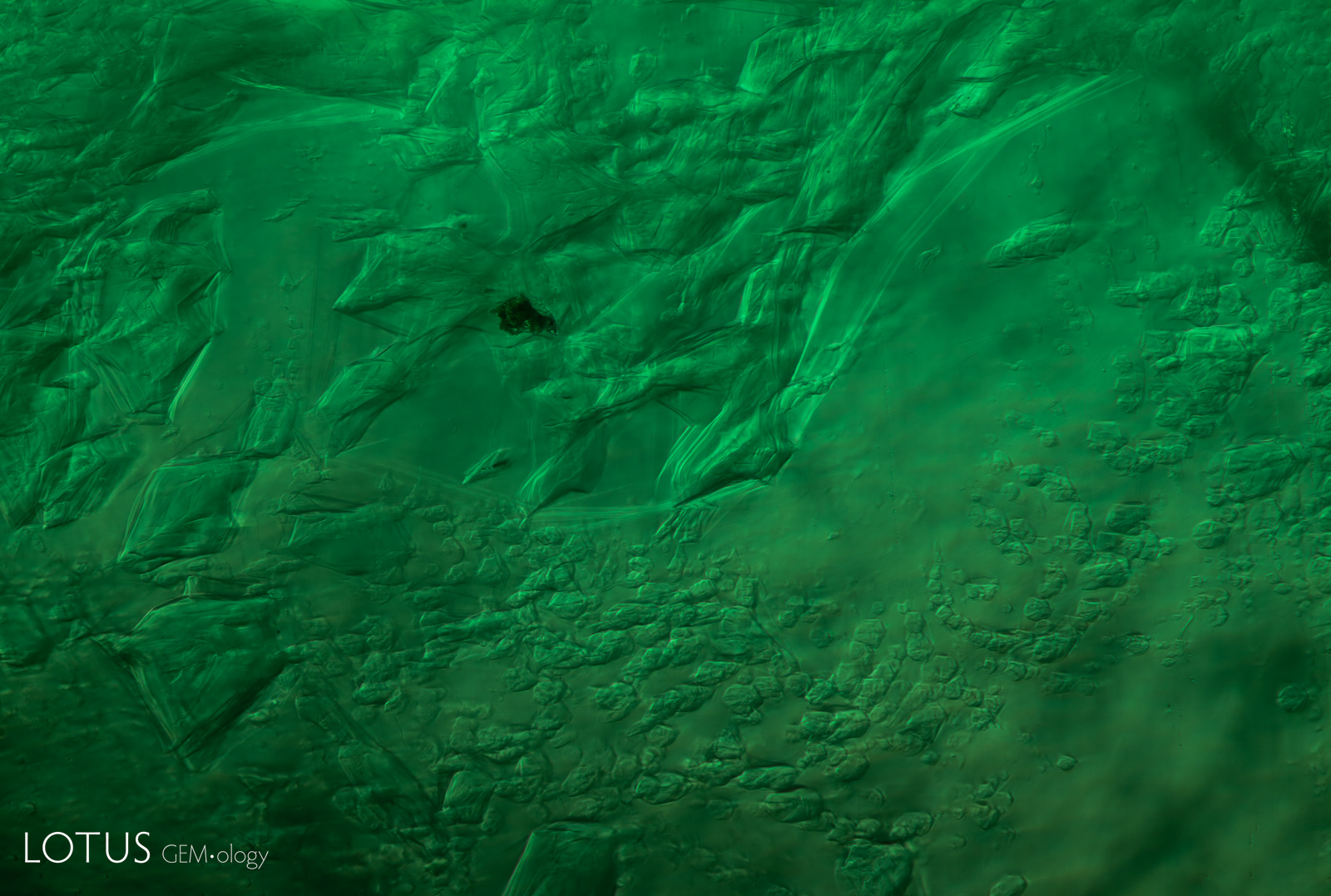
The “gota de aceite” (Spanish for “drop of oil”) effect in this Colombian emerald creates an appearance similar to a topographic map. Sample courtesy Nasser S. Altayyar.
Natural • Beryl • Beryl • Emerald •
Colombia •
Enhancements:
Fissure Filling with colorless Oil/resin (FF-O3) •
Lighting Conditions:
Dark Field
Photographer:
E. Billie Hughes •
Image Number:
R-005-9114-1
• Field of View = 3.6mm
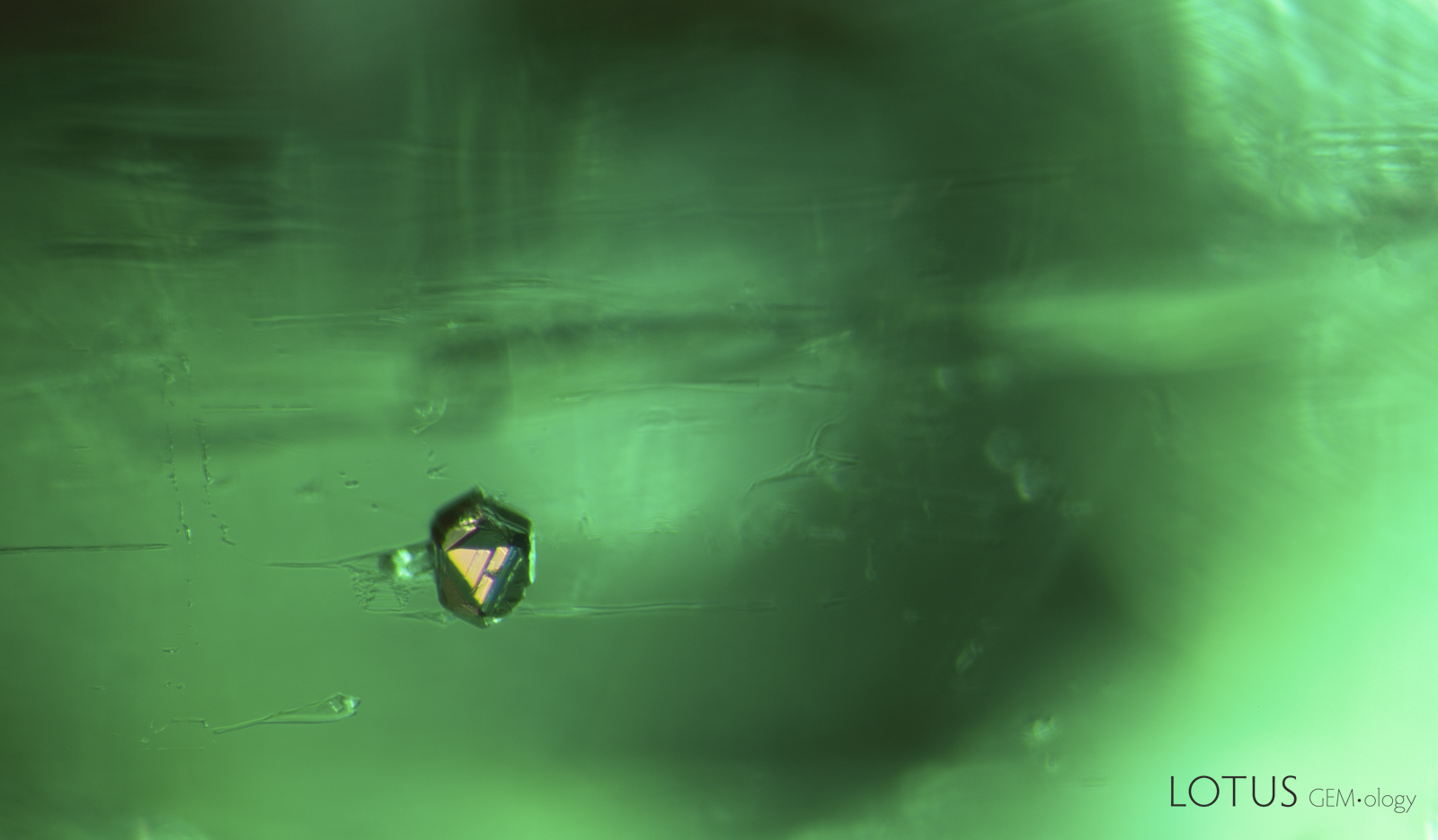
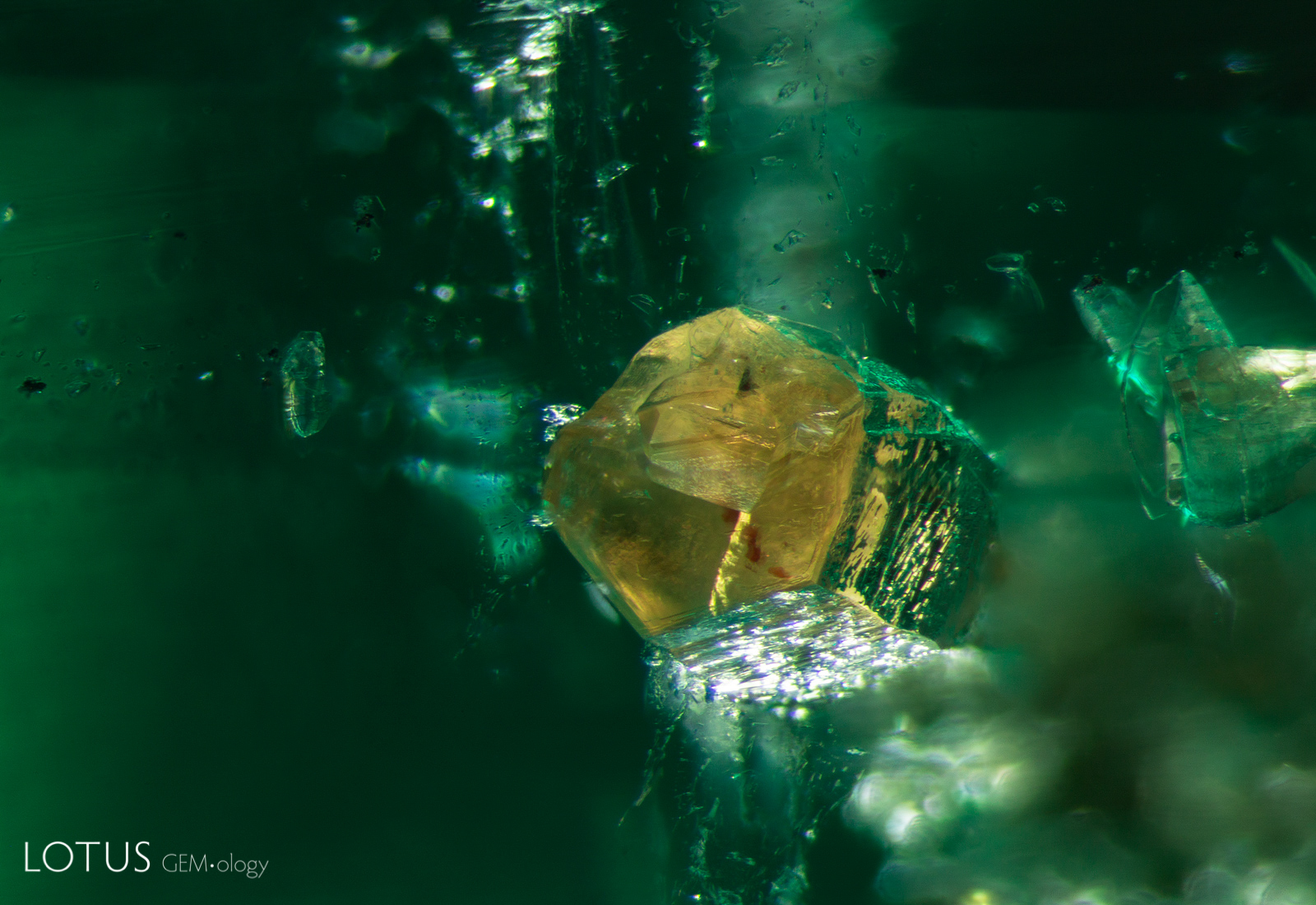
Pyrite (an iron sulfide) is a common mineral inclusion found in emeralds from Colombia and some other sources. The defined crystal faces of this crystal indicate a syngenetic origin. However, pyrite is known to form slightly earlier than emerald in most conditions. Its formation reduces the iron content that is available in the emerald-mineralizing fluid; hence the low iron content of most Colombian emeralds.
Natural • Beryl • Beryl • Emerald •
Colombia •
Enhancements:
Fissure Filling with colorless Oil/resin (FF-O2–3) •
Lighting Conditions:
Dark Field
Photographer:
Kaylan Khourie •
Image Number:
A-005-6992-2
• Field of View = 2.2mm
• Magnification = 8x
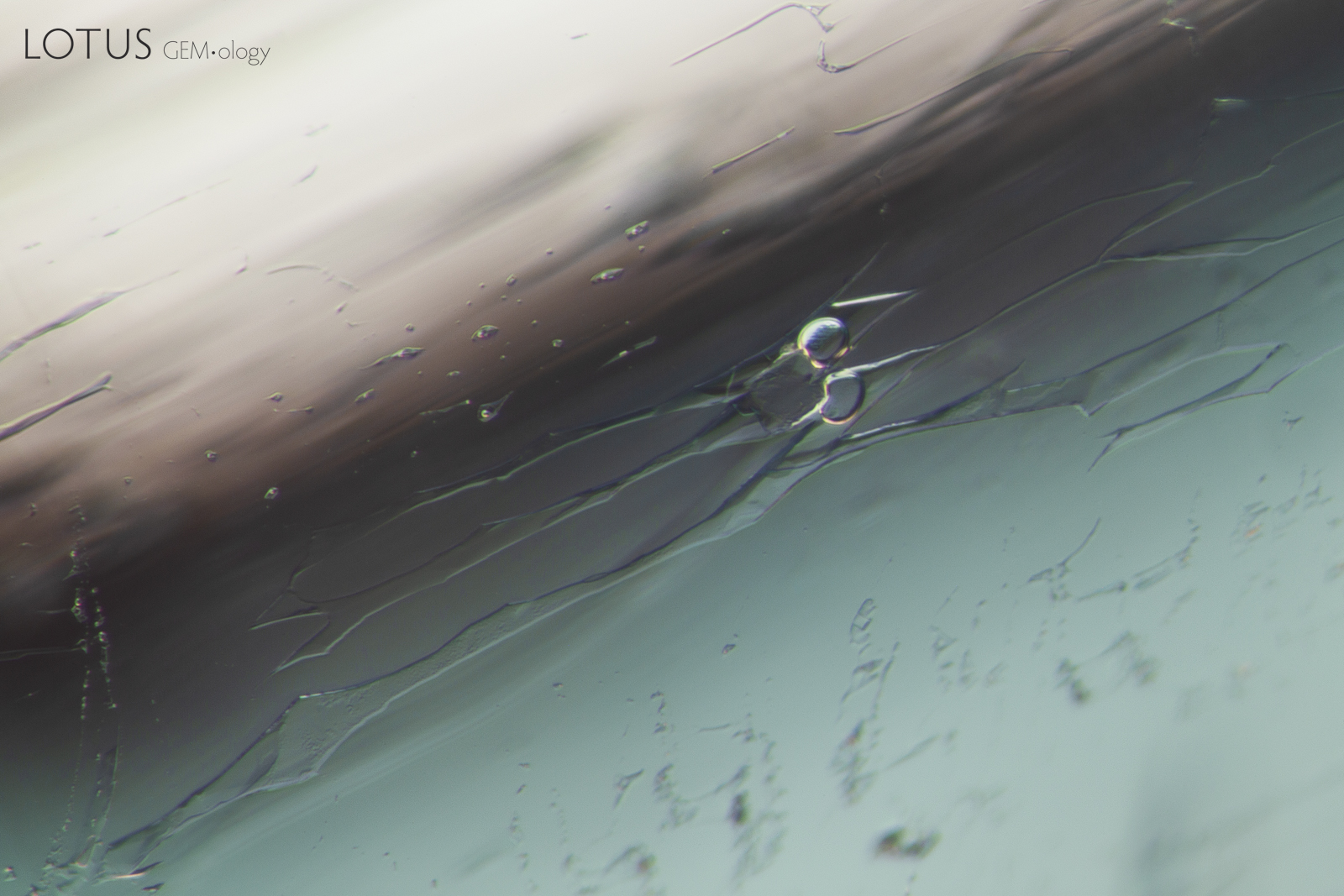
Although previously thought to be exclusive to Colombian emeralds, three-phase fluid inclusions can be found in emeralds from many different deposits. In this example, two fluid inclusions appear to be sharing one solid phase (probably halite).
Natural • Beryl • Beryl • Emerald •
Colombia •
Enhancements:
Fissure Filling with colorless Oil/resin (FF-O2–3) •
Lighting Conditions:
Diffuse Dark Field
Photographer:
Kaylan Khourie •
Image Number:
A-005-6992-1
• Field of View = 1.6mm
• Magnification = 11x
Trapiche emeralds display a striking hexagonal pattern, a reflection of the crystal’s underlying symmetry.
Natural • Beryl • Trapiche • Beryl • Emerald •
Colombia •
Enhancements:
Fissure Filling with colorless Oil/resin (FF-O2) •
Lighting Conditions:
Light Field (Transmitted Light)
Photographer:
E. Billie Hughes •
Image Number:
A-005-6893-1
• Field of View = 5.2mm
3-phase inclusion in Colombian emerald.
Natural • Beryl • Beryl • Emerald •
Colombia •
Enhancements:
Fissure Filling with colorless Oil/resin (FF-O1) •
Lighting Conditions:
Dark Field
Photographer:
Wimon Manorotkul •
Image Number:
A-003-8198-1
• Field of View = 1.8mm
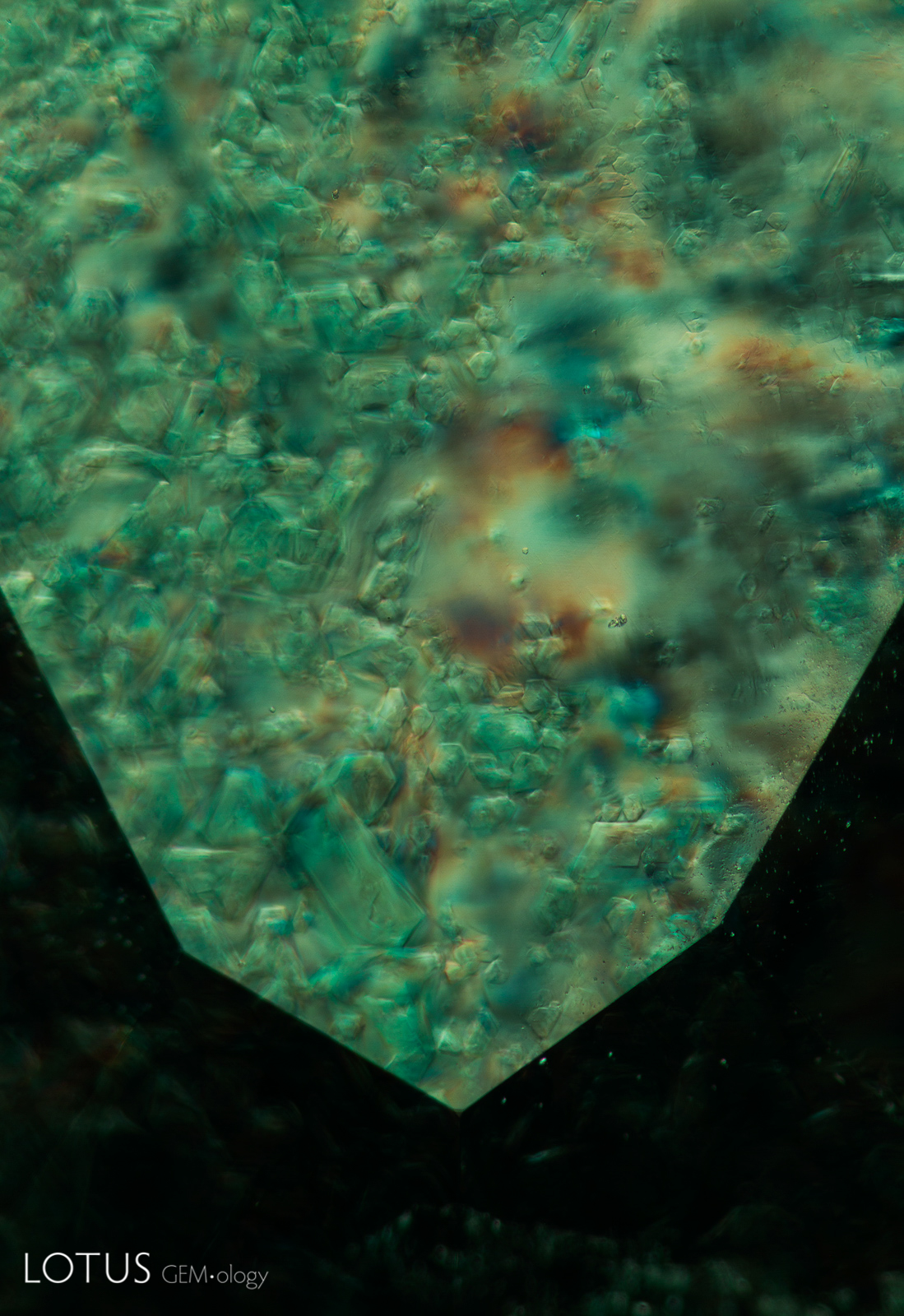
Irregularities in the crystal structure create the roiled “gota de aceite,” (Spanish for “drop of oil”) effect in this emerald. This effect is often associated with Colombian emeralds. Here crossed polars reveal strain patterns between the growth structures.
Natural • Beryl • Emerald •
Colombia •
Enhancements:
Fissure Filling with colorless Oil/resin (FF-O1) •
Lighting Conditions:
Light Field + Crossed Polars
Photographer:
E. Billie Hughes •
Image Number:
A-004-8605-2
• Field of View = 3.2mm
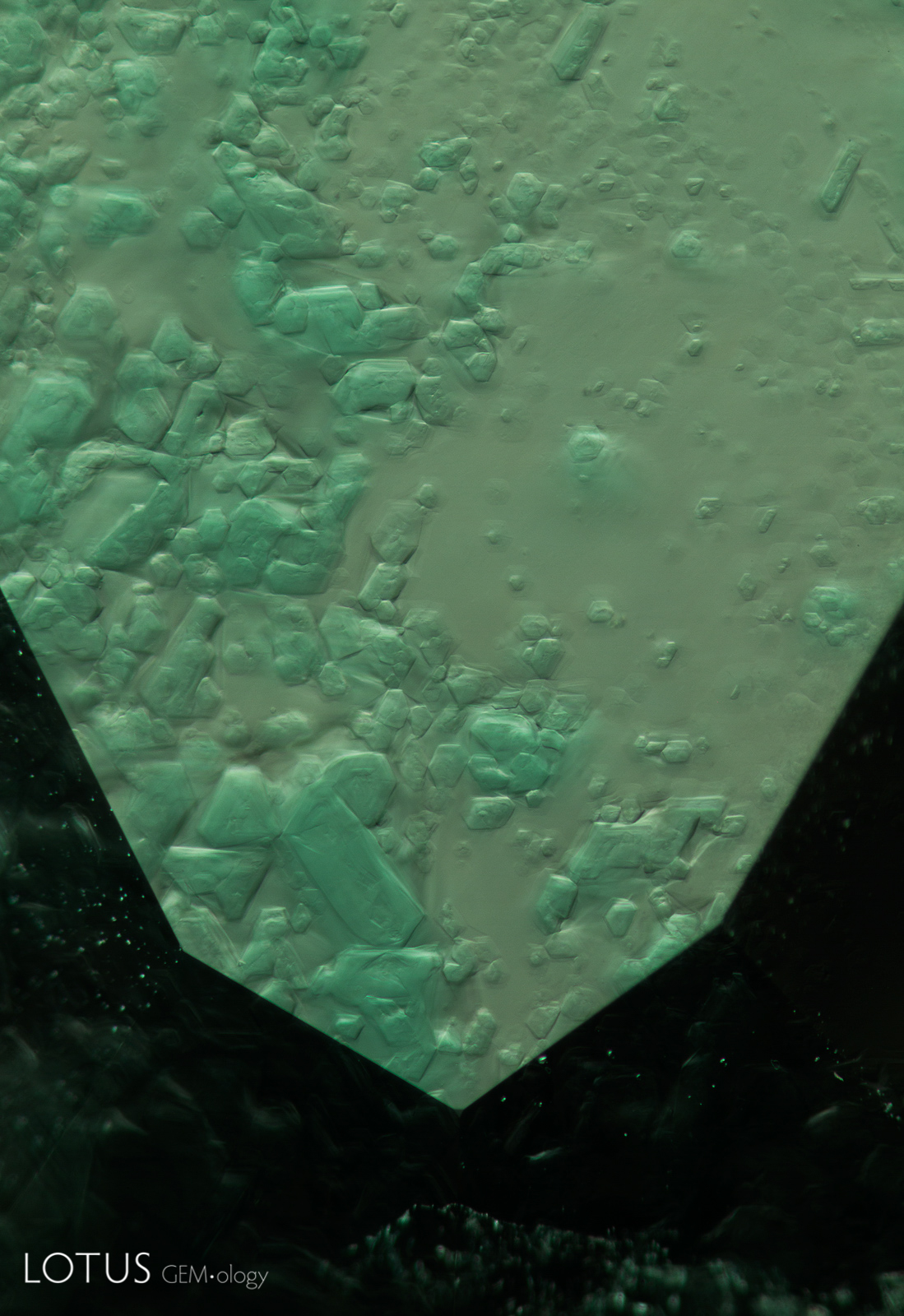
Irregularities in the crystal structure create the roiled “gota de aceite,” (Spanish for “drop of oil”) effect in this emerald. This effect is often associated with Colombian emeralds.
Natural • Beryl • Emerald •
Colombia •
Enhancements:
Fissure Filling with colorless Oil/resin (FF-O1) •
Lighting Conditions:
Diffuse Light Field (Transmitted Light)
Photographer:
E. Billie Hughes •
Image Number:
A-004-8605-1
• Field of View = 3.2mm
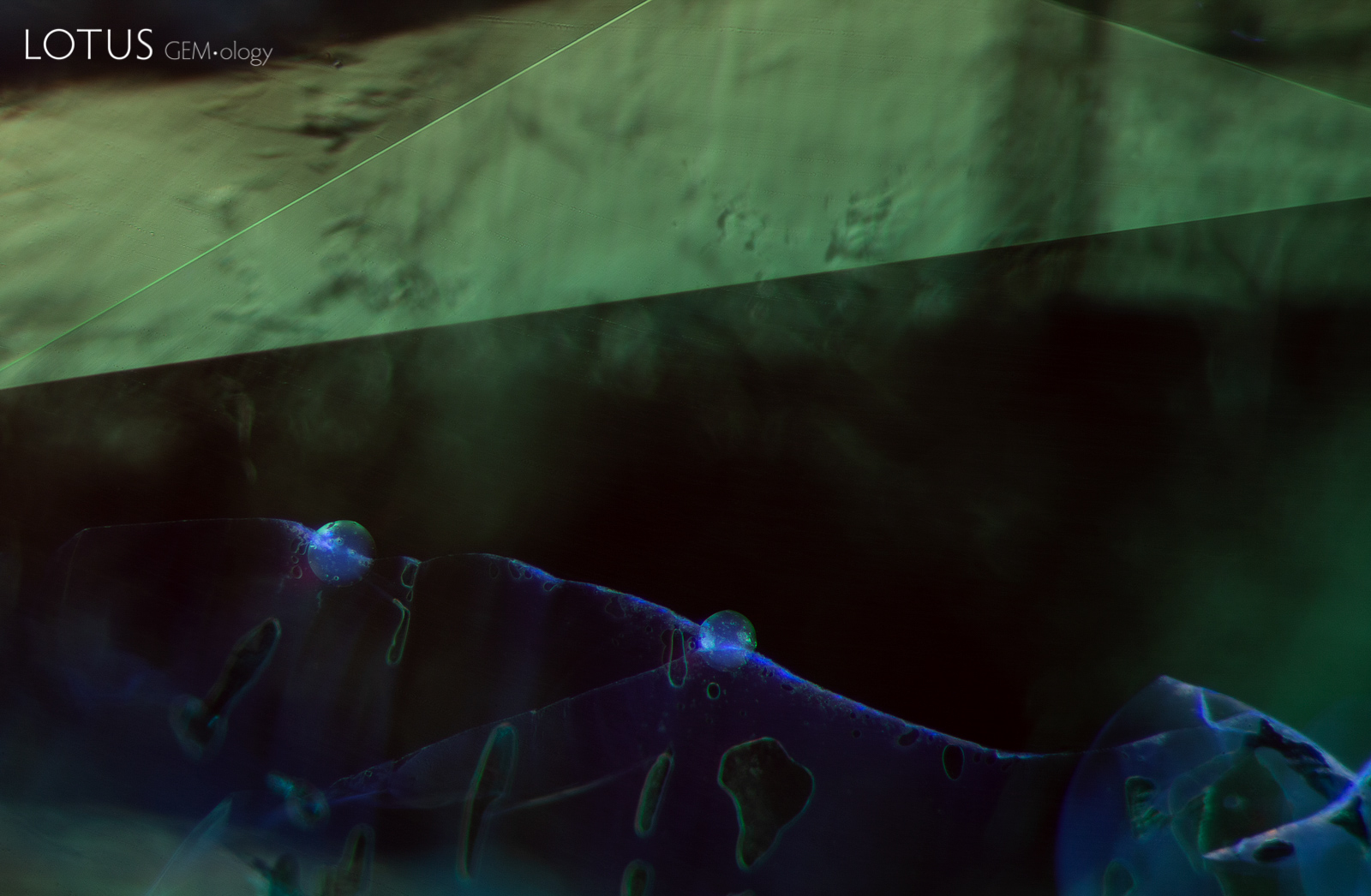
When this emerald was gently warmed with a hot point, droplets of resin began to leak out of the fissures. When illuminated with a long wave UV torch, the areas with resin display a chalky appearance, particularly where two large round droplets are concentrated.
Natural • Beryl • Beryl • Emerald •
Colombia •
Enhancements:
Fissure Filling with colorless Oil/resin (FF-O2) •
Lighting Conditions:
Dark Field + Ultraviolet: Long Wave
Photographer:
E. Billie Hughes •
Image Number:
A-004-7855-2
• Field of View = 3mm
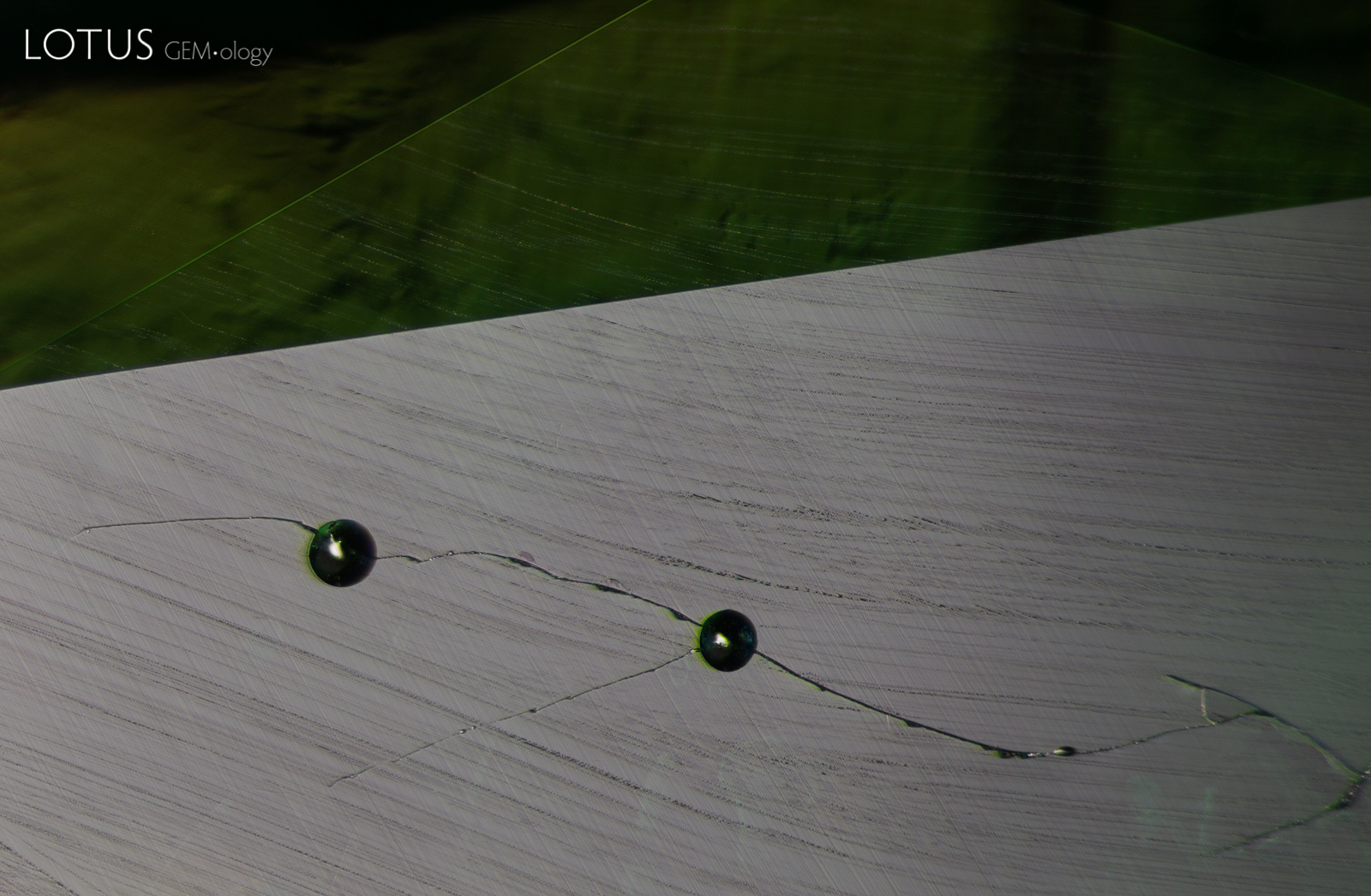
When this emerald was gently warmed with a hot point, droplets of resin began to leak out of the fissures. These droplets can be observed with reflected light.
Natural • Beryl • Beryl • Emerald •
Colombia •
Enhancements:
Fissure Filling with colorless Oil/resin (FF-O2) •
Lighting Conditions:
Fiber Optic: Diffuse Overhead + Dark Field
Photographer:
E. Billie Hughes •
Image Number:
A-004-7855-1
• Field of View = 3mm
Close up of a trapiche emerald. The hexagonal structure of the emerald can be clearly observed.
Natural • Beryl • Trapiche • Emerald •
Colombia •
Enhancements:
Fissure Filling with colorless Oil/resin (FF-O1–2) •
Lighting Conditions:
Dark Field
Photographer:
E. Billie Hughes •
Image Number:
A-004-7422-1
• Field of View = 6mm
When this emerald is illuminated with a longwave UV torch, chalky areas can be observed in the fissures. This is a sign that the fissures contain filler.
Natural • Beryl • Emerald •
Colombia •
Enhancements:
Fissure Filling with colorless Oil/resin (FF-O2) •
Lighting Conditions:
Ultraviolet: Longwave
Photographer:
E. Billie Hughes •
Image Number:
A-003-5979-3
Colombian emeralds crystallize from a saline-based brine, remnants of which can be found as three-phase inclusions featuring jagged-edged liquid-filled pockets containing blocky crystals of halite (sodium chloride—rock salt).
Natural • Beryl • Emerald •
Colombia •
Enhancements:
Fissure Filling with colorless Oil/resin (FF-O2) •
Lighting Conditions:
Fiber Optic: Transmitted
Photographer:
E. Billie Hughes •
Image Number:
A-003-5979-2
• Field of View = 2mm
Colombian emerald inclusions may include mineral crystals, fluid inclusions, multiphase inclusions, healed fissures, growth features and other internal features formed during or after crystal growth. Such features are important to gemologists because they can provide evidence useful in identifying emerald and evaluating a possible Colombian origin.
Colombian Emerald Inclusion Photomicrographs
The Hyperion Colombian emerald gallery includes microscopic features documented in emeralds from Colombia. Each entry is accompanied by descriptive information and, where available, references to the gemological literature.
What Inclusions Can Reveal About Colombian Emerald
Inclusions are an important part of geographic origin determination in emerald. Their form, composition and associations can provide evidence that, when considered together with other gemological properties, may support or contradict a Colombian origin.
Hyperion combines inclusion photomicrography with supporting gemological information so that individual features can be compared with documented examples from Colombian emeralds.
About Hyperion
Hyperion is the Lotus Gemology searchable inclusion database. It allows users to browse gemstone inclusions by gem type, geographic origin, treatment and keyword.