Mozambique Ruby Inclusions
Explore Mozambique ruby inclusions in Hyperion, the Lotus Gemology inclusion database. Hyperion contains photomicrographs of inclusions and internal features in natural rubies from Mozambique, documented with information on treatment, lighting conditions, field of view, photographer and published references.
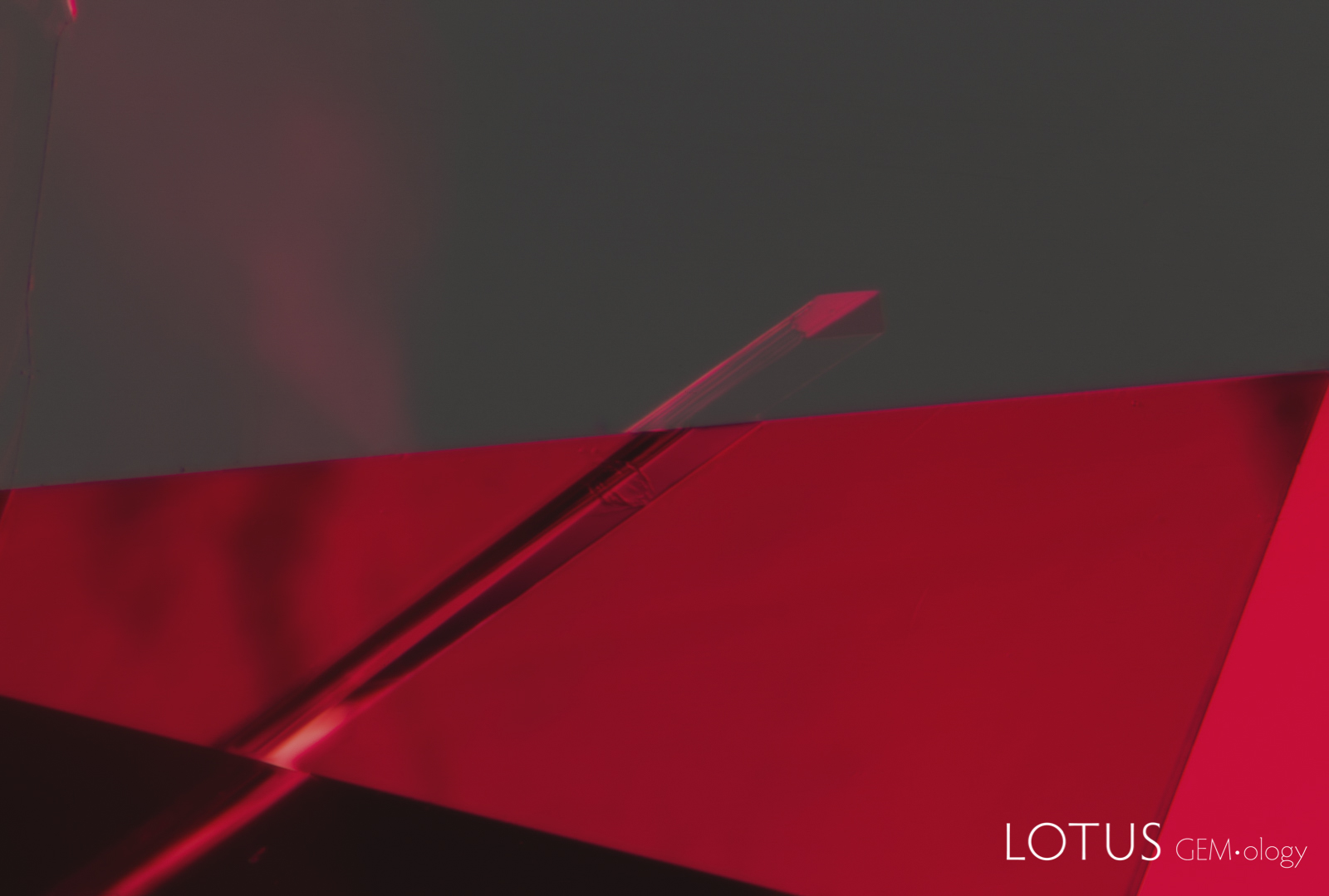
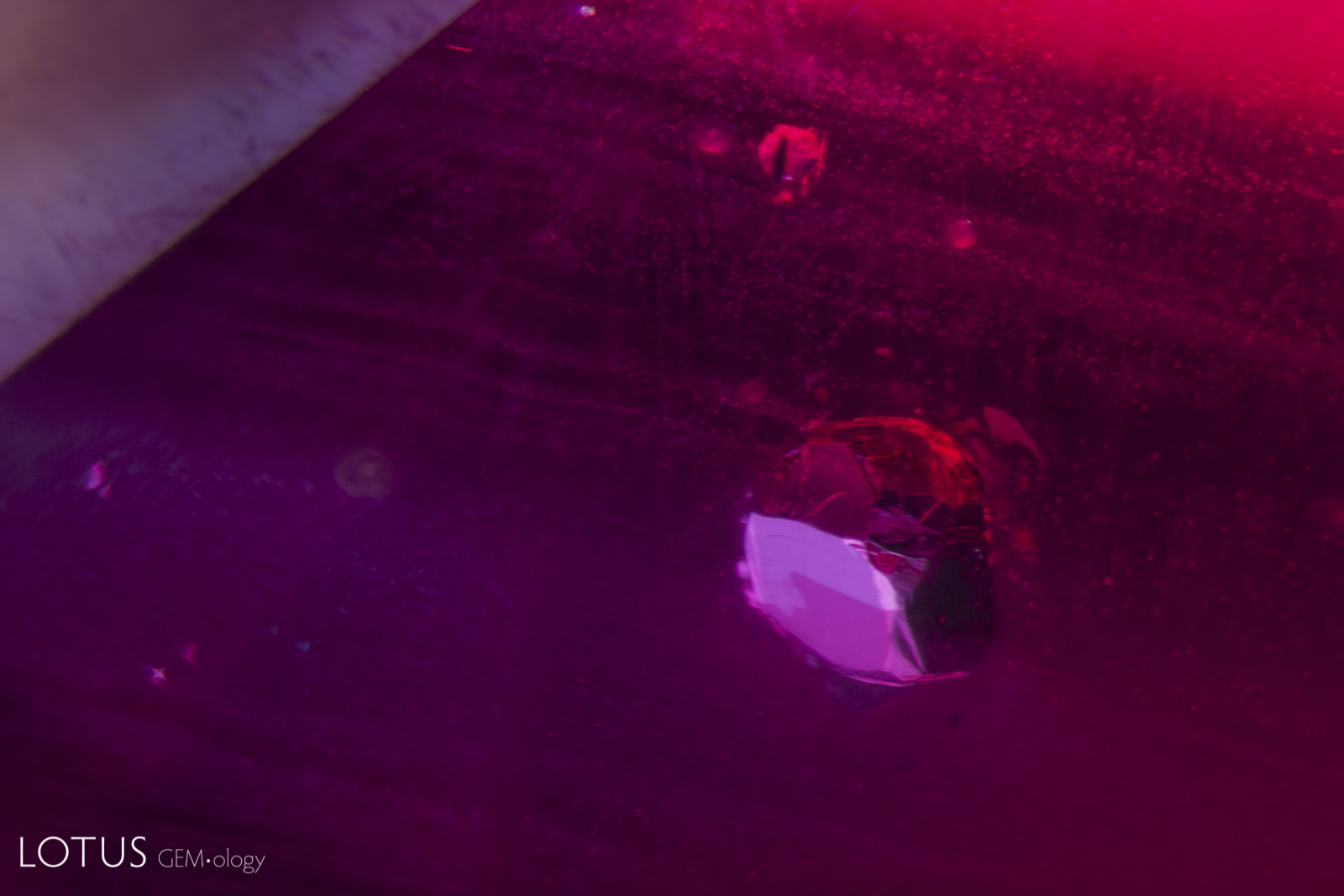
This ruby believed to originate from the Montepuez region of Mozambique contained long crystals of a transparent, birefringent material. One was cut through on the surface. Analysis via micro Raman revealed it to be pargasite, a common guest in Mozambique rubies which come from an amphibolite schist host rock.
Natural Ruby •
Mozambique •
Enhancements:
None Detected (None) •
Lighting Conditions:
Dark Field + Diffuse Overhead Fiber Optic
Photographer:
Richard W. Hughes •
Image Number:
A-003-6642-2
• Field of View = 2mm
Pardieu, V., Sangsawong, S. et al. (2013) Rubies from the Montepuez area (Mozambique). Gemological Institute of America, October 5, 84 pp.; RWHL*.
Hughes, R.W., Manorotkul, W. and Hughes, E.B. (2017) Ruby & Sapphire: A Gemologist's Guide. Bangkok, Lotus Publishing, 816 pp.; RWHL*.
This ruby believed to originate from the Montepuez region of Mozambique contained long crystals of a transparent, birefringent material. One was cut through on the surface. Analysis via micro Raman revealed it to be pargasite, a common guest in Mozambique rubies which come from an amphibolite schist host rock.
Natural Ruby •
Mozambique •
Enhancements:
None Detected (None) •
Lighting Conditions:
Dark Field + Diffuse Overhead Fiber Optic
Photographer:
Richard W. Hughes •
Image Number:
A-003-6642-1
• Field of View = 2mm
Pardieu, V., Sangsawong, S. et al. (2013) Rubies from the Montepuez area (Mozambique). Gemological Institute of America, October 5, 84 pp.; RWHL*.
Hughes, R.W., Manorotkul, W. and Hughes, E.B. (2017) Ruby & Sapphire: A Gemologist's Guide. Bangkok, Lotus Publishing, 816 pp.; RWHL*.
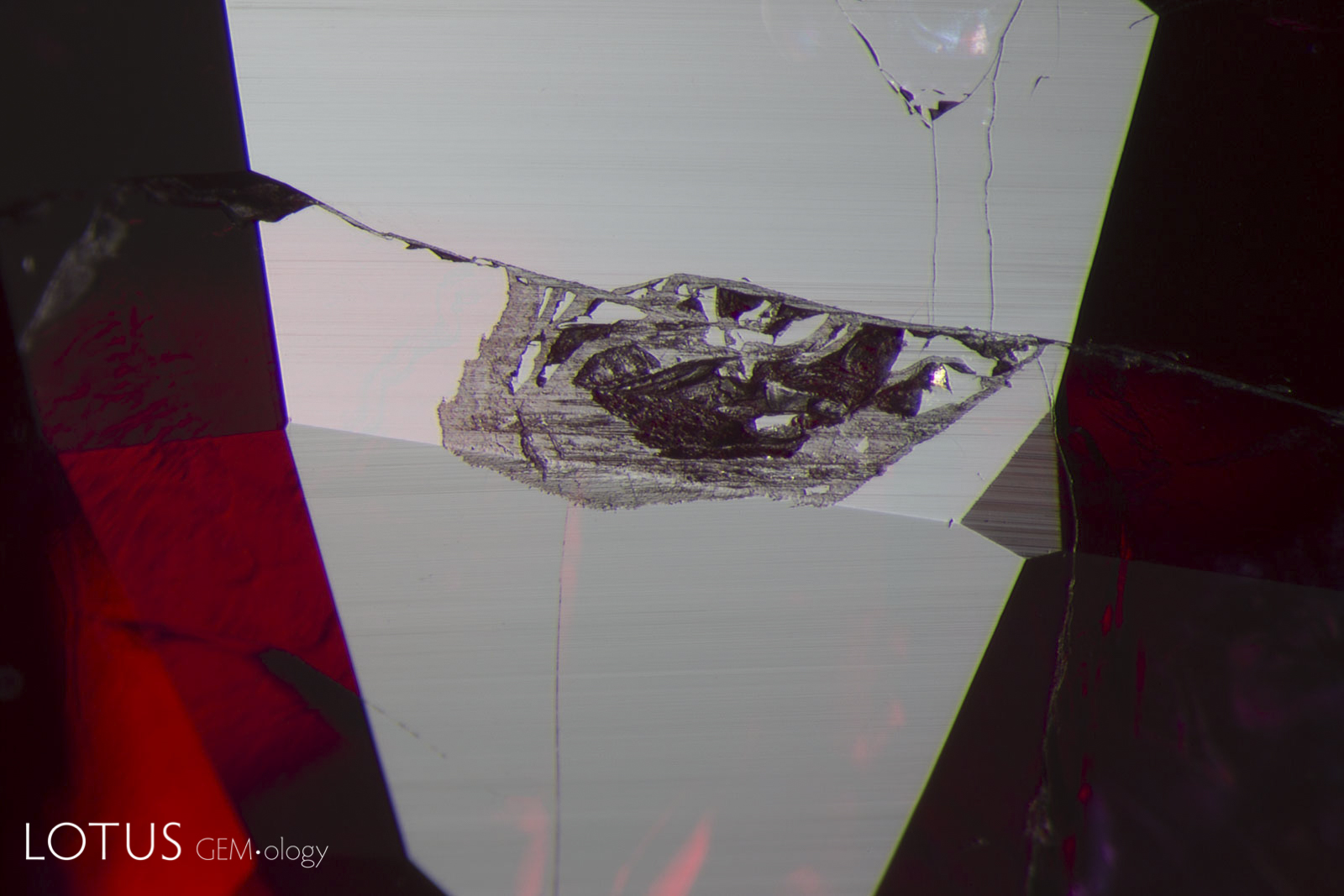
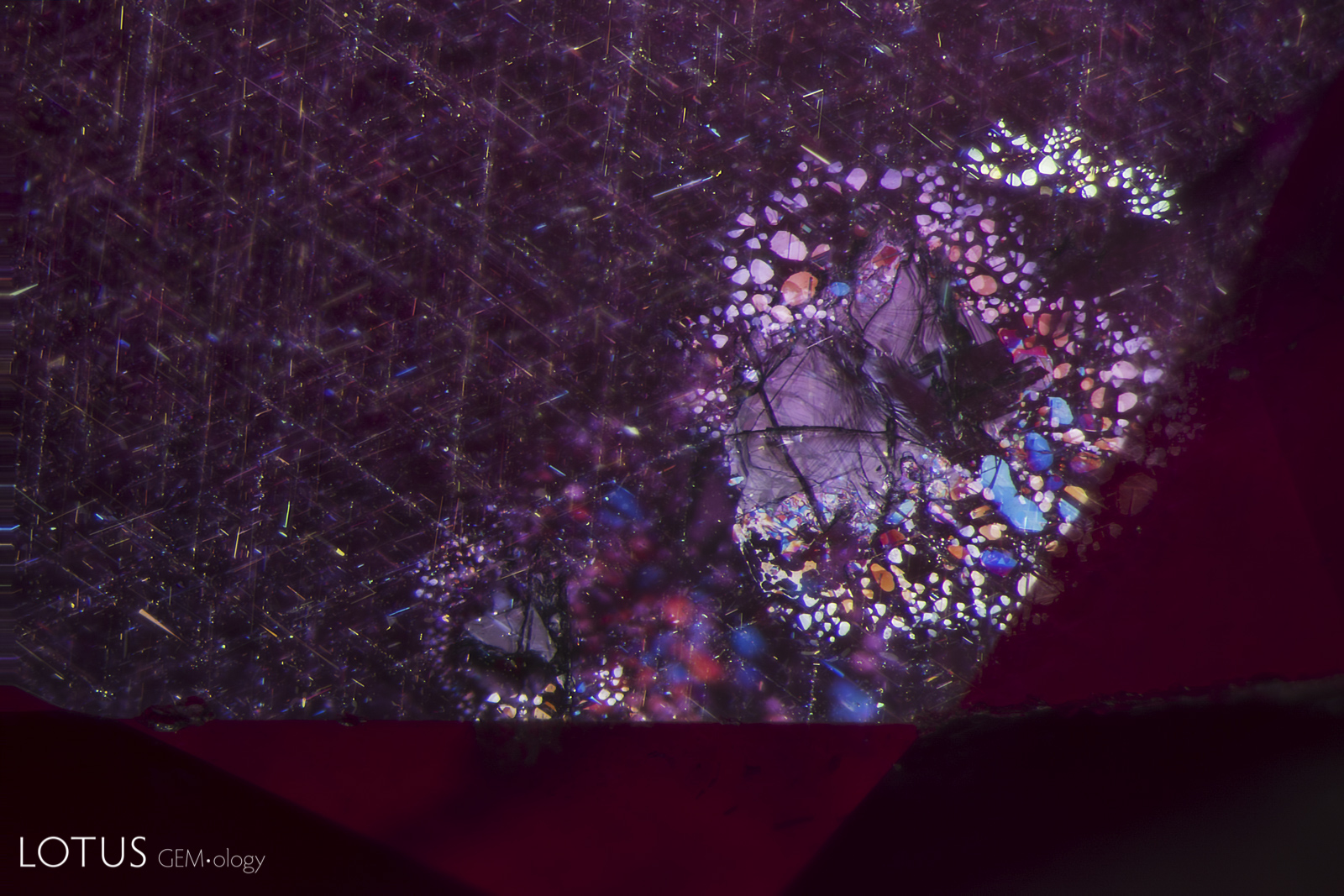
In this ruby believed to originate from Mozambique’s Montepuez area, a crystal was cut through on the surface. Closer examination revealed it to be composed of several solid phases. Micro Raman revealed the largest portion (left) to be zoisite, while the lower right area was margarite mica, with areas of clinochlorite and pargasite. To the best of our knowledge, this is the first reported occurrence of zoisite and clinochlorite in ruby from Mozambique.
Natural Ruby •
Mozambique •
Enhancements:
None Detected (None) •
Lighting Conditions:
Dark Field + Overhead Fiber Optic
Photographer:
Richard W. Hughes •
Image Number:
A-003-6483-2
• Field of View = 2mm
Pardieu, V., Sangsawong, S. et al. (2013) Rubies from the Montepuez area (Mozambique). Gemological Institute of America, October 5, 84 pp.; RWHL*.
Hughes, R.W., Manorotkul, W. and Hughes, E.B. (2017) Ruby & Sapphire: A Gemologist's Guide. Bangkok, Lotus Publishing, 816 pp.; RWHL*.
In this ruby believed to originate from Mozambique’s Montepuez area, a crystal was cut through on the surface. Closer examination revealed it to be composed of several solid phases. Micro Raman revealed the largest portion (left) to be zoisite, while the lower right area was margarite mica, with areas of clinochlorite and pargasite. To the best of our knowledge, this is the first reported occurrence of zoisite and clinochlorite in ruby from Mozambique.
Natural Ruby •
Mozambique •
Enhancements:
None Detected (None) •
Lighting Conditions:
Fiber Optic: Overhead
Photographer:
Richard W. Hughes •
Image Number:
A-003-6483-1
• Field of View = 2mm
Pardieu, V., Sangsawong, S. et al. (2013) Rubies from the Montepuez area (Mozambique). Gemological Institute of America, October 5, 84 pp.; RWHL*.
Hughes, R.W., Manorotkul, W. and Hughes, E.B. (2017) Ruby & Sapphire: A Gemologist's Guide. Bangkok, Lotus Publishing, 816 pp.; RWHL*.
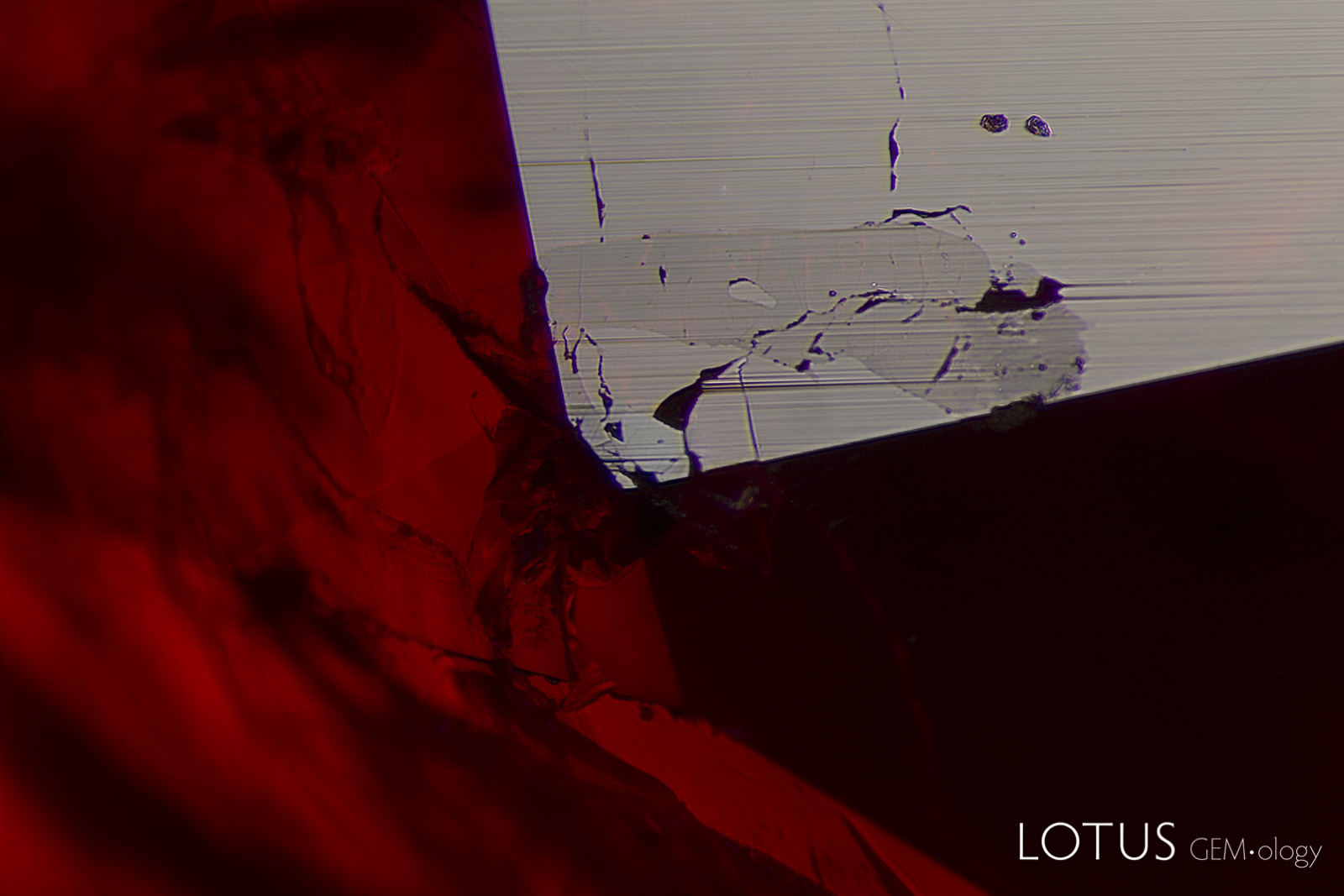
This ruby from Mozambique’s Montepuez region showed a substance polished through on the pavilion. It was not affected by the hot point, so we performed a micro Raman analysis that showed it to be boehmite. The same substance infilled other fissures in the stone. exsolved boehmite along rhombohedral planes is one cause of parting in corundum. Boehmite can also show up in the infrared spectrum, in the form of peaks at approximately 3313 and 3089 cm-1.
Natural Ruby •
Mozambique •
Enhancements:
None Detected (None) •
Lighting Conditions:
Dark Field + Diffuse Overhead Fiber Optic
Photographer:
Richard W. Hughes •
Image Number:
A-003-6442-1
• Field of View = 3mm
Hughes, R.W., Manorotkul, W. and Hughes, E.B. (2017) Ruby & Sapphire: A Gemologist's Guide. Bangkok, Lotus Publishing, 816 pp.; RWHL*.
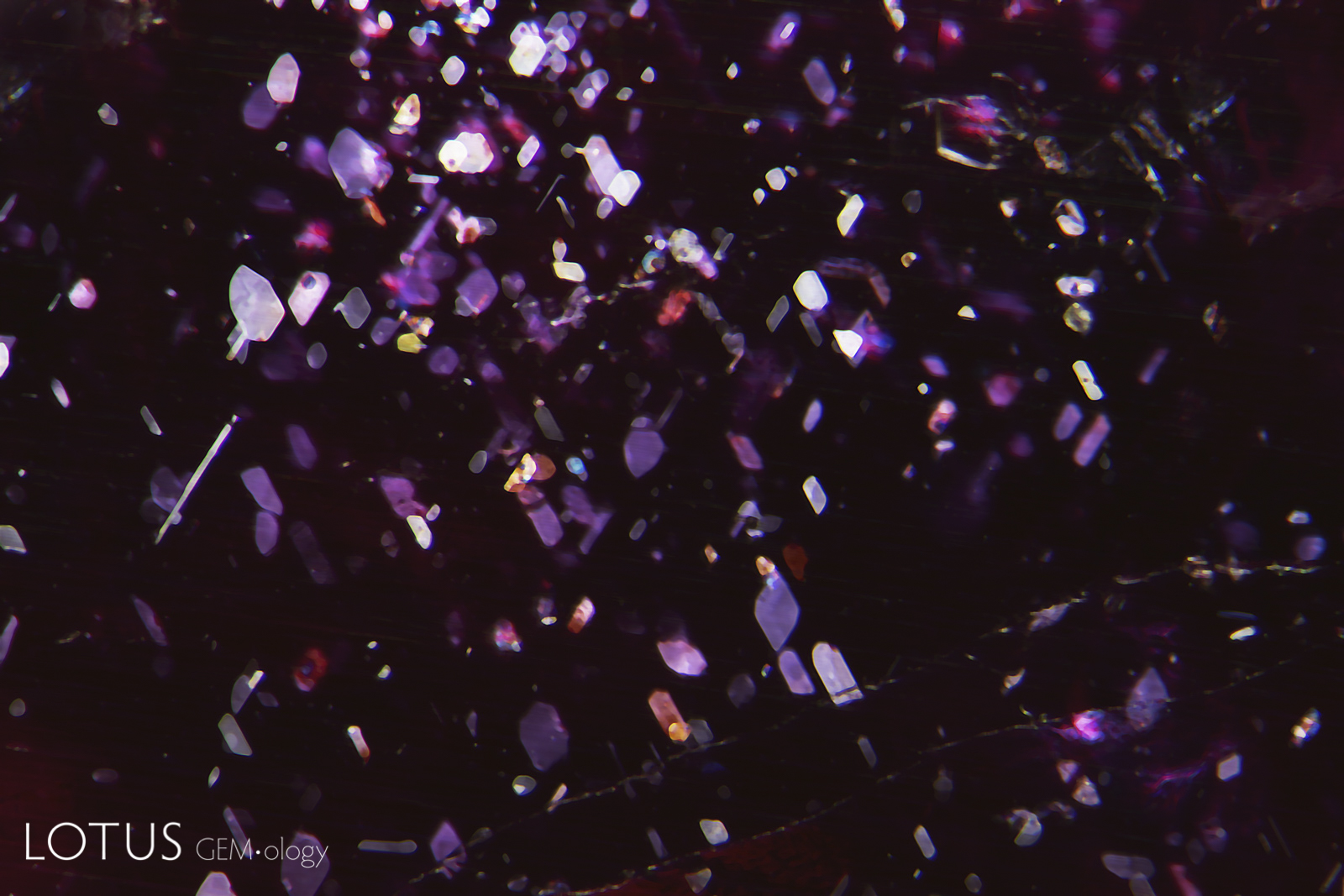
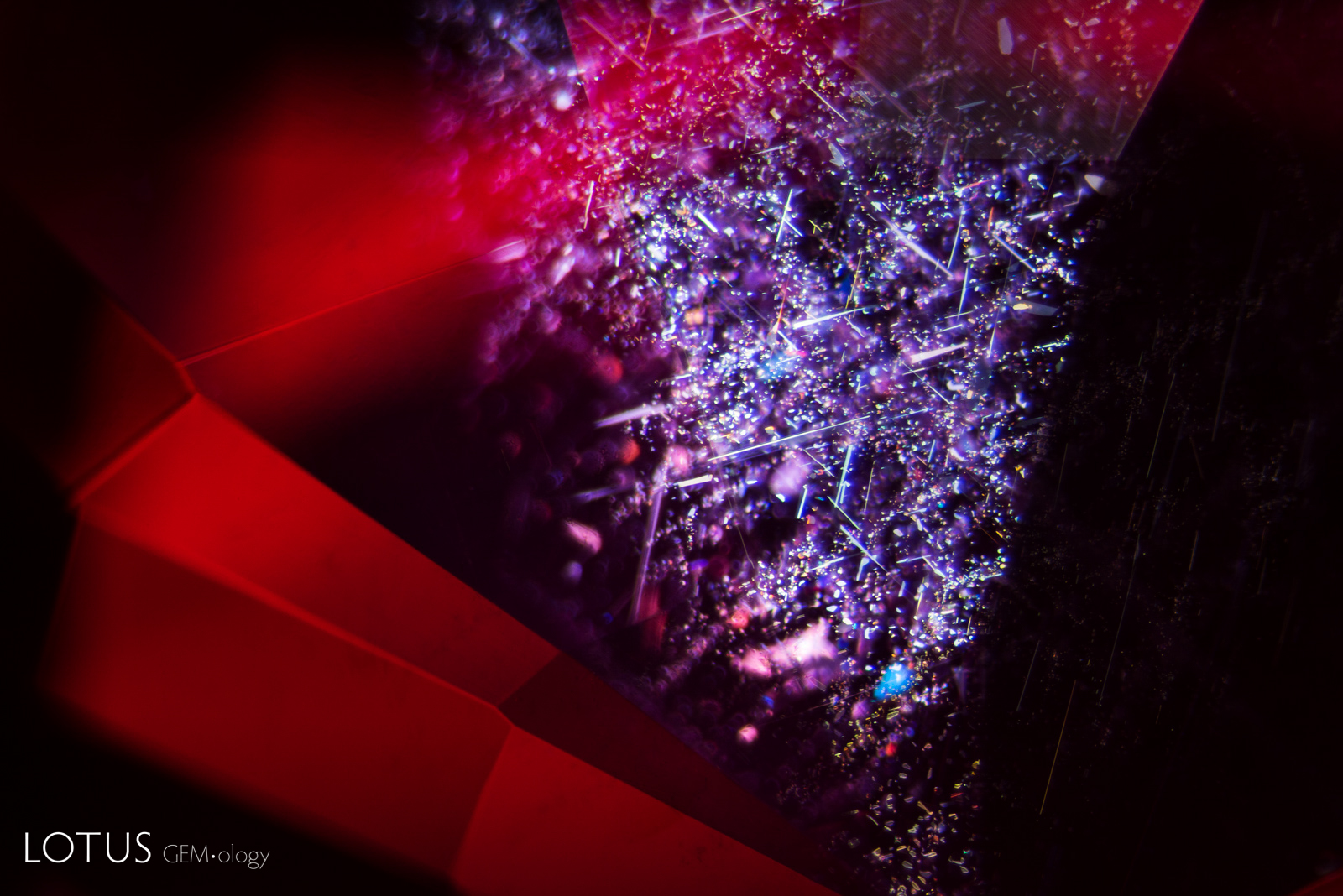
Rutile “silk” in needles, triangular platelets, and small particles like this is a typical scene found in Mozambique ruby.
Natural Ruby •
Mozambique •
Enhancements:
None Detected (None) •
Lighting Conditions:
Dark Field + Diffuse Fiber Optic
Photographer:
E. Billie Hughes •
Image Number:
A-003-3791-1
• Field of View = 4mm
Hughes, R.W., Manorotkul, W. et al. (2017) Ruby & Sapphire: A Gemologist's Guide. Bangkok, Lotus Publishing, 816 pp.; RWHL*.
Pardieu, V., Sangsawong, S. et al. (2013) Rubies from the Montepuez area (Mozambique). Gemological Institute of America, October 5, 84 pp.; RWHL*.
A metallic chalcopyrite crystal shines in this untreated Mozambique ruby.
Natural Ruby •
Mozambique •
Enhancements:
None Detected (None) •
Lighting Conditions:
Dark Field + Diffuse Fiber Optic
Photographer:
E. Billie Hughes •
Image Number:
A-002-5564-1
Hughes, R.W., Manorotkul, W. et al. (2017) Ruby & Sapphire: A Gemologist's Guide. Bangkok, Lotus Publishing, 816 pp.; RWHL*.
Pardieu, V., Saeseaw, S. et al. (2015) "Low temperature" heat treatment of Mozambique ruby: Results report. Gemological Institute of America, 16 April, 34 pp.; RWHL*.
Pardieu, V., Sangsawong, S. et al. (2013) Rubies from the Montepuez area (Mozambique). Gemological Institute of America, October 5, 84 pp.; RWHL*.
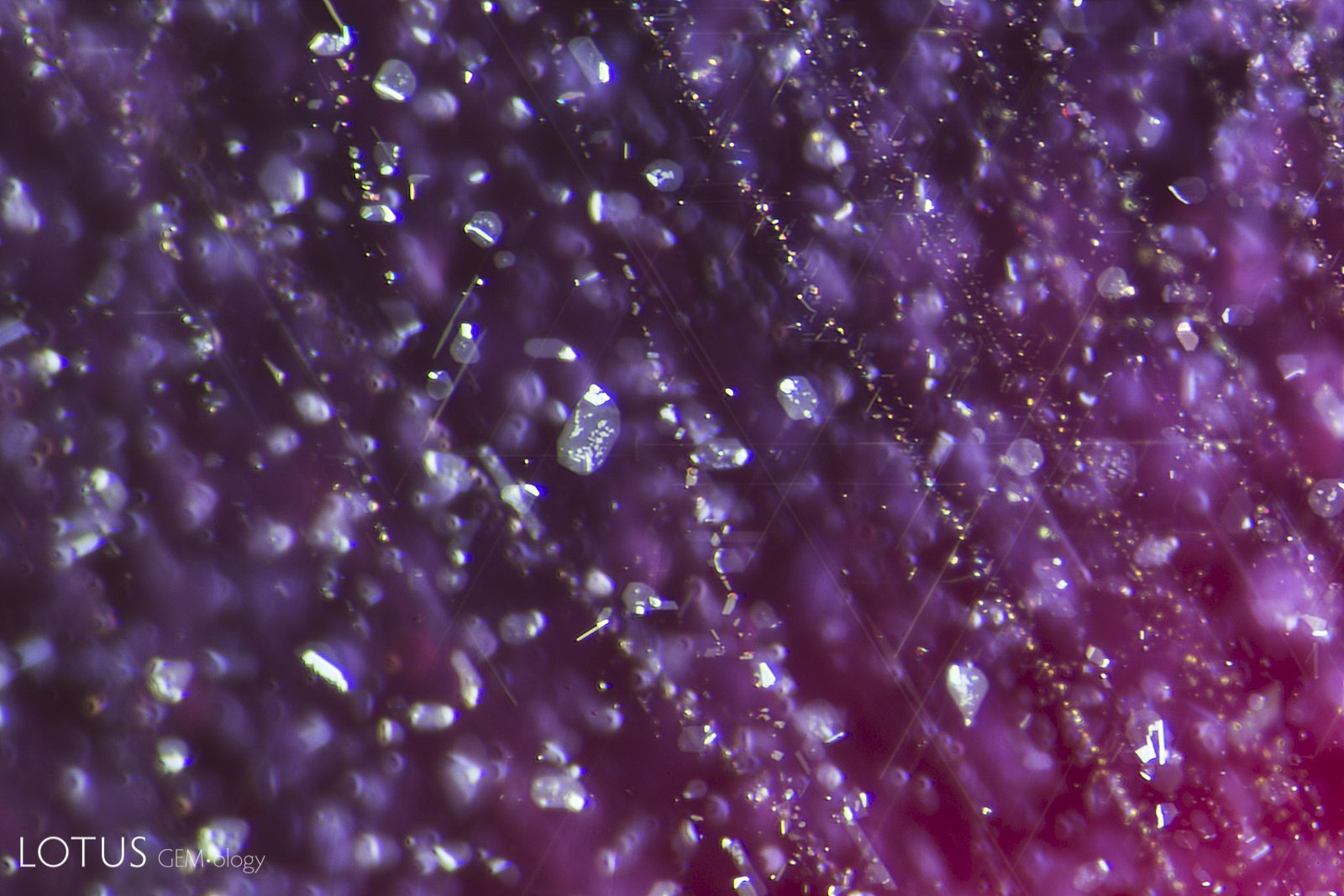
Virtually all Mozambique rubies contain exsolved rutile silk. These needles consist of two connected crystals, one a titanium-rich portion of high relief (rutile) and at the broad end, a Ti-Fe “daughter” crystal (probably ilmenite) of lower relief. When such a gem is heated, the daughter portion may start to break down, resulting in a mottled appearance on the daughter platelets.
Natural Ruby •
Mozambique •
Enhancements:
Heat (H) •
Lighting Conditions:
Fiber Optic: Diffuse Overhead
Photographer:
Richard W. Hughes •
Image Number:
A-002-5932-1
Pardieu, V., Saeseaw, S. et al. (2015) "Low temperature" heat treatment of Mozambique ruby: Results report. Gemological Institute of America, 16 April, 34 pp.; RWHL*.
Hughes, R.W., Manorotkul, W. et al. (2017) Ruby & Sapphire: A Gemologist's Guide. Bangkok, Lotus Publishing, 816 pp.; RWHL*.
The mottled appearance of the platelets suggests this Mozambique ruby was heated.
Natural Ruby •
Mozambique •
Enhancements:
Heat (H) •
Lighting Conditions:
Dark Field + Diffuse Fiber Optic
Photographer:
E. Billie Hughes •
Image Number:
A-002-4887-1
Hughes, R.W., Manorotkul, W. et al. (2017) Ruby & Sapphire: A Gemologist's Guide. Bangkok, Lotus Publishing, 816 pp.; RWHL*.
Pardieu, V., Saeseaw, S. et al. (2015) "Low temperature" heat treatment of Mozambique ruby: Results report. Gemological Institute of America, 16 April, 34 pp.; RWHL*.
Bright “rosettes” highlight the mica crystals inside this untreated Mozambique ruby.
Natural Ruby •
Mozambique •
Enhancements:
None Detected (None) •
Lighting Conditions:
Dark Field + Diffuse Fiber Optic
Photographer:
E. Billie Hughes •
Image Number:
A-002-4416-1
Hughes, R.W., Manorotkul, W. et al. (2017) Ruby & Sapphire: A Gemologist's Guide. Bangkok, Lotus Publishing, 816 pp.; RWHL*.
Pardieu, V., Saeseaw, S. et al. (2015) "Low temperature" heat treatment of Mozambique ruby: Results report. Gemological Institute of America, 16 April, 34 pp.; RWHL*.
151 Total Images
Results: 37 – 48 | Page 4 of 13 Pages
Mozambique ruby inclusions may include mineral crystals, rutile silk, healed fissures, fluid inclusions, negative crystals, growth features and other internal features formed during or after crystal growth. Such features are important to gemologists because they can provide evidence useful in identifying ruby and evaluating a possible Mozambique origin.
Mozambique Ruby Inclusion Photomicrographs
The Hyperion Mozambique ruby gallery includes microscopic features documented in rubies from Mozambique. Each entry is accompanied by descriptive information and, where available, references to the gemological literature.
What Inclusions Can Reveal About Mozambique Ruby
Inclusions are an important part of geographic origin determination in ruby. Their form, composition, orientation and associations can provide evidence that, when considered together with other gemological properties, may support or contradict a Mozambique origin.
Hyperion combines inclusion photomicrography with supporting gemological information so that individual features can be compared with documented examples from Mozambique rubies.
About Hyperion
Hyperion is the Lotus Gemology searchable inclusion database. It allows users to browse gemstone inclusions by gem type, geographic origin, treatment and keyword.
Search the Complete Hyperion Database