Mozambique Ruby Inclusions
Explore Mozambique ruby inclusions in Hyperion, the Lotus Gemology inclusion database. Hyperion contains photomicrographs of inclusions and internal features in natural rubies from Mozambique, documented with information on treatment, lighting conditions, field of view, photographer and published references.
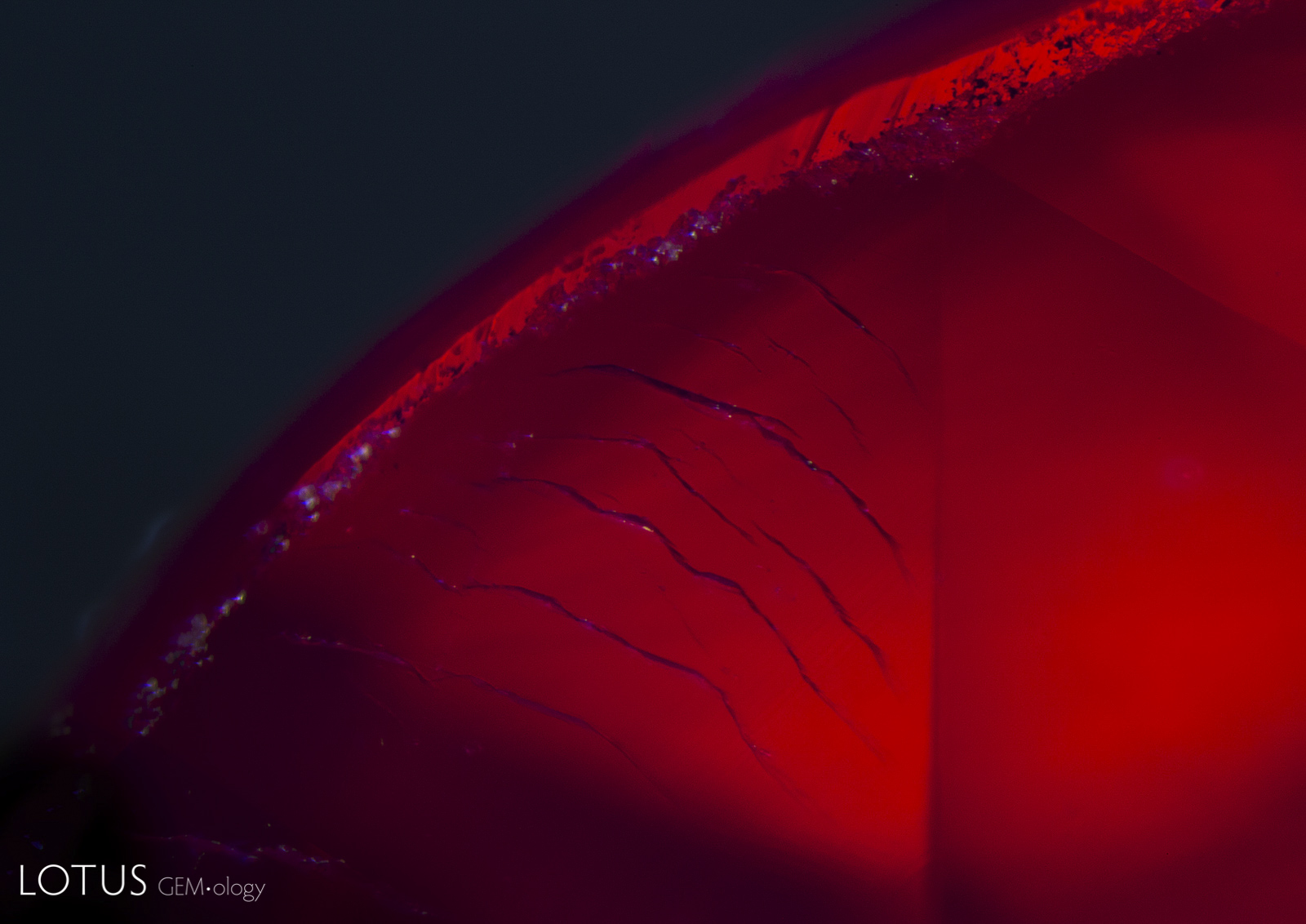
These disruption cracks are shallow fissures that form as a result of rapid polishing.
Natural Ruby •
Mozambique •
Enhancements:
None Detected (None) •
Lighting Conditions:
Fiber Optic: Diffuse Oblique
Photographer:
E. Billie Hughes •
Image Number:
A-001-4237-1
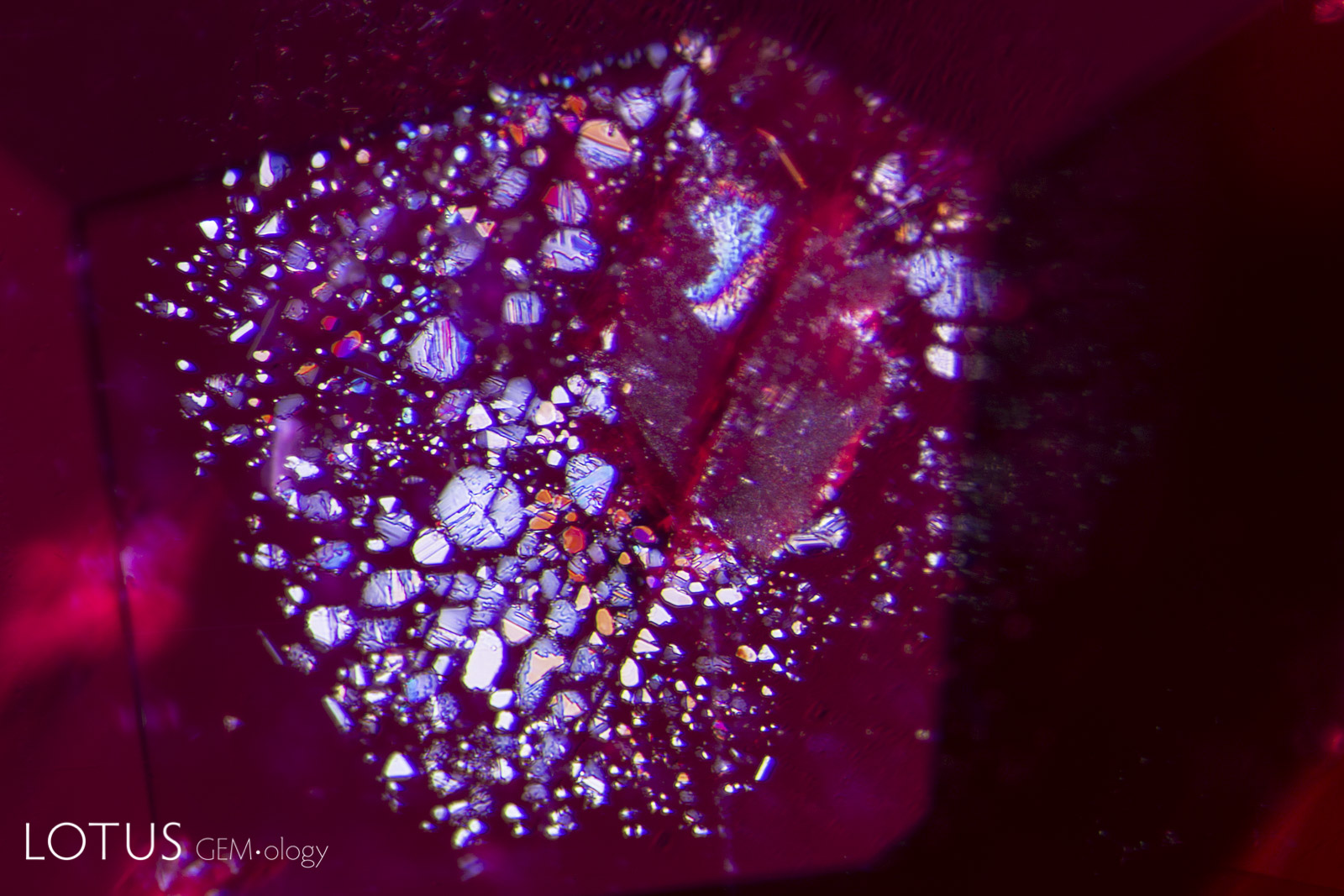
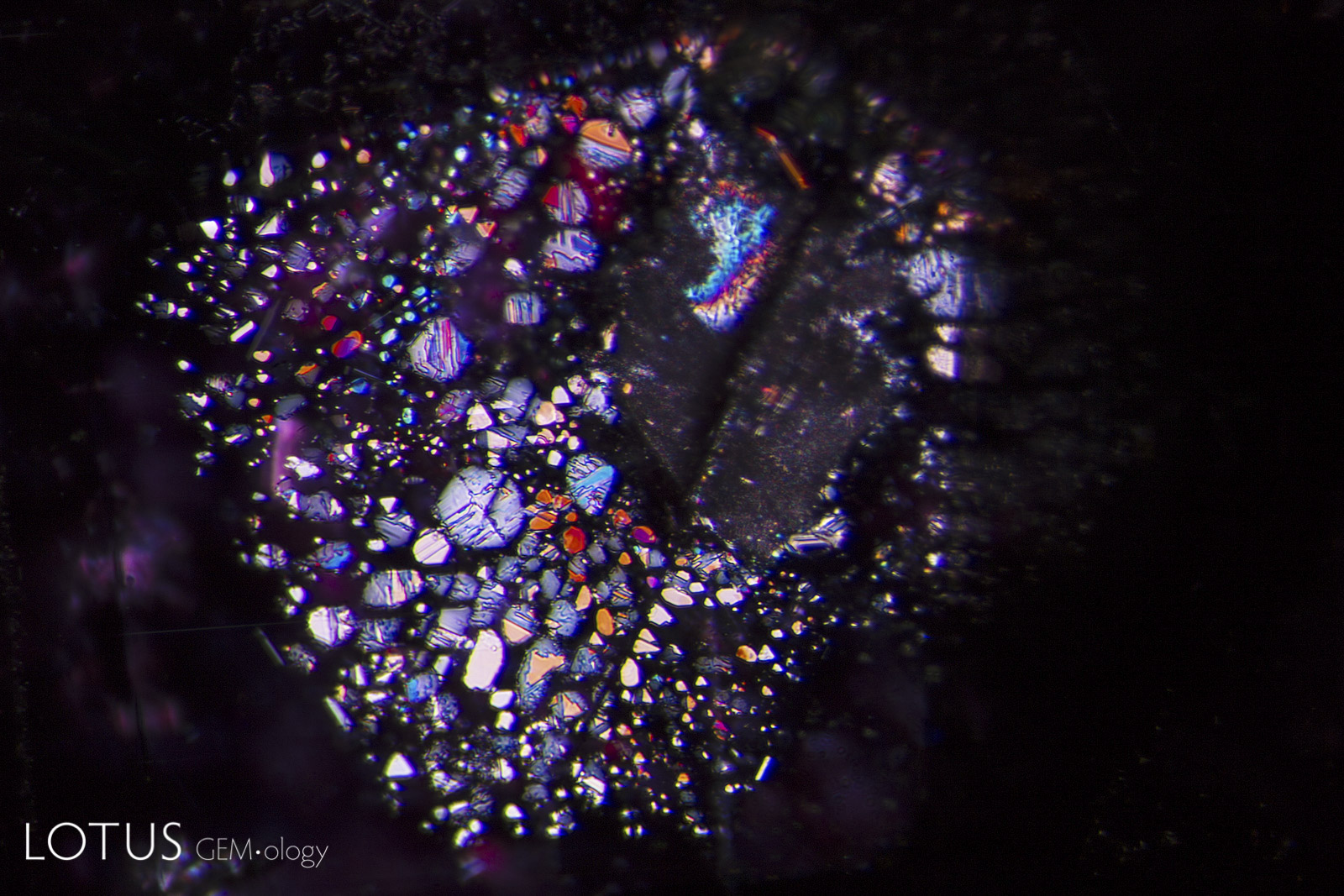
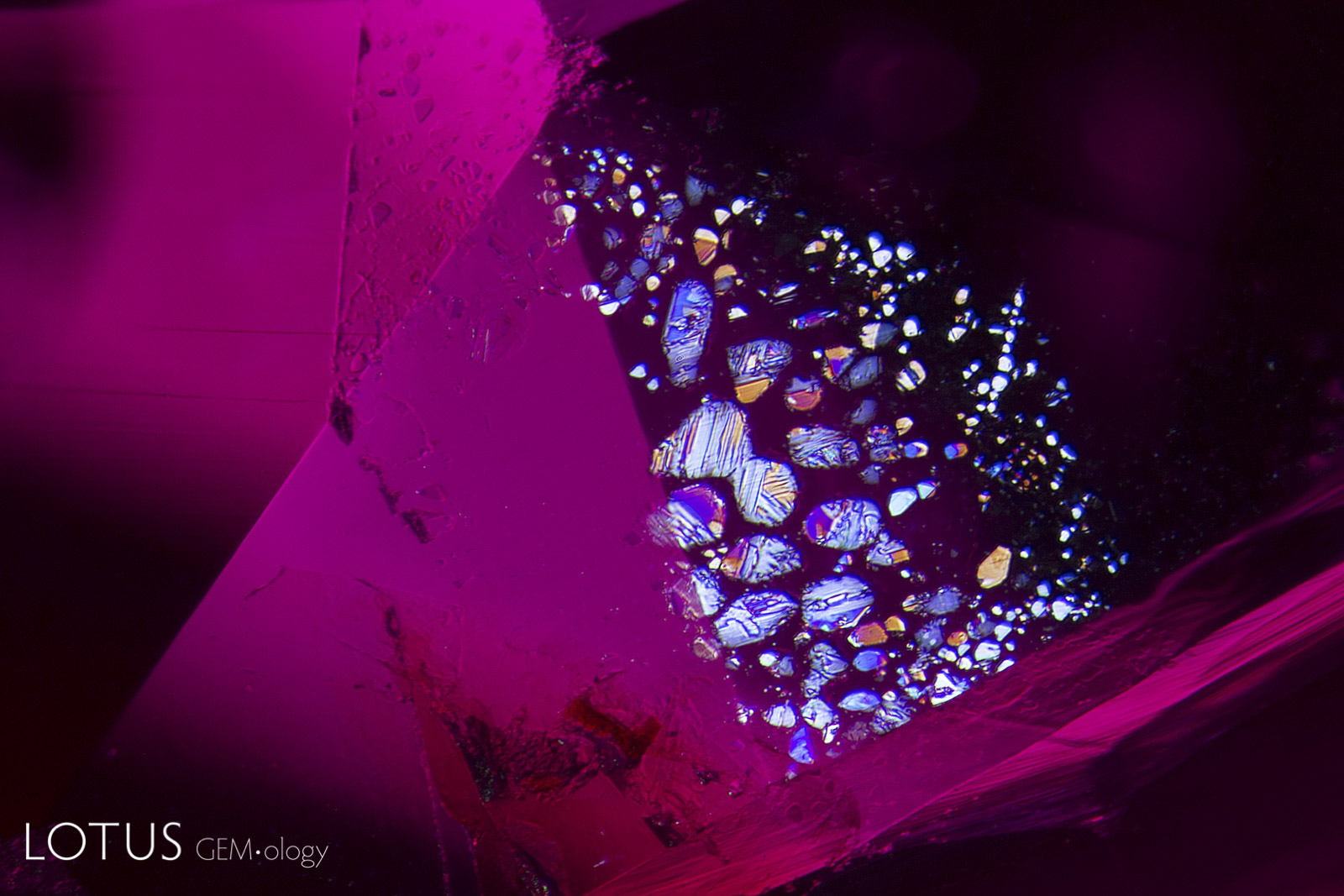
A lovely rosette inclusion surrounds a mica crystal in this ruby from Mozambique’s Montepuez region. This “rosette” actually consists of negative crystals flattened in the plane of basal pinacoid (perpendicular to the c axis).
Natural Ruby •
Mozambique •
Enhancements:
None Detected (None) •
Lighting Conditions:
Dark Field + Oblique Fiber Optic
Photographer:
Richard W. Hughes •
Image Number:
A-001-4273-2
A lovely rosette inclusion surrounds a mica crystal in this ruby from Mozambique’s Montepuez region. This “rosette” actually consists of negative crystals flattened in the plane of basal pinacoid (perpendicular to the c axis).
Natural Ruby •
Mozambique •
Enhancements:
None Detected (None) •
Lighting Conditions:
Fiber Optic: Oblique
Photographer:
Richard W. Hughes •
Image Number:
A-001-4273-1
The fact that this hot pink ruby from Mozambique owes some of its beauty to artificial heat treatment is betrayed by the spall marks on a small natural on the pavilion. Like drops of frozen water, they cannot be scraped off with a dental pick, thus demonstrating that they are the result of heat treatment.
Natural Ruby •
Mozambique •
Enhancements:
Heat (H) •
Lighting Conditions:
Fiber Optic: Overhead
Photographer:
E. Billie Hughes •
Image Number:
A-001-4190-1
A lovely “rosette” inclusion lights up the interior of this ruby from Montepuez, Mozambique. These inclusions consist of tiny negative crystals flattened in the basal plane, and become iridescent when illuminated in reflected light.
Natural Ruby •
Mozambique •
Enhancements:
None Detected (None) •
Lighting Conditions:
Fiber Optic: Oblique
Photographer:
Patharaphum Sudprasert •
Image Number:
A-001-4066-1
This platelet in a Mozambique ruby shows clear signs of heat treatment. Note the spotted, mottled appearance where the platelet has begun to break down.
Natural Ruby •
Mozambique •
Enhancements:
Heat + Fissure Healing (H-FH) •
Lighting Conditions:
Fiber Optic: Diffuse Oblique
Photographer:
E. Billie Hughes •
Image Number:
A-001-3425-1
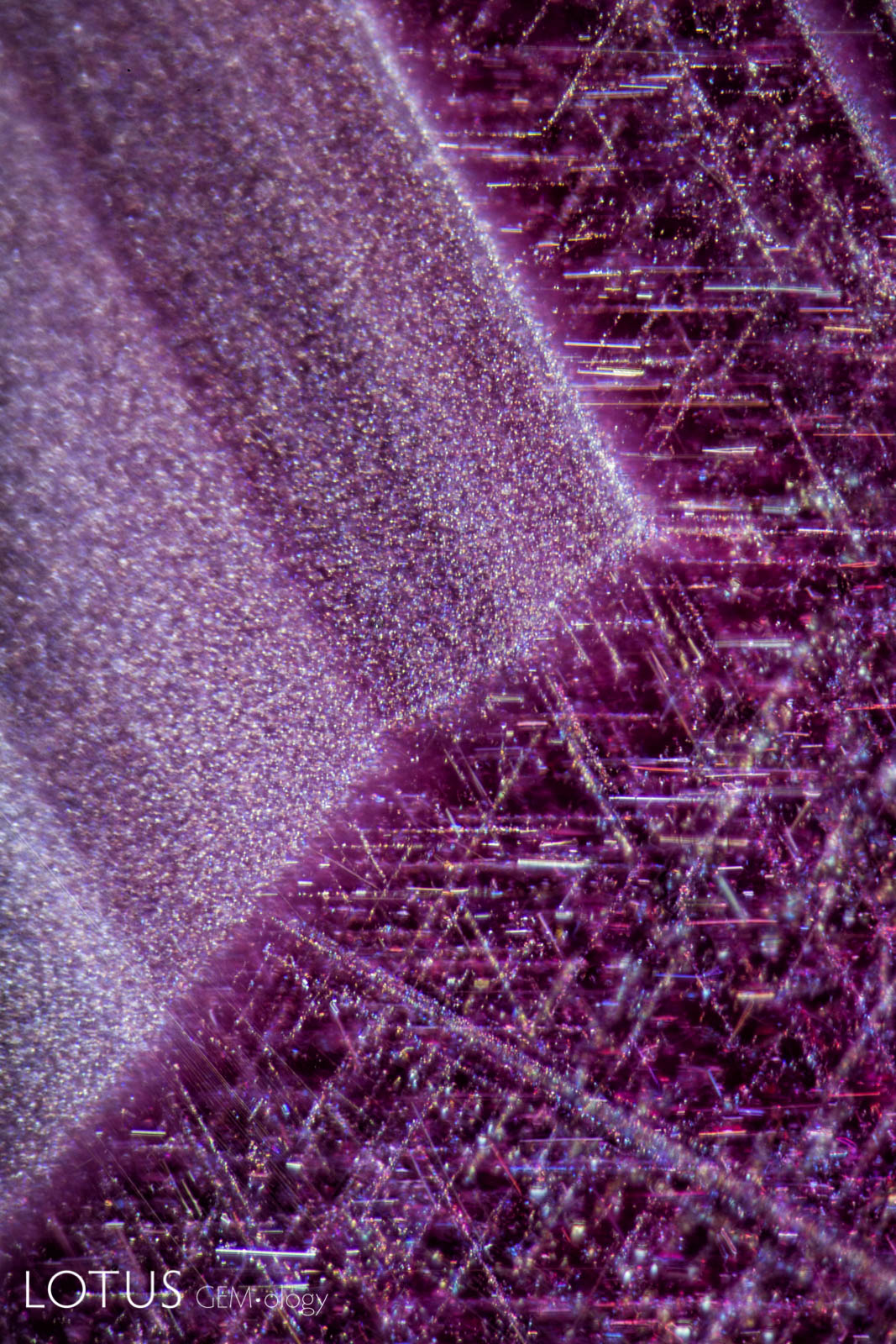
In Mozambique rubies, rutile silk typically occurs in different forms, and here we can see two. At left is a zoned cloud of fine particles, while on the right, well developed needles are seen.
Natural Ruby •
Mozambique •
Enhancements:
None Detected (None) •
Lighting Conditions:
Fiber Optic: Overhead
Photographer:
Richard W. Hughes •
Image Number:
A-001-3427-1
This mica crystal has a glassy tension fissure surrounding it, providing evidence that the stone was heated.
Natural Ruby •
Mozambique •
Enhancements:
Heat (H) •
Lighting Conditions:
Fiber Optic: Oblique
Photographer:
E. Billie Hughes •
Image Number:
A-001-3245-1
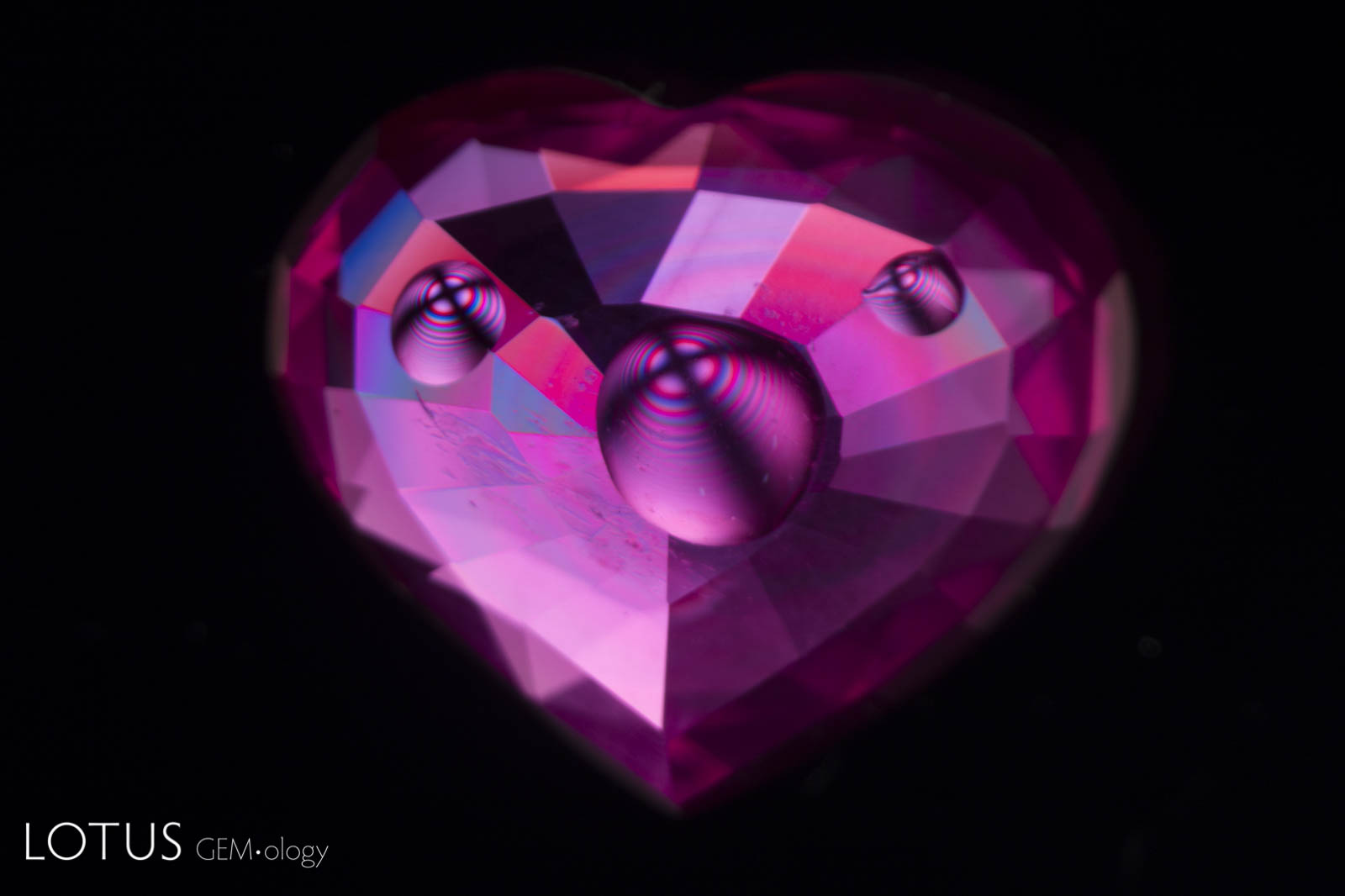
When drops of di-iodomethane are placed on the surface of this rather shallow Mozambique ruby and it is examined between crossed polars, small uniaxial interference figures are readily resolved.
Natural Ruby •
Mozambique •
Enhancements:
None Detected (None) •
Lighting Conditions:
Diffuse Light Field + Crossed Polars
Photographer:
Richard W. Hughes •
Image Number:
A-001-3126-1
Hughes, R.W. (1997) Ruby & Sapphire. Boulder, CO, RWH Publishing, 512 pp.; RWHL*.
Melted crystals and boehmite needles in a heat-treated ruby from Mozambique.
Natural Ruby •
Mozambique •
Enhancements:
Heat (H) •
Lighting Conditions:
Fiber Optic: Oblique
Photographer:
E. Billie Hughes •
Image Number:
A-001-2802-3
When a Mozambique ruby is heated, the silk may start to break down, resulting if mottling or bubbles appearing in the daughter minerals, as seen here.
Natural Ruby •
Mozambique •
Enhancements:
Heat (H) •
Lighting Conditions:
Fiber Optic: Diffuse Overhead
Photographer:
E. Billie Hughes •
Image Number:
A-001-2802-2
When a Mozambique ruby is heated, the silk may start to break down, resulting if mottling or bubbles appearing in the daughter minerals, as seen here.
Natural Ruby •
Mozambique •
Enhancements:
Heat (H) •
Lighting Conditions:
Fiber Optic: Diffuse Overhead
Photographer:
E. Billie Hughes •
Image Number:
A-001-2802-1
Mozambique ruby inclusions may include mineral crystals, rutile silk, healed fissures, fluid inclusions, negative crystals, growth features and other internal features formed during or after crystal growth. Such features are important to gemologists because they can provide evidence useful in identifying ruby and evaluating a possible Mozambique origin.
Mozambique Ruby Inclusion Photomicrographs
The Hyperion Mozambique ruby gallery includes microscopic features documented in rubies from Mozambique. Each entry is accompanied by descriptive information and, where available, references to the gemological literature.
What Inclusions Can Reveal About Mozambique Ruby
Inclusions are an important part of geographic origin determination in ruby. Their form, composition, orientation and associations can provide evidence that, when considered together with other gemological properties, may support or contradict a Mozambique origin.
Hyperion combines inclusion photomicrography with supporting gemological information so that individual features can be compared with documented examples from Mozambique rubies.
About Hyperion
Hyperion is the Lotus Gemology searchable inclusion database. It allows users to browse gemstone inclusions by gem type, geographic origin, treatment and keyword.