Thai Ruby Inclusions
Explore Thai ruby inclusions in Hyperion, the Lotus Gemology inclusion database. Hyperion contains photomicrographs of inclusions and internal features in natural rubies from Thailand, documented with information on treatment, lighting conditions, field of view, photographer and published references.
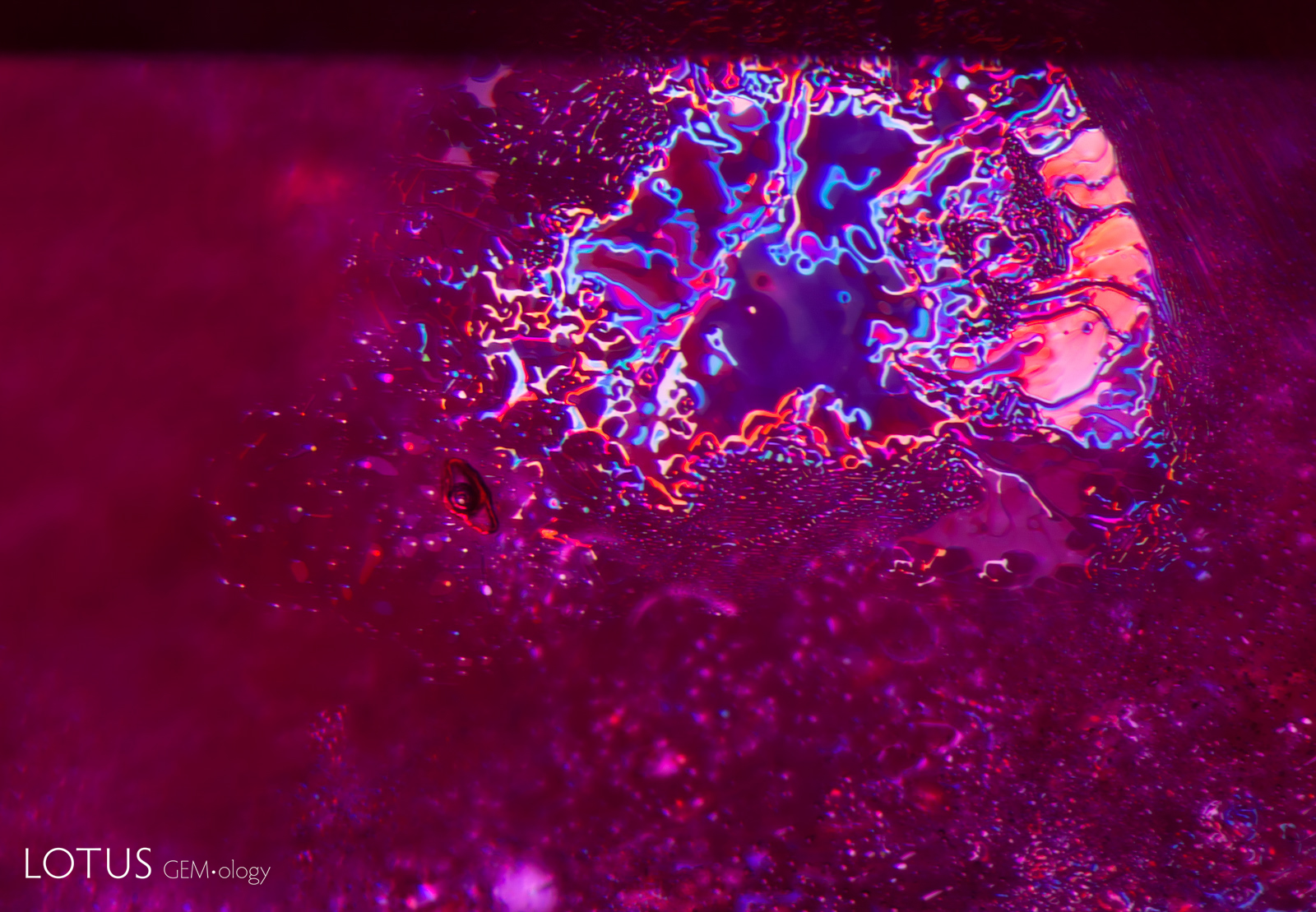
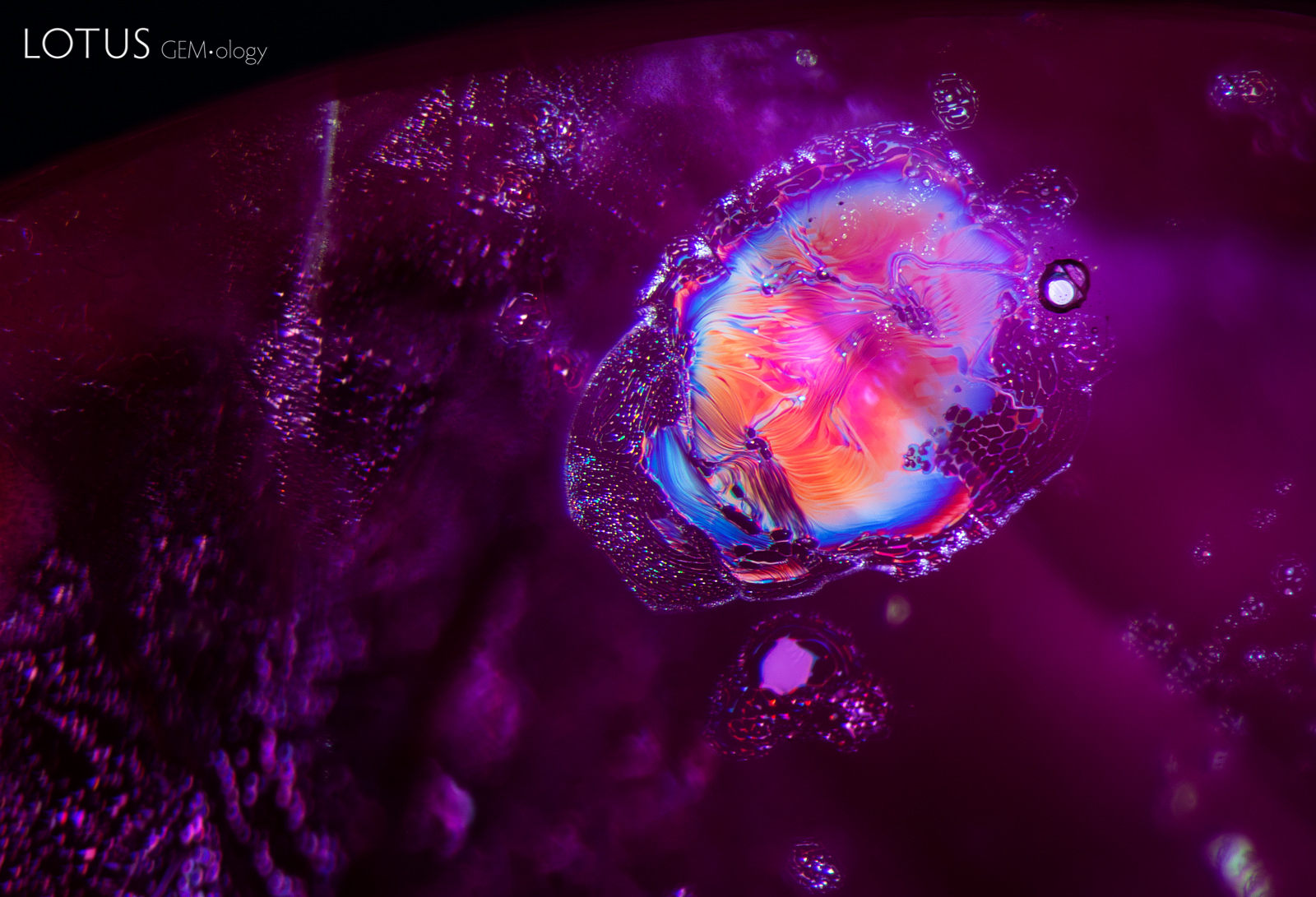
This Thai/Cambodian ruby displays thin films with drippy, irregular edges and a melted crystal inclusion featuring an immobile gas bubble. These features act as evidence that the stone has been heat treated.
Natural Ruby •
Thailand/Cambodia •
Enhancements:
Heat (H) •
Lighting Conditions:
Dark Field + Diffuse Fiber Optic
Photographer:
E. Billie Hughes •
Image Number:
A-005-6897-1
• Field of View = 1.8mm
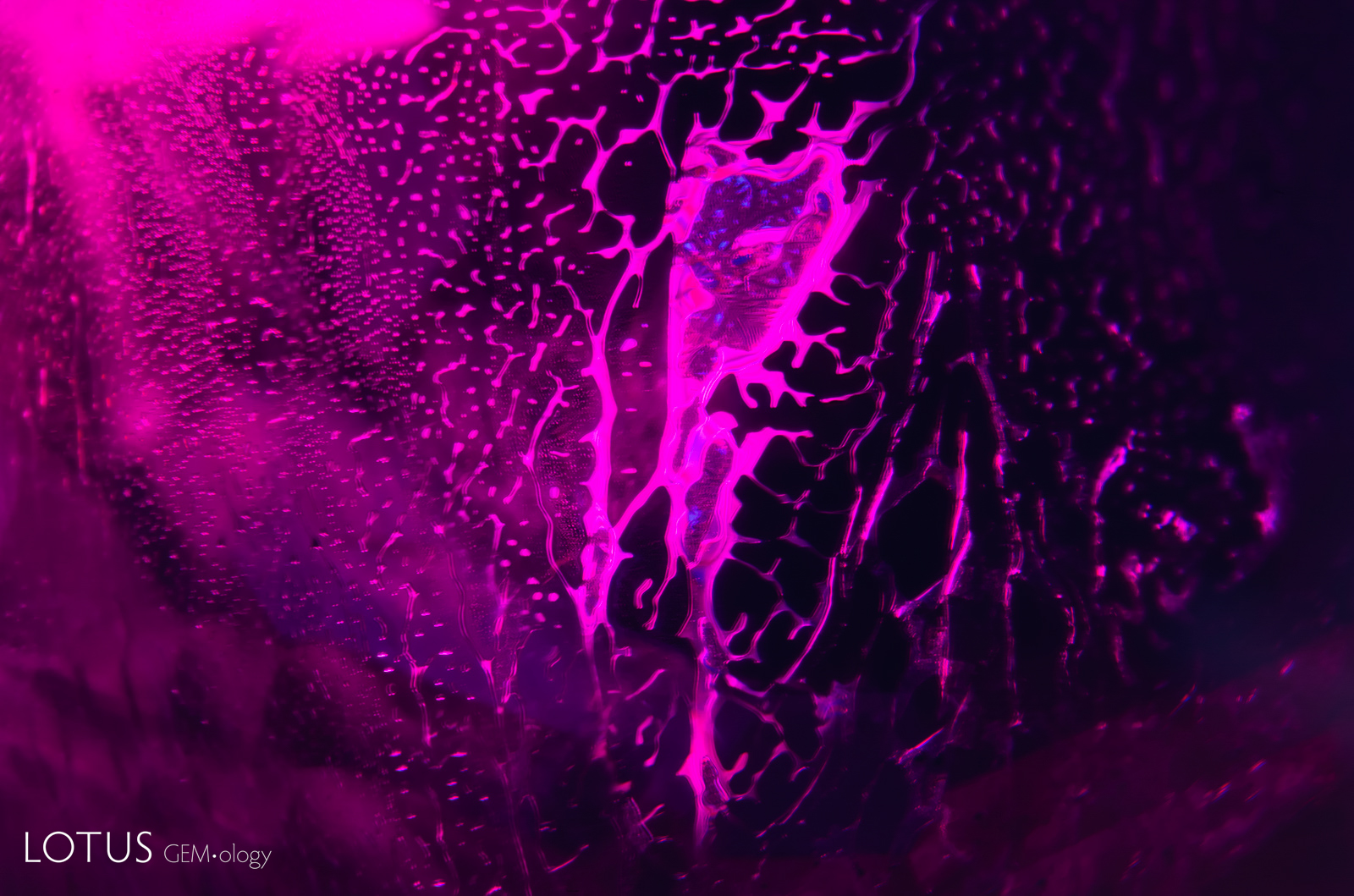
A fingerprint, or partially healed fissure, in a heated Thai ruby. Note the rounded, slightly melted edges.
Natural Ruby •
Thailand/Cambodia •
Enhancements:
Heat (H) •
Lighting Conditions:
Fiber Optic: Diffuse Oblique
Photographer:
E. Billie Hughes •
Image Number:
A-005-4661-1
• Field of View = 3.6mm
When illuminated with a long wave UV torch, the filler in this ruby becomes easy to spot with a chalky appearance.
Natural Ruby •
Thailand/Cambodia •
Enhancements:
Heat (H); Fissure Filling with colorless Oil/resin (FF-O1) •
Lighting Conditions:
Ultraviolet: Longwave
Photographer:
E. Billie Hughes •
Image Number:
A-004-6354-2
• Field of View = 7mm
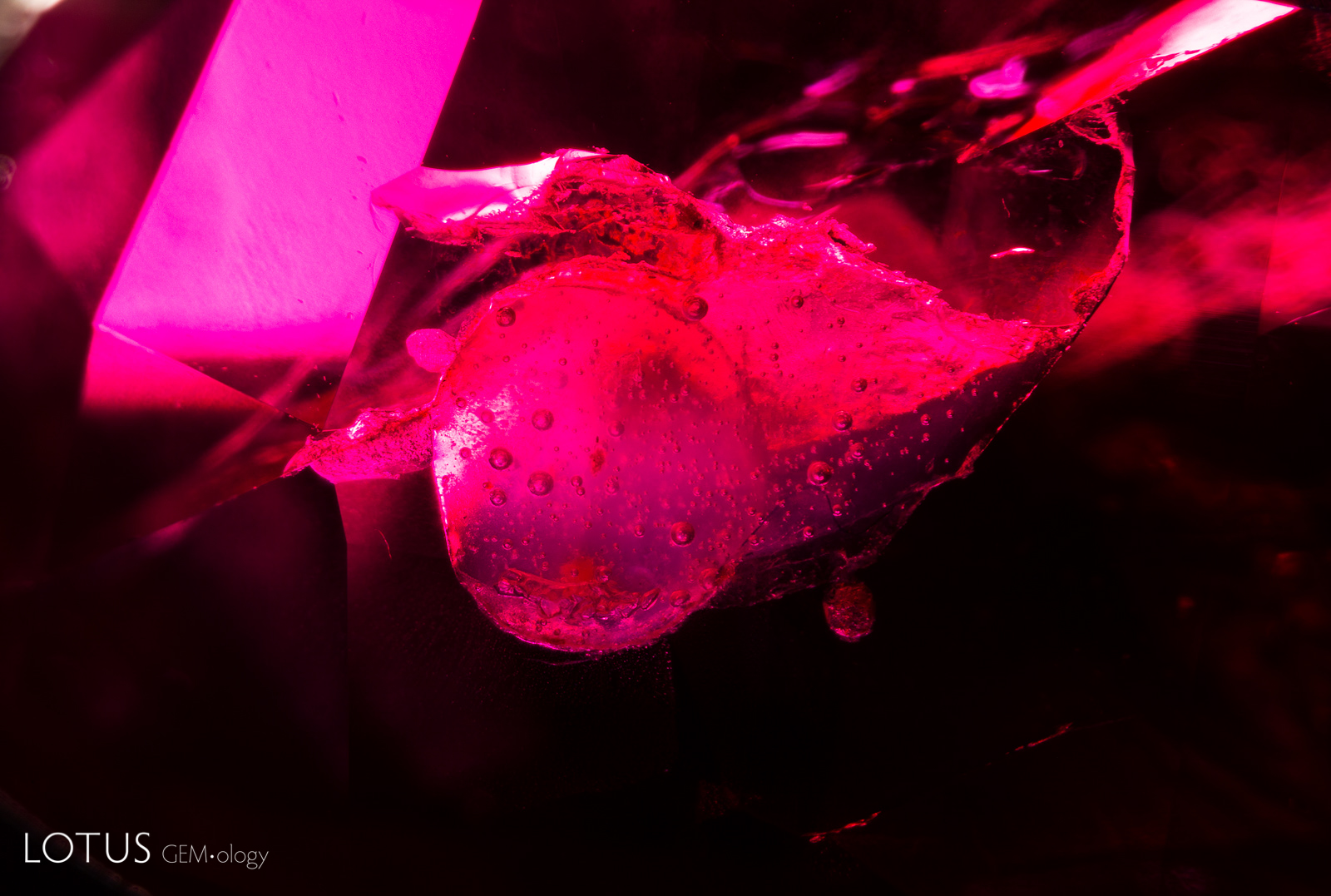
Bubbles can be observed in the filler that is present in the cavity in this ruby.
Natural Ruby •
Thailand/Cambodia •
Enhancements:
Heat (H); Fissure Filling with colorless Oil/resin (FF-O1) •
Lighting Conditions:
Dark Field
Photographer:
E. Billie Hughes •
Image Number:
A-004-6354-1
• Field of View = 7mm
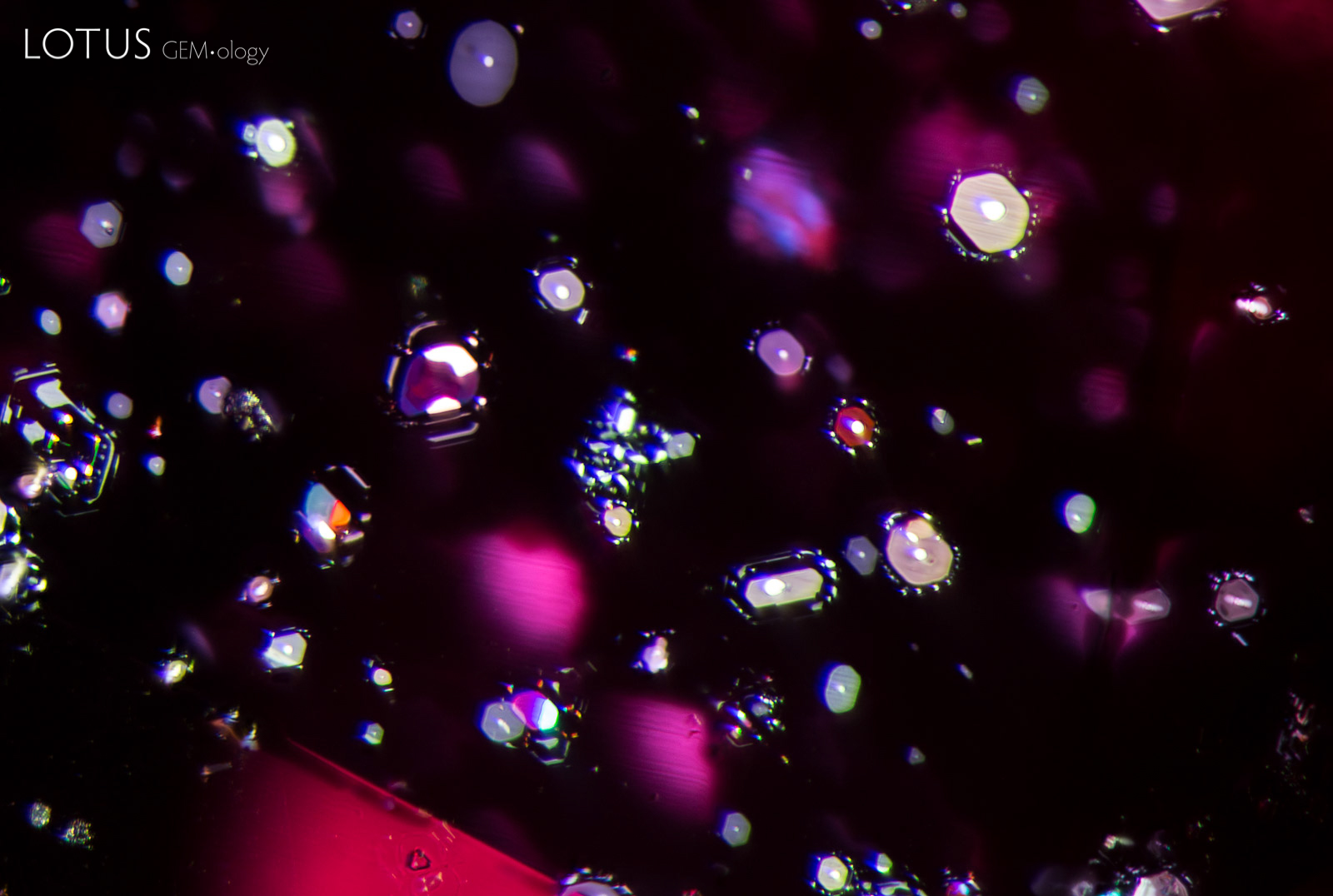
“Saturn inclusion” type crystals, as seen here, are a hallmark of Thai/Cambodian ruby. Although we were unable to identify the composition of the whole crystal, the black spots on the surface were identified as magnetite with micro Raman.
Natural Ruby •
Thailand/Cambodia •
Enhancements:
Heat (H) •
Lighting Conditions:
Dark Field + Oblique Fiber Optic
Photographer:
Wimon Manorotkul •
Image Number:
A-004-1969-3
• Field of View = 5mm
Thin films, as seen here, are a classic inclusion in Thai/Cambodian ruby.
Natural Ruby •
Thailand/Cambodia •
Enhancements:
Heat (H) •
Lighting Conditions:
Fiber Optic: Oblique
Photographer:
Wimon Manorotkul •
Image Number:
A-004-1969-1
• Field of View = 3.5mm
A small melted crystal and associated thin film inclusion dazzle with color when lit with fiber optic illumination. Inclusions like these are typical in Thai/Cambodian ruby.
Natural Ruby •
Thailand/Cambodia •
Enhancements:
Heat + Fissure Healing (H-FH) •
Lighting Conditions:
Fiber Optic: Diffuse Oblique
Photographer:
E. Billie Hughes •
Image Number:
A-004-1087-1
• Field of View = 2.5mm
Iridescent fingerprint in a ruby from the Thai/Cambodian border.
Natural Ruby •
Thailand/Cambodia •
Enhancements:
Heat (H) •
Lighting Conditions:
Fiber Optic: Oblique
Photographer:
E. Billie Hughes •
Image Number:
A-001-4425-2
• Field of View = 4mm
Rose channels in Thai/Cambodian ruby. These are often confused with rutile silk in corundum, but they are easily distinguished as they run in entirely different crystallographic directions. Rutile silk unmixes in three intersecting directions (60/120°) parallel to the faces of the hexagonal prism in the plane of the basal pinacoid (90° to the c-axis). In contrast, Rose channels form parallel to the edges of the rhombohedron, in three directions, but only two in the same place, oblique to the c-axis. They intersect at 86.1/93.9°.
Natural Ruby •
Thailand/Cambodia •
Enhancements:
Heat (H) •
Lighting Conditions:
Dark Field
Photographer:
E. Billie Hughes •
Image Number:
A-001-4425-1
• Field of View = 6mm
Spall marks on a natural on the girdle of this Thai/Cambodian ruby reveal the heated nature of this stone.
Natural Ruby •
Thailand/Cambodia •
Enhancements:
Heat (H) •
Lighting Conditions:
Fiber Optic: Diffuse Overhead
Photographer:
Richard W. Hughes •
Image Number:
A-003-2866-1
Thai/Cambodian rubies like this often show thin film inclusions that light up under fiber optic illumination.
Natural Ruby •
Thailand/Cambodia •
Enhancements:
Heat (H) •
Lighting Conditions:
Diffuse Light Field + Diffuse Fiber Optic
Photographer:
E. Billie Hughes •
Image Number:
A-002-8599-2
Melted crystals are surrounded by runny channels in the heat-altered fingerprints in this Thai/Cambodian ruby.
Natural Ruby •
Thailand/Cambodia •
Enhancements:
Heat (H) •
Lighting Conditions:
Dark Field + Diffuse Fiber Optic + Blue Filter
Photographer:
E. Billie Hughes •
Image Number:
A-002-6263-1
Thai ruby inclusions may include mineral crystals, healed fissures, fluid inclusions, negative crystals, growth features and other internal features formed during or after crystal growth. Such features are important to gemologists because they can provide evidence useful in identifying ruby and evaluating a possible Thai origin.
Thai Ruby Inclusion Photomicrographs
The Hyperion Thai ruby gallery includes microscopic features documented in rubies from Thailand and the Thailand–Cambodia border region. Each entry is accompanied by descriptive information and, where available, references to the gemological literature.
What Inclusions Can Reveal About Thai Ruby
Inclusions are an important part of geographic origin determination in ruby. Their form, composition, orientation and associations can provide evidence that, when considered together with other gemological properties, may support or contradict a Thai origin.
Hyperion combines inclusion photomicrography with supporting gemological information so that individual features can be compared with documented examples from Thai rubies.
About Hyperion
Hyperion is the Lotus Gemology searchable inclusion database. It allows users to browse gemstone inclusions by gem type, geographic origin, treatment and keyword.