Madagascar Ruby Inclusions
Explore Madagascar ruby inclusions in Hyperion, the Lotus Gemology inclusion database. Hyperion contains photomicrographs of inclusions and internal features in natural rubies from Madagascar, documented with information on treatment, lighting conditions, field of view, photographer and published references.
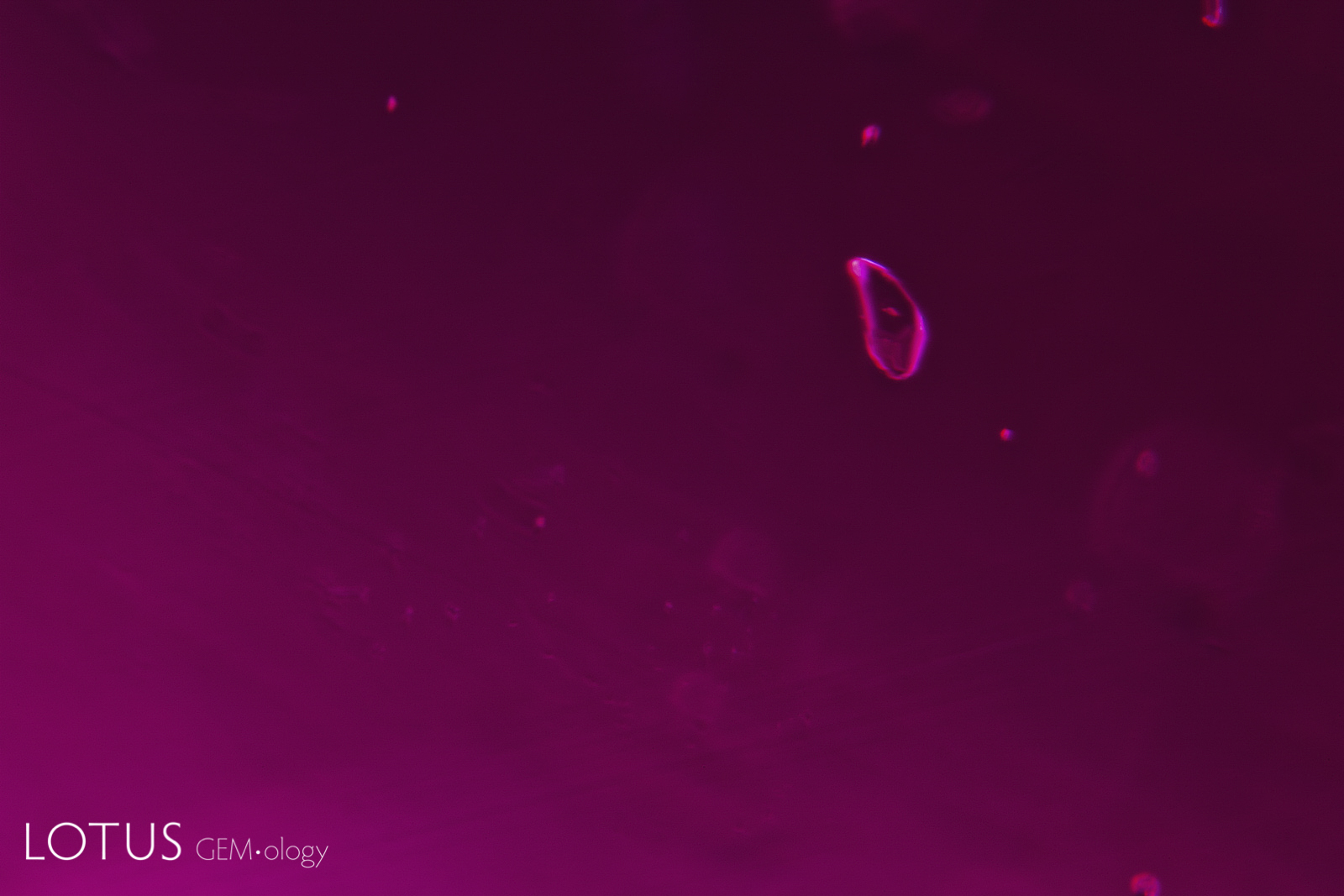
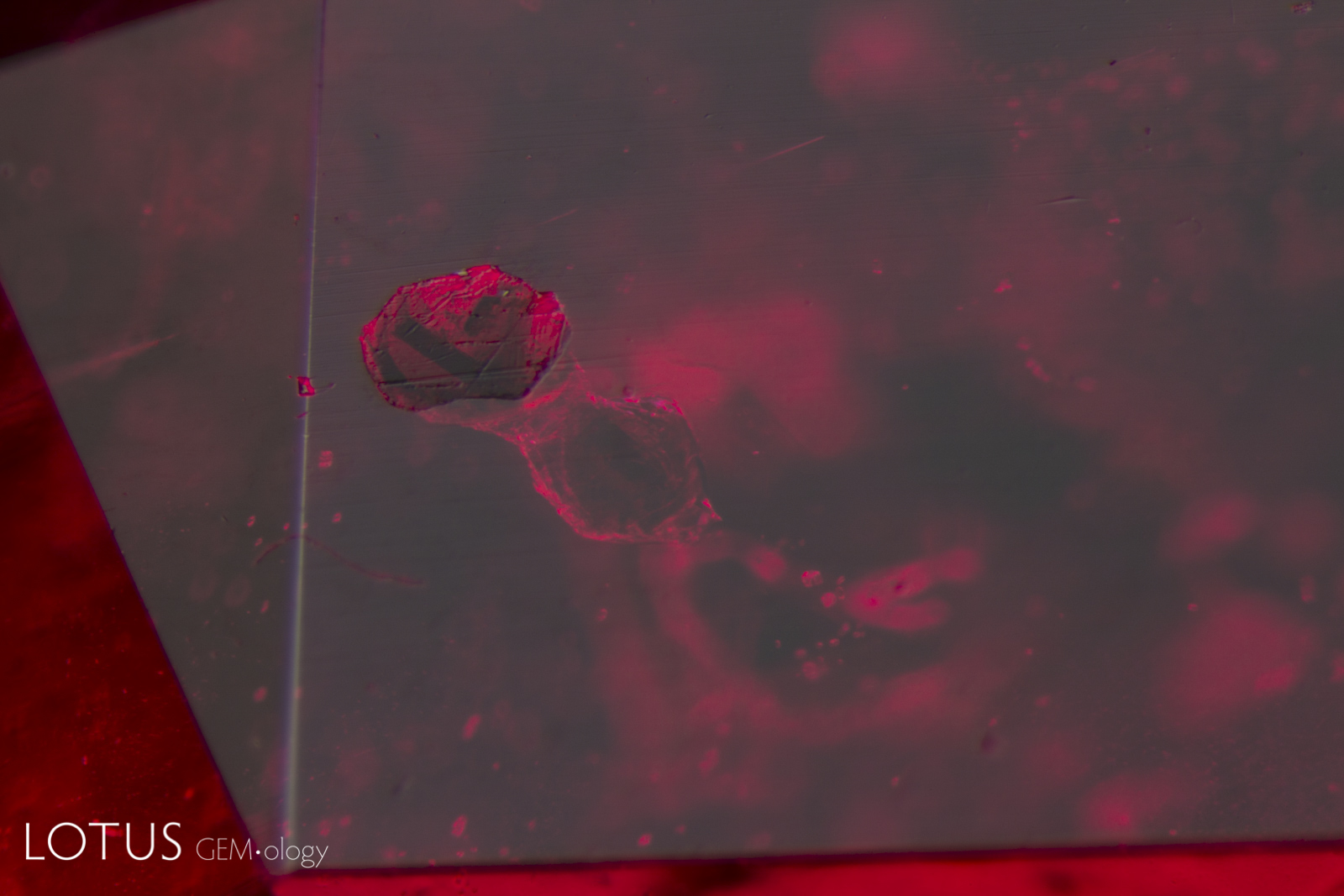
A ruby was sent to us for testing. It featured rutile silk, mica and some small rounded crystal grains. The inclusion evidence suggested that it could be from either Mozambique or Madagascar. The rounded grains could be amphibole or zircon. So we did micro Raman analysis on the grain pictured here. It turned out to be zircon. As zircon has not been found in Mozambique ruby, but is found in Madagascar ruby, this pointed to the stone as being from Madagascar.
Natural Ruby •
Madagascar •
Enhancements:
None Detected (None) •
Lighting Conditions:
Dark Field
Photographer:
Richard W. Hughes •
Image Number:
A-003-6329-1
• Field of View = 1mm
This ruby from central Madagascar featured a large crystal that was cut through on the surface. Using micro Raman, we identified the crystal as phlogopite mica.
Natural Ruby •
Madagascar •
Enhancements:
None Detected (None) •
Lighting Conditions:
Fiber Optic: Diffuse Overhead + Dark Field
Photographer:
Richard W. Hughes •
Image Number:
A-003-6321-1
• Field of View = 2.5mm
Deep red crystals were found in a Madagascar ruby. Examination with Lotus Gemology’s micro Raman identified them as the mineral staurolite. This is the first example of staurolite found in corundum. These examples are surrounded by what appears to be small zircon crystals.
Natural Ruby •
Madagascar •
Enhancements:
None Detected (None) •
Lighting Conditions:
Light Field (Transmitted Light)
Photographer:
E. Billie Hughes •
Image Number:
A-003-2182-7
Deep red crystals were found in a Madagascar ruby. Examination with Lotus Gemology’s micro Raman identified them as the mineral staurolite. This is the first example of staurolite found in corundum.
Natural Ruby •
Madagascar •
Enhancements:
None Detected (None) •
Lighting Conditions:
Light Field (Transmitted Light)
Photographer:
E. Billie Hughes •
Image Number:
A-003-2182-5
Deep red crystals were found in a Madagascar ruby. Examination with Lotus Gemology’s micro Raman identified them as the mineral staurolite. This is the first example of staurolite found in corundum.
Natural Ruby •
Madagascar •
Enhancements:
None Detected (None) •
Lighting Conditions:
Dark Field
Photographer:
E. Billie Hughes •
Image Number:
A-003-2182-2
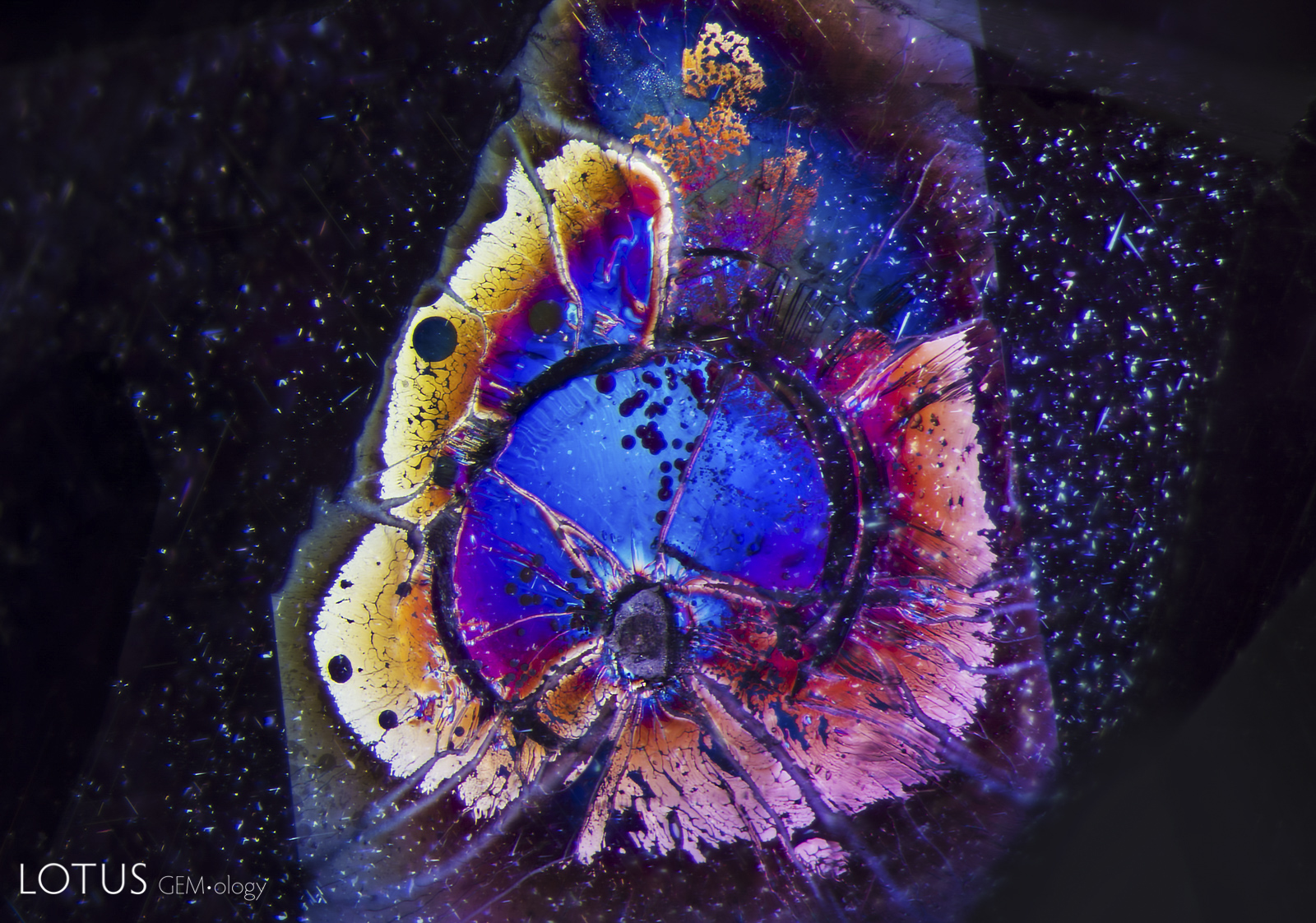
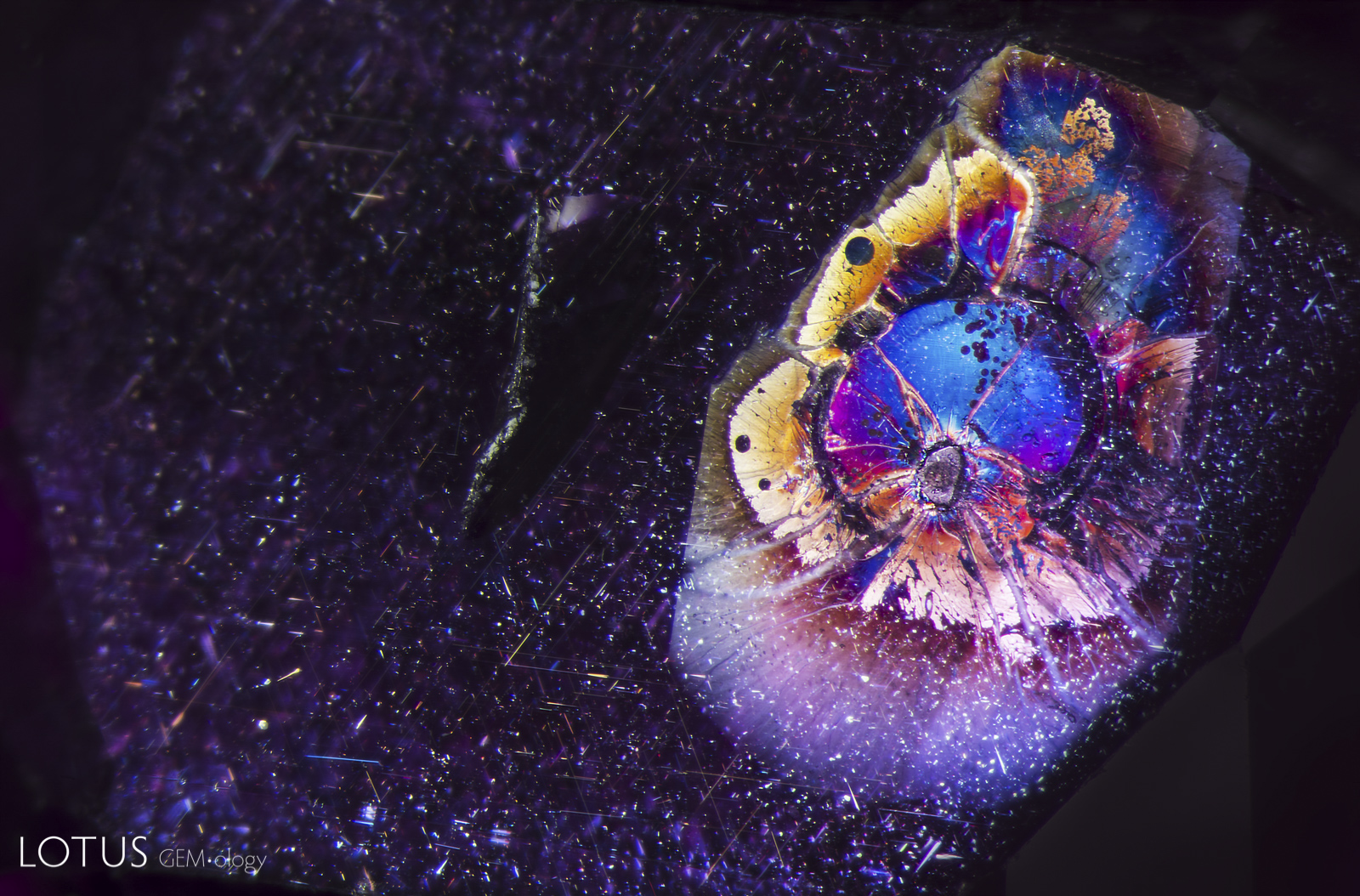
A fine fissure radiates out from this crystal in a Madagascar ruby, creating a rainbow-like halo around it.
Natural Ruby •
Madagascar •
Enhancements:
None Detected (None) •
Lighting Conditions:
Fiber Optic: Diffuse Oblique
Photographer:
E. Billie Hughes •
Image Number:
A-002-4458-2
A fine fissure radiates out from this crystal in a Madagascar ruby, creating a rainbow-like halo around it.
Natural Ruby •
Madagascar •
Enhancements:
None Detected (None) •
Lighting Conditions:
Fiber Optic: Diffuse Oblique
Photographer:
E. Billie Hughes •
Image Number:
A-002-4458-1
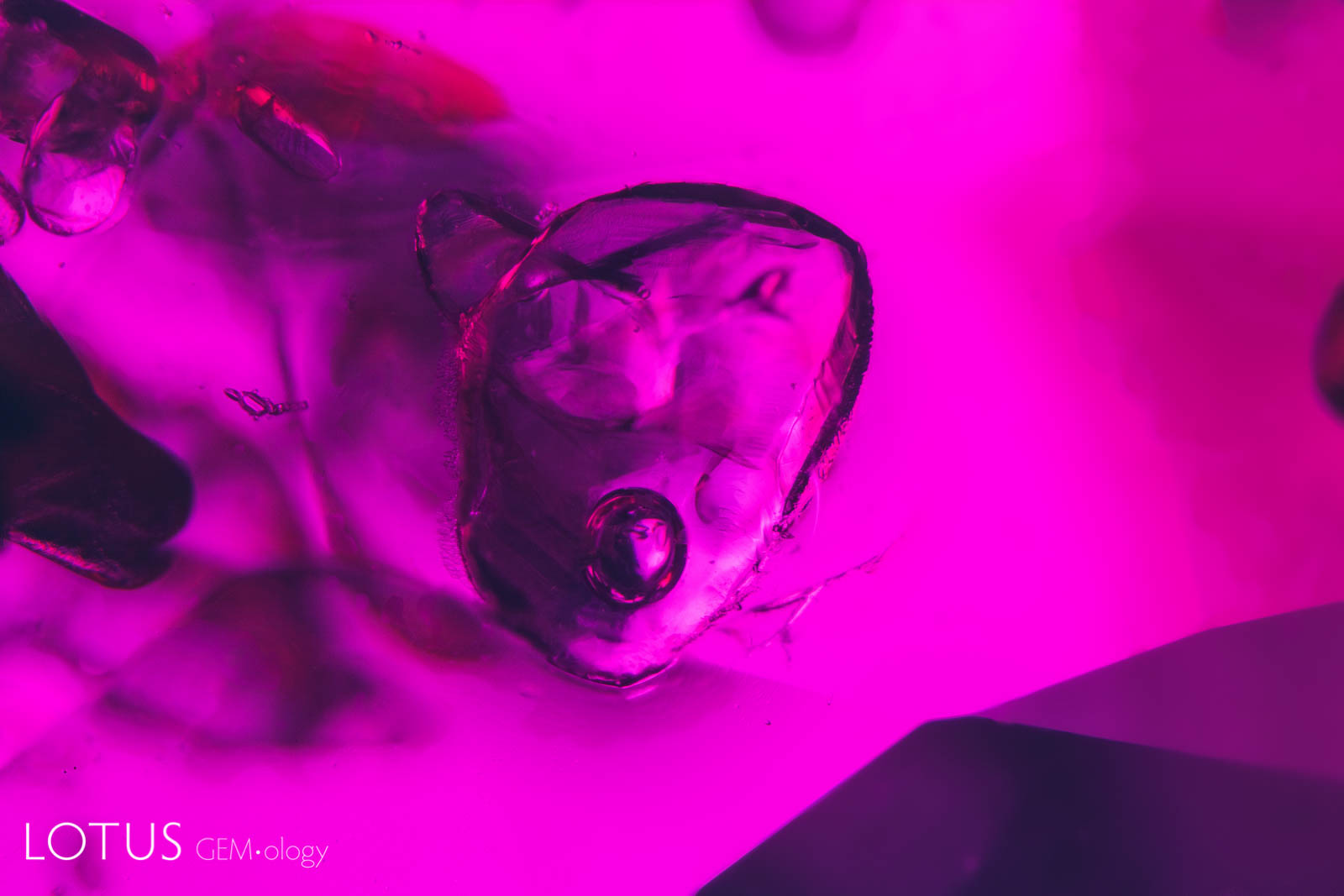
A melted crystal with a frozen gas bubble betray the fact that this ruby from Madagascar was subjected to heat treatment. Note also the tension fracture around the crystal, resulting from the crystal’s expansion during heat treatment.
Natural Ruby •
Madagascar •
Enhancements:
Heat (H) •
Lighting Conditions:
Fiber Optic: Oblique
Photographer:
Richard W. Hughes •
Image Number:
A-001-5255-1
Dark orange primary rutile crystals are seen against a backdrop of smaller rounded zircon crystals. This combination rules out Mozambique as an origin, thus showing that this ruby is from Ambodivoahangy, Madagascar. The undamaged nature of the zircons also tells us the stone has not been heat-treated at a high temperature.
Natural Ruby •
Madagascar •
Enhancements:
None Detected (None) •
Lighting Conditions:
Dark Field
Photographer:
Richard W. Hughes •
Image Number:
A-001-3535-1
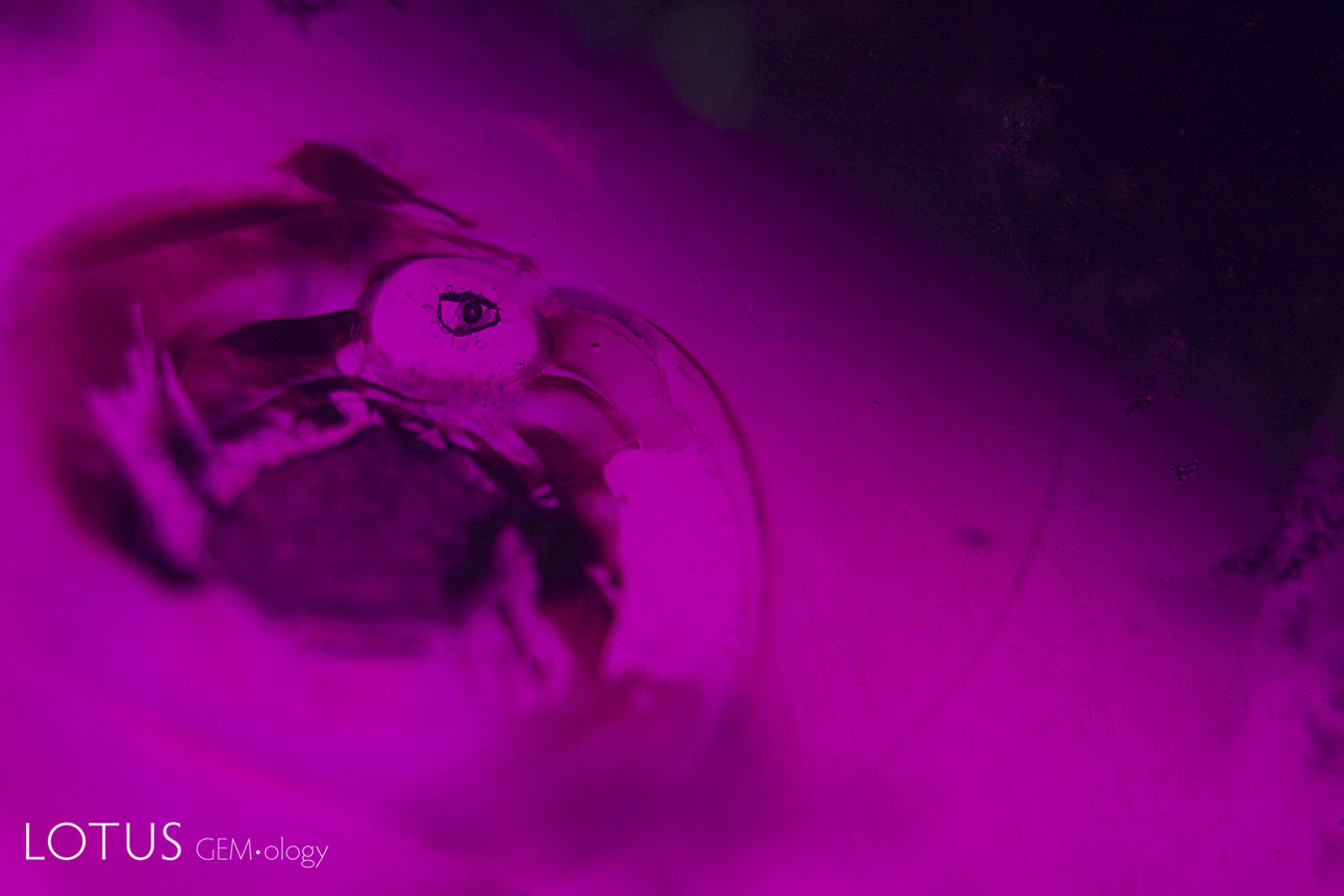
A mobile bubble within a negative crystal in a ruby from Madagascar. Such inclusions cannot withstand heat treatment and thus are proof of natural origin.
Natural Ruby •
Madagascar •
Enhancements:
None Detected (None) •
Lighting Conditions:
Fiber Optic: Transmitted
Photographer:
E. Billie Hughes •
Image Number:
A-001-2388-2
A mobile bubble within a negative crystal in a ruby from Madagascar. Such inclusions cannot withstand heat treatment and thus are proof of natural origin.
Natural Ruby •
Madagascar •
Enhancements:
None Detected (None) •
Lighting Conditions:
Fiber Optic: Transmitted
Photographer:
E. Billie Hughes •
Image Number:
A-001-2388-1
A slender amphibole rod perches next to a secondary healed fissure (’fingerprint’) in this untreated ruby from Ambodivoahangy, Madagascar.
Natural Ruby •
Madagascar •
Enhancements:
None Detected (None) •
Lighting Conditions:
Fiber Optic: Oblique
Photographer:
Richard W. Hughes •
Image Number:
A-001-2162-1
Madagascar ruby inclusions may include mineral crystals, rutile silk, healed fissures, fluid inclusions, negative crystals, color zoning and other features formed during or after crystal growth. Such features are important to gemologists because they can provide evidence useful in identifying ruby and evaluating a possible Madagascar origin.
Madagascar Ruby Inclusion Photomicrographs
The Hyperion Madagascar ruby gallery includes microscopic features documented in rubies from Madagascar. Each entry is accompanied by descriptive information and, where available, references to the gemological literature.
What Inclusions Can Reveal About Madagascar Ruby
Inclusions are an important part of geographic origin determination in ruby. Their form, composition, orientation and associations can provide evidence that, when considered together with other gemological properties, may support or contradict a Madagascar origin.
Hyperion combines inclusion photomicrography with supporting gemological information so that individual features can be compared with documented examples from Madagascar rubies.
About Hyperion
Hyperion is the Lotus Gemology searchable inclusion database. It allows users to browse gemstone inclusions by gem type, geographic origin, treatment and keyword.