Madagascar Ruby Inclusions
Explore Madagascar ruby inclusions in Hyperion, the Lotus Gemology inclusion database. Hyperion contains photomicrographs of inclusions and internal features in natural rubies from Madagascar, documented with information on treatment, lighting conditions, field of view, photographer and published references.
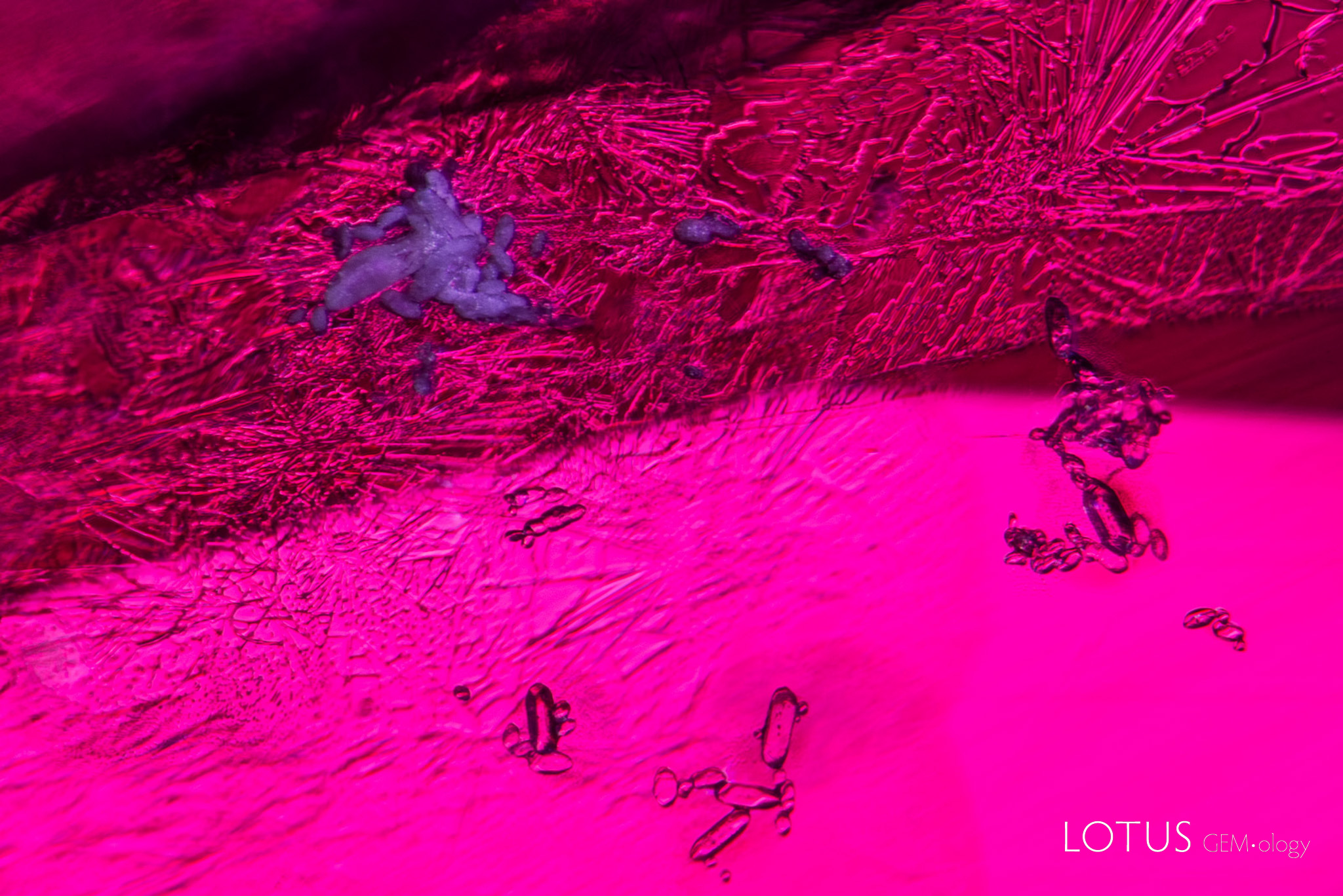
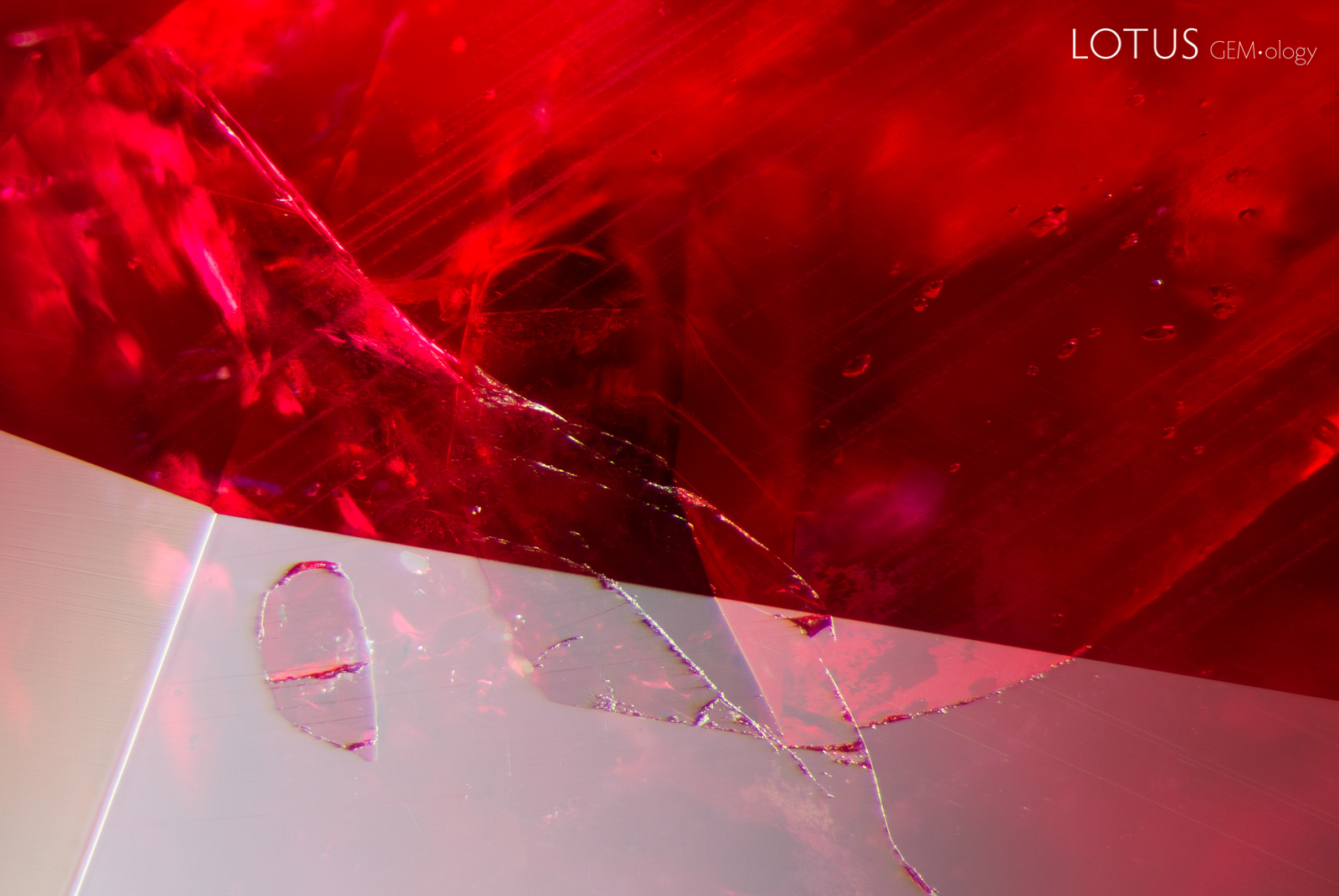
When a gem is heated, certain inclusion may dissolve or melt. In this case, it appears that the white crystals have dissolved/melted, creating a dendrite-like healing pattern in the surrounding fissure. Also visible are clusters of small crystals of what is probably zircon.
Natural Ruby •
Madagascar •
Enhancements:
Heat (H) •
Lighting Conditions:
Dark Field + Diffused Light
Photographer:
Wimon Manorotkul •
Image Number:
A-004-6703-1
• Field of View = 3mm
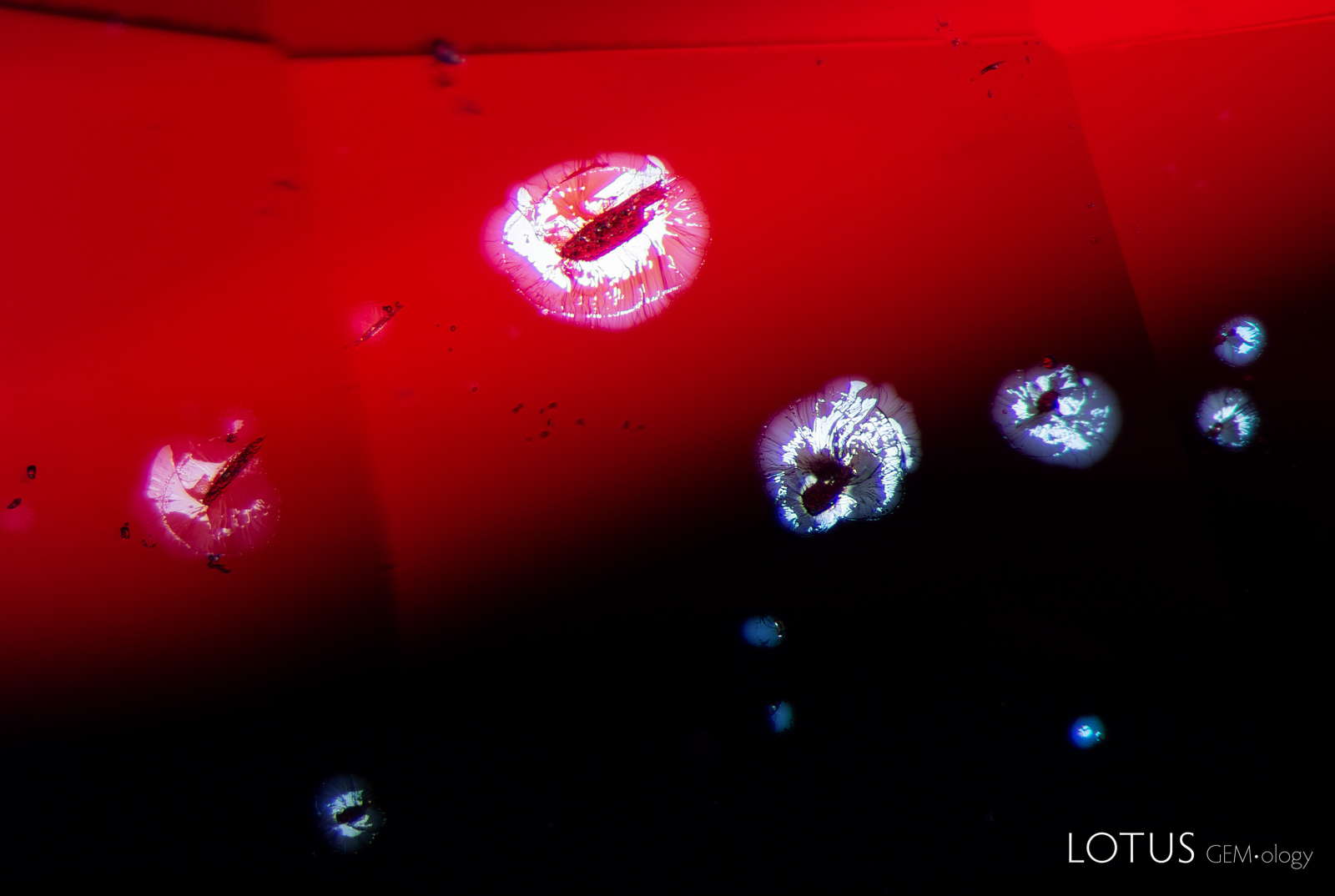
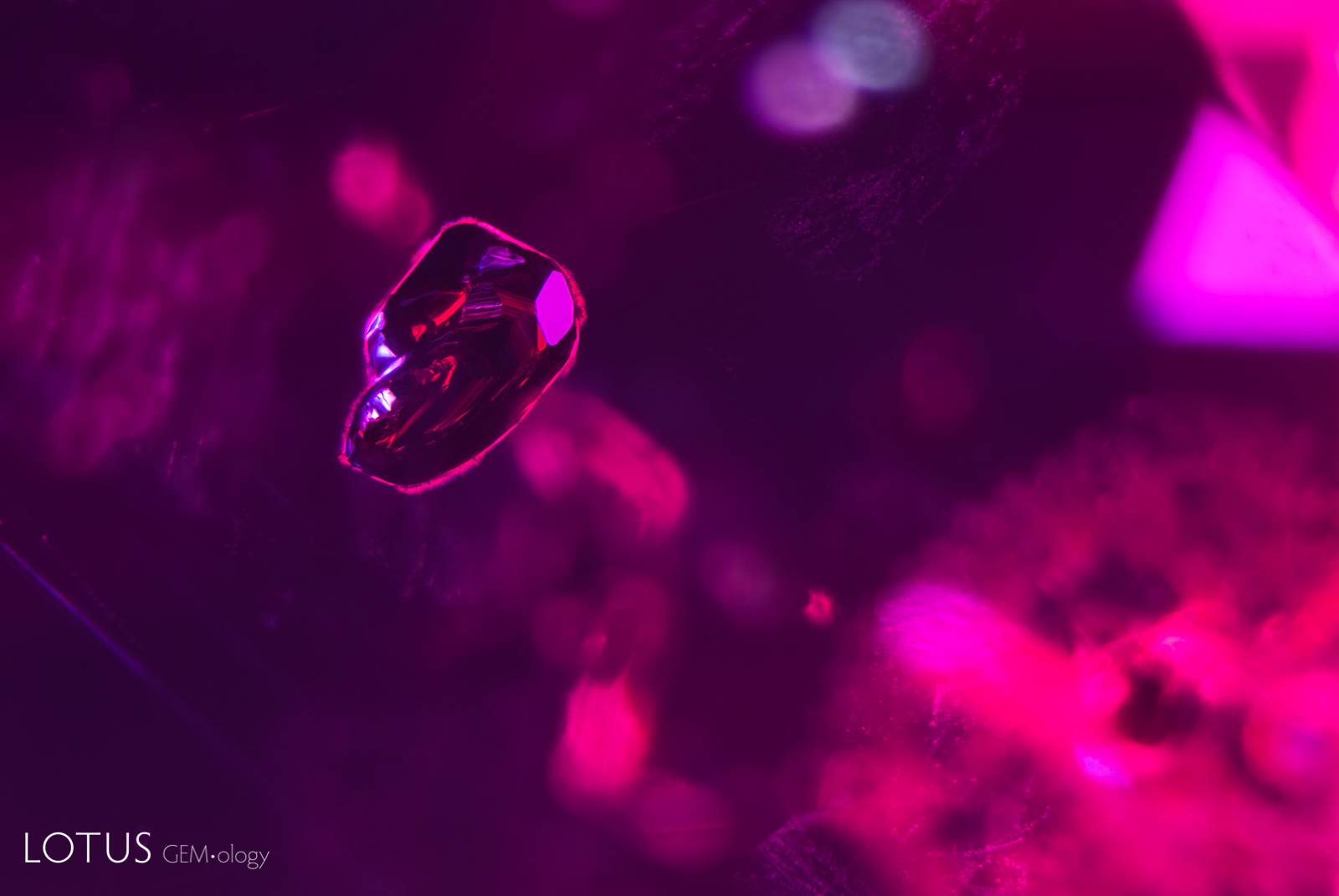
Several crystals in this ruby from Madagascar are surrounded by small reflective fissures.
Natural Ruby •
Madagascar •
Enhancements:
Heat (H) •
Lighting Conditions:
Dark Field + Diffuse Fiber Optic
Photographer:
E. Billie Hughes •
Image Number:
A-004-3304-2
• Field of View = 6mm
Hughes, R.W., Manorotkul, W. and Hughes, E.B. (2017) Ruby & Sapphire: A Gemologist's Guide. Bangkok, Lotus Publishing, 816 pp.; RWHL*.
Hughes, R.W., Manorotkul, W. et al. (2015) Let it bleed: New rubies from Madagascar. Bangkok, Lotus Gemology Co. Ltd., RWHL*.
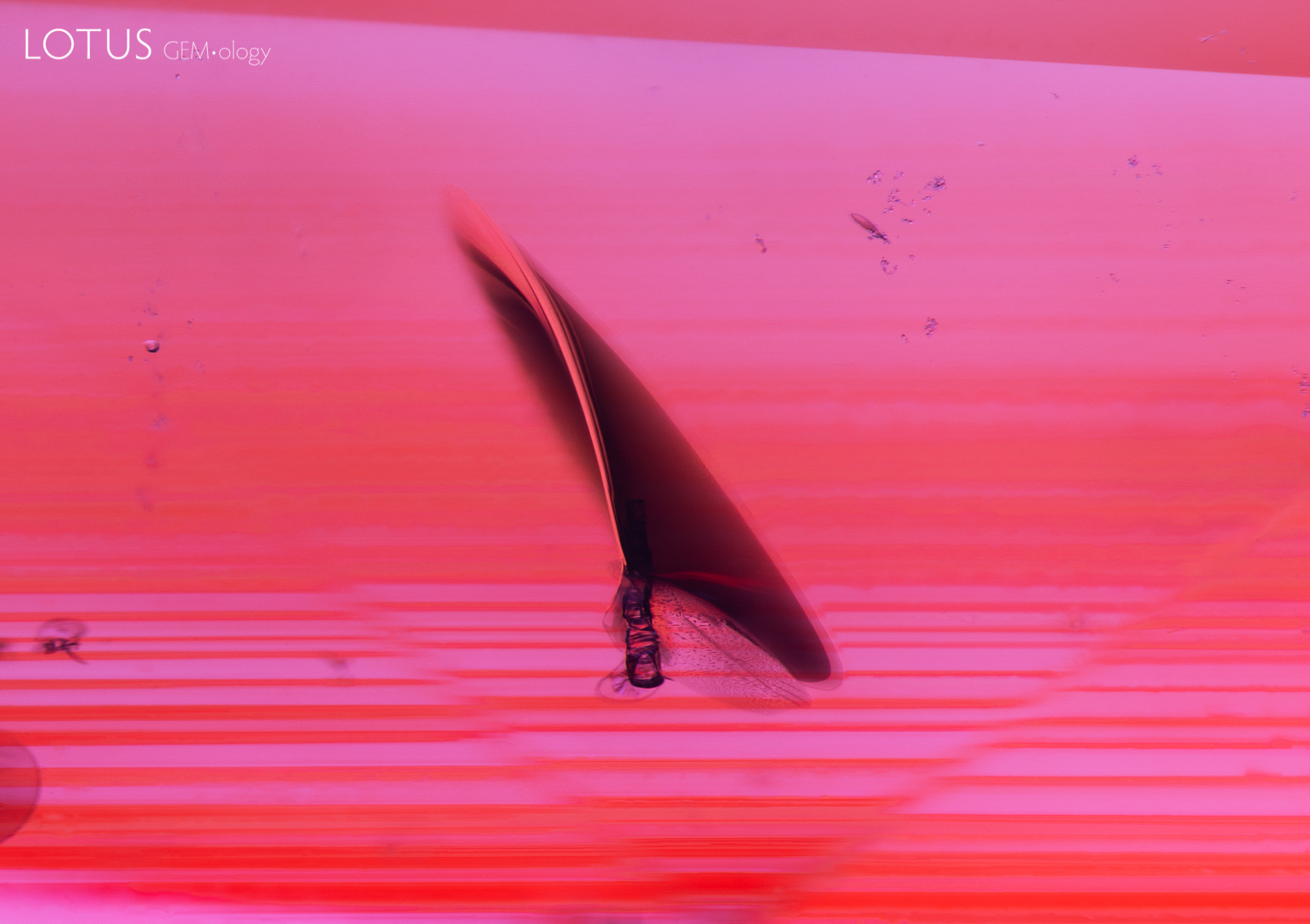
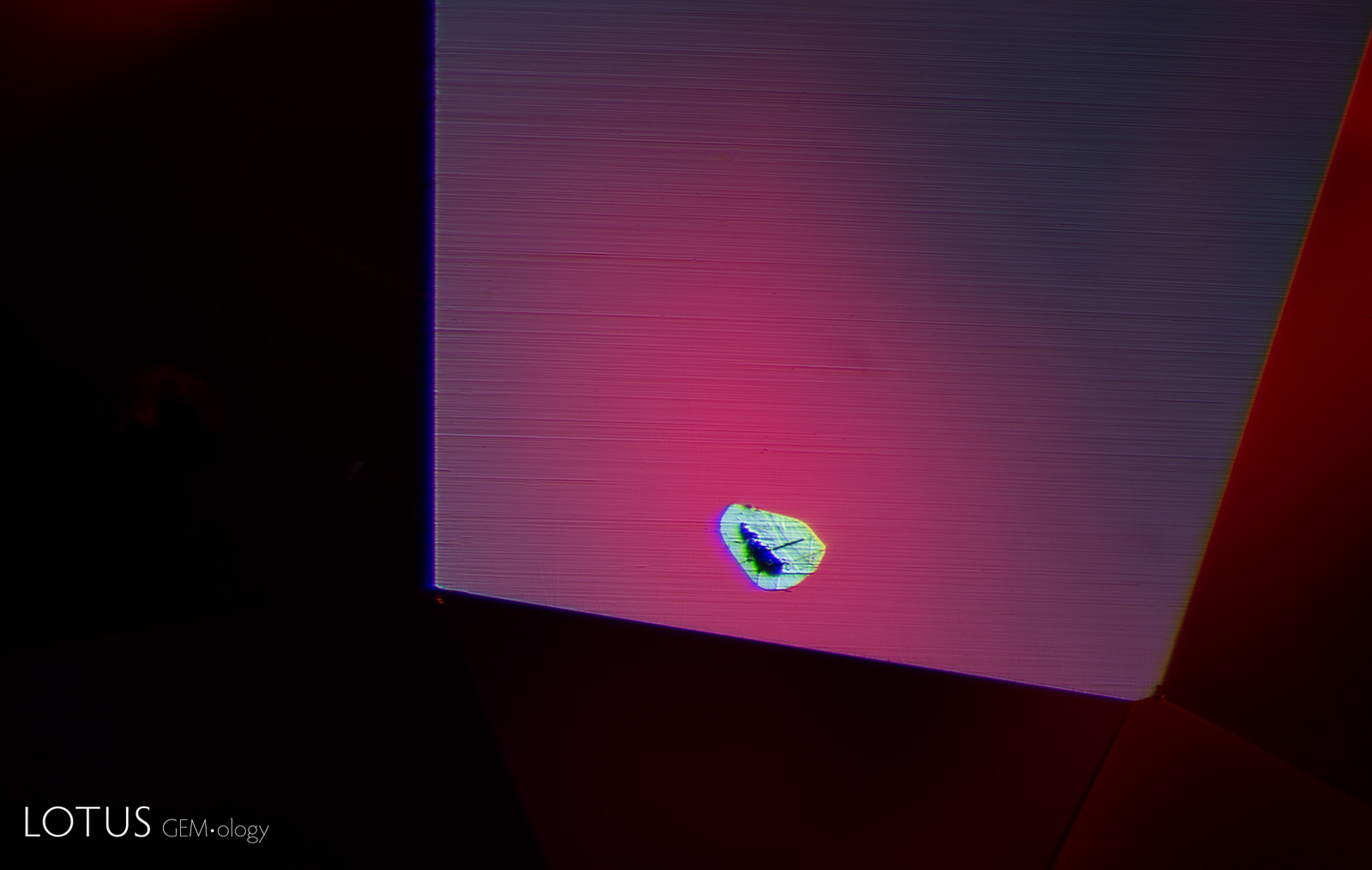
A small crystal with a shiny discoid attached can be seen clearly against a backdrop of orange color zoning in this ruby from Madagascar.
Natural Ruby •
Madagascar •
Enhancements:
Heat (H) •
Lighting Conditions:
Diffuse Light Field + Blue Filter
Photographer:
E. Billie Hughes •
Image Number:
A-004-3304-1
• Field of View = 5mm
Hughes, R.W., Manorotkul, W. and Hughes, E.B. (2017) Ruby & Sapphire: A Gemologist's Guide. Bangkok, Lotus Publishing, 816 pp.; RWHL*.
Hughes, R.W., Manorotkul, W. et al. (2015) Let it bleed: New rubies from Madagascar. Bangkok, Lotus Gemology Co. Ltd., RWHL*.
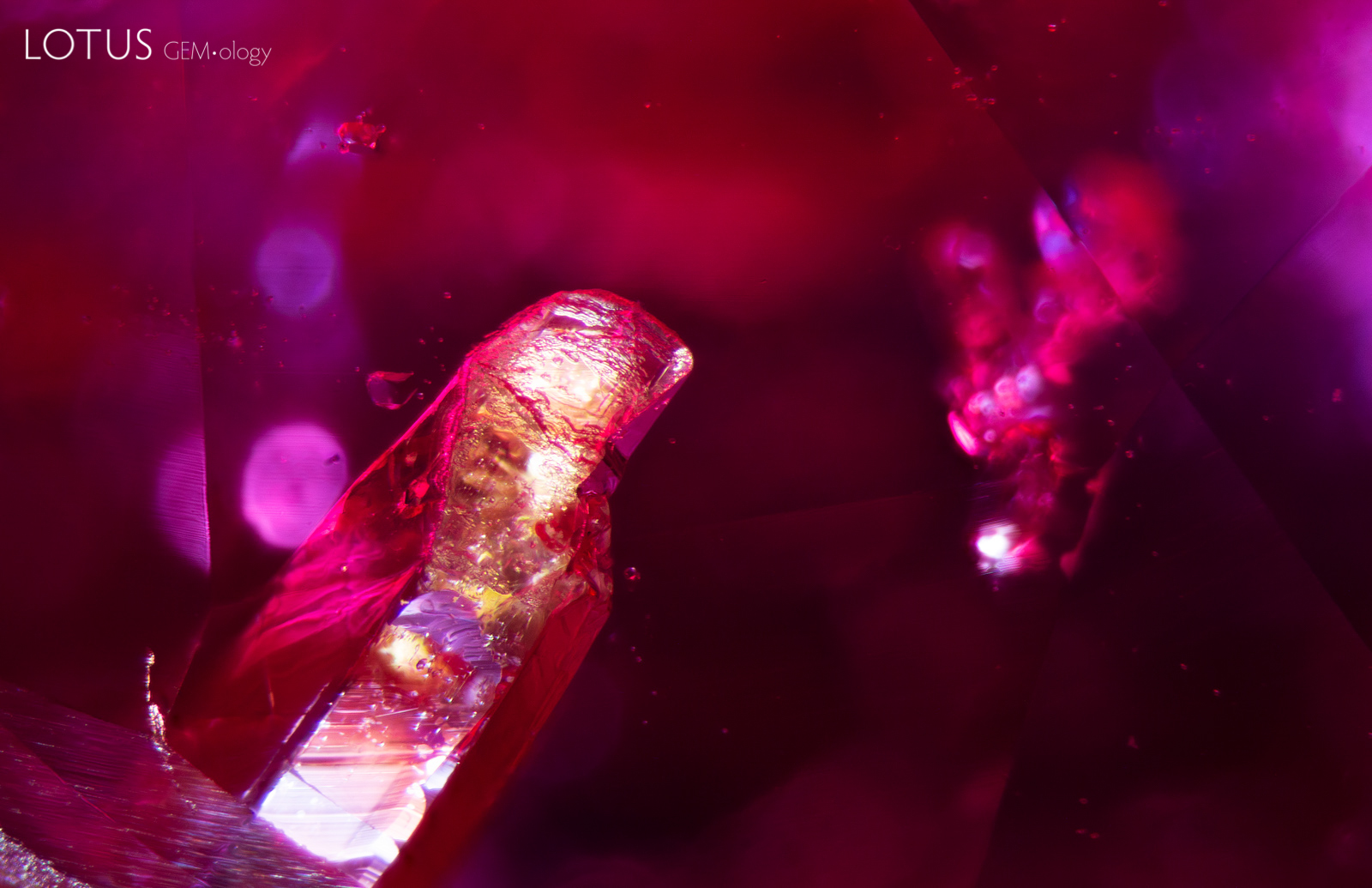
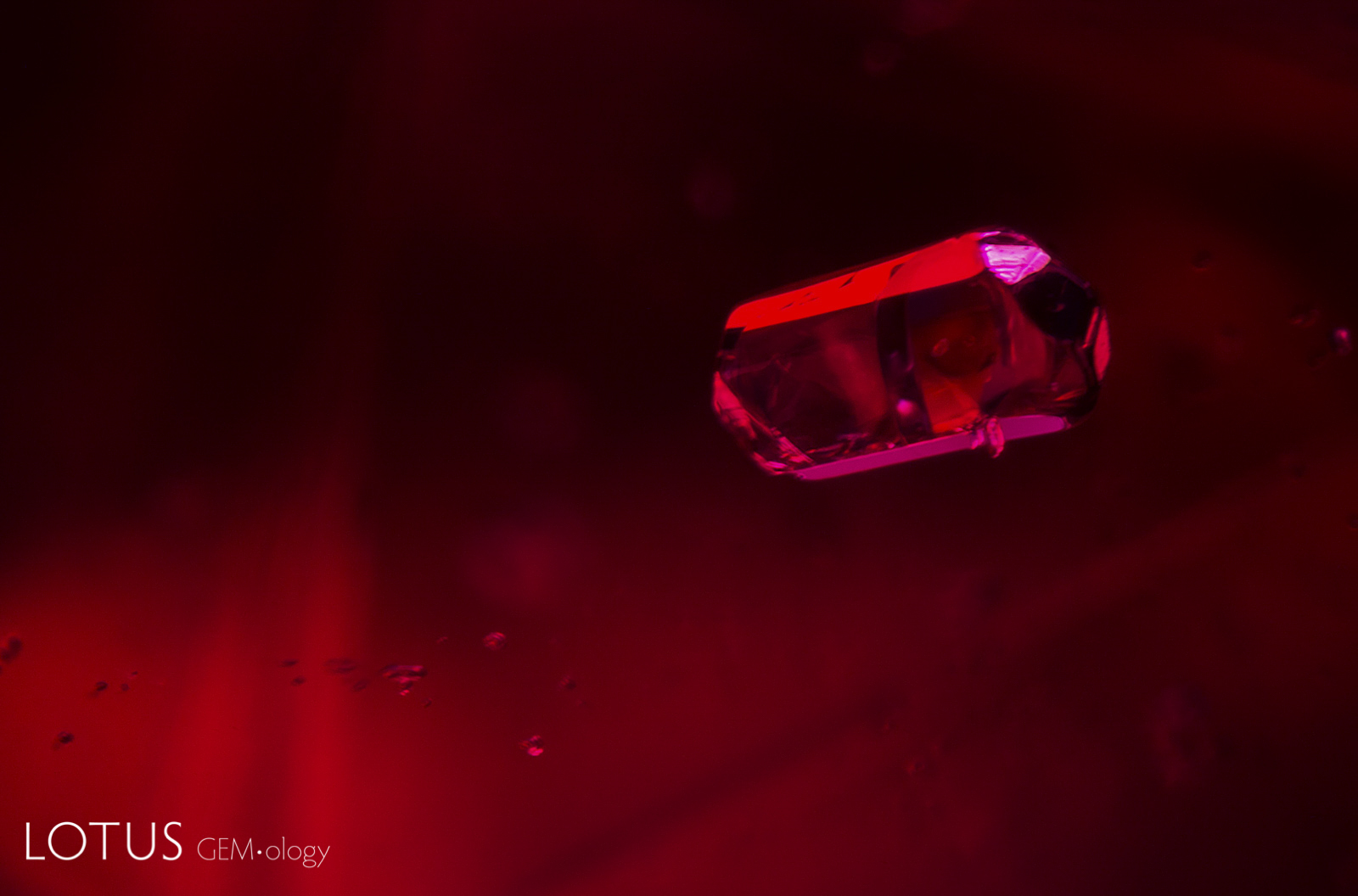
The pictured Madagascar ruby contains a prismatic yellow crystal. Micro Raman analysis identified this as apatite. Apatite is found in corundum from many localities.
Natural Ruby •
Madagascar •
Enhancements:
None Detected (None) •
Lighting Conditions:
Dark Field + Diffuse Fiber Optic
Photographer:
E. Billie Hughes •
Image Number:
A-004-0167-1
• Field of View = 2.5mm
Hughes, R.W., Manorotkul, W. and Hughes, E.B. (2017) Ruby & Sapphire: A Gemologist's Guide. Bangkok, Lotus Publishing, 816 pp.; RWHL*.
Hughes, R.W., Manorotkul, W. et al. (2015) Let it bleed: New rubies from Madagascar. Bangkok, Lotus Gemology Co. Ltd., RWHL*.
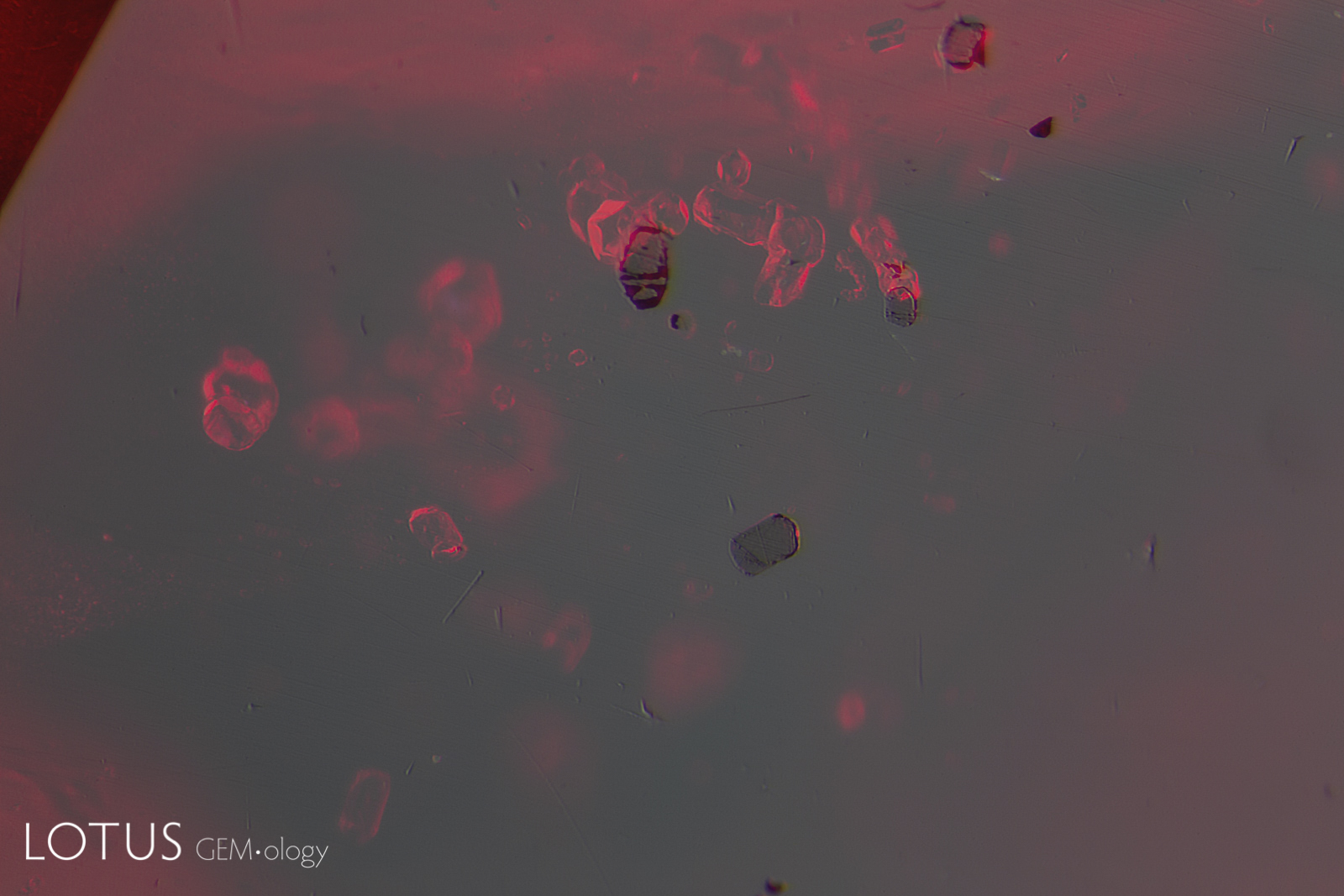
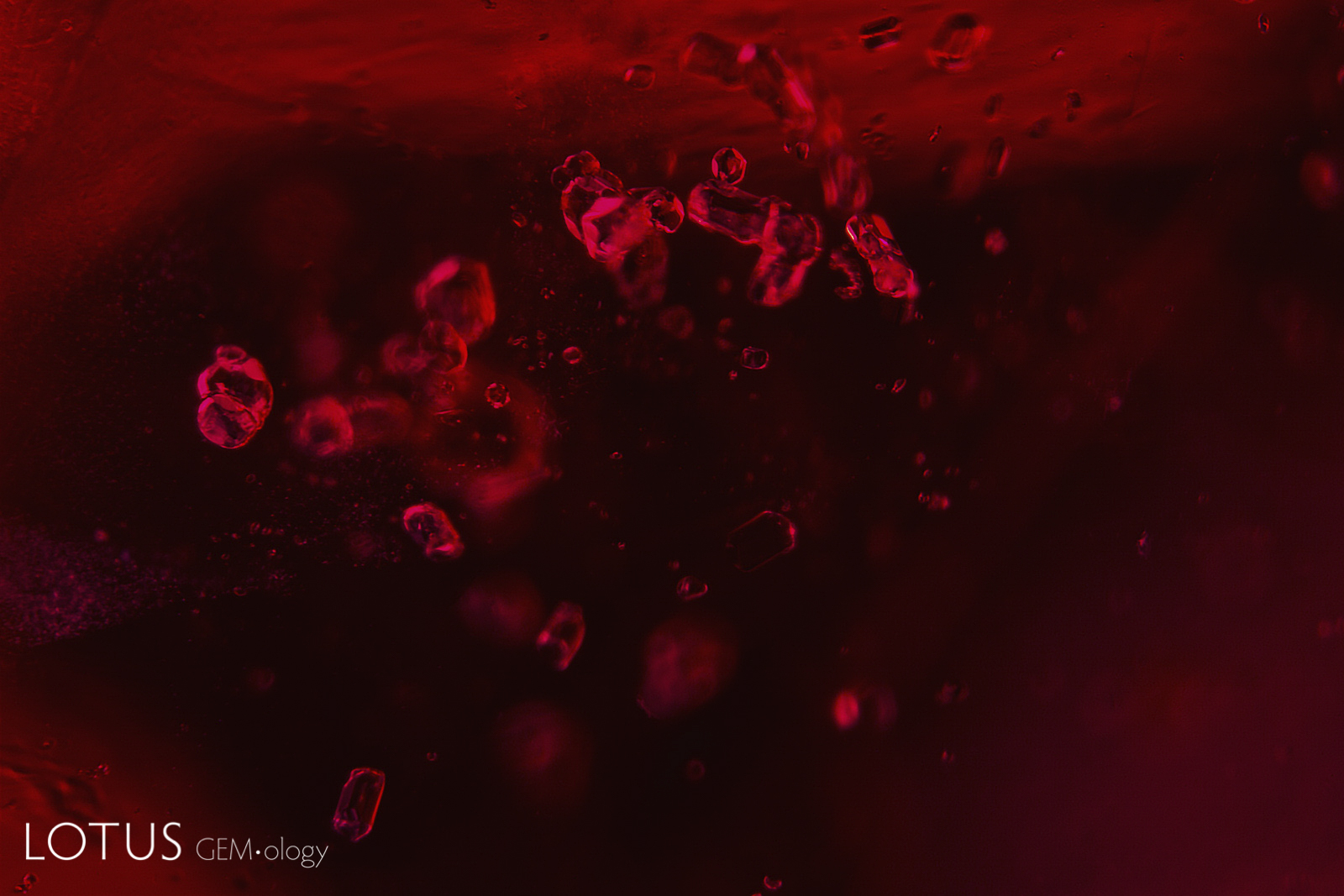
A variety of crystals were present in this Madagascar ruby, which we tested with micro Raman. Analysis revealed that the rounded crystal on the left is apatite, the large block crystal in the center is amphibole, and the small rounded crystals are zircon.
Natural Ruby •
Madagascar •
Enhancements:
None Detected (None) •
Lighting Conditions:
Dark Field + Diffuse Fiber Optic
Photographer:
E. Billie Hughes •
Image Number:
A-003-8316-1
• Field of View = 3mm
Hughes, R.W., Manorotkul, W. and Hughes, E.B. (2017) Ruby & Sapphire: A Gemologist's Guide. Bangkok, Lotus Publishing, 816 pp.; RWHL*.
Hughes, R.W., Manorotkul, W. et al. (2015) Let it bleed: New rubies from Madagascar. Bangkok, Lotus Gemology Co. Ltd., RWHL*.
A large negative crystal was cut through on the pavilion of this ruby and filled with debris. Its appearance makes for an imposing figure in this ruby from Madagascar.
Natural Ruby •
Madagascar •
Enhancements:
None Detected (None) •
Lighting Conditions:
Dark Field + Diffuse Fiber Optic
Photographer:
E. Billie Hughes •
Image Number:
A-003-7817-1
• Field of View = 3mm
Hughes, R.W., Manorotkul, W. and Hughes, E.B. (2017) Ruby & Sapphire: A Gemologist's Guide. Bangkok, Lotus Publishing, 816 pp.; RWHL*.
Hughes, R.W., Manorotkul, W. et al. (2015) Let it bleed: New rubies from Madagascar. Bangkok, Lotus Gemology Co. Ltd., RWHL*.
Zircon crystals like the ones captured here (ID confirmed with Raman spectroscopy) are a common feature in rubies from Madagascar.
Natural Ruby •
Madagascar •
Enhancements:
None Detected (None) •
Lighting Conditions:
Dark Field
Photographer:
E. Billie Hughes •
Image Number:
A-003-7490-1
• Field of View = 2mm
Hughes, R.W., Manorotkul, W. et al. (2015) Let it bleed: New rubies from Madagascar. Bangkok, Lotus Gemology Co. Ltd., RWHL*.
Hughes, R.W., Manorotkul, W. and Hughes, E.B. (2017) Ruby & Sapphire: A Gemologist's Guide. Bangkok, Lotus Publishing, 816 pp.; RWHL*.
In this ruby from Central Madagascar, we noticed a large number of prismatic crystals that resembled apatite. Micro Raman testing of four cut through on the surface confirmed that they were fluorapatite. Since apatite has yet to be found in rubies from Mozambique, this provides an excellent means of separation.
Natural Ruby •
Madagascar •
Enhancements:
None Detected (None) •
Lighting Conditions:
Dark Field + Diffuse Fiber Optic
Photographer:
E. Billie Hughes •
Image Number:
A-003-6339-3
• Field of View = 2mm
Hughes, R.W., Manorotkul, W. et al. (2015) Let it bleed: New rubies from Madagascar. Bangkok, Lotus Gemology Co. Ltd., RWHL*.
Hughes, R.W., Manorotkul, W. and Hughes, E.B. (2017) Ruby & Sapphire: A Gemologist's Guide. Bangkok, Lotus Publishing, 816 pp.; RWHL*.
In this ruby from Central Madagascar, we noticed a large number of prismatic crystals that resembled apatite. Micro Raman testing of four cut through on the surface confirmed that they were fluorapatite. Since apatite has yet to be found in rubies from Mozambique, this provides an excellent means of separation.
Natural Ruby •
Madagascar •
Enhancements:
None Detected (None) •
Lighting Conditions:
Dark Field + Diffuse Overhead Fiber Optic
Photographer:
R.W. Hughes •
Image Number:
A-003-6339-1
• Field of View = 2mm
Hughes, R.W., Manorotkul, W. et al. (2015) Let it bleed: New rubies from Madagascar. Bangkok, Lotus Gemology Co. Ltd., RWHL*.
Hughes, R.W., Manorotkul, W. and Hughes, E.B. (2017) Ruby & Sapphire: A Gemologist's Guide. Bangkok, Lotus Publishing, 816 pp.; RWHL*.
In this ruby from Central Madagascar, we noticed a large number of prismatic crystals that resembled apatite. Micro Raman testing of four cut through on the surface confirmed that they were fluorapatite. Since apatite has yet to be found in rubies from Mozambique, this provides an excellent means of separation.
Natural Ruby •
Madagascar •
Enhancements:
None Detected (None) •
Lighting Conditions:
Dark Field
Photographer:
R.W. Hughes •
Image Number:
A-003-6339-2
• Field of View = 2mm
Hughes, R.W., Manorotkul, W. et al. (2015) Let it bleed: New rubies from Madagascar. Bangkok, Lotus Gemology Co. Ltd., RWHL*.
Hughes, R.W., Manorotkul, W. and Hughes, E.B. (2017) Ruby & Sapphire: A Gemologist's Guide. Bangkok, Lotus Publishing, 816 pp.; RWHL*.
44 Total Images
Results: 1 – 12 | Page 1 of 4 Pages
Search the Complete Hyperion Database
Madagascar ruby inclusions may include mineral crystals, rutile silk, healed fissures, fluid inclusions, negative crystals, color zoning and other features formed during or after crystal growth. Such features are important to gemologists because they can provide evidence useful in identifying ruby and evaluating a possible Madagascar origin.
Madagascar Ruby Inclusion Photomicrographs
The Hyperion Madagascar ruby gallery includes microscopic features documented in natural rubies from Madagascar. Each entry is accompanied by descriptive information and, where available, references to the gemological literature.
What Inclusions Can Reveal About Madagascar Ruby
Inclusions are an important part of geographic origin determination in ruby. Their form, composition, orientation and associations can provide evidence that, when considered together with other gemological properties, may support or contradict a Madagascar origin.
Hyperion combines inclusion photomicrography with supporting gemological information so that individual features can be compared with documented examples from Madagascar rubies.
About Hyperion
Hyperion is the Lotus Gemology searchable inclusion database. It allows users to browse gemstone inclusions by gem type, geographic origin, treatment and keyword.