Synthetic Ruby Inclusions
Explore Ruby inclusions in Hyperion, the Lotus Gemology inclusion database. Hyperion contains photomicrographs of inclusions and internal features in natural Ruby, documented with information on geographic origin, treatment, lighting conditions, field of view, photographer and published references.
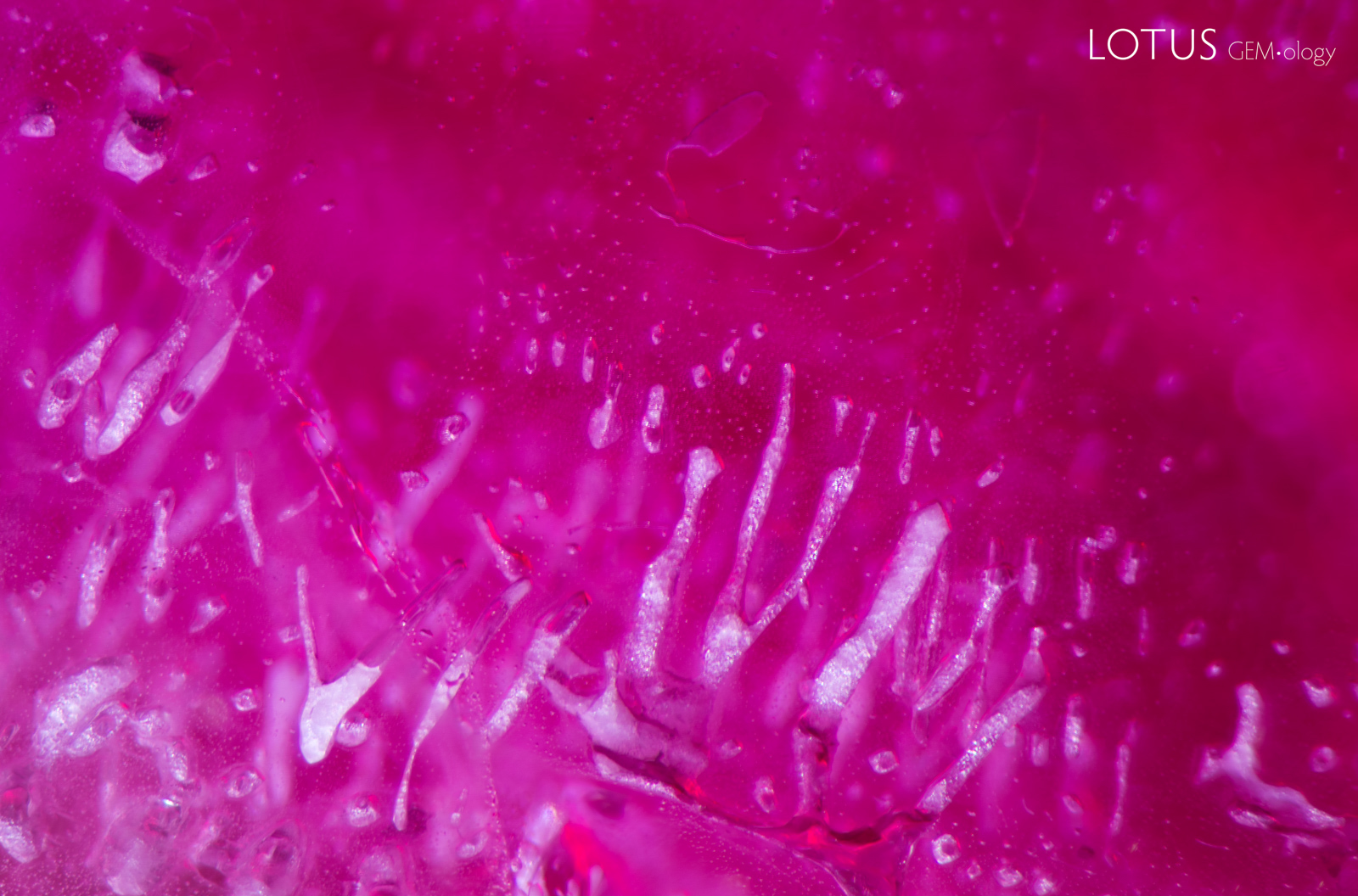
Frosty “flux icicles” in a heated flux grown synthetic ruby.
Synthetic Ruby •
Flux •
Enhancements:
Heat (H) •
Lighting Conditions:
Dark Field + Diffuse Fiber Optic
Photographer:
E. Billie Hughes •
Image Number:
A-005-4964-3
• Field of View = 2.8mm
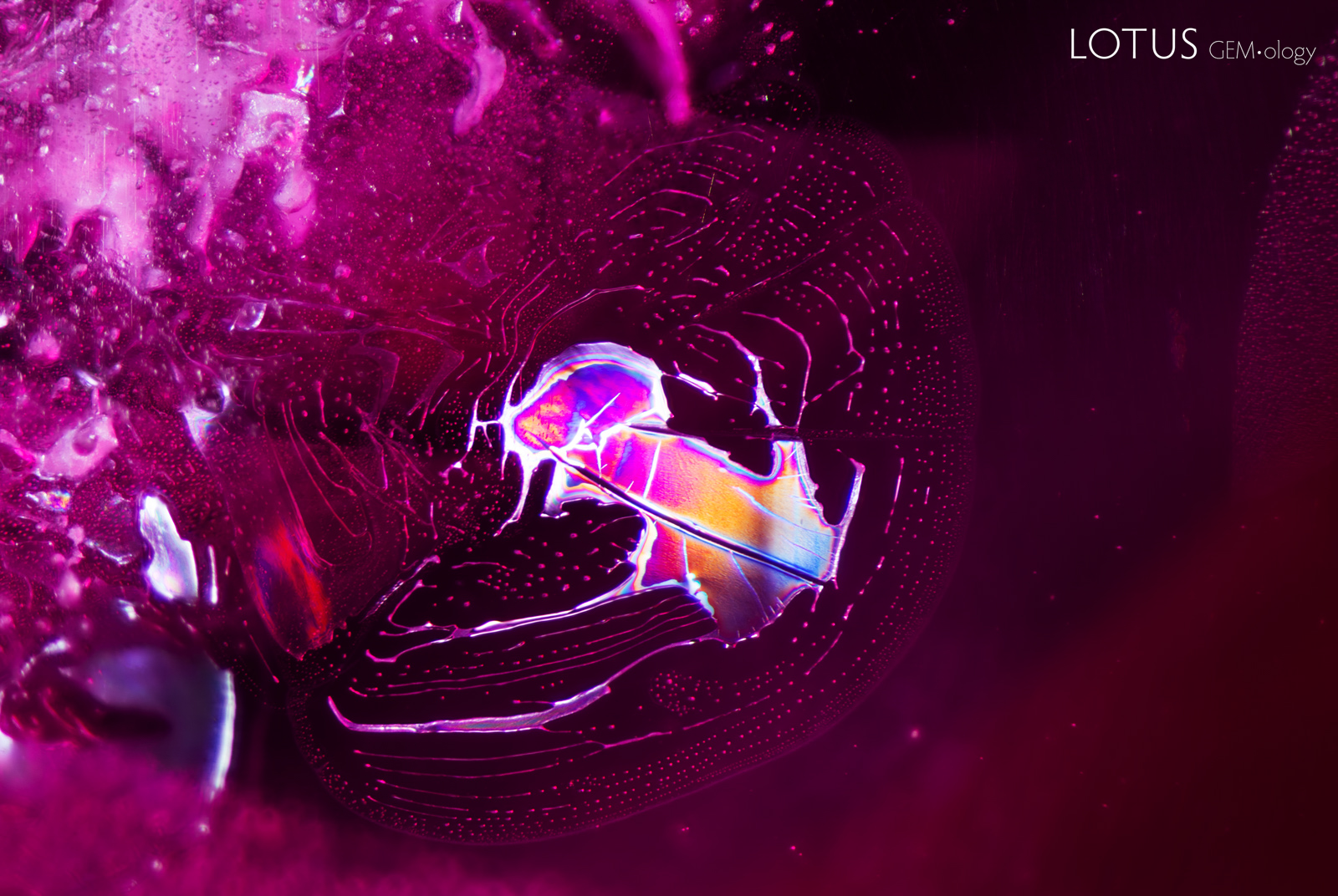
A melted fingerprint with drippy channels in a heated flux grown synthetic ruby.
Synthetic Ruby •
Flux •
Enhancements:
Heat (H) •
Lighting Conditions:
Dark Field + Diffuse Fiber Optic
Photographer:
E. Billie Hughes •
Image Number:
A-005-4964-2
• Field of View = 2.8mm
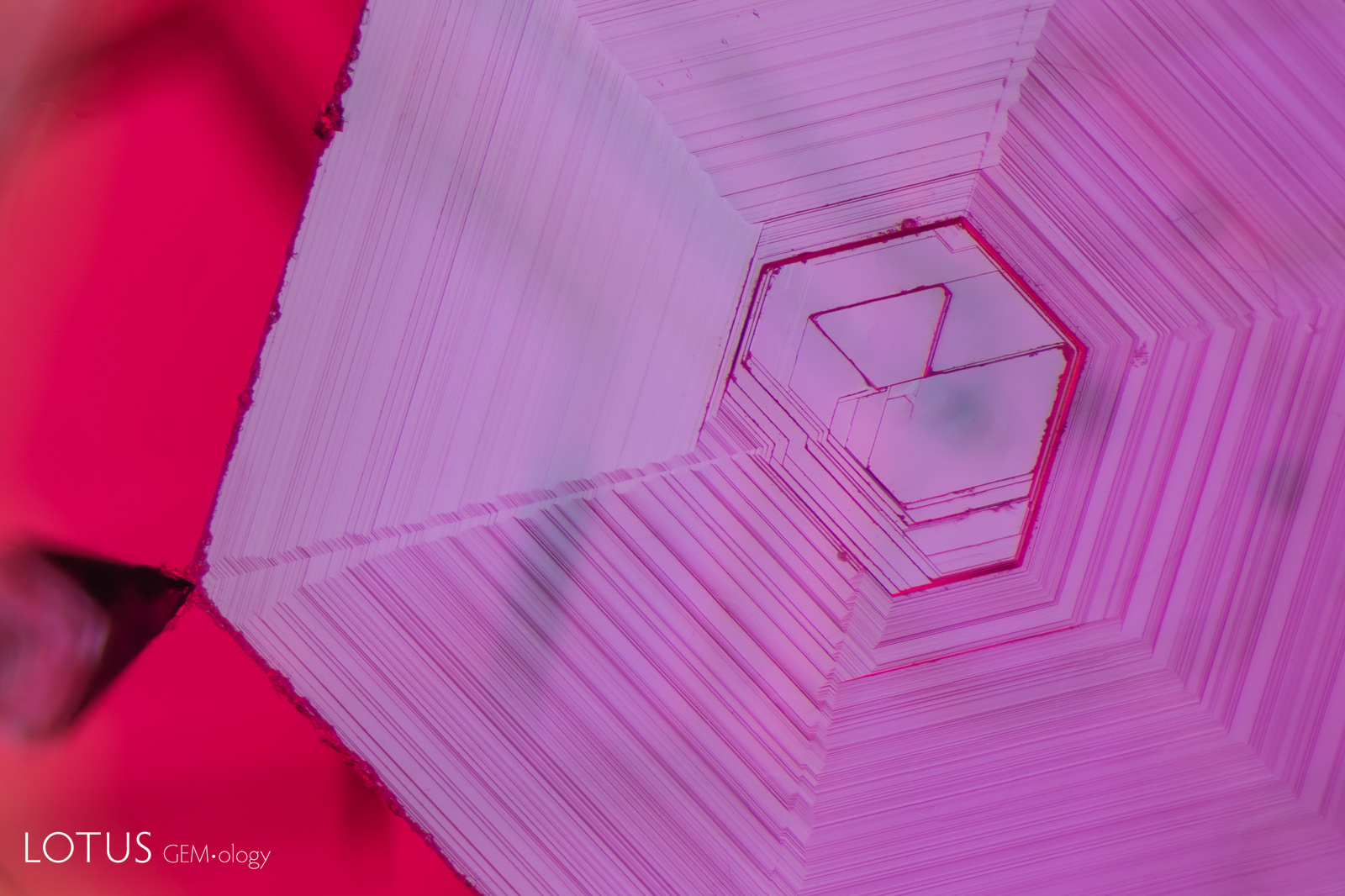
Not all synthetic rubies have curved growth zoning. This Ramaura flux synthetic shows angular growth markings on its surface. Specimen courtesy Nicolas Francfort.
Synthetic Ruby •
Flux •
Enhancements:
None Detected (None) •
Lighting Conditions:
Diffuse Light Field + Fiber Optic
Photographer:
E. Billie Hughes •
Image Number:
R-005-0512-1
• Field of View = 3.6mm
Triangular growth zoning and orangey red flux crystals are a hallmark of flux synthetic ruby. This sample was produced by Ramaura. Specimen courtesy Nicolas Francfort.
Synthetic Ruby •
Flux •
Enhancements:
None Detected (None) •
Lighting Conditions:
Diffuse Light Field + Fiber Optic
Photographer:
E. Billie Hughes •
Image Number:
R-005-0513-2
• Field of View = 3.6mm
Triangular growth zoning and orangey red flux crystals are a hallmark of flux synthetic ruby. This sample was produced by Ramaura. Specimen courtesy Nicolas Francfort.
Synthetic Ruby •
Flux •
Enhancements:
None Detected (None) •
Lighting Conditions:
Diffuse Light Field + Fiber Optic
Photographer:
E. Billie Hughes •
Image Number:
R-005-0513-1
• Field of View = 3mm
Smoke-like wisps in a Seiko synthetic ruby.
Synthetic Ruby •
Floating Zone •
Enhancements:
None Detected (None) •
Lighting Conditions:
Dark Field
Photographer:
E. Billie Hughes •
Image Number:
R-001-6520-1
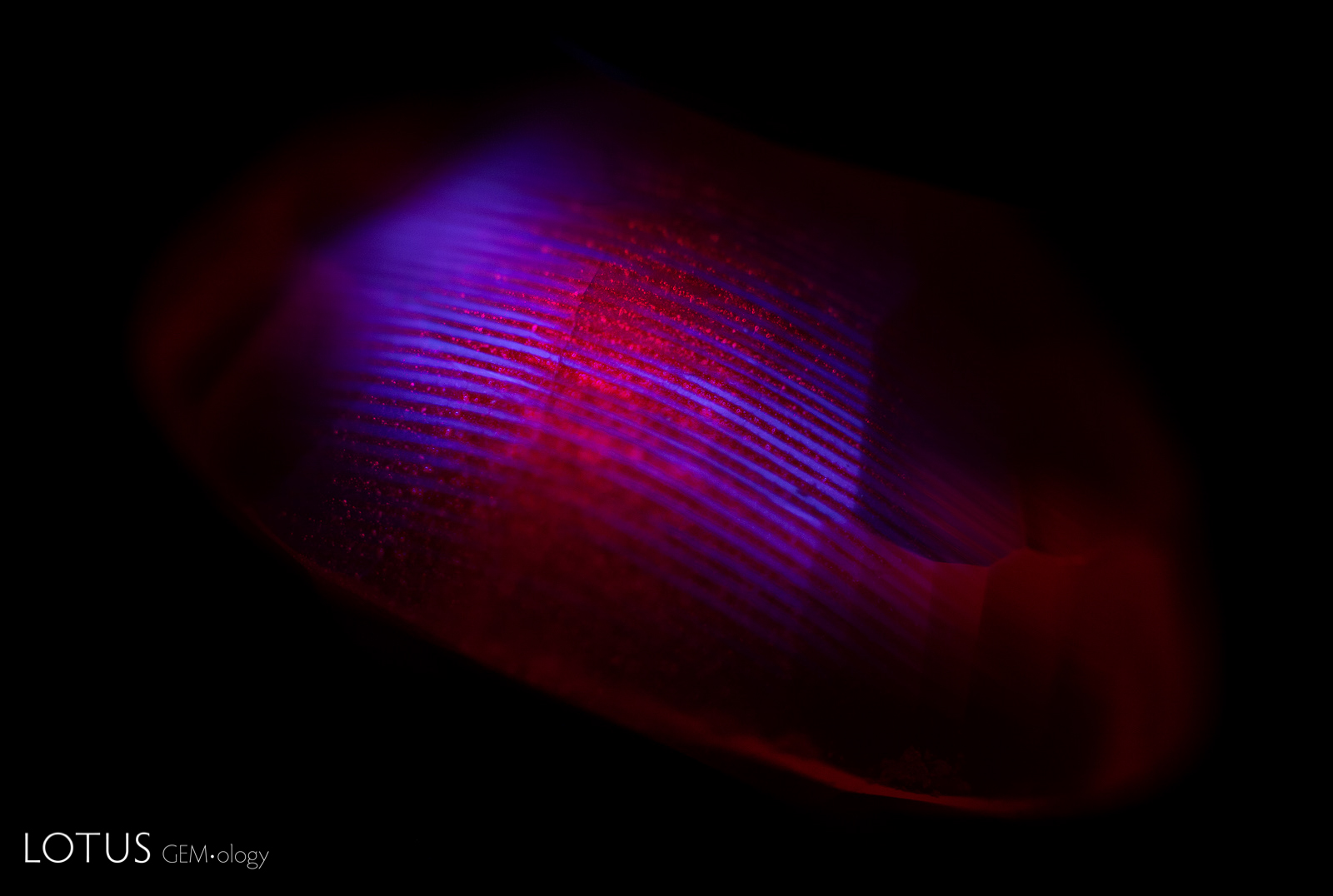
The curved striae in this synthetic ruby become clear when the stone is viewed under shortwave ultraviolet illumination. Between the striae streams of gas bubbles can also be observed.
Synthetic Ruby •
Verneuil •
Enhancements:
None Detected (None) •
Lighting Conditions:
Ultraviolet: Shortwave
Photographer:
E. Billie Hughes •
Image Number:
A-004-8739-1
While straight growth zoning is often seen as a sign that corundum is natural, this is not always. This flux synthetic ruby displays sharp straight growth zoning.
Synthetic Ruby •
Flux •
Enhancements:
None Detected (None) •
Lighting Conditions:
Dark Field
Photographer:
E. Billie Hughes •
Image Number:
A-003-9684-3
• Field of View = 4mm
Whitish, flux filled cavities in a flux synthetic ruby display a melted appearance.
Synthetic Ruby •
Flux •
Enhancements:
None Detected (None) •
Lighting Conditions:
Diffuse Light Field + Fiber Optic
Photographer:
E. Billie Hughes •
Image Number:
A-003-9684-2
• Field of View = 2mm
A string of small flux filled cavities stands out in this flux synthetic ruby.
Synthetic Ruby •
Flux •
Enhancements:
None Detected (None) •
Lighting Conditions:
Light Field (Transmitted Light)
Photographer:
E. Billie Hughes •
Image Number:
A-003-9684-1
• Field of View = 2mm
The curved striae and gas bubbles present here are a tell-tale sign that this ruby is a Verneuil synthetic.
Synthetic Ruby •
Verneuil •
Enhancements:
None Detected (None) •
Lighting Conditions:
Dark Field
Photographer:
E. Billie Hughes •
Image Number:
A-003-8043-2
• Field of View = 2mm
Curved striae reveal the true nature of this Verneuil flame fusion synthetic ruby.
Synthetic Ruby •
Verneuil •
Enhancements:
None Detected (None) •
Lighting Conditions:
Diffuse Light Field + Immersion
Photographer:
E. Billie Hughes •
Image Number:
A-002-3096-1
Hughes, R.W. and Koivula, J. (2005) Dangerous curves: Verneuil synthetic corundum. Bangkok, Lotus Gemology; RWHL.
Synthetic Ruby inclusions may include curved striae, curved color banding, gas bubbles, healed fissures, Plato lines, twinning, platinum plates, rain-like flux, primary flux and other features formed during or after crystal growth. Such features are important to gemologists because they can provide evidence useful in identifying Ruby, understanding its geological history, recognizing treatment and, in some cases, determining geographic origin.
Synthetic Ruby Inclusion Photomicrographs
The Hyperion natural Ruby gallery includes microscopic features found in rubies from major deposits around the world. Each entry is accompanied by descriptive information and, where available, references to the gemological literature.
What Inclusions Can Reveal About Synthetic Ruby
Inclusions are an important part of Ruby identification. Their form, composition, orientation and alteration can help gemologists distinguish natural Ruby from synthetic material, recognize evidence of heat treatment, and study the geological environment in which the Ruby formed.
Hyperion combines inclusion photomicrography with supporting gemological information so that individual features can be compared with documented examples from known Ruby deposits.
About Hyperion
Hyperion is the Lotus Gemology searchable inclusion database. It allows users to browse gemstone inclusions by gem type, geographic origin, treatment and keyword.