Synthetic Ruby Inclusions
Explore Ruby inclusions in Hyperion, the Lotus Gemology inclusion database. Hyperion contains photomicrographs of inclusions and internal features in natural Ruby, documented with information on geographic origin, treatment, lighting conditions, field of view, photographer and published references.
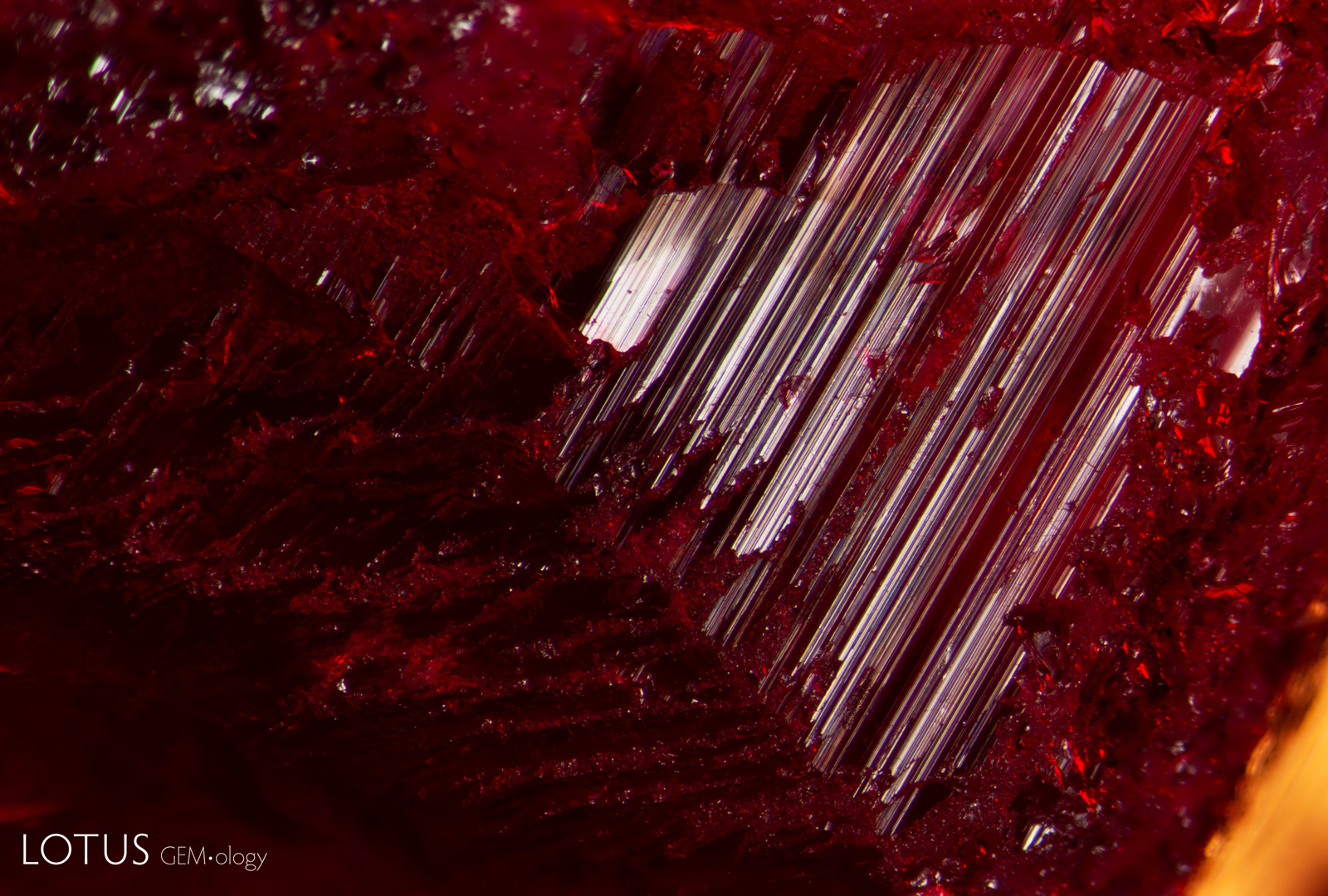
Curved striae and dark inclusions in a flame fusion synthetic ruby. The dark areas may be concentrations of coloring agents and alumina used in the growth process.
Synthetic Ruby •
Verneuil •
Enhancements:
None Detected (None) •
Lighting Conditions:
Dark Field
Photographer:
E. Billie Hughes •
Image Number:
A-005-9139-2
• Field of View = 3.6mm
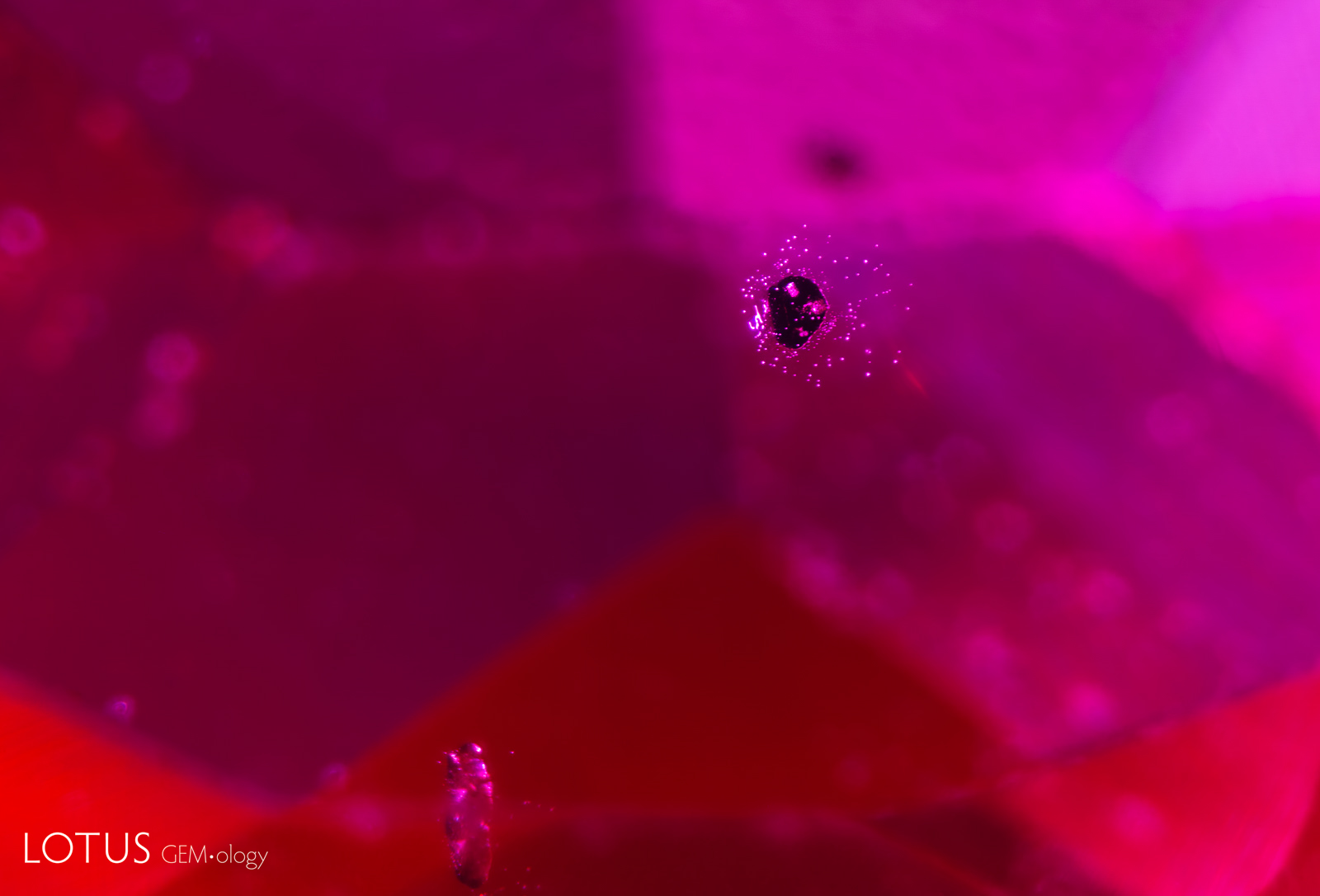
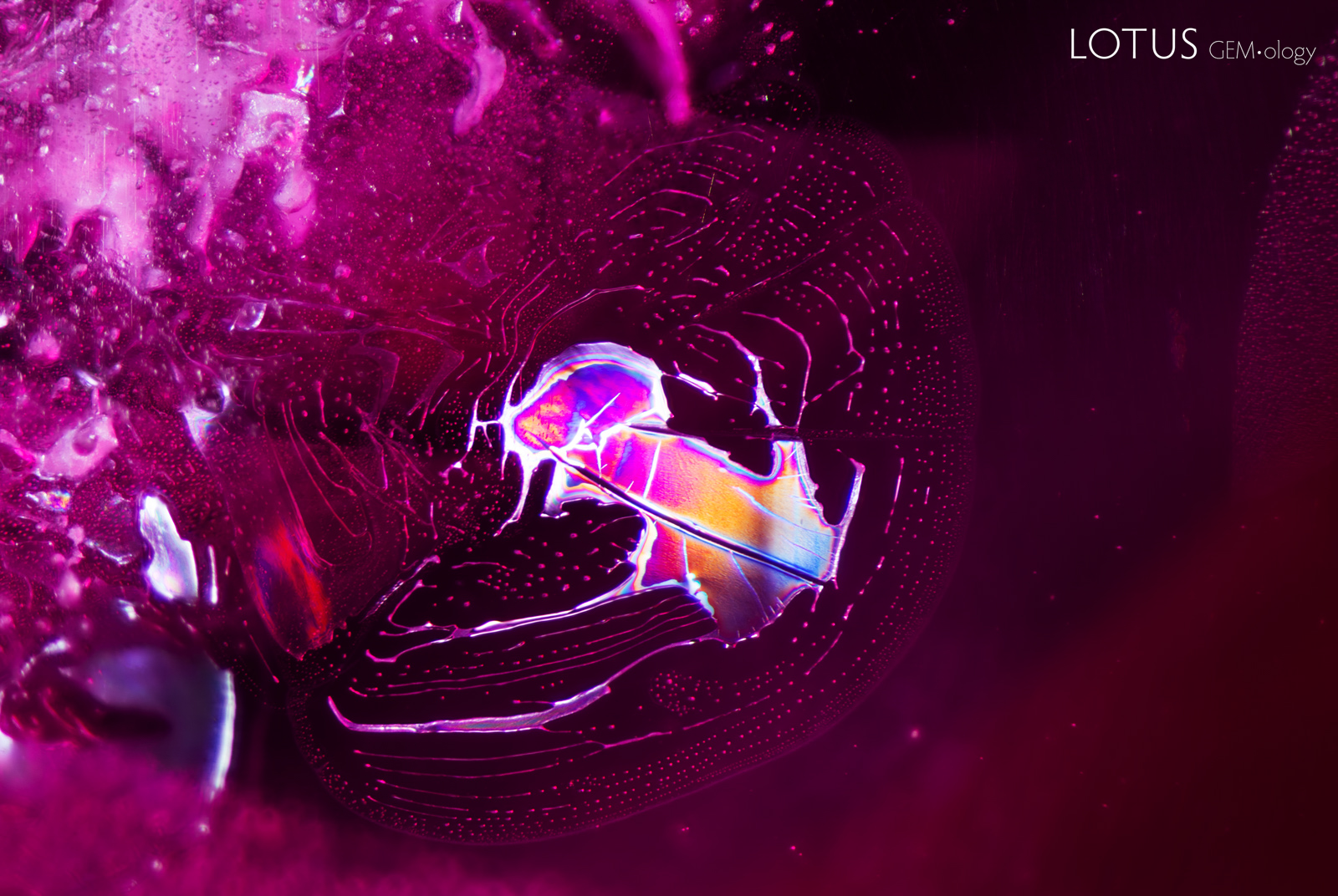
A dark platelet surrounded by gas bubbles in a flame fusion synthetic ruby. This platelet may be a concentration of the chromium coloring agent and alumina used in the growth process.
Synthetic Ruby •
Verneuil •
Enhancements:
None Detected (None) •
Lighting Conditions:
Fiber Optic: Diffuse Oblique
Photographer:
E. Billie Hughes •
Image Number:
A-005-9139-1
• Field of View = 3.7mm
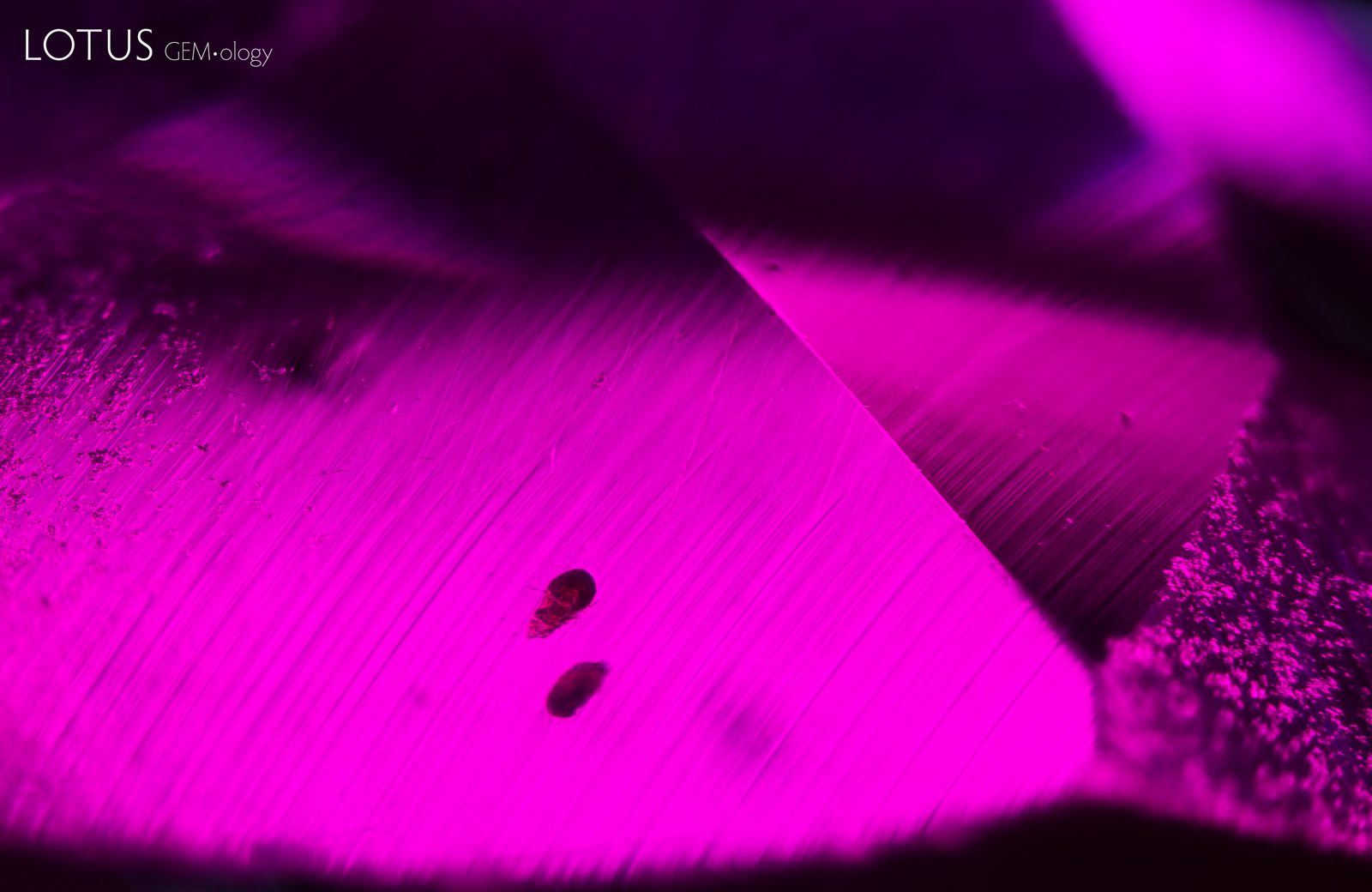
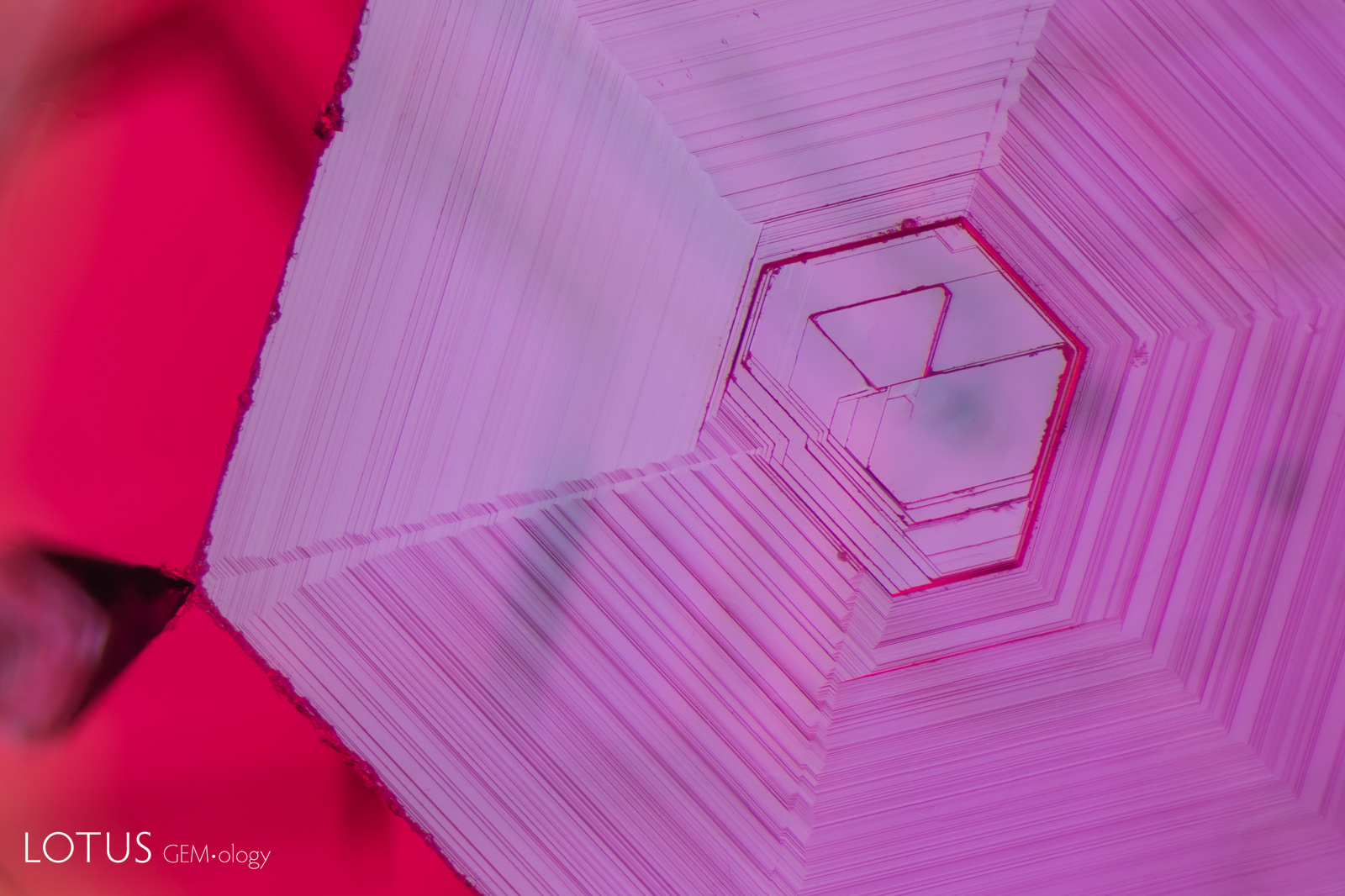
Step-like growth zoning on the surface of this Verneuil synthetic ruby is unusual.
Synthetic Ruby •
Verneuil •
Enhancements:
None Detected (None) •
Lighting Conditions:
Dark Field + Diffuse Fiber Optic
Photographer:
Natcha Rattana-anan •
Image Number:
A-005-5955-1
• Field of View = 7.2mm
• Magnification = 2.5x
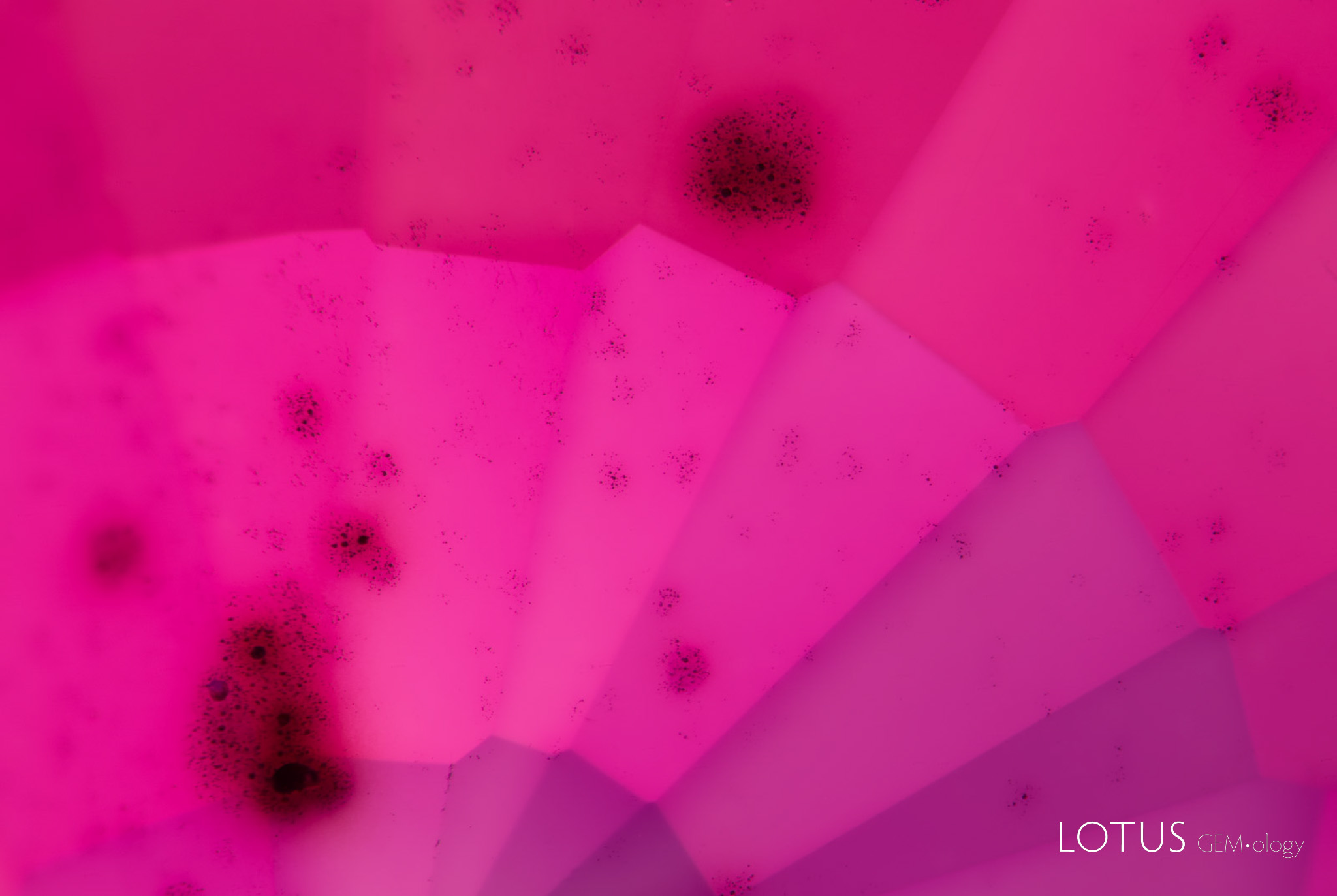
On rare occasions, we encounter synthetic gems that have been subjected to heat or diffusion treatment. Here we see concentration of diffused color around pits in a diffusion-treated synthetic ruby.
Synthetic Ruby •
No Origin •
Enhancements:
Heat + Diffusion of external coloring agents (H-D) •
Lighting Conditions:
Diffuse Light Field (Transmitted Light)
Photographer:
Wimon Manorotkul •
Image Number:
A-004-8927-7
• Field of View = 2.8mm
On rare occasions, we encounter synthetic gems that have been subjected to heat or diffusion treatment. a healed fissure with bubbly, rounded channels and concentration of diffused color around a pit in a diffusion-treated synthetic ruby.
Synthetic Ruby •
No Origin •
Enhancements:
Heat + Diffusion of external coloring agents (H-D) •
Lighting Conditions:
Diffuse Light Field + Fiber Optic
Photographer:
Wimon Manorotkul •
Image Number:
A-004-8927-2
• Field of View = 2.2mm
On rare occasions, we encounter synthetic gems that have been subjected to heat or diffusion treatment. Here we see concentration of diffused color around pits in a diffusion-treated synthetic ruby.
Synthetic Ruby •
No Origin •
Enhancements:
Heat + Diffusion of external coloring agents (H-D) •
Lighting Conditions:
Fiber Optic: Diffuse Oblique
Photographer:
Wimon Manorotkul •
Image Number:
A-004-8927-3
• Field of View = 2.8mm
On rare occasions, we encounter synthetic gems that have been subjected to heat or diffusion treatment. Here we see crackling at the surface of a diffusion-treated synthetic ruby.
Synthetic Ruby •
No Origin •
Enhancements:
Heat + Diffusion of external coloring agents (H-D) •
Lighting Conditions:
Fiber Optic: Oblique
Photographer:
Wimon Manorotkul •
Image Number:
A-004-8927-4
• Field of View = 2.1mm
On rare occasions, we encounter synthetic gems that have been subjected to heat or diffusion treatment. Here we see soap-scum like inclusions and gas bubbles just under the surface in a synthetic diffusion-treated ruby.
Synthetic Ruby •
No Origin •
Enhancements:
Heat + Diffusion of external coloring agents (H-D) •
Lighting Conditions:
Fiber Optic: Oblique
Photographer:
Wimon Manorotkul •
Image Number:
A-004-8927-6
• Field of View = 2.8mm
On rare occasions, we encounter synthetic gems that have been subjected to heat or diffusion treatment. Here we see pinpoint inclusions in a diffusion-treated synthetic ruby.
Synthetic Ruby •
No Origin •
Enhancements:
Heat + Diffusion of external coloring agents (H-D) •
Lighting Conditions:
Fiber Optic: Oblique
Photographer:
Wimon Manorotkul •
Image Number:
A-004-8927-5
• Field of View = 2.2mm
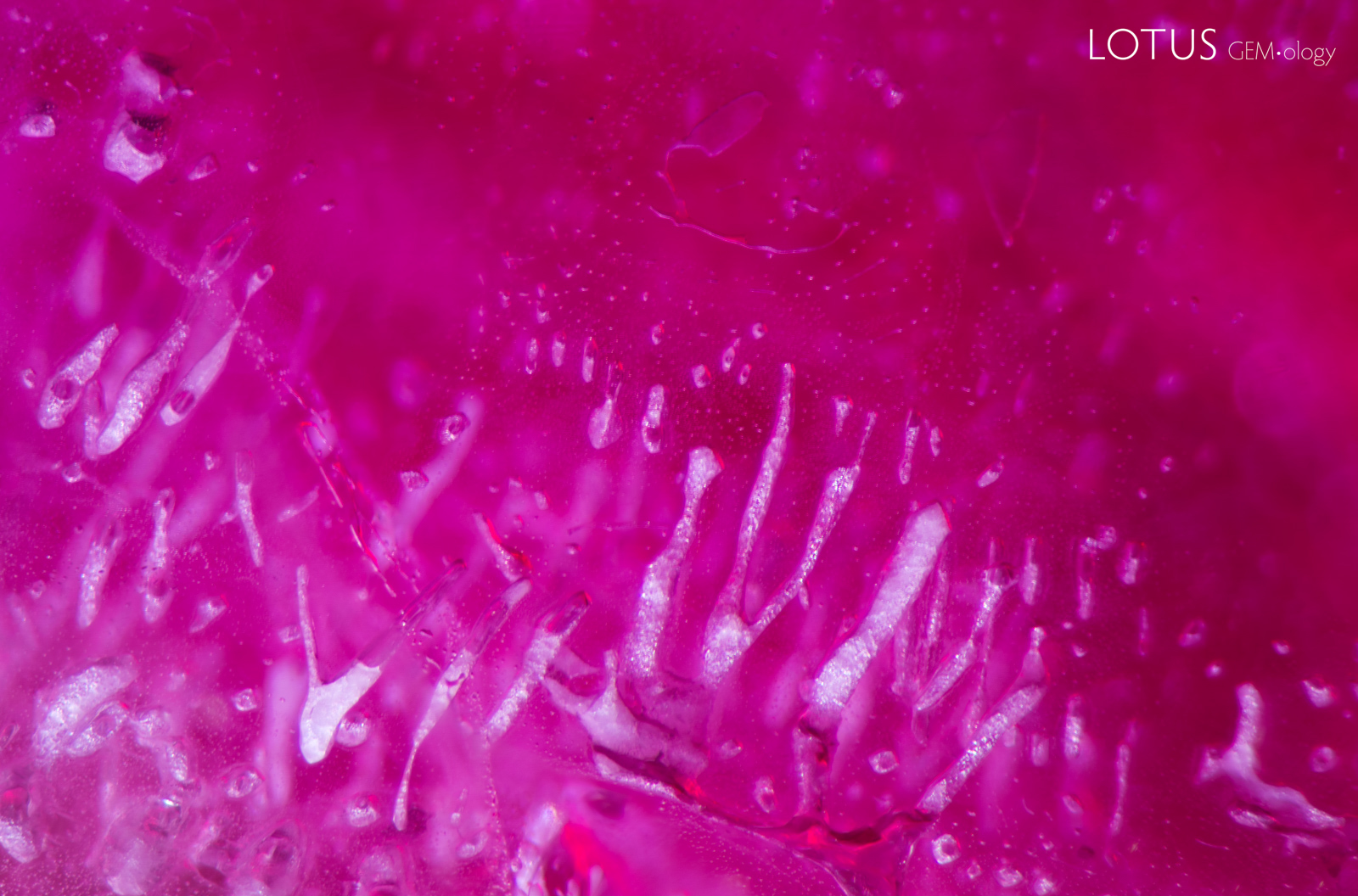
Flux “icicles” in a Kashan flux synthetic ruby.
Synthetic Ruby •
Flux •
Enhancements:
None Detected (None) •
Lighting Conditions:
Dark Field + Diffuse Fiber Optic
Photographer:
E. Billie Hughes •
Image Number:
R-005-5802-1
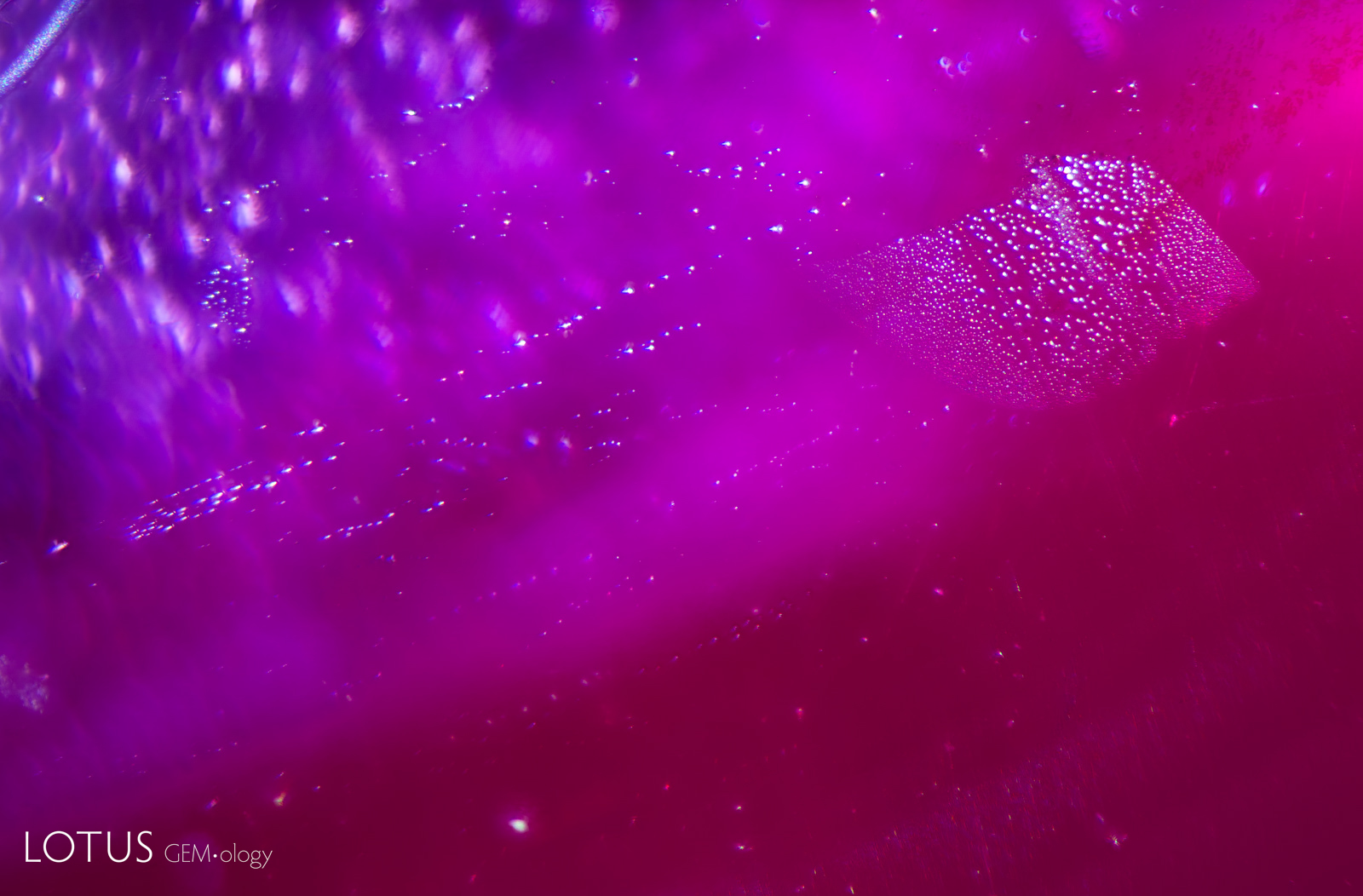
Fine streams of “rain-like” particles in a heated flux grown synthetic ruby.
Synthetic Ruby •
Flux •
Enhancements:
Heat (H) •
Lighting Conditions:
Fiber Optic: Oblique
Photographer:
E. Billie Hughes •
Image Number:
A-005-4964-5
• Field of View = 1.4mm
Fine streams of “rain-like” particles in a heated flux grown synthetic ruby.
Synthetic Ruby •
Flux •
Enhancements:
Heat (H) •
Lighting Conditions:
Fiber Optic: Oblique
Photographer:
E. Billie Hughes •
Image Number:
A-005-4964-4
• Field of View = 2mm
Synthetic Ruby inclusions may include curved striae, curved color banding, gas bubbles, healed fissures, Plato lines, twinning, platinum plates, rain-like flux, primary flux and other features formed during or after crystal growth. Such features are important to gemologists because they can provide evidence useful in identifying Ruby, understanding its geological history, recognizing treatment and, in some cases, determining geographic origin.
Synthetic Ruby Inclusion Photomicrographs
The Hyperion natural Ruby gallery includes microscopic features found in rubies from major deposits around the world. Each entry is accompanied by descriptive information and, where available, references to the gemological literature.
What Inclusions Can Reveal About Synthetic Ruby
Inclusions are an important part of Ruby identification. Their form, composition, orientation and alteration can help gemologists distinguish natural Ruby from synthetic material, recognize evidence of heat treatment, and study the geological environment in which the Ruby formed.
Hyperion combines inclusion photomicrography with supporting gemological information so that individual features can be compared with documented examples from known Ruby deposits.
About Hyperion
Hyperion is the Lotus Gemology searchable inclusion database. It allows users to browse gemstone inclusions by gem type, geographic origin, treatment and keyword.