Afghan Ruby Inclusions
Explore Afghan ruby inclusions in Hyperion, the Lotus Gemology inclusion database. Hyperion contains photomicrographs of inclusions and internal features in natural rubies from Afghanistan, documented with information on treatment, lighting conditions, field of view, photographer and published references.
In this ruby believed to be from Afghanistan’s Jegdalek mines, a colorless mineral was cut through on the surface. Micro Raman analysis revealed it to be calcite.
Natural Ruby •
Afghanistan; Jegdalek •
Enhancements:
None Detected (None) •
Lighting Conditions:
Fiber Optic: Oblique
Photographer:
Wimon Manorotkul •
Image Number:
A-003-7035-5
• Field of View = 4mm
Bowersox, G.W., Foord, E.E. et al. (2000) Ruby and sapphire from Jegdalek, Afghanistan. Gems & Gemology, Vol. 36, No. 2, Summer, pp. 110–126; RWHL*.
Gübelin, E.J. and Koivula, J.I. (2008) Photoatlas of Inclusions in Gemstones, Volume 3. Basel, Switzerland, Opinio Publishers, 672 pp.; RWHL*.
Hughes, R.W., Manorotkul, W. and Hughes, E.B. (2017) Ruby & Sapphire: A Gemologist's Guide. Bangkok, Lotus Publishing, 816 pp.; RWHL*.
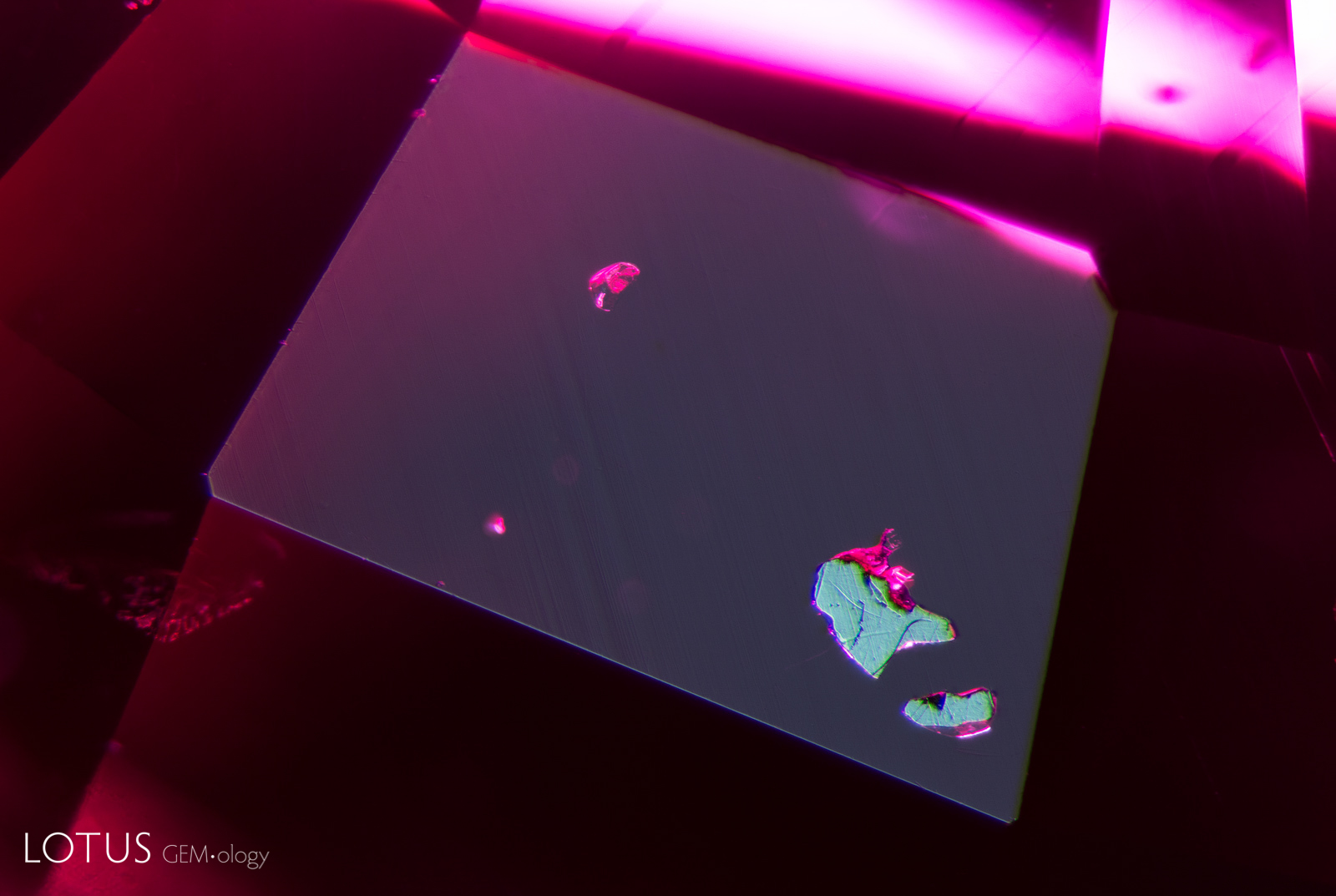
In this ruby believed to be from Afghanistan’s Jegdalek mines, a colorless mineral was cut through on the surface. Micro Raman analysis revealed it to be calcite.
Natural Ruby •
Afghanistan; Jegdalek •
Enhancements:
None Detected (None) •
Lighting Conditions:
Fiber Optic: Diffuse Overhead
Photographer:
Wimon Manorotkul •
Image Number:
A-003-7035-4
• Field of View = 4mm
Bowersox, G.W., Foord, E.E. et al. (2000) Ruby and sapphire from Jegdalek, Afghanistan. Gems & Gemology, Vol. 36, No. 2, Summer, pp. 110–126; RWHL*.
Gübelin, E.J. and Koivula, J.I. (2008) Photoatlas of Inclusions in Gemstones, Volume 3. Basel, Switzerland, Opinio Publishers, 672 pp.; RWHL*.
Hughes, R.W., Manorotkul, W. and Hughes, E.B. (2017) Ruby & Sapphire: A Gemologist's Guide. Bangkok, Lotus Publishing, 816 pp.; RWHL*.
In this ruby believed to be from Afghanistan’s Jegdalek mines, dark orange to black tetragonal prisms were seen. We used micro Raman on one cut through at the surface to confirm its identity as primary rutile. In addition, there were several rounded transparent crystals. The one at the center of this photomicrograph proved to be zircon.
Natural Ruby •
Afghanistan; Jegdalek •
Enhancements:
None Detected (None) •
Lighting Conditions:
Fiber Optic: Diffuse Oblique
Photographer:
Wimon Manorotkul •
Image Number:
A-003-7035-3
• Field of View = 1mm
Bowersox, G.W., Foord, E.E. et al. (2000) Ruby and sapphire from Jegdalek, Afghanistan. Gems & Gemology, Vol. 36, No. 2, Summer, pp. 110–126; RWHL*.
Gübelin, E.J. and Koivula, J.I. (2008) Photoatlas of Inclusions in Gemstones, Volume 3. Basel, Switzerland, Opinio Publishers, 672 pp.; RWHL*.
Hughes, R.W., Manorotkul, W. and Hughes, E.B. (2017) Ruby & Sapphire: A Gemologist's Guide. Bangkok, Lotus Publishing, 816 pp.; RWHL*.
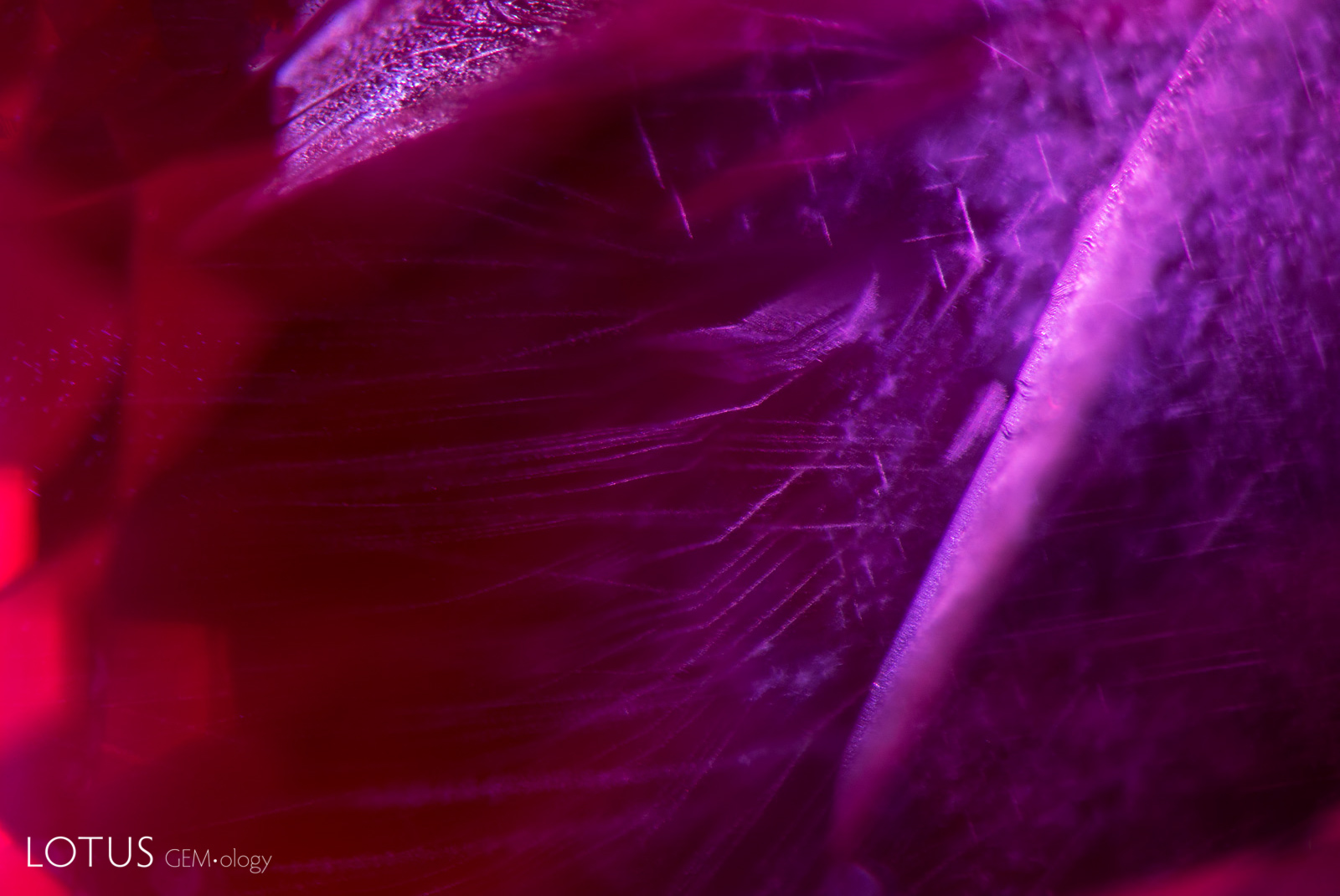
In this ruby believed to be from Afghanistan’s Jegdalek mines, dark orange to black tetragonal prisms were seen. We used micro Raman on one cut through at the surface to confirm its identity as primary rutile.
Natural Ruby •
Afghanistan; Jegdalek •
Enhancements:
None Detected (None) •
Lighting Conditions:
Fiber Optic: Diffuse Overhead
Photographer:
Wimon Manorotkul •
Image Number:
A-003-7035-2
• Field of View = 2mm
Bowersox, G.W., Foord, E.E. et al. (2000) Ruby and sapphire from Jegdalek, Afghanistan. Gems & Gemology, Vol. 36, No. 2, Summer, pp. 110–126; RWHL*.
Gübelin, E.J. and Koivula, J.I. (2008) Photoatlas of Inclusions in Gemstones, Volume 3. Basel, Switzerland, Opinio Publishers, 672 pp.; RWHL*.
Hughes, R.W., Manorotkul, W. and Hughes, E.B. (2017) Ruby & Sapphire: A Gemologist's Guide. Bangkok, Lotus Publishing, 816 pp.; RWHL*.
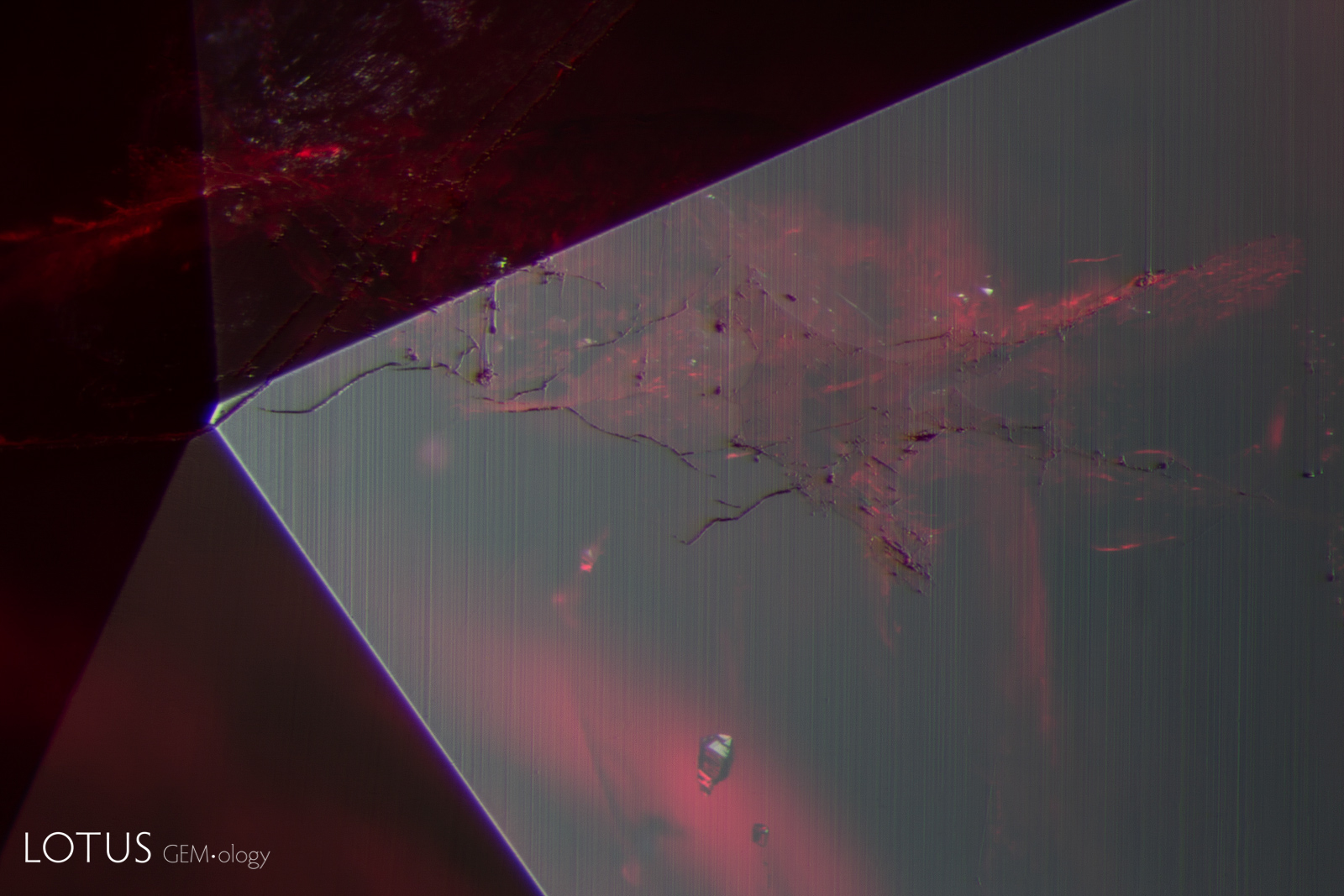
In this ruby believed to be from Afghanistan’s Jegdalek mines, dark orange to black tetragonal prisms were seen. We used micro Raman on one cut through at the surface to confirm its identity as primary rutile.
Natural Ruby •
Afghanistan; Jegdalek •
Enhancements:
None Detected (None) •
Lighting Conditions:
Fiber Optic: Diffuse Oblique
Photographer:
Wimon Manorotkul •
Image Number:
A-003-7035-1
• Field of View = 2mm
Bowersox, G.W., Foord, E.E. et al. (2000) Ruby and sapphire from Jegdalek, Afghanistan. Gems & Gemology, Vol. 36, No. 2, Summer, pp. 110–126; RWHL*.
Gübelin, E.J. and Koivula, J.I. (2008) Photoatlas of Inclusions in Gemstones, Volume 3. Basel, Switzerland, Opinio Publishers, 672 pp.; RWHL*.
Hughes, R.W., Manorotkul, W. and Hughes, E.B. (2017) Ruby & Sapphire: A Gemologist's Guide. Bangkok, Lotus Publishing, 816 pp.; RWHL*.
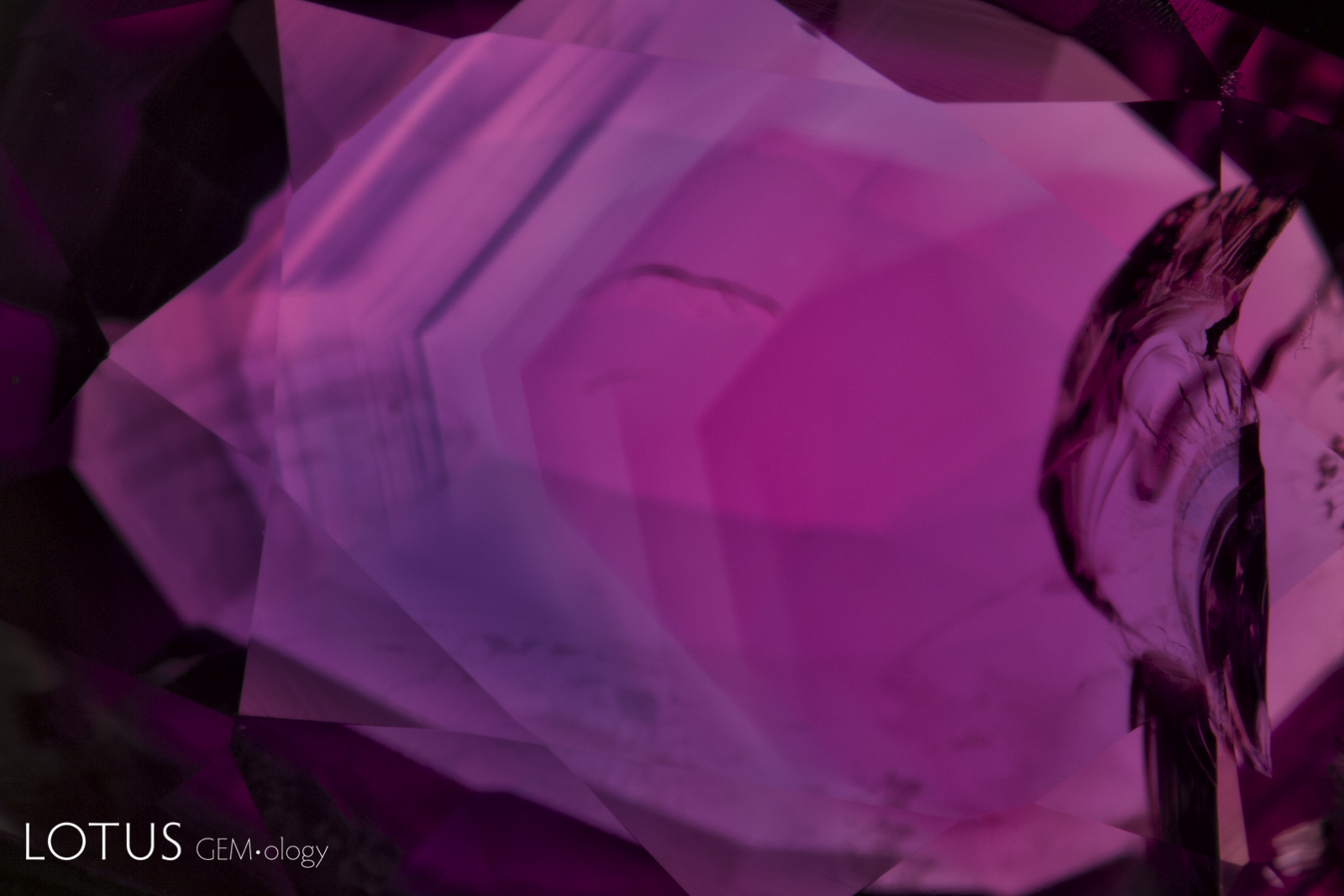
One of the most distinctive features of rubies from Afghanistan’s Jegdalek mines are the alternating zones of blue and red color, as shown here. FoV = 7 mm.
Natural Ruby •
Afghanistan •
Enhancements:
None Detected (None) •
Lighting Conditions:
Diffuse Light Field (Transmitted Light)
Photographer:
Richard W. Hughes •
Image Number:
A-003-4797-1
• Field of View = 7mm
Bowersox, G.W., Foord, E.E. et al. (2000) Ruby and sapphire from Jegdalek, Afghanistan. Gems & Gemology, Vol. 36, No. 2, Summer, pp. 110–126; RWHL*.
Hughes, R.W., Manorotkul, W. et al. (2017) Ruby & Sapphire: A Gemologist's Guide. Bangkok, Lotus Publishing, 816 pp.; RWHL*.
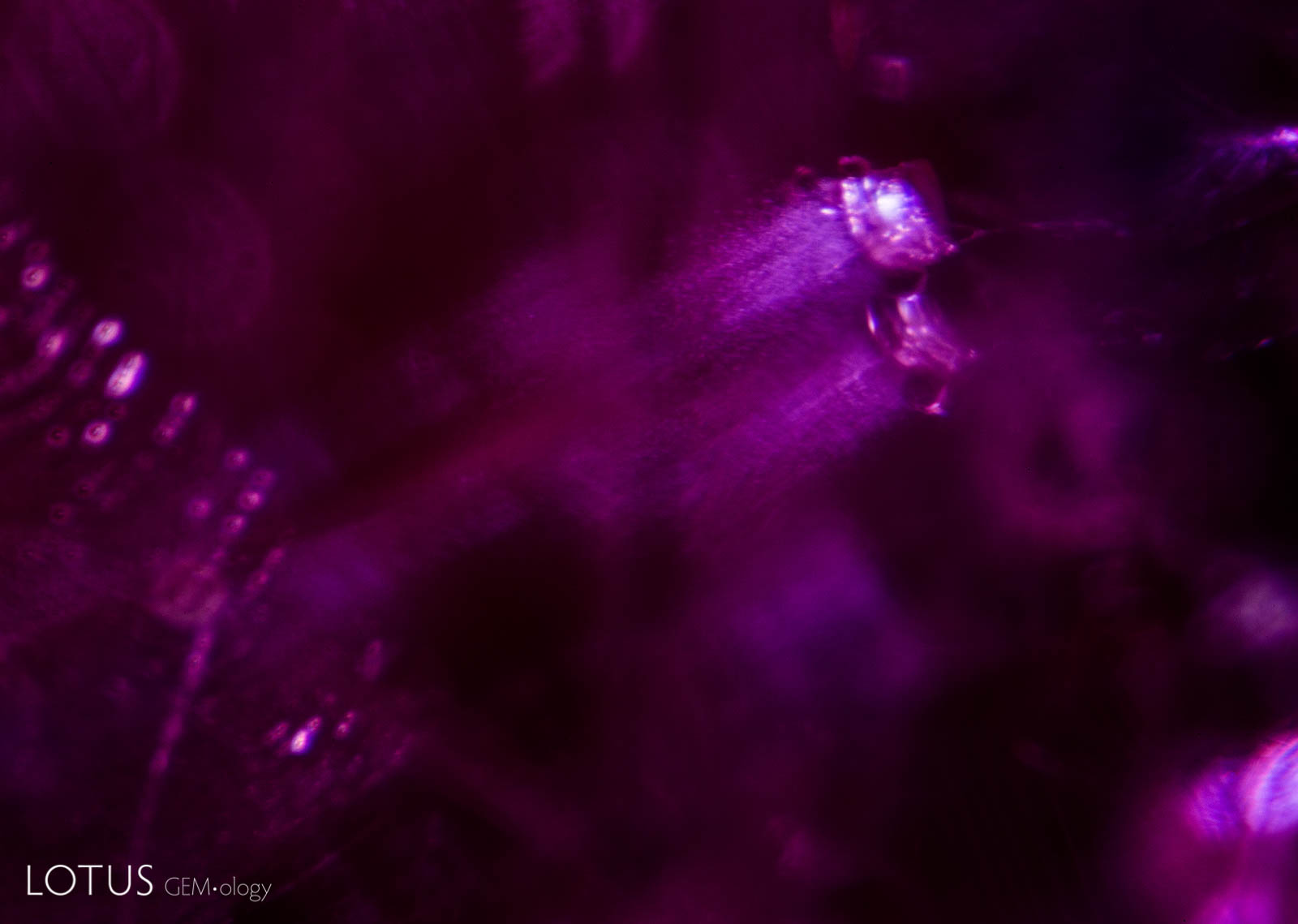
Two crystals with particle trails jet through the depths of a ruby from Afghanistan’s Jegdalek mines. Such particle trails are common next to included crystals as the solids act as a shadow to trap matter as the gem grows in the direction of the trails.
Natural Ruby •
Afghanistan •
Enhancements:
None Detected (None) •
Lighting Conditions:
Fiber Optic: Oblique
Photographer:
Wimon Manorotkul •
Image Number:
A-003-3238-2
Gübelin, E.J. and Koivula, J.I. (1986) Photoatlas of Inclusions in Gemstones, Volume 1. Basel, Switzerland, ABC Edition, 532 pp.; RWHL*.
Bowersox, G.W., Foord, E.E. et al. (2000) Ruby and sapphire from Jegdalek, Afghanistan. Gems & Gemology, Vol. 36, No. 2, Summer, pp. 110–126; RWHL*.
13 Total Images
Results: 1 – 12 | Page 1 of 2 Pages
Search the Complete Hyperion Database
Afghan ruby inclusions may include mineral crystals, healed fissures, fluid inclusions, negative crystals, growth features and other internal features formed during or after crystal growth. Such features are important to gemologists because they can provide evidence useful in identifying ruby and evaluating a possible Afghan origin.
Afghan Ruby Inclusion Photomicrographs
The Hyperion Afghan ruby gallery includes microscopic features documented in rubies from Afghanistan. Each entry is accompanied by descriptive information and, where available, references to the gemological literature.
What Inclusions Can Reveal About Afghan Ruby
Inclusions are an important part of geographic origin determination in ruby. Their form, composition, orientation and associations can provide evidence that, when considered together with other gemological properties, may support or contradict an Afghan origin.
Hyperion combines inclusion photomicrography with supporting gemological information so that individual features can be compared with documented examples from Afghan rubies.
About Hyperion
Hyperion is the Lotus Gemology searchable inclusion database. It allows users to browse gemstone inclusions by gem type, geographic origin, treatment and keyword.