Gemology Books Bibliography

Gemology Books Bibliography

Explore books on gems, gemology, jewelry and mineralogy in Four Treasures, the Lotus Gemology reference database. This bibliography brings together matching book records from the collection, with publication details, abstracts and cover images where available.

Gemology Book References

The list below matches books concerning gemology and related subjects in the database's searchable fields. Some works cover several branches of gems, jewelry or mineralogy.
2,501–2,520 of 3,454 matching references

Beobachtungen an rubinen aus Prilep, Jugoslawien
Observations on rubies from Prilep, Yugoslavia
Journal Article
Schiffmann, C.A. (1974) Beobachtungen an rubinen aus Prilep, Jugoslawien. [Observations on rubies from Prilep, Yugoslavia] Zeitschrift der Deutschen Gemmologischen Gesellschaft, Vol. 23, No. 2, Juni, pp. 131–138.
Record No. 1543  |  Sinkankas/Born No.: NIS/NIB  |  Language: In German  |  RWHL
Schiffmann reports gemological observations on rubies from the Prilep area of Yugoslavia (now North Macedonia), describing the characteristics of the material and features useful in its identification. Particular attention is given to the appearance and internal characteristics of the corundum, including inclusions and other properties observed during examination. The study provides an early gemological description of ruby from this Balkan occurrence and documents material from a locality comparatively little represented in the gemological literature.

Le rubis himalayen d’Hunza

The Himalayan ruby of Hunza
Journal Article
Piat, D. (1974) Le rubis himalayen d’Hunza. [The Himalayan ruby of Hunza] Revue de Gemmologie A.F.G., No. 41, pp. 5, 7.
Record No. 1423  |  Sinkankas/Born No.: NIS/NIB  |  Language: in French  |  RWHL
Piat describes ruby from the Hunza region of the western Himalayas, drawing attention to this remote locality as a source of gem-quality corundum. The brief account discusses the occurrence of the ruby and its geological setting, together with observations on the appearance and gemological character of the material. The article is an early notice of Hunza ruby and is of particular interest in documenting a Himalayan ruby occurrence outside the better-known deposits of Burma and Southeast Asia.

Über einige Einschlüsse in Birma-Rubin
On some inclusions in Burmese ruby
Journal Article
Eppler, W.F. (1974) Über einige Einschlüsse in Birma-Rubin. [On some inclusions in Burmese ruby] Zeitschrift der Deutschen Gemmologischen Gesellschaft, Vol. 23, No. 2, pp. 102–108, 9 figs..
Record No. 720  |  Sinkankas/Born No.: NIS/NIB  |  Language: In German  |  RWHL
Eppler examines inclusions observed microscopically in Burmese ruby and discusses their value for characterizing the material. Illustrated with nine figures, the paper describes characteristic internal features, including mineral inclusions and growth-related structures, and considers their appearance and identification under the microscope. Particular attention is given to features useful in recognizing natural Burmese ruby and understanding its formation, demonstrating the importance of inclusions both as diagnostic gemological evidence and as indicators of the geological environment in which the corundum crystallized.

Developments and highlights at GIA’s lab in New York: A first look at rubies from Kenya
Journal Article
Crowningshield, G.R. (1974) Developments and highlights at GIA’s lab in New York: A first look at rubies from Kenya. Gems & Gemology, Vol. 14, No. 11, Fall, pp. 334–336.
Record No. 632  |  ISBN/ISSN: 0016626X  |  RWHL

An old source for spinel?

Journal Article
Cooper, S.B.N. (1974) An old source for spinel? Journal of Gemmology, Vol. 14, No. 2, April, pp. 76–78.
Record No. 608  |  ISBN/ISSN: 221252  |  RWHL
Our forebears who named gems may have lacked modern scientific knowledge, but they compensated with a direct and literal approach to descriptions. A stone resembling ice (κρύσταλλος) was simply called crystal," while a red gem (ruber) naturally became "ruby." This makes the usual derivation of "spinel"—from the Italian diminutive "spinella," originating from the Latin "spina" (spine), meaning "little spine"—all the more intriguing. While spinel crystals do form sharp-angled octahedra, they are not particularly spiny, especially compared to other crystals that can more easily prick the fingers. This suggests a misunderstanding in the name’s origin, indicating that we must look elsewhere for its true etymology."

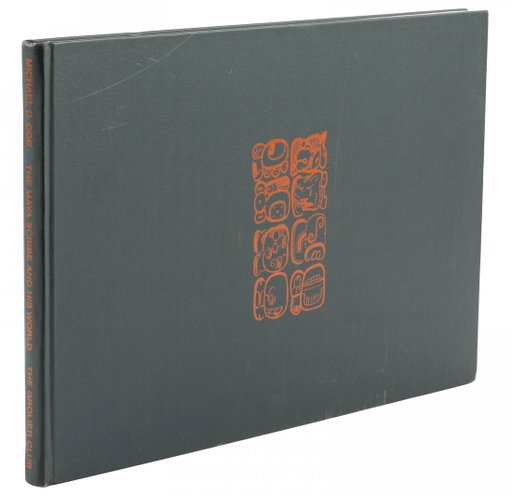
The Maya Scribe and His World

Book
Coe, M.D. (1973) The Maya Scribe and His World. New York, Grolier Club, 160 pp.
Record No. 28638  |  ISBN/ISSN: 9780810000000  |  Sinkankas/Born No.: NIS/NIB  |  RWHL
First edition, limited to 1000 copies Asaf 139 . Designed by Norman Ives. Features the Mayas beautiful alphabets on 87 objects such as pottery, statuery, stone panels, boxes, shells, jewelry and documents. Illustrated throughout, some in color. 160 pages. cloth.. oblong small folio.

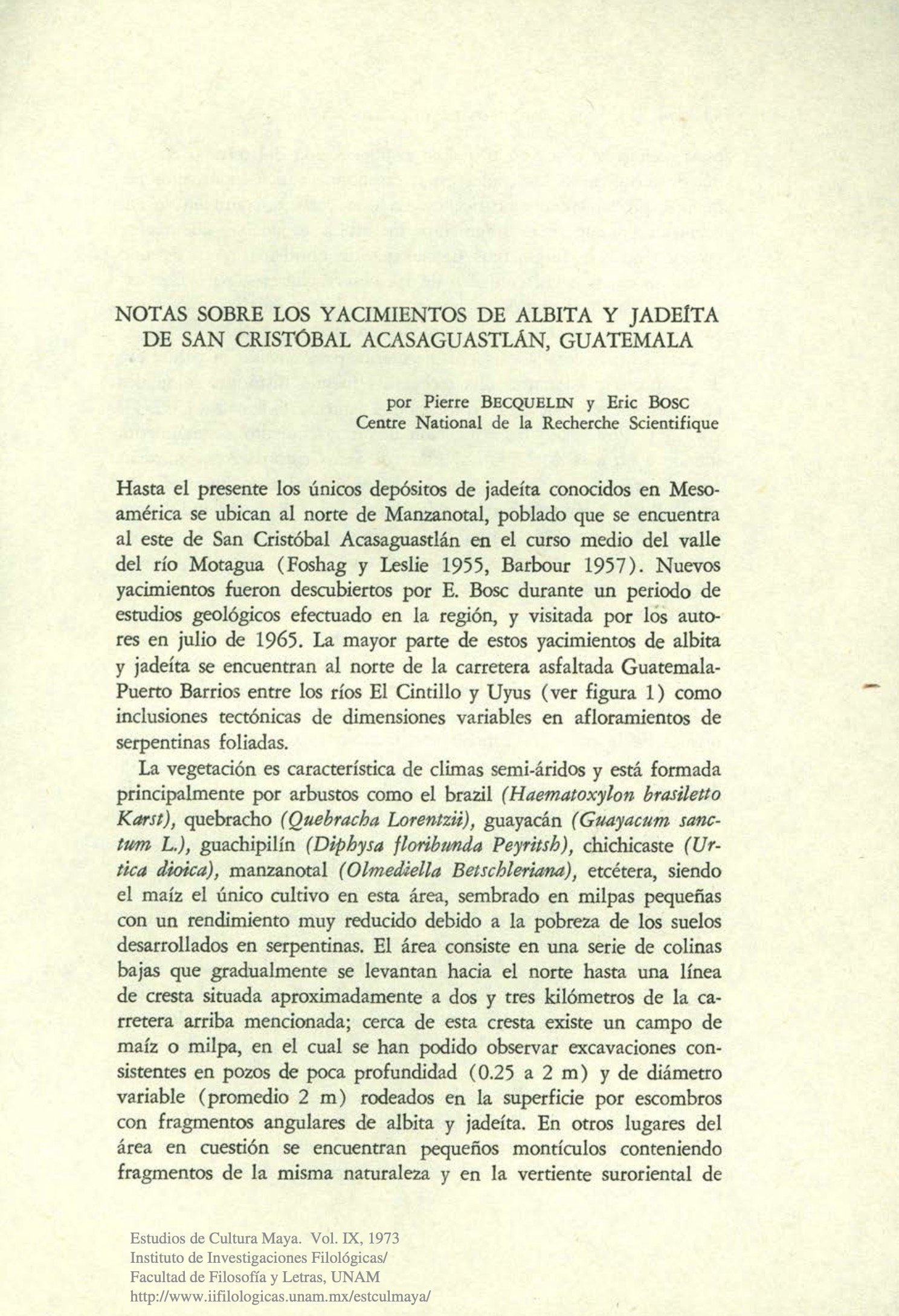
Notas sobre los yacimientos de albita y jadeita de San Cristobal Acasaguastlan, Guatemala
Notes on the albite and jadeite deposits of San Cristóbal Acasaguastlán, Guatemala
Journal Article
Becquelin, P. and Bosc, E. (1973) Notas sobre los yacimientos de albita y jadeita de San Cristobal Acasaguastlan, Guatemala. [Notes on the albite and jadeite deposits of San Cristóbal Acasaguastlán, Guatemala] Estudios de Cultura Maya, Vol. 9, pp. 67–73.
Record No. 28417  |  Sinkankas/Born No.: NIS/NIB  |  Language: in Spanish  |  RWHL
Up to the present, the only jadeite deposits known in Mesoamerica are located north of Manzanotal, a settlement situated east of San Cristóbal Acasaguastlán in the middle course of the Motagua River Valley (Foshag and Leslie 1955; Barbour 1957). New deposits were discovered by E. Böse during a period of geological studies carried out in the region and were visited by the authors in July 1965. Most of these albite and jadeite deposits are located north of the paved Guatemala–Puerto Barrios highway, between the El Cintillo and Uyús rivers (see Figure 1), occurring as tectonic inclusions of varying dimensions within outcrops of foliated serpentinite. Becquelin and Bosc describe newly identified albite and jadeite occurrences near San Cristóbal Acasaguastlán in Guatemala’s middle Motagua Valley, where the deposits occur as tectonic inclusions of varying dimensions within foliated serpentinite. The authors report shallow pits surrounded by angular fragments of albite and jadeite, small mounds, terraces, and nearby obsidian blade fragments, which together suggest rudimentary extraction, possibly in prehistoric times, although they stress that further investigation is required to establish the nature and age of the workings. Other jadeite occurrences in the region lack evidence of ancient exploitation. The archaeological evidence from nearby Guaytán, Manzanotal, and other middle Motagua sites includes jade fragments, partly worked beads and drills, and a jadeite block bearing percussion marks. The authors suggest that inhabitants of the valley collected albite and jadeite from terraces and gravels of the Motagua and perhaps directly from serpentinite sources, manufactured beads and other simple ornaments, and exported jade as blocks and, in some cases, finished objects. They conclude that exploitation and trade in jade probably flourished during the Classic period and that the San Cristóbal region may have supplied a substantial portion of the jade used elsewhere in Mesoamerica.

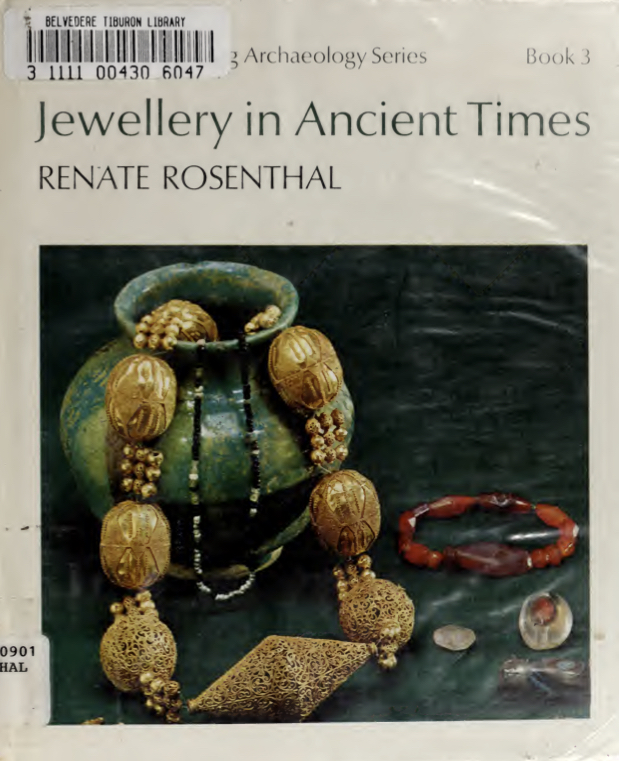
Jewellery in Ancient Times

Book
Rosenthal, R. (1973) Jewellery in Ancient Times. London, Cassel & Co., 96 pp.
Record No. 27852  |  ISBN/ISSN: 304292699  |  Sinkankas/Born No.: NIS/NIB  |  RWHL
Jewellery in Ancient Times is the third title in this handsome series for the general reader whose interest in archaeology has been aroused by the growing coverage given the science by television, newspapers, journals, and the spate of exhibitions and specialist books of recent years. The series is also designed as an introductory primer for students making archaeology a course subject or, ultimately, a profession. The complete series is intended to be world-wide in its scope, and ranges from pre-history to post-Biblical Roman and Byzantine times. The art of the jeweller not only bears witness to early craftsmanship, or dress, costume, and cultural standards, but as Renate Rosenthal’s Jewellery in Ancient Times shows, it is an important indication of the trading-empires of the ancient world which were of a size and importance we are only just learning to appreciate.

Great Zimbabwe

Book
Garlake, P.S. (1973) Great Zimbabwe. London, Thames and Hudson, 224 pp.
Record No. 26470  |  ISBN/ISSN: 500390126  |  Sinkankas/Born No.: NIS/NIB  |  RWHL
Although the Great Zimbabwe Ruins are widely regarded as sub-Saharan Africa’s largest and most dramatic ancient site, historical evidence concerning their origin and purpose remains fragmentary, confused, and often contradictory. The central question—whether Great Zimbabwe was the unaided work of indigenous Africans—has sparked lasting controversy and provoked strong, widespread, and sometimes bizarre emotional responses. The scarcity of reliable archaeological information is underscored by the fact that only three resident professional archaeologists have focused on the proto-history of Rhodesia over the past eighty years, including the author, who served as Senior Inspector of Monuments from 1964 to 1970. Well-conducted excavations by D. Randall-MacIver in 1905 and Gertrude Caton-Thompson in 1929 helped clarify the site’s significance, recovering insights from the damage caused by earlier amateur excavators like R. N. Hall. Peter Garlake re-examines and reassesses the findings of these early researchers, connecting them to growing archaeological knowledge of related ruins, groups, and cultures in Rhodesia and East Africa now understood to be linked to the culture of Great Zimbabwe. His study presents a thorough account of the site, beginning with sixteenth-century Portuguese reports and covering its architecture, explorations, excavations, trade, traditions, and history. Drawing on his own fieldwork, Garlake places this material in a broad social and historical framework, offering a balanced and well-informed resolution to the enduring mystery of Great Zimbabwe.

Crystal-balling future synthetic gemstones
Journal Article
Mariner, T.H. (1973) Crystal-balling future synthetic gemstones. Gems & Gemology, Vol. 14, No. 8, Winter, pp. 241–247.
Record No. 1229  |  ISBN/ISSN: 0016626X  |  RWHL

Developments and highlights at GIA’s lab in New York: Glass
Journal Article
Crowningshield, G.R. (1973) Developments and highlights at GIA’s lab in New York: Glass. Gems & Gemology, Vol. 14, No. 5, Spring, pp. 134–137.
Record No. 138  |  ISBN/ISSN: 0016626X  |  RWHL

Olmec jaguars and Olmec kings

Book Section
Coe, M.D. (1972) Olmec jaguars and Olmec kings. In: The Cult of the Feline: A Conference in Pre-Columbian Iconography, Washington, DC: Dumbarton Oaks, pp. 1–18.
Record No. 28555  |  Sinkankas/Born No.: NIS/NIB  |  RWHL
This is the second version of a paper that I have prepared on the feline motif in Olmec art. I tore up the first and began again after hearing a fascinating talk by Eric Thompson at the Metropolitan Museum of Art, in which he demonstrated the close connection between the supreme god of the Maya—Itzamná—and the cult of Maya kings. While initially somewhat sceptical, I have become convinced that just such a relationship, involving the very same god-complex, existed between the jaguar and the royal house of the Olmec. While some of my paper may seem far-fetched to those unfamiliar with the unbelievably tortuous details of Mesoamerican religion, it should be pointed out that this study is only part of a much larger structural investigation of all known Mesoamerican theogonies, which I strongly feel comprise a single great system of tremendous antiquity. There are four possible sources of information available for the interpretation of Olmec iconography, the religious imagery of a civilization that began over three thousand years ago and is thus the earliest known in Mesoamerica. The first is Olmec art itself, which can be viewed from a purely formal standpoint; such an iconological study has been carried out by David Joralemon (1971) of Yale University. The second is the natural history of those animals—including man—which play a major role in Olmec iconography. The third comprises the rich data from Indigenous American cultures on the relationships between humans and those groups of animals that seem to have been of overriding importance to the Olmec; here I call attention to Peter Furst’s (1968) excellent examination of man-jaguar transformations in the tropical lowlands of South America. Fourthly and lastly, there is the possibility of a genetic analysis that would detect the homologies between Maya and Mexican religious iconographies; after relatively late items of diffusion between the two have been screened out, it is quite obvious that those images that are cognate should stem from their common origin, an origin that can only be Olmec.

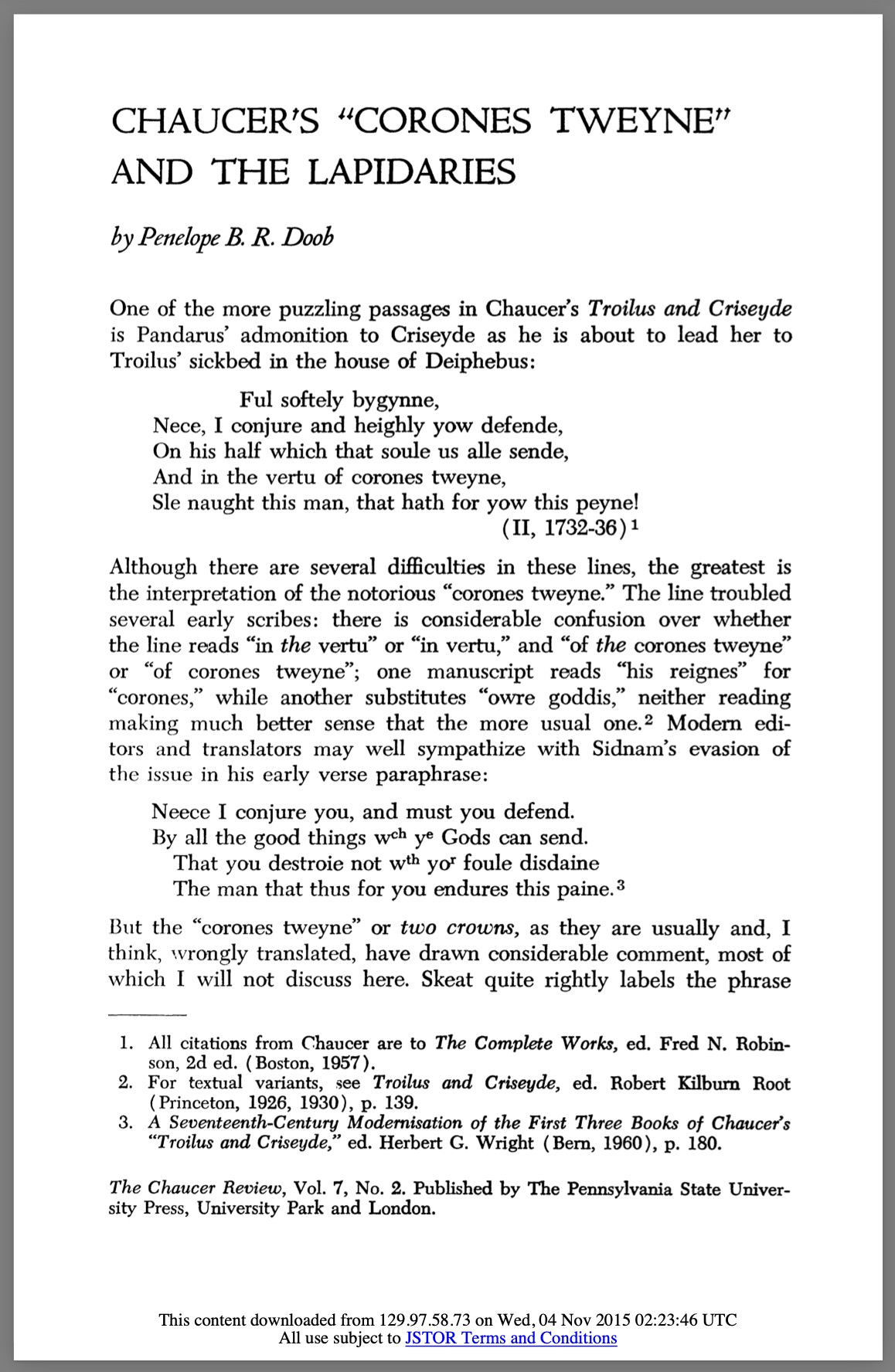
Chaucer's Corones Tweyne and the lapidaries
Journal Article
Doob, P.B.R. (1972) Chaucer's Corones Tweyne and the lapidaries. The Chaucer Review, Vol. 7, No. 2, pp. 85–96.
Record No. 27942  |  ISBN/ISSN: 00092002, 15284204  |  Sinkankas/Born No.: NIS/NIB  |  RWHL
There has not yet been a satisfactory interpretation of what Chaucer meant when he had Pandarus order Criseyde in the vertu of corones twenyne" (Troilus, II. 1735) not to slay Troilus. If "corones" is taken as a variant spelling of the gemstone "ceraunius," the reference becomes clearer. The characteristics and "virtues" of the ceraunius include these points: there are two kinds of ceraunius; one is red, the other blue; both kinds are brilliant; both can either attract or repel lightning depending on their owner's chastity; they confer martial victory and sweet sleep. Pandarus uses the ceraunius as an emblem of Criseyde's beauty: the colors of the two kinds of ceraunius correspond to the rosy lips and blue eyes of the feminine ideal, and the stones' brilliance corresponds to Criseyde's marked radiance. Consequently, Pandarus is urging Criseyde not to kill Troilus by the destructive power of her lightning-like beauty, but, since he is chaste, to heal him by means of that same beauty combined with gentleness and the gift of sleep. This reference to the ceraunius fits into the complex of gem imagery in the poem; moreover, the association of the ceraunius with both protection and destruction appropriately reflects the ambiguities surrounding Criseyde and earthly love."

Gem-quality garnets: Correlations between gemmological properties, chemical composition and infrared spectroscopy
Journal Article
Adamo, I., Pavese, A., Prosperi, L., Diella, V. and Ajo, D. (1972) Gem-quality garnets: Correlations between gemmological properties, chemical composition and infrared spectroscopy. Journal of Gemmology, Vol. 30, Nos. 5–6, pp. 307–319.
Record No. 26741  |  ISBN/ISSN: 221252  |  Sinkankas/Born No.: NIS/NIB  |  RWHL
A suite of 19 natural gem-quality garnets has been investigated to determine the correlations between those measurable quantities which are effective in their identification. The results reveal that IR spectroscopy, along with gemmological and chemical analyses, can provide sufficient data to enable positive characterization of garnet gemstones. In particular, the IR active bands over the 1150–800 and 650–450 cm⁻¹ ranges allow a discrimination between pyralspite and ugrandite series. Furthermore, pyrope, spessartine and andradite garnets exhibit such mid-infrared patterns that are potentially useful in their identification.

A comparative study of Rhodesian rhodolite garnet in relation to other known data and a discussion in relation to a more acceptable name

Journal Article
Campbell, I.C.C. (1972) A comparative study of Rhodesian rhodolite garnet in relation to other known data and a discussion in relation to a more acceptable name. Journal of Gemmology, Vol. 13, No. 2, pp. 53–64.
Record No. 26705  |  ISBN/ISSN: 221252  |  Sinkankas/Born No.: NIS/NIB  |  RWHL
The final remarks by B. F. Martin in his April 1970 Journal of Gemmology study on rhodolite garnet (Vol. 12, No. 2), calling for further investigation into the subject, prompted a comparative study of rhodolite garnets of known Rhodesian origin. Twelve stones were selected for this purpose. It is hoped that the original author will not object to the reproduction of the main points from his study, which are presented again in tabular form for comparison with the results from the Rhodesian specimens.

Developments and highlights at GIA’s Gem Trade Lab in New York: An age-old problem [burial jade vs. heated jade]
burial jade vs. heated jade
Journal Article
Crowningshield, G.R. (1972) Developments and highlights at GIA’s Gem Trade Lab in New York: An age-old problem [burial jade vs. heated jade]. Gems & Gemology, Vol. 14, No. 3, Fall, pp. 83–85.
Record No. 5083  |  ISBN/ISSN: 0016626X  |  RWHL

Developments and highlights at GIA’s lab in New York: Carvings
Journal Article
Crowningshield, G.R. (1972) Developments and highlights at GIA’s lab in New York: Carvings. Gems & Gemology, Vol. 14, No. 4, Winter, pp. 112–113.
Record No. 2242  |  ISBN/ISSN: 0016626X  |  RWHL

Sapphire substitutes

Journal Article
Anderson, B.W. (1972) Sapphire substitutes. Journal of Gemmology, Vol. 13, No. 1, January, p. 4.
Record No. 242  |  ISBN/ISSN: 221252  |  RWHL

Notes from the laboratory: Kashan synthetic rubies; ruby doublets
Journal Article
Anderson, B.W. (1972) Notes from the laboratory: Kashan synthetic rubies; ruby doublets. Journal of Gemmology, Vol. 13, No. 3, July, pp. 96–97.
Record No. 241  |  ISBN/ISSN: 221252  |  RWHL

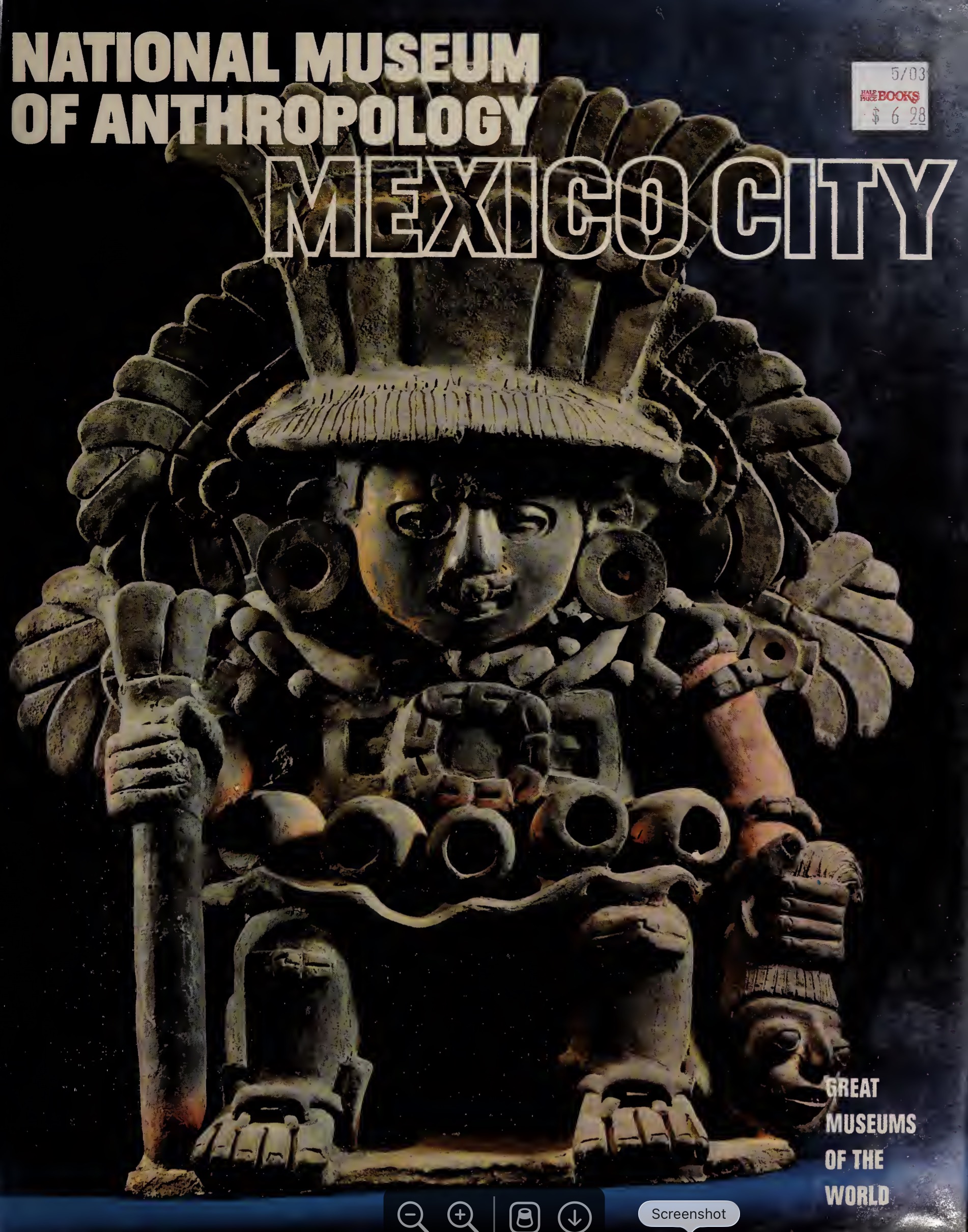
National Museum of Anthropology, Mexico City

Book
Ragghianti, C.L. and Collobi, L.R. (1971) National Museum of Anthropology, Mexico City. New York, Newsweek, 172 pp.
Record No. 28398  |  ISBN/ISSN: 088225233X  |  Sinkankas/Born No.: NIS/NIB  |  RWHL
The ancient roots of Mexican civilization, as seen in its art and artifacts, are on view in the pages of this book, just as they are in the National Museum of Anthropology itself. Here the reader encounters the treasures of pre-Hispanic Mexico, as on a guided tour through the Museum’s splendours led by its Director. These range from the earliest traces of primitive civilizations to the most refined examples of sixteenth-century Aztec culture — from the small figures and pottery of the twelfth century B.C. Pre-Classic period, and the urns, frescoes and colossal statues of the Classic period, to the ceremonial dishes, ornaments and giant votive tablets of the Postclassic era, when the Spanish conquistadors first set foot in the new world of Mexico. From Tlatilco comes one of the earliest and most original creations of representational art in the Valley of Mexico, the Kneeling Woman Kissing a Dog, a small masterpiece that is highly personal and remarkably sophisticated in composition. From the Olmec culture comes the Group of Figures, composed of sixteen standing male statuettes arranged in an exceptionally impressive tableau, reproduced here in a magnificent double spread. Also represented are such masterpieces of the Classic period as the Seated Woman, a fifth-century image of sovereign authority embodying the goddess of fertility, sensual in its vibrant play of light and shade, and the figure of the god Tlaloc, innocent and refined, pouring upon the earth the life-giving waters that nourish the crops. The genius of later Mexican art is seen in the fourteenth-century Flower Prince, a sacred portrait of Xochipilli, the Aztec god of spring, love, poetry and dance, which combines floral elements with geometric simplicity; the Crouching Rabbit, an exquisite rock-crystal sculpture of exceptional balance and compact stylization; and, crowning the collection, the giant Sun Stone, representing the history of the world — abstract, occult and filled with the fire and movement of the Aztec universe.

Building a Gemological Library

Gemological books range from general identification manuals and textbooks to specialized works on individual gems, mineralogy, jewelry, treatments, synthesis, history and gem-producing regions.

For a curated selection of particularly useful books, read The Gemologist's Core Library — Classic Books on Gemology, Jewelry and Mineralogy.

About Four Treasures

Four Treasures is Lotus Gemology's freely accessible gemological reference database. Use the full database to search by author, title or keyword and explore literature on gemology, mineralogy, jewelry and related fields. Where available, hyperlinks on titles may lead directly to the full publication.

Search the Complete Four Treasures Database