Gemology Books Bibliography

Gemology Books Bibliography

Explore books on gems, gemology, jewelry and mineralogy in Four Treasures, the Lotus Gemology reference database. This bibliography brings together matching book records from the collection, with publication details, abstracts and cover images where available.

Gemology Book References

The list below matches books concerning gemology and related subjects in the database's searchable fields. Some works cover several branches of gems, jewelry or mineralogy.
2,521–2,540 of 3,454 matching references

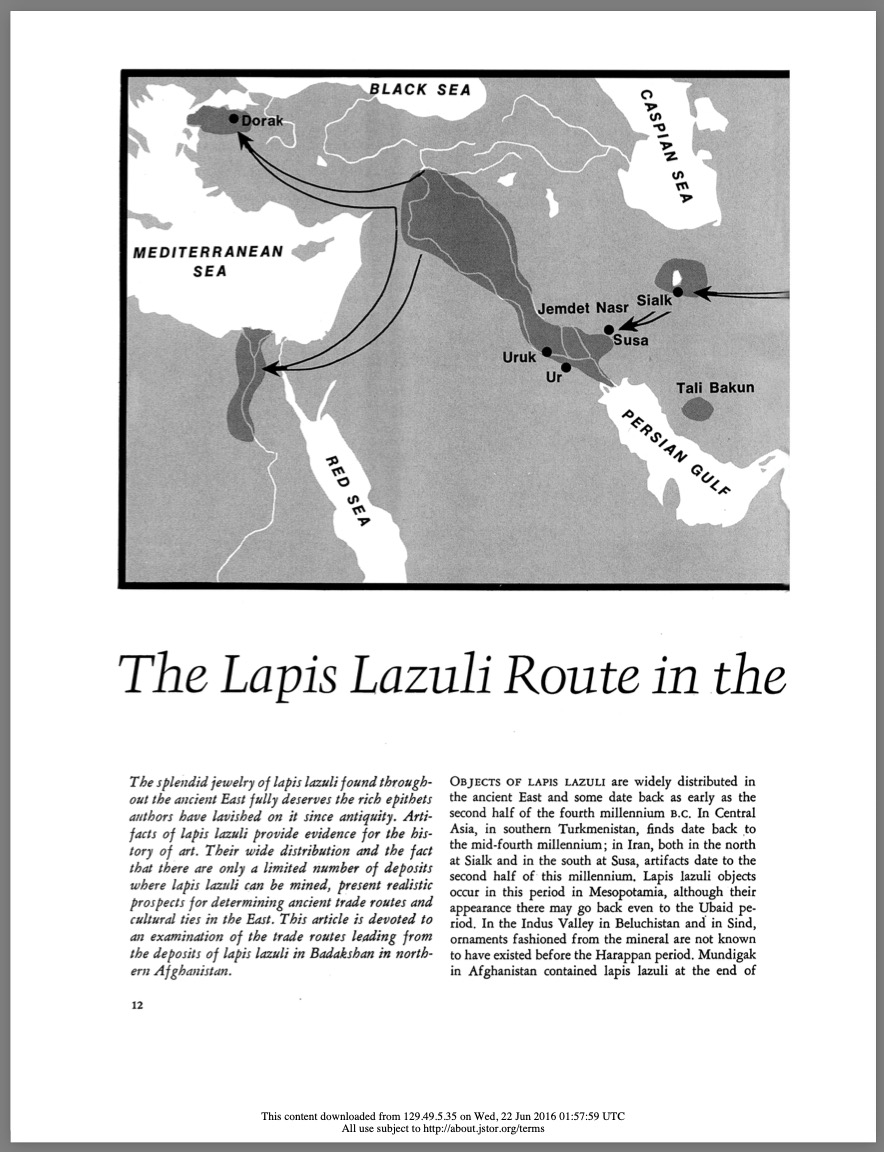
The lapis lazuli route in the ancient East
Journal Article
Sarianidi, V.I. and Kowalski, L.H. (1971) The lapis lazuli route in the ancient East. Archaeology, Vol. 24, No. 4, January, pp. 12–15.
Record No. 27762  |  Sinkankas/Born No.: NIS/NIB  |  RWHL
The splendid jewelry of lapis lazuli found throughout the ancient East fully deserves the rich epithets authors have lavished on it since antiquity. Artifacts of lapis lazuli provide evidence for the history of art. Their wide distribution and the fact that there are only a limited number of deposits where lapis lazuli can be mined present realistic prospects for determining ancient trade routes and cultural ties in the East. This article is devoted to an examination of the trade routes leading from the deposits of lapis lazuli in Badakhshan in northern Afghanistan.

Kauṭilya and the Arthaśāstra: A Statistical Investigation of the Authorship and Evolution of the Text
Book
Trautmann, T.R. (1971) Kauṭilya and the Arthaśāstra: A Statistical Investigation of the Authorship and Evolution of the Text. Leiden, Brill, 227 pp.
Record No. 27147  |  Sinkankas/Born No.: NIS/NIB  |  RWHL
The Arthashastra by Kautilya (Chanakya) provides detailed regulations concerning the trade in diamonds and other precious stones, including preferred trade routes, tolls, and systems of weights and measures. Land routes are favored over maritime ones for the transport of high-value, low-bulk goods like gems, as they allow for greater state oversight and reduce the risks associated with piracy. Merchants dealing in diamonds were subject to tolls at checkpoints, inspections by the Superintendent of Commerce, and penalties for fraud, evasion, or price manipulation. Diamonds were weighed using a precise metrological system based on the ratti (approximately 0.1215 grams), with larger units such as the masha and tola used for bulk. Pricing and taxation were determined per ratti, and gem quality was assessed based on clarity, shape, and provenance. The state often maintained control or oversight of the gem trade, especially for locally sourced stones, and imposed higher duties on foreign merchants.

Mafic and ultramafic inclusions associated with undersaturated basalt on Kod Ali Island, Southern Red Sea
Journal Article
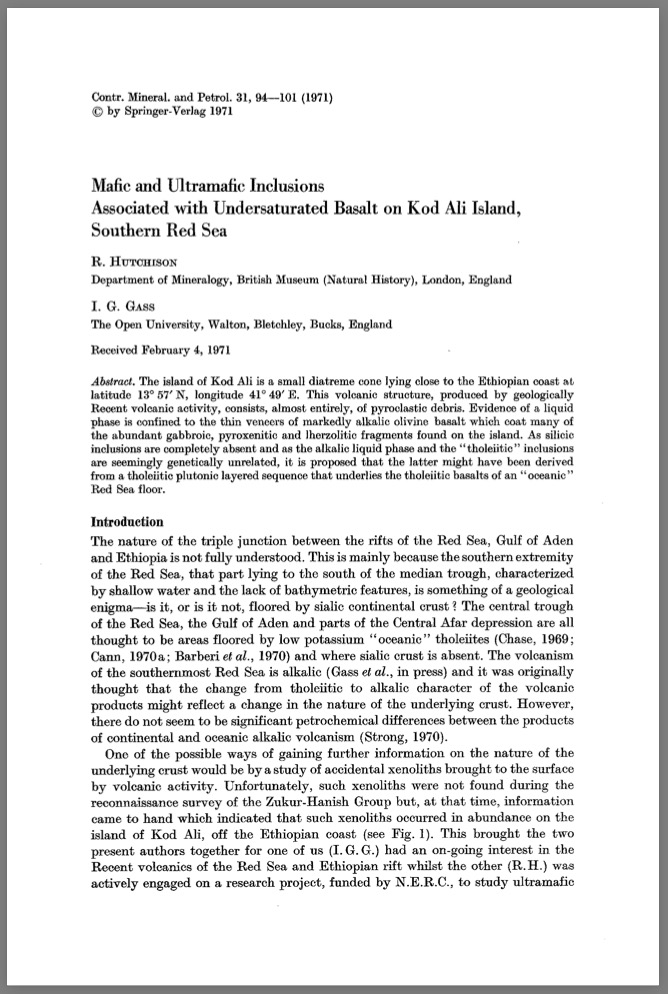
Hutchison, R. and Gass, I.G. (1971) Mafic and ultramafic inclusions associated with undersaturated basalt on Kod Ali Island, Southern Red Sea. Contributions to Mineralogy and Petrology, Vol. 31, No. 2,, 6/1/71 pp. 94–101.
Record No. 17256  |  ISBN/ISSN: 14320967  |  DOI: https://doi.org/10.1007/BF00373452  |  Sinkankas/Born No.: NIS/NIB  |  RWHL
The island of Kod Ali is a small diatreme cone lying close to the Ethiopian coast at latitude 13° 57′ N, longitude 41° 49′ E. This volcanic structure, produced by geologically Recent volcanic activity, consists, almost entirely, of pyroclastic debris. Evidence of a liquid phase is confined to the thin veneers of markedly alkalic olivine basalt which coat many of the abundant gabbroic, pyroxenitic and lherzolitic fragments found on the island. As silicic inclusions are completely absent and as the alkalic liquid phase and the “tholeiitic” inclusions are seemingly genetically unrelated, it is proposed that the latter might have been derived from a tholeiitic plutonic layered sequence that underlies the tholeiitic basalts of an “oceanic” Red Sea floor.

Three Dynasties of Jade

Book
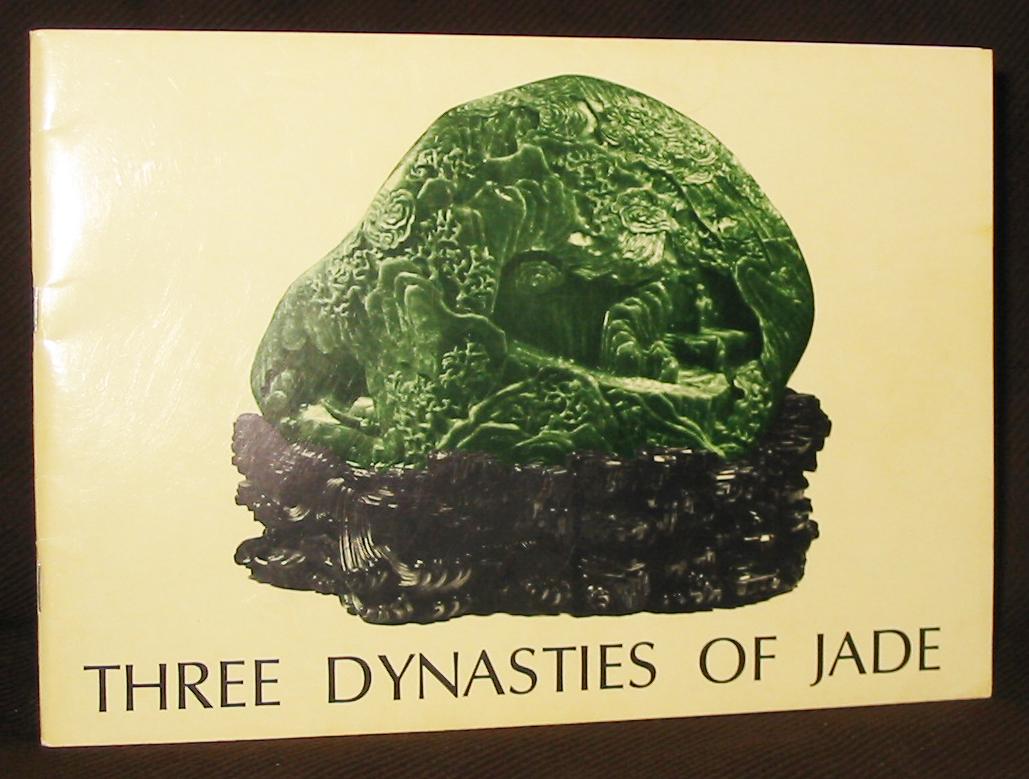
Hartman, J.M. (1971) Three Dynasties of Jade. Indianapolis, Indianapolis Museum of Art, 42 pp., 71 b/w photos
Record No. 7433  |  Sinkankas/Born No.: 2778; Born, p. 169  |  RWHL
Sinkankas: Introduced with a brief history of Chinese jade and the development of carving into the 19th century. Objects include mountains, animals, human figures, vessels, plaques, wands, etc., each depicted and described with dates and dimensions. Handsome catalog of unusual format. Comment by Born, 169.

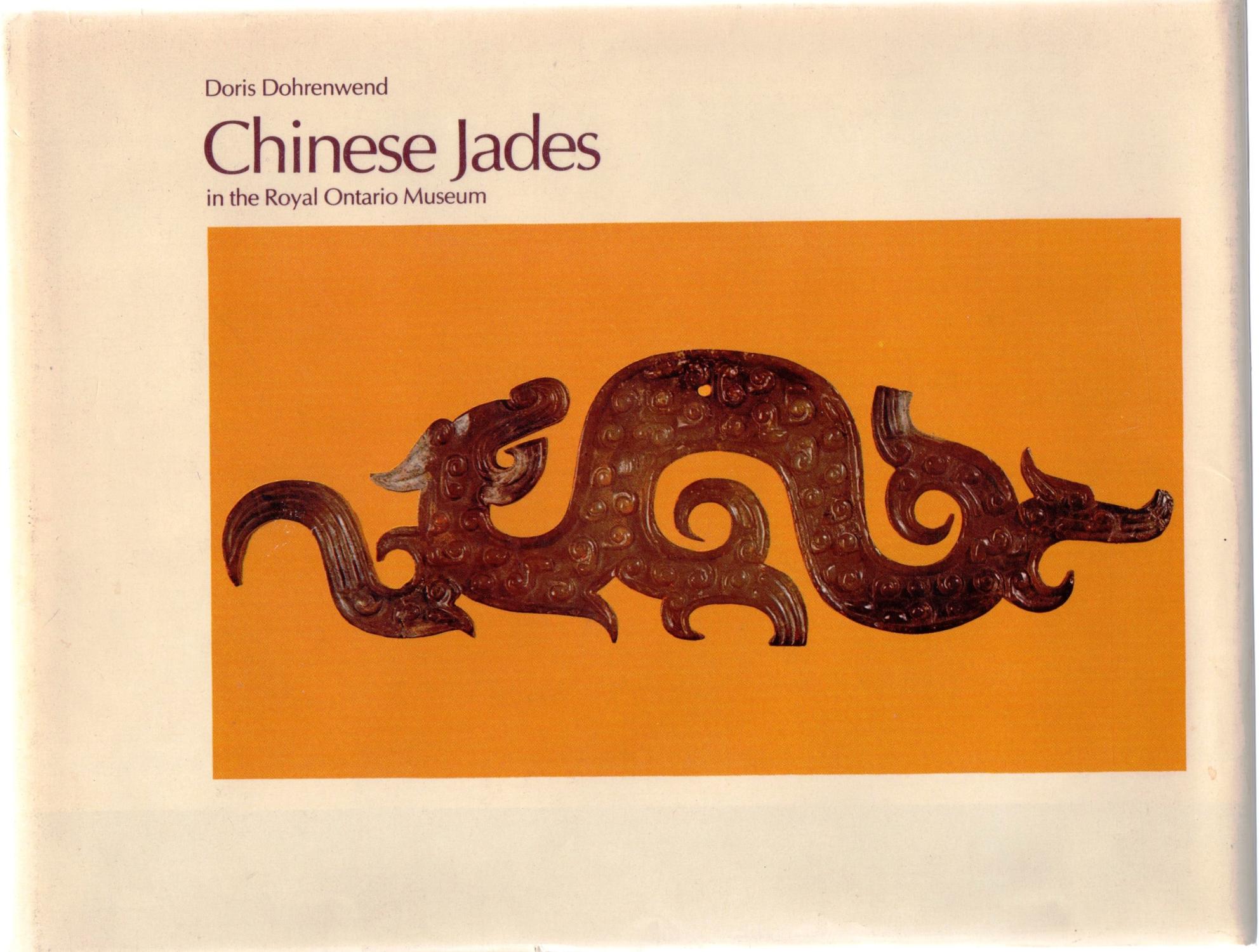
Chinese Jades in the Royal Ontario Museum
Book
Dohrenwend, D. (1971) Chinese Jades in the Royal Ontario Museum. Toronto, Royal Ontario Museum, 135 pp.
Record No. 5780  |  Sinkankas/Born No.: 1743  |  RWHL
Sinkankas: A work perhaps less remarkable for its cataloguing of about 200 examples in the museum collection than for its discerning commentary. Here it is revealed that the author wrote from observations made while cataloguing more than 600 pieces in the collection, assembled between 1919 and 1969 and now numbering over 1,000 objects. Among these is a suite of Eastern Zhou jades dating from the fifth to third centuries BC, derived from the Bishop White Collection and discussed in part in his Tombs of Old Loyang (Shanghai, 1934). Many of the pieces illustrated in the present work, however, had never previously been published. Dohrenwend provides an excellent discussion of the problems associated with jade studies, namely correct mineralogical identification, dating, and answering the question, “Are these Chinese jades?” Another valuable contribution is his study of tool marks on jade objects as evidence of manufacturing techniques characteristic of particular periods, thereby improving the accuracy of dating. A further interesting section reviews the pioneering contributions to jade studies by scholars such as Laufer, Salmony, Willetts, Pelliot, and Hansford, together with a special discussion of Chinese documentary sources. The final part of the text examines the various types and classes of jade objects, whether ceremonial or utilitarian. The catalogue entries are exceptionally detailed, although in many instances photographs of light-coloured jades do not contrast well against the white paper background, making details difficult to discern. Includes an extensive and useful bibliography. Reviewed in Journal of Gemmology 13(3), 1972, pp. 111–112; also discussed in Born, pp. 115–117.

Indian Gemmology

Book
Tank, R.R. (1971) Indian Gemmology. Jaipur, Dulichand Tank, 171 pp.
Record No. 1679  |  Sinkankas/Born No.: 6484; NIB  |  RWHL
Sinkankas: Gemstones as viewed by an Indian author steeped in traditional lore presents a perspective deeply rooted in India’s enduring cultural relationship with gems, much of which remains seriously regarded today. As noted in a review in Gems & Gemology (Vol. 14, No. 2, 1972, pp. 61–63), the work is a unique combination of Indian culture and gemology." The lengthy and valuable introduction offers insights into Indian gem lore, tracing its origins to ancient texts as well as to more recent sources, many of which are cited by the author, Tank, along with the names of their authors. Topics discussed include the critical importance of imperfections in gems, distinctions between synthetics and naturals, and traditional Indian classifications, listing 84 gemstones in total. At the heart of the book is a focus on the nine traditional gems—emerald, diamond, pearl, coral, zircon, blue sapphire, sapphire, ruby, and cat’s-eye—shown on the color plate preceding the text. These are described using both traditional beliefs and modern scientific knowledge, with an emphasis on the qualities a gem must possess to be considered protective or influential. Tank also explores various gem varieties, their sources, and recommendations for when and where they should be worn for their protective powers. For instance, in the case of pearls, shape is crucial, and over 20 forms are illustrated with their Indian names. The book also includes synonyms for gems in different Indian languages and covers additional stones such as garnet, feldspar, quartz, opal, topaz, tourmaline, and beryl. It concludes with short notes on lapidary treatments and birthstones. Monochrome plates primarily depict cutting styles and one plate on inclusions. Unfortunately, and typically of much modern bookbinding in India, the physical binding is very poor—the spine is unrounded and the inner hinges tend to break upon opening. As noted in Rev/Gemm (Vol. 13, No. 6, 1973, p. 239), the book is not a scientific treatise."

A visit to the Topkapi Museum and Treasury, Istanbul, Turkey
Journal Article
Mosey, I. (1971) A visit to the Topkapi Museum and Treasury, Istanbul, Turkey. Journal of Gemmology, Vol. 12, No. 6, April, pp. 214–218.
Record No. 1307  |  ISBN/ISSN: 221252  |  RWHL
The old Palace of the Sultans of the Ottoman Empire stands on a promontory in the city of Istanbul. It is built high above the Bosphorus with a view across to Asia just over one mile away. Istanbul has been on the trade route between East and West throughout the centuries so that some of the choicest silks, jewels, gold, silver and porcelain reached the city. The Palace is really a series of pavilions built by successive Sultans around inner courtyards, cooled by many fountains and surrounded by high walls. Here the Sultans lived in the hey-day of the Ottoman Empire. Originally in the 15th Century, the Treasury was housed in seven towers guarded by 250 Janissaries. The first four towers contained precious jewels, gold coins were consigned to the fifth, whilst the sixth was filled with silver coins. The seventh was reserved for government documents. Sultan Murat III moved the Treasury to seven large rooms in the Palace; and a record taken in the 18th Century showed that it contained 199,371 jewels. Over the years each Sultan added more to the Treasury and when the last Sultan was deposed in 1919, by Kemal Ataturk, the Palace was turned into a museum, so that the treasures have remained intact.

Heat treatment of pale blue sapphire from Malawi

Journal Article
Jobbins, E.A. (1971) Heat treatment of pale blue sapphire from Malawi. Journal of Gemmology, Vol. 12, No. 8, October, pp. 342–343.
Record No. 1065  |  ISBN/ISSN: 221252  |  RWHL

Developments and Highlights at GIA’s Lab in New York: Treated [dyed] corundum
Journal Article
Crowningshield, G.R. (1971) Developments and Highlights at GIA’s Lab in New York: Treated [dyed] corundum. Gems & Gemology, Vol. 13, No. 9, Spring, p. 285.
Record No. 631  |  ISBN/ISSN: 0016626X  |  RWHL

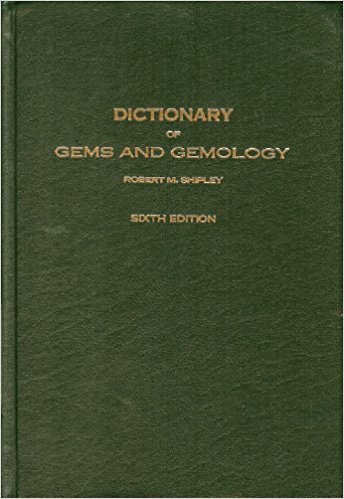
Dictionary of Gems and Gemology

Book
Shipley, R.M. (1971) Dictionary of Gems and Gemology. Los Angeles, GIA, 230 pp.
Record No. 183  |  Sinkankas/Born No.: 6031  |  RWHL

Farb und Farbveranderungen bei Topas

Color and color changes in topaz
Journal Article
Bank, H. (1970) Farb und Farbveranderungen bei Topas. [Color and color changes in topaz] Zeitschrift der Deutschen Gemmologischen Gesellschaft, Vol. 18, No. 4, pp. 171–175.
Record No. 29383  |  Sinkankas/Born No.: NIS/NIB  |  Language: in German  |  RWHL
Bank discusses the causes of color in topaz and the changes that may be produced by natural or artificial influences. He examines the behavior of differently colored topaz and considers the effects of irradiation and subsequent heating on color, including the production, alteration, and loss of color centers within the crystal. The paper relates these changes to the structural and chemical characteristics of topaz and discusses their significance for understanding naturally occurring colors as well as artificially induced coloration. The study is of gemological importance in demonstrating that topaz color may be unstable or modified by treatment and that observed color does not necessarily represent the original state of the material.

Lithotherapy in the Middle Ages. Lapidaries considered as medical texts
Journal Article
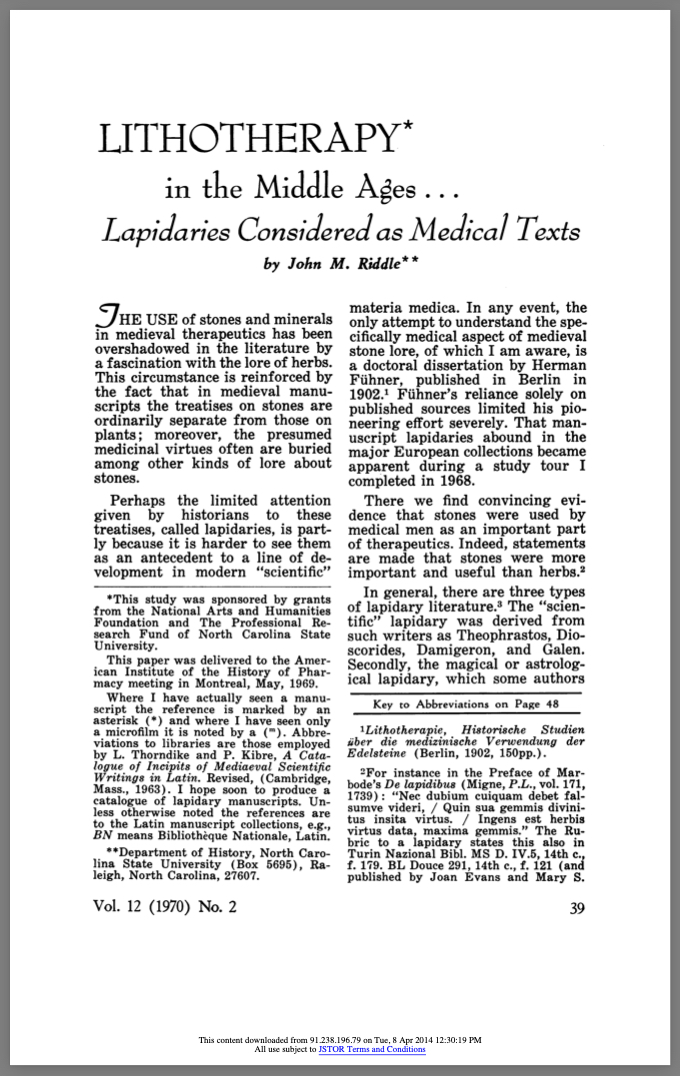
Riddle, J.M. (1970) Lithotherapy in the Middle Ages. Lapidaries considered as medical texts. Pharmacy in History, Vol. 12, No. 2, pp. 39–50.
Record No. 27963  |  Sinkankas/Born No.: NIS/NIB  |  RWHL
The use of stones and minerals in medieval therapeutics has often been overshadowed by a stronger scholarly focus on herbal medicine, partly because medieval manuscripts typically separated treatises on stones—lapidaries—from those on plants, and because the medicinal virtues of stones were frequently obscured by layers of mythological or symbolic lore. Historians may have overlooked these texts due to the difficulty of connecting them to the modern scientific lineage of materia medica. The only known dedicated study of the medical dimension of medieval stone lore is a 1902 doctoral dissertation by Herman Fühner, which, however, was limited by its dependence solely on printed sources. During a 1968 study tour, the author discovered that numerous manuscript lapidaries are housed in major European collections, and these provide compelling evidence that stones were actively used by physicians in therapeutic practices—often even claimed to be more effective than herbs.

A study of rhodolite garnet

Journal Article
Martin, B.F. (1970) A study of rhodolite garnet. Journal of Gemmology, Vol. 12, No. 2, April, pp. 29–36.
Record No. 26729  |  ISBN/ISSN: 221252  |  Sinkankas/Born No.: NIS/NIB  |  RWHL
It is well known that a whole series of garnets exists from pyrope to almandine, due to the isomorphous replacement of Fe for Mg in the basic chemical composition, and for those lying near the middle of the series Anderson has proposed the name “pyrandine”. It is not so well known that a distinct subvariety of the series is recognized which, because of its rose-red to pale violet colour, has been named “rhodolite” (Gr. rhodon, a rose). It is a rare stone and many gemmologists may not have encountered a specimen. According to Phillips, this variety was found, in limited quantity, in Cowee Valley, Macon County, North Carolina. However, a few other sources are known and Sinkankas reports that fine quality material of unprecedented size has recently appeared from Tanzania. Very occasionally, stones having the colour described for rhodolite are encountered, but carrying no qualification other than “garnet”. It seems that there is some reluctance to apply the term “rhodolite” unless it is known that the stone originated from Macon County. If, however, a garnet possesses physical features, in addition to colour, which mark it as a distinctive entity within the pyrope-almandine series, it seems only reasonable that it be granted its status and accorded its value, irrespective of its source. Rhodolite is a subvariety near to pyrope and Webster notes that its composition lies between pyrope and almandine in the ratio of 2:1. The constants for pyrope show a considerable range and the figures given by different authors do not exactly correspond, particularly in the upper limits. This is not surprising, since one is reaching the intermediate (“pyrandine”) type. Phillips states the R.I. range to be from 1.730 to 1.751, but Anderson gives 1.76 as the upper limit and Webster records 1.77. It is perhaps rather curious that the R.I. of rhodolite, which belongs to this series, has only the single figure of 1.76 recorded against it. The same applies to the S.G.; Phillips gives a range of 3.65 to 3.82 for pyrope and other authors quote similarly, yet the single figure of 3.84 is given for rhodolite. Apart from these two constants, the only definite information recorded in standard works is that rhodolite shows the absorption bands characteristic of the almandine spectrum.

P2 omphacite, intermediate in composition between jadeite and hedenbergite, from metamorphosed acid volcanics, Bouehndep, New Caledonia
Journal Article
Black, P.M. (1970) P2 omphacite, intermediate in composition between jadeite and hedenbergite, from metamorphosed acid volcanics, Bouehndep, New Caledonia. American Mineralogist, Vol. 55, No. 3–4_Part_1, pp. 512–514.
Record No. 6485  |  ISBN/ISSN: 0003004X  |  RWHL
P2 omphacite with the composition Jd₄₆Hd₄₂Ac₂Di₄ is described from metamorphosed acid volcanics within New Caledonian blueschists. Chemical composition, physical properties, and X-ray data are given for the omphacite.

Modern synthetic gemstones

Journal Article
Webster, R. (1970) Modern synthetic gemstones. Journal of Gemmology, Vol. 12, No. 4, pp. 101–148.
Record No. 1830  |  ISBN/ISSN: 221252  |  RWHL

The treasure of the Moghul emperors of India
Journal Article
Viswanath, N. (1970) The treasure of the Moghul emperors of India. Journal of Gemmology, Vol. 12, No. 3, July, pp. 73–76.
Record No. 1781  |  ISBN/ISSN: 221252  |  RWHL

Gemology and lapidary in ancient India
Journal Article
Ruzic, R.H. (1970) Gemology and lapidary in ancient India. Lapidary Journal, August, p. 696.
Record No. 1515  |  RWHL

The Townshend Collection of precious stones in the Victoria and Albert Museum: Notes on gemstone prices of the middle nineteenth century
Journal Article
O’Donoghue, M. (1970) The Townshend Collection of precious stones in the Victoria and Albert Museum: Notes on gemstone prices of the middle nineteenth century. Journal of Gemmology, Vol. 12, No. 1, Jan., pp. 1–5.
Record No. 1371  |  ISBN/ISSN: 221252  |  RWHL

Developments and highlights at GIA’s lab in Los Angeles: Striae in light-green synthetic sapphire
Journal Article
Liddicoat, R.T. (1970) Developments and highlights at GIA’s lab in Los Angeles: Striae in light-green synthetic sapphire. Gems & Gemology, Vol. 13, No. 4, Winter, p. 127.
Record No. 1186  |  ISBN/ISSN: 0016626X  |  RWHL

Developments and Highlights at GIA’s Lab in New York: Unusual fluorescence

Journal Article
Crowningshield, G.R. (1970) Developments and Highlights at GIA’s Lab in New York: Unusual fluorescence. Gems & Gemology, Vol. 13, No. 4, Winter, pp. 120–122.
Record No. 630  |  ISBN/ISSN: 0016626X  |  RWHL

Building a Gemological Library

Gemological books range from general identification manuals and textbooks to specialized works on individual gems, mineralogy, jewelry, treatments, synthesis, history and gem-producing regions.

For a curated selection of particularly useful books, read The Gemologist's Core Library — Classic Books on Gemology, Jewelry and Mineralogy.

About Four Treasures

Four Treasures is Lotus Gemology's freely accessible gemological reference database. Use the full database to search by author, title or keyword and explore literature on gemology, mineralogy, jewelry and related fields. Where available, hyperlinks on titles may lead directly to the full publication.

Search the Complete Four Treasures Database