Gemology Books Bibliography

Gemology Books Bibliography

Explore books on gems, gemology, jewelry and mineralogy in Four Treasures, the Lotus Gemology reference database. This bibliography brings together matching book records from the collection, with publication details, abstracts and cover images where available.

Gemology Book References

The list below matches books concerning gemology and related subjects in the database's searchable fields. Some works cover several branches of gems, jewelry or mineralogy.
2,881–2,900 of 3,451 matching references

Notes on the early literature of chemistry: The book of the balance of wisdom
Journal Article
Bolton, H.C. (1876) Notes on the early literature of chemistry: The book of the balance of wisdom. American Chemist, Vol. 6, May, pp. 413–422.
Record No. 478  |  Sinkankas/Born No.: NIS/NIB  |  RWHL
A historical study by Henry Carrington Bolton of the twelfth-century Arabic scientific treatise The Book of the Balance of Wisdom (Kitāb Mīzān al-Ḥikma), attributed to al-Khāzinī. Bolton examines the work’s treatment of the balance, hydrostatic weighing and the determination of specific gravity, drawing on the Arabic text and earlier translations and studies. Of particular gemological interest are the tables and discussions of the specific gravities of precious stones and minerals, including such materials as emerald, rock crystal, cornelian, lapis lazuli and pearl. Bolton emphasizes the sophistication and accuracy of medieval Islamic experimental methods and shows that the treatise represents an important early contribution to quantitative mineralogy and the measurement of density. The paper was subsequently reprinted in expanded form as The Book of the Balance of Wisdom: An Essay on Determinations of Specific Gravity by the Arabians of the XIIth Century.

Damigeron de Lapidibus

Damigeron on stones
Journal Article
Damigeron and Rose, V. (1875) Damigeron de Lapidibus. [Damigeron on stones] Hermes | Zeitschrift für classische Philologie, Vol. 9, No. 4, pp. 471–491.
Record No. 7546  |  ISBN/ISSN: 180777  |  Sinkankas/Born No.: 5546  |  Language: in German  |  RWHL
Rose publishes and critically examines the Latin lapidary attributed to Damigeron, De lapidibus, an important late-antique text on stones and their supposed properties. The work describes numerous stones, giving their names, appearances, sources, and especially the magical, medicinal, protective, and divinatory powers attributed to them, including their use as amulets and engraved talismans. Rose’s edition compares manuscript readings and addresses textual and philological problems in an effort to reconstruct the surviving text and clarify its relationship to Greek and Roman lapidary traditions. The paper is an important source for the history of ancient and medieval gem lore and for understanding the transmission of beliefs concerning the occult and therapeutic properties of gemstones and minerals.

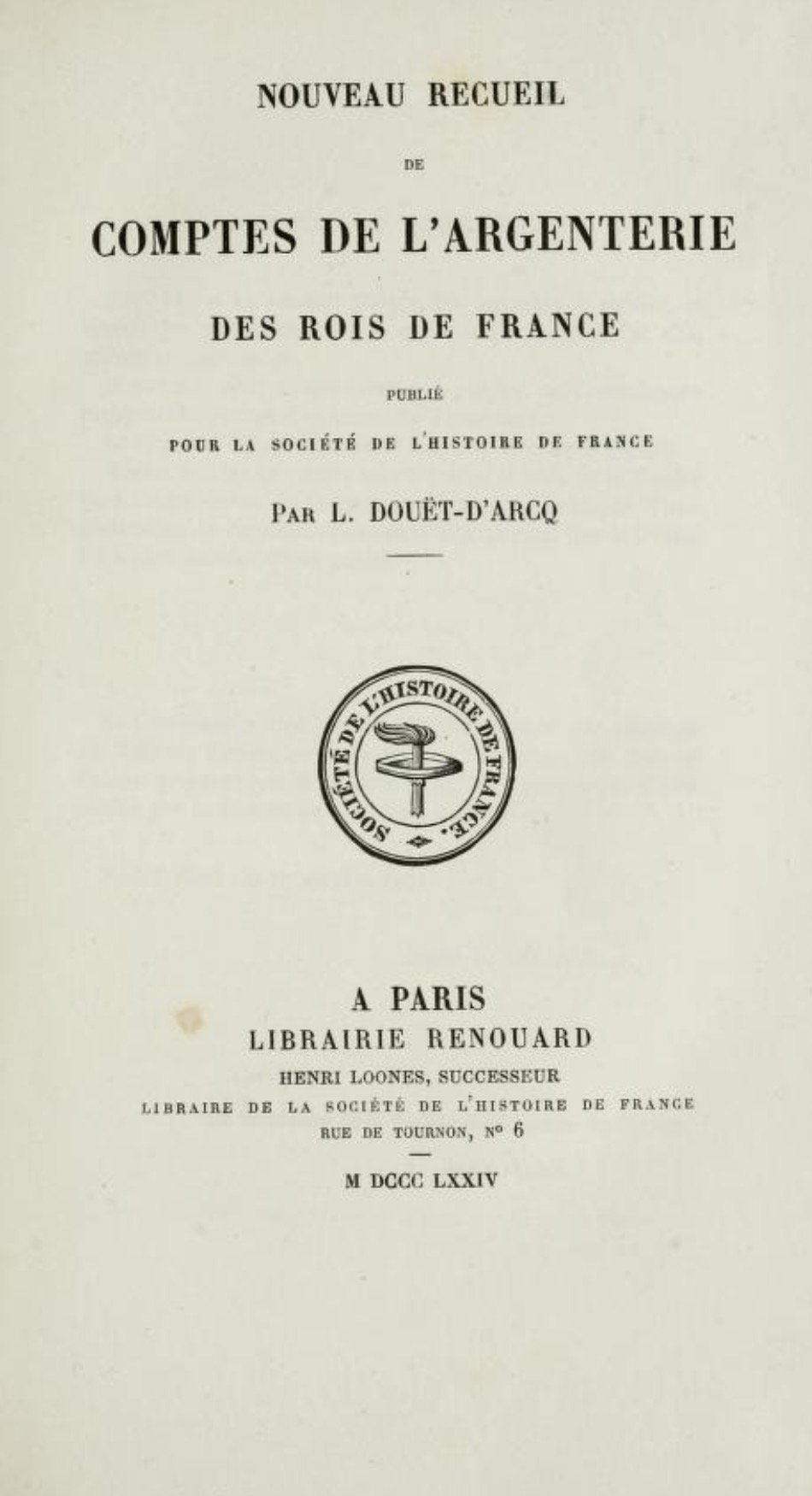
Nouveau recueil de comptes de l’argenterie des rois de France
New Collection of Accounts of the Silver Treasury of the Kings of France
Book
Douët-d’Arq, L. (1874) Nouveau recueil de comptes de l’argenterie des rois de France. [New Collection of Accounts of the Silver Treasury of the Kings of France] Paris, Renouard, 430 pp.
Record No. 17066  |  Sinkankas/Born No.: NIS/NIB  |  Language: in French  |  RWHL
Douët-d’Arcq publishes a collection of medieval accounts relating to the argenterie of the kings of France, providing documentary evidence for royal expenditure on precious objects, jewelry, plate, clothing, and ceremonial furnishings. Drawn from archival records, the accounts record payments to goldsmiths, jewelers, craftsmen, and merchants and describe objects made or acquired for the royal household, often specifying materials, weights, workmanship, and costs. Of particular gemological interest are references to diamonds, rubies, sapphires, emeralds, pearls, and other precious stones employed in royal jewels and ornaments, together with information on their valuation, setting, purchase, and reuse. The work is an important primary source for the history of medieval French jewelry, precious stones, goldsmithing, and the organization and expenditure of the royal treasury.

Das Land und die Stadt “Caindu” von Marco Polo
The country and the city “Caindu” by Marco Polo
Journal Article
Richthofen, F.F., von (1874) Das Land und die Stadt “Caindu” von Marco Polo. [The country and the city “Caindu” by Marco Polo] Gesellschaft für Erdkunde zu Berlin [Society of Geography of Berlin], Vol. 1, Part 2, 3 January, pp. 33–39.
Record No. 8111  |  Sinkankas/Born No.: NIS/NIB  |  Language: in German  |  RWHL
Richthofen examines the identity and location of the country and city called “Caindu” in Marco Polo’s account, comparing the Venetian traveler’s description with Chinese geographical and historical sources and with nineteenth-century knowledge of southwestern China. He analyzes Marco Polo’s itinerary, distances, place names, physical geography, and descriptions of local products in an attempt to identify Caindu with a specific region and settlement. Of particular gemological interest is Marco Polo’s description of precious stones and other mineral products associated with Caindu, which Richthofen considers alongside the geography and trade of the region. The paper forms part of nineteenth-century efforts to reconcile Marco Polo’s narrative with Chinese sources and modern geographical exploration.

Travels to Tana and Persia

Book
Barbaro, J. (1873) Travels to Tana and Persia. London, Hakluyt Society, pp. 53–60
Record No. 29167  |  Sinkankas/Born No.: NIS/NIB  |  RWHL
Barbaro recounts his fifteenth-century travels to Tana on the Sea of Azov and through Persia, describing the countries, peoples, rulers, customs, commerce, routes, and natural products encountered during his journeys. His observations provide firsthand information on regions linking the Black Sea, Caucasus, Persia, and Central Asia during a period of extensive Venetian commercial activity. Of particular gemological interest are pp. 53–60, where he describes precious stones and their reputed sources, including the celebrated balas rubies associated with Badakhshan and other valuable materials entering Persian and international trade. The account is an important early European source for knowledge of the gemstone-producing regions and trading networks of Persia and Central Asia.

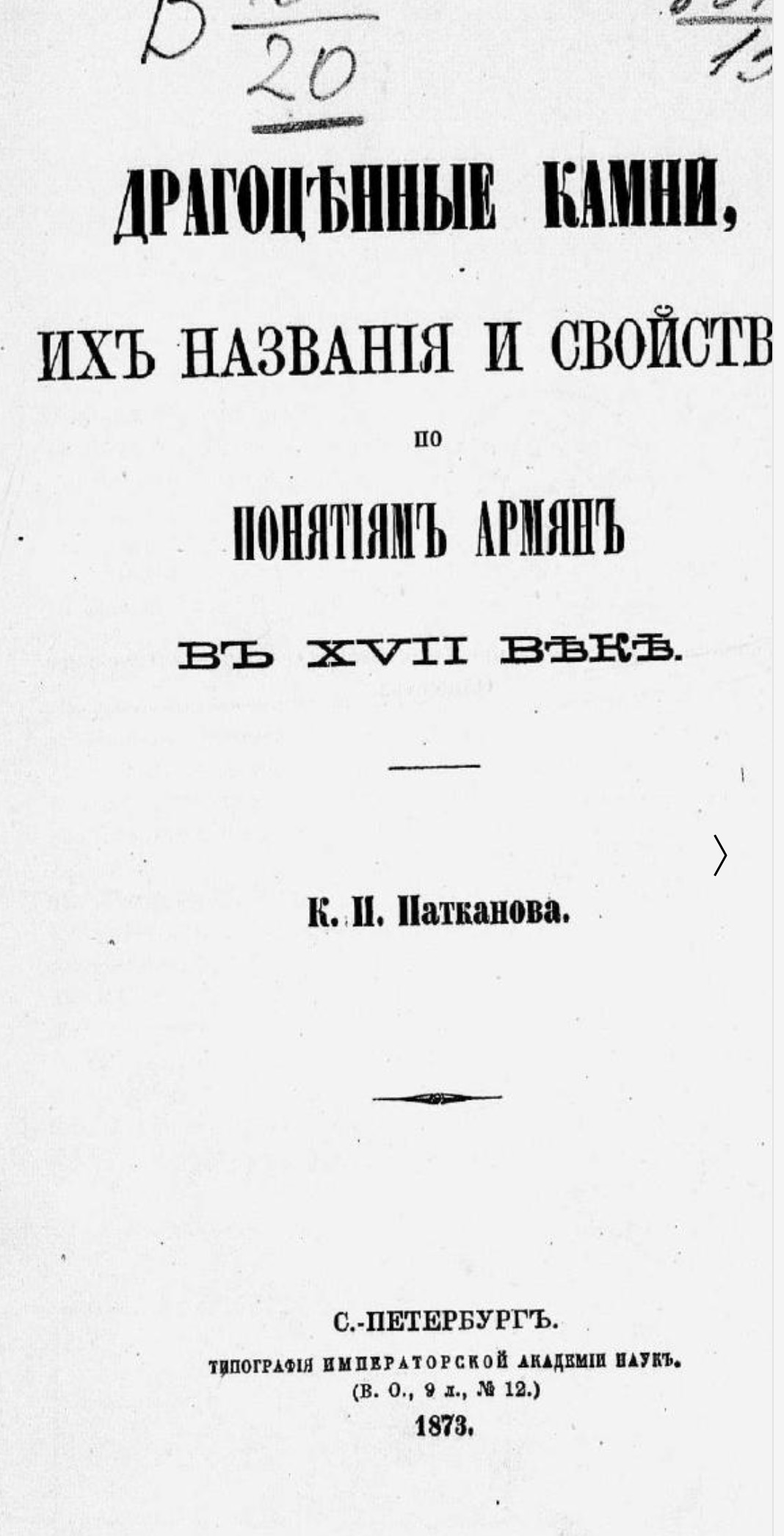
Драгоценные камни, их названия и свойства по понятиям армян в XVII веке
Precious Stones, their Names and Properties among Armenians of Seventeenth Century
Journal Article
Patkanov, K.P. (1873) Драгоценные камни, их названия и свойства по понятиям армян в XVII веке. [Precious Stones, their Names and Properties among Armenians of Seventeenth Century] Труды Восточно-Сибирского отделения Русского археологического общества [Trudy Vostochnogo-Sibirskogo Otdelenie Russkom Arkbeologicbeskikh Obshchestva], Vol. 17, pp. 1–92.
Record No. 29129  |  Sinkankas/Born No.: 5005 (not seen)  |  Language: in Russian  |  RWHL
The book written on behalf of the Imperial Academy of Sciences contains a brief historical introduction dedicated to ancient medieval and oriental collections of lapidary stones a translation of three fragments of works on gems found by the author in the manuscript of the famous Armenian historian of the seventeenth century Arakel Tavrizhetsi (1590–1670) as well as the Armenian text of these fragments. Patkanov examines Armenian knowledge and terminology concerning precious stones in the seventeenth century, drawing upon Armenian manuscripts and lapidary traditions. He discusses the Armenian names of numerous gemstones and minerals, their supposed physical characteristics, colors, sources, varieties, values, and methods of identification, together with the medicinal, magical, and talismanic properties traditionally attributed to them. The study compares and explains terminology and preserves information derived from earlier Near Eastern and Armenian traditions concerning diamonds, rubies, sapphires, emeralds, pearls, turquoise, and other precious and ornamental materials. The work is an important source for the history of Armenian gemology and lapidary literature and for tracing the transmission of mineralogical and gemstone knowledge through the medieval and early modern Near East.

Sur l’hylodes martinicensis et ses métamorphoses
On the hylodes martinicensis and its metamorphoses
Journal Article
Bavay, L. (1873) Sur l’hylodes martinicensis et ses métamorphoses. [On the hylodes martinicensis and its metamorphoses] Journal de zoologie, Vol. 2, pp. 13–21.
Record No. 7992  |  Sinkankas/Born No.: NIS/NIB  |  Language: in French  |  RWHL
Bavay discusses Hylodes martinicensis, a frog from Martinique, and its development and metamorphosis. He examines the animal’s reproductive and developmental characteristics, particularly its departure from the more familiar amphibian pattern involving a free-swimming aquatic tadpole stage. The note concerns zoology and developmental biology rather than mineralogy or gemology and is of interest chiefly as a nineteenth-century observation on the life history of a Caribbean amphibian.

Notes on Hwen Thsang's Account of the Principalities of Tokháristán, in which some Previous Geographical Identifications are Reconsidered
Journal Article
Yule, H. (1873) Notes on Hwen Thsang's Account of the Principalities of Tokháristán, in which some Previous Geographical Identifications are Reconsidered. Journal of the Royal Asiatic Society of Great Britain and Ireland, Vol. 6, No. 1, pp. 92–120.
Record No. 6899  |  ISBN/ISSN: 0035869X  |  Sinkankas/Born No.: NIS/NIB  |  RWHL
Yule examines the account of Tokhāristān given by the seventh-century Chinese Buddhist pilgrim Xuanzang (Hwen Thsang), critically reconsidering earlier attempts to identify the principalities, towns, rivers, and mountain regions described in his travels. By comparing Xuanzang’s itinerary with Chinese, Islamic, classical, and contemporary geographical evidence, Yule seeks to reconstruct the historical geography of the upper Oxus region, including Badakhshan, Wakhan, and neighboring territories. Of particular gemological interest is the geographical context of Badakhshan, historically renowned for its balas rubies (spinel) and lapis lazuli. The paper provides an important nineteenth-century attempt to reconcile early Chinese descriptions with the physical and political geography of Central Asia and helps clarify the historical setting of some of its most celebrated gemstone-producing regions. Contains a brief mention of Khotan.

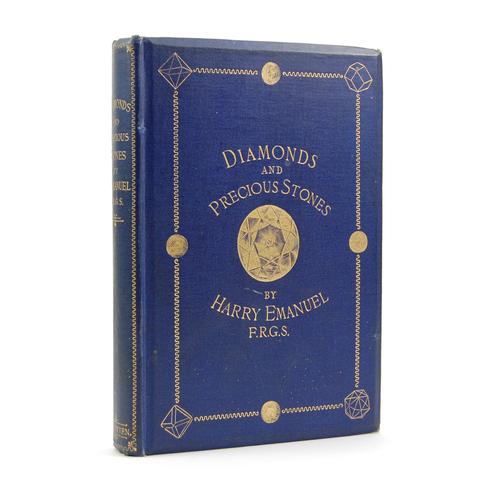
Diamonds and Precious Stones

Book
Emanuel, H. (1873) Diamonds and Precious Stones. New York, G.P. Putnam’s Sons, 266 pp.
Record No. 2752  |  Sinkankas/Born No.: 1888; NIB  |  RWHL
Emanuel presents a practical and historical survey of diamonds and other precious stones, intended particularly for jewelers, merchants, collectors, and general readers. He discusses the physical properties, colors, qualities, sources, cutting, polishing, valuation, and commercial classification of diamonds, rubies, sapphires, emeralds, pearls, opals, turquoise, garnets, and numerous other gem materials. Considerable attention is given to famous diamonds and other celebrated jewels, historic gem-producing localities, methods of distinguishing genuine stones from imitations, and contemporary practices in the gem and jewelry trade. The work provides a useful nineteenth-century account of gemstones from the perspective of the commercial jeweler, combining contemporary gemological knowledge with historical anecdotes and practical information on identification and value.

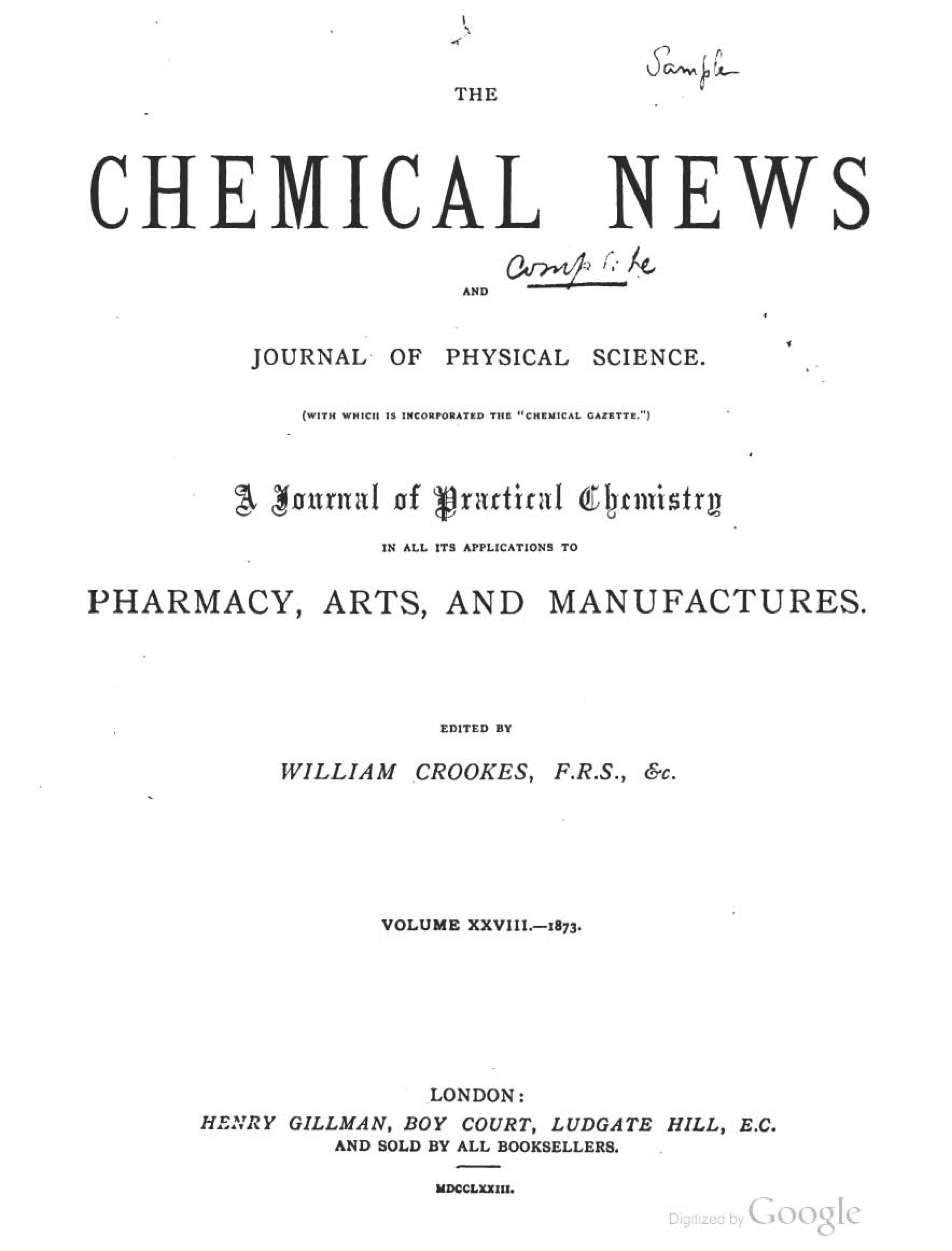
Memorandum on the metals and minerals of Upper Burmah
Journal Article
Strover, G.A. (1873) Memorandum on the metals and minerals of Upper Burmah. Chemical News and Journal of Physical Science, Vol. 28, No. 724,, October  10 pp. 187–190.
Record No. 2602  |  Sinkankas/Born No.: NIS/NIB  |  RWHL
Strover surveys the metals and minerals known from Upper Burma, describing their occurrence, geographical distribution, extraction, and economic importance. He discusses mineral resources including gold, silver, copper, lead, iron, coal, petroleum, and precious stones, drawing on contemporary information concerning mines and mineral-producing districts. Of particular gemological importance are his observations on Burmese gemstones and jade, including materials obtained from the northern districts and entering local and Chinese trade. The memorandum provides a useful nineteenth-century overview of Upper Burma’s mineral wealth and contemporary knowledge of the country’s economically important mineral and gemstone resources.

Eight Years’ Wanderings in Ceylon

Book
Baker, S.W. (1873) Eight Years’ Wanderings in Ceylon. Philadelphia, J.B. Lippincott, 323 pp.
Record No. 404  |  Sinkankas/Born No.: NIS/NIB  |  RWHL
Baker recounts eight years of travel, hunting, exploration, and residence in Ceylon, describing the island’s landscapes, wildlife, peoples, agriculture, settlements, and natural resources. Much of the narrative concerns journeys through the mountainous interior and encounters with elephants and other wildlife, together with observations on colonial and local life. Of gemological interest are references to Ceylon’s precious stones and gem-bearing districts, including the recovery and trade of sapphires, rubies, cat’s-eyes, and other gems for which the island was famous. The work provides a vivid mid-nineteenth-century account of Ceylon and useful contemporary context for its gem-producing regions and gem trade.

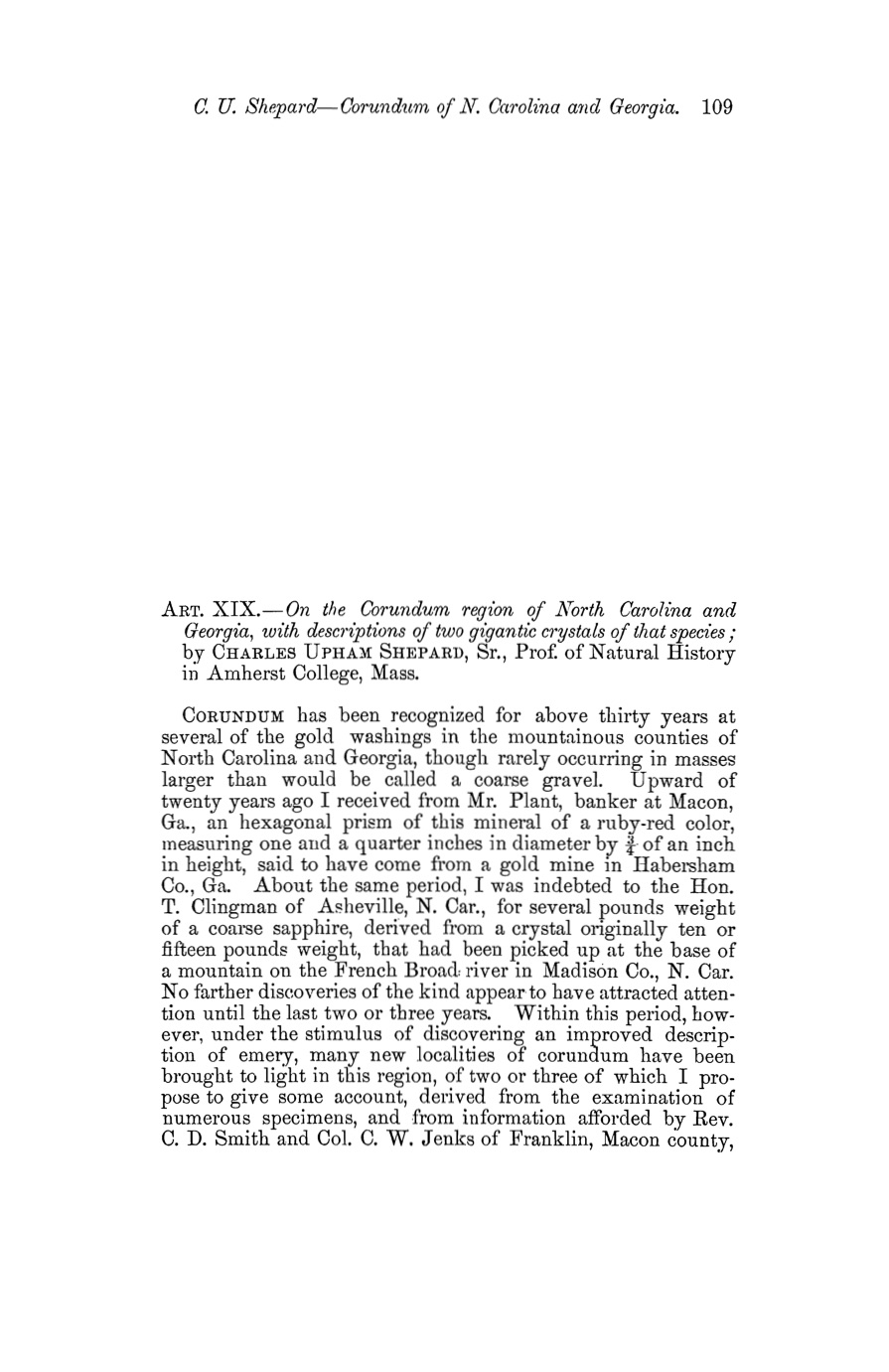
On the corundum region of North Carolina and Georgia, with descriptions of two gigantic crystals of that species
Journal Article
Shepard, C.U. (1872) On the corundum region of North Carolina and Georgia, with descriptions of two gigantic crystals of that species. American Journal of Science, Series 3, Vol. 4, pp. 109–114.
Record No. 7403  |  Sinkankas/Born No.: 6005; NIB  |  RWHL
Shepard describes the corundum-bearing region extending through parts of North Carolina and Georgia, discussing the geological occurrence, associated rocks and minerals, mining localities, and physical characteristics of the corundum found there. He records the occurrence of unusually large masses and crystals and gives particular attention to two gigantic corundum crystals, describing their dimensions, form, weight, and mineralogical characteristics. The paper documents the emerging importance of the southeastern United States as a major nineteenth-century source of corundum, then valued chiefly as an abrasive rather than as a gemstone, and provides early geological and mineralogical observations on deposits that also produced crystals of gemological interest.

Antique Gems and Rings

Book
King, C.W. (1872) Antique Gems and Rings. London, Bell and Daldy, 2 Vols., 483 pp.
Record No. 2802  |  Sinkankas/Born No.: 3411; NIB  |  RWHL
King presents an extensive study of ancient engraved gems and finger rings, principally of Greek, Etruscan, and Roman origin, combining archaeological, historical, artistic, and gemological information. He discusses the materials used by ancient engravers—including carnelian, sard, chalcedony, jasper, agate, amethyst, garnet, emerald, sapphire, and other stones—the techniques of engraving and polishing, forms and construction of rings, and the identification and dating of intaglios and cameos. Considerable attention is given to subjects represented on gems, including deities, portraits, mythological scenes, animals, symbols, inscriptions, and magical devices, as well as to their use as seals, ornaments, amulets, and signet rings. King also examines ancient literary sources concerning precious stones, notable collections and individual gems, later imitations and forgeries, and the reuse of classical gems in subsequent periods. The work is an important nineteenth-century synthesis of glyptic art and remains valuable for its detailed observations on engraved gemstones, their materials, manufacture, iconography, and historical use.

Papers connected with the upper Oxus regions
Journal Article
Yule, H. (1872) Papers connected with the upper Oxus regions. Journal of the Royal Geographical Society, Vol. 42, pp. 438–513, 2 maps.
Record No. 1906  |  Sinkankas/Born No.: NIS/NIB  |  RWHL
Yule assembles and discusses geographical information concerning the upper Oxus (Amu Darya) and the poorly known regions of the Pamirs, Badakhshan, Wakhan, and adjoining Central Asia. Drawing upon historical sources, contemporary travelers, native reports, and recent exploration, he examines the courses and headwaters of the Oxus, mountain ranges and passes, settlements, routes, political geography, and the identification of places mentioned by earlier writers. Of particular gemological interest is the treatment of Badakhshan, historically renowned for its balas rubies, or spinels, and for lapis lazuli. The paper provides geographical context for the celebrated balas ruby (spinel) mines near the upper Oxus and the lapis lazuli deposits of the Kokcha Valley, helping to clarify the locations and routes associated with two of Central Asia’s most important historic gemstone-producing districts.

To High Tartary, Yârkand, and Kâshgar (formerly Chinese Tartary) and Return Journey over the Karakoram Pass
Book
Shaw, R. (1871) To High Tartary, Yârkand, and Kâshgar (formerly Chinese Tartary) and Return Journey over the Karakoram Pass. London, John Murray, 486 pp. (see pp. 474–475)
Record No. 7363  |  Sinkankas/Born No.: NIS/NIB  |  RWHL
Shaw recounts his journey from India across the Karakoram to Yarkand and Kashgar in Eastern Turkestan, describing the geography, peoples, customs, political conditions, commerce, and caravan routes of a region then rarely visited by Europeans. Of particular gemological importance are his remarks on pp. 474–475 concerning Khotan jade. He describes jade as an important product of the Khotan region, obtained both from river deposits and from workings in the mountains, and discusses its transport and trade. The material was particularly valued for the Chinese market, while local demand was comparatively limited. Shaw’s observations provide valuable nineteenth-century evidence for the sources, recovery, and commerce of Khotan nephrite and for the trade routes linking the jade-producing districts of the Kunlun with Yarkand and China.

A Report on the Expedition to Western Yunan via Bhamo
Book
Anderson, J. (1871) A Report on the Expedition to Western Yunan via Bhamo. Calcutta, Office of the Supt. of Govt. Printing, 458 pp., 2 maps
Record No. 2692  |  Sinkankas/Born No.: NIS/NIB  |  RWHL
Anderson reports on the British expedition from Bhamo in Upper Burma into western Yunnan, describing the route, geography, geology, natural history, peoples, political conditions, commerce, and resources of the region. Particular attention is given to the important overland trade between Burma and China, including the markets and caravan routes connecting Bhamo with Yunnan. Of gemological interest are observations on the mineral products and trade of northern Burma and southwestern China, including jade, which moved through this commercial network from the jade-producing districts of Upper Burma toward Chinese markets. The work provides an important nineteenth-century account of the geography and commerce of the Burma–Yunnan frontier and historical context for the development and organization of the Burmese jade trade.

Nouvelles remarques sur la fabrication de pierres précieuses artificielles; indication des procédés employés
New remarks on the manufacturing of artificial gemstones; indication of the methods used
Journal Article
Gaudin, M.A.A. (1870) Nouvelles remarques sur la fabrication de pierres précieuses artificielles; indication des procédés employés. [New remarks on the manufacturing of artificial gemstones; indication of the methods used] Compte Rendu hebdomadaires des Séances de l’Académie des Sciences, Vol. 70, No. 1, 3 janvier, pp. 40–41.
Record No. 2922  |  Sinkankas/Born No.: NIS/NIB  |  Language: in French  |  RWHL
Gaudin provides further remarks on the artificial production of precious stones and specifies the experimental procedures he employed. He describes the preparation and intense heating of suitable chemical substances to obtain crystalline materials resembling natural gems, particularly corundum. Of special gemological importance are his experiments with alumina and small quantities of coloring agents, including chromium compounds, in attempts to reproduce ruby and other colored varieties of corundum. He discusses the conditions necessary for fusion and crystallization and the difficulty of obtaining crystals sufficiently large and transparent for practical use. The note represents an important early contribution to gemstone synthesis and to experimental investigation of the chemical causes of gemstone color.

Wanderungen auf der Insel Ceylon

Wanderings on the island of Ceylon
Journal Article
Anonymous (1869) Wanderungen auf der Insel Ceylon. [Wanderings on the island of Ceylon] Globus, Vol. 16, No. 20; No. 21; No. 22, pp. 305–310; pp. 321–330; pp. 338–342.
Record No. 29894  |  Sinkankas/Born No.: NIS/NIB  |  Language: in German  |  RWHL
A wide-ranging account of travel and life in Ceylon, beginning with the approach from southern India across the Palk Strait and Adam’s Bridge and continuing through the island’s geography, population, customs, religion, agriculture, and commerce. The author discusses the Sinhalese caste system, Buddhist practices and funerary customs, transportation and settlements, and important agricultural products including coffee, cinnamon, and coconuts. Of particular gemological and natural-history interest, the article describes the Gulf of Mannar and its pearl-oyster fishery, placing this long-established industry within the geography and economy of Ceylon. The narrative combines contemporary observations with information drawn from earlier travelers and geographical works and is illustrated with numerous views of the island and its inhabitants.

Analytical alphabet for the Mexican & Central American languages
Book
Berendt, C.H. (1869) Analytical alphabet for the Mexican & Central American languages. New York, American Ethnology Society, 8 pp.
Record No. 8138  |  Sinkankas/Born No.: NIS/NIB  |  RWHL
Berendt presents a proposed analytical alphabet for recording the Indigenous languages of Mexico and Central America, intended to provide a consistent system for representing sounds encountered in linguistic and ethnographic research. Drawing on his extensive study of Mesoamerican languages and manuscripts, he identifies significant speech sounds and assigns characters and diacritical signs for their transcription, with the aim of reducing the inconsistencies produced by Spanish and other European orthographies. The brief work is primarily linguistic rather than archaeological or gemological and reflects nineteenth-century efforts to establish systematic phonetic methods for documenting Indigenous American languages.

Beiträge zur Kenntniss der Constitution mehrerer Silikate

Contributions to the knowledge of the constitution of several silicates
Journal Article
Rammelsberg, C.F. (1869) Beiträge zur Kenntniss der Constitution mehrerer Silikate. [Contributions to the knowledge of the constitution of several silicates] Zeitschrift der Deutschen Geologischen Gesellschaft, Vol. 21, pp. 84–99.
Record No. 7887  |  Sinkankas/Born No.: NIS/NIB  |  Language: in German  |  RWHL
Rammelsberg presents chemical investigations of several silicate minerals in an effort to clarify their composition and chemical constitution. Using quantitative analyses, he compares the proportions of silica, alumina, magnesia, lime, iron, alkalies, and other constituents and considers how analytical results should be expressed in mineral formulas and used to distinguish related species. The paper forms part of Rammelsberg’s broader work to place mineral classification on a rigorous chemical basis at a time when the compositions and relationships of many complex silicates were still being established. It provides contemporary analytical data relevant to the developing chemical understanding of silicate minerals, including groups containing species of mineralogical and gemological importance.

Building a Gemological Library

Gemological books range from general identification manuals and textbooks to specialized works on individual gems, mineralogy, jewelry, treatments, synthesis, history and gem-producing regions.

For a curated selection of particularly useful books, read The Gemologist's Core Library — Classic Books on Gemology, Jewelry and Mineralogy.

About Four Treasures

Four Treasures is Lotus Gemology's freely accessible gemological reference database. Use the full database to search by author, title or keyword and explore literature on gemology, mineralogy, jewelry and related fields. Where available, hyperlinks on titles may lead directly to the full publication.

Search the Complete Four Treasures Database