Gemology Books Bibliography

Gemology Books Bibliography

Explore books on gems, gemology, jewelry and mineralogy in Four Treasures, the Lotus Gemology reference database. This bibliography brings together matching book records from the collection, with publication details, abstracts and cover images where available.

Gemology Book References

The list below matches books concerning gemology and related subjects in the database's searchable fields. Some works cover several branches of gems, jewelry or mineralogy.
2,901–2,920 of 3,451 matching references

Further notes on microscopic crystals
Journal Article
Lea, I. (1869) Further notes on microscopic crystals. Proceedings of the Academy of Natural Sciences of Philadelphia, 11-May, pp. 119–121; reprinted in Gems & Gemology, Fall, 1955, pp. 205–207, 218–219.
Record No. 1177  |  ISBN/ISSN: 0016626X  |  Sinkankas/Born No.: 3820; NIB  |  RWHL
Lea continues his microscopic investigation of minute crystals enclosed within minerals, adding observations to those reported in his earlier 1869 paper. He describes the forms and occurrence of microscopic crystalline inclusions and considers their identification and relationship to their host minerals. Particular attention is given to the value of careful microscopic examination for recognizing well-developed crystal forms that are invisible or indistinct to the unaided eye. The study is of historical gemological interest as an early investigation of mineral inclusions by microscopy, anticipating the later importance of internal features for gemstone identification and for interpreting mineral growth and formation.

Notes on microscopic crystals included in some minerals
Journal Article
Lea, I. (1869) Notes on microscopic crystals included in some minerals. Proceedings of the Academy of Natural Sciences of Philadelphia, Feb. 16, reprinted in Gems & Gemology, Fall, 1955, pp. 203–205.
Record No. 1176  |  ISBN/ISSN: 0016626X  |  Sinkankas/Born No.: NIS/NIB  |  RWHL
Lea reports microscopic observations of minute crystals enclosed within larger mineral specimens, emphasizing that such inclusions may themselves possess recognizable crystalline forms and provide evidence concerning the formation of their host minerals. He describes microscopic crystals observed in several minerals and considers their shapes, arrangement, and possible mineralogical identity. Of particular gemological importance is the early application of microscopy to the study of inclusions in transparent minerals, demonstrating that internal features could reveal information not obtainable from external examination alone. The paper anticipates the later systematic use of inclusions in gemology for mineral identification and for interpreting the conditions and sequence of crystal growth.

Wanderung nach den Türkisminen und der Sinai-Halbinsel
Journey to the Turquoise Mines and the Sinai Peninsula
Book
Brugsch, H. (1868) Wanderung nach den Türkisminen und der Sinai-Halbinsel. [Journey to the Turquoise Mines and the Sinai Peninsula] Leipzig, J.C. Hinrichs, 96 pp.
Record No. 7991  |  Sinkankas/Born No.: NIS/NIB  |  Language: in German  |  RWHL
Brugsch recounts his journey through the Sinai Peninsula to the ancient turquoise-mining district of Wadi Maghara and Serabit el-Khadim, combining travel observations with descriptions of the archaeological remains and inscriptions encountered there. Of particular gemological importance is his account of the Sinai turquoise mines, including the geological setting, ancient workings, extraction of turquoise, and evidence for Egyptian mining expeditions. He discusses the hieroglyphic inscriptions and reliefs left by pharaonic expeditions and their value for establishing the antiquity and organization of turquoise exploitation in Sinai. The work provides an important nineteenth-century eyewitness account of one of the world’s oldest documented gemstone-mining regions and links the physical remains of turquoise extraction with contemporary understanding of ancient Egyptian history and epigraphy.

Report on his journey to Ilchí, the capital of Khotan, in Chinese Tartary
Journal Article
Johnson, W.H. (1868) Report on his journey to Ilchí, the capital of Khotan, in Chinese Tartary. Journal of the Royal Geographical Society, Vol. 37, 25-Apr, pp. 1– 47.
Record No. 7366  |  Sinkankas/Born No.: NIS/NIB  |  RWHL
Johnson gives a detailed account of his 1865 journey from Ladakh across the Karakoram and Kunlun ranges to Ilchí (modern Hotan/Khotan), the capital of Khotan in Chinese Turkestan. He describes the route, mountain passes, rivers, settlements, climate, agriculture, population, government, commerce, and political conditions of a region then little known to European geographers. Of particular gemological importance are his observations on the celebrated Khotan jade industry, including the occurrence and recovery of jade from river deposits and mountain sources and its importance as an article of commerce with China. Johnson’s firsthand observations provide valuable evidence concerning the geography of one of the principal historic source regions for Chinese nephrite and the routes by which jade was obtained and transported.

The Natural History of Precious Stones and of the Precious Metals
Journal Article
King, C.W. (1867) The Natural History of Precious Stones and of the Precious Metals. 364 pp..
Record No. 2620  |  Sinkankas/Born No.: 3407; NIB  |  RWHL
Sinkankas: This work represents a second stage of fractionation from its immediate predecessor, The Natural History, Ancient and Modern, of 1865. In the preface, King justifies this division by explaining that the present volume, omitting the precious," focuses exclusively on the commoner species of decorative minerals, using the term "Gems" for lack of a more precise term. Presented in alphabetical order, the work details 46 gem materials—many retaining their ancient names and, in some cases, remaining uncertainly identified—with King offering his reasoning for the identifications he supports. In addition to these entries, the volume includes a contribution on pastes and a description of the illustrations of engraved gems. The entire text is engaging and enriched with new material King uncovered since the publication of the earlier treatise."

Precious stones, their prestige chiefly due to fashion
Journal Article
Anonymous (1866) Precious stones, their prestige chiefly due to fashion. Edinburgh Review, Vol. 124, No. 253, July, pp. 228–260.
Record No. 29105  |  Sinkankas/Born No.: 3401  |  RWHL
The anonymous author surveys precious stones from historical, mineralogical, commercial, and social perspectives, arguing that much of their exceptional monetary value and prestige derives from fashion, rarity, and human convention rather than intrinsic usefulness. The article discusses diamonds and the principal colored gemstones, their celebrated historical examples, sources, physical properties, cutting, valuation, and use in personal ornament, while examining changing preferences for particular gems in different periods and societies. Considerable attention is given to famous jewels and royal collections and to the influence of new discoveries and changing supplies upon prices. The author contrasts the enormous sums paid for certain stones with their limited practical utility and emphasizes the roles of taste, scarcity, fashion, and social display in creating demand. The article provides a broad mid-nineteenth-century view of the gem trade and of contemporary attitudes toward the economic and cultural value of precious stones.

Polynesia; A Popular Description of the Physical Features, Inhabitants, Natural History and Productions of the Islands of the Pacific
Book
Angas, G.F. (1866) Polynesia; A Popular Description of the Physical Features, Inhabitants, Natural History and Productions of the Islands of the Pacific. London, Society for Promoting Christian Knowledge, 436 pp.
Record No. 15509  |  Sinkankas/Born No.: NIS/NIB  |  RWHL
Angas presents a popular survey of the geography, inhabitants, natural history, customs, and products of the Pacific islands, drawing upon contemporary travel accounts and his own experience in the region. Of particular gemological and ethnographic interest is his discussion of New Zealand pounamu or greenstone, which he describes as a highly valued material employed by Māori for weapons and ornaments. He notes its use for mere and hei-tiki, the laborious methods required to shape and polish the exceptionally tough stone, and the importance attached to individual objects, which could be preserved and handed down as valued possessions. The account provides a useful nineteenth-century description of Māori nephrite working and the cultural value of pounamu at a time when traditional practices were undergoing rapid change.

A Description of the Coasts of East Africa and Malabar in the Beginning of the Sixteenth Century, by Duarte Barbosa, a Portuguese
Book
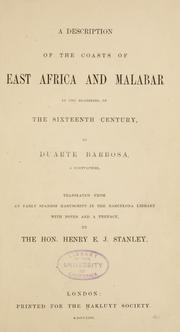
Barbosa, D. (1866) A Description of the Coasts of East Africa and Malabar in the Beginning of the Sixteenth Century, by Duarte Barbosa, a Portuguese. London, Hakluyt Society, Vol. 35 , see p. 208
Record No. 2706  |  Sinkankas/Born No.: NIS/NIB  |  RWHL
Barbosa provides an early sixteenth-century account of the coasts and trading centers of East Africa, Arabia, India, and the Indian Ocean, describing their peoples, customs, rulers, religions, commodities, and maritime commerce as encountered by the Portuguese during the first decades of their expansion into the region. Of particular gemological interest are his observations on the trade in precious stones, including diamonds, rubies, sapphires, spinels, and other gems moving through the commercial centers of India and the wider Asian trading network. On p. 208, in his description of Pegu, Barbosa discusses the rubies obtained there and their commerce, providing important early evidence for the Burmese ruby trade and its connection with Indian markets. The work is a valuable primary source for understanding the organization and geographical extent of the Asian gem trade at the beginning of the sixteenth century.

Antique Gems: Their Origin, Uses and Value
Journal Article
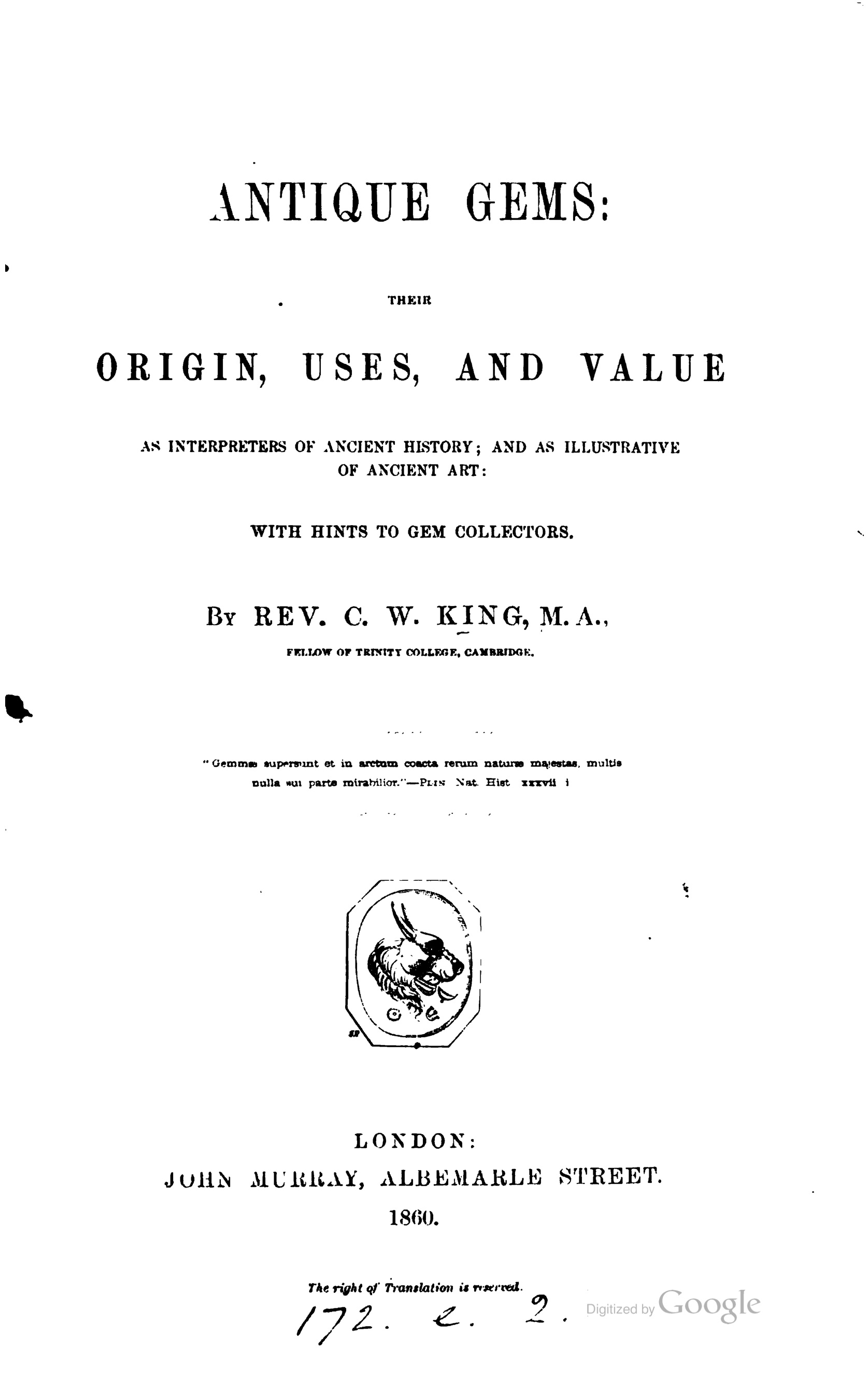
King, C.W. (1866) Antique Gems: Their Origin, Uses and Value. 498 pp..
Record No. 2621  |  Sinkankas/Born No.: 3397; NIB  |  RWHL
Sinkankas: This is King's first book publication on a subject that he took up early in his career and pursued with single-minded persistence throughout his life. As a first effort, it leaves much to be desired, not because of neglect to provide a plethora of information, which is still very useful, but as Vinet, 1663, notes, it is very difficult to analyze. Faced with so much data uncovered in his solitary studies at Cambridge he crammed as much as he could within the covers of a single volume, but failed to organize it well with the result that the text is often confusing to the reader. The introduction cites the views of Goethe on the usefulness of study of antique engraved gems and also provides a short history of the glyptic art. The five engraved plates, lauded by Vinet for their quality and fidelity to the originals, are inserted after the table of contents and explained in accompanying text, with many more single gems in wood engravings sprinkled throughout the text or used as head- or tailpieces. The first section of text describes the materials of gems, with notes on minerals and rocks used and possible sources of rough. There is some useful gemological information here, much of it based on King's researches into Pliny's Natural History, and other ancient sources. Here too are found remarks on pastes, gem impressions, and notes on forms of gems. The second section treats art as displayed in gems, beginning with tests of antiquity and the instruments used in engraving, the latter obviously useful in determining age. Next are essays on styles, symbolism, and subjects upon gems as assigned to various cultures during various periods. In this section also appear such diverse topical discussions as on rings, flexible glass," names of artists, coin-dies, famous collections, and other bits and pieces of knowledge that should have been more carefully organized and presented to the reader. The third section treats the subjects depicted upon gems, while the last section, again a catch-~ considers mystic virtues of gems, and provides his own translation into English of Marbodeus' celebrated poem on gemstones, p 391-417, which is accompanied by another translation of parts of Orpheus' poem on stones, p 420-26, passim, the last being interspersed with short descriptions of gemstones as given in Camillus Leonardus' Speculum Lapidum, p 418–28, passim. The final part of this section is a commentary on books concerning engraved gems but treating only a few of the most important. King later published a much larger bibliography in his Antique Gems and Rings, see below. The appendix again treats a variety of topics, among them, remarks on the tools of the ancient engraver, the Sassanian alphabet, and notes on statements made previously in the text. The encyclopedic, albeit confused nature of this work moved A Furtwangler, Die antiken Gemmen, vol 3,433, to be less than kind in his review, noting the "confusion" in this and subsequent works by King, and voicing the opinion that from this initial treatise sprang all the others that appeared in the following decade, eg, his The Natural History, Ancient and Modern of Precious Stones, etc, 1865, which grew from his section on gemstones, The Gnostics and Their Remains, 1864, 1887, which emerged from his section on mystical properties of gemstones, and so on. Furtwangler notes other defects in this and subsequent King books, summarizing them all as being "dilettante" in character, crammed with unplanned information, but still containing much that is worthwhile. Zazoffs, Gemmensammler, however, state that Furtwangler went "too far" in his criticism. Despite these adverse remarks it remains true that King, more than anyone else, was the first English writer to provide a major fund of information, all in one place, on engraved gems. He was responsible in large measure for arousing interest in this branch of ancient art among the people of Great Britain and America. Rev Edinburgh Rev, Oct 1966, 511–552."

Grammaire des Arts du Dessin; Glyptique
Grammar of the Arts of Drawing; Glyptics
Journal Article
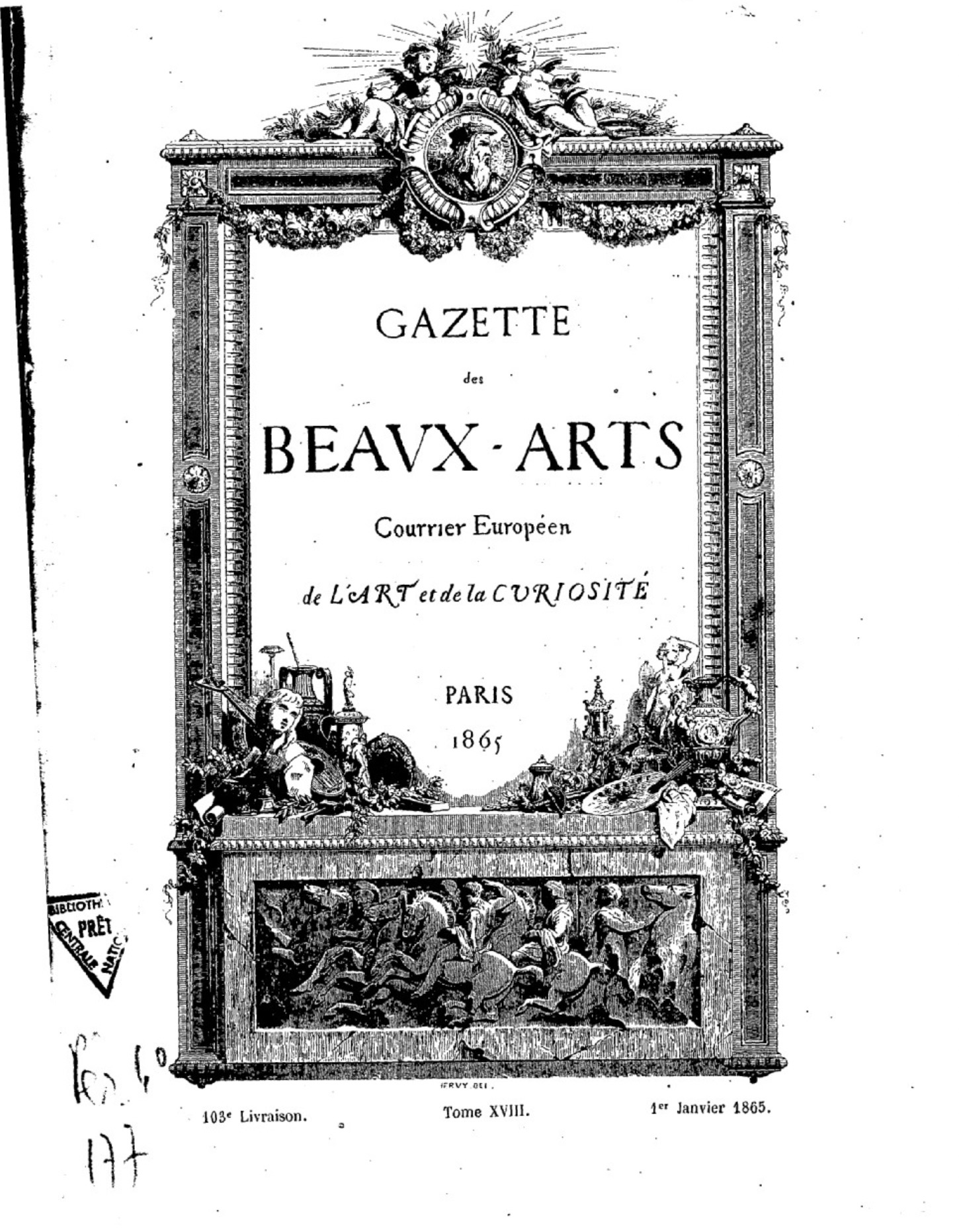
Blanc, C. (1865) Grammaire des Arts du Dessin; Glyptique. [Grammar of the Arts of Drawing; Glyptics] Gazette des Beaux-Arts, Vol. 18, pp. 248–274.
Record No. 28843  |  Sinkankas/Born No.: NIS/NIB  |  Language: in French  |  RWHL
If one supposes that, through an invasion of barbarism or through some cataclysm, the monuments of history had been destroyed; that traditions had been broken; that the knowledge of the ancient world had vanished from the memory of men; that books had perished; and that, from this shipwreck of human knowledge, nothing had been saved except an entire collection of engraved stones, coins, and medals, it might perhaps suffice, through the discovery of this single treasure, gradually to restore the vanished monuments, to reconnect the traditions, to rebuild learning, and to reconstruct history. Medals, coins, cameos, and intaglios are indeed books printed on metal or on hard stone; their descriptions are eloquent. Men and things are represented there by tangible images, patiently cut or boldly sculpted in relief; the inscriptions engraved upon them are concise, yet clear, eloquent, and decisive. Their testimony, finally, while not irrefutable, must appear more naïve and often more authentic and trustworthy than that of written history, when one considers that a moment and a stroke of the pen suffice to write an error or a lie, whereas so much labor and so many days are required to engrave them.

Matériaux pour l’Histoire Positive et Philosophiqué de l’Homme
Materials for the Positive and Philosophical History of Man
Book
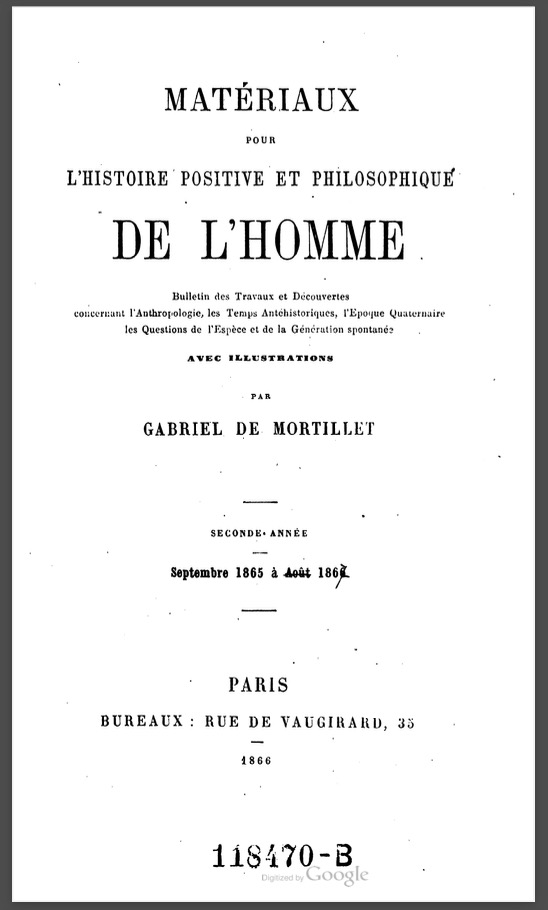
Mortillet, G., de (1865) Matériaux pour l’Histoire Positive et Philosophiqué de l’Homme. [Materials for the Positive and Philosophical History of Man] Paris, 580 pp.
Record No. 7984  |  Sinkankas/Born No.: NIS/NIB  |  Language: in French  |  RWHL
Mortillet’s Matériaux pour l’Histoire Positive et Philosophique de l’Homme is an early prehistoric and anthropological publication devoted to archaeological discoveries, human antiquity, prehistoric industries, and the material evidence for early peoples. Of particular gemological interest is the discussion of jade on p. 244, where nephrite implements from European prehistoric contexts are considered in connection with the problem of the geographical origin of their raw material. Such finds, especially polished nephrite axes from Swiss lake dwellings, contributed to the developing nineteenth-century debate over whether European prehistoric jade was obtained from indigenous sources or introduced through long-distance exchange with Asia. The publication provides contemporary evidence for the emergence of jade provenance as an important archaeological and mineralogical question.

Leechdoms, Wortcunning, and Starcraft of Early England: Being a Collection of Documents, for the Most Part Never before Printed, Illustrating the History of Science in This Country before the Norman Conquest
Edited Book
Cockayne, T.O., editor (1864) Leechdoms, Wortcunning, and Starcraft of Early England: Being a Collection of Documents, for the Most Part Never before Printed, Illustrating the History of Science in This Country before the Norman Conquest.. London, Longman, Green, Roberts, 3 Vols., 405, 415, 454 pp..
Record No. 27933  |  Sinkankas/Born No.: NIS/NIB  |  RWHL
This three-volume work, published in 1864–6, was edited by Thomas Oswald Cockayne (1807–73), a Cambridge graduate, much-published early member of the London Philological Society, and teacher of the philologists Walter Skeat and Henry Sweet. It is a collection of writings from pre-Conquest Britain on plants, medicine and the heavens, mostly in Old English with accompanying modern English translations. Vol. 1: Volume 1 begins with a substantial preface outlining the Anglo-Saxon reception of Greek and Latin medical texts. The main work in this volume is an Old English version of the late Latin Herbarium formerly attributed to Apuleius, augmented by material deriving from Dioscorides' De Materia Medica. The volume concludes with an Old English translation of the fourth-century Roman physician Sextus Placitus' writings on animal-derived medicines, and some short medicinal recipes in Old English and Latin taken from the fly leaves of manuscripts. Vol. 2: The preface of Volume 2 outlines evidence for early medieval British material culture, particularly foodstuffs, drink, fabrics and metals, and argues against dismissing the Anglo-Saxons and their contemporaries as 'primitive'. The Old English text in this volume is taken from a tenth-century manuscript in the Royal Collection, which Cockayne suggests may have belonged to the Abbot of Glastonbury. It is a careful and thorough compilation of remedies for conditions ranging from toothache to complications of pregnancy, and digestive problems to mental illness, and reveals the influence of Greek medical learning in the Anglo-Saxon world. Vol. 3: The preface of Volume 3 discusses questions including the identity of the Anglo-Saxon translator of Bede's De Temporibus and the similarities between Classical and medieval dream-interpretation and divination, and the Victorian penchant for spiritualism and astrology. The texts in this volume include remedies, charms and prayers for the sick, in Latin and Old English, lists of plant names, works on solar and lunar calendars and horoscopes, and explanations of the prophetic meaning of dreams. The volume ends with some historical fragments in Old English relating to monastic foundations.

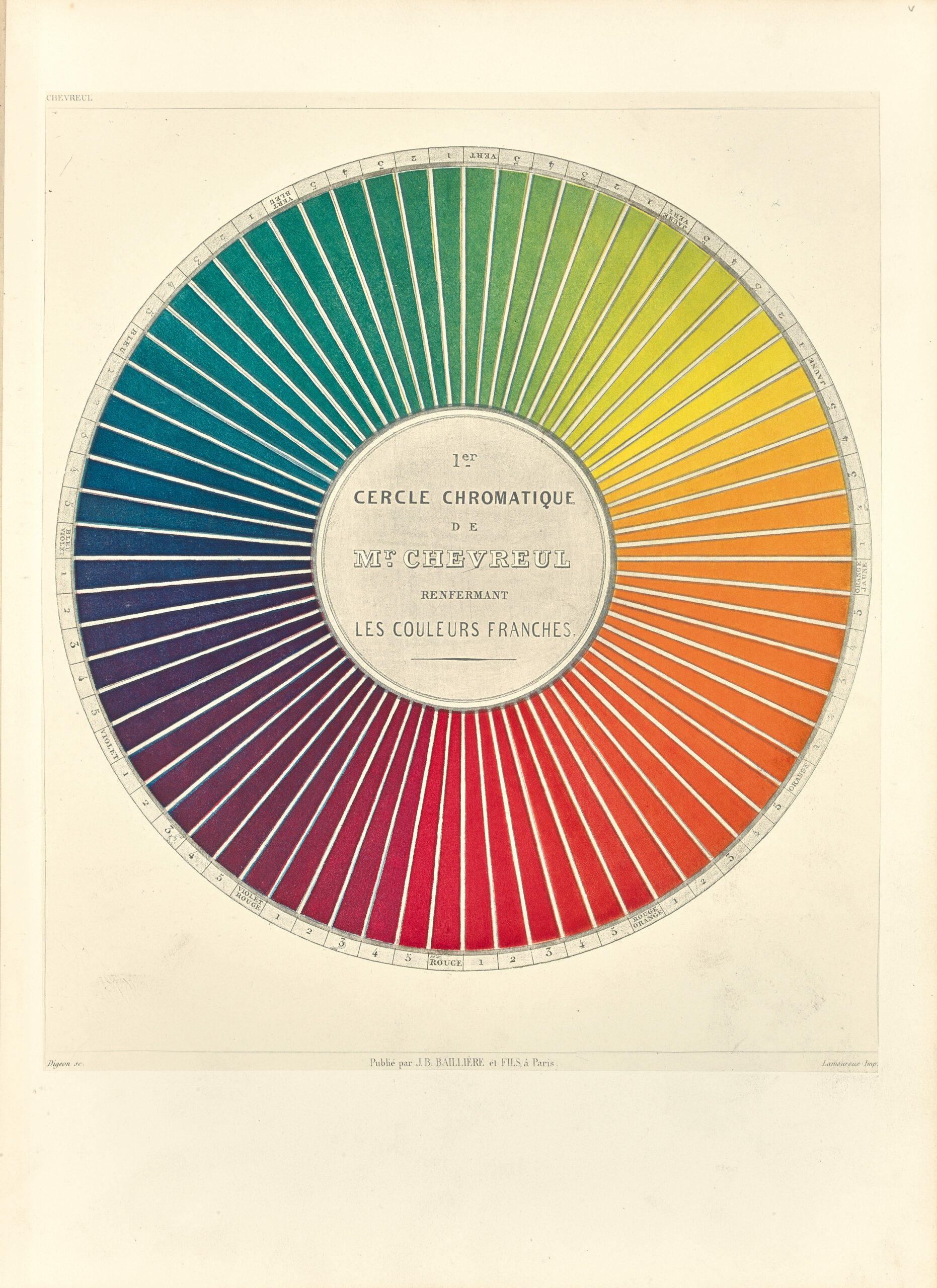
Des Couleurs et de leurs Applications aux Arts Industriels à l'Aide de Cercles Chromatiques
On Colors and Their Applications to the Industrial Arts Using Color Wheels
Book
Chevreul, E. (1864) Des Couleurs et de leurs Applications aux Arts Industriels à l'Aide de Cercles Chromatiques. [On Colors and Their Applications to the Industrial Arts Using Color Wheels] Paris, J.B. Baillière et Fils, 27 pp., many color plates
Record No. 8027  |  Sinkankas/Born No.: NIS/NIB  |  Language: in French  |  RWHL
Chevreul presents a practical application of his theories of color and simultaneous contrast to the industrial and decorative arts, using chromatic circles to demonstrate the relationships between hues, their mixtures, harmonies, and contrasts. Building upon his earlier researches on color perception, he shows how colors may be systematically arranged and compared and how their appearance changes according to adjacent colors and differences in tone and saturation. The accompanying colored plates provide a visual system for selecting and coordinating colors in textiles, painting, decoration, and other manufactured objects. Although not specifically concerned with gemstones, the work is relevant to gemology through its systematic treatment of color description, comparison, and perception—particularly the influence of surrounding colors on apparent hue—and forms part of the nineteenth-century development of scientific approaches to color that would later become fundamental to gemstone description and grading.

Catálogo de las especies minerales y de sus variedades que se encuentran en México
Catalog of mineral species and their varieties found in Mexico
Book
del Castillo, A. (1864) Catálogo de las especies minerales y de sus variedades que se encuentran en México. [Catalog of mineral species and their varieties found in Mexico] México, A. Boix, 9 pp.
Record No. 7355  |  Sinkankas/Born No.: NIS/NIB  |  Language: in Spanish  |  RWHL
Del Castillo provides a concise catalogue of the mineral species and varieties then known to occur in Mexico, assembling information on their identification and geographical distribution from specimens, earlier literature, and contemporary mineralogical investigations. Despite its brevity, the work represents an early attempt to inventory Mexico’s mineral resources according to systematic mineralogical nomenclature rather than merely their economic uses. Of gemological interest are occurrences of precious and ornamental materials among the minerals listed, providing evidence for the state of knowledge of Mexican gem and lapidary resources in the mid-nineteenth century. The catalogue is an early contribution by Antonio del Castillo, who later became one of Mexico’s leading geologists and mineralogists, and is useful for tracing the development of systematic mineralogy and mineral-resource documentation in Mexico.

Travels in the Central Parts of Indo-China (Siam), Cambodia, and Laos, during the Years 1858, 1859, and 1860
Book
Mouhot, H. (1864) Travels in the Central Parts of Indo-China (Siam), Cambodia, and Laos, during the Years 1858, 1859, and 1860. London, John Murray, 2 Vols., xix, 303, viii, 301 pp.
Record No. 2833  |  Sinkankas/Born No.: NIS/NIB  |  RWHL
Mouhot’s posthumously published account records his travels through Siam, Cambodia, and Laos between 1858 and 1860, combining personal narrative with observations on geography, natural history, peoples, customs, commerce, and antiquities. Particularly celebrated are his descriptions and illustrations of the monuments of Angkor, which played an important role in bringing the Khmer ruins to wider European attention. Of gemological interest are observations on precious materials, jewelry and personal ornament, mineral resources, and the use of precious stones and pearls in royal and religious contexts; at Angkor, for example, he describes figures represented with elaborate headdresses apparently composed of precious stones, pearls, gold, and silver. The work also contains extensive natural-history observations and, in the second volume, scientific appendices describing specimens collected during his journeys. Published after Mouhot’s death near Luang Prabang in 1861 and prepared from his journals and papers by his brother Charles, the two-volume work is an important firsthand source for the natural history and material culture of mainland Southeast Asia in the mid-nineteenth century.

Notes on Ceylon and its affairs: during a period of thirty-eight years, ending in 1855; to which are appended some observations on the antiquity of Point de Galle and on the pearl fishery
Book
Steuart, J. (1862) Notes on Ceylon and its affairs: during a period of thirty-eight years, ending in 1855; to which are appended some observations on the antiquity of Point de Galle and on the pearl fishery. London, privately published, 174 pp.
Record No. 16852  |  Sinkankas/Born No.: NIS/NIB  |  RWHL
Steuart presents observations on Ceylon (Sri Lanka) drawn from thirty-eight years of residence and experience on the island, discussing its colonial administration, economy, agriculture, commerce, society, and historical development up to 1855. Of particular gemological interest is the appended account of the Ceylon pearl fishery, in which he discusses the celebrated pearl banks of the Gulf of Mannar, their history and administration, the pearl oyster, the organization and conduct of the fisheries, and the economic uncertainties caused by fluctuations in the oyster populations. The work provides a valuable firsthand perspective on one of the world’s historically most important sources of natural pearls and complements the contemporary scientific investigations of the Ceylon pearl oyster by E.F. Kelaart and others.

Ueber die Prüfung. der. Mineralien auf ihren Wassergehalt
On the testing of minerals for their water content
Journal Article
Fischer, H. (1862) Ueber die Prüfung. der. Mineralien auf ihren Wassergehalt. [On the testing of minerals for their water content] Berichte über die Verhandlungen der naturforschenden Gesellschaft zu Freiburg, No. 25, pp. 400–402.
Record No. 10933  |  Sinkankas/Born No.: NIS/NIB  |  Language: in German  |  RWHL
Fischer discusses methods for testing minerals for the presence of water, particularly the water released when specimens are heated. He considers the practical difficulties of distinguishing structurally or chemically bound water from moisture and describes procedures for detecting the small quantities evolved from mineral samples. The note reflects the increasing importance of chemical and blowpipe tests in nineteenth-century mineral identification and analysis. Of relevance to gemology and Fischer’s later research on jade and prehistoric stone implements, determination of water content provided an additional means of characterizing minerals and distinguishing superficially similar substances. The paper is a brief contribution to analytical mineralogy rather than a study devoted specifically to gemstones.

Report on the Trade and Resources of the Countries on the North-western Boundary of British India
Book
Montgomery, R. and Davies, R.H. (1862) Report on the Trade and Resources of the Countries on the North-western Boundary of British India. Lahore, Printed at the Government Press, 377 pp.
Record No. 7460  |  Sinkankas/Born No.: NIS/NIB  |  RWHL
Montgomery and Davies compile official information on the commerce, communications, products, and economic resources of the territories lying beyond the north-western frontier of British India, including Afghanistan, Kashmir, the Punjab frontier regions, and the trade routes leading toward Central Asia. Based largely on reports from political officers, merchants, travellers, and local informants, the volume describes principal markets, caravan routes, imports and exports, duties, currencies, and commodities moving between India, Afghanistan, Turkistan, Persia, and adjoining regions. Of particular gemological importance are references to precious stones and mineral products entering these trading networks, including the celebrated rubies or “Balas rubies” of Badakhshan, lapis lazuli, turquoise, and other valuable materials. The report is a useful primary source for reconstructing the mid-nineteenth-century Central Asian gem trade and the routes by which stones from Afghanistan and the Pamir-Badakhshan region reached the markets of British India.

Le Lapidaire du Quatorzième Siècle

The Lapidary of the Fourteenth Century
Book
Sotto, I., del (1862) Le Lapidaire du Quatorzième Siècle. [The Lapidary of the Fourteenth Century] Vienna, Impremerie Impériale et Royale de la Cour et de l’État, 215 pp.
Record No. 5193  |  Sinkankas/Born No.: 6254; NIB  |  Language: in French  |  RWHL
Del Sotto publishes and studies a fourteenth-century French lapidary, providing a nineteenth-century edition of a medieval text devoted to precious stones and the properties traditionally attributed to them. The lapidary describes numerous stones, their names, appearance, supposed geographical origins, and methods of recognition, together with the medicinal, protective, magical, and astrological virtues they were believed to possess. As was characteristic of medieval lapidary literature, empirical observations concerning minerals are interwoven with traditions inherited from classical, biblical, Arabic, and earlier medieval authorities. The volume is particularly valuable for the history of gemology because it preserves medieval gemstone nomenclature and beliefs and illustrates how precious stones were understood before the development of modern mineralogical classification. Del Sotto’s edition also provides a useful philological source for tracing the transmission and changing meanings of European gemstone names.

Nicaragua: Its People, Scenery, Monuments, Resources, Condition, and Proposed Canal

Book
Squirer, E.G. (1860) Nicaragua: Its People, Scenery, Monuments, Resources, Condition, and Proposed Canal. New York, Harper & Bros., 691 pp.
Record No. 16715  |  Sinkankas/Born No.: NIS/NIB  |  RWHL
This revised and expanded account of Nicaragua by American diplomat and archaeologist Ephraim George Squier describes the country’s geography, peoples, natural resources, antiquities, economy, political condition, and prospects for an inter-oceanic canal. Drawing on Squier’s travels and diplomatic service in Central America, it includes extensive observations on indigenous cultures and archaeological remains, with descriptions and illustrations of monuments, sculptures, pottery, stone implements, and personal ornaments. Of particular relevance to gemological and jade studies are references to pre-Columbian objects fashioned from valued green stones and other lapidary materials, as well as observations on Nicaragua’s mineral resources and indigenous use of stone. The volume is also important for documenting nineteenth-century interpretations of Central American antiquities before the development of modern archaeological methods. As a substantially revised, single-volume successor to Squier’s 1852 Nicaragua: Its People, Scenery, Monuments, and the Proposed Inter-oceanic Canal, it provides a useful early source for the archaeology, mineral resources, and material culture of Nicaragua.

Building a Gemological Library

Gemological books range from general identification manuals and textbooks to specialized works on individual gems, mineralogy, jewelry, treatments, synthesis, history and gem-producing regions.

For a curated selection of particularly useful books, read The Gemologist's Core Library — Classic Books on Gemology, Jewelry and Mineralogy.

About Four Treasures

Four Treasures is Lotus Gemology's freely accessible gemological reference database. Use the full database to search by author, title or keyword and explore literature on gemology, mineralogy, jewelry and related fields. Where available, hyperlinks on titles may lead directly to the full publication.

Search the Complete Four Treasures Database