Gemology Books Bibliography

Gemology Books Bibliography

Explore books on gems, gemology, jewelry and mineralogy in Four Treasures, the Lotus Gemology reference database. This bibliography brings together matching book records from the collection, with publication details, abstracts and cover images where available.

Gemology Book References

The list below matches books concerning gemology and related subjects in the database's searchable fields. Some works cover several branches of gems, jewelry or mineralogy.
2,921–2,940 of 3,451 matching references

The Lake Regions of Central Africa

Book
Burton, R.F. (1860) The Lake Regions of Central Africa. New York, Harper & Bros., 572 pp.
Record No. 7950  |  Sinkankas/Born No.: NIS/NIB  |  RWHL
Burton recounts the East African expedition of 1857–1859 undertaken with John Hanning Speke, during which Europeans first documented Lake Tanganyika and gathered information on the interior of eastern and central Africa. He describes the routes from the Zanzibar coast through present-day Tanzania, the geography and peoples encountered, political conditions, natural history, and the extensive caravan trade linking the African interior with the Indian Ocean. Of particular relevance to gemological and mineralogical history are observations on mineral resources, ornaments, beads, and other valued materials employed in local and long-distance trade. Burton gives especially detailed attention to the commercial importance of beads as currency and barter goods, recording their varieties, colors, names, relative values, and differing regional preferences. The work provides valuable evidence for nineteenth-century East African trade networks and the role played by beads, ornaments, metals, ivory, and other prestige materials in exchanges between coastal merchants and communities of the interior.

Ricerche critico-bibliographiche intorno alla Storia naturale del Messico di Fr. Hernandez esposta in dieci libri dat N.A. Recchi ed illustrata dagli accademici Lincei
Critical-bibliographical research around the Natural History of Mexico by Fr. Hernandez exhibited in ten books dat N.A. Recchi and illustrated by Lincei academics
Journal Article
Proja, S. (1860) Ricerche critico-bibliographiche intorno alla Storia naturale del Messico di Fr. Hernandez esposta in dieci libri dat N.A. Recchi ed illustrata dagli accademici Lincei. [Critical-bibliographical research around the Natural History of Mexico by Fr. Hernandez exhibited in ten books dat N.A. Recchi and illustrated by Lincei academics] Atti Dell’ Accademia Pontificia de’ Nuovi Lincei, pp. 441–477.
Record No. 7356  |  Sinkankas/Born No.: NIS/NIB  |  Language: In Italian  |  RWHL
Proja presents a critical and bibliographical study of Francisco Hernández’s Natural History of Mexico and of the complex history by which Hernández’s sixteenth-century investigations were edited by Nardo Antonio Recchi and subsequently published and augmented by members of the Accademia dei Lincei. He examines the surviving manuscripts, editions, editorial interventions, and circumstances surrounding the preparation of the celebrated 1651 Rerum medicarum Novae Hispaniae thesaurus, attempting to distinguish Hernández’s original material from the contributions of Recchi and the Lincean scholars. The study is valuable for establishing the textual history and transmission of one of the earliest major European scientific accounts of the natural products of New Spain. Of gemological relevance, Hernández’s work included Mexican minerals and stones alongside its much more extensive treatment of plants and animals; Proja’s bibliographical analysis therefore helps establish the provenance and authority of early European descriptions of indigenous Mexican mineral materials.

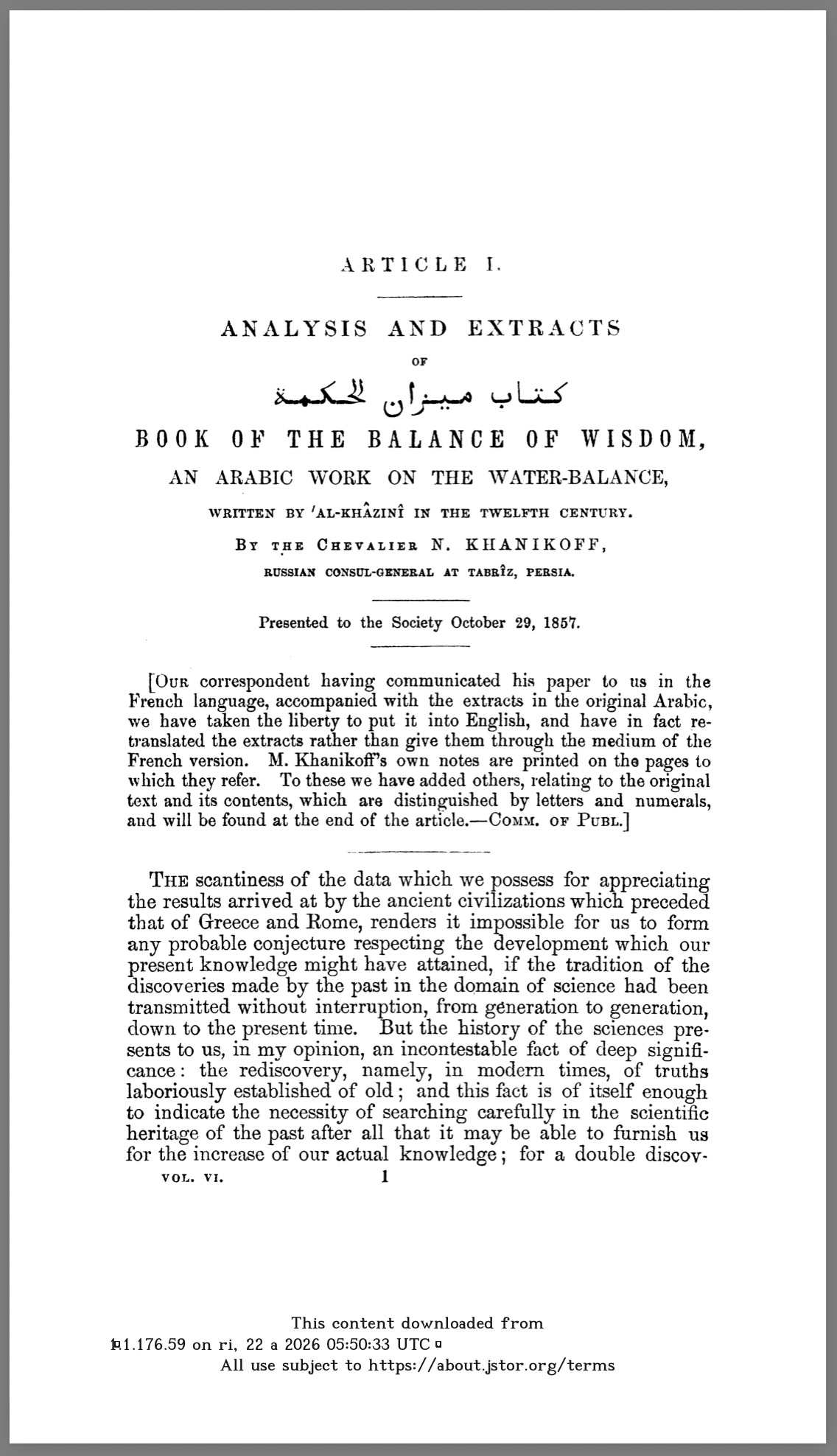
Analysis and extracts of كتاب ميزان الحكمة Book of the Balance of Wisdom, an Arabic work on the water-balance written by al-Khâzinî in the Twelfth Century
Journal Article
Khanikoff, N. (1860) Analysis and extracts of كتاب ميزان الحكمة Book of the Balance of Wisdom, an Arabic work on the water-balance written by al-Khâzinî in the Twelfth Century. Journal of the American Oriental Society, Vol. 6, pp. 1–128.
Record No. 4577  |  Sinkankas/Born No.: NIS/NIB  |  RWHL
Khanikoff presents an extensive analysis and extracts from al-Khāzinī’s twelfth-century Arabic Kitāb Mīzān al-Ḥikma [Book of the Balance of Wisdom], an important medieval treatise on balances, hydrostatics, and the determination of specific gravity. The work describes the construction and operation of highly sensitive balances, methods of weighing substances in air and water, and procedures for determining the specific gravities of metals, minerals, precious stones, and liquids. Of particular gemological importance are numerical data for precious stones and minerals—including ruby, emerald, diamond, sapphire, and quartz—and discussions of their identification by density. Khanikoff also examines al-Khāzinī’s reliance on earlier Greek and Islamic scientific traditions, particularly Archimedes and al-Bīrūnī, whose experimental determinations of specific gravity are preserved in the treatise. The paper provides an important nineteenth-century Western account of medieval Islamic achievements in quantitative mineralogy and demonstrates the sophisticated application of hydrostatic weighing to the examination and identification of gemstones centuries before the development of modern gemology.

Antique Gems: Their Origin, Uses and Value
Book
King, C.W. (1860) Antique Gems: Their Origin, Uses and Value. London, John Murray, 498 pp.
Record No. 2800  |  Sinkankas/Born No.: 3396; NIB  |  RWHL
Sinkankas: This is King’s first book publication on a subject that he took up early in his career and pursued with single-minded persistence throughout his life. As a first effort, it leaves much to be desired, not because of a lack of information—which is still very useful—but because, as Vinet (1663) notes, it is very difficult to analyze. Faced with the wealth of data uncovered in his solitary studies at Cambridge, he crammed as much as he could into a single volume but failed to organize it well, resulting in a text that is often confusing to the reader. The introduction cites Goethe’s views on the usefulness of studying antique engraved gems and offers a short history of the glyptic art. Five engraved plates, praised by Vinet for their quality and fidelity to the originals, are inserted after the table of contents and explained in accompanying text, with many more single gems in wood engravings scattered throughout the book or used as head- or tailpieces. The first section of the text describes the materials of gems, including notes on minerals and rocks used and possible sources of rough, with some useful gemological information based on King’s research into Pliny’s Natural History and other ancient sources; it also includes remarks on pastes, gem impressions, and forms of gems. The second section explores art as displayed in gems, beginning with tests of antiquity and instruments used in engraving—helpful for determining age—and continues with essays on styles, symbolism, and subjects as assigned to various cultures over time. This section also contains diverse topics such as rings, “flexible glass,” names of artists, coin-dies, famous collections, and other fragments of knowledge that should have been better organized. The third section addresses the subjects depicted on gems, while the final section, another catch-all, considers the mystical virtues of gems and provides King’s English translation of Marbodeus’ celebrated poem on gemstones (pp. 391–417), along with a translation of parts of Orpheus’ poem on stones (pp. 420–426, passim), interspersed with descriptions of gemstones as given in Camillus Leonardus’ Speculum Lapidum (pp. 418–428, passim). The last part of this section includes a brief commentary on books concerning engraved gems, though it treats only a few of the most important; King would later publish a much larger bibliography in his Antique Gems and Rings. The appendix covers a variety of topics, including tools of the ancient engraver, the Sassanian alphabet, and notes on earlier statements in the text. The encyclopedic, albeit confused, nature of this work led A. Furtwängler (Die antiken Gemmen, vol. 3, p. 433) to be less than generous in his review, noting the “confusion” in this and subsequent works by King and suggesting that this initial treatise gave rise to all of King’s later books of the following decade, such as The Natural History, Ancient and Modern, of Precious Stones (1865), which developed from the gemstone section, and The Gnostics and Their Remains (1864, 1887), which stemmed from the mystical properties section. Furtwängler criticized the “dilettante” character of King’s works—crammed with unplanned information—but admitted that they still contain much that is worthwhile. Zazoff, in Gemmensammler, argues that Furtwängler went “too far” in his critique. Despite these adverse remarks, it remains true that King, more than anyone else, was the first English writer to assemble a major body of information on engraved gems in one place and was largely responsible for sparking interest in this branch of ancient art among readers in Britain and America.

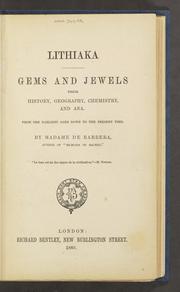
Gems and Jewels: Their History, Geography, Chemistry, and Ana
Book
Barrera, A., de (1860) Gems and Jewels: Their History, Geography, Chemistry, and Ana. London, Richard Bentley, 382 pp.
Record No. 2707  |  Sinkankas/Born No.: 409; NIB  |  RWHL
De Barrera presents a popular but wide-ranging survey of gemstones and jewelry, combining their history, geographical sources, physical and chemical properties, valuation, cutting, trade, and use in personal ornament. Individual sections treat the principal gems—including diamond, ruby, sapphire, emerald, topaz, garnet, amethyst, turquoise, opal, pearl, and other ornamental materials—with accounts of famous specimens, historical traditions, mining localities, and contemporary commercial practices. The book also discusses methods of distinguishing gems, their hardness, specific gravity, color, and composition, together with imitation stones and aspects of lapidary work and jewelry manufacture. Drawing extensively on earlier mineralogical, historical, and travel literature, the volume provides a useful picture of popular and commercial gemological knowledge in Britain around the middle of the nineteenth century, before gemology emerged as a distinct scientific discipline.

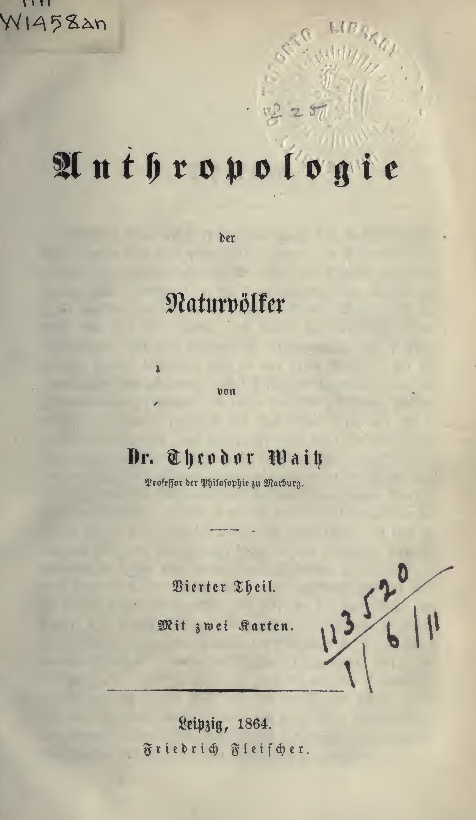
Anthropologie der Naturvölker

Anthropology of Indigenous Peoples
Book
Waitz, T. (1859–1872) Anthropologie der Naturvölker. [Anthropology of Indigenous Peoples] Leipzig, Fleischer, 6 Vols.
Record No. 7987  |  Sinkankas/Born No.: NIS/NIB  |  Language: in German  |  RWHL
Waitz’s Anthropologie der Naturvölker is an ambitious six-volume comparative study of the peoples and cultures of the world, combining physical anthropology, ethnography, linguistics, history, religion, and material culture. The series appeared between 1859 and 1872; after Waitz’s death in 1864 it was continued by Georg Gerland. Volumes 3–4, Die Amerikaner (1862–1864), are devoted to the indigenous peoples of the Americas, with Volume 4 treating Mexico, Central America, the Chibcha region, and Peru. Of particular relevance to gemological and jade studies are Waitz’s accounts of Aztec and other Mesoamerican material culture, including precious objects, ornaments, stoneworking, metals, and valued green stones, assembled from early Spanish chronicles and nineteenth-century archaeological and ethnographic scholarship. The work is useful for tracing how indigenous American uses of precious and ornamental materials were understood in European scholarship during the formative period of scientific anthropology and archaeology.

Die Spuren der aztekifchen Sprache im nördlichen Mexico und höheren amerikanifchen Norden
The traces of the Aztec language in northern Mexico and higher American north
Journal Article
Buschmann, J.C.E. (1859) Die Spuren der aztekifchen Sprache im nördlichen Mexico und höheren amerikanifchen Norden. [The traces of the Aztec language in northern Mexico and higher American north] Abhandlungen der Königlichen Akademie der Wissenschaften zu Berlin, Vol. 1854, Supplement, 819 pp. (see p. 161).
Record No. 7469  |  Sinkankas/Born No.: NIS/NIB  |  Language: in German  |  RWHL
Buschmann presents an extensive comparative linguistic investigation of the geographical spread and relationships of Nahuatl (Aztec) and related languages, tracing linguistic evidence northward from central Mexico through northern Mexico and into the southwestern and western regions of North America. Using vocabularies, place names, early historical accounts, and comparative word lists, he attempts to identify relationships between Nahuatl and the languages of indigenous peoples farther north and to reconstruct patterns of migration and cultural contact. Of particular relevance to gemological history, p. 161 discusses terminology associated with chalchihuitl, the highly valued green or blue-green stone of the ancient Mexicans, in connection with indigenous mineral and color vocabulary. The work is valuable for the nineteenth-century history of attempts to interpret Nahuatl gemstone terminology and the geographical and linguistic distribution of terms associated with precious green stones.

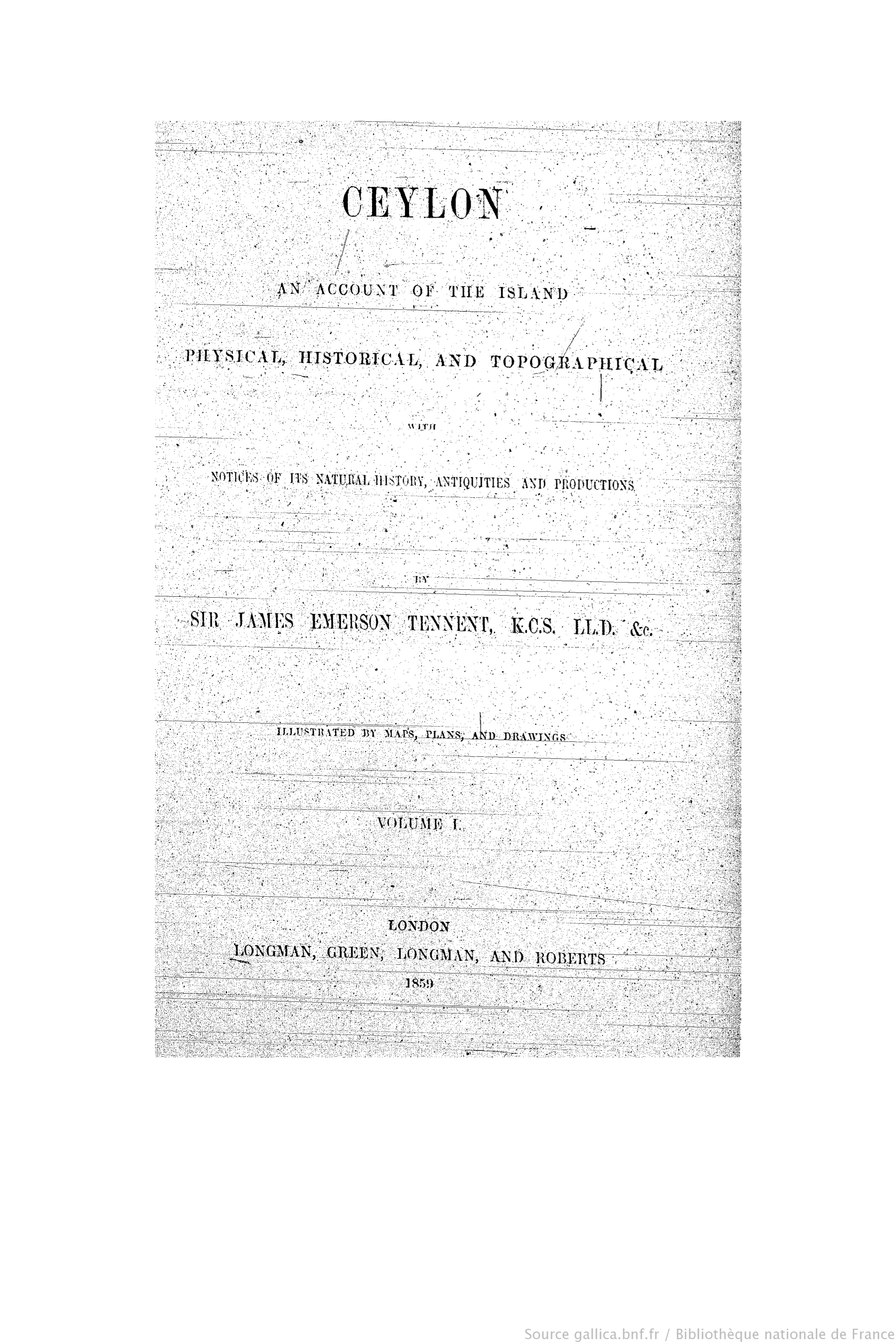
Ceylon: An Account of the Island, Physical, Historical and Topographical
Book
Tennent, J.E. (1859) Ceylon: An Account of the Island, Physical, Historical and Topographical. London, Longman, Green, Longman, and Roberts, 2 Vols., 702 pp.
Record No. 1691  |  Sinkankas/Born No.: NIS/NIB  |  RWHL
Tennent presents a comprehensive account of Ceylon (Sri Lanka), treating its physical geography, geology, natural history, history, antiquities, population, economy, and commerce. Based on his years in the colonial administration and extensive documentary research, the work contains substantial information on the island’s natural resources and traditional industries. Of particular gemological importance are descriptions of Ceylon’s celebrated precious stones—including sapphire, ruby and other corundum, cat’s-eye, spinel, garnet, zircon, and tourmaline—their occurrence, recovery from gem-bearing gravels, and aspects of the contemporary gem trade. Tennent also discusses pearls and the historically important pearl fisheries of the Gulf of Mannar, including the pearl oyster, fishing operations, and organization of the fisheries. The work is an important mid-nineteenth-century source for the history of Sri Lankan gemstones, gem mining, and pearl production.

Analysis and extracts of ﺘﺎﺏ ﻣﻴﺰﺍﻥ ﺍﻟﺤﻜﻤﺔ – Book of the Balance of Wisdom, an Arabic work on the water-balance, written by al-Khazini in the twelfth century
Journal Article
Khanykov, N.V. (1858) Analysis and extracts of ﺘﺎﺏ ﻣﻴﺰﺍﻥ ﺍﻟﺤﻜﻤﺔ – Book of the Balance of Wisdom, an Arabic work on the water-balance, written by al-Khazini in the twelfth century. Journal of the American Oriental Society, Vol. 6, pp. 1–128.
Record No. 28391  |  Sinkankas/Born No.: NIS/NIB  |  RWHL
Khanykov presents an extensive analysis, translation, and series of extracts from al-Khāzinī’s twelfth-century Arabic Kitāb Mīzān al-Ḥikma [Book of the Balance of Wisdom], a major medieval treatise on hydrostatics, specific gravity, and the construction and use of balances. The work describes sophisticated balances designed for determining the relative weights and specific gravities of substances in air and water, discusses principles derived from Archimedes and earlier Greek and Islamic scholars, and preserves information from works otherwise lost or imperfectly known. Of particular gemological importance are tables and discussions of the specific gravities of minerals, metals, and precious stones, including ruby, sapphire, emerald, diamond, quartz, and other materials, together with methods for distinguishing substances through quantitative measurement. Khanykov compares al-Khāzinī’s results with those attributed to earlier investigators, notably al-Bīrūnī, demonstrating the high level of experimental precision achieved by medieval Islamic scientists. The paper provides one of the earliest substantial European-language accounts of The Book of the Balance of Wisdom and is an important source for the history of hydrostatics, mineralogy, and quantitative gem testing.

Geschichte des Zeitalters der Entdeckungen
History of the Age of Discovery
Book
Peschel, O.F. (1858) Geschichte des Zeitalters der Entdeckungen. [History of the Age of Discovery] Stuttgart and Augsburg, 681 pp.
Record No. 10934  |  Sinkankas/Born No.: NIS/NIB  |  Language: in German  |  RWHL
Peschel presents a comprehensive history of the European age of geographical discovery, tracing the expansion of geographical knowledge from medieval exploration through the Portuguese voyages around Africa, Columbus and the discovery of the Americas, and subsequent Spanish and Portuguese exploration of the New World and Asia. Drawing critically on early travel narratives, chronicles, maps, and archival sources, he examines the motives, routes, achievements, and consequences of the principal voyages and the changing European conception of world geography. Of relevance to gemological history are discussions of the search for valuable commodities—including gold, pearls, precious stones, and other luxury products—which provided powerful incentives for exploration and shaped early European accounts of Africa, Asia, and the Americas. The work is particularly useful for placing early reports of gem resources and trade within the broader economic and geographical context of the Age of Discovery.

Cabinet d’Antiquités Américaines à Copenhague: Rapport Ethnographique
Cabinet of American Antiquities in Copenhagen: Ethnographic Report
Book Section
Rafn, C.C. (1858) Cabinet d’Antiquités Américaines à Copenhague: Rapport Ethnographique. [Cabinet of American Antiquities in Copenhagen: Ethnographic Report] In: Mémoires et de la Revue de la Société Royale des Antiquaires du Nord, Copenhagen: Thiele, unpaginated.
Record No. 7983  |  Sinkankas/Born No.: NIS/NIB  |  Language: in French  |  RWHL
Rafn describes the American antiquities preserved in the collections of the Royal Society of Northern Antiquaries in Copenhagen, presenting them as evidence for the archaeology and ethnography of the indigenous peoples of the Americas. The report discusses objects from several regions and cultural traditions, including implements, weapons, ornaments, and ceremonial objects manufactured from stone and other materials, with attention to their forms, uses, and geographical origins. Of particular relevance to gemological and jade studies are greenstone artifacts from the Americas and contemporary attempts to identify the materials from which such objects were fashioned. The report belongs to the early development of comparative American archaeology in Europe and is useful for documenting the provenance, terminology, and interpretation assigned to American stone artifacts in nineteenth-century museum collections.

The States of Central America

Book
Squirer, E.G. (1858) The States of Central America. New York, Harper & Bros., 782 pp.
Record No. 6904  |  Sinkankas/Born No.: NIS/NIB  |  RWHL
Squier presents an extensive geographical, historical, political, and economic survey of Central America, principally Guatemala, Honduras, San Salvador, Nicaragua, and Costa Rica, drawing on his diplomatic service, travels, earlier publications, and contemporary documentary sources. He describes the region’s physical geography, population, indigenous peoples, antiquities, agriculture, commerce, transportation, and natural resources, with particular attention to routes proposed for inter-oceanic communication. Of gemological and mineralogical interest are his accounts of mines and mineral resources and his descriptions of pre-Columbian artifacts and indigenous materials, including objects fashioned from valued green stones. The volume provides an important mid-nineteenth-century synthesis of contemporary knowledge of Central America and is useful for tracing early reports of its mineral resources and archaeological stone objects.

On the microscopical structure of crystals, indicating the origin of minerals and rocks
Journal Article
Sorby, H.C. (1858) On the microscopical structure of crystals, indicating the origin of minerals and rocks. Quarterly Journal of the Geological Society of London, Vol. 14, pp. 453–500.
Record No. 1624  |  Sinkankas/Born No.: NIS/NIB  |  RWHL
Sorby’s landmark paper demonstrates how microscopic examination of minerals and rocks can be used to reconstruct the conditions under which they formed. Using thin sections and transmitted-light microscopy, he studies crystal textures and, especially, microscopic cavities and fluid inclusions containing liquids, gases, and sometimes daughter crystals. Sorby shows that such inclusions may preserve samples of the fluids present during crystal growth and that changes in their liquid and vapor proportions upon heating can provide information on formation temperatures. From these observations he distinguishes minerals formed from aqueous solutions, molten material, and other geological environments and applies the method to interpreting the origin of rocks. The paper is foundational to microscopic petrography and fluid-inclusion research and is particularly important to gemology because the study of inclusions subsequently became one of the principal means of determining gemstone genesis, geological environment, and, ultimately, distinguishing natural from synthetic and treated gems.

India in the Fifteenth Century

Edited Book
Major, R.H., editor (1857) India in the Fifteenth Century.. London, Hakluyt Society, Includes a description of Asian travels of Abd–er–Razzak, Persian ambassador to Vijayanagar (1413–1482), Nicolo di Conti, a Venetian jeweler (1419–1444), Athanasius Nikitin, a Russian trader (1470), and Santo Stefano, a Genoese merchant (ca. late 1400s); ~227 pp.. reprinted by Burt Franklin, New York, 1970.
Record No. 2824  |  ISBN/ISSN: 833721895  |  Sinkankas/Born No.: NIS/NIB  |  RWHL
Edited by R.H. Major for the Hakluyt Society, this volume brings together four fifteenth-century narratives describing travel in India and other parts of Asia: the journeys of the Persian ambassador ʿAbd al-Razzāq, the Venetian traveller Niccolò de’ Conti, the Russian merchant Afanasy Nikitin, and the Genoese merchant Hieronimo di Santo Stefano. Their accounts provide contemporary information on Indian Ocean trade, ports, cities, political courts, customs, commodities, and the wealth of South and Central Asia. Of particular gemological importance are descriptions of diamonds, rubies, pearls, and other precious stones, their sources and markets, and the prominent role of gems and jewelry in Asian courts and long-distance commerce. The accounts of Vijayanagara and the trading networks linking India with Persia, Southeast Asia, and the Mediterranean are especially valuable for reconstructing the fifteenth-century gem trade. Major’s edition made these early travel narratives readily accessible in English and remains an important source for the history of Asian commerce and precious stones.

Caravan Journeys and Wanderings in Persia, Afghanistan, Turkistan and Beloochistan
Book
Ferrier, J.P. (1856) Caravan Journeys and Wanderings in Persia, Afghanistan, Turkistan and Beloochistan. London, John Murray, 556 pp.
Record No. 29064  |  Sinkankas/Born No.: NIS/NIB  |  RWHL
Ferrier recounts his extensive travels through Persia, Afghanistan, Turkistan, and Baluchistan during the 1840s, combining a personal travel narrative with observations on geography, politics, commerce, military affairs, and the peoples of Central and Southwest Asia. Of particular gemological interest, pp. 103–107 describe the celebrated spinel mines of Badakhshan, traditionally associated with the “Balas rubies” of medieval and early modern literature. Ferrier discusses their location, the workings and conditions under which the stones were obtained, and traditions concerning their exploitation and control. His account is an important nineteenth-century Western source on the historic Badakhshan spinel deposits, now identified principally with the Kuh-i-Lal mines in the Pamir region, and contributes valuable evidence to the history of the mining and trade of these famous red and pink spinels.

Narrative of the Expedition of an American Squadron to the China Seas and Japan, Performed in the Years 1852, 1853, and 1854, under the command of Commodore M.C. Perry, United States Navy
Journal Article
Hawks, F.L. (1856) Narrative of the Expedition of an American Squadron to the China Seas and Japan, Performed in the Years 1852, 1853, and 1854, under the command of Commodore M.C. Perry, United States Navy. 537 pp..
Record No. 7982  |  Sinkankas/Born No.: NIS/NIB  |  RWHL
Compiled by Francis L. Hawks from the journals and official records of Commodore Matthew C. Perry and his officers, this volume presents the narrative of the United States naval expedition to Japan in 1852–1854 that resulted in the Convention of Kanagawa and the opening of Japanese ports to American vessels (at gunpoint; so much for the 'rule of law'). It describes the expedition’s voyages through the China Seas and Japan, diplomatic negotiations, geography, natural history, commerce, customs, industries, and material culture, with numerous illustrations and maps. Of mineralogical and gemological interest are observations on Japanese mineral resources, manufactured objects, ornaments, and the stones and other natural materials employed in decorative and practical arts. The work is also valuable for its detailed contemporary documentation of Japanese crafts and commodities immediately before the rapid expansion of Western contact during the Meiji era.

Herodoti … Musæ. Textum ad Gaisfordii ed. recogn. J.C.F. Baehr
Herodotus … The Muses. The text revised according to Gaisford's edition by J.C.F. Baehr
Edited Book
Baehr, J.C.F., editor (1856) Herodoti … Musæ. Textum ad Gaisfordii ed. recogn. J.C.F. Baehr. [Herodotus … The Muses. The text revised according to Gaisford's edition by J.C.F. Baehr]. Lipsiae, Bibliopolio Hahniano, 897 pp..
Record No. 7503  |  Sinkankas/Born No.: NIS/NIB  |  Language: in Latin  |  RWHL
Edited by Johann Christian Felix Baehr, this volume presents the Greek text of Herodotus’s Histories (The Muses), revised principally from Thomas Gaisford’s edition. Herodotus’s nine books describe the peoples, geography, customs, natural products, and historical events of the Mediterranean, Egypt, the Near East, and parts of Asia during the ancient world. Of gemological interest are numerous passages concerning gold and other mineral resources, precious objects, seals, ornaments, and stones, together with accounts of mining and the acquisition and use of valuable natural materials among Egyptians, Persians, Scythians, Indians, and other peoples. Particularly important for the history of gemstones are Herodotus’s early descriptions of Indian gold, engraved signet stones, and objects of rock crystal and other materials. This nineteenth-century edition is principally significant as a scholarly source for the original Greek text rather than as an independent contribution to mineralogy.

The Natural History of Pliny

Book
Pliny the Elder, Bostock, J. and Riley, H.T. (1855–1857) The Natural History of Pliny. London, Henry G. Bohn, 6 Vols., xxviii + 499; xii + 555; xiv + 536; xix + 523; xxii + 523; xiv + 529 pp.
Record No. 2847  |  Sinkankas/Born No.: 5168; NIB  |  RWHL
Sinkankas: The translation is generally conceded to be superior to Holland’s and is further enriched by abundant, discerning, and helpful footnotes. This edition was kept in print in various bindings as late as 1893, with full sets dated from 1856 to 1893. Primarily of interest to the gemologist are pages 305–85 and 386–468, which treat building stones and gemstones, respectively, in the sixth volume (Books XXXVI and XXXVII). The first book deals with building stones and other matters, sometimes classed with gemstones, while gemstones proper are fully treated in the last book, the contents of which are analyzed and explained in detail by Sidney Henry Ball in his A Roman Book on Precious Stones (1950), which see. However, Ball’s work is based on the Holland translation rather than the present one, and the reader desiring to explore more fully the material presented in Pliny’s gemological dissertations should compare both. Here, as in his other books, Pliny accumulated all he could find about the nature, sources, attributes, and uses of gemstones, with data and tales ranging from fabulous anecdotes and superstitions to the cold, hard facts of science. It is also here that one finds the curious names for many gemstones, borrowed more or less from earlier writers and repeated by writers after Pliny well into the seventeenth century. The legacy of such names in the post-Plinian lapidaries is usefully discussed by Frank Dawson Adams in his Birth and Development of the Geological Sciences (1938, pp. 143ff), who also attempts to group and correlate the names with known gemstones or other mineral and non-mineral substances classed as gemstones by earlier writers. The problem of such identification is also addressed by Dorothy Wyckoff in her Albertus Magnus: Book of Minerals (1967, esp. pp. 286–92), which see. Neither Philemon Holland nor John Bostock and Henry Thomas Riley were trained in the earth sciences, and for this reason the interpretations of gemstones and minerals provided by them should be compared to those of Ball, Adams, and Wyckoff, all trained in the earth sciences. See also the commentaries in Rackham’s edition of Pliny in a later English translation below.

Travels in Peru, during the years 1838–1842
Book
Tschudi, J.J., von (1854) Travels in Peru, during the years 1838–1842. New York, A.S. Barnes & Co., 354 pp.
Record No. 3206  |  Sinkankas/Born No.: NIS/NIB  |  RWHL
Johann Jakob von Tschudi’s account of his travels in Peru between 1838 and 1842 combines observations on the country’s geography, natural history, peoples, customs, economy, and antiquities. A Swiss naturalist and physician, Tschudi travelled extensively along the Pacific coast and through the Andes, recording information on indigenous communities, animals and plants, mining, agriculture, and the physical environment. Of mineralogical and gemological interest are his observations on Peru’s mineral wealth and mining districts, while his descriptions of pre-Columbian antiquities and indigenous material culture provide useful contemporary evidence for the use of stone and other ornamental materials. The book offers an important mid-nineteenth-century naturalist’s perspective on Peru and complements Tschudi’s more specialized scientific and ethnographic publications on the country.

Description du Royaume Thai ou Siam

Description of the Thai or Siamese Kingdom
Book
Pallegoix, M. (1854) Description du Royaume Thai ou Siam. [Description of the Thai or Siamese Kingdom] Paris, Se Vende, 488 pp.
Record No. 2842  |  Sinkankas/Born No.: NIS/NIB  |  Language: in French  |  RWHL
Pallegoix’s Description du Royaume Thai ou Siam is a wide-ranging account of Siam by the French missionary Jean-Baptiste Pallegoix, covering its geography, population, government, religion, customs, commerce, agriculture, and natural products. Drawing on his long residence in the country and knowledge of the Thai language, Pallegoix provides one of the more substantial European descriptions of mid-nineteenth-century Siam. Of particular gemological interest, pp. 117–121 treat the kingdom’s mineral resources and precious stones, including accounts of gemstones obtained in Siam and the localities or regions associated with them. These passages are useful early evidence for European knowledge of the Siamese gem trade and mineral resources before the major development of the ruby and sapphire deposits of eastern Siam later in the nineteenth century.

Building a Gemological Library

Gemological books range from general identification manuals and textbooks to specialized works on individual gems, mineralogy, jewelry, treatments, synthesis, history and gem-producing regions.

For a curated selection of particularly useful books, read The Gemologist's Core Library — Classic Books on Gemology, Jewelry and Mineralogy.

About Four Treasures

Four Treasures is Lotus Gemology's freely accessible gemological reference database. Use the full database to search by author, title or keyword and explore literature on gemology, mineralogy, jewelry and related fields. Where available, hyperlinks on titles may lead directly to the full publication.

Search the Complete Four Treasures Database