Gemology Books Bibliography

Gemology Books Bibliography

Explore books on gems, gemology, jewelry and mineralogy in Four Treasures, the Lotus Gemology reference database. This bibliography brings together matching book records from the collection, with publication details, abstracts and cover images where available.

Gemology Book References

The list below matches books concerning gemology and related subjects in the database's searchable fields. Some works cover several branches of gems, jewelry or mineralogy.
2,961–2,980 of 3,451 matching references

Historical Researches into the Politics, Intercourse, and Trade of the Carthaginians, Ethiopians, and Egyptians
Book
Heeren, A.H.L. (1838) Historical Researches into the Politics, Intercourse, and Trade of the Carthaginians, Ethiopians, and Egyptians. Oxford, D.A. Talboys, 2 Vols., Vol. 1
Record No. 26447  |  Sinkankas/Born No.: NIS/NIB  |  Language: trans. from German  |  RWHL
A broad historical study of the political organization, international relations, and commerce of the ancient Carthaginians, Ethiopians, and Egyptians, based on classical literary sources and the geographical and historical scholarship available in the early nineteenth century. Volume 1 deals principally with Carthage and Ethiopia, examining their territories, political systems, colonies, trading networks, and connections with other parts of Africa, the Mediterranean, Arabia, and Asia. Of particular interest to gemological history are Heeren’s discussions of ancient long-distance commerce and the luxury commodities—including gold, precious stones, ivory, and other valuable materials—that moved through African and Arabian trade routes.

A Treatise on Gems

Book
Feuchtwanger, L. (1838) A Treatise on Gems. New York, A. Hanford, 178 pp.
Record No. 2757  |  Sinkankas/Born No.: 2081–2085  |  RWHL
Sinkankas: The first monograph on gemstones published in the United States and an excellent one at that. In the testimonial letter, James Renwick (1792–1863), LLD, professor of chemistry & physics in Columbia College, noted that “in reference to the native minerals and rocks of the United States, that I conceive your treatise to be most likely to be eminently useful.” In his Gems and Precious Stones of North America, the eventual successor to Feuchtwanger, published in 1890, G.F. Kunz notes that “Dr. Lewis Feuchtwanger, of New York, was, in 1838, an authority on precious stones, and his book was one of the first to be written on the subject in the United States. During his long residence in this country, he made an interesting and valuable collection of minerals, fossils, and gems, many of the latter being fine specimens, but it has not been sold, and is in the possession of his daughters. Moving has greatly damaged this collection, which originally included nearly 900 specimens; it was placed on sale in 1874, and for a time was deposited in the American Museum of Natural History in New York” (p. 322). In regard to the priority of Feuchtwanger’s book, I have not found any published earlier and unlike Kunz, conclude that it is the first. The text begins with general gemology: properties, chemistry, geology, geographical distribution, enhancement of color, gem setting, cleaning of gems, imitations, commerce, and gems used in optical applications. The second part considers individual gemstones and ornamental materials beginning with the diamond and working through the major and minor species into such rarities as natrolite, apatite, pyrite, and numerous ornamental stones. Feuchtwanger took special care to record as much information as he could find on native gemstones and the localities that furnished them, and while some localities were previously recorded by Samuel Robinson in his Catalogue of American Minerals, 1825, these were treated very briefly and without amplifying details such as characterizes Feuchtwanger’s treatment. Another “first” of the present work is the extended description of pearls, artificial pearls, and corals, but nothing was said about the freshwater pearls of the United States which apparently were largely unknown at the time. As alluded to in Renwick’s letter, Feuchtwanger’s writing sometimes borders on the quaint, but all of it is easily followed and forms much pleasant as well as informative reading. Very rare.

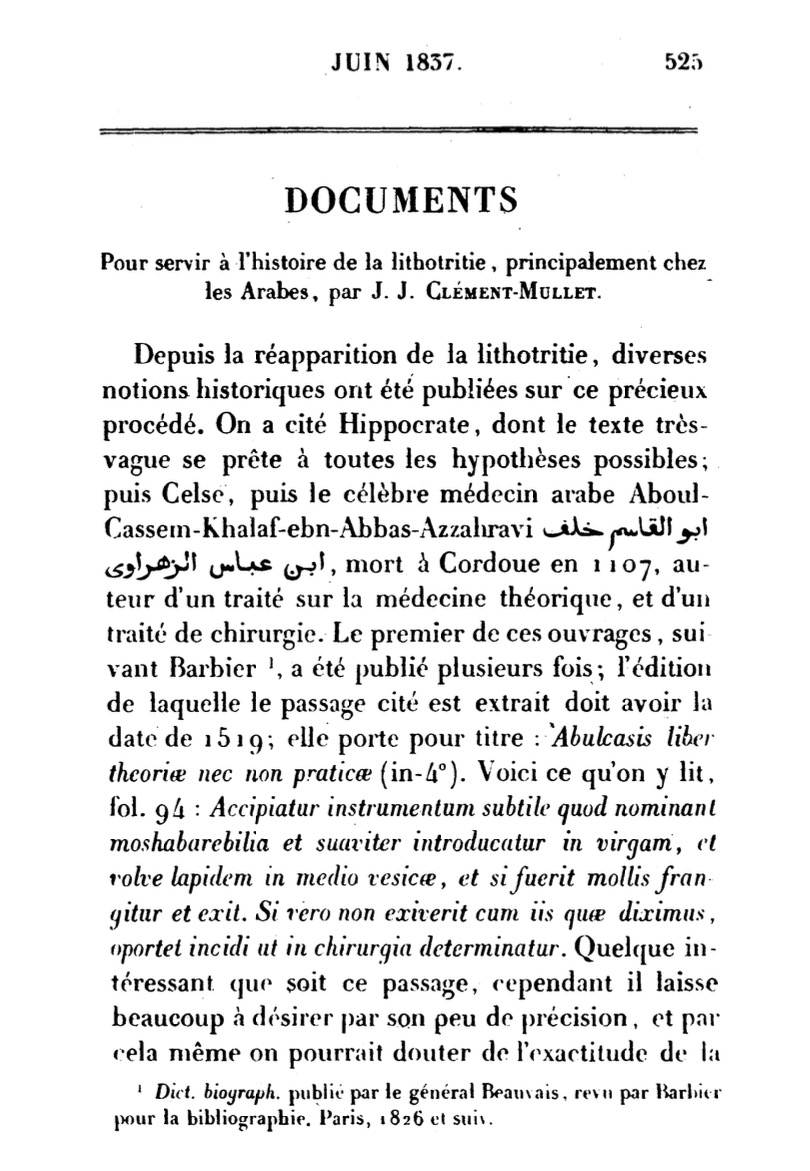
Pour servir à l'histoire de la lithotritie, principalement chez les Arabes
To contribute to the history of lithotripsy, mainly among the Arabs
Journal Article
Clément-Mullet, J.-J. (1837) Pour servir à l'histoire de la lithotritie, principalement chez les Arabes. [To contribute to the history of lithotripsy, mainly among the Arabs] Journal Asiatique, June, pp. 525–533.
Record No. 6823  |  Sinkankas/Born No.: NIS/NIB  |  Language: in French  |  RWHL
A historical study by Jean-Jacques Clément-Mullet of lithotripsy in medieval Arabic medicine. Drawing on Arabic medical and lapidary texts, he discusses accounts by Abū al-Qāsim al-Zahrāwī (Abulcasis), al-Tīfāshī and al-Qazwīnīdescribing methods for breaking urinary calculi. Of particular gemological interest is al-Tīfāshī’s account of a procedure in which a small diamond was fixed to the end of a metal rod, inserted into the urinary tract and used to grind or crush the stone by repeated friction. Clément-Mullet reproduces the Arabic passages with French translations and examines the tradition attributing the technique to Aristotle, while expressing doubt about that attribution. The paper is an important source for the history of the medicinal and practical uses attributed to diamond in medieval Islamic literature.

L’Univers pittoresque. Histoire et description de tous les peuples, de leurs religions, moeurs, coutumes, industries, etc.

The Picturesque Universe. History and description of all peoples, their religions, customs, industries, etc.
Book
Denis, F. (1835–1863) L’Univers pittoresque. Histoire et description de tous les peuples, de leurs religions, moeurs, coutumes, industries, etc. [The Picturesque Universe. History and description of all peoples, their religions, customs, industries, etc.] Paris, 67 Vols.
Record No. 7978  |  Sinkankas/Born No.: NIS/NIB  |  Language: in French  |  RWHL
A vast illustrated French series devoted to the history, geography, peoples and cultures of the world. Published by Firmin Didot from the mid-nineteenth century, L’Univers pittoresque was divided geographically into sections on Europe, Asia, Africa, the Americas and Oceania and comprised dozens of separately authored volumes. The series combines historical narrative with descriptions of geography, religion, customs, dress, industries, monuments, natural resources and material culture, accompanied by thousands of engraved illustrations. For gemological research, individual volumes are useful for references to regional minerals, precious stones, jewelry, mining and decorative arts, although the content and authority vary according to the individual author. Contemporary bibliographies commonly describe the complete series as 67 volumes, though some sets and catalogues count the parts differently.

Notice respecting a remarkable specimen of amber [from Ava]
from Ava
Journal Article
Brewster, D. (1834) Notice respecting a remarkable specimen of amber [from Ava]. Report of the Fourth Meeting of the British Association for the Advancement of Science, Vol. 4, pp. 574–575.
Record No. 29474  |  Sinkankas/Born No.: NIS/NIB  |  RWHL
A brief account by Sir David Brewster of an unusual specimen of amber from Ava in Burma (Myanmar). Brewster describes the material’s appearance and remarkable internal features, examining them in the context of the physical and optical properties of amber. The notice is of particular gemological interest as an early scientific description of Burmese amber, documenting material from a region now famous for its fossiliferous amber deposits and contributing to nineteenth-century knowledge of the geographical occurrence and characteristics of this organic gem material.

Bemerkungen über Meister Chunrad von Megenberg, Domherrn zu Regensburg im XIV. Jahrhundert, und über den damaligen Zustand der Naturkunde im deutschen Volk
Remarks on Master Conrad von Megenberg, Canon of Regensburg in the 14th Century, and on the condition of natural science among the German people at that time
Journal Article
Schmeller, J.A. (1833) Bemerkungen über Meister Chunrad von Megenberg, Domherrn zu Regensburg im XIV. Jahrhundert, und über den damaligen Zustand der Naturkunde im deutschen Volk. [Remarks on Master Conrad von Megenberg, Canon of Regensburg in the 14th Century, and on the condition of natural science among the German people at that time] Jahres-Bericht der Königlich Bayerischen Akademie der Wissenschaften, Vol. 3 (1831/33), p. 41.
Record No. 10936  |  Sinkankas/Born No.: NIS/NIB  |  Language: in German  |  RWHL
A short scholarly notice by Johann Andreas Schmeller on the fourteenth-century German writer Konrad von Megenbergand the state of natural-history knowledge in medieval Germany. Schmeller discusses Konrad’s life and writings, particularly his Buch der Natur, one of the earliest substantial natural-history works in the German language, and considers its place in the transmission of medieval scientific knowledge to a vernacular audience. Of particular interest to gemological history is Konrad’s treatment of stones and minerals, which preserves medieval descriptions, names and traditional properties of precious stones derived largely from earlier Latin authorities. Schmeller’s paper is valuable for the nineteenth-century rediscovery and study of this important medieval natural-history text.

The Mahávansi, the Rájá-Ratnácari, and the Rájá-Vali
Edited Book
Upham, E., editor (1833) The Mahávansi, the Rájá-Ratnácari, and the Rájá-Vali.. London, Parbury, Allen & Co., 3 Vols., 358, 325, 369 pp..
Record No. 6906  |  RWHL
A three-volume English edition of major historical and religious chronicles of Ceylon (Sri Lanka), edited by Edward Upham and translated from Pali and Sinhala sources. The collection includes the Mahāvamsa, Rājā-Ratnākara and Rājāvali, together with additional tracts on Buddhist doctrine and literature. The chronicles recount the legendary and historical succession of Sri Lankan kings, the introduction and development of Buddhism on the island, dynastic events and aspects of political and religious life. For gemological research, the work is of secondary but potentially useful interest through references to royal wealth, precious objects and the material culture of ancient Ceylon. The edition is important chiefly as an early English presentation of Sri Lankan historical texts, although later scholarship produced more reliable translations and critical editions.

Memoir of Giuseppe d’Amato

Journal Article
Burney, H. (1832) Memoir of Giuseppe d’Amato. Journal of the Asiatic Society of Bengal, Vol. 1, No. 8, Aug., pp. 349–353.
Record No. 544  |  Sinkankas/Born No.: NIS/NIB  |  RWHL
A biographical memoir by Henry Burney of the Italian Catholic missionary Giuseppe d’Amato, who spent nearly five decades in Burma and died at Moun-lha in 1832. Burney describes d’Amato’s long residence in the country, his missionary work, knowledge of Burmese language and society, and the respect he had acquired among the local population. Of particular gemological importance, d’Amato had personally visited the precious-stone mines of Kyat-pyen (Kyatpyin) in the Mogok district and left a description of their workings. That account, published separately in the Journal of the Asiatic Society of Bengal in 1833, is among the earliest firsthand European descriptions of the Burmese ruby mines. Burney’s memoir is therefore an important source for establishing d’Amato’s identity, background and connection with the early documentation of Mogok.

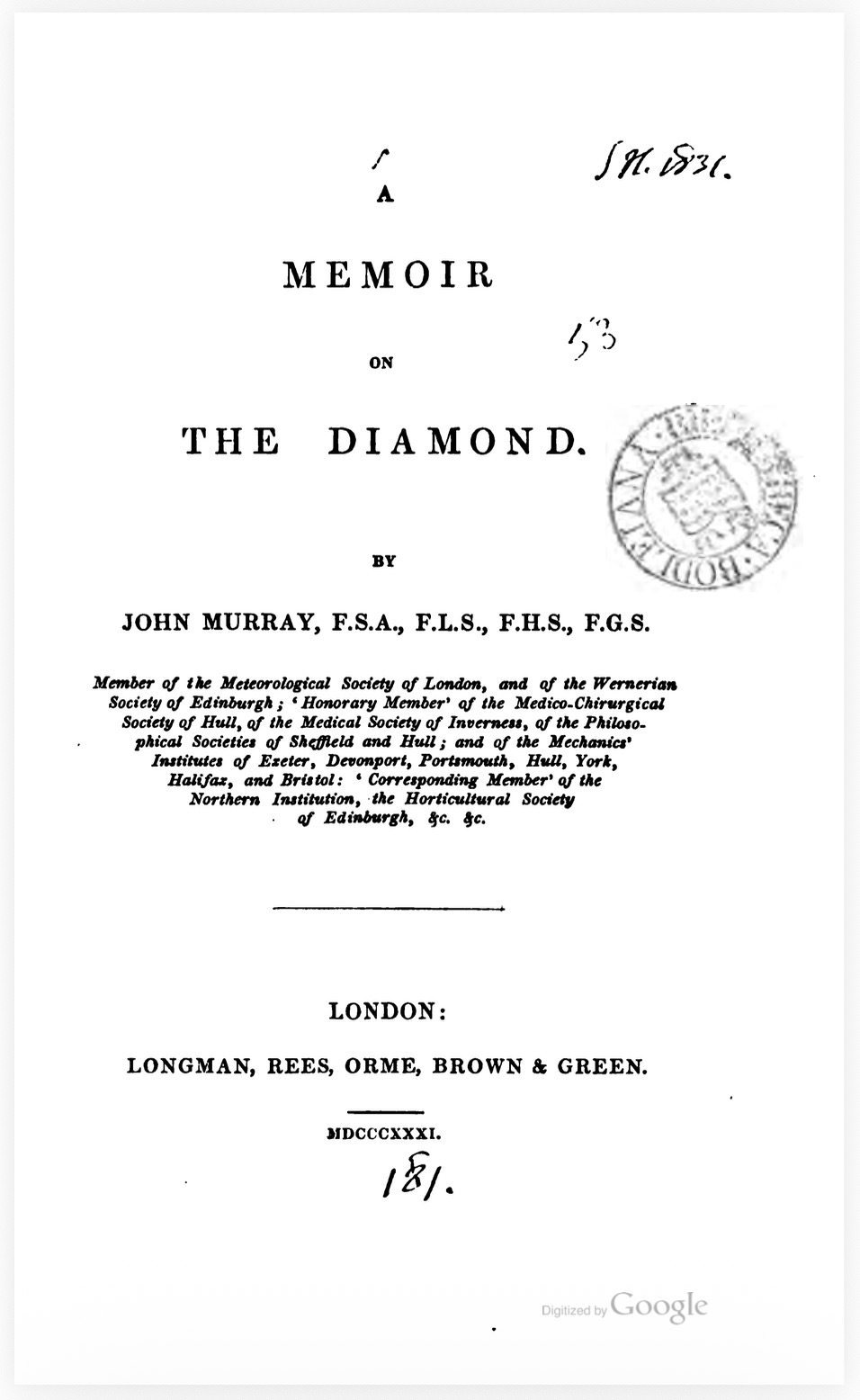
A Memoir on the Diamond

Book
Murray, J. (1831) A Memoir on the Diamond. London, 67 pp.
Record No. 29478  |  Sinkankas/Born No.: NIS/NIB  |  RWHL
A short treatise devoted to the diamond, summarizing contemporary knowledge of its physical and chemical properties, geological occurrence, geographical sources, and distinctive characteristics. Murray discusses the exceptional hardness and combustibility of diamond, together with experiments concerning its composition and behavior, and considers the principal diamond-producing regions known at the time. The work is of gemological interest as an early nineteenth-century synthesis of scientific knowledge of diamond, reflecting the transition from traditional descriptions of precious stones to their investigation through chemistry, mineralogy, and experimental science.

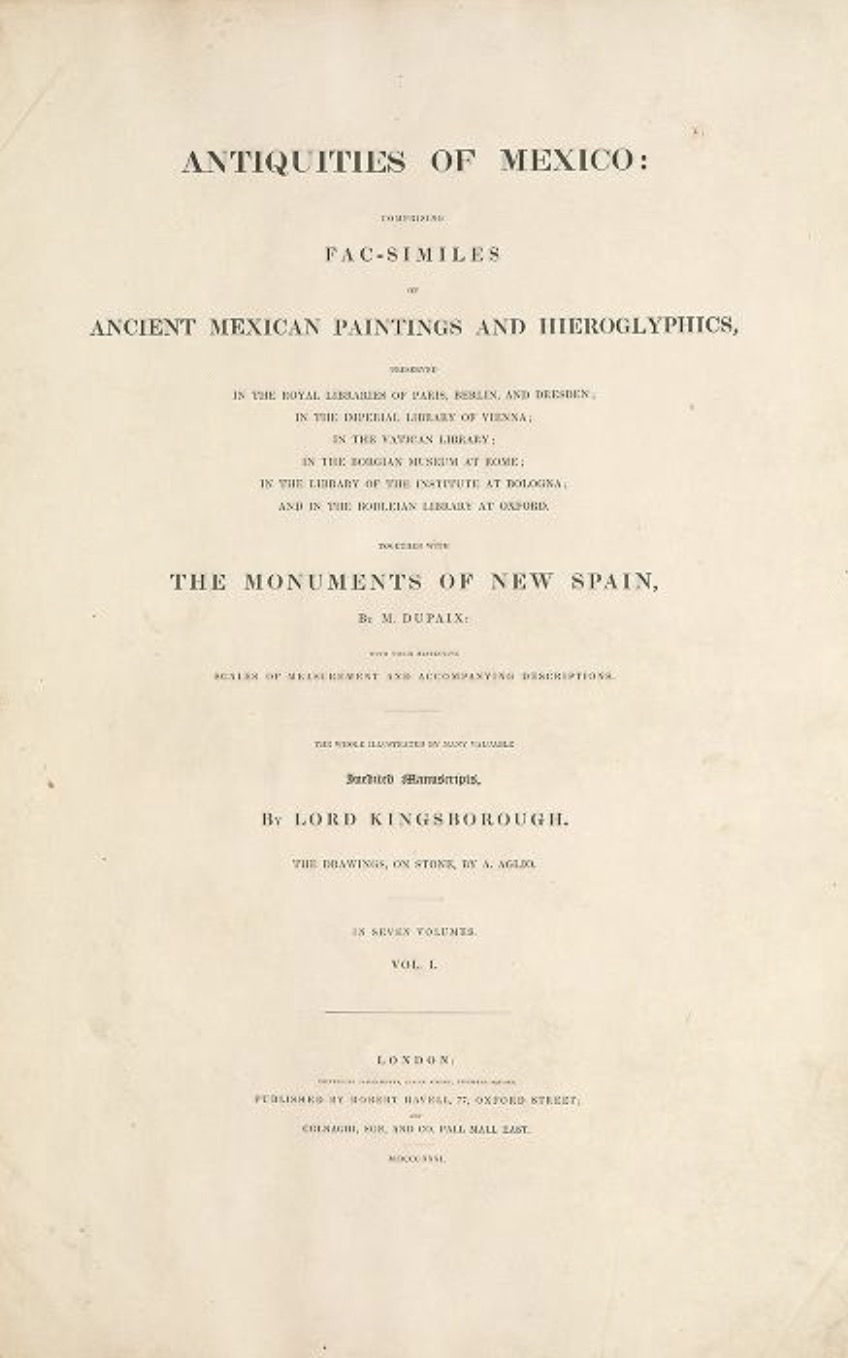
Antiquities of Mexico | Comprising Fac-similes of Ancient Mexican Paintings and Hieroglyphics, Preserved in the Royal Libraries of Paris, Berlin, and Dresden; in the Imperial Library of Vienna
Book
Kingsborough, E.K. (1831–1848) Antiquities of Mexico | Comprising Fac-similes of Ancient Mexican Paintings and Hieroglyphics, Preserved in the Royal Libraries of Paris, Berlin, and Dresden; in the Imperial Library of Vienna. London, Robert Havell, 9 Vols.
Record No. 7972  |  Sinkankas/Born No.: NIS/NIB  |  RWHL
A monumental nine-volume publication devoted to the antiquities and pictorial manuscripts of pre-Columbian Mexico, assembled by Edward King, Viscount Kingsborough. The work reproduces in elaborate facsimile a number of major Mexican codices and other Indigenous manuscripts preserved in European collections, accompanied by historical, linguistic and antiquarian commentary drawn from colonial sources. Its contents document religion, calendrical systems, tribute, costume, warfare, ritual and material culture. Of particular relevance to gemological research are depictions and references to valued materials such as greenstone/jade, turquoise, gold and other ornaments used in elite and ceremonial contexts. Despite Kingsborough’s highly speculative interpretations, the volumes remain an important early source for the publication and study of Mesoamerican manuscripts and material culture.

Strabons Erdbeschreibung in Siebenzhen Büchern
Strabo's Geography in Seventeen Books
Edited Book
Groskurd, C.G., editor (1831–1834) Strabons Erdbeschreibung in Siebenzhen Büchern. [Strabo's Geography in Seventeen Books]. Berlin, Nicolai, 4 Vols., 590, 634, 464, 456 pp..
Record No. 7492  |  Sinkankas/Born No.: NIS/NIB  |  Language: in German  |  RWHL
A four-volume German translation of Strabo’s Geographica, edited and translated by Christian Gottlieb Groskurd. The work presents Strabo’s seventeen books of geography, covering the known world of the Greco-Roman period and combining geographical description with history, ethnography, natural resources and accounts of trade. Of particular relevance to gemological research are Strabo’s references to precious stones, pearls, mineral resources and mining districts in regions including India, Arabia, Egypt and the Near East. This nineteenth-century edition is useful both as an accessible German rendering of the ancient text and as a source for studying classical knowledge of gemstones and mineral wealth.

Notices of Brazil in 1828 and 1829

Book
Walsh, R. (1830) Notices of Brazil in 1828 and 1829. London, F. Westley and A.H. Davis, 2 Vols., 528, 542 pp.
Record No. 29370  |  Sinkankas/Born No.: NIS/NIB  |  RWHL
A two-volume account by the Irish clergyman and traveler Robert Walsh describing Brazil during his residence and travels there in 1828–1829. The work covers Rio de Janeiro and journeys into the interior, with observations on politics, society, slavery, religion, natural history, agriculture and commerce. Of particular gemological interest is Walsh’s visit to Minas Gerais, where he describes mining districts, gold workings and the Capão topaz mine near Ouro Preto (Vol. 2, pp. 104–108), including the occurrence and extraction of Brazilian topaz. The work is a valuable firsthand source for the mineral wealth and mining practices of Brazil in the early nineteenth century.

The Modern Traveller: Burmah, Siam, Etc.
Book
Conder, J. (1830) The Modern Traveller: Burmah, Siam, Etc. London, James Duncan, 30 Vols.
Record No. 2739  |  Sinkankas/Born No.: NIS/NIB  |  RWHL
A volume in Josiah Conder’s Modern Traveller series devoted to Burma, Siam and neighboring regions, compiled from contemporary travel narratives, diplomatic accounts and geographical sources rather than from Conder’s own travels. The work summarizes the geography, government, peoples, customs, commerce and natural productions of mainland Southeast Asia. Of particular gemological interest are its notices of the ruby and sapphire resources of Burma and the gem-producing districts of Siam, reflecting European knowledge of these sources in the early nineteenth century. The volume is useful as a synthesis of contemporary reports on the mineral wealth and trade of the region.

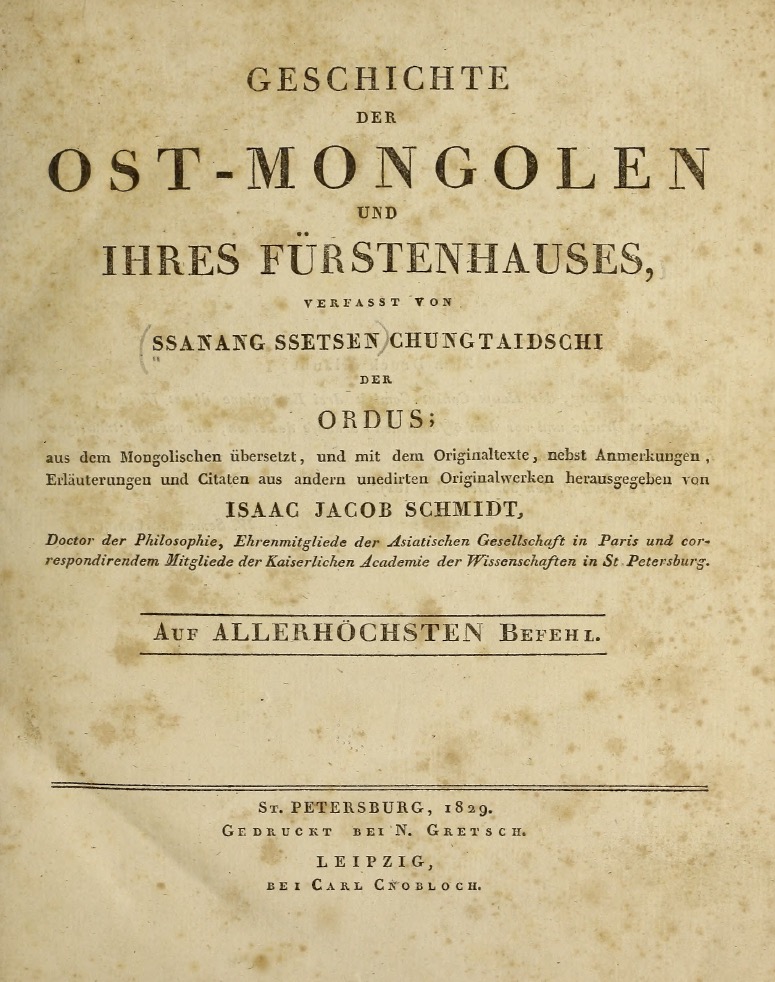
Geschichte der Ost-Mongolen und ihres Fürstenhauses
History of the Eastern Mongols and Their Princely House
Book
Ssanang Ssetsen, C. (1829) Geschichte der Ost-Mongolen und ihres Fürstenhauses. [History of the Eastern Mongols and Their Princely House] St. Petersburg, N. Gretsch, 511 pp.
Record No. 6900  |  Sinkankas/Born No.: NIS/NIB  |  Language: in German  |  RWHL
A German translation of the seventeenth-century Mongolian chronicle commonly known as the Erdeni-yin Tobči(“Precious Summary”), composed by Ssanang Ssetsen Chungtaidschi of the Ordos Mongols. The work traces the history of the Mongols and their ruling houses from legendary origins through the era of Chinggis Khan and his successors to the seventeenth century, combining dynastic history, genealogy, Buddhist tradition and accounts of relations with Tibet and China. It is an important source for Mongolian historiography and for the political and religious history of Inner Asia. Its relevance to gemological research is secondary, chiefly through references to precious objects, royal gifts and material culture rather than any systematic discussion of gemstones.

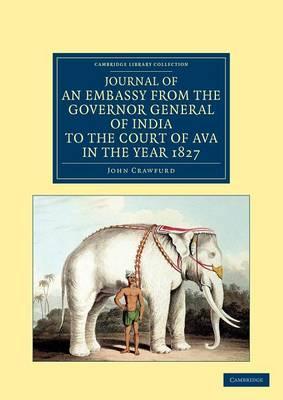
Journal of an Embassy From the Governor-General of India to the Court of Ava, in the Year 1827
Book
Crawfurd, J. (1829) Journal of an Embassy From the Governor-General of India to the Court of Ava, in the Year 1827. London, Henry Colburn, 2 Vols., 605 pp.
Record No. 3124  |  Sinkankas/Born No.: NIS/NIB  |  RWHL
A detailed account by John Crawfurd of his diplomatic mission from British India to the Burmese court at Ava in 1827. The work describes the journey, the court and government of Burma, its peoples, customs, commerce, geography and natural resources. Of particular gemological interest are Crawfurd’s remarks on rubies and other precious stones of Burma, including their occurrence, trade and association with the royal economy. The book is an important early nineteenth-century source for European knowledge of Burma and for the history of its gemstone resources before the later colonial-era investigations of the Mogok ruby mines.

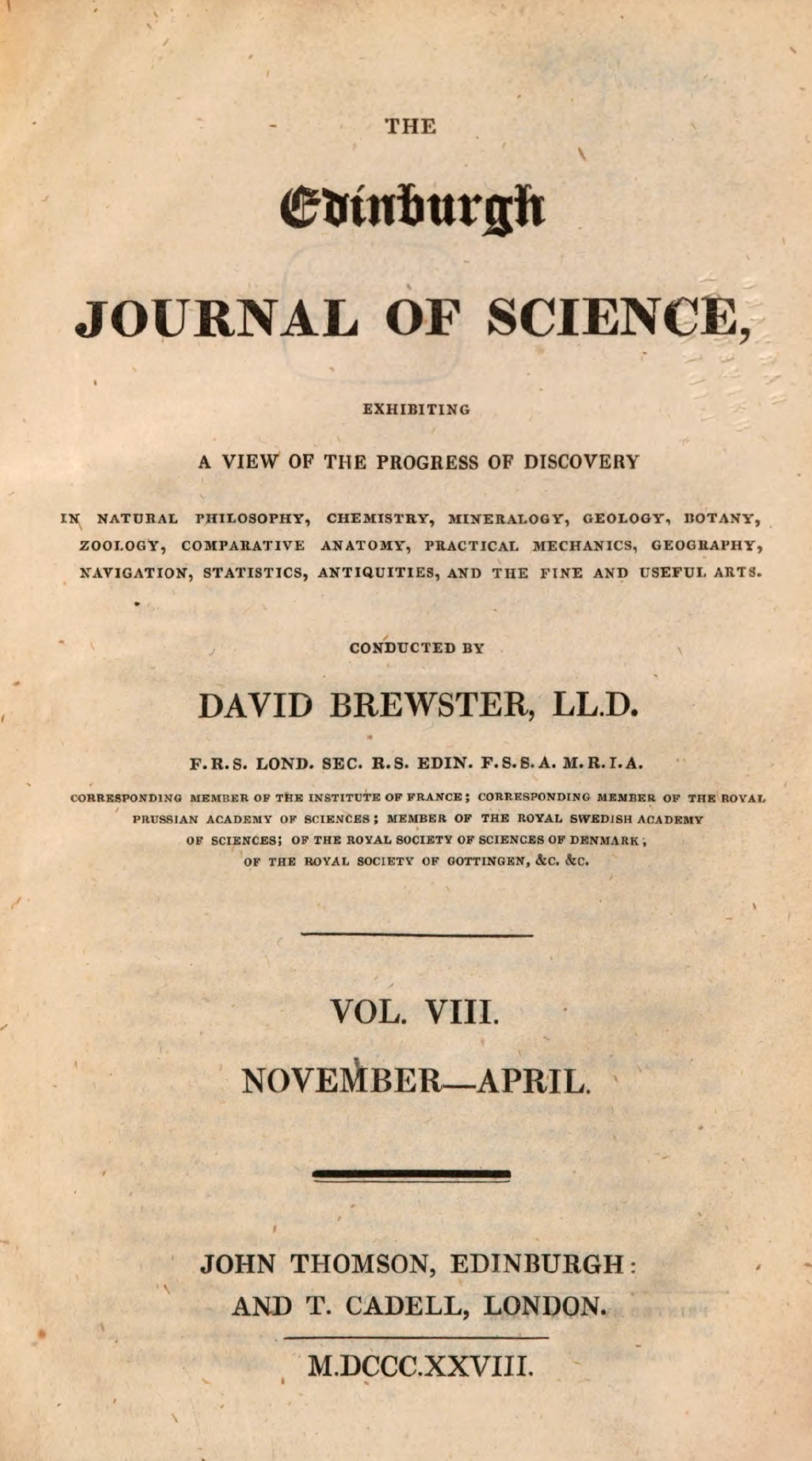
Narrative of the proceedings and scientific observations of the late mission to Ava
Journal Article
Anonymous (1828) Narrative of the proceedings and scientific observations of the late mission to Ava. Edinburgh Journal of Science, Vol. 8, No. 15, pp. 10–25.
Record No. 29570  |  Sinkankas/Born No.: NIS / NIB  |  RWHL
Account of a British mission to Ava following the First Anglo-Burmese War, combining a narrative of its journey from Rangoon to the Burmese capital and return with observations on the country’s geography, geology, mineral resources, botany, zoology, and economy. The mission travelled up the Irrawaddy, visiting Prome, the petroleum wells at Renangyoung, Pagan, and Ava, where it attended the Burmese court and concluded a short commercial treaty. Of particular gemological importance is its description of the celebrated ruby and sapphire mines at “Mo-gaot” and “Kyat-pyan,” said to lie about five days’ journey ESE of Ava. Members of the mission examined sapphires in both crystallized and rough states and the gem-bearing gravel, and collected specimens. The stones reported include ruby (“red sapphire”), blue sapphire, spinel ruby, white, yellow, green, opalescent, amethyst and girasol sapphires, together with common corundum. Fine ruby was described as scarce and expensive even at Ava, while blue sapphire was more common and cheaper; one imperfect sapphire examined reportedly weighed 951 carats. The account also records the Burmese king’s claim to rubies and sapphires exceeding 100 ticals in value, the alleged practice of miners breaking valuable stones to evade this claim, and the export of rubies and sapphires by Chinese merchants. Precious serpentine is likewise noted as an important Burmese product exported by the Chinese. The wider scientific survey describes fossiliferous deposits near the petroleum wells, marble around Ava, metallic ores and mining in the Shan regions, the petroleum industry, and extensive botanical collections made during the mission.

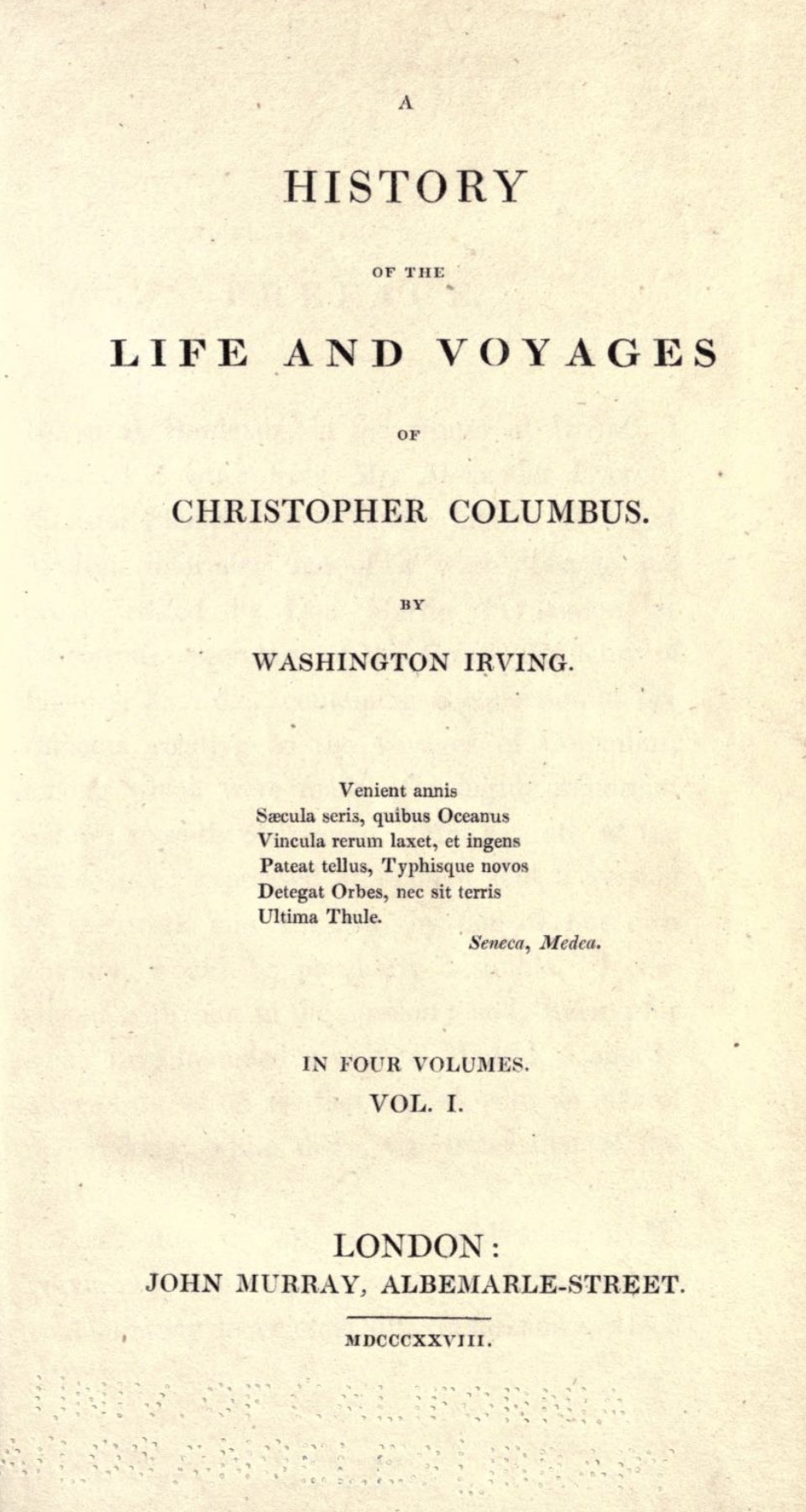
A History of the Life and Voyages of Christopher Columbus
Book
Irving, W. (1828) A History of the Life and Voyages of Christopher Columbus. New York, G. & C. Carvill, 3 Vols., 389 pp.
Record No. 8006  |  Sinkankas/Born No.: NIS/NIB  |  RWHL
A three-volume biography and narrative history of Christopher Columbus by Washington Irving, based on published accounts and archival materials consulted during Irving’s residence in Spain. The work recounts Columbus’s life, his four voyages across the Atlantic, encounters with Indigenous peoples, and the Spanish exploration and colonization of the Caribbean and adjacent regions. Of interest to gemological and economic history are repeated references to the search for gold, pearls and other valuable natural products, which figured prominently in European expectations of the newly encountered lands. Although written in a literary style and not regarded today as a fully reliable modern historical study, the work was highly influential in shaping nineteenth-century perceptions of Columbus and the early Spanish voyages.

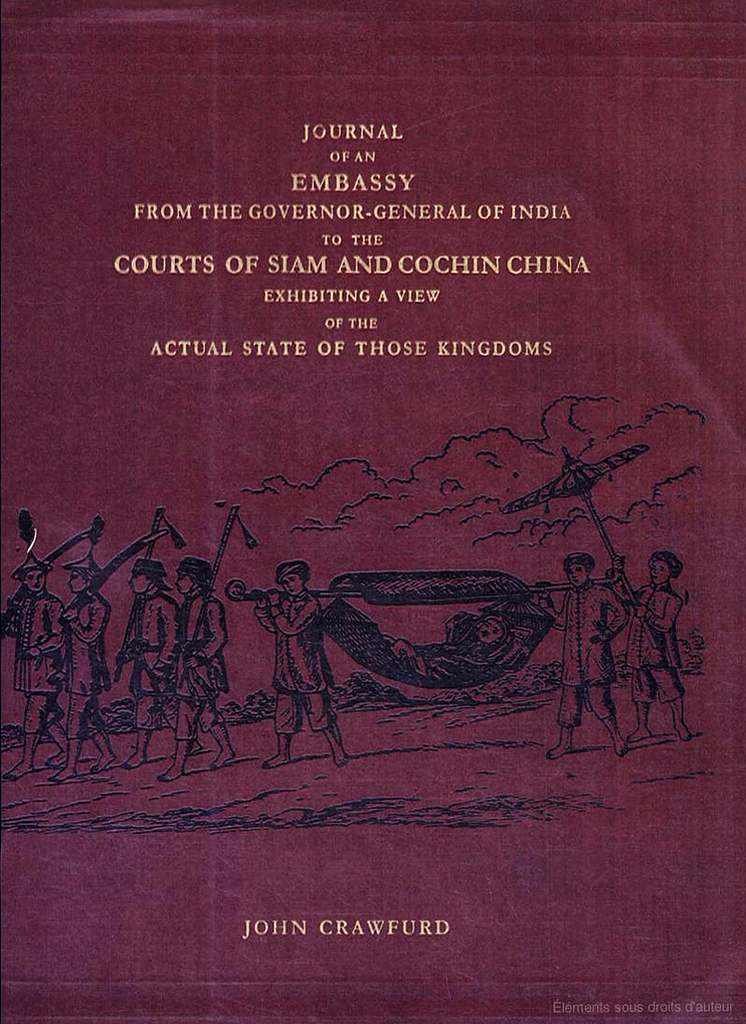
Journal of an Embassy to the Courts of Siam and Cochin China
Book
Crawfurd, J. (1828, 1830) Journal of an Embassy to the Courts of Siam and Cochin China. London, Henry Colburn, 2 Vols., see pp. 419–420
Record No. 2744  |  Sinkankas/Born No.: NIS/NIB  |  RWHL
A detailed account of John Crawfurd’s British diplomatic mission to Siam and Cochin China in 1821–1822, combining travel narrative with observations on government, commerce, society, geography and natural resources. Of particular gemological importance are his remarks on the gem deposits of Chanthaburi, where he records sapphire, ruby and “Oriental topaz” (yellow sapphire) occurring in alluvial ground at the foot of the hills. He describes the washing of the gem-bearing soil, notes that the recovered gravel was sent to Bangkok for examination, and states that the Chanthaburi gem workings were a royal monopoly. Crawfurd also compares Siamese ruby and sapphire unfavorably with stones from Ava. The work is an important early nineteenth-century source for the history of the Chanthaburi gem fields and the Siamese gem trade.

Notice respecting the existence of the new fluid in a large cavity in a specimen of sapphire
Journal Article
Brewster, D. (1827) Notice respecting the existence of the new fluid in a large cavity in a specimen of sapphire. Edinburgh Journal of Science, Vol. 6, pp. 155–156.
Record No. 491  |  Sinkankas/Born No.: 919; NIB  |  RWHL
A brief note by David Brewster reporting a large fluid-filled cavity observed in a specimen of sapphire. The paper extends his earlier investigations of fluids enclosed within minerals and records the presence and behavior of the trapped liquid in corundum. Of particular gemological importance, it is an early specific description of a fluid inclusion in sapphire, demonstrating that such inclusions occur in precious stones as well as in other minerals. The notice forms part of Brewster’s pioneering work on mineral inclusions and the physical conditions under which crystals form.

Travels and Adventures in the Persian Provinces on the Southern Banks of the Caspian Sea

Book
Fraser, J.B. (1826) Travels and Adventures in the Persian Provinces on the Southern Banks of the Caspian Sea. London, Longman, Rees, Orme, Brown and Green, 384 pp.
Record No. 29482  |  Sinkankas/Born No.: NIS/NIB  |  RWHL
An account of James Baillie Fraser’s travels through the Persian provinces bordering the southern Caspian Sea, describing the geography, peoples, settlements, political conditions, commerce, and natural resources encountered along his route. The cited pages (pp. 343–347) are of particular gemological interest for Fraser’s discussion of turquoise and its trade, including observations on the stones, their sources, qualities, valuation, and commercial importance. The work provides useful firsthand evidence for the early nineteenth-century Persian gemstone trade and complements Fraser’s more detailed account of the celebrated turquoise mines of Khorasan.

Building a Gemological Library

Gemological books range from general identification manuals and textbooks to specialized works on individual gems, mineralogy, jewelry, treatments, synthesis, history and gem-producing regions.

For a curated selection of particularly useful books, read The Gemologist's Core Library — Classic Books on Gemology, Jewelry and Mineralogy.

About Four Treasures

Four Treasures is Lotus Gemology's freely accessible gemological reference database. Use the full database to search by author, title or keyword and explore literature on gemology, mineralogy, jewelry and related fields. Where available, hyperlinks on titles may lead directly to the full publication.

Search the Complete Four Treasures Database