Gemology Books Bibliography

Gemology Books Bibliography

Explore books on gems, gemology, jewelry and mineralogy in Four Treasures, the Lotus Gemology reference database. This bibliography brings together matching book records from the collection, with publication details, abstracts and cover images where available.

Gemology Book References

The list below matches books concerning gemology and related subjects in the database's searchable fields. Some works cover several branches of gems, jewelry or mineralogy.
3,021–3,040 of 3,451 matching references

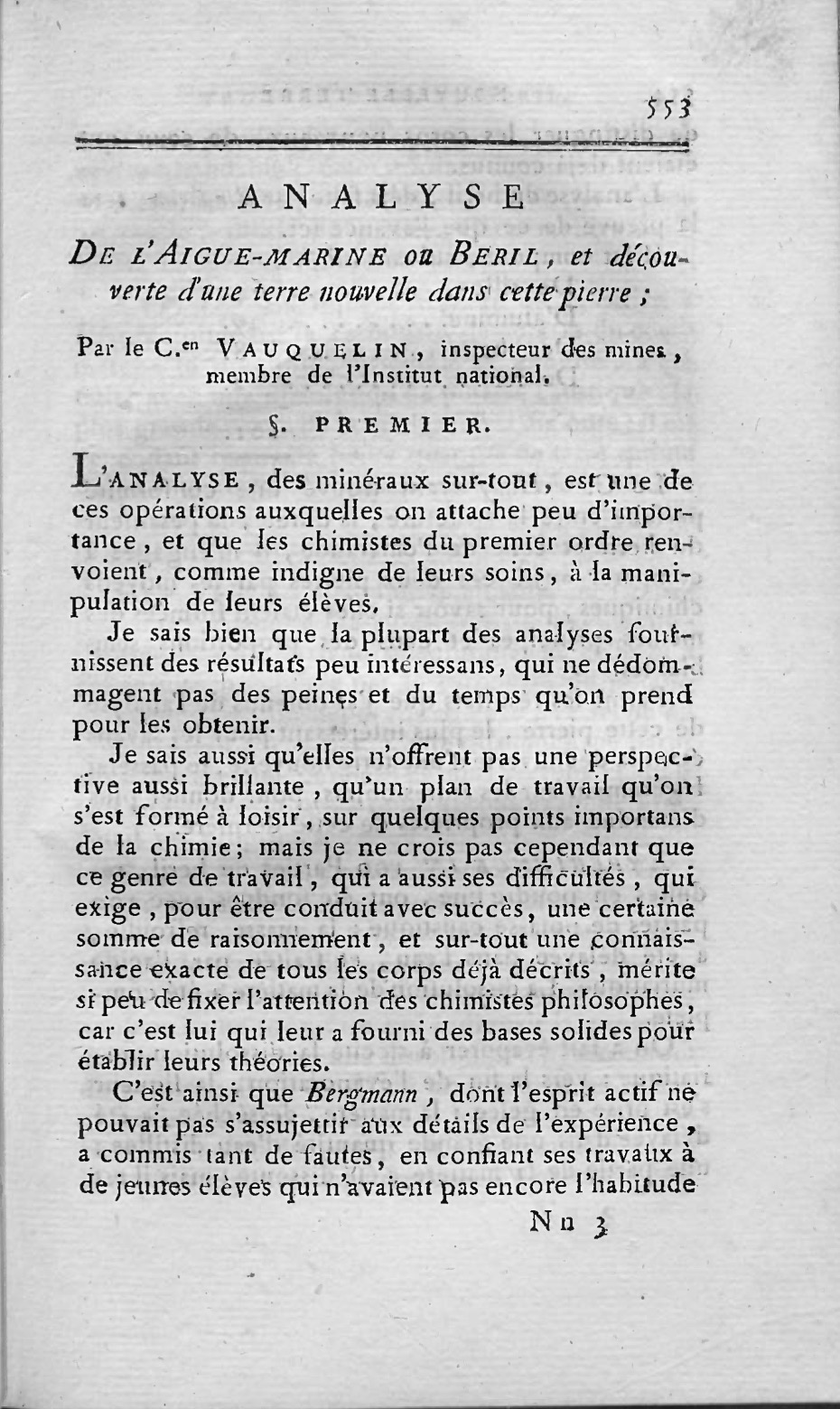
Analyse de l'aigue-marine ou beril, et découverte d'une terre nouvelle dans cette pierre
Analysis of aquamarine, or beryl, and discovery of a new earth in this stone
Journal Article
Vauquelin, N.-L. (1798) Analyse de l'aigue-marine ou beril, et découverte d'une terre nouvelle dans cette pierre. [Analysis of aquamarine, or beryl, and discovery of a new earth in this stone] Journal des mines, Vol. 2, No. 43, pp. 553–564.
Record No. 28377  |  Sinkankas/Born No.: NIS/NIB  |  Language: in French  |  RWHL
An important chemical investigation of aquamarine (beryl) by Nicolas-Louis Vauquelin, in which he announced the discovery of a previously unknown earth in the mineral. Through chemical analysis, Vauquelin distinguished this substance from alumina and identified what became known as glucina (beryllia), beryllium oxide, thereby establishing beryl as chemically distinct from minerals with which it had previously been associated. The discovery ultimately led to recognition of the element beryllium. The paper is particularly important to gemology because it demonstrated that emerald and aquamarine are varieties of the same mineral species, beryl, despite their markedly different colors, and illustrates the growing importance of chemical composition in the scientific classification of gemstones.

Analysis of the Oriental lapis lazuli
Journal Article
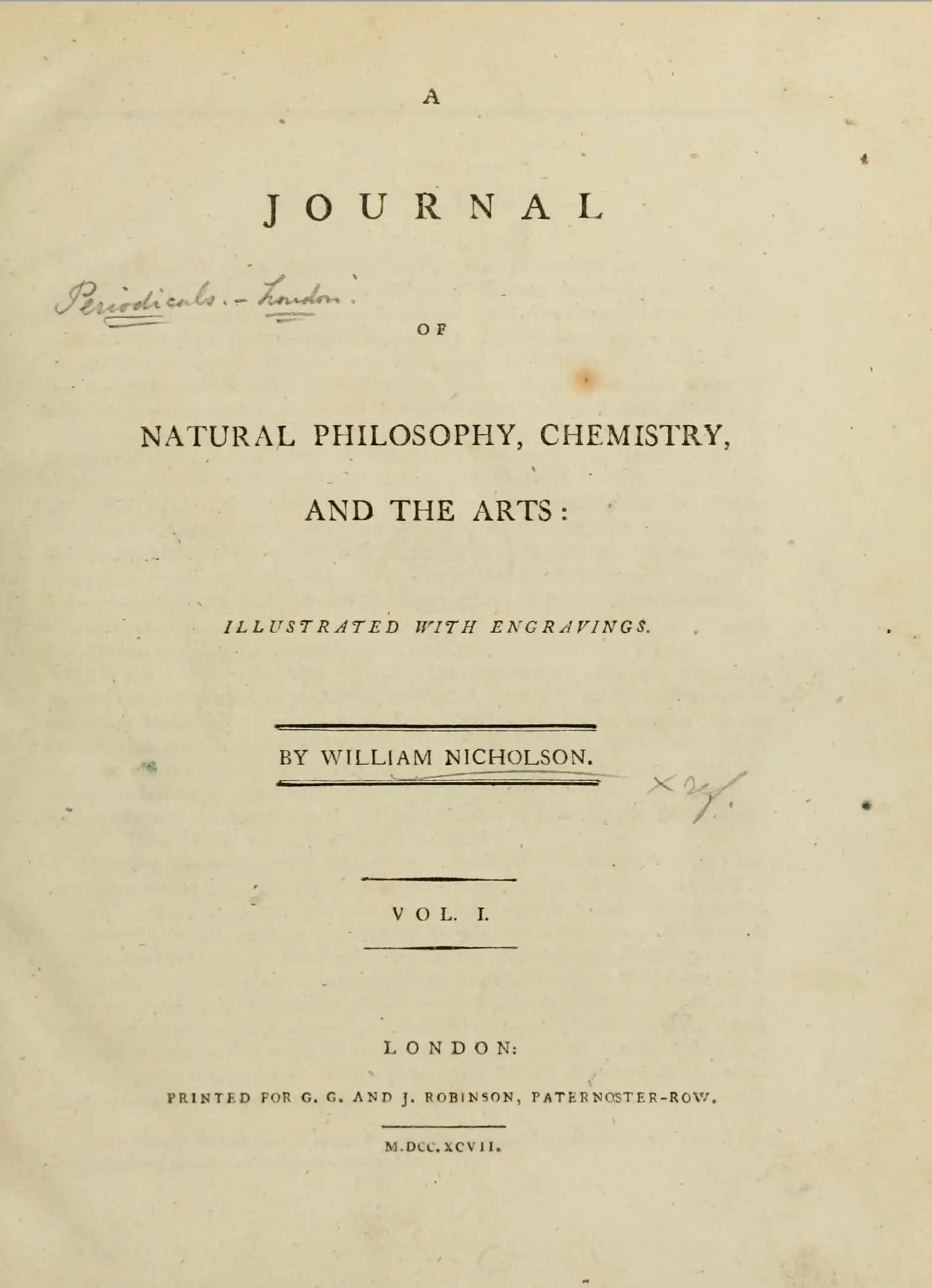
Klaproth, M.H. (1797) Analysis of the Oriental lapis lazuli. Journal of Natural Philosophy, Chemistry, and the Arts, Vol. 1, April, pp. 77–80.
Record No. 29161  |  Sinkankas/Born No.: NIS/NIB  |  RWHL
The analysis of lapis lazuli made by Margraff has shewn that the blue colour of this stone is not owing to copper, as has commonly been thought, but that it arises from iron. But as we have not hitherto possessed any accurate analysis of this stone, I have thought it might be useful to examine it anew. In fact, Margraff informs us, that lime, gypsum, and silex, together with iron, are its component parts; but he does not determine their proportions; and his analysis is incomplete, as he does not mention the alumine which this stone also contains. According to Rinmann, the lapis lazuli contains lime, quartz, iron, and the acid of fluor. I have not found the latter; and it is probable that Rinmann’s opinion was grounded upon the phosphorescence of this stone when it is heated. Cronstedt and some others have affirmed that the lapis contains a quantity of silver, after the rate of two ounces per quintal. But my essays have afforded no certain indication of the presence of this metal. I selected for experiment a species of the lapis of a beautiful deep blue colour, and carefully separated the white and pyritous specks. This early chemical analysis of lapis lazuli by Martin Heinrich Klaproth, published in English translation in the *Journal of Natural Philosophy, Chemistry, and the Arts*. Klaproth examines the composition of “Oriental” lapis lazuli using the analytical methods of late eighteenth-century chemistry, seeking to identify the substances responsible for the stone’s characteristic blue color and associated mineral components. The paper is important in the history of gemology and mineral chemistry because it represents one of the early systematic attempts to characterize lapis lazuli chemically rather than solely by appearance and traditional lapidary descriptions.

Mémoire sur l'Hyacinthe de France, congénère à celle de Ceylan, et sur la nouvelle terre simple qui entre dans sa composition
Memoir on the hyacinth of France, akin to that of Ceylon, and on the new simple earth that enters into its composition
Journal Article
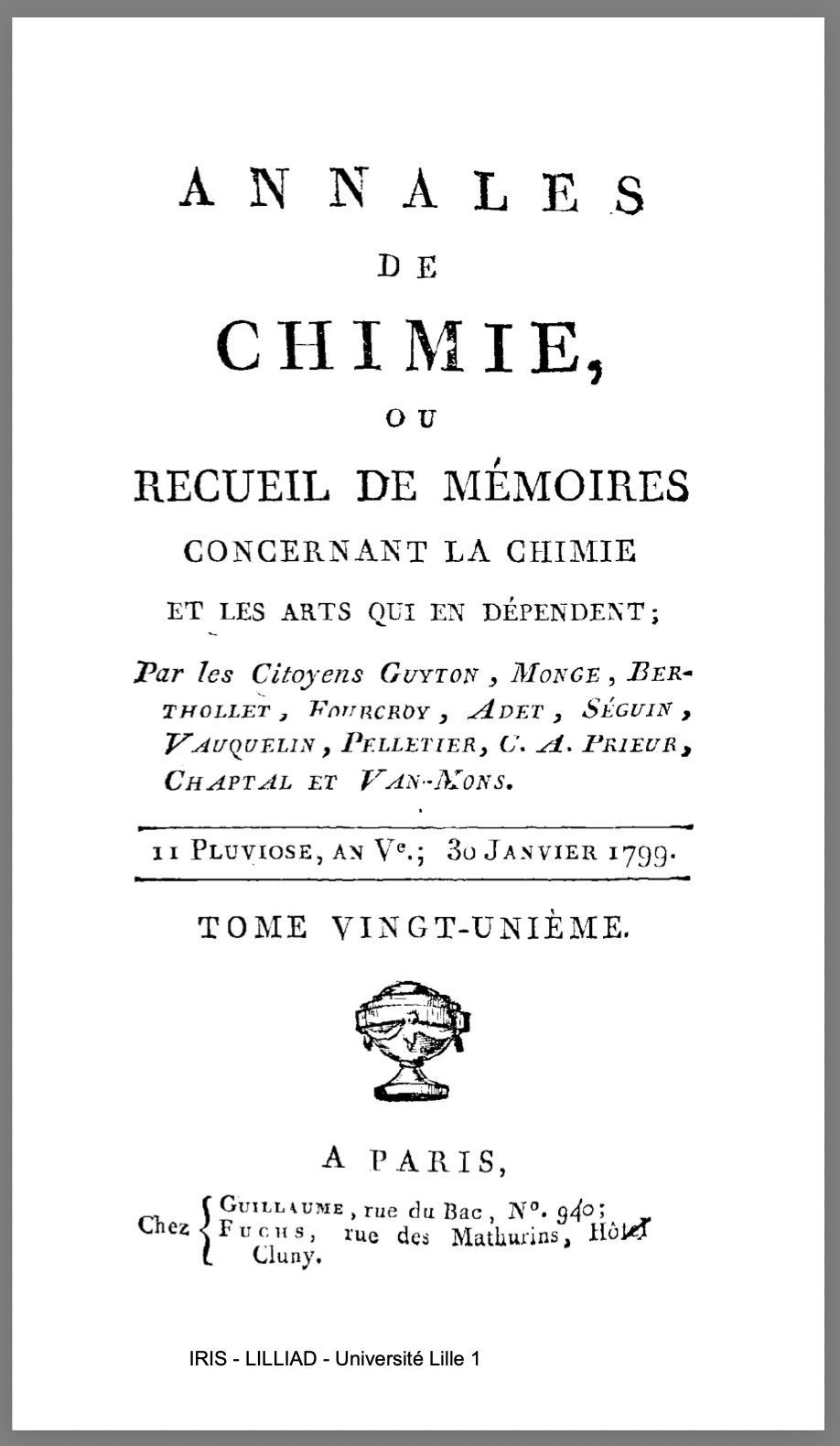
Guyton de Morveau, L.-B. (1797) Mémoire sur l'Hyacinthe de France, congénère à celle de Ceylan, et sur la nouvelle terre simple qui entre dans sa composition. [Memoir on the hyacinth of France, akin to that of Ceylon, and on the new simple earth that enters into its composition] Annales de Chimie, Vol. 22, pp. 72–95.
Record No. 28366  |  Sinkankas/Born No.: NIS/NIB  |  Language: in French  |  RWHL
One of the chemists who has devoted the most attention in recent times to the analysis of minerals, Martin Heinrich Klaproth of Berlin, announced in 1789 that he had extracted from stones known under the name jargon de Ceylan [Ceylon jargon], in the proportion of 0.60, an earth which could not be identified by its properties with any of the five previously discovered substances generally classified among the earths. This scholar rightly imagined that, in the present state of science, which has made those who cultivate it more rigorous in the examination of facts, this new principle would be admitted only after a series of confirmatory experiments. He therefore invited naturalists to direct their researches toward this object; and, in the collection of analyses which he has just published, he complains that they have not responded to his invitation. He attributes this to the rarity of the mineral, and hopes to remove this obstacle to the confirmation of his experiments by indicating the same earth as a constituent part, in at least equal quantity, of a somewhat more common material, the hyacinth of Ceylon.

Chemische Untersuchung des Spinells

Investigation of the spinel, contributions to the chemical knowledge of mineral bodies
Book Section
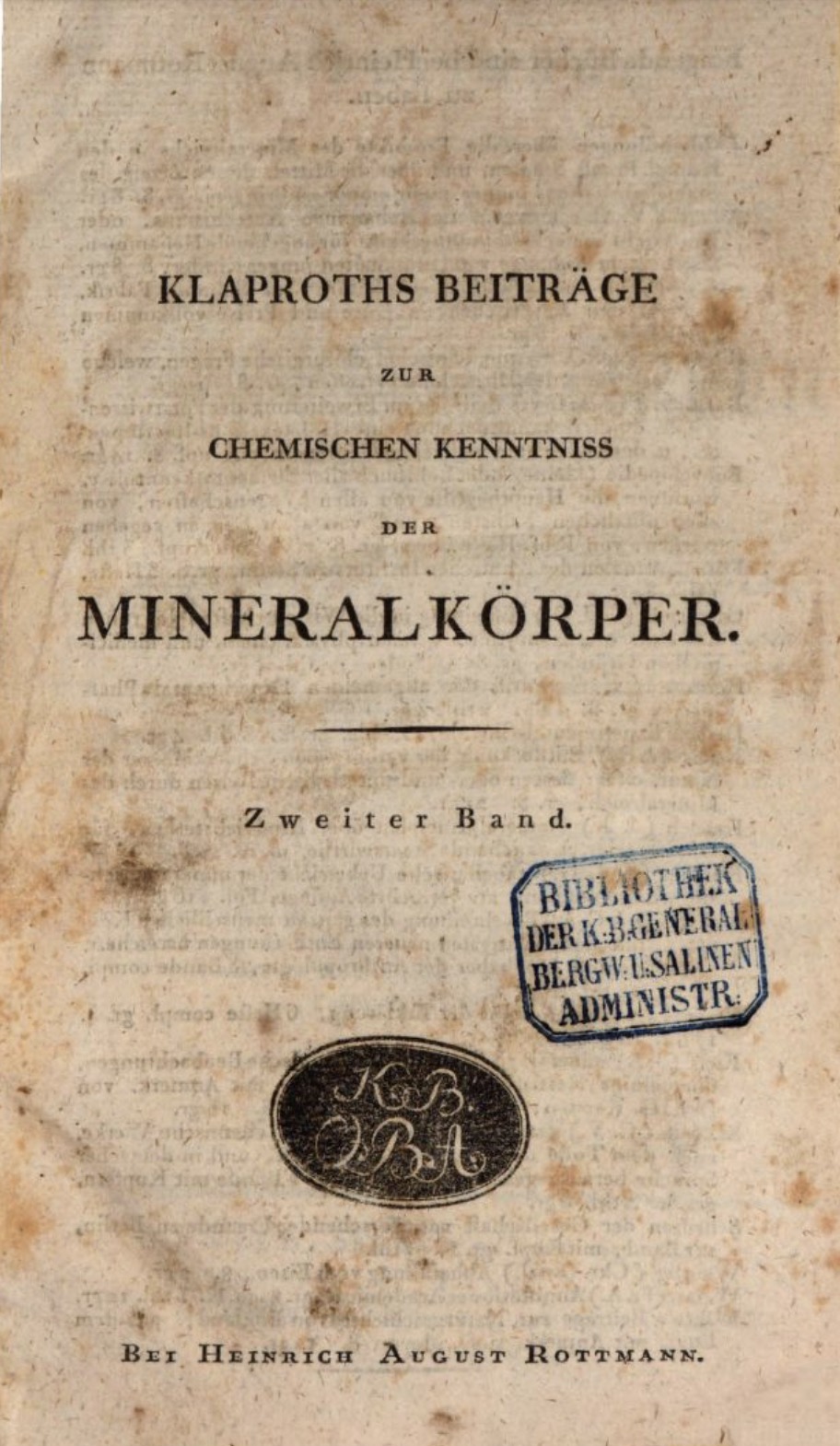
Klaproth, M.H. (1797) Chemische Untersuchung des Spinells. [Investigation of the spinel, contributions to the chemical knowledge of mineral bodies] In: Beiträge zur chemischen Kenntniss der Mineralkörper, Berlin: Heinrich August Rottmann, Vol. 2 , pp. 1–11.
Record No. 4636  |  Sinkankas/Born No.: NIS/NIB  |  Language: in German  |  RWHL
An important chemical investigation of spinel by Martin Heinrich Klaproth, published in his Beiträge zur chemischen Kenntniss der Mineralkörper. Klaproth subjects spinel to quantitative chemical analysis in order to determine its constituent substances and clarify its mineralogical nature. The study belongs to his pioneering program of applying rigorous analytical chemistry to minerals, helping to replace classifications based primarily on color and external appearance with distinctions based on composition. Of particular importance to gemology, the work contributed to the scientific characterization of spinel as a distinct mineral at a time when red spinel and ruby had long been confused in both commercial and descriptive literature. It represents an important step in the chemical differentiation and modern classification of gemstones.

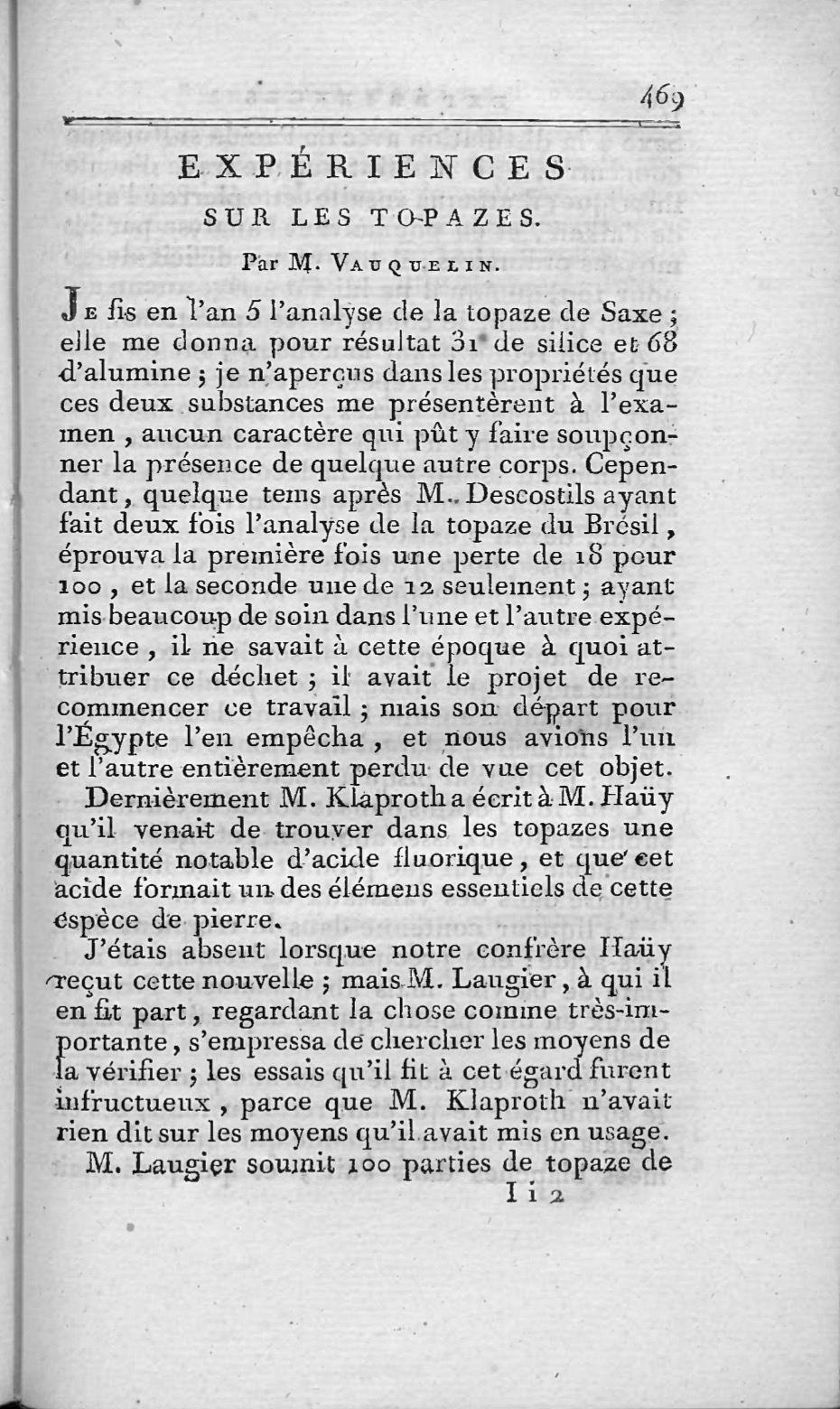
Expériences sur les topazes

Experiments on topazes
Journal Article
Vauquelin, N.-L. (1796) Expériences sur les topazes. [Experiments on topazes] Journal des Mines, Vol. 16, No. 37, pp. 469–474.
Record No. 28376  |  Sinkankas/Born No.: NIS/NIB  |  Language: in French  |  RWHL
An experimental study by Nicolas-Louis Vauquelin on the chemical composition of topaz. Using the analytical methods available at the end of the eighteenth century, Vauquelin examines topaz in an effort to determine its constituent substances and clarify its position among minerals. The paper belongs to the period in which chemical analysis was becoming increasingly important for distinguishing gemstones that earlier mineralogists had classified primarily by external appearance and physical properties. It is an early contribution to the chemical characterization of topaz and to the broader development of analytical mineralogy and scientific gemology.

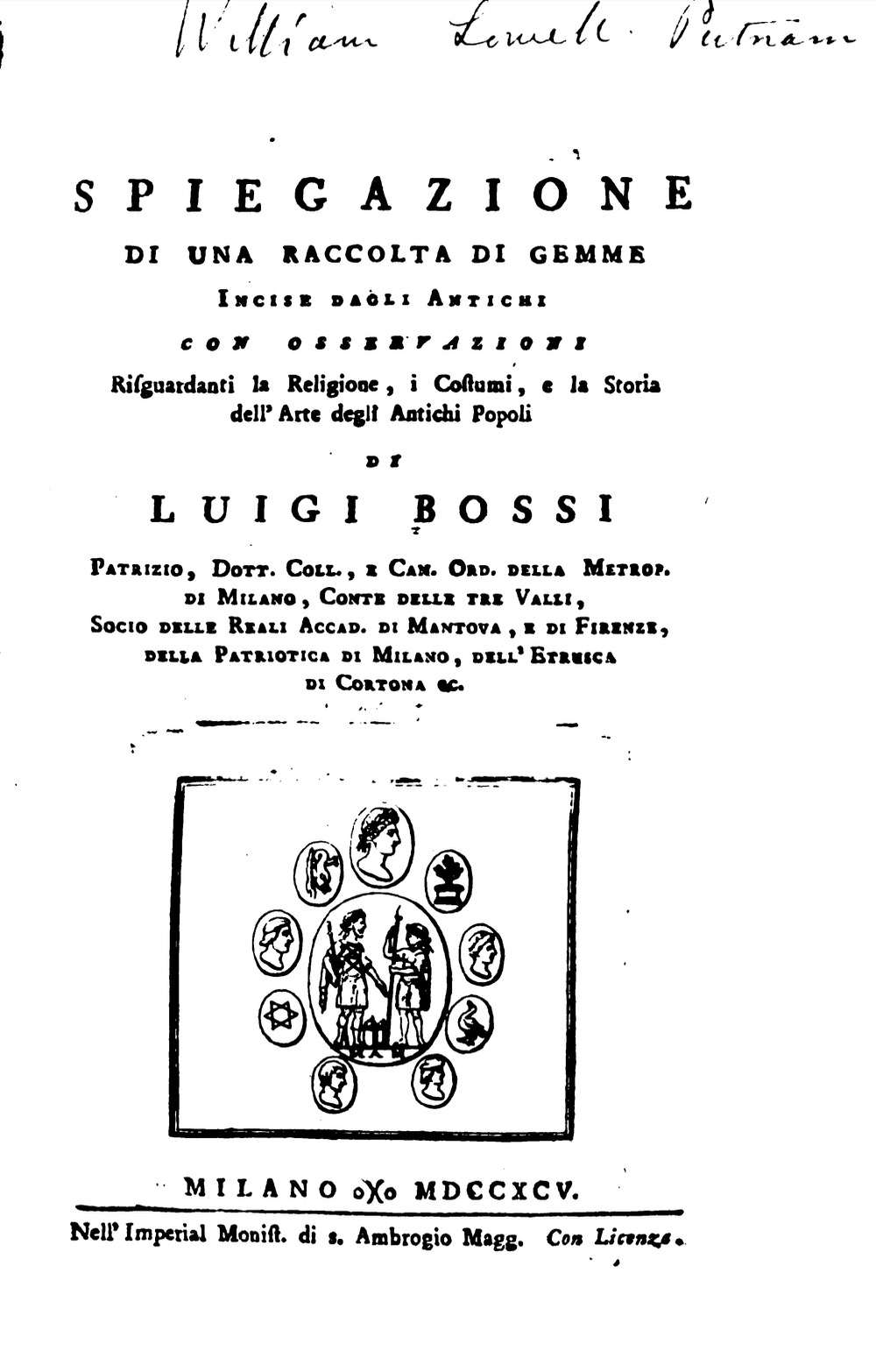
Spiegazione di una raccolta di gemme: incise dagli antichi con osservazioni risguardanti la religione, i costumi, e la storia dell'arte degli antichi popoli
Explanation of a Collection of Gems Engraved by the Ancients, with Observations Concerning the Religion, Customs, and the History of the Art of Ancient Peoples
Book
Bossi, L. (1795) Spiegazione di una raccolta di gemme: incise dagli antichi con osservazioni risguardanti la religione, i costumi, e la storia dell'arte degli antichi popoli. [Explanation of a Collection of Gems Engraved by the Ancients, with Observations Concerning the Religion, Customs, and the History of the Art of Ancient Peoples], Nell' imperial monist. di s. Ambrogio magg., 488 pp.
Record No. 28845  |  Sinkankas/Born No.: 813: NIB  |  Language: in Italian  |  RWHL
Spiegazione di una raccolta di gemme (“Explanation of a Collection of Gems”) is a book written by Luigi Bossi in 1795. This text is a detailed guide to the gem collection of Francesco Melzi d’Eril, an eighteenth-century Milanese nobleman. The book describes each individual gem in the collection with precision and detail, offering information on the physical and chemical properties of the precious stones, as well as on their history and artistic value. Bossi, a passionate gem enthusiast and an expert in mineralogy, wrote this work with the aim of sharing his knowledge and love of gems with the public. His writing is elegant and meticulous, and the book is considered an important work in the history of gemology and the history of art. This scarce antiquarian book is a facsimile reprint of the old original and may contain some imperfections such as library marks and annotations. Because we believe this work is culturally important, we have made it available as part of our commitment to protecting, preserving, and promoting the world’s literature in affordable, high-quality modern editions that are faithful to the original work.

Vergleichungen mineralogischer Benennungen der deutschen mit arabischen Wörtern
Comparisons of Mineralogical Terms in German with Arabic Words
Book
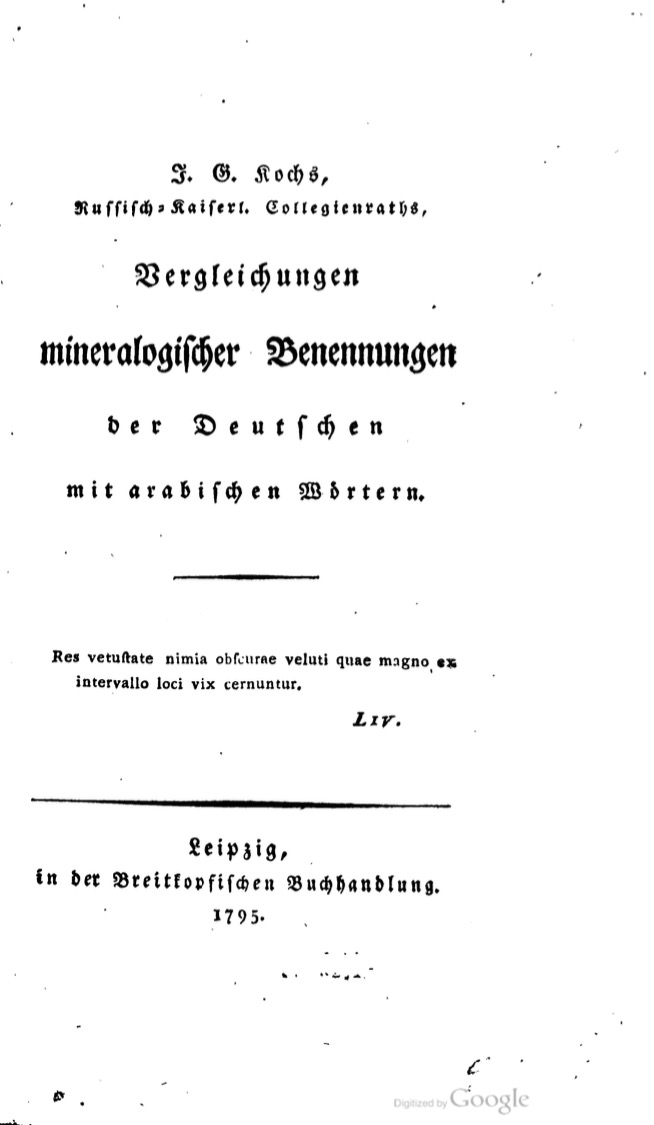
Koch, J.G. (1795) Vergleichungen mineralogischer Benennungen der deutschen mit arabischen Wörtern. [Comparisons of Mineralogical Terms in German with Arabic Words] Leipzig, Breitkopf, 54 pp.
Record No. 8126  |  Sinkankas/Born No.: NIS/NIB  |  Language: in German  |  RWHL
A short comparative study of German and Arabic mineralogical terminology by Johann Georg Koch. The work sets German names for minerals and related natural substances alongside corresponding Arabic terms, with the aim of clarifying their meanings and relationships. It is particularly useful for the history of mineralogy and gemology because Arabic scientific and lapidary literature employed a rich vocabulary for precious stones and minerals that was often inconsistently rendered in European sources. Koch’s comparison provides evidence for how late eighteenth-century European scholars interpreted Arabic mineral names and is a useful source for tracing historical gemstone terminology across the Arabic and German scholarly traditions.

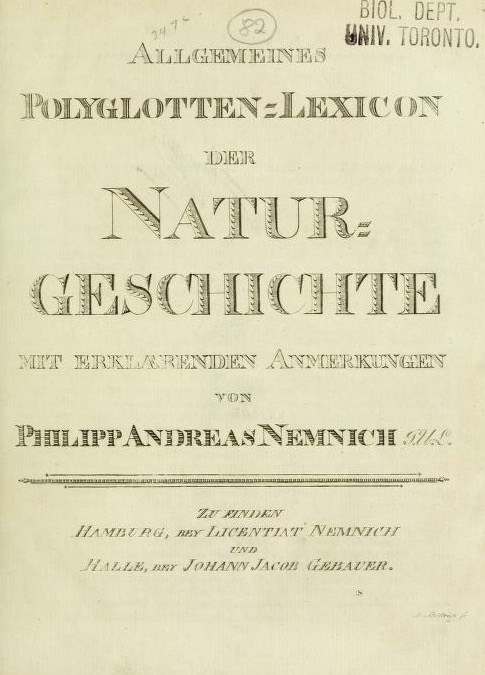
Allgemeines Polyglotten-Lexicon Der Naturgeschichte
General Polyglot Lexicon Of Natural History
Book
Nemnich, P.A. (1793) Allgemeines Polyglotten-Lexicon Der Naturgeschichte. [General Polyglot Lexicon Of Natural History] Hamburg, Nemnich, 4 Vols.
Record No. 8141  |  Sinkankas/Born No.: NIS/NIB  |  Language: in German  |  RWHL
A multilingual natural-history dictionary compiled by Philipp Andreas Nemnich, designed to correlate the names of natural substances across numerous European and other languages. The work covers animals, plants and minerals, giving equivalent vernacular terms and variant names rather than serving primarily as a descriptive natural-history treatise. For gemological research, it is particularly useful for tracing historical names of gemstones, minerals and ornamental stones across different languages and identifying synonyms that appear in older scientific, commercial and lapidary literature. The Allgemeines Polyglotten-Lexicon der Naturgeschichte is therefore an important bibliographical and terminological aid for studying eighteenth-century mineral and gemstone nomenclature.

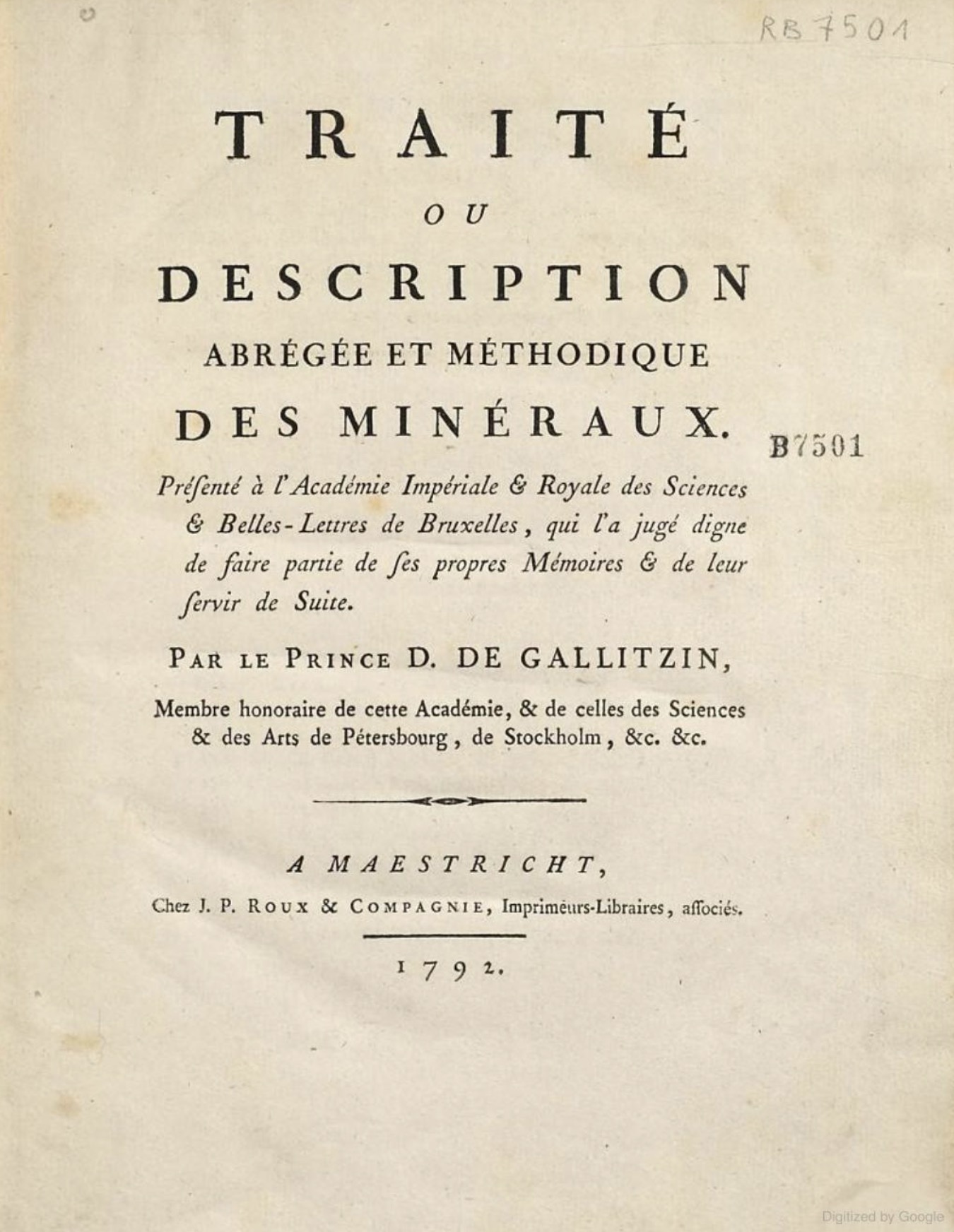
Traité ou description abrégée et méthodique des minéraux
Treatise on the Concise and Methodical Description of Minerals
Book
Gallitzin, D.d., Prince (1792) Traité ou description abrégée et méthodique des minéraux. [Treatise on the Concise and Methodical Description of Minerals] Maestricht, J.P. Roux & Co., 244 pp. (jade p. 57)
Record No. 6896  |  Sinkankas/Born No.: 2294 (not seen); NIB  |  Language: in French  |  RWHL
A systematic mineralogical treatise by Prince Dmitri Alexeievich Gallitzin (Golitsyn), intended to provide a concise and methodical means of describing and classifying minerals according to their observable characteristics. The work treats the external and physical properties used for mineral identification and applies them to individual mineral substances within the classificatory framework of late eighteenth-century mineralogy. Of particular gemological interest is the treatment of jade (p. 57), reflecting contemporary European attempts to characterize and classify a material whose mineralogical nature was not yet fully understood. The work is useful for tracing the development of systematic mineral description and gemstone nomenclature immediately before the major advances in chemical and crystallographic mineralogy of the nineteenth century.

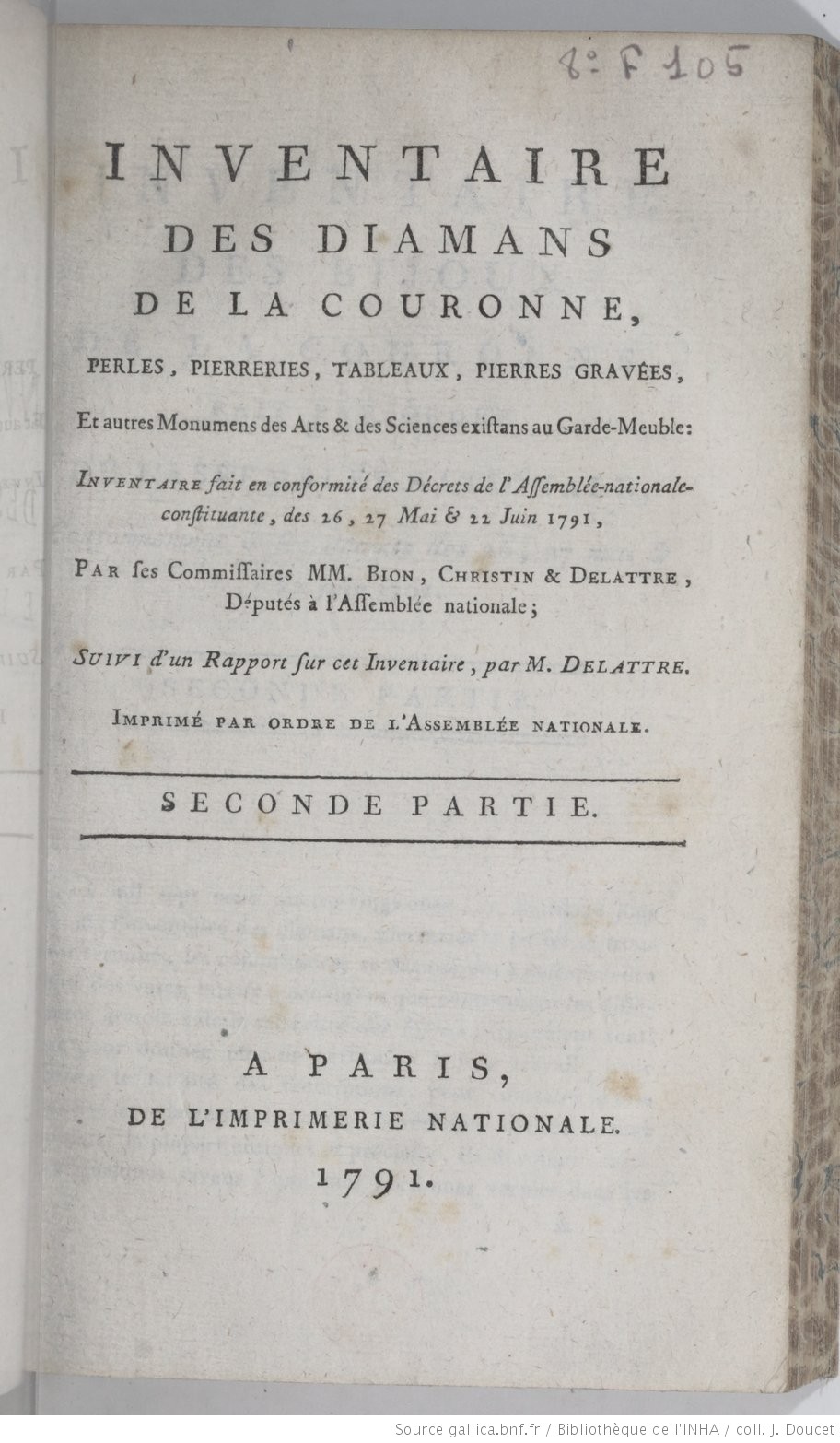
Inventaire des Diamans de la Couronne, Perles, Pierries, Tableaux, Pierres Gravées et autres Monumens des Arts & des Sciences existens au Garde-Meuble
Inventory of the Diamonds of the Crown, Pearls, Jewelry, Paintings, Engraved Stones, and other Monuments of the Arts & Sciences existing in the Garde-Meuble
Book
Bion, J.-M., Christin, C.-G.-F. and Delattre, F.-P. (1791) Inventaire des Diamans de la Couronne, Perles, Pierries, Tableaux, Pierres Gravées et autres Monumens des Arts & des Sciences existens au Garde-Meuble. [Inventory of the Diamonds of the Crown, Pearls, Jewelry, Paintings, Engraved Stones, and other Monuments of the Arts & Sciences existing in the Garde-Meuble] Paris, L’Assemblée Nationale, 272 pp.
Record No. 5223  |  Sinkankas/Born No.: NIS/NIB  |  Language: in French  |  RWHL
An official inventory of the French Crown’s diamonds, pearls, jewels, engraved stones, paintings and other objects preserved in the Garde-Meuble during the early years of the French Revolution. Compiled for the National Assembly by Jean-Marie Bion, Charles-Gabriel-Frédéric Christin and François-Pierre Delattre, the volume records the contents and valuations of the royal collections at a moment when Crown property was being documented as national property. Of particular gemological and jewelry-historical importance are the detailed listings of diamonds, pearls, mounted jewels and engraved gems, making the work a major primary source for the composition and value of the French Crown Jewels immediately before the famous theft from the Garde-Meuble in 1792.

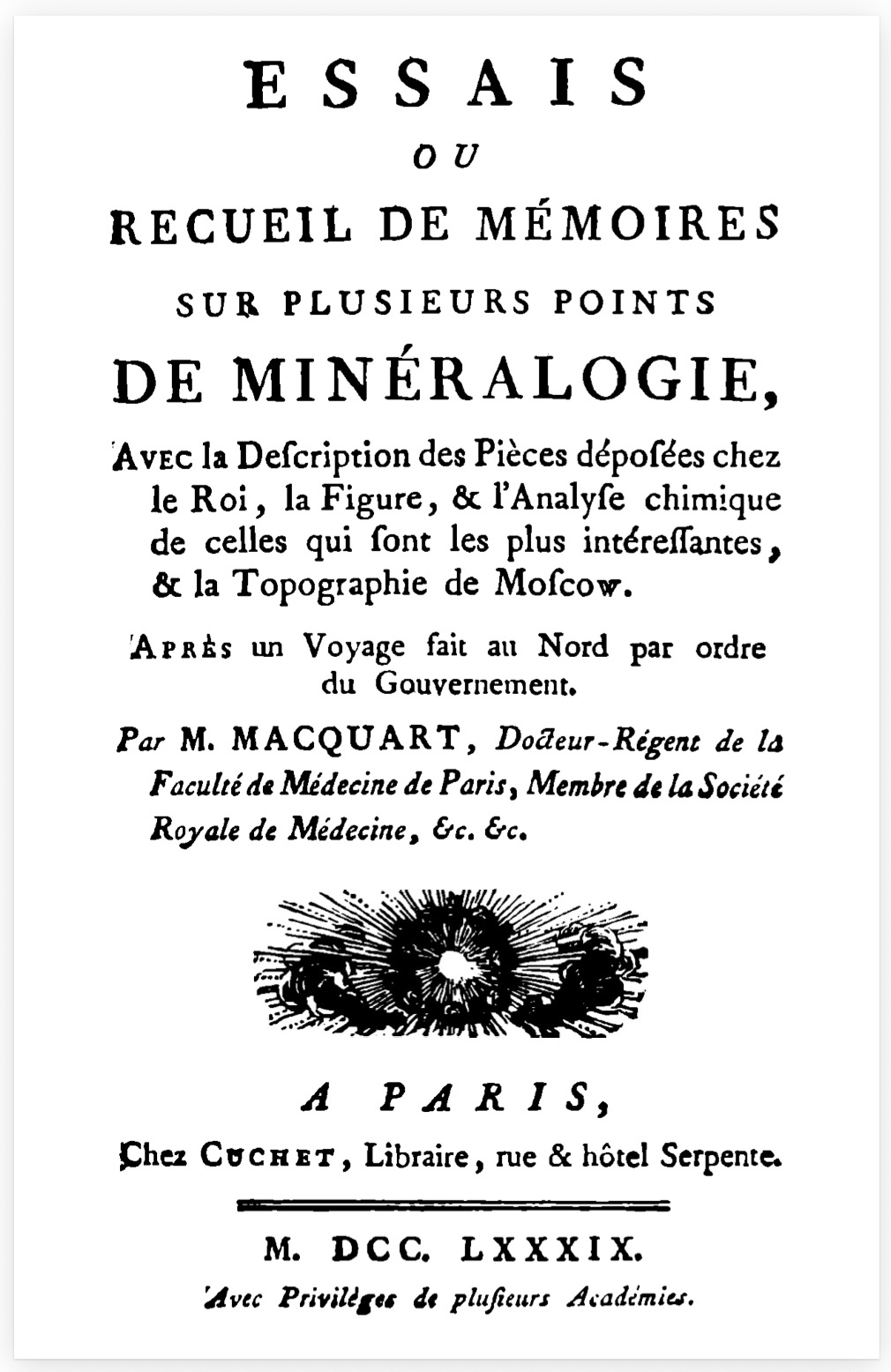
Essais ou Recueil de Memoires sur Plusiers Points de Mineralogie
Essays, or Collection of Memoirs on Various Topics in Mineralogy
Book
Macquart, L.C.H. (1789) Essais ou Recueil de Memoires sur Plusiers Points de Mineralogie. [Essays, or Collection of Memoirs on Various Topics in Mineralogy] Paris, Cuchet, 580 pp.
Record No. 29409  |  Sinkankas/Born No.: 4117  |  Language: in French  |  RWHL
Sinkankas: The work comprises eight memoirs based on the author’s travels in the Urals, Siberia, the Moscow region, and Poland. Of particular gemmological interest are accounts of chalcedony pseudomorphs after gypsum from near Cracow; visits to the Wieliczka and Siberian salt mines; and descriptions of minerals from several Siberian mining districts. The Beresov deposit is noted for its crocoite (“plomb rouge”), which the author analysed without recognising chromium, while the Gumeshevsk copper mine is mentioned for its large masses of malachite. The eighth memoir is especially important for its treatment of aquamarine and topaz from Adun Chilon in Transbaikalia and includes a catalogue of aquamarine and other mineral specimens. Further observations concern Siberian amethyst, including illustrated sceptre-growth crystals, as well as quartz, agate, jasper, and other ornamental stones. The work concludes with geographical observations on Moscow and its surroundings and descriptions and catalogues of Russian fossils.

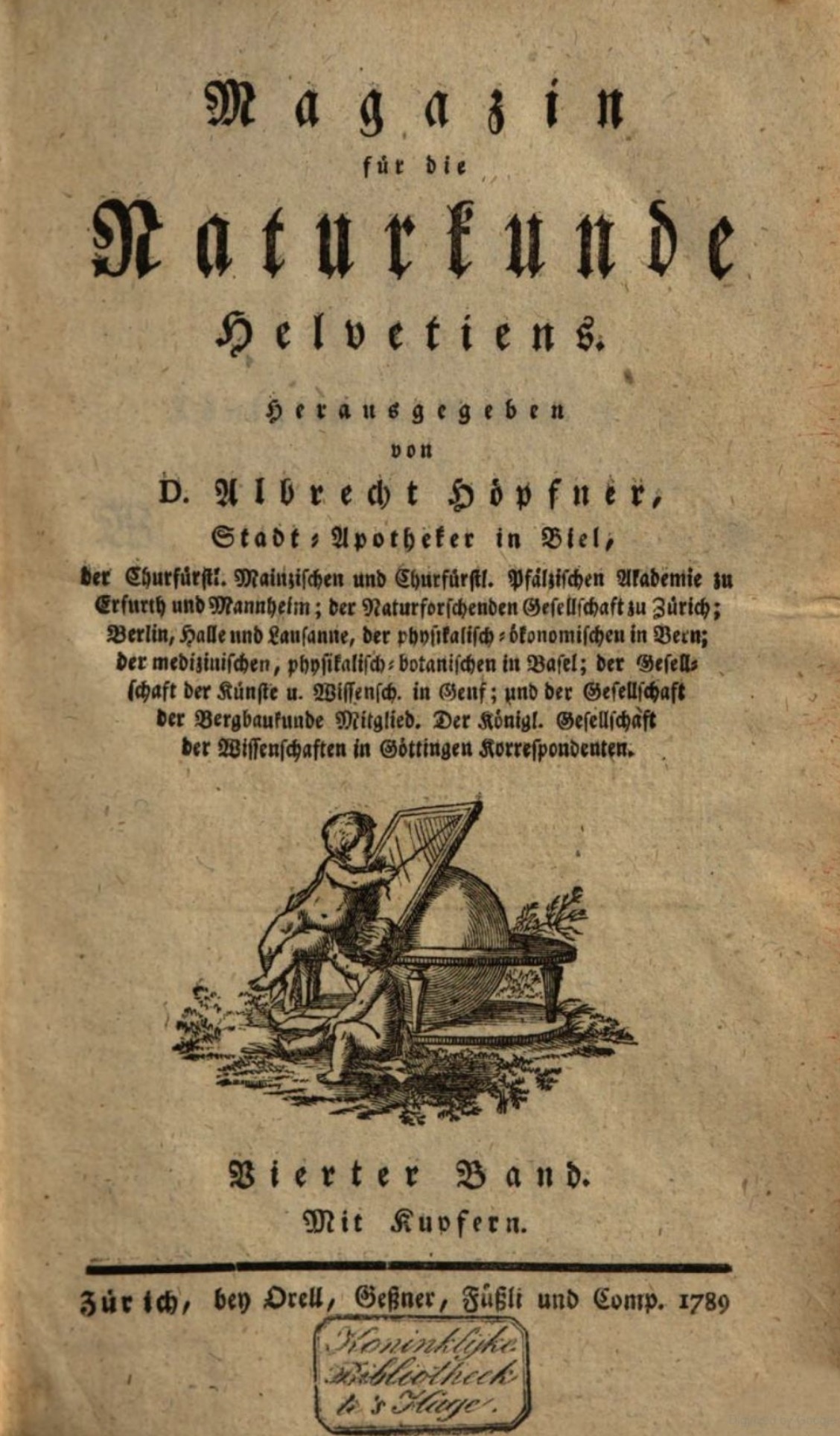
Ueber die Klassifikation der Fossilien in einem Schreiben des Herausgebers an Herrn Dr. Karsten in Halle
About the classification of fossils in a letter from the editor to Dr. Karsten in Halle
Journal Article
Höpfner, A. (1789) Ueber die Klassifikation der Fossilien in einem Schreiben des Herausgebers an Herrn Dr. Karsten in Halle. [About the classification of fossils in a letter from the editor to Dr. Karsten in Halle] Magazin für die Naturkunde Helvetiens [Magazine for the Natural History of Switzerland], Vol. 4, pp. 255–332.
Record No. 7336  |  Sinkankas/Born No.: NIS/NIB  |  Language: in German  |  RWHL
A substantial essay on the classification of minerals, written by Albrecht Höpfner in the form of a letter to the mineralogist Dietrich Ludwig Gustav Karsten. Using the eighteenth-century term “fossils” for substances dug from the earth, Höpfner discusses principles for arranging and distinguishing mineral species and engages with contemporary systems of mineral classification. The paper is useful for understanding the transition from older descriptive schemes toward more systematic mineralogy based on observable properties and chemical composition. For gemological history, it provides context for how precious stones and related mineral substances were being incorporated into broader mineralogical classification at the end of the eighteenth century.

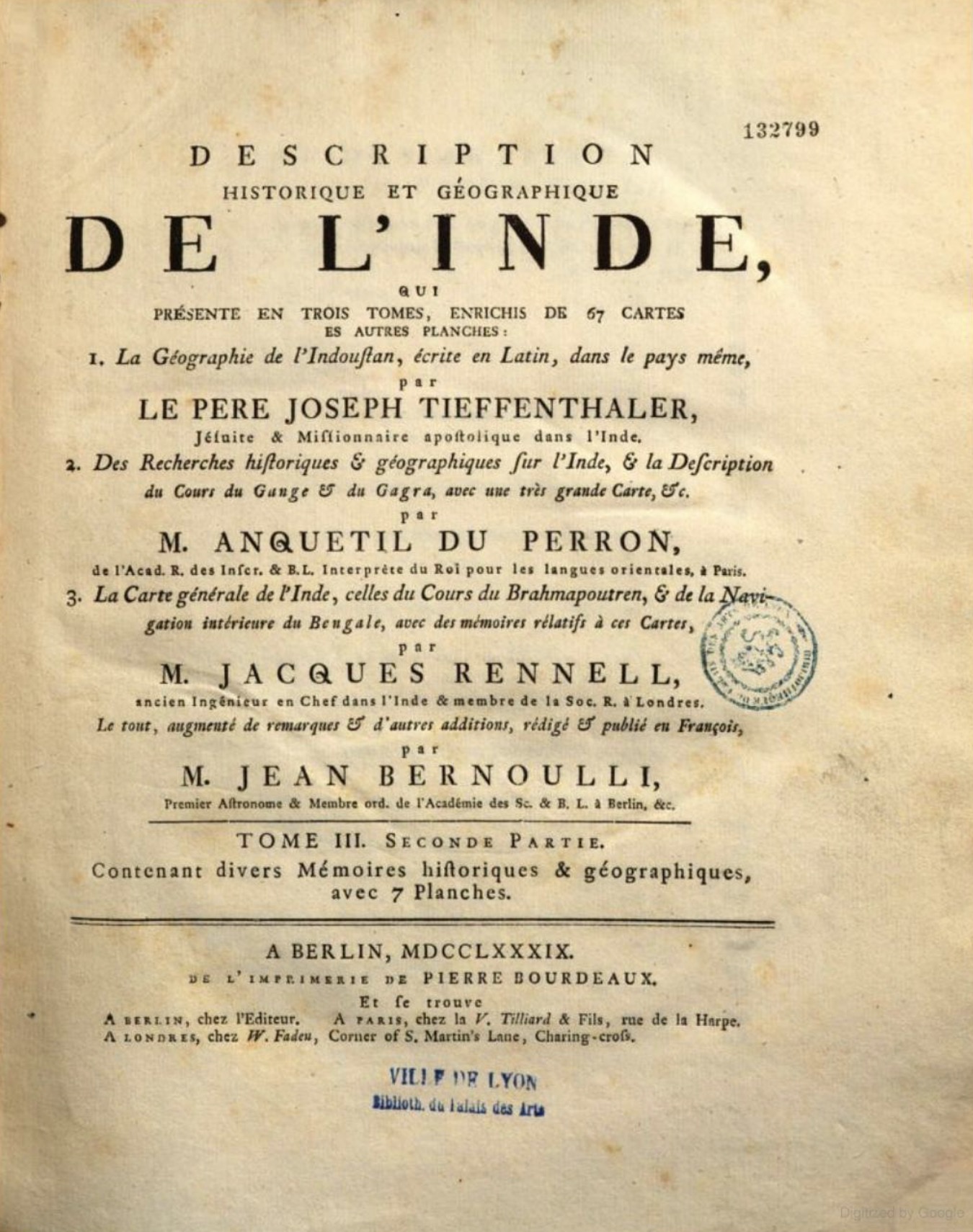
Description historique et géographique de l'Inde
Historical and Geographical Description of India
Book
Tiefenthaler, J. (1787) Description historique et géographique de l'Inde. [Historical and Geographical Description of India] Berlin, Pierre Bourdeaux, 259 pp.
Record No. 7081  |  Language: in French  |  RWHL
A geographical and historical account of India based on the extensive travels and observations of the Jesuit missionary Joseph Tiefenthaler, who spent several decades in the subcontinent. The work describes regions, cities, rivers, routes, political divisions, peoples, religions, customs, commerce and natural products, with particularly detailed geographical information on northern India and the Ganges basin. Tiefenthaler combined firsthand observation with information obtained from local informants and Indian and European sources. Of interest to gemological research are his notices of mineral resources, precious materials and regional trade. The work is an important eighteenth-century European source for the geography and natural and economic resources of India.

Gazetteer of the Yongchang Prefecture
永昌府志
Book
Xuan, S. (1785) Gazetteer of the Yongchang Prefecture. [永昌府志]
Record No. 16783  |  Sinkankas/Born No.: NIS/NIB  |  Language: in Chinese  |  RWHL
A local gazetteer of Yongchang Prefecture (永昌府), in western Yunnan, an important region on the routes connecting China with Burma and Southeast Asia. The work records the prefecture’s administrative geography, history, settlements, mountains and rivers, population, customs, products and other local information. Of particular gemological interest are its notices concerning jade and other valuable materials associated with the Yunnan–Burma trade, for which Yongchang was an important commercial and administrative center. The gazetteer is consequently a useful Qing-period source for studying the movement of Burmese jade and other commodities into southwestern China. Sun Laichen: Volumes 23, 25, and 26 of the 1785 edition by Xuan Shitao contain several memorials from Ming and Qing times that touch upon Ming- and Qing-Burmese relations, a number of poems and records by Ming poets regarding Burmese precious stones and other products, and a short account of a Burmese letter to the Ming during the late 16th century. Volumes 65 and 66 of the 1884 edition by Liu Yuke includes several other poems on Ming- and Qing-Burmese relations. There are altogether four editions of this work, and I have so far gained access to only the two mentioned above. The other two were compiled in 1702 and 1826, respectively.

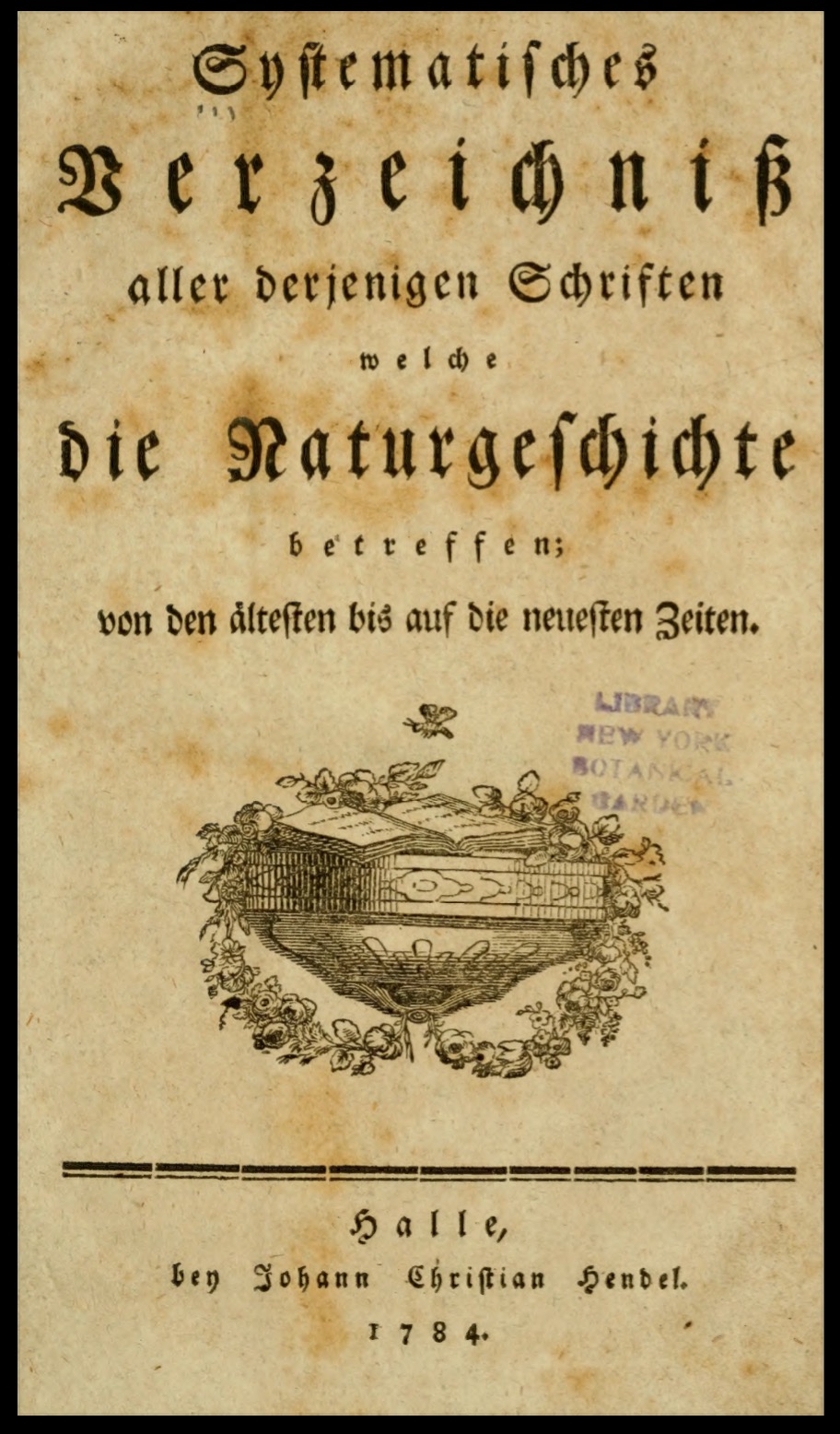
Verzeichniss, systematisches, aller deijenigen Schriften, welche die Naturgeschichte betreffen
A Systematic Catalog of all those Writings that Concern Natural History
Book
Anonymous (1784) Verzeichniss, systematisches, aller deijenigen Schriften, welche die Naturgeschichte betreffen. [A Systematic Catalog of all those Writings that Concern Natural History] Halle, Johann Christian Hendel, 446 pp.
Record No. 8071  |  Sinkankas/Born No.: NIS/NIB  |  Language: in German  |  RWHL
An anonymous systematic bibliography of writings on natural history, published at Halle in 1784. The work organizes the contemporary and earlier literature of the natural sciences by subject, providing references to books and other publications concerned with the natural world. Its coverage includes mineralogy and related literature on minerals, stones and precious stones, making it useful for identifying works available to eighteenth-century naturalists and tracing the bibliography of early gemological and mineralogical studies. As a subject-arranged bibliography rather than a natural-history treatise itself, its principal value lies in documenting the literature and development of the natural sciences up to the time of its publication.

Specimen Arabicum: Continens Descriptionem et Excerpta Libri Achmedis Teifaschii de Gemmis et Lapidibus Pretiosis
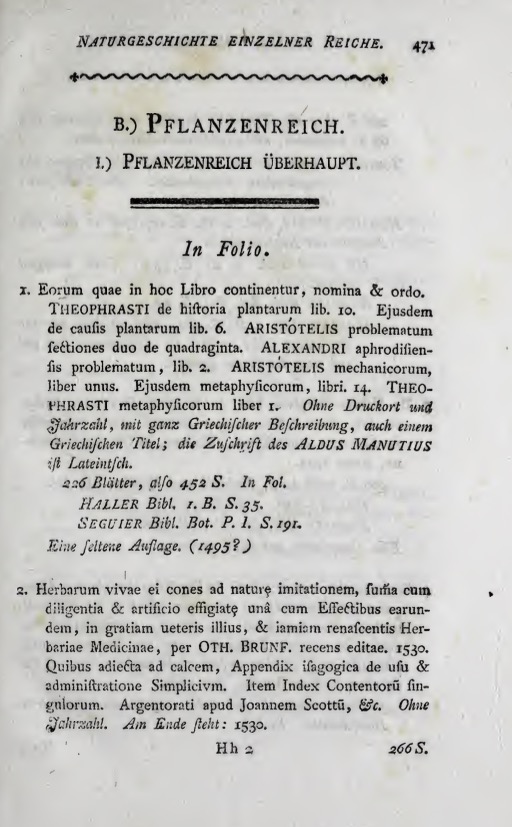
Arabic Specimen: Containing a Description and Excerpts from the Book of Ahmed Teifaschi on Gems and Precious Stones
Book
al-Tīfāshī, A.i.Y.i.I. (1784) Specimen Arabicum: Continens Descriptionem et Excerpta Libri Achmedis Teifaschii de Gemmis et Lapidibus Pretiosis. [Arabic Specimen: Containing a Description and Excerpts from the Book of Ahmed Teifaschi on Gems and Precious Stones] Utrecht, Academiae Typographum, 103 pp.
Record No. 6846  |  Sinkankas/Born No.: 6556; NIB  |  Language: in Latin  |  RWHL
A Latin scholarly edition presenting a description of, and selected extracts from, the Arabic gemstone treatise of Aḥmad al-Tīfāshī (Teifaschi), the thirteenth-century author of one of the most important medieval works on precious stones. The volume introduces al-Tīfāshī’s text to European readers and reproduces passages dealing with individual gems and precious materials, their names, properties, sources, qualities and uses. It is of particular importance to the history of gemology as an early printed European engagement with the Arabic lapidary tradition and as a conduit through which medieval Islamic knowledge of gemstones entered eighteenth-century Orientalist scholarship.

Deliciae Cobresianiae: Büchersammlung zur Naturgeschichte
Delights of Cobresiana: Book Collection on Natural History
Book
Cobres, J.P. (1782) Deliciae Cobresianiae: Büchersammlung zur Naturgeschichte. [Delights of Cobresiana: Book Collection on Natural History] Augsburg, Kosten des Verfassers, 2 Vols., 957 pp.
Record No. 8070  |  Sinkankas/Born No.: NIS/NIB  |  Language: in German  |  RWHL
A large bibliographical catalogue of the natural-history library assembled by the Augsburg merchant and collector Johann Paul Cobres. Deliciae Cobresianae records books and other printed works relating to natural history, including zoology, botany, mineralogy, geology, chemistry and related subjects, often with bibliographical notes and references useful for identifying earlier literature. For gemological research, it is particularly valuable as an eighteenth-century guide to books on minerals, precious stones, lapidary subjects and related branches of natural history. The work provides an important snapshot of the scientific literature available to a well-informed private collector in the late eighteenth century and remains useful for tracing rare or obscure early works.

ΠΕΡΙ ΛΙΘΩΝ. De Lapidus, Poema Orpheo a a quibusdam adscriptum, Græce et latine, ex editione Jo. Matthiæ Gesneri. Recensuit notasque adjecit Thomas Tyrwhitt. Simul prodit Auctarium dissertationes de Babrio
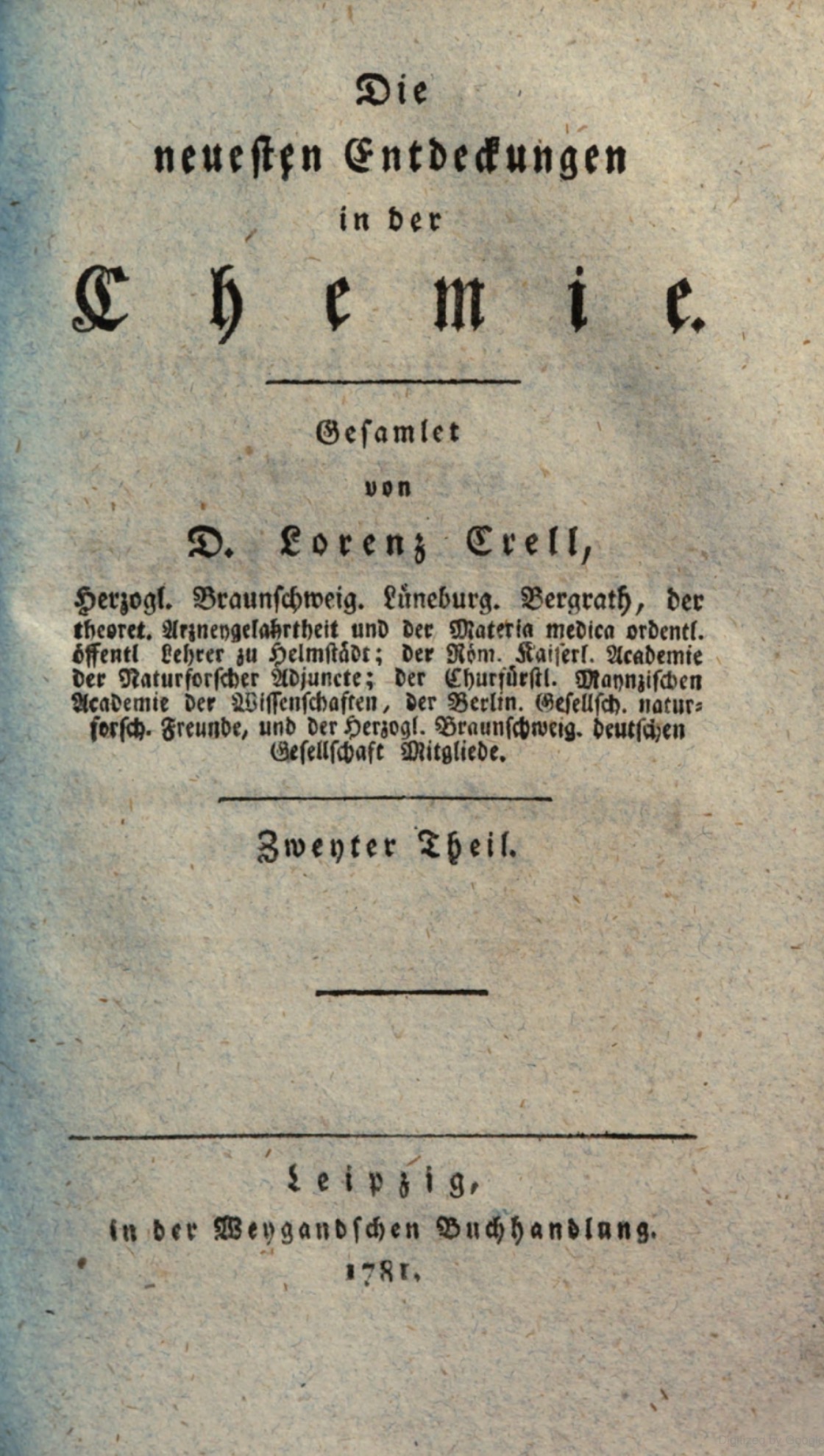
On Stones. De Lapidibus, a poem attributed to Orpheus by some, in Greek and Latin, from the edition of Johann Matthias Gesner. Edited and with notes added by Thomas Tyrwhitt. Published together with a supplement to the dissertation on Babrius.
Edited Book
Orpheus and Tyrwhitt, T., editor (1781) ΠΕΡΙ ΛΙΘΩΝ. De Lapidus, Poema Orpheo a a quibusdam adscriptum, Græce et latine, ex editione Jo. Matthiæ Gesneri. Recensuit notasque adjecit Thomas Tyrwhitt. Simul prodit Auctarium dissertationes de Babrio. [On Stones. De Lapidibus, a poem attributed to Orpheus by some, in Greek and Latin, from the edition of Johann Matthias Gesner. Edited and with notes added by Thomas Tyrwhitt. Published together with a supplement to the dissertation on Babrius.]. London, J. Nichols, 55 pp..
Record No. 27916  |  Sinkankas/Born No.: 4893  |  Language: in Latin and Greek  |  RWHL
Sinkankas: Text in Greek and Latin. Recto: Περί Λίθων or De lapidibus appears on f.65–30 verso. According to Thorndike (ibid., p. 294), “the Lithica, representing Hermes, opens by bestowing upon mankind the precious lore of the marvelous virtues of gems… After this introduction… the virtues of the individual stones are described, first in the words of Theodamas, a wise and divine man whom the author meets on his way to perform annual sacrifice at an altar of the Sun… The virtues of a number of gems are attributed to Apollo rather than Hermes; and there are allusions to Greek mythology and the Trojan War. Some gems are found in animals, for instance, in the viper or the brain of the stag.” Thorndike then examines some of the stones and the magical powers attributed to them (pp. 294–297). He also notes Abel’s reproduction of the Greek text (see below), and the translation by C. W. King in The Natural History, Ancient and Modern, of Precious Stones and of Precious Metals, 1865, which he considers to be “a rather too free English verse translation.” See also Adams, The Birth and Development of the Geological Sciences, pp. 28–32; British Museum, Italian Books, p. 457; Brunet 3:1957; Dibdin, Greek and Latin Classics, 2:239; STC, Class. See also the comments of F. D. Thomas Tyrwhitt was of the opinion that the original manuscript was composed before Constantine (306 AD) and not long after 364 AD.

Neue Entdeckungen der Chemie

New Discoveries in Chemistry
Book
Crell, L. (1781) Neue Entdeckungen der Chemie. [New Discoveries in Chemistry] Leipzig, Weygandschen Buchhandlun, 284 pp. (see pp. 42–44)
Record No. 6894  |  Language: in German  |  RWHL
A volume of Lorenz Crell’s influential chemical periodical devoted to reporting recent discoveries and experimental investigations in chemistry. Of particular gemological interest is section III (pp. 42–44), which discusses the so-called Rice Stone from China and investigates its constituent materials. The substance is described as an artificially formed mass rather than a natural stone and refers to the material later known as pâte de riz, used in China to imitate nephrite. The account is an early European chemical discussion of an artificial jade imitation and is therefore of particular interest to the history of gem materials, simulants and their identification.

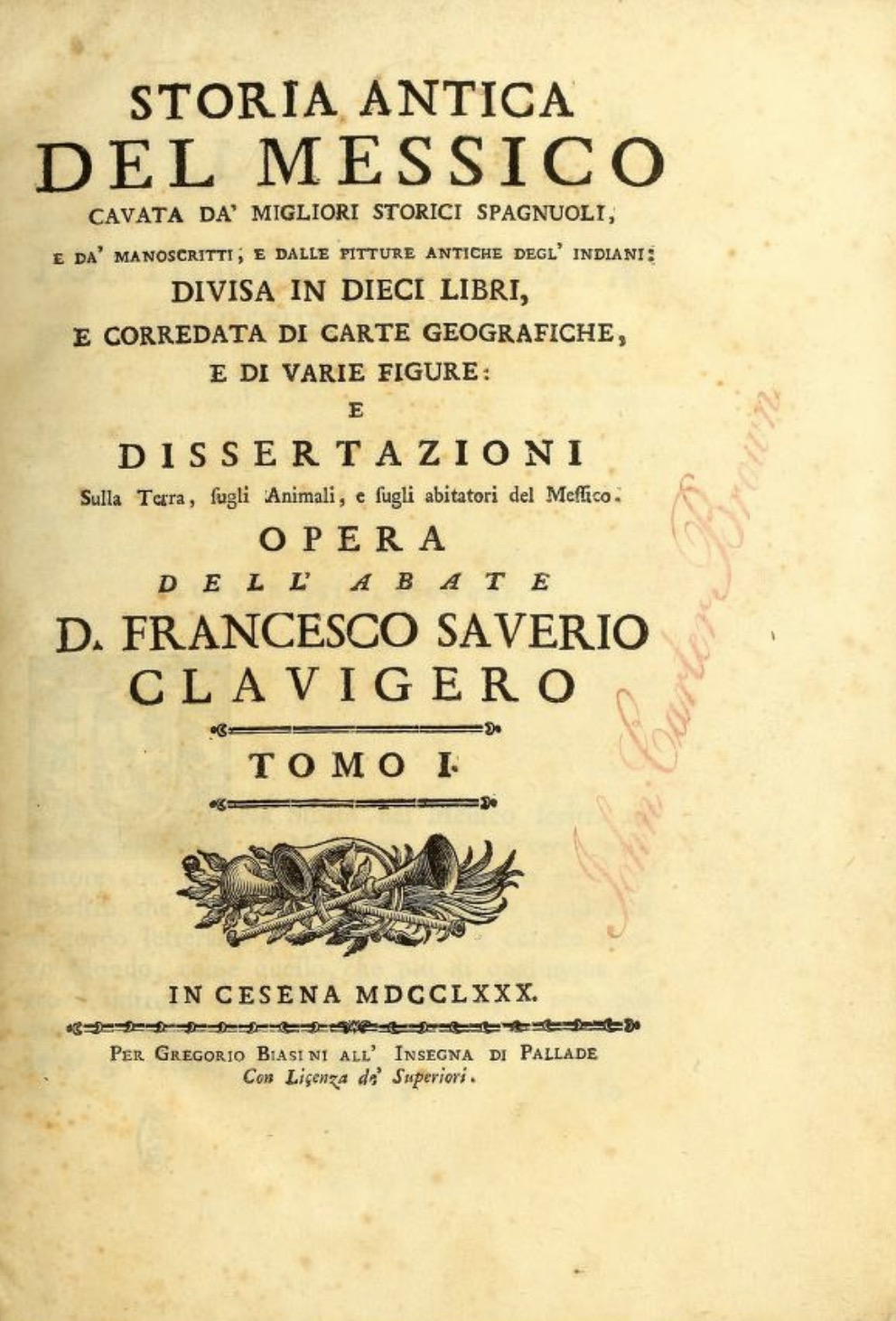
Storia antica del Messico, cavata da’ migliori storici spagnuoli

Ancient History of Mexico, Extracted from the Best Spanish Historians
Book
Clavigero, F.S. (1780) Storia antica del Messico, cavata da’ migliori storici spagnuoli. [Ancient History of Mexico, Extracted from the Best Spanish Historians] Cesna, 276 pp. (nephrite, see Vol. 1, p. 43
Record No. 6893  |  Sinkankas/Born No.: NIS/NIB  |  Language: in Latin  |  RWHL
A history of ancient Mexico by the Jesuit scholar Francisco Saverio Clavigero (Francisco Javier Clavijero), written during his exile in Italy and based on Indigenous traditions, manuscripts and earlier Spanish accounts. The work describes the geography and natural history of Mexico, its peoples, government, religion, calendar, arts, agriculture, commerce and material culture before and during the Spanish conquest. Of gemological interest are Clavigero’s descriptions of Mexican stones and minerals and the use of valuable greenstones for ornaments and other objects. The work is particularly valuable for its systematic treatment of pre-Hispanic Mexican civilization and for Clavigero’s efforts to correct what he considered errors and prejudices in earlier European accounts.

Building a Gemological Library

Gemological books range from general identification manuals and textbooks to specialized works on individual gems, mineralogy, jewelry, treatments, synthesis, history and gem-producing regions.

For a curated selection of particularly useful books, read The Gemologist's Core Library — Classic Books on Gemology, Jewelry and Mineralogy.

About Four Treasures

Four Treasures is Lotus Gemology's freely accessible gemological reference database. Use the full database to search by author, title or keyword and explore literature on gemology, mineralogy, jewelry and related fields. Where available, hyperlinks on titles may lead directly to the full publication.

Search the Complete Four Treasures Database