Gemology Books Bibliography

Gemology Books Bibliography

Explore books on gems, gemology, jewelry and mineralogy in Four Treasures, the Lotus Gemology reference database. This bibliography brings together matching book records from the collection, with publication details, abstracts and cover images where available.

Gemology Book References

The list below matches books concerning gemology and related subjects in the database's searchable fields. Some works cover several branches of gems, jewelry or mineralogy.
3,001–3,020 of 3,451 matching references

Chemische Untersuchung des chinesischen Reissteins
II. Chemical Examination of Chinese Rice Stone
Book Section
Klaproth, M.H. (1815) Chemische Untersuchung des chinesischen Reissteins. [II. Chemical Examination of Chinese Rice Stone] In: Beiträge zur chemischen Kenntniss der Mineralkörper, Berlin: Nicolaischen Buchhandlung, Vol. 6 , pp. 15–20.
Record No. 29304  |  Sinkankas/Born No.: NIS/NIB  |  Language: in German  |  RWHL
An early chemical investigation by Martin Heinrich Klaproth of the Chinese material known as “rice stone” (Reisstein), an artificial stone used in imitation of jade. Klaproth analyzes the substance in order to determine its composition and establish that it is a manufactured material rather than a natural mineral. The paper is of particular interest to the history of gemology because it documents an early European chemical examination of a Chinese jade simulant and illustrates the growing use of analytical chemistry to distinguish natural gemstones from artificial substitutes.

A Voyage to Abysinnia

Book
Salt, H. (1814) A Voyage to Abysinnia. London, F.C. and J. Rivington, 506, lxxv pp.
Record No. 27321  |  Sinkankas/Born No.: NIS/NIB  |  RWHL
A voyage to Abyssinia, and travels into the interior of that country, executed under the orders of the British government, in the years 1809 and 1810; in which are included, an account of the Portugese settlements on the east coast of Africa, visited in the course of the voyage; and a concise narrative of late events in Arabia Felix. And some particulars respecting the aboriginal African tribes, extending from Mosambique to the borders of Egypt; together with vocabularies of their respective languages / Illustrated with a map of Abyssinia, numerous engravings, and charts.

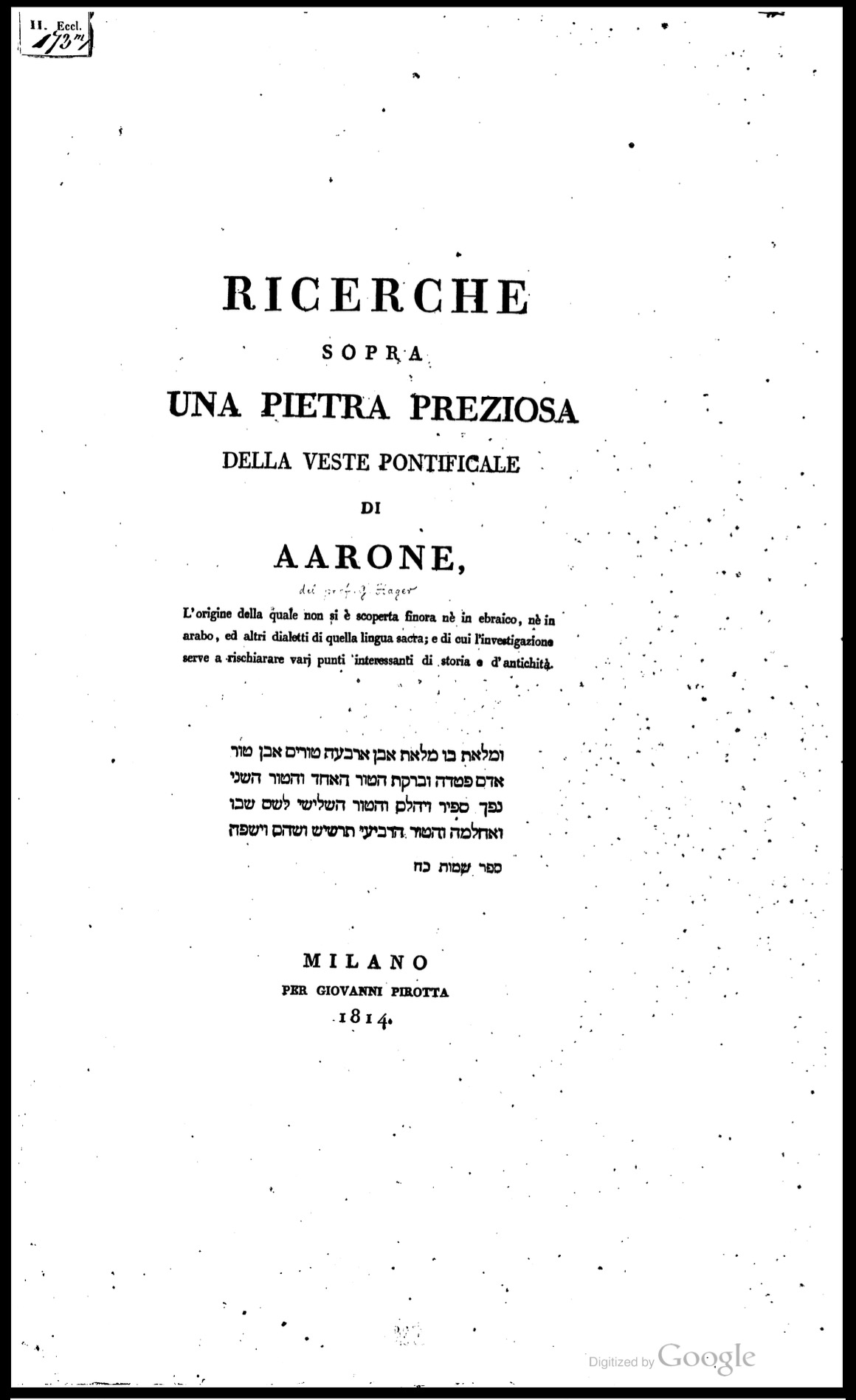
Ricerche sopra una pietra preziosa della vêste pontificale di Aarone
Research on a precious stone from Aaron's pontifical robe
Book
Hager, J. (1814) Ricerche sopra una pietra preziosa della vêste pontificale di Aarone. [Research on a precious stone from Aaron's pontifical robe] Milano, Giovanni Pirotta, 65 pp.
Record No. 6918  |  Sinkankas/Born No.: NIS/NIB  |  Language: in Italian  |  RWHL
A short antiquarian study by Joseph Hager devoted to identifying one of the precious stones named among the twelve gems of the breastplate of Aaron described in the Hebrew Bible. Hager examines ancient names and descriptions of the stone through biblical, classical and Oriental sources, comparing linguistic evidence with contemporary knowledge of gemstones in an attempt to establish its identity. The work illustrates the close relationship between philology, biblical scholarship and mineralogy in early nineteenth-century investigations of ancient gem names. It is of particular interest to the history of gemology for its treatment of the persistent problem of correlating ancient lapidary terminology with modern mineral species.

Voyage aux Iles de Trinidad, de Tabago, de la Marguerite, et dans Diverses Parties de Vénézuéla, dans l’Amérique Méridionale
Travel to the Islands of Trinidad, Tabago, Marguerite, and Various Parts of Venezuela, South America
Book
Lavaysse, J.J.D. (1813) Voyage aux Iles de Trinidad, de Tabago, de la Marguerite, et dans Diverses Parties de Vénézuéla, dans l’Amérique Méridionale. [Travel to the Islands of Trinidad, Tabago, Marguerite, and Various Parts of Venezuela, South America] Paris, F. Schoëll, Vol. 1 , 414 pp.
Record No. 8162  |  Sinkankas/Born No.: NIS/NIB  |  Language: in French  |  RWHL
A travel account by Jean-Joseph Dauxion Lavaysse describing Trinidad, Tobago, Margarita and parts of Venezuela based on his experiences in the Caribbean and northern South America. The work combines travel narrative with observations on geography, population, colonial society, agriculture, commerce, natural history and regional resources. Lavaysse discusses the economic products and physical character of the territories he visited and provides a useful early nineteenth-century European account of Venezuela and the neighboring islands during a period of major political and commercial change. For gemological research, its relevance is secondary, chiefly through notices of local natural resources and mineral wealth rather than any sustained treatment of gemstones.

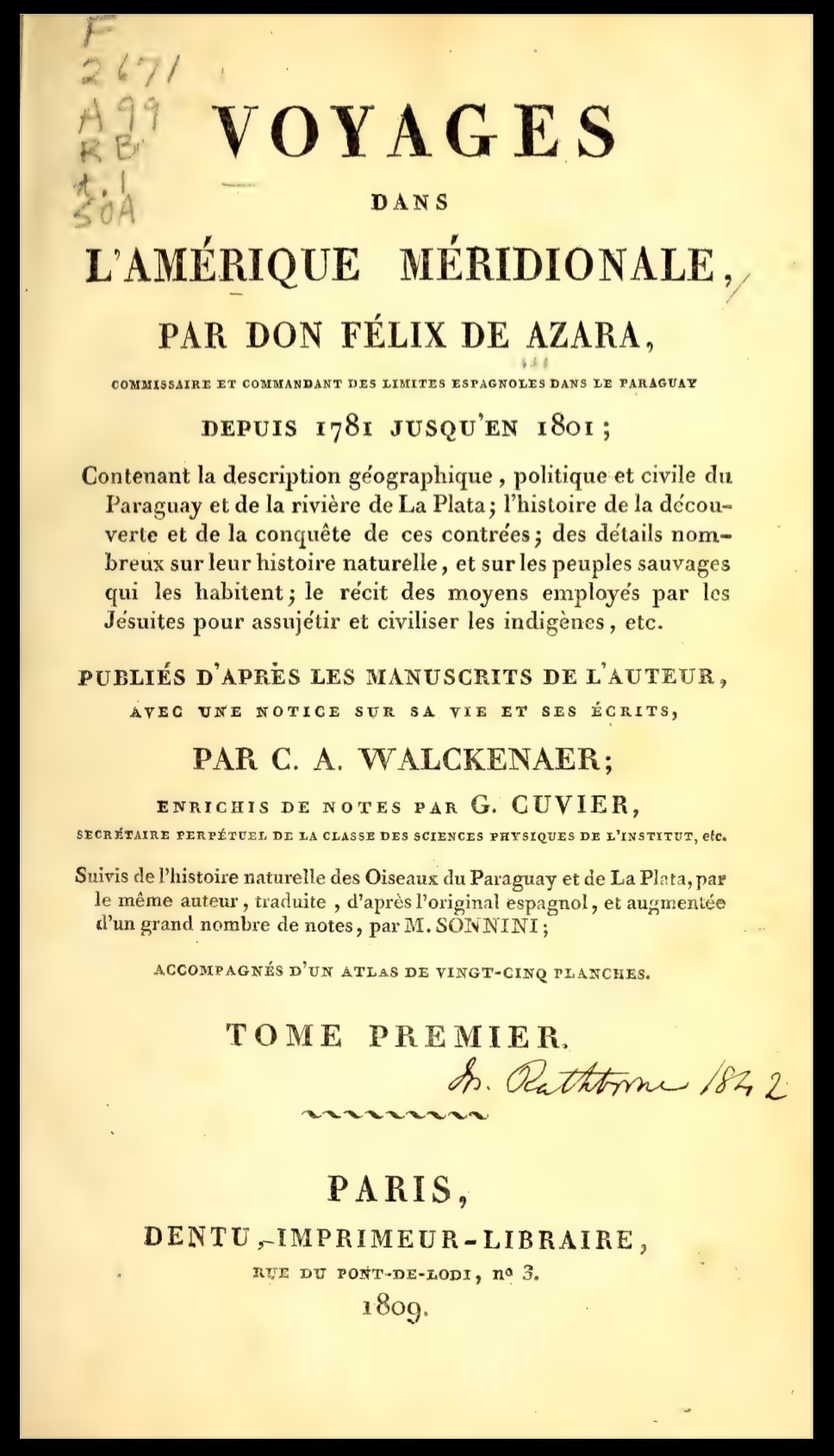
Voyages dans l’Amérique Méridionale par Don Félix de Azara
Travels to South America by Don Félix de Azara
Book
Azara, D.F., de (1809) Voyages dans l’Amérique Méridionale par Don Félix de Azara. [Travels to South America by Don Félix de Azara] Paris, Dentu, 4 Vols.
Record No. 7979  |  Sinkankas/Born No.: NIS/NIB  |  Language: in French  |  RWHL
A French edition of the travels and observations of the Spanish naturalist and military officer Félix de Azara, based on his long residence in the Río de la Plata and Paraguay region of South America. The work describes the geography, rivers, settlements, peoples, animals, plants and natural resources of the territories he visited, combining travel narrative with detailed natural-history observations. Azara’s firsthand accounts were particularly important for European knowledge of Paraguay, Argentina and neighboring regions at the beginning of the nineteenth century. For gemological and mineralogical research, the work is of secondary interest for its notices of regional natural resources and materials rather than as a specialized study of gemstones.

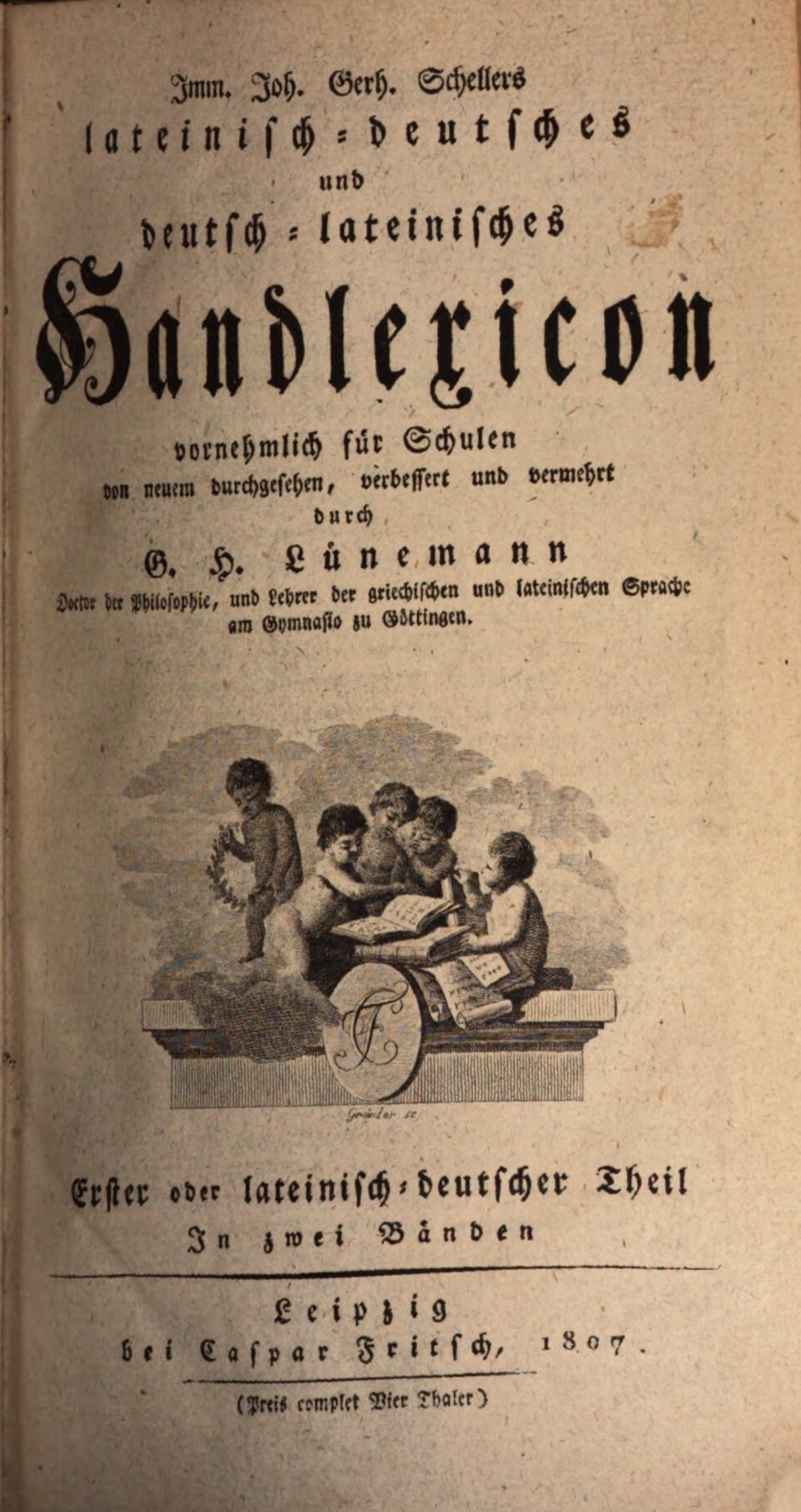
Imm. Joh. Gerh. Schellers lateinisch-deutsches und deutsch-lateinisches Handlexicon
Imm. Joh. Gerh. Scheller's Latin-German and German-Latin Handlexicon
Book
Scheller-Lünemann, I.J.G. (1807) Imm. Joh. Gerh. Schellers lateinisch-deutsches und deutsch-lateinisches Handlexicon. [Imm. Joh. Gerh. Scheller's Latin-German and German-Latin Handlexicon] Leipzig, Caspar Fritsch, 1728 pp.
Record No. 16349  |  Sinkankas/Born No.: NIS/NIB  |  Language: in German  |  RWHL
A large bilingual Latin–German and German–Latin dictionary based on the lexicographical work of Immanuel Johann Gerhard Scheller and prepared in this edition by I. J. G. Scheller-Lünemann. The Handlexicon provides Latin vocabulary with German equivalents and German terms with their Latin counterparts, including terminology drawn from classical literature, natural history and the sciences. For gemological research, it is useful for interpreting historical Latin names for gemstones, minerals, metals and related materials and for establishing how such terms were understood and translated by German scholars in the early nineteenth century. Its principal value is therefore linguistic and terminological rather than mineralogical.

A Description of Ceylon, Containing an Account of the Country, Inhabitants, and Natural Productions
Book
Cordiner, J. (1807) A Description of Ceylon, Containing an Account of the Country, Inhabitants, and Natural Productions. Aberdeen, Longman, Hurst, Rees and Orme, 2 Vols., Vol. 1, pp. 14–15 (gems); Vol. 2, pp. 35–78 (pearls)
Record No. 7390  |  Sinkankas/Born No.: NIS/NIB  |  RWHL
A two-volume account of Ceylon (Sri Lanka) by the British chaplain James Cordiner, describing the island’s geography, inhabitants, customs, economy and natural productions during the early period of British rule. Of gemological interest, Cordiner briefly discusses the island’s precious stones (Vol. 1, pp. 14–15), reflecting Ceylon’s longstanding reputation as a source of gems. A much more extensive section is devoted to the pearl fishery of the Gulf of Mannar (Vol. 2, pp. 35–78), describing the pearl banks, oysters, fishing grounds, diving, organization of the fishery and its economic importance. The work provides a valuable contemporary account of both gemstones and the natural-pearl industry of early nineteenth-century Ceylon.

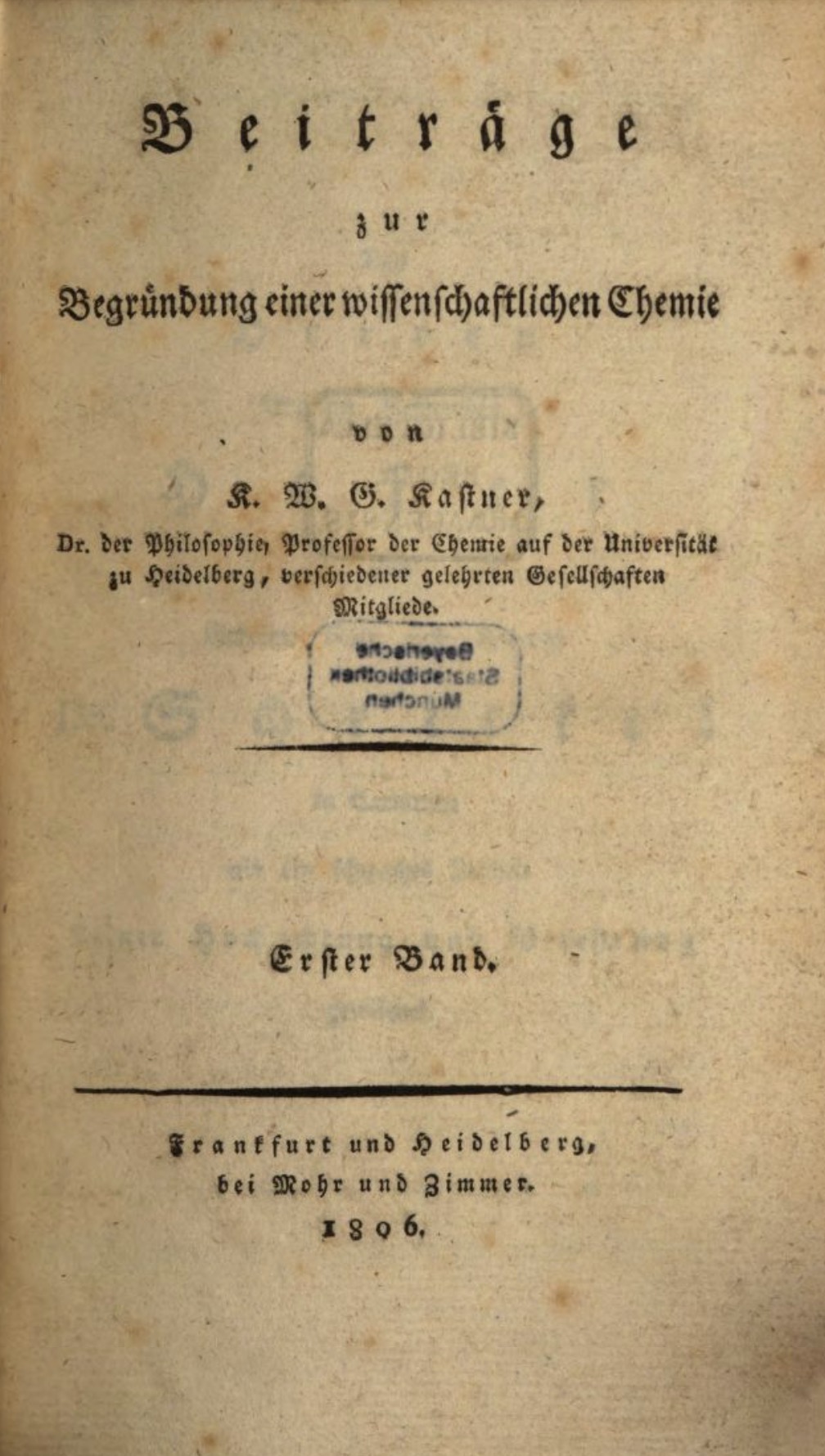
Beiträge zur Begründung einer wissenschaftlichen Chemie
Contributions to the Foundation of a Scientific Chemistry
Book
Kastner, K.W.G. (1806–1807) Beiträge zur Begründung einer wissenschaftlichen Chemie. [Contributions to the Foundation of a Scientific Chemistry] Heidelberg, 2 Vols.
Record No. 14346  |  Language: in German  |  RWHL
A work by the German chemist Karl Wilhelm Gottlob Kastner concerned with establishing chemistry on a systematic scientific basis. Kastner discusses chemical principles, substances and analytical methods within the rapidly developing framework of early nineteenth-century chemistry, including their application to mineral substances. Of interest to mineralogical and gemological history is the use of chemical analysis to characterize minerals and distinguish substances that could not reliably be separated by external appearance alone. The work reflects the period in which chemistry was becoming fundamental to mineral classification and provides context for Kastner’s contemporary investigations of mineral materials, including jade.

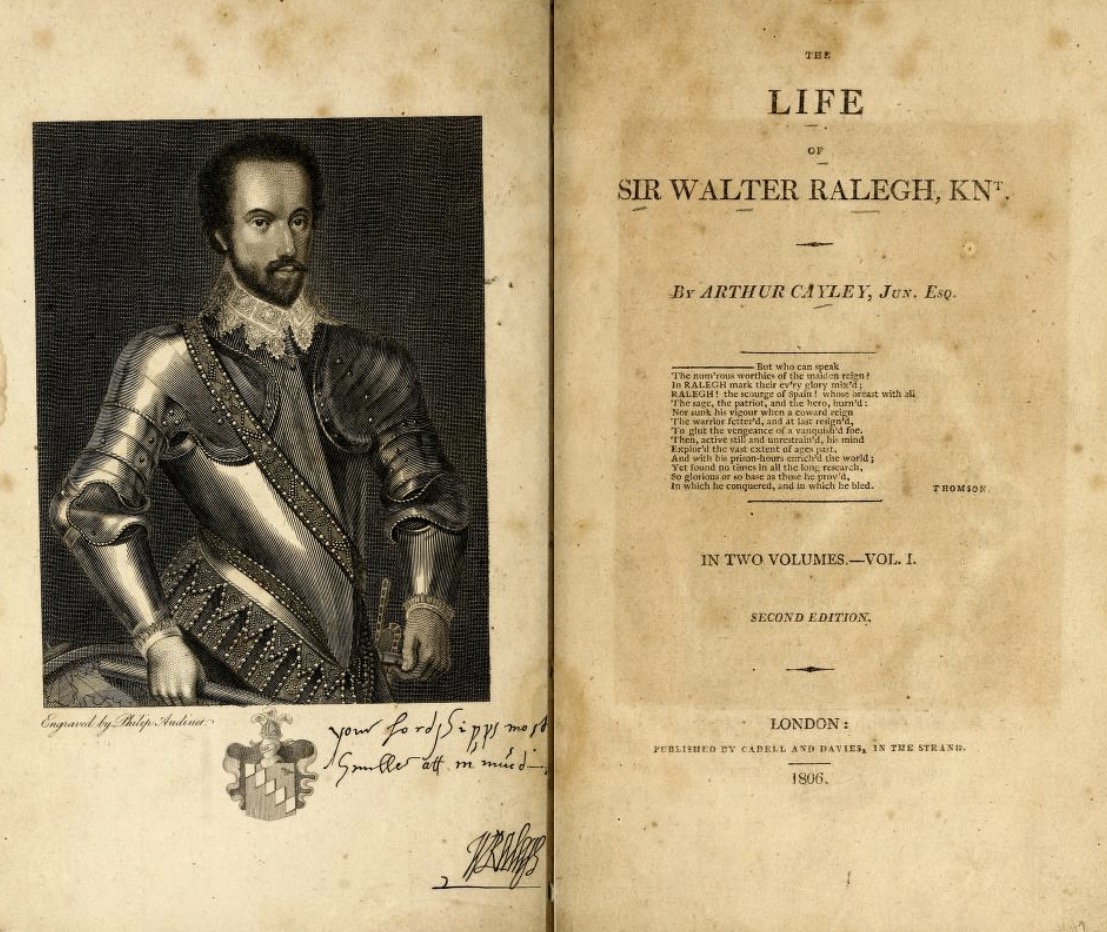
The Life of Sir Walter Raleigh

Book
Cayley, A. (1805) The Life of Sir Walter Raleigh. London, Cadell and Davies, 2 Vols., 320, 218 pp. + appendix
Record No. 16707  |  Sinkankas/Born No.: NIS/NIB  |  RWHL
A two-volume biography of Sir Walter Raleigh by Arthur Cayley, tracing Raleigh’s career as courtier, soldier, explorer, colonial promoter and writer during the reigns of Elizabeth I and James I. Drawing on historical documents and earlier accounts, Cayley describes Raleigh’s involvement in English ventures in the Americas, his political career, imprisonment and final expedition to Guiana. Of particular interest to gemological and mining history are the accounts of Guiana and Raleigh’s search for mineral wealth, including reports and expectations of gold and other valuable natural resources associated with the legendary riches of the region. The work is useful as an early nineteenth-century compilation of sources concerning Raleigh and English exploration of northern South America.

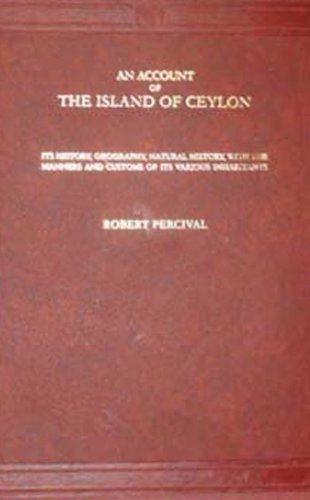
An Account of the Island of Ceylon

Book
Percival, R. (1803) An Account of the Island of Ceylon. London, C. and R. Baldwin, pp. 59–80 (pearls); pp. 352–360 (minerals)
Record No. 2844  |  Sinkankas/Born No.: NIS/NIB  |  RWHL
An early nineteenth-century account of Ceylon (Sri Lanka) by Robert Percival, describing the island’s geography, inhabitants, economy, natural resources and colonial administration. Of particular gemological interest are his detailed remarks on the pearl fisheries (pp. 59–80), including the Gulf of Mannar fishery, its organization, diving and commercial importance, and his discussion of the island’s minerals and precious stones (pp. 352–360). The work is a useful contemporary source for the natural resources and gem-related industries of Ceylon at the beginning of British rule.

An analysis of a variety of the corundum [from Thibet]
from Thibet
Journal Article
Gregor, W. (1803) An analysis of a variety of the corundum [from Thibet]. Nicholson’s Journal, Vol. 4, April, pp. 209–214.
Record No. 844  |  Sinkankas/Born No.: NIS/NIB  |  RWHL
An early chemical analysis by William Gregor of a variety of corundum from Tibet. Gregor examines the material to determine its composition and compare it with other forms of corundum then under study in Europe. The paper belongs to the period when chemical analysis was being used increasingly to establish the identity and relationships of hard minerals that had previously been distinguished mainly by appearance and locality. It is particularly relevant to the history of gemology because it contributed to the chemical characterization of corundum and to the broader effort to understand the relationship between massive corundum and its gem varieties, ruby and sapphire.

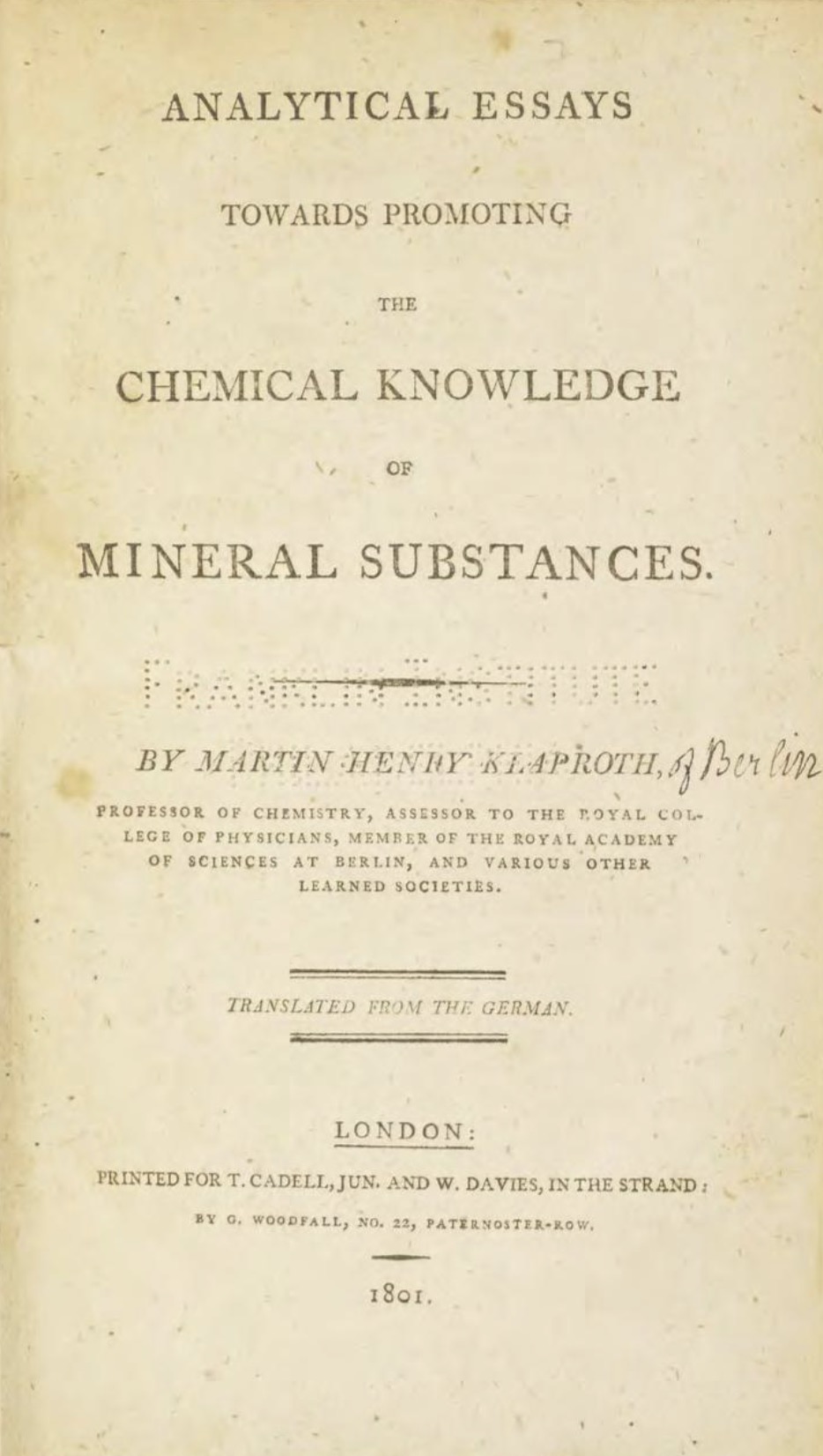
Chemical examination of the circon, or jargon of Ceylon; Chemical examination of hyacinth
Book Section
Klaproth, M.H. (1801–1804) Chemical examination of the circon, or jargon of Ceylon; Chemical examination of hyacinth. In: Analytical Essays Towards Promoting the Chemical Knowledge of Mineral Substances, London: Cadell, Jun and W. Davies, Vol. 1 , pp. 175–199.
Record No. 28354  |  Sinkankas/Born No.: NIS/NIB  |  RWHL
Among the precious stones coming from Sri Lanka, there occurs a particular genus, hitherto little noticed, which is distinguished from other gems by the following characters. Its colour consists of various shades of pale yellowish green and a dull hue inclining altogether toward smoky grey. Externally, a greasy lustre is observed, and it feels rough when uncut. The size of the individual stones is inconsiderable; commonly twenty or thirty of them weigh only one drachm. The form of their crystals is a rectangular four-sided prism (parallelepipedon), terminated by tetrahedral faces resting upon the edges. However, this form of crystallization is distinctly perceptible in very few specimens only, for the greater part occur merely as loose, minute, rounded grains (abgerundete Geschiebe). But this kind of gem is especially distinguished by its specific gravity, which I have found to be 4.615. Romé de l’Isle was the first, to my knowledge, who mentioned these particular species of stones from Ceylon as a gem; giving them the name Jargon of Ceylon, and stating their specific weight, according to Brisson’s experiments, at 4.416. Other mineralogists and writers, who notice this stone, class it — some with the sapphire, others with the topaz, others with the ruby, others with the diamond, and some with the hyacinth. But Werner has assigned to it a peculiar place in the mineralogic system, immediately under the diamond and the chrysoberyl, and called it Zircon (Silex circonius).

Opera omnia

Complete Works
Book
Isidore of Seville (1801) Opera omnia. [Complete Works], 7 Vols., see Vol. 4, gemmis, p. 263 , 563 pp.
Record No. 10939  |  Sinkankas/Born No.: NIS/NIB  |  Language: in Latin  |  RWHL
A collected edition of the works of Isidore of Seville (c. 560–636), the influential early medieval scholar and archbishop of Seville. Of particular importance to the history of gemology is his Etymologiae (or Origines), an encyclopedic compilation of knowledge derived largely from classical and late-antique sources. Book XVI, De lapidibus et metallis(On Stones and Metals), discusses minerals, metals and numerous precious stones, including emerald, beryl, sapphire, amethyst, jasper, diamond and pearls, giving their names, supposed origins, physical characteristics and traditional properties. Isidore’s writings became an important conduit through which classical lapidary knowledge was transmitted to medieval Europe and strongly influenced subsequent medieval encyclopedias and lapidaries.

Account of an Embassy to the Kingdom of Ava
Book
Symes, M. (1800) Account of an Embassy to the Kingdom of Ava. London, J. Debrett, 2 Vols., Vol. 2, see pp. 375–381
Record No. 1673  |  RWHL
An account of Michael Symes’s diplomatic mission to the Burmese court at Ava in 1795, undertaken on behalf of the British government in India. Symes describes Burma’s geography, government, society, religion, commerce, natural resources and relations with neighboring countries, together with his journey to and reception at the royal court. Of particular gemological interest is his discussion of Burma’s precious stones, including the ruby-producing region and the royal control and valuation of gemstones. The work provides an important late eighteenth-century European account of the Burmese gem trade and of the association between the kingdom and its celebrated ruby deposits.

Analysis of the spinel

Journal Article
Klaproth, M.H. (1799) Analysis of the spinel. Journal of Natural Philosophy, Chemistry and the Arts, Vol. 3, pp. 349–353.
Record No. 29301  |  Sinkankas/Born No.: NIS/NIB  |  RWHL
An English translation of Martin Heinrich Klaproth’s chemical investigation of spinel, reporting experiments undertaken to determine its composition and mineralogical character. Klaproth’s analysis showed spinel to consist principally of alumina and magnesia, providing a chemical basis for distinguishing it from other hard gemstones with which it had historically been confused. Of particular gemological importance was the differentiation of red spinel from ruby, whose similar appearance had long led the two materials to be grouped together in the gem trade. The paper illustrates the increasing importance of quantitative chemical analysis in establishing mineral species and represents an important step in the scientific characterization of spinel.

Du Béril de Saxe, dans lequel M. Tromsdorf a annoncé l'existence d'une terre nouvelle qu'il a nommée Agustine
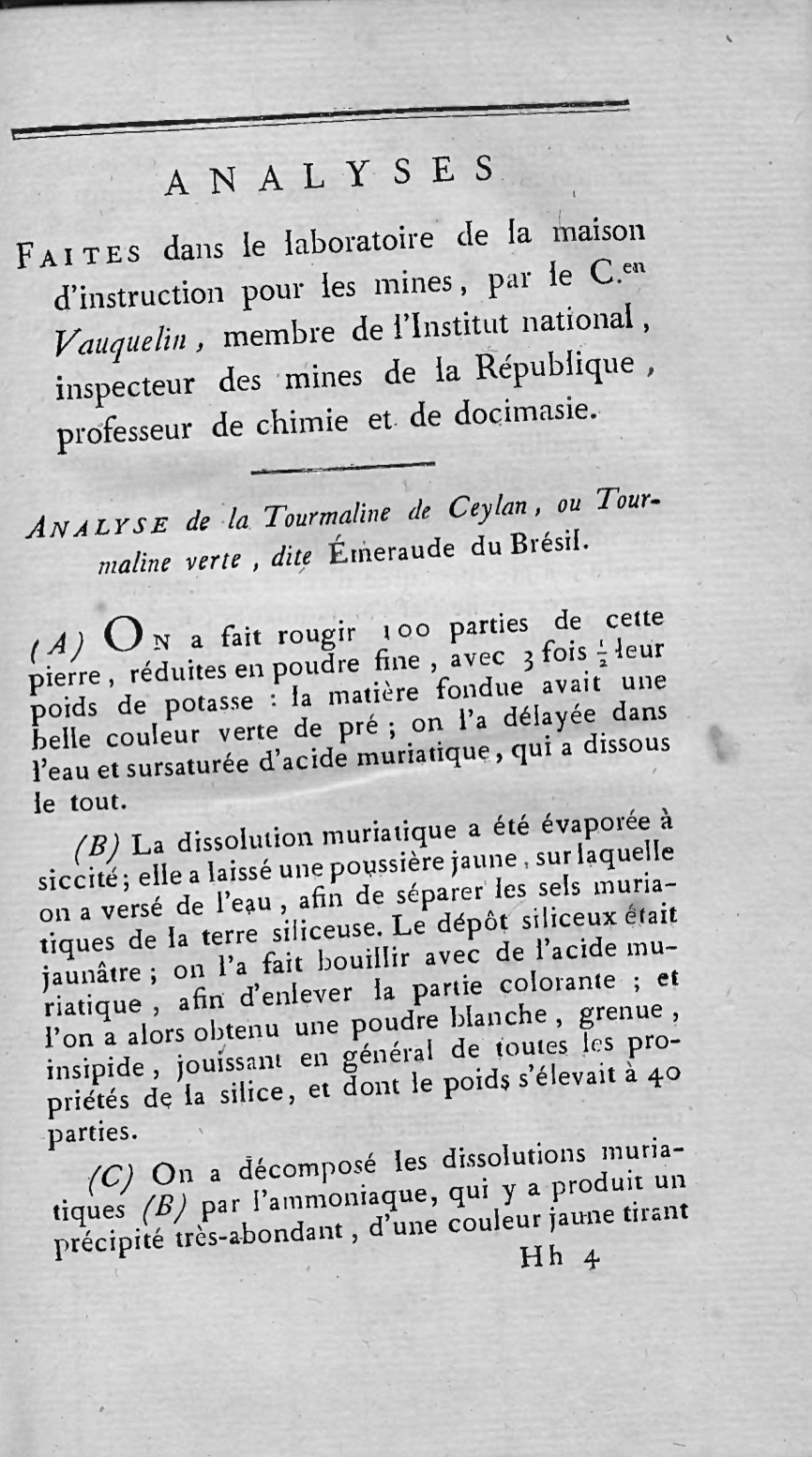
Analysis of the Saxon Beryl, in which Mr. Johann Bartholomäus Trommsdorff announced the existence of a new earth which he named Agustine
Journal Article
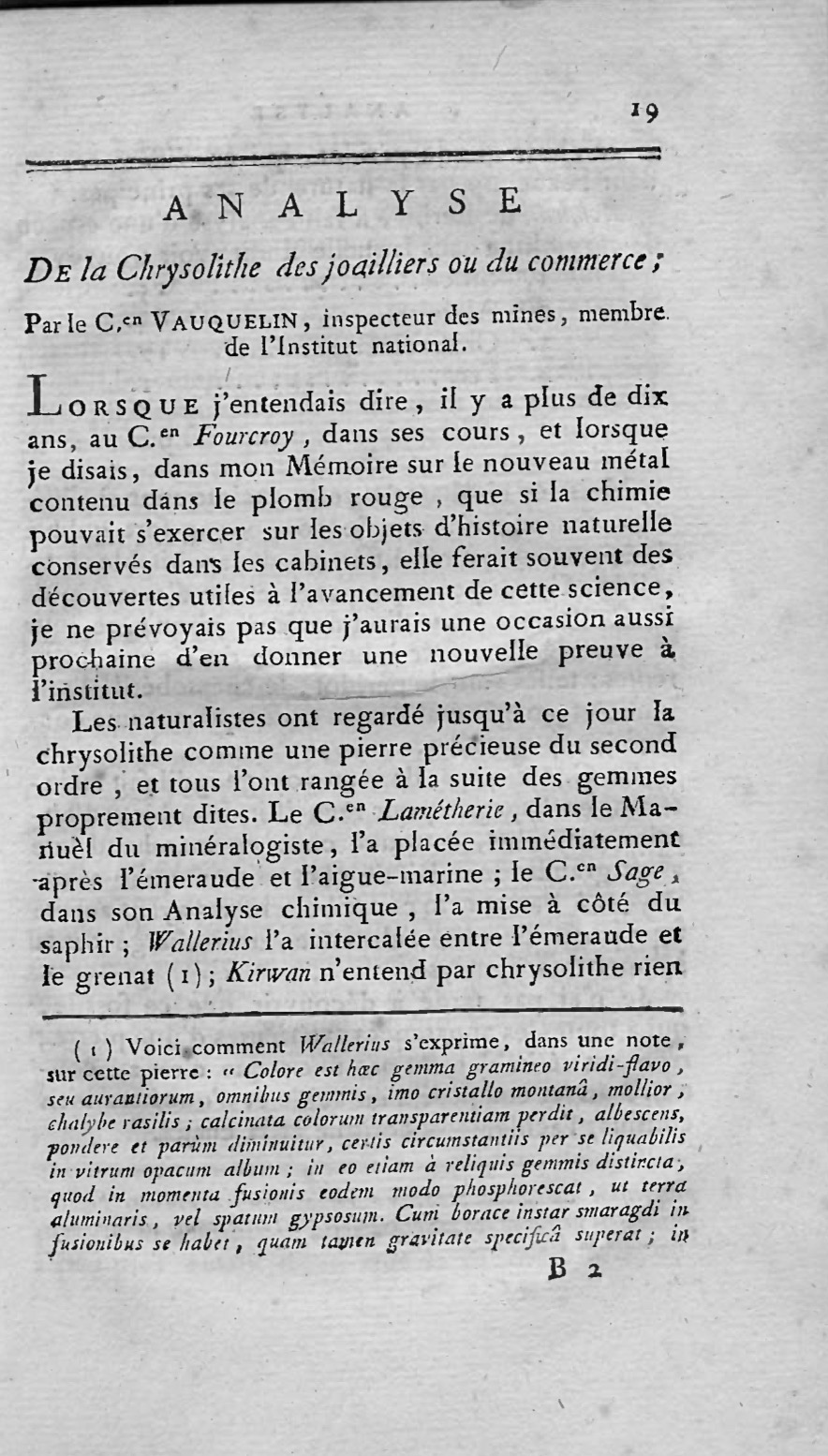
Vauquelin, N.-L. (1799) Du Béril de Saxe, dans lequel M. Tromsdorf a annoncé l'existence d'une terre nouvelle qu'il a nommée Agustine. [Analysis of the Saxon Beryl, in which Mr. Johann Bartholomäus Trommsdorff announced the existence of a new earth which he named Agustine] Journal des Mines, Vol. 12, No. 86, pp. 81–87.
Record No. 28374  |  Sinkankas/Born No.: NIS/NIB  |  Language: in French  |  RWHL
An investigation by Nicolas-Louis Vauquelin of beryl from Saxony following Johann Bartholomäus Trommsdorff’s announcement that it contained a supposed new earth, which he named Agustine (Agusterde). Vauquelin chemically examined the material to determine whether this represented a genuinely new substance and found no justification for recognizing Trommsdorff’s proposed earth as a new constituent. The paper belongs to the intense late eighteenth-century effort to determine the chemical composition of minerals and identify new elements and earths. Of gemological interest, it contributed to clarification of the chemistry of beryl shortly after Vauquelin’s own discovery of glucina (beryllia) in beryl and emerald.

Analyse de la tourmaline de Ceylan

Analysis of the tourmaline of Ceylon
Journal Article
Vauquelin, N.-L. (1799) Analyse de la tourmaline de Ceylan. [Analysis of the tourmaline of Ceylon] Journal des Mines, Vol. 9, No. 54, pp. 477–479.
Record No. 28367  |  Sinkankas/Born No.: NIS/NIB  |  Language: in French  |  RWHL
An early chemical investigation by Nicolas-Louis Vauquelin of tourmaline from Ceylon (Sri Lanka). Vauquelin subjected the mineral to chemical analysis in an attempt to determine its constituent substances and clarify its mineralogical composition. The study belongs to the period when chemical analysis was increasingly being used alongside crystallographic and physical properties to distinguish mineral species and varieties. Of particular gemological interest, the paper represents an early analytical study of gem tourmaline from one of the historically important gemstone-producing regions of Asia and contributes to the development of the chemical characterization of tourmaline at the end of the eighteenth century.

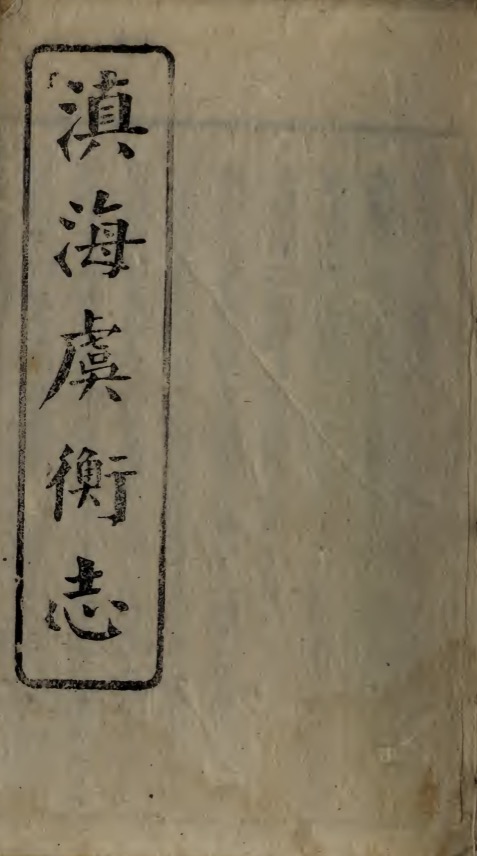
Record of the Resources of Yunnan

Dian Hai Yu Heng Zhi; 滇海虞衡志
Book
Tan, C. (1799) Record of the Resources of Yunnan. [Dian Hai Yu Heng Zhi; 滇海虞衡志], 13 juan
Record No. 16784  |  Sinkankas/Born No.: NIS/NIB  |  Language: in Chinese  |  RWHL
A wide-ranging description of the natural resources, products, geography, peoples, and material culture of Yunnan, completed by Tan Cui in 1799. The work comprises 13 sections, including caves and mountains, minerals and stones, aromatics, implements, animals, plants, and peoples. Of particular gemological importance is the second section, Zhi Jinshi [志金石], which discusses gold, silver, copper, jade, amber, gemstones, pearls, cinnabar, and other mineral substances. Its account of jade is especially significant because it explicitly describes jade from the region beyond Tengyue, the extraction and trading of boulder-like rough material, its transport to Dali and Yunnan, and the considerable uncertainty involved in cutting the rough to reveal fei cui [翡翠]. It is therefore an important early source for the history of the Burmese jadeite trade into China. The work was completed in 1799 and first printed in 1804. Sun Laichen: Volumes 2, 5, and 9 contain descriptions of Burmese products, including jade and jade Buddha images, penis bells, eggplants, insects, rubies, cotton, and cotton cloth. Prefaced in 1799 and printed in 1804.

An analytical description of the crystalline forms of corundum, from the East-Indies, and from China
Journal Article
Bournon, J.-L., de (1799) An analytical description of the crystalline forms of corundum, from the East-Indies, and from China. A Journal of Natural Philosophy, Chemistry and the Arts [Nicholson's journal], Vol. 2, March, pp. 540–544, plate facing p. 556.
Record No. 16631  |  Sinkankas/Born No.: 823; NIB  |  RWHL
An early crystallographic study by Jacques-Louis, Comte de Bournon, devoted to corundum specimens from the East Indies and China. Bournon describes the principal crystal forms and their modifications, using geometrical relationships to characterize the mineral more precisely. The paper was closely associated with contemporary work by Charles Francis Greville on corundum and helped establish crystallography as an important means of distinguishing corundum from other hard stones then confused with it. Of particular gemological significance, the study contributed to the scientific recognition of corundum as the mineral species that includes ruby and sapphire.

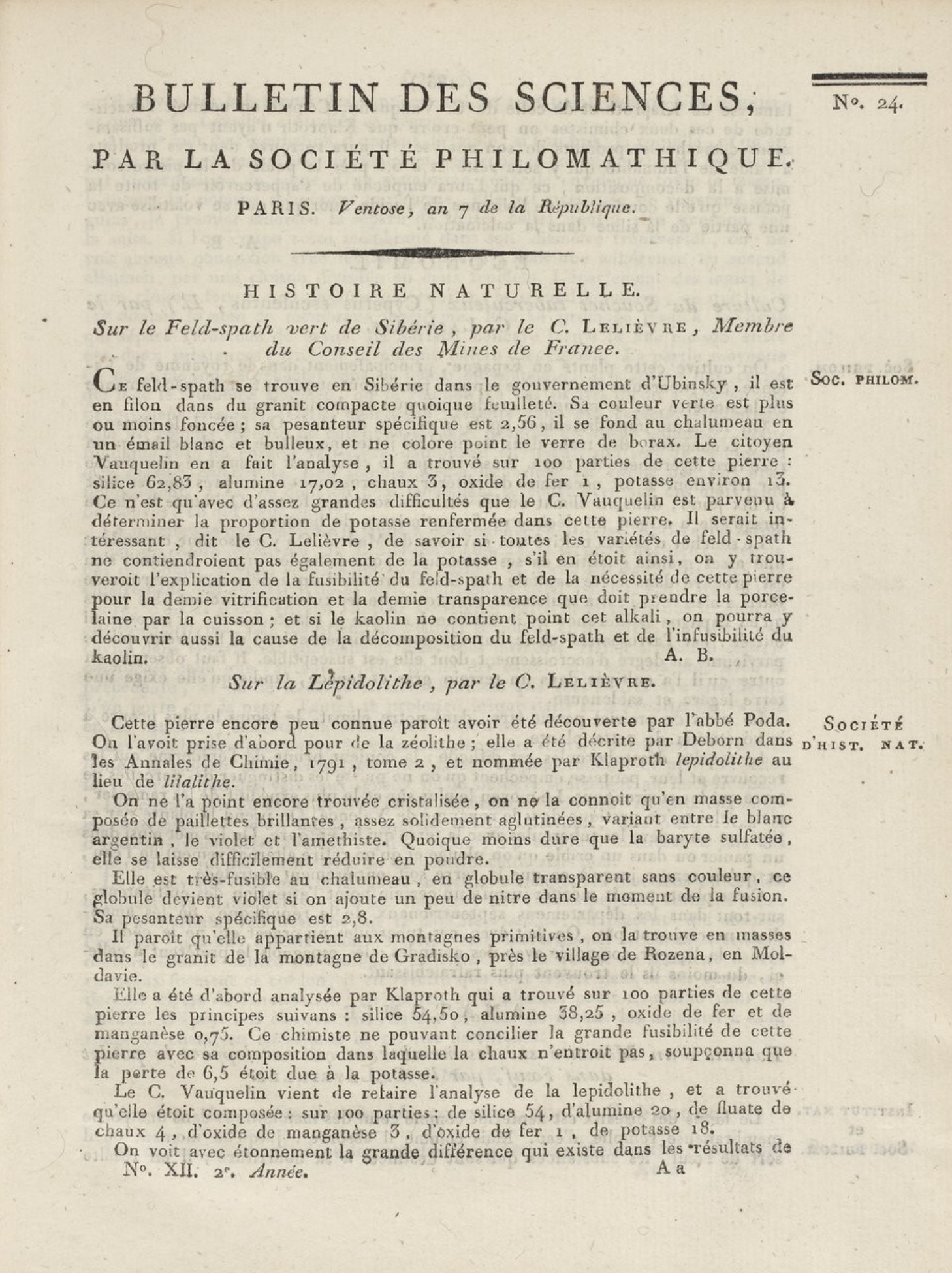
Sur le Feld-spath vert de Sibérie

On the Siberian green feldspar
Journal Article
Lelièvre, C. (1799) Sur le Feld-spath vert de Sibérie. [On the Siberian green feldspar] Bulletin des sciences, Vol. 7, No. 24, p. 185.
Record No. 8059  |  Sinkankas/Born No.: NIS/NIB  |  Language: in French  |  RWHL
A brief mineralogical notice by Claude-Hugues Lelièvre on the green feldspar of Siberia, the material now known as amazonite, a green variety of microcline feldspar. Lelièvre discusses the distinctive green stone and its mineralogical character at a time when the identities and relationships of feldspar varieties were still being established. The notice is of gemological interest as an early scientific reference to Siberian green feldspar, a material valued for ornamental and lapidary use and subsequently known as amazonstone or amazonite.

Building a Gemological Library

Gemological books range from general identification manuals and textbooks to specialized works on individual gems, mineralogy, jewelry, treatments, synthesis, history and gem-producing regions.

For a curated selection of particularly useful books, read The Gemologist's Core Library — Classic Books on Gemology, Jewelry and Mineralogy.

About Four Treasures

Four Treasures is Lotus Gemology's freely accessible gemological reference database. Use the full database to search by author, title or keyword and explore literature on gemology, mineralogy, jewelry and related fields. Where available, hyperlinks on titles may lead directly to the full publication.

Search the Complete Four Treasures Database