Gemology Books Bibliography

Gemology Books Bibliography

Explore books on gems, gemology, jewelry and mineralogy in Four Treasures, the Lotus Gemology reference database. This bibliography brings together matching book records from the collection, with publication details, abstracts and cover images where available.

Gemology Book References

The list below matches books concerning gemology and related subjects in the database's searchable fields. Some works cover several branches of gems, jewelry or mineralogy.
3,061–3,080 of 3,451 matching references

Allgemeines Gelehrten-Lexicon

General Lexicon of Scholars
Book
Jöcher, C.G. (1750–51) Allgemeines Gelehrten-Lexicon. [General Lexicon of Scholars] Leipzig, Johann Friedrich Gleditschens Buchhandlung, 4 Vols.
Record No. 16482  |  Language: in German  |  RWHL
A major eighteenth-century German biographical and bibliographical reference work compiled by Christian Gottlieb Jöcher. The Allgemeines Gelehrten-Lexicon provides alphabetically arranged accounts of scholars and writers, giving biographical information together with lists or notices of their published works. Published at Leipzig in four volumes between 1750 and 1751, it covers authors from antiquity through Jöcher’s own time and became an important reference source for European intellectual and publishing history. For research into the history of gemology and mineralogy, it is particularly useful for identifying early authors, variant names, biographical details and bibliographical information concerning works cited in older scientific and lapidary literature.

Verzeichniss derjenigen Schriftsteller, die von Edelsteinen gehandelt haben
List of those writers who have written about gemstones
Book Section
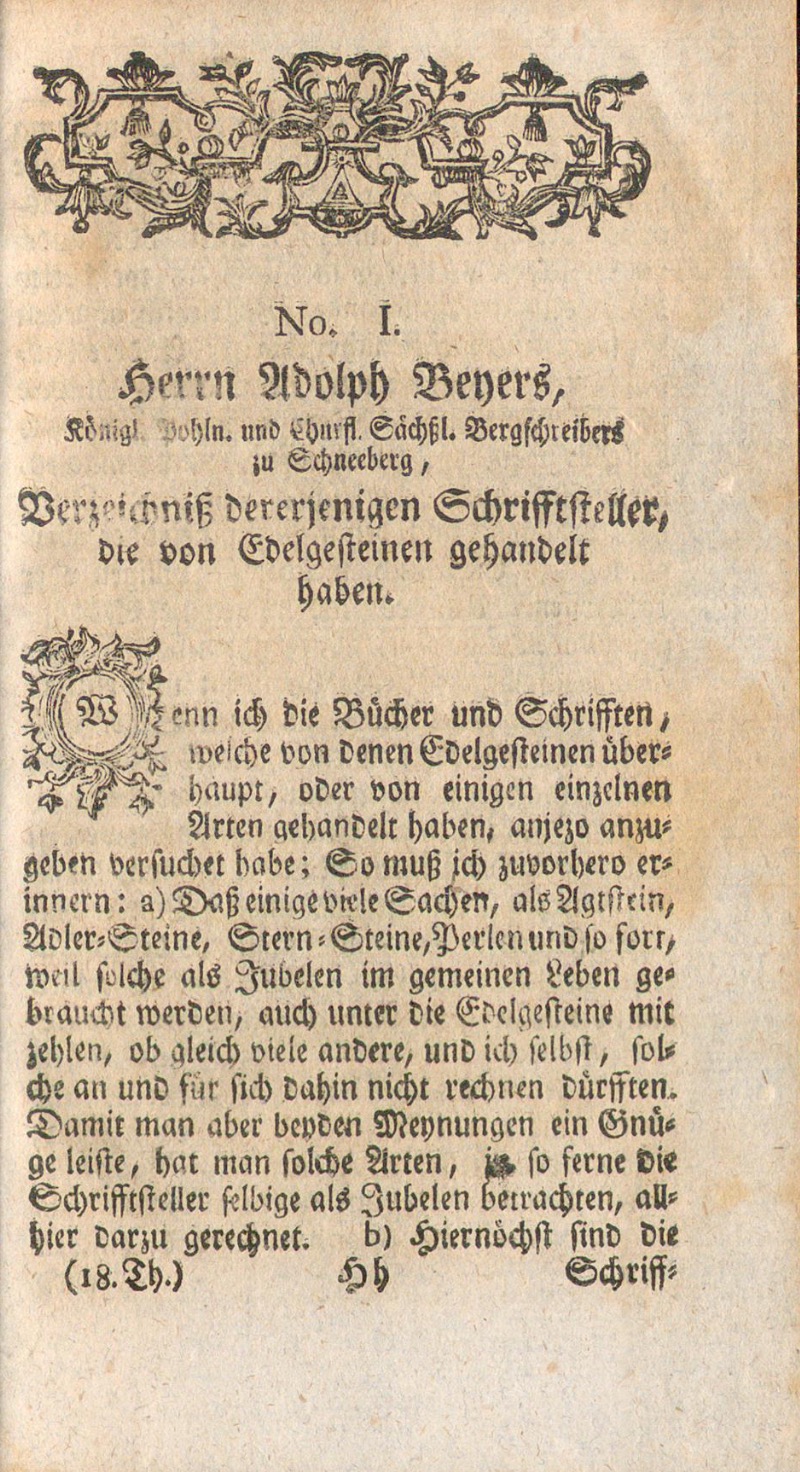
Beyer, A. (1750–1765) Verzeichniss derjenigen Schriftsteller, die von Edelsteinen gehandelt haben. [List of those writers who have written about gemstones] In: Neue Versuche nützlicher Sammlungen zu der Natur- und Kunstgeschichte, sonderlich von Ober-Sachsen, Vol. 18 , pp. 471–494.
Record No. 10937  |  Sinkankas/Born No.: NIS/NIB  |  Language: in German  |  RWHL
An early bibliography of writings on gemstones, published as a contribution to Christian Gottlob Grundig’s Neue Versuche nützlicher Sammlungen zu der Natur- und Kunstgeschichte, sonderlich von Ober-Sachsen. Beyer surveys authors who had written about precious stones, providing a useful guide to the gemological and lapidary literature known in the eighteenth century. The work is of particular historical value as an early attempt to gather references on gemstones into a dedicated bibliographical compilation, and as a record of the sources available to German scholars before mineralogy and gemology developed into more formally organized scientific disciplines.

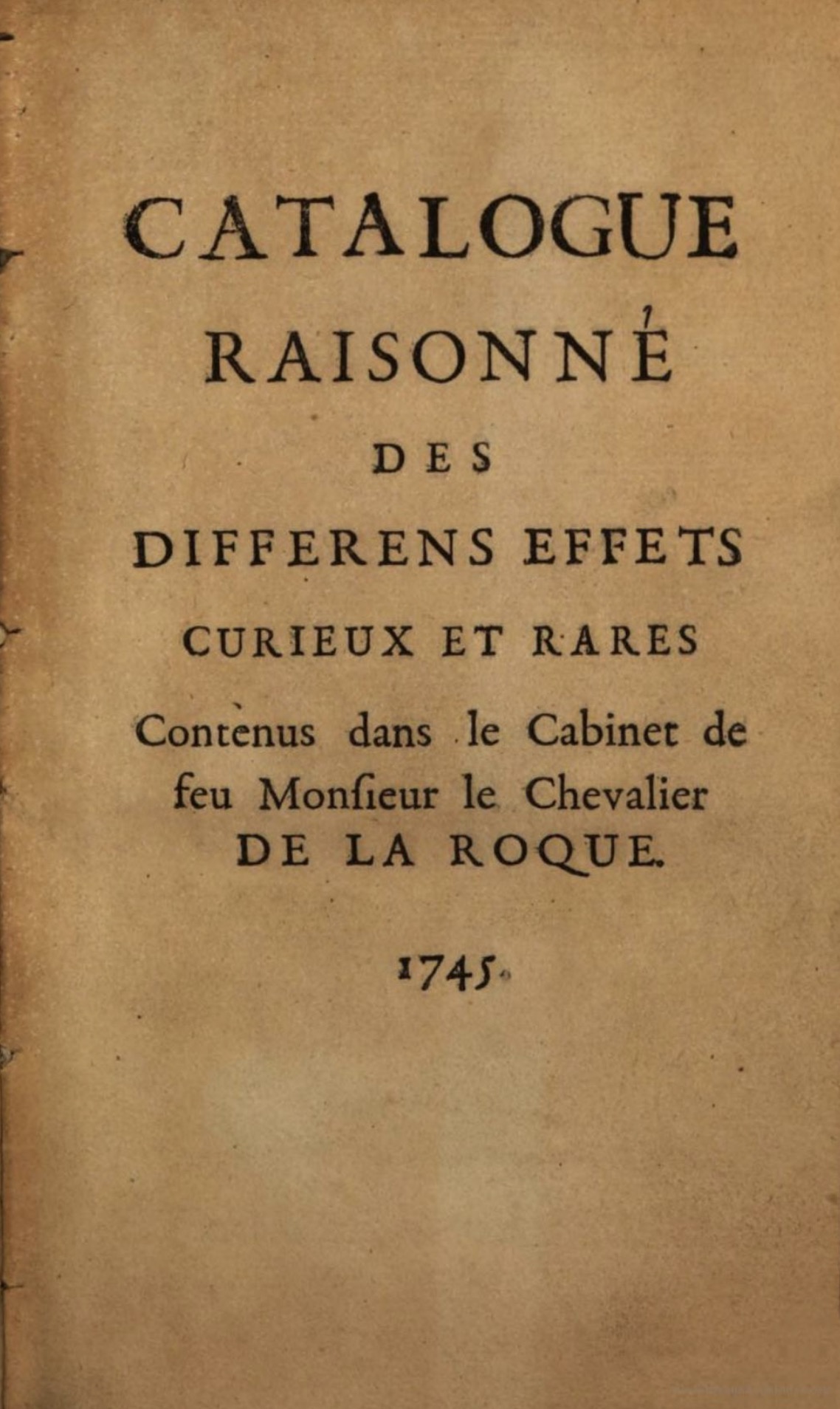
Catalogue raisonné des differens effets curieux & rares, contenus dans le Cabinet de seu Monsieur le Chevalier de la Roque
Annotated Catalog of the Various Curious and Rare Objects Contained in the Cabinet of the Late Monsieur Chevalier de La Roque
Book
Gersaint, E.-F. (1745) Catalogue raisonné des differens effets curieux & rares, contenus dans le Cabinet de seu Monsieur le Chevalier de la Roque. [Annotated Catalog of the Various Curious and Rare Objects Contained in the Cabinet of the Late Monsieur Chevalier de La Roque] Paris, Jaques Barois, 258 pp.
Record No. 29000  |  Sinkankas/Born No.: 2362  |  Language: in French  |  RWHL
Sinkankas: The collection of Jean, chevalier De La Roque (1661–1745). Pp. 109–147: “Pierreries, Agates, Pierres gravées … [etc.].” Includes diamonds, rubies, emeralds, oriental topaz, sapphire, oriental amethyst, turquoise, balas ruby, hyacinth, and others, not to mention the engraved gems (cameos, intaglios, mounted in rings, and loose). Mentioned by Mariette, Traité des pierres gravées, I, 458.

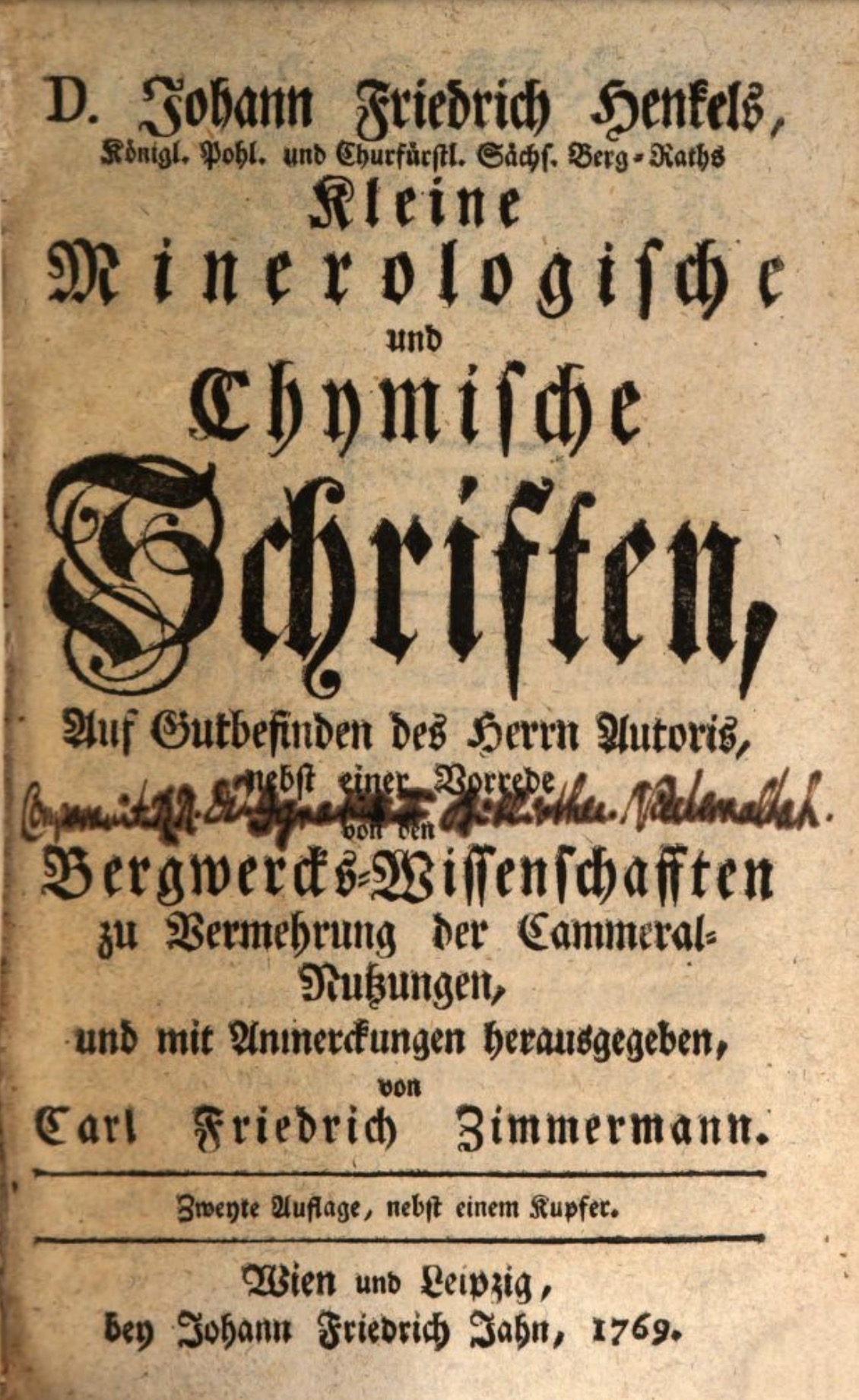
Kleine Mineralogische und Chymische Schrifften. Auf Gutbefinden des Herrn Autoris. Nebst einer Vorrede von den Bergwercks-Wissenschafften zu Vermehrung der Cammeral-Nutzungen, und mit Anmerckungen herausgegeben von Carl Friedrich Zimmermann
D. Johann Friedrich Henkel’s, Royal Polish and Electoral Saxon Mining Councillor, Small Mineralogical and Chemical Writings. Published with the approval of the author, together with a preface on the mining sciences for the increase of cameral (state fiscal) revenues, and with annotations by Carl Friedrich Zimmermann
Book
Henkel, J.F. (1744) Kleine Mineralogische und Chymische Schrifften. Auf Gutbefinden des Herrn Autoris. Nebst einer Vorrede von den Bergwercks-Wissenschafften zu Vermehrung der Cammeral-Nutzungen, und mit Anmerckungen herausgegeben von Carl Friedrich Zimmermann. [D. Johann Friedrich Henkel’s, Royal Polish and Electoral Saxon Mining Councillor, Small Mineralogical and Chemical Writings. Published with the approval of the author, together with a preface on the mining sciences for the increase of cameral (state fiscal) revenues, and with annotations by Carl Friedrich Zimmermann] Dresden, Friedrich Henkel, 619 pp.
Record No. 28994  |  Sinkankas/Born No.: 2883–2884  |  Language: in German  |  RWHL
Sinkankas: Henkel presents his views on the formation of minerals, including coral and gemstones, with extensive annotations by Zimmermann. He recognized five modes of formation: (1) congelation, (2) concretion, (3) vegetation (as in coral), (4) crystallization, and (5) petrifaction. Henkel believed that durable minerals—especially gemstones—were composed of minute particles that grew together into structurally continuous masses or crystals, producing transparency while excluding water. He discusses at length, as does Zimmermann, experiments by Robert Boyle, Francis I, and others on the effects of intense heat on gemstones, describing the behavior of diamond, emerald, ruby, and other gems. Additional topics include Saxon fossil resin (pp. 539–553), the celebrated Saxon topaz (pp. 554–565), and a green jasper bearing “hieroglyphic figures” (pp. 607–619), possibly referring to graphic granite. The work is described by John Ferguson in Bibliotheca Chemica (Vol. I, p. 386), which also notes later editions published in 1747 and in Vienna in 1769, together with biographical and bibliographical information on Henkel and his writings.

Edelgesteine

Gemstones
Book Section
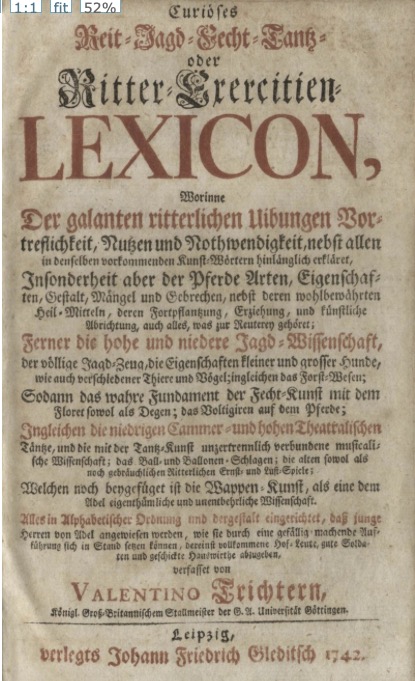
Trichter, V. (1742) Edelgesteine. [Gemstones] In: Curiöses Reit- Jagd- Fecht- Tantz- oder Ritter-Rxercitien-Lexicon, Leiipzig, pp. 575–576.
Record No. 8139  |  Language: in German  |  RWHL
Precious stones: These are those which are made valuable not only due to their rarity and beauty but also because nature has adorned them with a special light and radiance, making them, in a sense, noble—so that they sparkle like the finest stars and have always maintained a higher status than gold or silver. There are two types of precious stones: transparent and opaque. The transparent ones include amethyst, beryl, carbuncle, chrysolite, diamond, hyacinth, ruby, sapphire, and emerald. Among the opaque ones, though some are semi-transparent, are agate, carnelian, chalcedony, jasper, the so-called cat’s eye, lapis lazuli, nephrite, and gallstone, malachite and schreckstein, onyx, opal, turquoise, etc. These precious stones, especially the transparent ones, originate from water or moisture impregnated with mountain salt, which allows them to grow and develop into crystals. It is impossible for something to be transparent that has not first been in liquid form. Dense substances such as silver and lead, when dissolved in separating water or other acidic liquids, can easily grow into transparent crystals. Similarly, one often finds completely clear water droplets inside the most beautifully grown crystals, and in the hardest stones in India, the finest gemstones. Moreover, that there is some mountain salt mixed in is evident from the geometric shape of the precious stones, which are clearly recognizable as having the same structure as salt and saltpeter, as the mined crystals and diamonds, which differ only in hardness, grow entirely angular, often even with veins and such deposits, so that one can clearly see how the salty components have been layered on top of each other. Their charming colors come from a delicate metallic sulfur, similar to metals found in mines: for example, carbuncle, ruby, garnet, and amethyst from a gold-sulfur; sapphire from the tincture of silver; emerald and chrysolite from the greenish-sulfuric nature of copper; topaz and hyacinth from the sulfurous substance of iron, etc. However, this sulfur in precious stones is very volatile, so much so that the colors resulting from it can easily disappear and evaporate in the fire. But since these gemstones, when broken, are often irregular, or unclean and blotchy, even the most beautiful and purest stones do not shine as brightly as when they are cut, whereby the multiple facets reflect and play the light that falls on the foil or diamond ink all the more toward the eye. Therefore, those skilled in this art are called gem cutters, and they practice a free craft; however, they have been regulated by a noble order in Nuremberg for more than 100 years.

Exercitationes chymicae de sulphuribus metallorum, de auripigmento, de solutione corporum particulari, de terra foliata tartari, de acido vitrioli vinoso et de acido nitri vinoso
Chemical Exercises on the Sulphurs of Metals, Orpiment, the Solution of Particular Bodies, Foliated Tartar, Vinous Vitriolic Acid, and Vinous Nitric Acid
Book
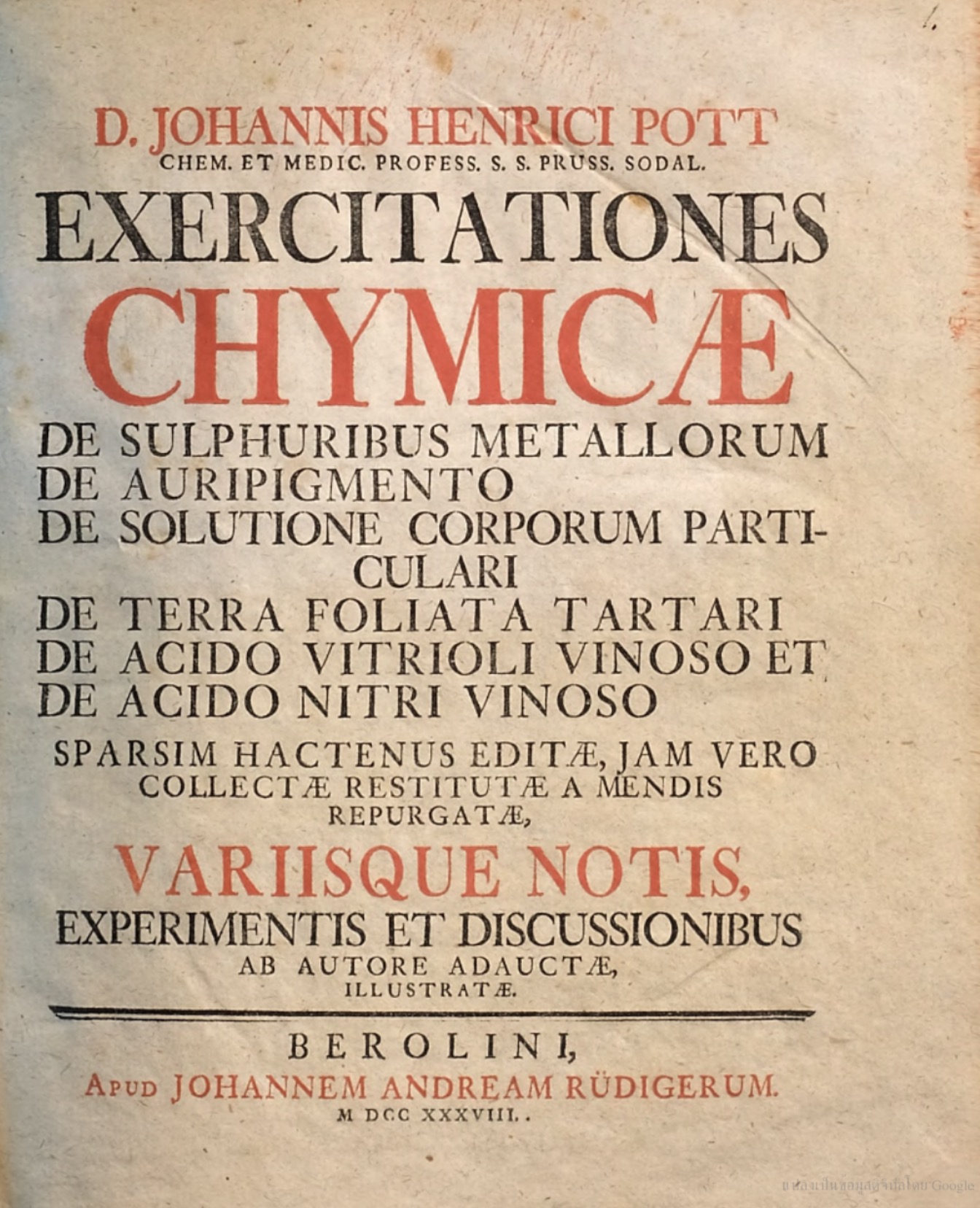
Pott, J.H. (1738) Exercitationes chymicae de sulphuribus metallorum, de auripigmento, de solutione corporum particulari, de terra foliata tartari, de acido vitrioli vinoso et de acido nitri vinoso. [Chemical Exercises on the Sulphurs of Metals, Orpiment, the Solution of Particular Bodies, Foliated Tartar, Vinous Vitriolic Acid, and Vinous Nitric Acid] Berlin, Johann Andreas Rüdiger, 200 pp.
Record No. 29413  |  Sinkankas/Born No.: NIS/NIB  |  Language: in Latin  |  RWHL
Pott’s Exercitationes chymicae is a collection of previously issued chemical dissertations, revised and enlarged with additional notes, experiments, and discussion. It treats the sulphurs of metals; orpiment; the selective dissolution of substances; terra foliata tartari; and preparations involving the acids of vitriol and nitre with spirit of wine. Of particular gemological and mineralogical interest is the dissertation on orpiment (auripigmentum), in which Pott discusses its names, occurrence, physical appearance, composition, preparation, reactions, and distinction from related arsenical sulphides. He describes natural orpiment as a mineral composed of arsenic and sulphur and notes that material could be fraudulently substituted for native cinnabar; he also reviews chemical and alchemical treatments involving orpiment, while critically testing claims made by earlier authors. The work is representative of early eighteenth-century experimental chemistry, combining mineralogical description with laboratory operations such as sublimation, solution, precipitation, distillation, and fixation.

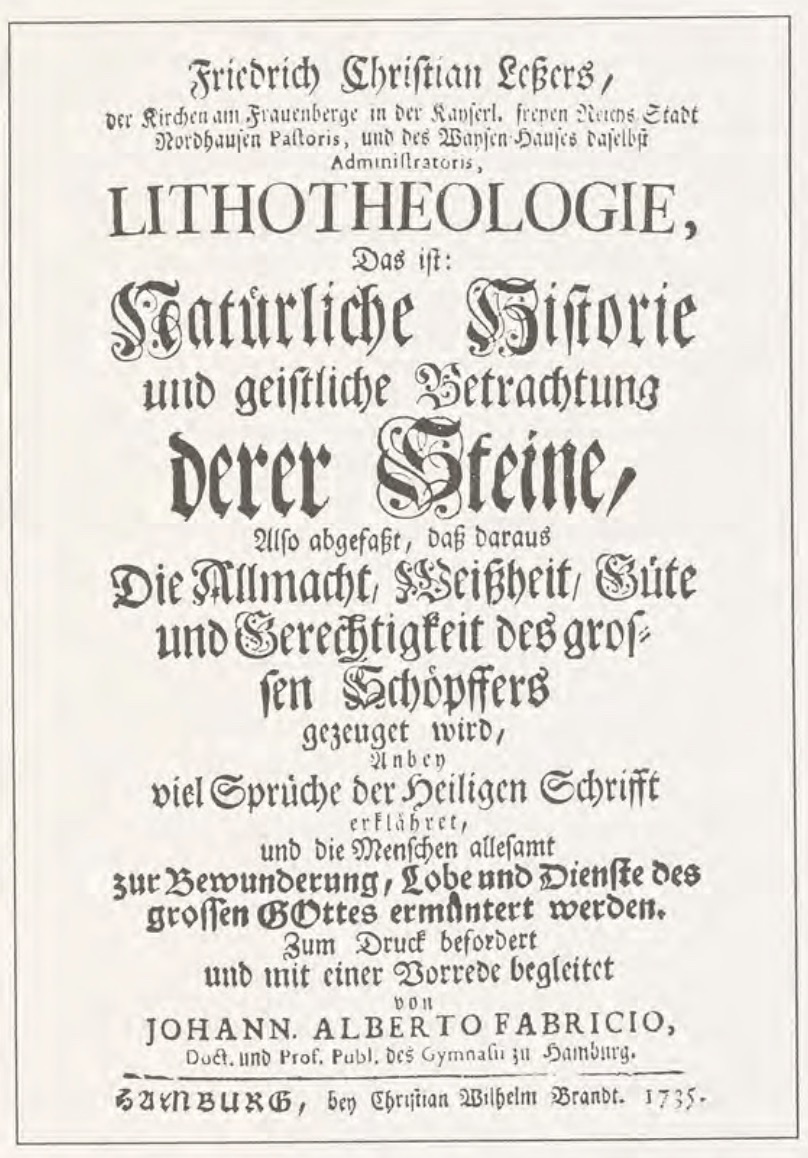
Lithotheologie, Das ist: Natürliche Historie und geistliche Betrachtung derer Steine, also abgefasst, dass daraus die Allmacht, Weisheit, Güte und Gerechtigkeit des grossen Schöpffers gezeuget wird, anbey viel Sprüche der Heiligen Schrifft erklähret und die Menschen allesamt zur Bewunderung, Lobe und Dienste des grossen Gottes ermuntert werden.
Lithotheologic, that is: Natural history and spiritual contemplation of stones, composed in such a way that from them the omnipotence, wisdom, goodness, and justice of the great Creator are demonstrated; together with explanations of many passages of Holy Scripture, and an exhortation to all mankind to admiration, praise, and service of the great God
Book
Lesser, F.C. (1735) Lithotheologie, Das ist: Natürliche Historie und geistliche Betrachtung derer Steine, also abgefasst, dass daraus die Allmacht, Weisheit, Güte und Gerechtigkeit des grossen Schöpffers gezeuget wird, anbey viel Sprüche der Heiligen Schrifft erklähret und die Menschen allesamt zur Bewunderung, Lobe und Dienste des grossen Gottes ermuntert werden. [Lithotheologic, that is: Natural history and spiritual contemplation of stones, composed in such a way that from them the omnipotence, wisdom, goodness, and justice of the great Creator are demonstrated; together with explanations of many passages of Holy Scripture, and an exhortation to all mankind to admiration, praise, and service of the great God] Hamburg, Christian Wilhelm, 1300 pp.
Record No. 28779  |  Sinkankas/Born No.: 3904  |  Language: in German  |  RWHL
Sinkankas: Utterly fascinating work in great detail and complexity, attempting to demonstrate the hand of God in every manifestation of the mineral kingdom. Lesser assembled an astounding fund of information culled from hundreds of ancient and modern sources and covering nearly every aspect of geology, mineralogy, paleontology, and gemology. So successful was he, and apparently so careful in his choices and interpretations, that the present work was very commonly quoted by later writers in earth sciences and mineralogy. It is divided into nine books, each with several parts and chapters. Book one explains fundamental interrelationships existing among the lithosphere, atmosphere, hydrosphere, and biosphere. Book two concerns the origin and formation of rocks and minerals. Book three treats occurrences or deposits of mineral materials, including gemstones. Book four discusses the properties of minerals and stones. Book five addresses “precious” and “non-precious” stones, with pp. 343–66 treating precious stones, though restricted to a limited number of the better-known species and varieties, the stones themselves being apportioned among transparent, translucent, and opaque kinds, i.e., diamond, ruby, garnet, hyacinth, sapphire, amethyst, emerald, topaz, opal, and chrysolite as transparent stones, and translucent stones such as carnelian, sard, and other varieties of chalcedony; opaque stones include turquoise, malachite, jasper, lapis lazuli, and jade. This book also contains descriptions of some famous diamonds and other large and valuable gems, as well as data on the precious stones mentioned in the Bible. Also among the stones in this book are those that display remarkable inclusions, fanciful portraits or scenes, fossils, and crystals, and other curious, if not marvelous, mineral materials. Book six treats architectural and monumental stones, and also includes brief discussions of engraved gems, seals, and ringstones, with pp. 832–46 describing and speculating on the true identities of the gemstones in the vestments and breastplate of the High Priest, suitably illustrated with diagrams showing their positions and identities. Book seven concerns the misuse of stones, ostentatious display of gemstones, superstitious belief in their powers, the use of birthstones and planetary stones, and other topics of this nature. Book eight treats artificial stones of all kinds, including gemstones. Book nine concerns “works of wonder” in stone, e.g., Lot’s wife turned into a pillar of salt!

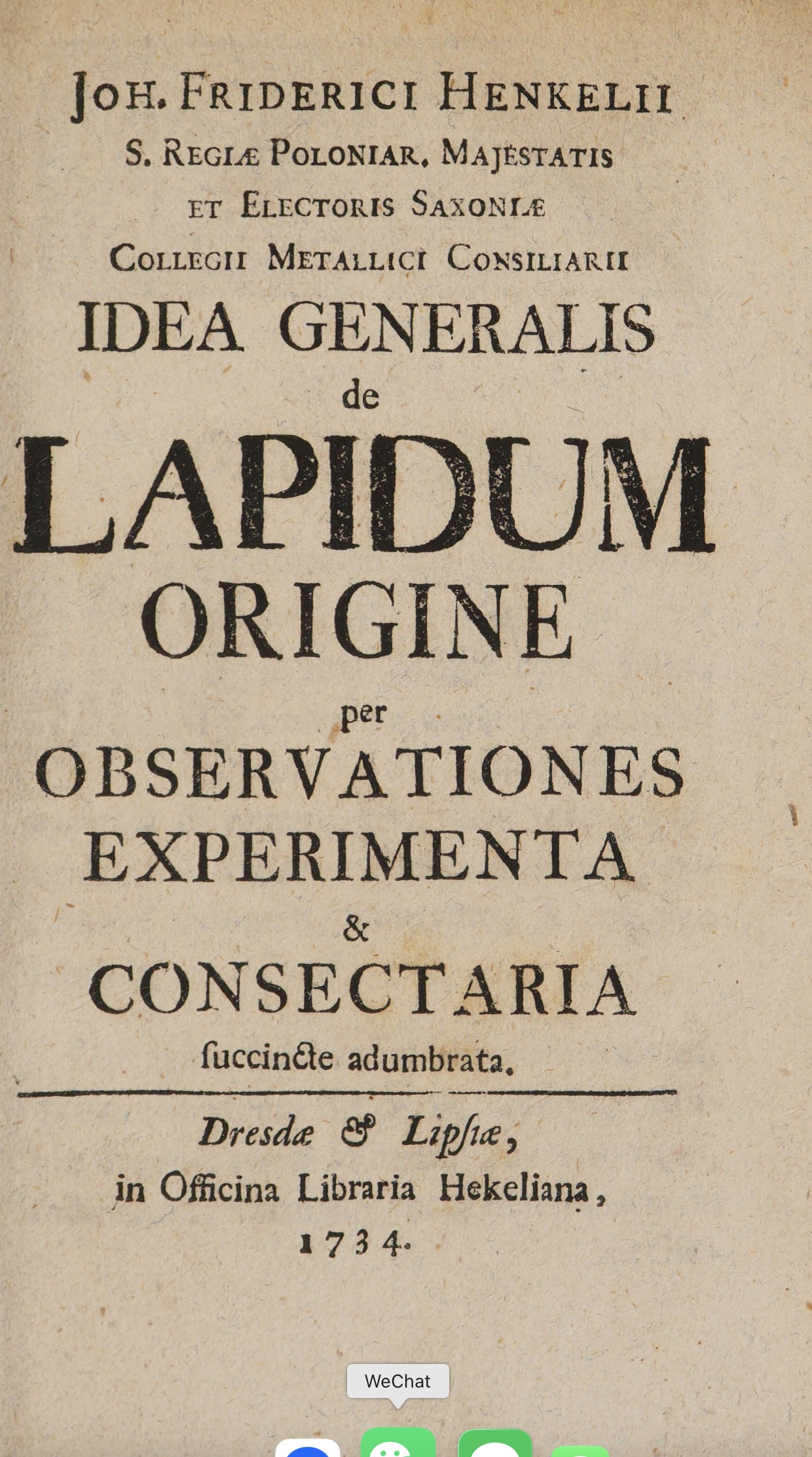
Idea Generalis De Lapidum Origine Per Observationes Experimenta & Consectaria Succinte Adumbrata
General Idea of the Origin of Stones, Succinctly Outlined through Observations, Experiments, and Conclusions
Book
Henkel, J.F. (1734) Idea Generalis De Lapidum Origine Per Observationes Experimenta & Consectaria Succinte Adumbrata. [General Idea of the Origin of Stones, Succinctly Outlined through Observations, Experiments, and Conclusions] Dresden, Officina Libraria Heclceliana, 92 pp.
Record No. 28995  |  Sinkankas/Born No.: 2882 (not seen)  |  Language: in Latin  |  RWHL
German mining engineer, mineralogist, and geologist; born in Freiberg, Saxony. He earned a medical degree and briefly practiced medicine before abandoning it in favor of the earth sciences, metallurgy, and chemistry. He was appointed Mining Councillor by Augustus II the Strong. Henkel was noted for his chemical research on porcelain and for analyses of vegetable substances. He assembled an extensive collection of minerals and fossils, which was eventually transferred to Saint Petersburg. A prolific author, he is discussed in Poggendorff (Vol. I, p. 1065), Biographisches Wörterbuch (Vol. 20, pp. 59–60), and the Dictionary of Scientific Biography (Vol. 6, pp. 259–260).

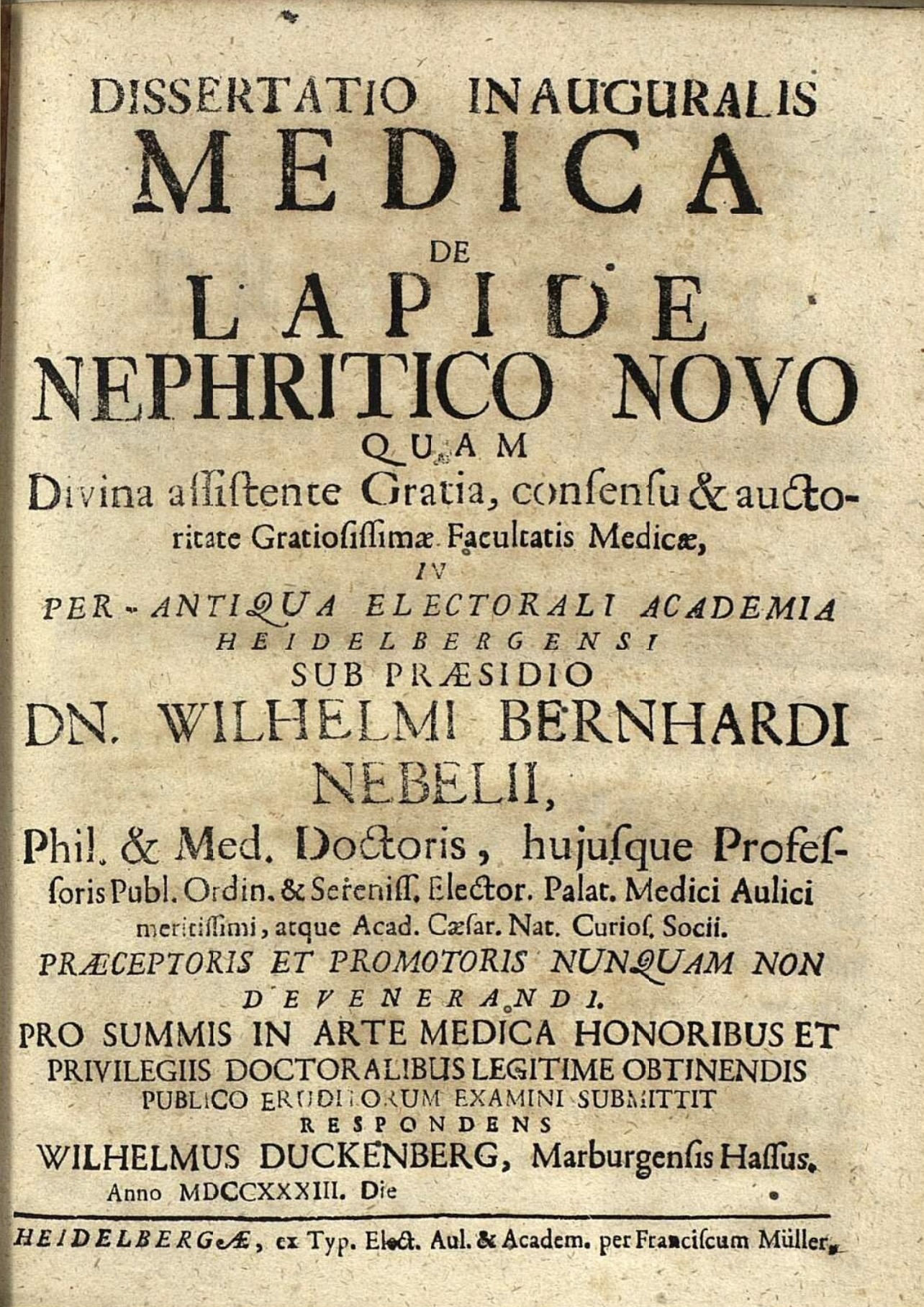
Dissertatio Inauguralis Medica de Lapide Nephretico Novo
Dissertation on the New Nephritic Stone
Book
Nebel, W.B. (1733) Dissertatio Inauguralis Medica de Lapide Nephretico Novo. [Dissertation on the New Nephritic Stone] Heidelbergae, Resp. Wilh. Duckenberg, 33 pp.
Record No. 29446  |  Sinkankas/Born No.: 4726 (not seen); NIB  |  Language: in Latin  |  RWHL
Wilhelm Bernhard Nebel’s Dissertatio inauguralis medica de lapide nephretico novo is an eighteenth-century medical dissertation devoted to a “new nephritic stone” and its reputed therapeutic action in disorders of the kidneys and urinary tract. The work examines the substance within the contemporary medical tradition of lapides nephritici, stones believed to prevent or alleviate renal complaints, and considers its nature and medicinal use. It is of particular interest to the history of gemology and medicine because it documents the continuing European investigation of so-called kidney stones at a time when the term nephritic stone could encompass materials distinct from the mineral later defined as nephrite. The dissertation thus provides evidence for the medical terminology and concepts from which the modern name nephrite ultimately developed.

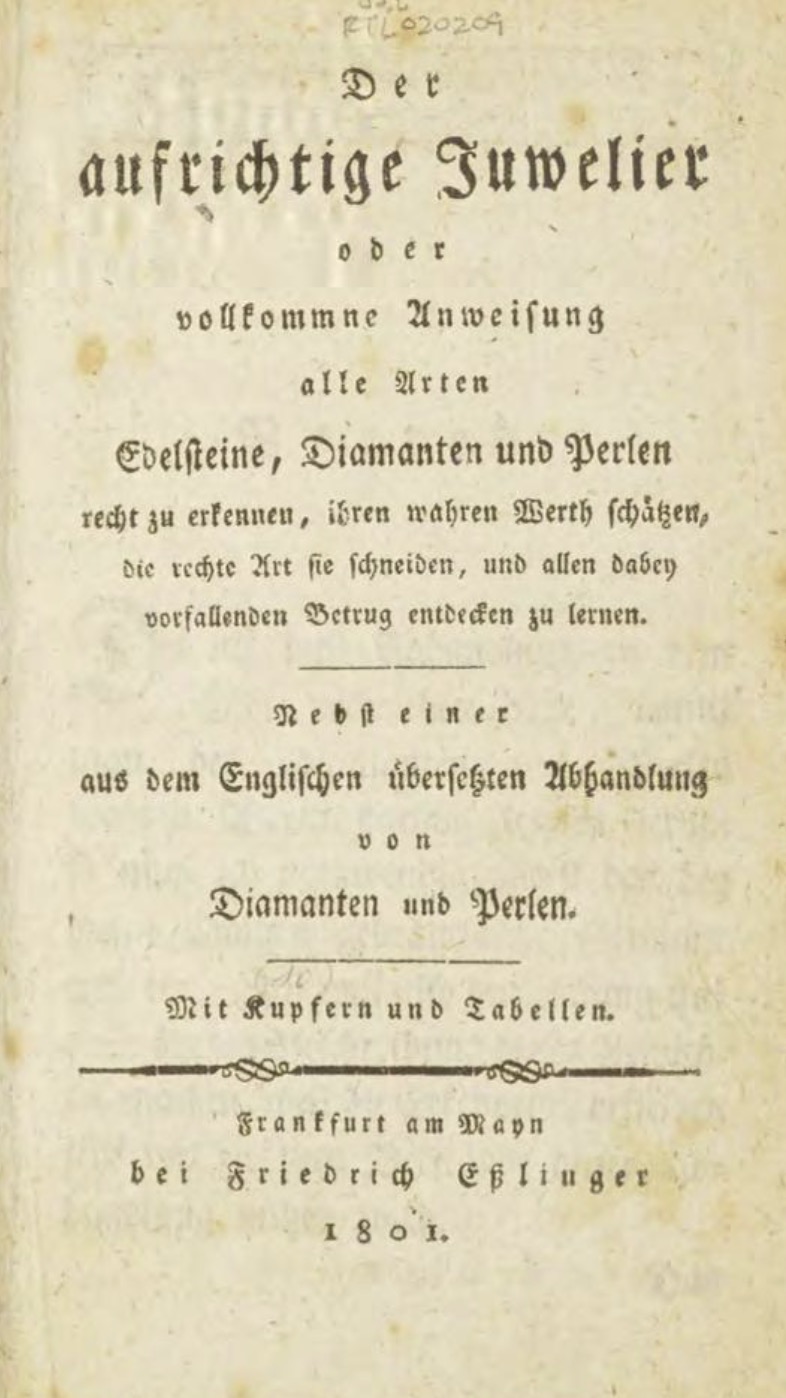
Der auffrichtige Jubelier

The Honest Jeweler
Book
Anonymous (1729) Der auffrichtige Jubelier. [The Honest Jeweler] Frankfurt a. M., F. Esslinger, 116 pp.
Record No. 29444  |  Sinkankas/Born No.: NIS/NIB  |  Language: in German  |  RWHL
Der auffrichtige Jubelier is an anonymous early eighteenth-century German handbook for jewelers dealing with precious stones, pearls, and the practical knowledge required in the jewelry trade. It discusses the principal varieties of gems, their characteristics, qualities, defects, and values, together with methods used to distinguish genuine stones from imitations and altered materials. The work also addresses aspects of buying, selling, and evaluating jewels, reflecting the practical concerns of contemporary merchants and craftsmen rather than purely mineralogical classification. It is of particular interest to the history of gemology because it documents the empirical methods, terminology, valuation practices, and commercial knowledge employed by German-speaking jewelers in the early eighteenth century.

Voyages de Mr. de Thevenot en Europe, Asie et Afrique
Book
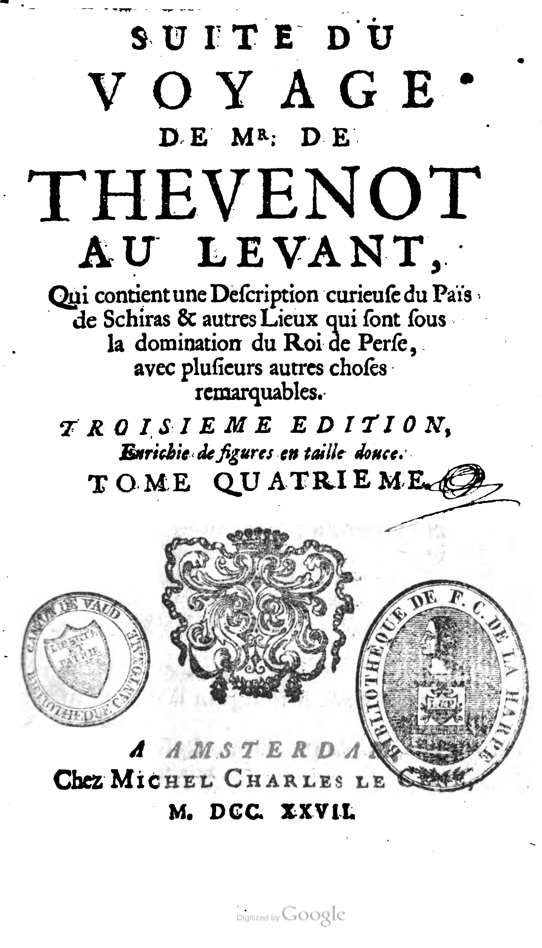
Thevenot, J., de, (1727) Voyages de Mr. de Thevenot en Europe, Asie et Afrique., 5 Vols., Vol. 5 , see p. 297
Record No. 1716  |  Sinkankas/Born No.: NIS/NIB  |  RWHL
Jean de Thévenot’s Voyages en Europe, Asie et Afrique recounts his extensive travels during the mid-17th century through Europe, the Ottoman Empire, Egypt, the Holy Land, Persia, and India. Based substantially on firsthand observations, the work describes geography, peoples, religions, customs, cities, natural products, commerce, transportation, and political conditions across the regions visited. Thévenot’s travels in Persia and India are particularly valuable for their descriptions of contemporary trade and luxury commodities. Of gemological interest are references to diamonds, pearls, precious stones, mines, jewelry, and the commerce in gems, including observations on Indian and Persian sources and markets. The passage in Vol. 5, p. 297, contributes to the work’s documentation of precious materials and their trade, making Thévenot an important European eyewitness source for the Asian gem trade of the 17th century.

De prodigiosis naturae et artis operibus, talismanes et amuleta dictis cum recensione scriptorum hujus argumenti liber singularis
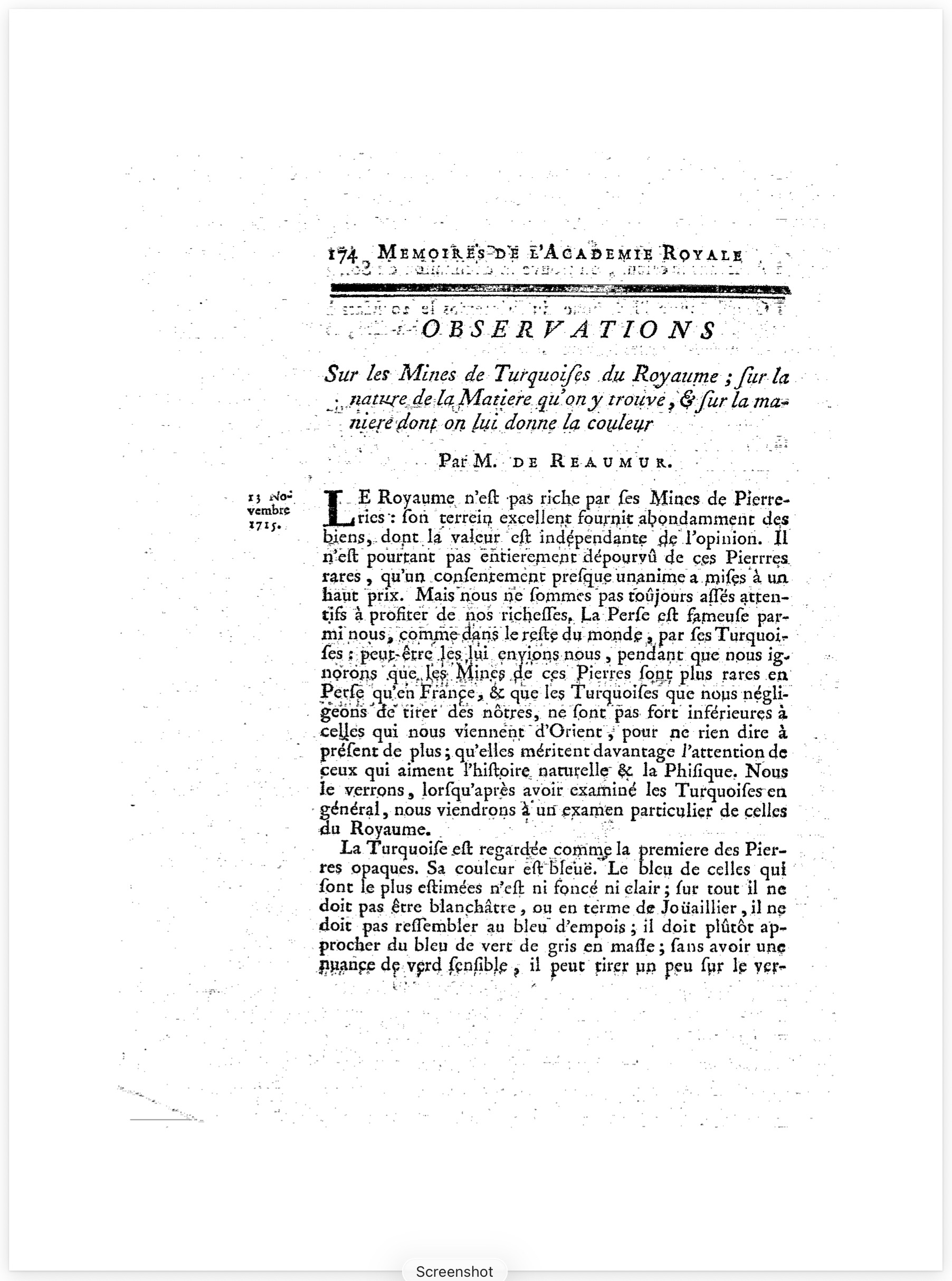
On the Wondrous Works of Nature and Art, a Singular Book on Talismans and Amulets with a Review of Writers on this Subject
Book
Arpe, P.F. (1717) De prodigiosis naturae et artis operibus, talismanes et amuleta dictis cum recensione scriptorum hujus argumenti liber singularis. [On the Wondrous Works of Nature and Art, a Singular Book on Talismans and Amulets with a Review of Writers on this Subject] Hamburg, Christian Liebezeit, 200 pp.
Record No. 6876  |  Sinkankas/Born No.: NIS/NIB  |  Language: in Latin  |  RWHL
Peter Friedrich Arpe’s De prodigiosis naturae et artis operibus is an early 18th-century scholarly examination of talismans, amulets, and objects believed to possess extraordinary natural or artificial powers. Drawing upon classical, medieval, Arabic, and early modern authorities, Arpe surveys writings on magical and protective objects and critically considers the claims made for their effects. Precious and engraved stones occupy an important place in these traditions, particularly gems bearing figures, symbols, astrological signs, or inscriptions and believed to confer protection, healing, good fortune, or other powers upon their owners. The work is of particular interest to historians of gemology for its treatment of magical gems and engraved talismans and for its extensive review of earlier lapidary and occult literature, documenting the persistence and scholarly reassessment of such beliefs in early 18th-century Europe.

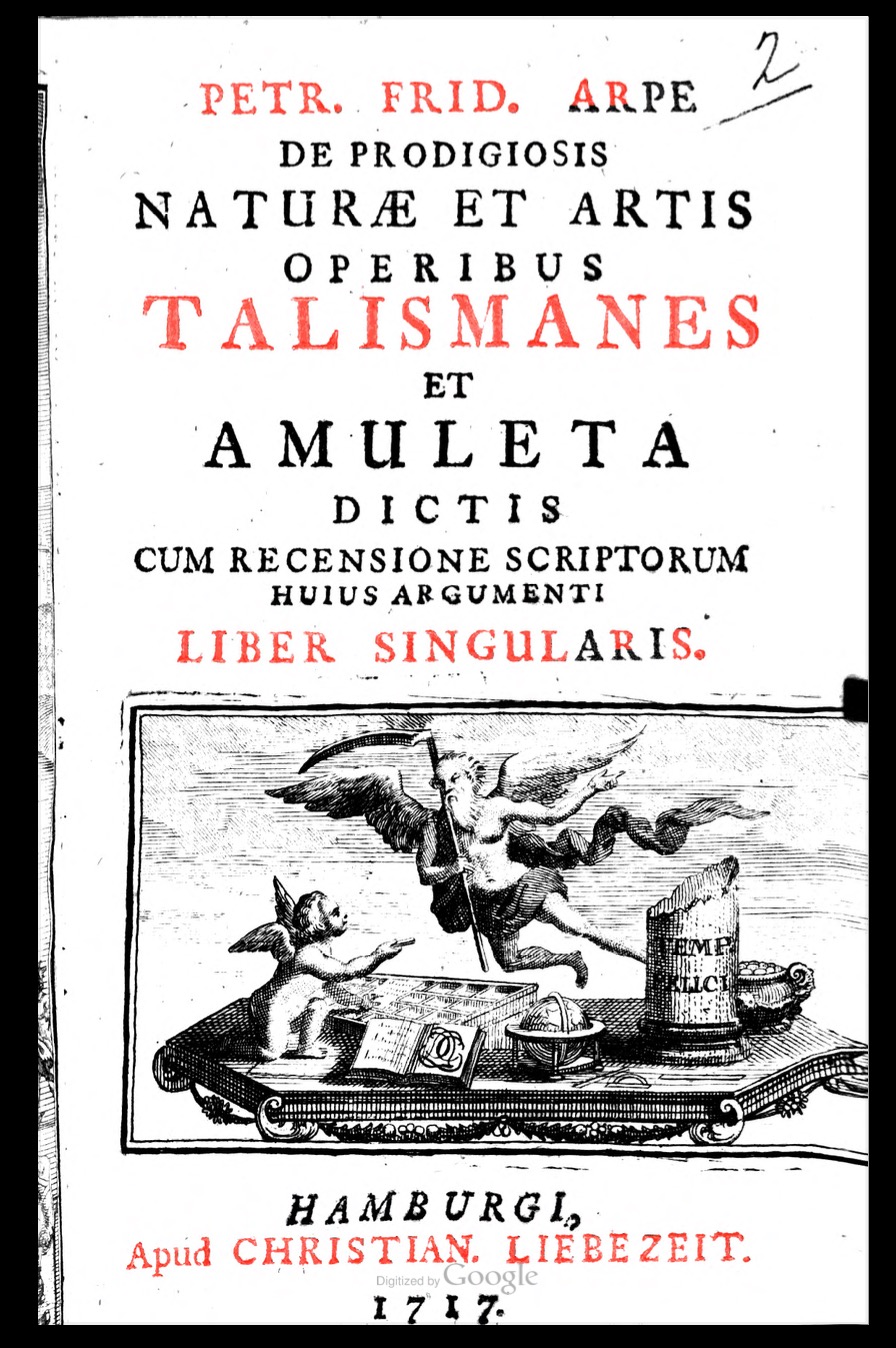
Observations sur les mines de turquoises du royaume; sur le nature de la matière dont on lui donne la couleur

Observations on the turquoise mines of the kingdom; on the nature of the material that gives them their color
Journal Article
Réaumur, R.A.F., de (1715) Observations sur les mines de turquoises du royaume; sur le nature de la matière dont on lui donne la couleur. [Observations on the turquoise mines of the kingdom; on the nature of the material that gives them their color] Memoires de l'academie royale des sciences, pp. 174–202, 3 plates.
Record No. 29047  |  Sinkankas/Born No.: 5396; NIB  |  Language: in French  |  RWHL
René-Antoine Ferchault de Réaumur’s paper is an early scientific investigation of French turquoise deposits and the origin of turquoise color. He describes the occurrence and working of turquoise-bearing material, examines specimens and their physical characteristics, and investigates the substance responsible for their blue and green coloration. Of particular gemological importance is his recognition that some material sold as turquoise consisted of fossil bone or teeth whose original substance had been altered and colored by mineral solutions—the material later known as odontolite or “bone turquoise.” The paper represents an important early attempt to distinguish true turquoise from visually similar materials through observation and experiment and contributes to the developing scientific understanding of gemstone composition, coloration, and imitation in the early 18th century. Sinkankas: Established that certain so-called turquoises (odontolites) were actually stained fossil teeth.

Wakan Sansai Zue [Illustrated Sino-Japanese Encyclopedia of the Three Realms]
和漢三才図会
Book
Terajima, R. (1712) Wakan Sansai Zue [Illustrated Sino-Japanese Encyclopedia of the Three Realms]. [和漢三才図会] Osaka, 105 vols. in 81 books
Record No. 28806  |  Sinkankas/Born No.: 6969  |  Language: in Japanese  |  RWHL
Sinkankas: The lapidary extracted from this work is reproduced by them in the usual reversed-text order, p. 144 top l., with many small woodcut figures in the text. A detailed commentary appears after the preliminaries on p. 1–150, with material on precious stones 56–67, but with ornamental stones on later pages, as in the case of diamond, on p. 124–125. Notes on gemstones are also provided on p. 178–188, while the stones themselves are identified on p. 253–264, i.e., jade, coral, petrified coral, agate, rock crystal, sagenite, glass, lapis lazuli (?), talc (or nacre?), fluorite (or amethyst?), and several ornamental stones. The notes frequently cite Les produits de la nature japonaise et chinoise, and Beiträge zur Geschichte der Edelsteine und des Goldes.

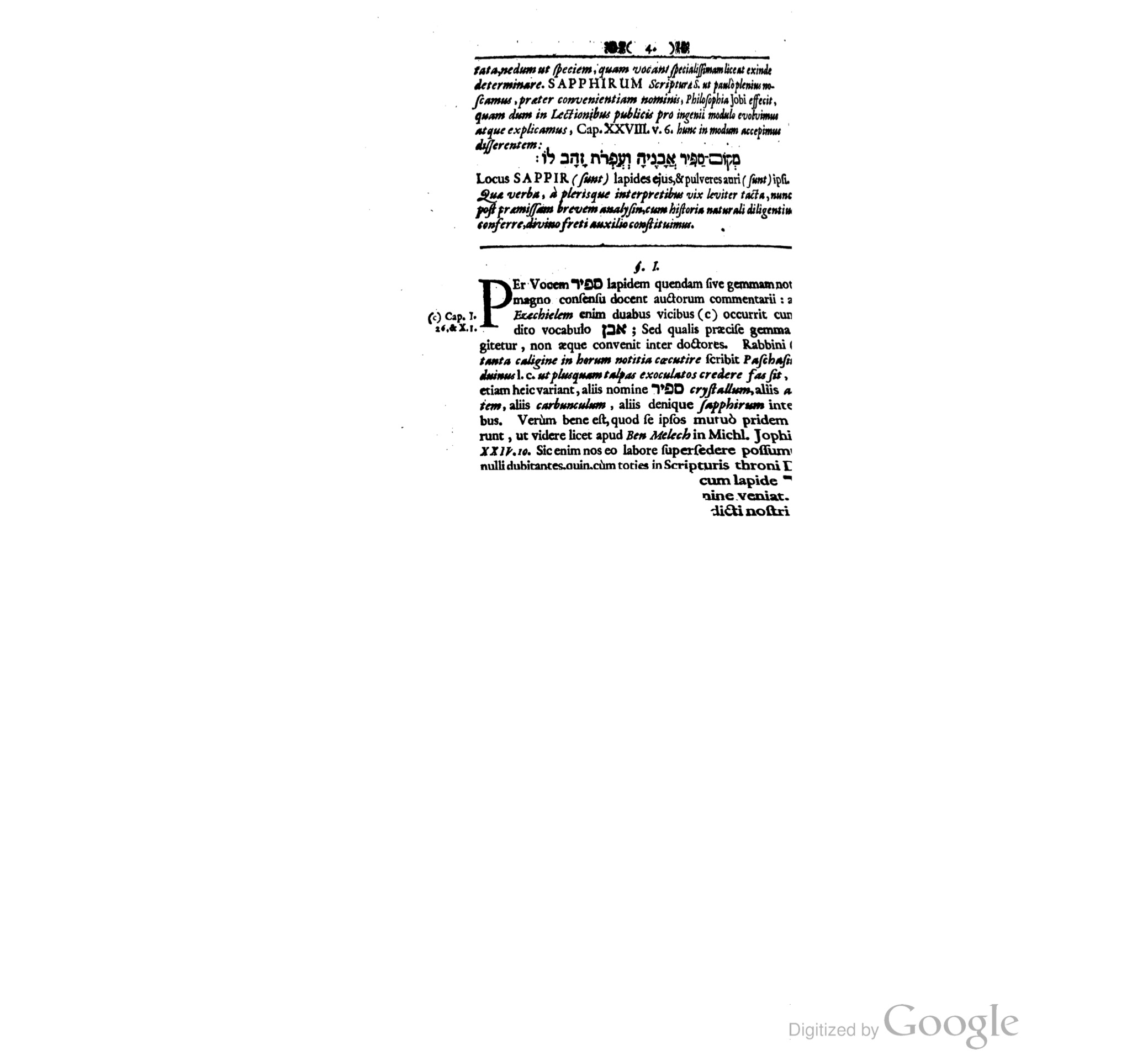
De Sapphiro Scripturaes

Book
Baier, J.W. (1705) De Sapphiro Scripturaes. Altdorf, 15 pp.
Record No. 2701  |  Sinkankas/Born No.: NIS/NIB  |  RWHL
Johann Wilhelm Baier’s De Sapphiro Scripturae is an early 18th-century Latin dissertation examining the “sapphire” mentioned in biblical scripture. The work considers passages containing sapphirus and related terms, drawing upon biblical texts, classical authorities, linguistic evidence, and contemporary knowledge of precious stones in an attempt to determine the identity and properties of the stone intended by ancient writers. Of particular interest to historians of gemology is its treatment of the difficulties involved in correlating ancient gemstone names with modern mineral species, especially the long-standing question of whether the biblical sapphire represented modern sapphire, lapis lazuli, or another blue stone. The dissertation illustrates the intersection of biblical scholarship, philology, mineralogy, and traditional lapidary literature in the early 18th century.

Traité des Dragons et des Escarboucles
Treatise on Dragons and Carbuncles
Book
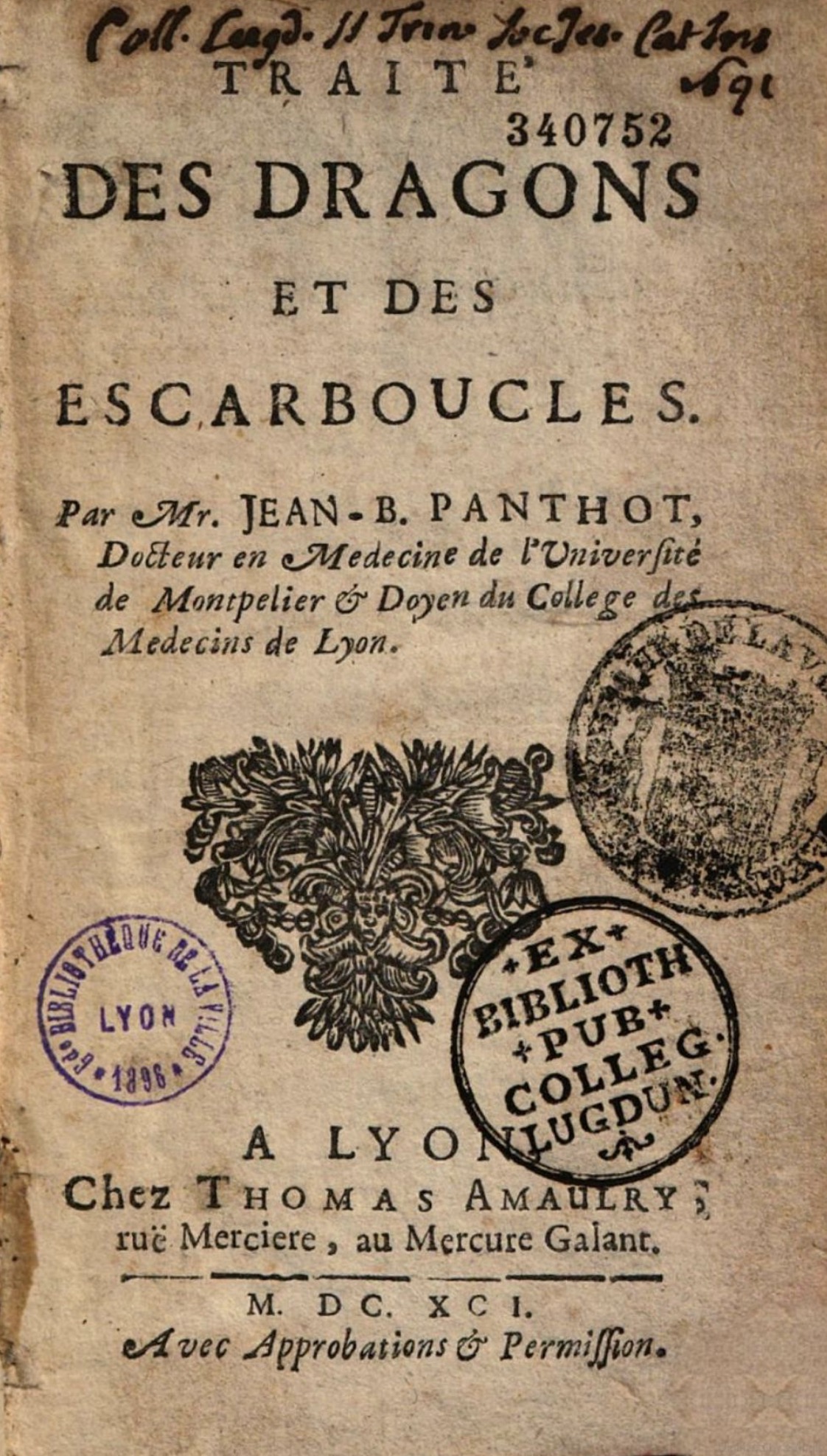
Panthot, J.-B. (1691) Traité des Dragons et des Escarboucles. [Treatise on Dragons and Carbuncles] Lyon, Thomas Amaulry, 93 pp.
Record No. 6924  |  Sinkankas/Born No.: 4957  |  Language: in French  |  RWHL
Jean-Baptiste Panthot’s Traité des Dragons et des Escarboucles is a late 17th-century French treatise examining traditions concerning dragons and the legendary carbuncle, a brilliant precious stone believed to shine with its own light and sometimes said to occur in or upon the heads of dragons and other creatures. Panthot considers accounts from classical, medieval, and contemporary authorities and discusses whether such creatures and luminous stones could exist in nature. Of particular interest to historians of gemology, the work explores the carbuncle tradition and contemporary ideas concerning exceptionally luminous red gemstones, while illustrating the persistence of fabulous lapidary lore alongside increasingly critical approaches to natural history. It provides an unusual example of the intersection of gemology, zoology, folklore, medicine, and natural philosophy at the end of the 17th century.

De jaspide antinephritico

On the anti-nephritic jasper
Journal Article
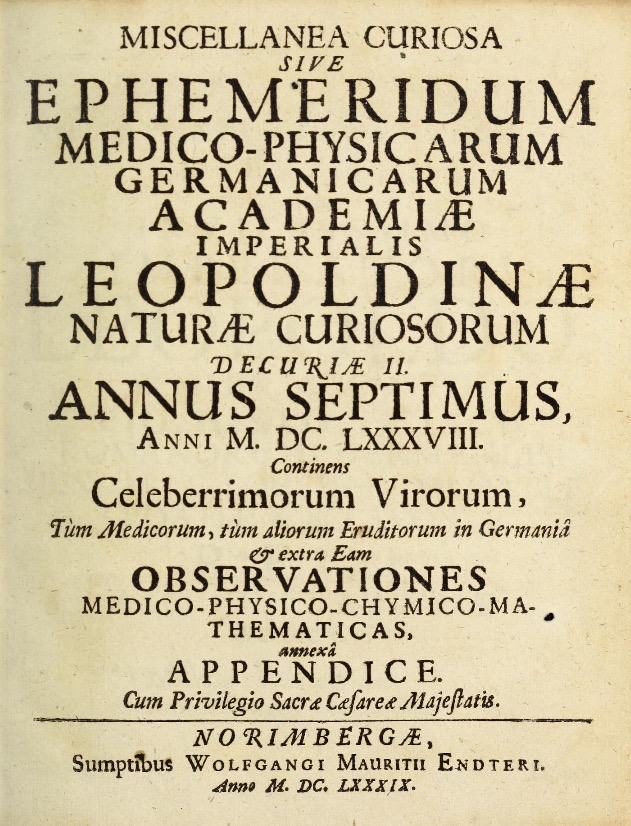
Menzel, C. (1689) De jaspide antinephritico. [On the anti-nephritic jasper] Miscellanea Curiosa, sive Ephemiridum Medico-Physicarum Germanicarum Academiae Naturae Curiosorum, Vol. 7, Dec. 2, 1688, pp. 4–5.
Record No. 10938  |  Sinkankas/Born No.: NIS  |  Language: in Latin  |  RWHL
Christian Menzel’s De jaspide antinephritico is a short medical-mineralogical notice concerning the so-called “anti-nephritic jasper,” a stone believed to possess therapeutic properties against ailments of the kidneys and urinary tract. Menzel discusses the material within the early modern European tradition of lapis nephriticus, in which certain stones—particularly jade-like materials brought from the Americas and Asia—were worn or otherwise employed as remedies for renal complaints. The article is of particular interest to historians of gemology because it documents the medical reputation, identification, and use of ornamental stones associated with nephrite before jade was recognized mineralogically as a distinct material. It illustrates the close relationship between mineralogy, medicine, commerce, and traditional lapidary beliefs in the late 17th century.

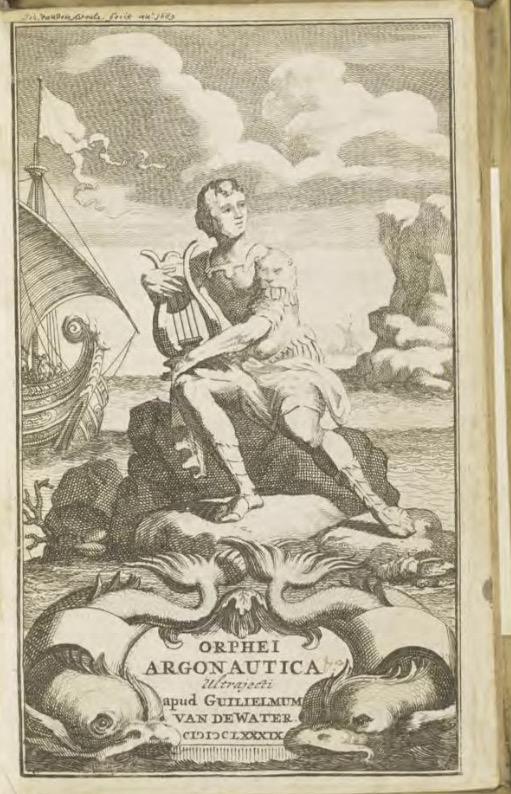
Orpheos Argonautika Hymnoi kai Peri lithon = Orphei Argonautica hymni et De lapidibus / curante Andrea Christiano Eschenbachio, Noribergense, cum ejusdem ad Argonautica notis & emendationibus. Accedunt Henrici Stephani in omnia & Josphi Scaligeri in hymnos notae
Orpheus' Argonautica, Hymns, and On Stones = Orpheus' Argonautica, hymns, and On Stones / edited by Andreas Christian Eschenbach, from Nuremberg, with his notes and corrections on Argonautica. Also included are Henri Estienne's notes on everything & Joseph Scaliger's notes on the hymns
Book
Orpheos (1689) Orpheos Argonautika Hymnoi kai Peri lithon = Orphei Argonautica hymni et De lapidibus / curante Andrea Christiano Eschenbachio, Noribergense, cum ejusdem ad Argonautica notis & emendationibus. Accedunt Henrici Stephani in omnia & Josphi Scaligeri in hymnos notae. [Orpheus' Argonautica, Hymns, and On Stones = Orpheus' Argonautica, hymns, and On Stones / edited by Andreas Christian Eschenbach, from Nuremberg, with his notes and corrections on Argonautica. Also included are Henri Estienne's notes on everything & Joseph Scaliger's notes on the hymns], G. vande Water, 329 pp.
Record No. 7497  |  Sinkankas/Born No.: 4891  |  Language: in Latin  |  RWHL
Sinkankas: The most important poem, or hymn, for the gemologist is the Lithica, where in 770 lines the virtues of some thirty gems are set forth with considerable allusion to magic...From the content, the form, the viewpoint and the style of this poem, it is most apparent the composer could only have lived...before the Emperor Constantine and not long after Emperor Valentine."

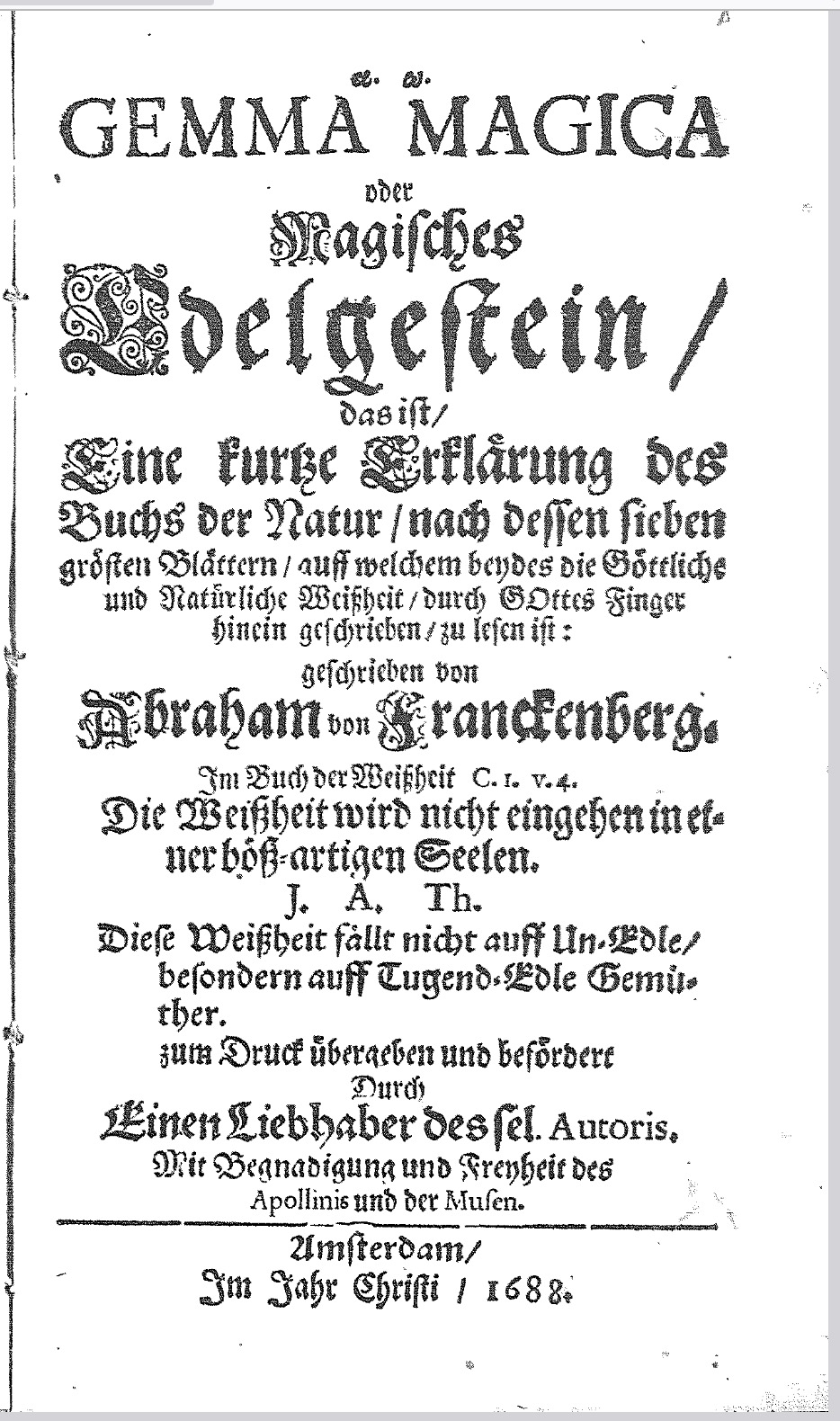
Gemma magica oder magisches Edelgestein
Gemma Magica, or The Magical Precious Stone
Book
Gemma, A. (1688) Gemma magica oder magisches Edelgestein. [Gemma Magica, or The Magical Precious Stone] Amsterdam, Jm Gabr Efrifi, 159 pp.
Record No. 29004  |  Sinkankas/Born No.: 2334 (not seen)  |  Language: in German  |  RWHL
Abraham Gemma’s Gemma magica oder magisches Edelgestein is a late 17th-century German lapidary devoted to the natural, medicinal, occult, and magical properties traditionally attributed to precious stones. The work discusses various gems and minerals, their supposed virtues and effects, and their uses as remedies, amulets, and talismans, drawing upon classical, medieval, and early modern lapidary traditions. It reflects a period in which empirical observations of gemstones coexisted with astrology, sympathetic magic, medicine, and beliefs concerning their supernatural powers. The work is of particular interest to historians of gemology as evidence for the persistence of traditional gem lore in early modern Europe and for the changing relationship between mineralogy, medicine, magic, and the emerging experimental sciences.

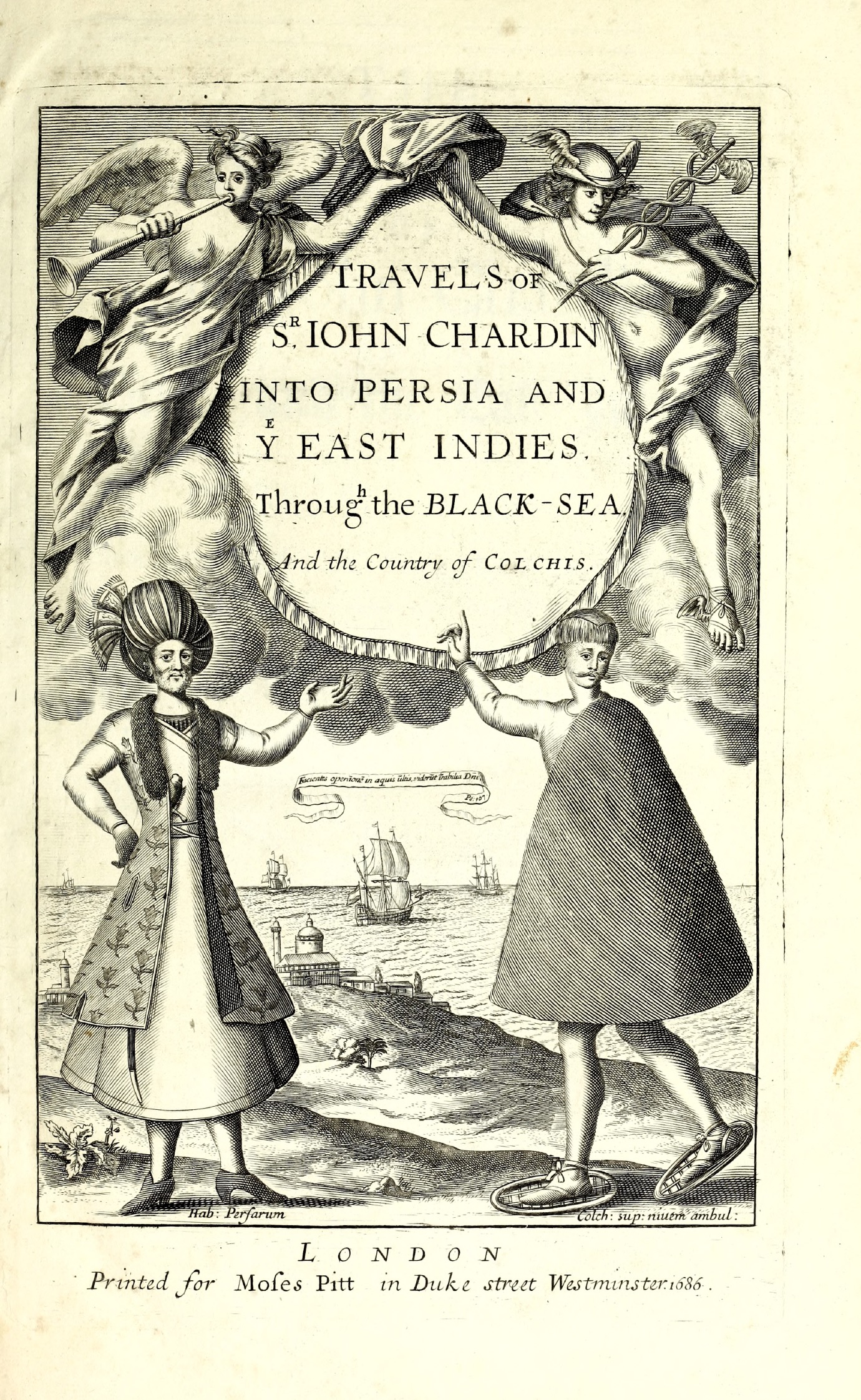
A New and Accurate Description of Persia

Book
Chardin, J. (1686) A New and Accurate Description of Persia. London, Moses Pitt, 2 Vols.
Record No. 29163  |  Sinkankas/Born No.: NIS/NIB  |  RWHL
Jean Chardin’s A New and Accurate Description of Persia is an English account of Safavid Persia based on the author’s extensive travels and residence there. Chardin describes the country’s geography, government, court, religion, customs, cities, architecture, manufactures, commerce, and natural products, drawing heavily on firsthand observation. As a trained jeweler and gem merchant, he provides particularly valuable information on precious stones, pearls, jewelry, goldsmithing, gem cutting, valuation, and the trade in luxury goods, including materials reaching Persia from India and other parts of Asia. His observations on gems and jewelry are among the most important 17th-century European accounts of the subject, combining a merchant’s practical knowledge with detailed descriptions of the Safavid court and international trade. The work is consequently a major source for the history of gemology, jewelry, and the gemstone trade in Persia and western Asia.

Building a Gemological Library

Gemological books range from general identification manuals and textbooks to specialized works on individual gems, mineralogy, jewelry, treatments, synthesis, history and gem-producing regions.

For a curated selection of particularly useful books, read The Gemologist's Core Library — Classic Books on Gemology, Jewelry and Mineralogy.

About Four Treasures

Four Treasures is Lotus Gemology's freely accessible gemological reference database. Use the full database to search by author, title or keyword and explore literature on gemology, mineralogy, jewelry and related fields. Where available, hyperlinks on titles may lead directly to the full publication.

Search the Complete Four Treasures Database