Gemology Books Bibliography

Gemology Books Bibliography

Explore books on gems, gemology, jewelry and mineralogy in Four Treasures, the Lotus Gemology reference database. This bibliography brings together matching book records from the collection, with publication details, abstracts and cover images where available.

Gemology Book References

The list below matches books concerning gemology and related subjects in the database's searchable fields. Some works cover several branches of gems, jewelry or mineralogy.

3,321–3,340 of 3,452 matching references

Technical Analysis of Pre-Columbian Costa Rican Jadeite and Greenstone Artifacts

Technical Analysis of Pre-Columbian Costa Rican Jadeite and Greenstone Artifacts

Thesis
Chenault, M.L. (1986) Technical Analysis of Pre-Columbian Costa Rican Jadeite and Greenstone Artifacts., Boulder: University of Colorado
Record No. 28421  |  Sinkankas/Born No.: NIS/NIB  |  not seen
La tradition manuscrite du Liber lapidum de Marbode de Rennes d'après les manuscrits conservés en France
La tradition manuscrite du Liber lapidum de Marbode de Rennes d'après les manuscrits conservés en France

Thesis
Herrera, M.E. (1986) La tradition manuscrite du Liber lapidum de Marbode de Rennes d'après les manuscrits conservés en France. Paris IV Sorbonne, 718 pp.
Record No. 27918  |  Sinkankas/Born No.: NIS/NIB  |  not seen
This thesis begins by an introduction which contains, the life of Marbode of Rennes, something about the history of lapidaries, above all of Latin lapidaries, and explains the contents of the liber lapidum. In the second chapter, the author enumerates the medieval translations of the book into eleven languages and describes the editions of the Latin text. The chapter ends with a list of the manuscripts of the liber lapidum kept outside of France and with a description of the history and of the contents of the manuscripts kept in France. In the third chapter, we have the classification into six families of the manuscripts kept in France. The thesis ends with a supplement containing two chapters of the critical edition that the author will publish in the future: the prologue and chapter vi on the emerald with a French translation. At the end we find a bibliography and an index of the manuscripts cited in the thesis.

Mineralogische Bestimmungen

Mineralogical identifications
Book Section
Riederer, J. (1986) Mineralogische Bestimmungen. [Mineralogical identifications] In: Mira et Magica, Gemmen im Ägyptischen Museum der Staatlichen Museen, Preussischer Kulturbesitz, Berlin-Charlottenburg, Mainz am Rhein, pp. 127–143.
Record No. 26894  |  Sinkankas/Born No.: NIS/NIB  |  Language: in German  |  not seen
Riederer provides the mineralogical identification of the materials used for the engraved and magical gems catalogued by Hanna Philipp in Mira et Magica. The contribution supplies the scientific basis for distinguishing the various natural stones and artificial materials represented in the collection and discusses the problems inherent in identifying ancient gem materials, particularly where traditional archaeological or gemological names do not correspond precisely with mineralogical nomenclature. The results complement Philipp’s archaeological and iconographic catalogue by establishing the actual materials from which the objects were made. A later archaeometric discussion specifically uses the Mira et Magica collection to illustrate how different investigators could arrive at differing identifications because of both analytical and nomenclatural problems.

Indian Antiquity

Journal Article
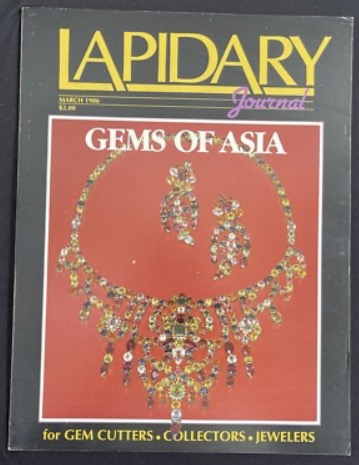
Francis, P. (1986) Indian Antiquity. Lapidary Journal, Vol. 39, No. 12, pp. 45–55.
Record No. 17138  |  Sinkankas/Born No.: NIS/NIB  |  not seen
Detailed discussion of lapidary industry using amethyst and citrine (natural and heat-treated) in ancient India producing centers; discussion pre-dates the seminal archaeology at Arikamedu under the direction of Vimala Begeley, and deputy site archaeologist Steven Sidebotham. A comparison of the amethyst and citrine beadmaking processes in South India at Kotalingala (Andhra Pradesh) and Arikamedu (Pondicherry) over the last four centuries B.C.

The Literature of Gemstones

Book
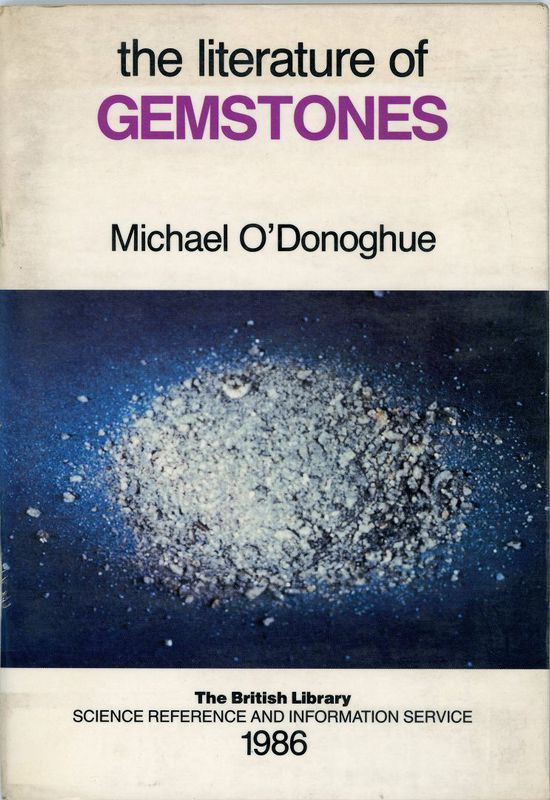
O’Donoghue, M. (1986) The Literature of Gemstones. London, British Library Science Reference and Information Service, 75 pp.
Record No. 16961  |  ISBN/ISSN: 9780710000000  |  not seen
Nigel Israel: This is an extremely useful little book (booklet would, I think, be a better description) by the Curator of Earth Sciences at the British Library. Starting with a general preface and introduction, it attempts, quite successfully, to list the more important works on gemmology under various categories, including encyclopaedic works, general comprehensive surveys, gem testing, gem testing instruments, quick reference publications, textbooks, synthetic gemstones, fashioning, works on individual species, jewellery, gemstones of particular localities, bibliographies, abstracts, journals, gemstone prices, guides to collections, and regalia. The works are listed with their publication details, including if and where they are held by the British Library, and, in many cases, with helpful descriptions by the author. The book ends with a useful index, followed, inexplicably, by two pages of beryl and corundum crystal diagrams. The literature of gemmology is extremely large, so the selection is necessarily a personal one by the author, and many people will likely be surprised by the omission of some of their favorite works. The reviewer was personally most surprised by the exclusion of Diamonds and Precious Stones by Emanuel (1865 and 1867), as this book contains an extremely extensive bibliography of historic books on gemstones. However, despite the unfortunately high price of a soft-covered booklet of little more than photostat quality, I would certainly recommend The Literature of Gemstones (together with the author’s companion work The Literature of Mineralogy) to anyone interested in gemmology.

Safirul si Rubinul

Sapphire and Ruby
Book
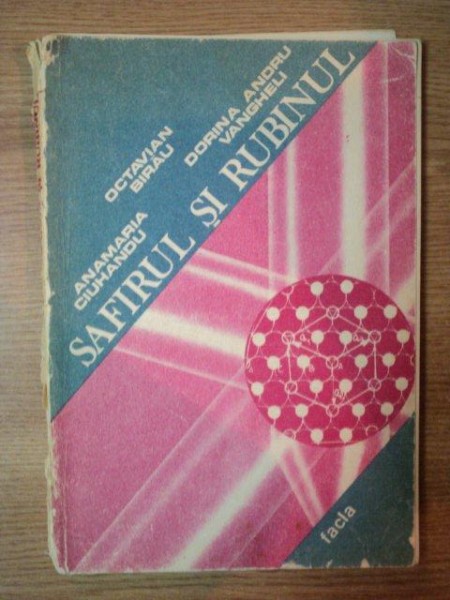
Birau, O., Ciuhandu, A. and Vangheli, D.A. (1986) Safirul si Rubinul. [Sapphire and Ruby] Timisoara, Rumania, Editura Facla, 171 pp.
Record No. 4711  |  Sinkankas/Born No.: NIS/NIB  |  Language: in Romanian  |  seen
Birău, Ciuhandu and Vangheli present a comprehensive Romanian-language treatment of ruby and sapphire as gem varieties of corundum. The book places particular emphasis on the crystallography and crystal structure of corundum, including its investigation by X-ray methods, while also treating the mineralogical and gemological properties of ruby and sapphire. Tables, diagrams, experimental methods and analytical techniques accompany the text. A contemporary Journal of Gemmology review describes it as an “exhaustive treatise” on ruby and sapphire, specifically noting its detailed treatment of crystal structure and its extensive bibliography.

Die diagnostischen eigenschaften der neuen synthesen
The diagnostic properties of the new syntheses
Journal Article
Gübelin, E.J. (1986) Die diagnostischen eigenschaften der neuen synthesen. [The diagnostic properties of the new syntheses] Deutsche Goldschmiede-Zeitung, Vol. 84, No. 11, pp. 69–76.
Record No. 2175  |  Language: in German  |  not seen
Gübelin reviews the diagnostic properties of several recently introduced synthetic gemstones and the problems they pose for separation from their natural counterparts. Emphasis is placed on the combination of conventional gemological properties with microscopic examination of inclusions and growth structures, supplemented where necessary by spectroscopic and other analytical methods. The article discusses characteristic features of newer synthetic materials, particularly synthetic corundum and emerald, and shows that physical constants alone may be insufficient for identification as manufacturing techniques increasingly reproduce the appearance and properties of natural stones. Gübelin stresses the diagnostic importance of flux residues, metallic inclusions, growth zoning and other internal features associated with particular synthesis processes. The paper summarizes practical criteria by which these newer products can be recognized in gemological testing.

Rediscovered Masterpieces of Mesoamerica: Mexico-Guatemala-Honduras
Book
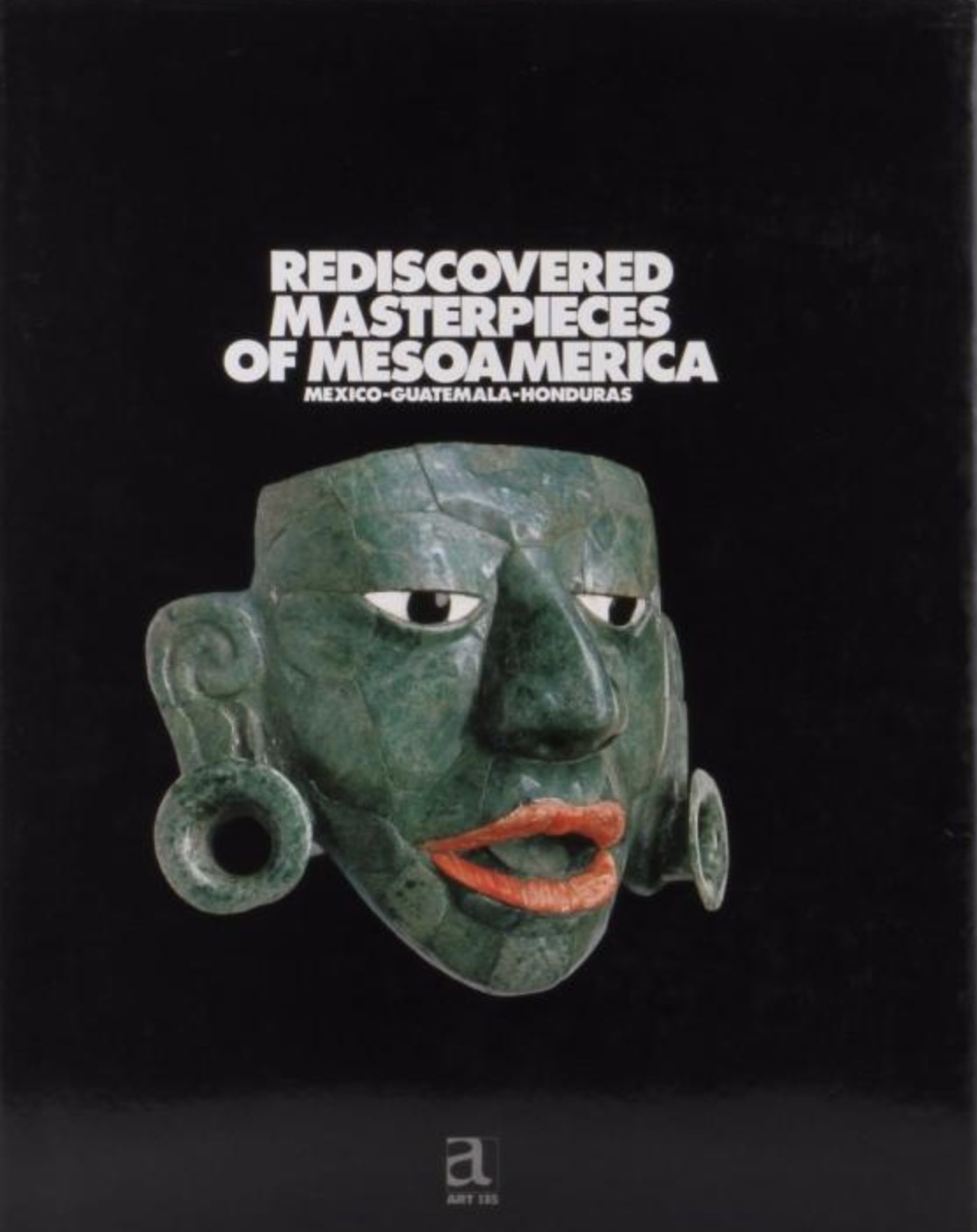
Bergonneau, G., Deletaille, E. and Sonnery, J.-L. (1985) Rediscovered Masterpieces of Mesoamerica: Mexico-Guatemala-Honduras. Boulonge, France, Editions Arts, 287 pp.
Record No. 28854  |  ISBN/ISSN: 9782910000000  |  Sinkankas/Born No.: NIS/NIB  |  not seen
Library Journal: The first in a proposed series on pre- Columbian, Oceanic, and African art, this book is a well designed and lavishly illustrated survey focusing on the sculpture traditions of pre-Columbian Mesoamerica. The very readable text provides an iconographic, social, and stylistic survey of Mesoamerican art in general. Unfortunately, the text does not directly relate to the illustrations and suffers from uneven explanatory documentation of the illustrated art ob jects. Still, the illustrations alone would make this a worthy purchase.

Chaucer's “Corones Tweyne” and Matheolus

Journal Article
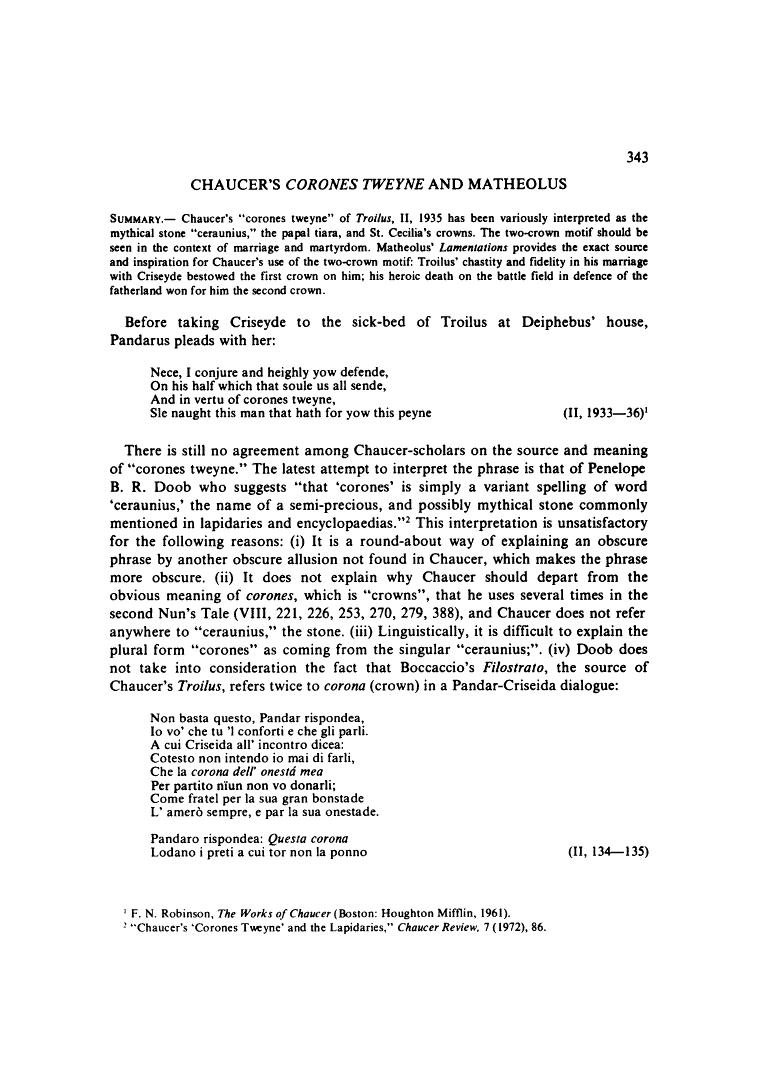
Thundy, Z.P. (1985) Chaucer's “Corones Tweyne” and Matheolus. Neuphilologische Mitteilungen, Vol. 86, No. 3, pp. 343–347.
Record No. 27943  |  ISBN/ISSN: 283754  |  Sinkankas/Born No.: NIS/NIB  |  not seen
Chaucer's corones tweyne" of Troilus, II, 1935 has been variously interpreted as the mythical stone "ceraunius," the papal tiara, and St. Cecilia's crowns. The two-crown motif should be seen in the context of marriage and martyrdom. Matheolus' Lamentations provides the exact source and inspiration for Chaucer's use of the two-crown motif: Troilus' chastity and fidelity in his marriage with Criseyde bestowed the first crown on him; his heroic death on the battle field in defence of the fatherland won for him the second crown."
Veirgleichende chemische und optische Untersuchungen an Chrysoberyllen verchiedener Laggerstätten
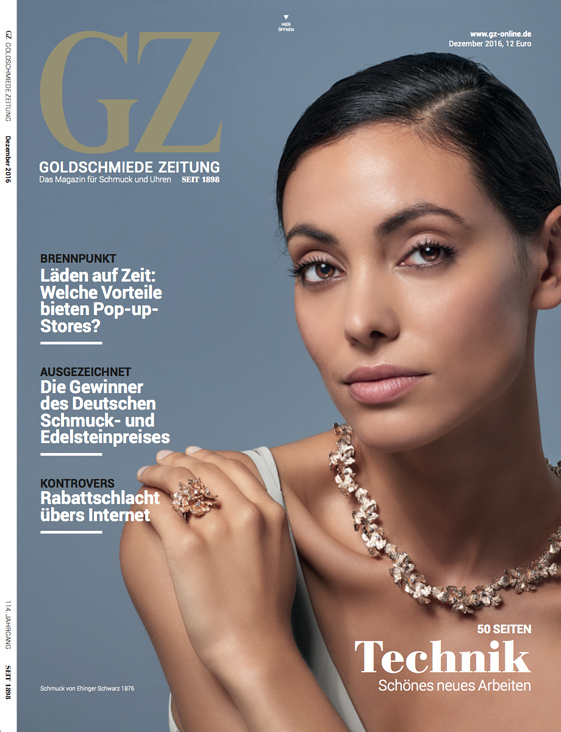
Veirgleichende chemische und optische Untersuchungen an Chrysoberyllen verchiedener Laggerstätten

Comparative chemical and optical studies on chrysoberyls from different deposits
Thesis
Henn, U. (1985) Veirgleichende chemische und optische Untersuchungen an Chrysoberyllen verchiedener Laggerstätten. [Comparative chemical and optical studies on chrysoberyls from different deposits]. Johannes Gutenberg Universität, Mainz
Record No. 4284  |  Language: in German  |  not seen
Henn presents a comparative investigation of chrysoberyl from different geographic deposits, examining relationships among chemical composition, optical properties, and geographic origin. The study uses chemical and spectroscopic data to characterize variations in ordinary chrysoberyl and alexandrite, with particular attention to trace elements responsible for coloration and the alexandrite color-change effect. Variations in chromium and other minor and trace constituents are compared with refractive and absorption behavior, allowing characteristic features of chrysoberyl from different deposits to be assessed. The work provides a mineralogical and gemological basis for understanding how compositional differences influence the color and optical properties of chrysoberyl and for evaluating the extent to which such properties may help characterize provenance.

Rasterelektronen-mikroskopie. Einige anwendungen in der edelsteinforschung
Scanning electron microscopy. Some applications in gemstone research
Journal Article
Hofmann, C., Schrader, H.W. and Stender, E. (1985) Rasterelektronen-mikroskopie. Einige anwendungen in der edelsteinforschung. [Scanning electron microscopy. Some applications in gemstone research] Goldschmiede Zeitung, Vol. 83, No. 6, pp. 76–77.
Record No. 2382  |  Sinkankas/Born No.: NIS/NIB  |  Language: In German  |  not seen
Hofmann, Schrader and Stender describe applications of scanning electron microscopy (SEM) to gemological research, emphasizing its usefulness for examining surface structures and extremely small features beyond the practical resolution of conventional gemological microscopy. Examples illustrate how the technique can reveal the morphology of inclusions, growth and dissolution features, fracture surfaces, and other microscopic structures relevant to gemstone investigation. When combined with electron-beam microanalysis, SEM also permits localized chemical characterization of minute inclusions or surface features. The brief article demonstrates the value of SEM as a complementary research technique where conventional optical microscopy alone provides insufficient morphological or compositional information.

Edelsteine und ihre Mineraleinschlüsse
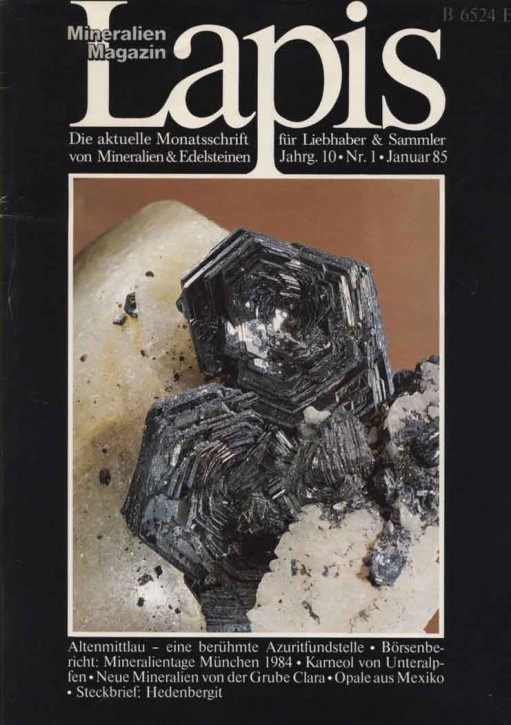
Gemstones and their mineral inclusions
Book
Weibel, M. (1985) Edelsteine und ihre Mineraleinschlüsse. [Gemstones and their mineral inclusions] Zürich, ABC Verlag, 111 pp.
Record No. 2217  |  ISBN/ISSN: 3855040885  |  Sinkankas/Born No.: 7113; NIB  |  Language: in German  |  not seen
Weibel provides a concise survey of the principal gemstones with particular emphasis on their mineral inclusions and what these reveal about gemstone formation. Rather than being solely an inclusion atlas, the book introduces the major gem species and relates their characteristic internal minerals and structures to their geological genesis. Numerous photomicrographs illustrate diagnostic inclusions and demonstrate their value for understanding the conditions under which their host gemstones crystallized. The volume was prepared with the assistance of Eduard J. Gübelin, who also supplied some of the photographs. It contains 83 color and 23 black-and-white illustrations. A contemporary Journal of Gemmology review specifically praises its treatment of inclusions and the accompanying explanations of their formation.

Opale aus Mexico

Opals from Mexico
Journal Article
Gübelin, E.J. (1985) Opale aus Mexico. [Opals from Mexico] Lapis, Vol. 10, No. 1, Januar, pp. 23–30.
Record No. 2174  |  Sinkankas/Born No.: 2595; NIB  |  Language: in German  |  not seen
Gübelin describes the opal deposits of Mexico, concentrating on the important occurrences in Querétaro and their characteristic transparent to translucent precious and fire opals. He discusses the volcanic geological setting, occurrence of opal in cavities and fractures in rhyolitic rocks, mining and recovery of the material, and the considerable range of body colors and play-of-color displayed by Mexican opals. Particular attention is given to the internal characteristics of the stones, including mineral and fluid inclusions, and to the differences between Mexican volcanic opal and opal from other major producing regions. The article provides both a description of the deposits and a gemological characterization of their products. Gübelin’s article is subsequently cited specifically for opal from the Carbonera mine at La Trinidad, Querétaro.
Gemmologisk Mikroskopi genom Faskontrast Metoden
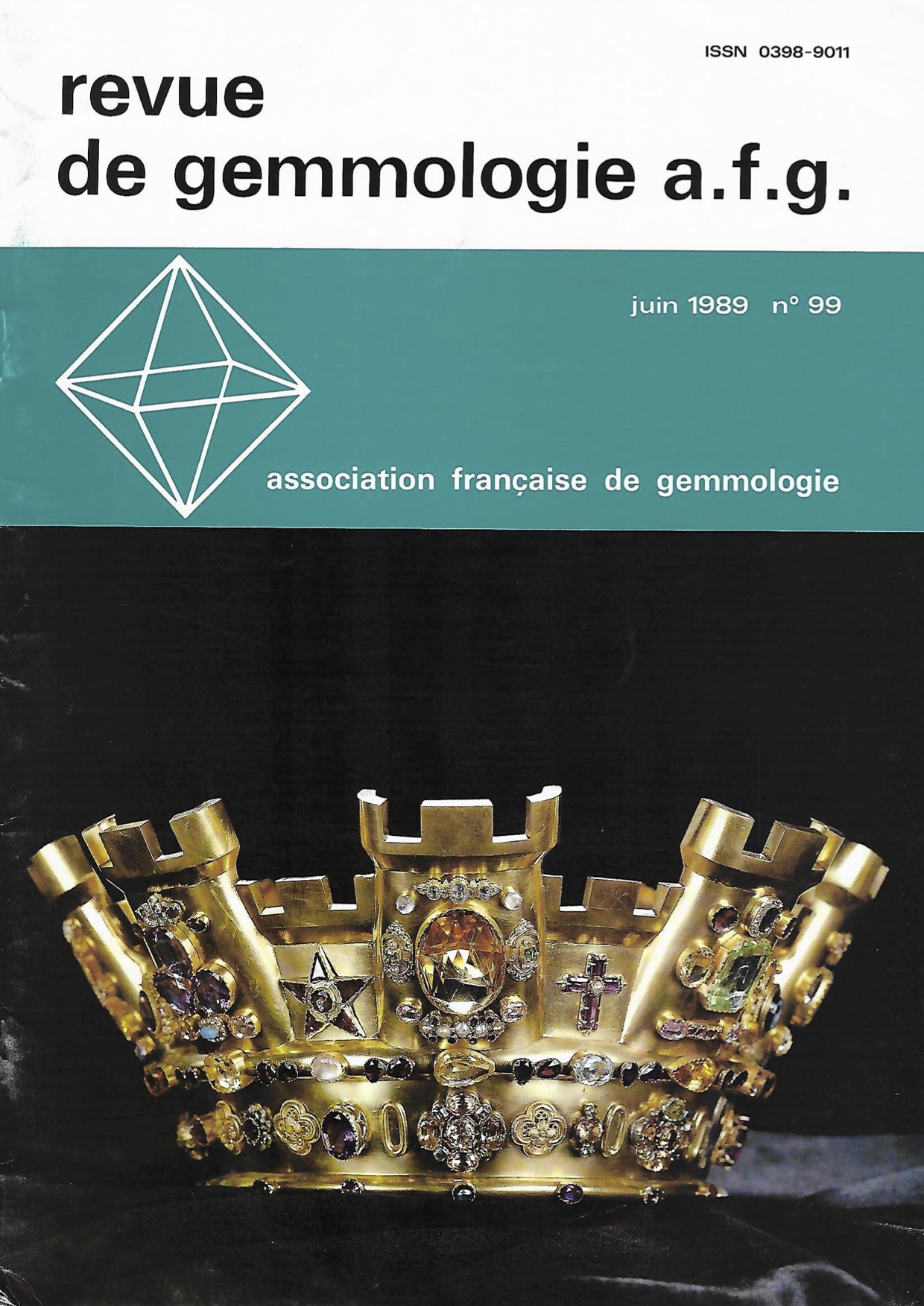
Gemmologisk Mikroskopi genom Faskontrast Metoden

Gemmological Microscopy through Phase Contrast Method
Journal Article
Gübelin, E.J. (1985) Gemmologisk Mikroskopi genom Faskontrast Metoden. [Gemmological Microscopy through Phase Contrast Method] Gem: Bulletinen Stockholms Gemmologiska Förening, No. 1,
Record No. 2172  |  Language: in Swedish  |  not seen
Gübelin describes the application of phase-contrast microscopy to gemology, a technique that greatly increases the visibility of otherwise faint internal structures in transparent gemstones. Phase contrast converts small differences in optical path—caused by variations in refractive index or thickness—into differences in image brightness, making extremely low-contrast inclusions and growth features easier to observe. Gübelin discusses the optical principle and the adaptation of a conventional gemological microscope for phase-contrast observation, emphasizing its usefulness for studying minute inclusions, growth structures and other internal features that may be difficult or impossible to recognize with ordinary bright-field illumination. The technique thus extends the diagnostic possibilities of inclusion microscopy in gemstone identification and research.

Deux nouveaux produits artificiels sur le marché des pierres précieuses: Le rubis synthétique “Ramaura” et le gallo-aluminate d’yttrium
Two new artificial products on the gemstone market: Synthetic ruby “Ramaura” and yttrium gallo-aluminate
Journal Article
Gübelin, E.J. (1985–1986) Deux nouveaux produits artificiels sur le marché des pierres précieuses: Le rubis synthétique “Ramaura” et le gallo-aluminate d’yttrium. [Two new artificial products on the gemstone market: Synthetic ruby “Ramaura” and yttrium gallo-aluminate] Revue de Gemmologie A.F.G., No. 85, pp. 13–16; No. 86, p. 15; No. 87, pp. 15–16,
Record No. 903  |  Sinkankas/Born No.: NIS/NIB  |  Language: in French  |  not seen
Gübelin describes two recently introduced artificial gem materials: Ramaura flux-grown synthetic ruby and yttrium gallium aluminate (YAG), the latter marketed as a green imitation of tsavorite garnet. The first portion discusses the manufacture and gemological properties of Ramaura ruby and emphasizes microscopic features useful for separating it from natural ruby, particularly characteristic flux residues and growth-related inclusions. The later installments treat yttrium gallium aluminate, describing its physical and optical properties and characteristic inclusions. The green material has a high refractive index and specific gravity and contains distinctive reddish-brown flux inclusions and wispy veil-like features. The series illustrates the importance of inclusion microscopy in recognizing artificial gem materials whose appearance may closely resemble natural gemstones. Contemporary abstracts confirm that the second installment concentrates on characteristic inclusions and the third on the physical and optical properties and inclusions of yttrium gallium aluminate.

Les pierres magiques et le merveilleux

Magical stones and the marvelous
Book Section
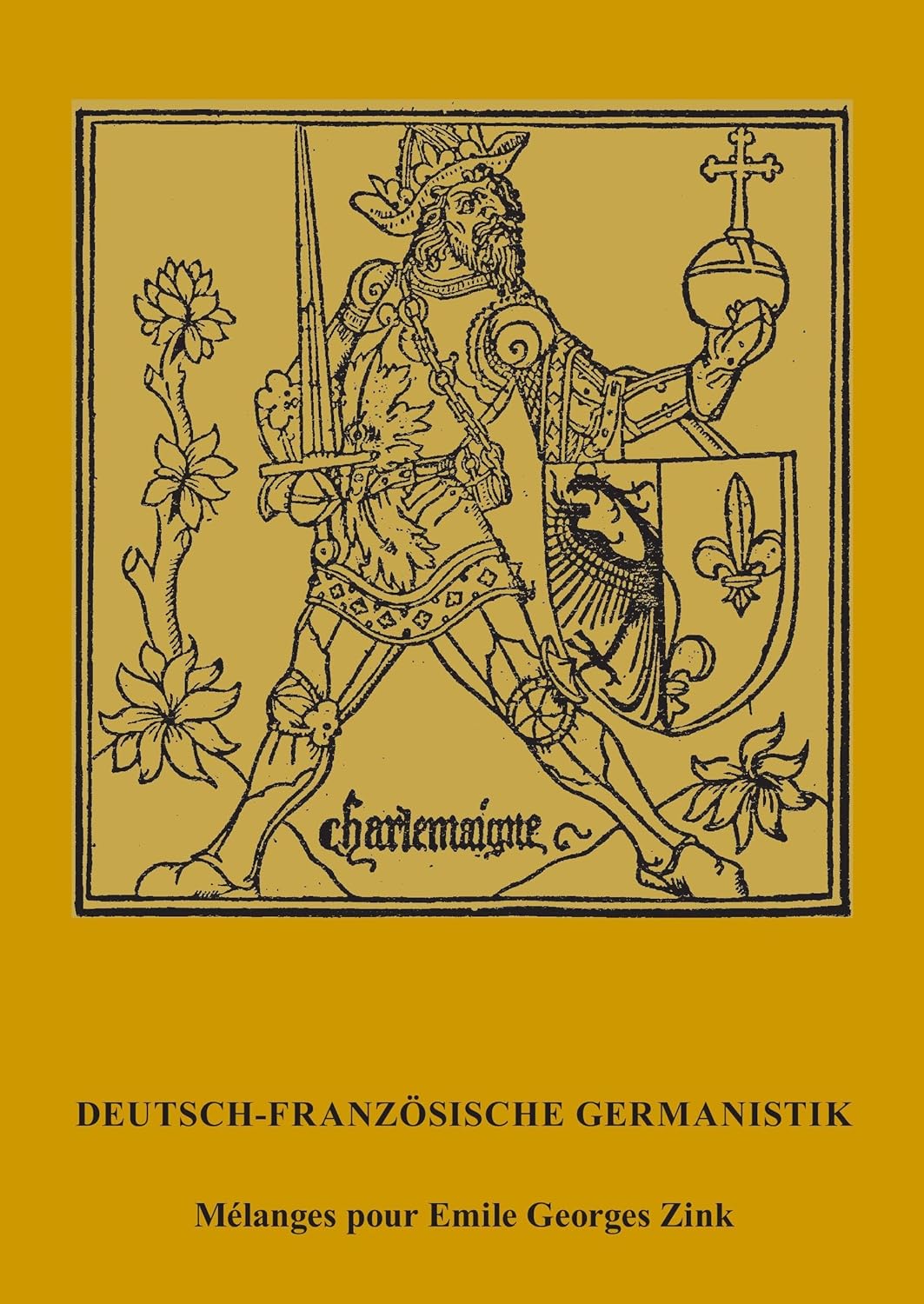
Lecouteux, C. (1984) Les pierres magiques et le merveilleux. [Magical stones and the marvelous] In: Deutsch-Französische Mediävistik. Mélanges pour G.E. Zink, Göppingen, pp. 53–67.
Record No. 27958  |  ISBN/ISSN: 9783870000000  |  Sinkankas/Born No.: NIS/NIB  |  Language: in French  |  not seen
Lecouteux examines the role of stones possessing magical or marvelous properties in medieval literature and belief. Drawing on lapidaries and literary sources, he considers stones credited with powers extending beyond their physical qualities, including protection, healing, divination, invisibility, and other supernatural effects. The study places such stones within the medieval conception of the merveilleux, showing how traditions inherited from Classical and late-antique lapidary literature were incorporated into medieval narratives and systems of belief. Rather than treating these accounts simply as mineralogical lore, Lecouteux emphasizes the cultural function of magical stones and the ways their supposed virtues contribute to the supernatural world of medieval texts.
The Middle English ‘Boke of Stones’: The Southern Version
The Middle English ‘Boke of Stones’: The Southern Version

Edited Book
Keiser, G.R., editor (1984) The Middle English ‘Boke of Stones’: The Southern Version.. Bruxelles, OMIREL, 93 pp..
Record No. 27924  |  Sinkankas/Born No.: NIS/NIB  |  not seen

Ancient Trade and Society

Book
Casson, L. (1984) Ancient Trade and Society. Detroit, Wayne State University Press, 232 pp.
Record No. 25410  |  ISBN/ISSN: 9780810000000  |  not seen

Ein neuer Edelstein aus der Feldspat-Familie
A new gemstone from the feldspar family
Journal Article
Gübelin, E.J., Bridges, C.R. and Graziani, G. (1984) Ein neuer Edelstein aus der Feldspat-Familie. [A new gemstone from the feldspar family] Zeitschrift der Deutschen Gemmologischen Gesellschaft, Vol. 33, No. 3/4, pp. 104–113.
Record No. 5055  |  Sinkankas/Born No.: NIS/NIB  |  Language: In German  |  not seen
Bridges, Graziani and Gübelin describe a newly recognized gem-quality feldspar from Kioo Hill, Kenya, occurring in the central portions of larger feldspar crystals in a kyanite-bearing pegmatite associated with vermiculite and quartz. Mineralogical and chemical investigation identifies the material as a low-temperature albite with peristerite structure. The pale blue to greenish material has refractive indices of approximately 1.531–1.539, birefringence 0.008, and specific gravity 2.623 ± 0.002. The study discusses its occurrence, composition, crystallographic structure and gemological properties, establishing the material as an unusual gem variety of sodic plagioclase. The paper includes eight color figures, four diagrams and two tables.

Objetos Ceremoniales en Piedra de la Cultura Mexica

Ceremonial Stone Objects of the Mexica Culture
Book
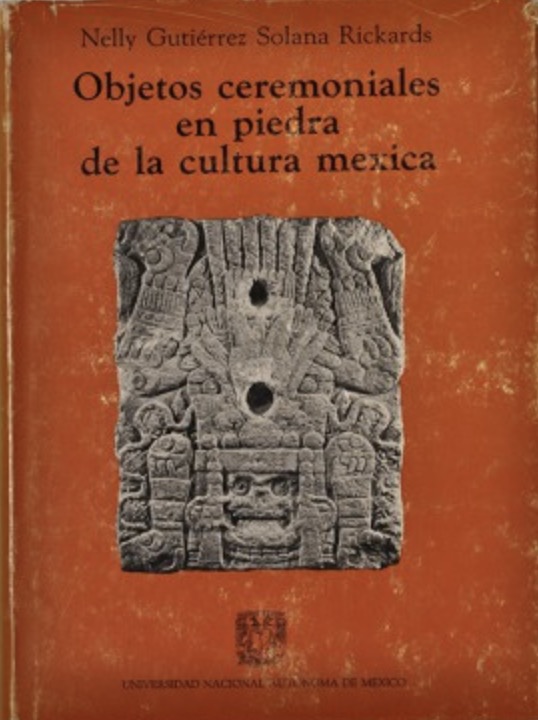
Gutiérrez Solana, N. (1983) Objetos Ceremoniales en Piedra de la Cultura Mexica. [Ceremonial Stone Objects of the Mexica Culture] Mexico City, Universidad Nacional Autónoma de México, 226 pp. + 124 pages of plates, 206 illustrations
Record No. 28860  |  ISBN/ISSN: 9685805946  |  Sinkankas/Born No.: NIS/NIB  |  Language: in Spanish  |  not seen
Gutiérrez Solana presents a systematic study of ceremonial stone objects associated with the Mexica (Aztec), examining their forms, iconography, religious functions, and relationship to ritual practices. The objects include stone representations and implements connected with sacrifice, autosacrifice, offerings, warfare, and the cult of particular deities. Individual pieces are analyzed through comparison with archaeological evidence and representations and descriptions in pre-Hispanic and early colonial sources. Among the objects discussed are zacatapayolli associated with bloodletting, as well as other carved stone implements and ritual forms. The study places these objects within Mexica religious symbolism rather than treating them simply as sculpture, providing an extensive illustrated corpus for understanding the material equipment of Aztec ceremonial life. Later scholarship continues to cite the book for individual ritual objects and their interpretation.

Building a Gemological Library

Gemological books range from general identification manuals and textbooks to specialized works on individual gems, mineralogy, jewelry, treatments, synthesis, history and gem-producing regions.

For a curated selection of particularly useful books, read The Gemologist's Core Library — Classic Books on Gemology, Jewelry and Mineralogy.

About Four Treasures

Four Treasures is Lotus Gemology's freely accessible gemological reference database. Use the full database to search by author, title or keyword and explore literature on gemology, mineralogy, jewelry and related fields. Where available, hyperlinks on titles may lead directly to the full publication.

Search the Complete Four Treasures Database