Gemstone Inclusions Bibliography

Gemstone Inclusions Bibliography

Explore books, articles and historical sources on inclusions in gemstones in Four Treasures, the Lotus Gemology reference database. This bibliography brings together matching records from the collection, with publication details, abstracts and cover images where available.

Gemstone Inclusion References

The list below matches the terms inclusion or inclusions in the database's searchable fields. Some references discuss inclusions as part of a broader subject.

141–160 of 1,120 matching references
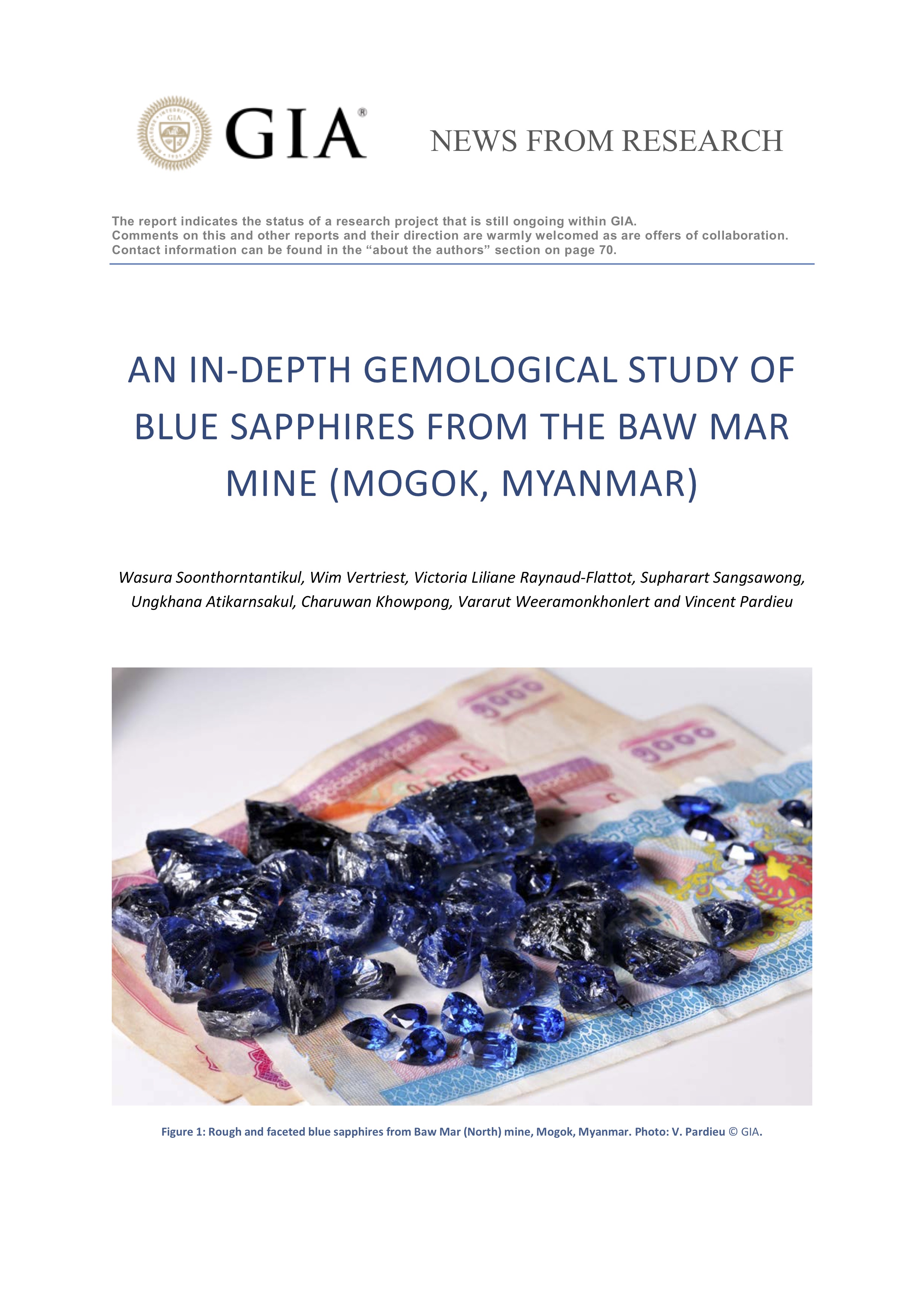
An in-depth gemological study of blue sapphires from the Baw Mar mine (Mogok, Myanmar)

An in-depth gemological study of blue sapphires from the Baw Mar mine (Mogok, Myanmar)

Soonthorntanikul, W., Vertriest, W., Raynaud-Flattot, V.L., Sangsawong, S., Atikarnsakul, U., Khowpong, C., Weeramonkhonlert, V. and Pardieu, V. (2017)

Report · Source: GIA News from Research · Publisher: Gemological Institute of America · Issue: February · Pages: 87 pp.

Abstract
High quality blue sapphires have been mined in Myanmar for centuries (Kane & Kammerling 1992, Themelis 2001, Hughes 1997). Until the end of the 20th Century, sapphires were mined from the Mogok Stone Tract, mainly in the western area near Kyatpin and around Mogok town. Towards the end of the 20th Century blue sapphire mining extended to the west around Kyauk Pya That, Kabaing and Kin, to the north around Barnard Myo and in the Chaung Gyi valley, and in the east around Peint Pyit village (Themelis 2008, Hughes 2016). Between 2011 and 2016 new production from Baw Mar area started to reach the market and attracted the attention of gemologists visiting the region (Phyo Kan Nyunt et al., 2013). GIA field gemologists visited Baw Mar operations in 2013, 2014, and 2015. It was evident the mine was not only the highest altitude mine in the whole of the Mogok area but also one of Mogok’s largest mining operations. Its sapphire production is interesting and challenging for gemologists as, its sapphire characteristics (chemistry and internal features) are slightly different from the classic Burmese sapphires. The aim of this research project is to expand our knowledge of these gemstones which can be a challenge in terms of origin determination. During the field expeditions and subsequent laboratory work it became clear that even within the same mine, sapphires can look different to one another depending on the area where they are mined; samples from the southern area are generally lighter in color than the sapphires recovered from the northern part of the mine. In this study, we analyzed samples collected at the office (located near the mining site where the production was sorted) during two separate expeditions. The samples were mined from opposite parts of the mine, southern and northern, respectively. The general gemological characteristics; inclusions, UV-VIS and IR spectra and trace element chemistry are covered. A description of the mine, mining techniques employed and preliminary geological observations are also provided. Most of the data collected reveals sufficient information to differentiate between the two sampled areas within the same mine. It is clear that the Baw Mar sapphires formed in a complex geological environment with the potential to produce a range of qualities (high to low), various inclusion scenes and variable trace element concentrations.
Keywords
corundum, Madagascar.12, gems
Jadeitite from Itoigawa, Niigata Prefecture, central Japan

Jadeitite from Itoigawa, Niigata Prefecture, central Japan

Miyajima, H. (2017)

Journal Article · Source: Journal of Mineralogical and Petrological Sciences · Volume: Vol. 112 · Issue: No. 5 · Pages: pp. 227–236

Abstract
This paper presents a review of Itoigawa’s jadeitite in history, culture, process of rediscovery, and geological characteristics. The people of the Jomon age used jadeitite as tools as far as 7000 years ago, making it one of the oldest jadeitite cultures in the world. The jadeitites from Itoigawa were the source of ornaments such as pendants or comma–shaped beads that can be dated to the Jomon age through to the Nara period. These ornaments are widely found in Japanese Islands from Hokkaido to Okinawa Prefecture, and also in the southern part of the Korean Peninsula. The jadeitite, however, was not used after the Nara period. The disappearance of jadeitite culture is not well understood, but it may have been caused by the introduction of Buddhism into Japan. Therefore, the existence of jadeitite in Japan was forgotten for a period of 1200 years after the Nara period. Mr. Eizo Ito rediscovered jadeitite from Itoigawa when he identified the durable green rock in the Kotakigawa River in 1938. His success was inspired by the idea of Mr. Gyofu Soma. The rediscovered jadeitite was studied by Dr. Yoshinori Kawano of the Tohoku Imperial University in 1939. There are large jadeitite boulders weighing more than 100 tons found in several areas of the Kotakigawa and Ohmigawa Rivers. These areas are designated national natural monuments. The jadeitite from Itoigawa can be found in various colors such as white, gray, black, lavender, and blue. These color variations are caused by the presence of trace elements such as iron and titanium in jadeite and omphacite, and tiny graphite inclusions in jadeitite. The absence of quartz and euhederal jadeite crystals with natrolite and veinlets of jadeitite indicates that the Itoigawa jadeitite does not form through decomposition of albite, but by hydrothermal activity. Some strontium dominant minerals such as itoigawaite were first found in jadeitite from Itoigawa. These strontium dominant minerals form in the calcium depleted hydrothermal solution in the late stages of jadeitite formation. The Jomon is the oldest jadeitite culture worldwide, and the first documented use of precious stones in the history of mankind. In addition, the jadeitite found in Itoigawa is the oldest known unit of its kind.
Keywords
gems, jade, jadeite, fei cui, Japan
Greek and Roman cartography

Greek and Roman cartography

Irby, G.L. (2016)

Book Section · Source: A Companion to Science, Technology, and Medicine in Ancient Greece and Rome · Volume: Vol. 1 · Pages: pp. 819–835

Abstract
At The Art of Love 2.125–142, Ovid recounts a charming vignette of Odysseus and Calypso spending a lazy seaside afternoon together. Calypso asks, again and again, that her captive lover recount his adventures in the Trojan War. Again and again, Odysseus “finds fresh words for the same old tale.” As they stroll, Calypso asks about one battle or another, while Odysseus, in answer, sketches out the scenes for her in the wet sand. “This,” he says, “is Troy (he made walls on the shore). This is the Simois. Let’s consider this spot my camp.” The allure of maps is universal: the arrangement of places, how one’s home fits into the scheme of the larger world, the extent of the inhabited world (oikoumenē). Like earlier Babylonian and Egyptian endeavors, early Greek maps depicted city plans, mine tunnels, geographical regions, the entire oikoumenē. Although the actual maps rarely survive—and maps were almost never included in manuscripts (see Neugebauer 1975 for an incomplete world map included in a thirteenth/fourteenth-century manuscript of Ptolemy’s Handy Tables)—some descriptions do: the information was considered useful, worth copying, and even entertaining. Ptolemy defines the art of cartography, inextricably intertwined with geography, as “an imitation through drafting of the entire known world together with the things that are, broadly speaking, connected with it” (Geography 1.1.1). He further distinguishes between world and regional cartography. The smaller scale of the latter allows for the inclusion of topographical details, such as harbors, rivers, and towns. It is also contested whether maps as we conceive of them existed at all in antiquity: Janni 1984 argues that graphic maps never extended beyond the initial stages, primarily because the ancients lacked a concept of scale. But the concept of “map” is fluid, and they took many forms, both pictorial and (more widely) verbal.
Keywords
gems, ancient technology, ancient science, mapmaking, Roman mapmaking, cartography
Emerald deposits around the world, their similarities and differences

Emerald deposits around the world, their similarities and differences

Giuliani, G., Branquet, Y., Fallick, A.E., Groat, L. and Marshall, D. (2015)

Journal Article · Source: InColor · Issue: December · Pages: pp. 56–69

Abstract
The French chemist N.L. Vauquelin (1763–1829) discovered chromium (Cr) in crocoite (PbCrO₄) from Beresov, Russia, and beryllium (Be) in emerald from Colombia more than 200 years ago. He determined the correct chemical composition of emerald and demonstrated that the difference between beryl and emerald was due to the presence of the coloring agent chromium. Today, emerald is defined by Schwarz and Schmetzer (2002) as “yellowish green, green or bluish green beryl—natural or synthetic—which reveals distinct Cr and/or vanadium (V) absorption bands in the red and blue-violet ranges of its absorption spectra.” Emerald is one of the most valuable gemstones. It is much rarer than diamond and can command a value thousands of times greater than gold. In the colored gemstone market, color is more important than clarity or brilliance in determining the value of an emerald. The green color of emerald arises from the unique geological conditions of its formation in contrasting environments. This article reviews, using state-of-the-art data, the crystal chemistry and formation of emerald, highlighting its paradoxes, as well as the geology of economically significant emerald deposits worldwide, comparing their origins, similarities, and differences.
Keywords
gems, beryl, emerald, Afghanistan, Brazil, Colombia, Zambia, Madagascar, China, Pakistan, Zimbabwe, inclusions
Internal Characteristics, Chemical Compounds and Spectroscopy of Sapphire as Single Crystals

Internal Characteristics, Chemical Compounds and Spectroscopy of Sapphire as Single Crystals

Diep, P.T.M. (2015)

Thesis · Publisher: Mainz University · Volume: PhD. · Pages: 140 pp.

Abstract
In this study more than 450 natural sapphire samples (most of basaltic type) collected from 19 different areas were examined. They are from Dak Nong, Dak Lak, Quy Chau, two unknown sources from the north (Vietnam); Bo Ploi, Khao Ploi Waen (Thailand); Ban Huay Sai (Laos); Australia; Shandong (China); Andapa, Antsirabe, Nosy Be (Madagascar); Ballapana (Sri Lanka); Brazil; Russia; Colombia; Tanzania and Malawi.
Keywords
gems, corundum, inclusions.5, Vietnam.12, Laos.12, Thailand.12, Australia.12, China.12, Madagascar.12, Sri Lanka, Brazil, Russia, Colombia, Tanzania, Malawi
Alluvial sapphires from Montana: Inclusions, geochemistry, and indications of a metamorphic origin

Alluvial sapphires from Montana: Inclusions, geochemistry, and indications of a metamorphic origin

Zwaan, J.C., Buter, E., Mertz-Kraus, R. and Kane, R.E. (2015)

Journal Article · Source: Gems & Gemology · Volume: Vol. 51 · Issue: No. 4, Winter · Pages: pp. 370–391

Abstract
Although the source rocks of alluvial sapphires in Montana have never been discovered, inclusions and geochemistry of material from this location may give clues to their original source. Mineral inclusions in alluvial Montana sapphires, mainly from Rock Creek, were identified and compared with existing data. Topaz was a remarkable find in one of these samples; other newly identified mineral inclusions in Montana sapphire were allanite, anatase, chalcopyrite, and monazite. Together with the presence of calcium-rich plagioclase, alkali-feldspar, apatite, barite, phlogopite, a pyrochlore-group mineral previously called uranpyrochlore, and chromite/spinel, these inclusions may reflect a metasomatic origin for the sapphires. This is supported by their chemical composition, which largely coincides with sapphires of plumasitic/metasomatic origin. The secondary Montana sapphires analyzed in this study are characterized by mean values of Fe (4686 ppmw), Ti (58 ppmw), Ga (51 ppmw), Mg (35 ppmw), and Cr (21 ppmw). Fe-Mg-Ga ratios help to distinguish them from sapphires with overlapping properties, such as those from Umba, Tanzania, and Rio Mayo, Colombia.
Keywords
corundum, Montana.12, Missouri River, USA.12, sapphire, Rock Creek, gems, inclusions.5
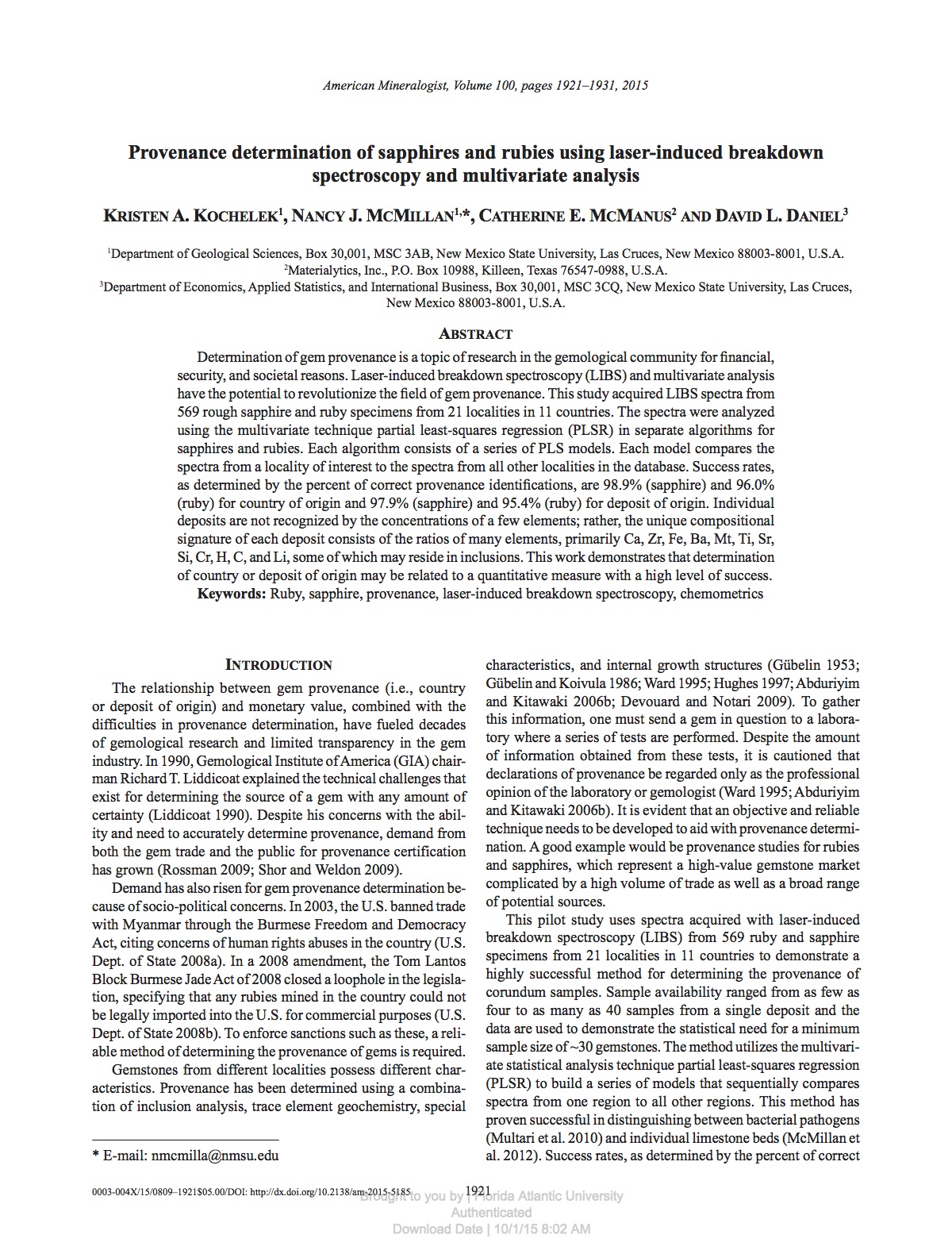
Provenance determination of sapphires and rubies using laser-induced breakdown spectroscopy and multivariate analysis

Provenance determination of sapphires and rubies using laser-induced breakdown spectroscopy and multivariate analysis

Kochelek, K.A., McMillan, N.J., McManus, C. and Daniel, D.L. (2015)

Journal Article · Source: American Mineralogist · Volume: Vol. 100 · Pages: pp. 1921–1931

Abstract
Determination of gem provenance is a topic of research in the gemological community for nancial, security, and societal reasons. Laser-induced breakdown spectroscopy (LIBS) and multivariate analysis have the potential to revolutionize the eld of gem provenance. This study acquired LIBS spectra from 569 rough sapphire and ruby specimens from 21 localities in 11 countries. The spectra were analyzed using the multivariate technique partial least-squares regression (PLSR) in separate algorithms for sapphires and rubies. Each algorithm consists of a series of PLS models. Each model compares the spectra from a locality of interest to the spectra from all other localities in the database. Success rates, as determined by the percent of correct provenance identi cations, are 98.9% (sapphire) and 96.0% (ruby) for country of origin and 97.9% (sapphire) and 95.4% (ruby) for deposit of origin. Individual deposits are not recognized by the concentrations of a few elements; rather, the unique compositional signature of each deposit consists of the ratios of many elements, primarily Ca, Zr, Fe, Ba, Mt, Ti, Sr, Si, Cr, H, C, and Li, some of which may reside in inclusions. This work demonstrates that determination of country or deposit of origin may be related to a quantitative measure with a high level of success.
Keywords
corundum, chemistry.2, geology.11, origin determination, gems
Rubies and Sapphires from Snezhnoe, Tajikistan

Rubies and Sapphires from Snezhnoe, Tajikistan

Sorokina, E.S., Litvinenko, A.K., Hofmeister, W., Häger, T., Jacob, D.E. and Z.Z., N. (2015)

Journal Article · Source: Gems & Gemology · Volume: Vol. 51 · Issue: No. 2, Summer · Pages: pp. 160–175

Abstract
Discovered during the late 1970s, the Snezhnoe ruby and sapphire deposit in Tajikistan was active until the collapse of the former Soviet Union in the early 1990s and the outbreak of regional conflicts. This marble-hosted occurrence has seen renewed interest, as it is a large and potentially productive deposit that has not been sufficiently studied. Testing of samples identified solid inclusions of margarite enriched with Na and Li (calcic ephesite or soda margarite). These are believed to be previously unreported for gem corundum. Allanite, muscovite, and fuchsite (chromium-bearing muscovite) were identified for the first time in ruby and sapphire from Snezhnoe. These and other inclusions such as zircon, rutile, K-feldspar, and Ca-Na-plagioclase could serve to distinguish them from stones mined elsewhere. Concentrations of trace elements were typical for ruby and sapphire of the same formation type. The highest Cr concentrations were observed within the bright red marble-hosted rubies, and these values were very similar to those of the famous Burmese rubies from Mogok.
Keywords
corundum, geology.11, Tajikistan.12, gems
Cobalt Diffusion of natural spinel: A report describing a new treatment on the gem market

Cobalt Diffusion of natural spinel: A report describing a new treatment on the gem market

Saeseaw, S., Weeramonkhonlert, V., Khowpong, C., Ng-Pooresatien, N., Sangsawong, S. and Ito, C. (2015)

Report · Source: GIA News from Research · Publisher: Gemological Institute of America · Pages: 22 pp.

Abstract
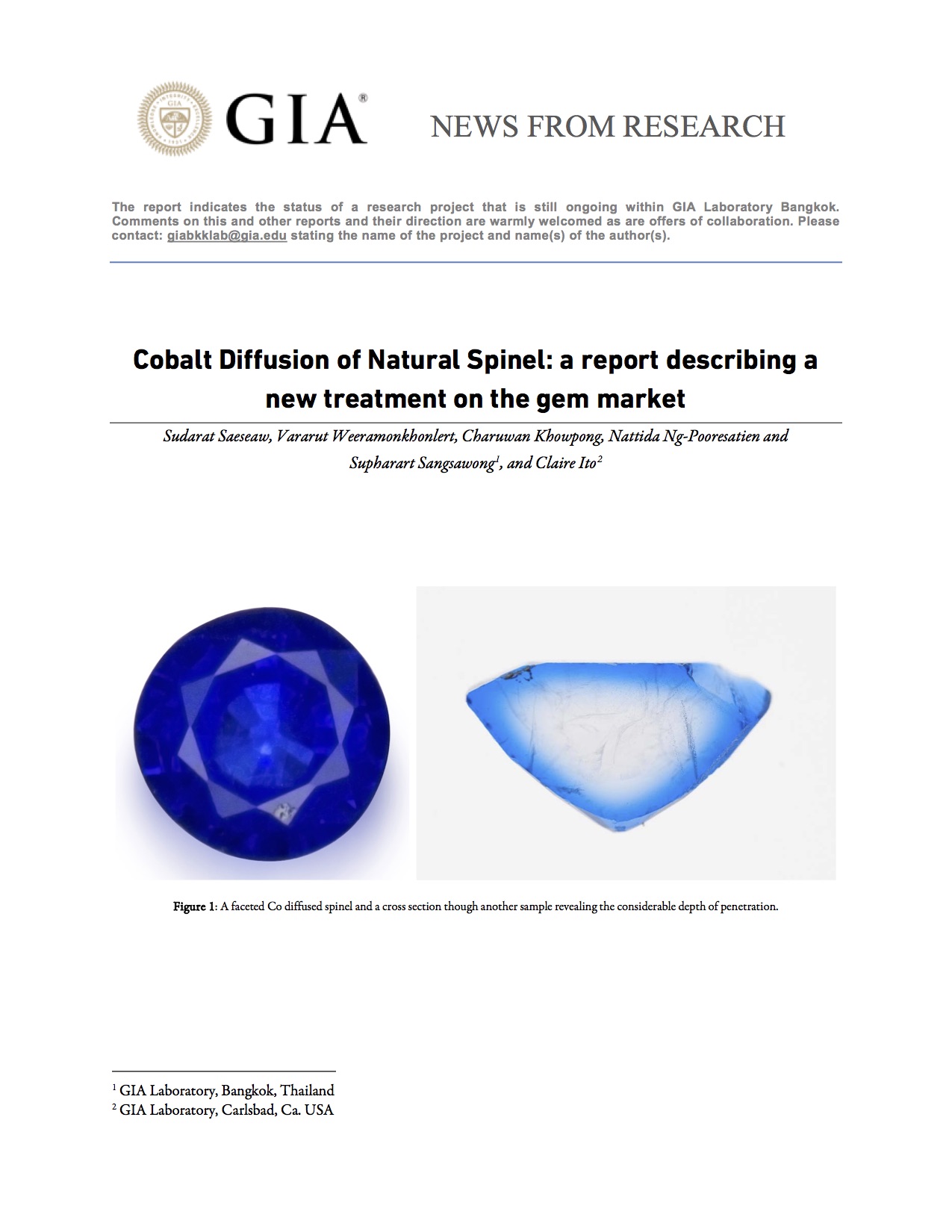
Recently (May 2015) several unusual looking faceted spinels were submitted to GIA’s New York, Carlsbad, and Bangkok identification laboratories. At the same time and within the social media it was announced by GRS Laboratory that Mr. M.T.M Harris of Emteem Gem Laboratory had reported seeing similar stones coming through his laboratory in Beruwela, Sri Lanka, and that GRS in cooperation with Günther and Harris (Peretti 2012 (updated 2015)) had determined that the stones were diffused with cobalt. From their inclusion scenes these stones appeared to have been heated at high temperatures, in particular this seemed to be so from the dissolved state of numerous solid inclusions and a profusion of fractures that seemed to have been artificially healed in a flux environment. Cobalt along with iron is known to contribute to the observed color of natural blue spinels from a number of locations (Harder 1986, Chauviré 2015, D'Ippolito 2015) however those colored mostly by cobalt have become sort after both in the general trade as well as with collectors. As such it is important that a clear distinction between natural cobalt spinels and those that owe their color to the artificial addition of cobalt be made and the techniques needed for this distinction be available for all to use. The following text, images and data set out the detail and results of the authors’ examination of eighteen samples supplied to them by the individual responsible for devising the process and placing the material in the market -Mr. Thamrong Charasaiya, who is the President of T.N., High Tech Gems limited, located in Ladprao, Bangkok Thailand. Mr. Charasaiya informed the authors’ that his treatment involved the “deep diffusion cobalt” into “low colored natural spinel from Burma” resulting in a strong blue color. He further stated that “cobalt will not diffuse into spinel on its own and that iron had also to be present along with the cobalt for the process to work”. The authors greatly appreciate the assistance of Mr. Charasaiya in donating the specimens for this examination as well as the open discussions that have taken place that have provided further useful information on the process being used. However it should be emphasized at the outset that the details of his process remain proprietary to Mr. Charasaiya and any description of it here results from the conversations we have had with him -the authors have not witnessed the actual treatment taking place and nor do they have details on such important areas as the manner in which the diffusion materials are applied, the temperatures or timescales used.
Keywords
spinel, treated spinel, cobalt diffusion, gems
Low temperature" heat treatment of Mozambique ruby: Results report"

Low temperature" heat treatment of Mozambique ruby: Results report"

Pardieu, V., Saeseaw, S., Detroyat, S., Raynaud, V., Sangsawong, S., Bhusrisom, T., Engniwat, S. and Muyal, J. (2015)

Report · Source: GIA News from Research · Publisher: Gemological Institute of America · Pages: 34 pp.

Abstract
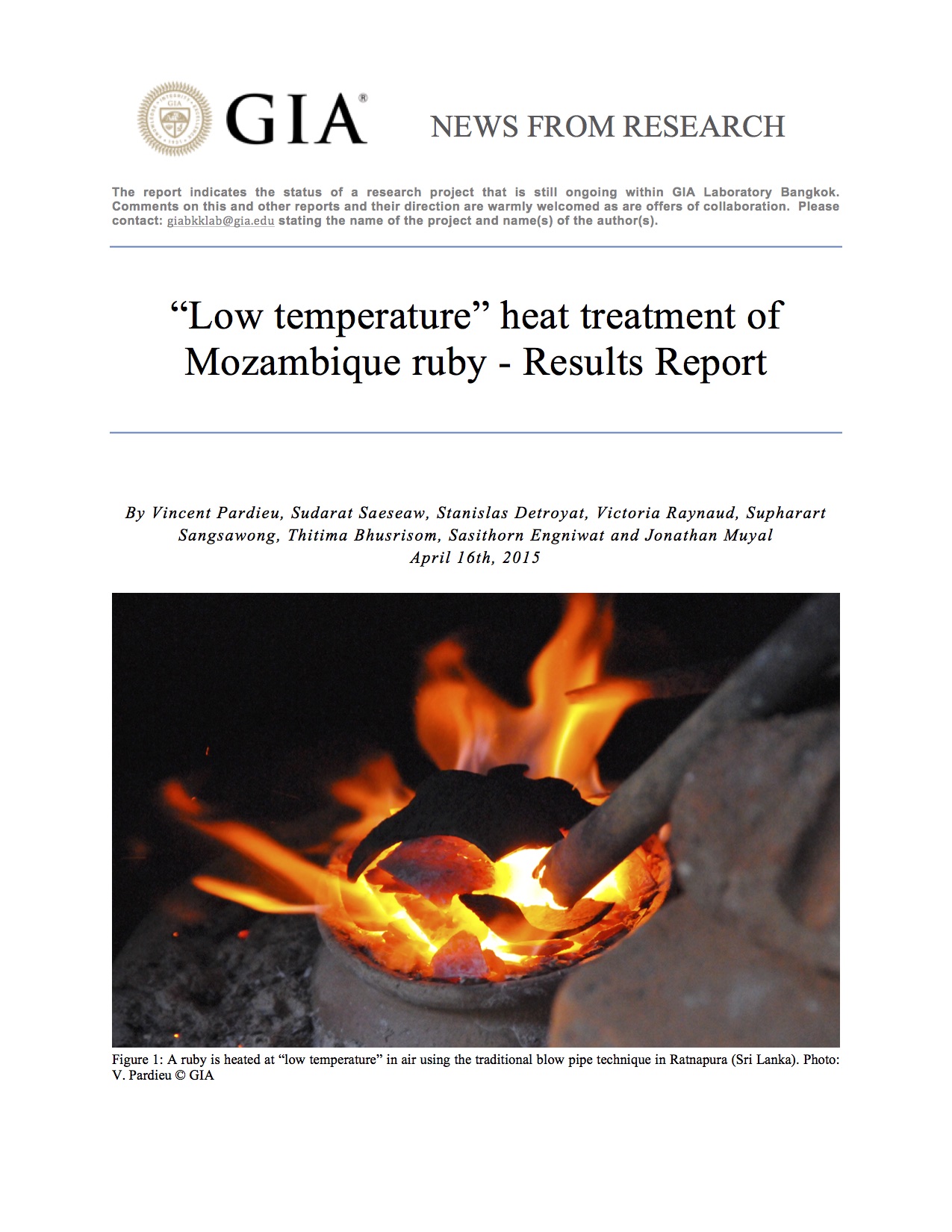
Heat treatment of corundum in Sri Lanka has likely been performed on gems for near 1000 years or more as Teifaschi, an Arab writer wrote the following in 1240 (Sersen, 1991): “In Serandib (Sri Lanka) and its environs, ruby is treated by fire. People take pebbles from the earth and crush and compress them into a mass with the aid of water. (This mixture) is daubed completely around a dry stone. Then, the whole thing is placed on a rock with other rocks set down around it. Dry firewood is thrown on the top, lit and blown upon (with bellows). The blowing is applied, along with more wood, till any black overtones on the ruby have disappeared. The amount of fire and the application of wood depends on the extent of the blackness present. People know this by experience. They heat-treat stones for at least one hour and, at most, twenty days and nights. Then, they carefully extract the ruby, its blackness having disappeared.” This description can be applied to the “blow pipe technique” we still can witness today in Sri Lanka (see Figure 1.) This technique is used is to remove or partially remove some blue components in rubies and sapphires to give in the case of rubies the appearance of a purer hue. In the past it was also used to turn light blue sapphires colorless. Another particularly interesting description of that treatment is also given by James Emerson Tennent, an English traveler who wrote “Ceylon an account of the Island” in 1859: “The blue tinge which detracts from the value of the pure ruby, whose colour should resemble “pigeon’s blood,” is removed by the Singhalese, by exposing the stone in the lime of a calcined shell and exposing it to high heat.” This reference is to the best knowledge of the authors also one of the earliest mention of “Pigeon’s Blood” in the English literature. A similar type of heat treatment of ruby to the ‘blow-pipe’ technique is also practiced in Vietnam and Thailand where a simple jeweler’s torch is used for few seconds or minutes and this is sometimes referred to as “snake bite” (see Figure 3 left). Usually only inclusion free stones are heated this way as included stones are likely to be damaged by the process. Generally the stone does not need to be repolished after this “snake bite” treatment.
Keywords
corundum, treatments.6, Mozambique.12, gems
Digital photomicrography for gemologists

Digital photomicrography for gemologists

Renfro, N. (2015)

Journal Article · Source: Gems & Gemology · Volume: Vol. 51 · Issue: No. 2, Summer · Pages: pp. 144–159

Abstract
Until recently, film was the preferred medium used for capturing images through the microscope, pri-marily due to resolution limitations of digital-format cameras. The image quality that can now be achieved by digital cameras is equal, and in many ways superior, to the quality offered by film. Digital photomicrography allows gemologists the opportunity to instantly see the resultant images, which can then be adjusted with image-refining software so that they represent their subject as realistically as pos-sible. This article offers examples of some basic techniques and tips on the application of digital pro-cessing to get the most out of photomicrographs.
Keywords
gems, corundum, inclusions.5
The microworld of diamonds: Images from earth's mantle

The microworld of diamonds: Images from earth's mantle

Koivula, J.I. and Skalwold, E.A. (2014)

Journal Article · Source: Rocks & Minerals · Volume: Vol. 89 · Issue: No. 1 · Pages: pp. 46–53

Abstract
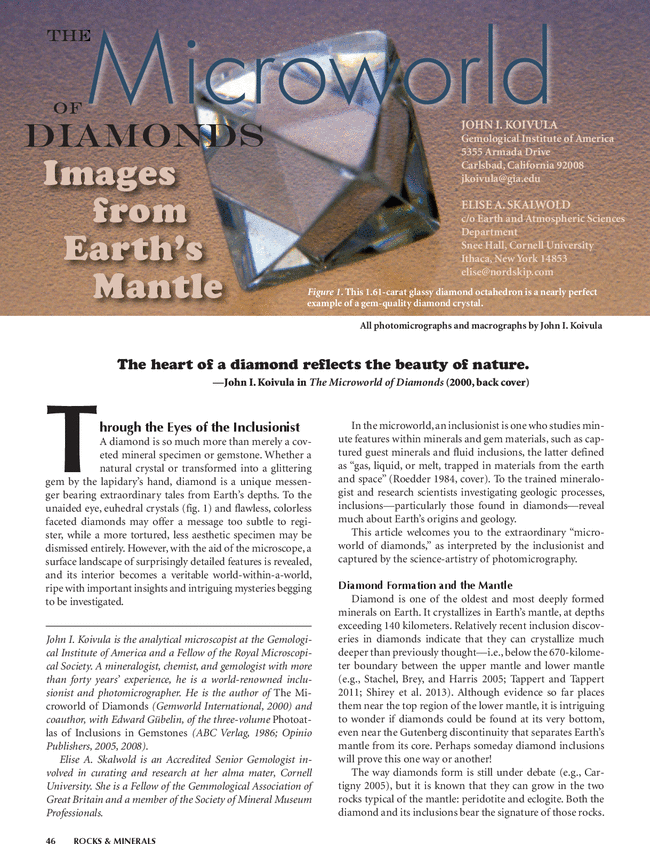
A diamond is so much more than merely a cov- eted mineral specimen or gemstone. Whether a natural crystal or transformed into a glittering gem by the lapidary’s hand, diamond is a unique messenger bearing extraordinary tales from Earth’s depths. To the unaided eye, euhedral crystals (fig. 1) and flawless, colorless faceted diamonds may offer a message too subtle to register, while a more tortured, less aesthetic specimen may be dismissed entirely. However, with the aid of the microscope, a surface landscape of surprisingly detailed features is revealed, and its interior becomes a veritable world-within-a-world, ripe with important insights and intriguing mysteries begging to be investigated.
Keywords
gems, diamond, inclusions
Three-phase inclusions in emerald and their impact on origin determination

Three-phase inclusions in emerald and their impact on origin determination

Saeseaw, S., Pardieu, V. and Sangsawong, S. (2014)

Journal Article · Source: Gems & Gemology · Volume: Vol. 50 · Issue: No. 2, Summer · Pages: pp. 114–132

Abstract
Until now, the observation of three-phase inclusions in emeralds has been considered a potential indicator of Colombian origin. Nevertheless, emeralds from Afghanistan (Panjshir Valley), China (Davdar), and Zambia (Kafubu and a new deposit at Musakashi) may contain three-phase inclusions resembling those often found in specimens from Colombian deposits (Muzo, Chivor, La Pita, Coscuez, and Peñas Blancas). This article presents detailed photomicrographs of samples from these localities, with a focus on their multiphase inclusions. Also investigated are spectroscopic features and trace-element data. For the gemologist studying the origin of emeralds hosting three-phase inclusions, a powerful set of tools to aid in this determination comes from the combination of detailed microscopic examination, UV-VisNIR and FTIR spectroscopy, and LA-ICP-MS trace-element analysis.
Keywords
gems, beryl, emerald, Colombia, Muzo, Chivor, Cosquez, Zambia, Afghanistan, Panjshir
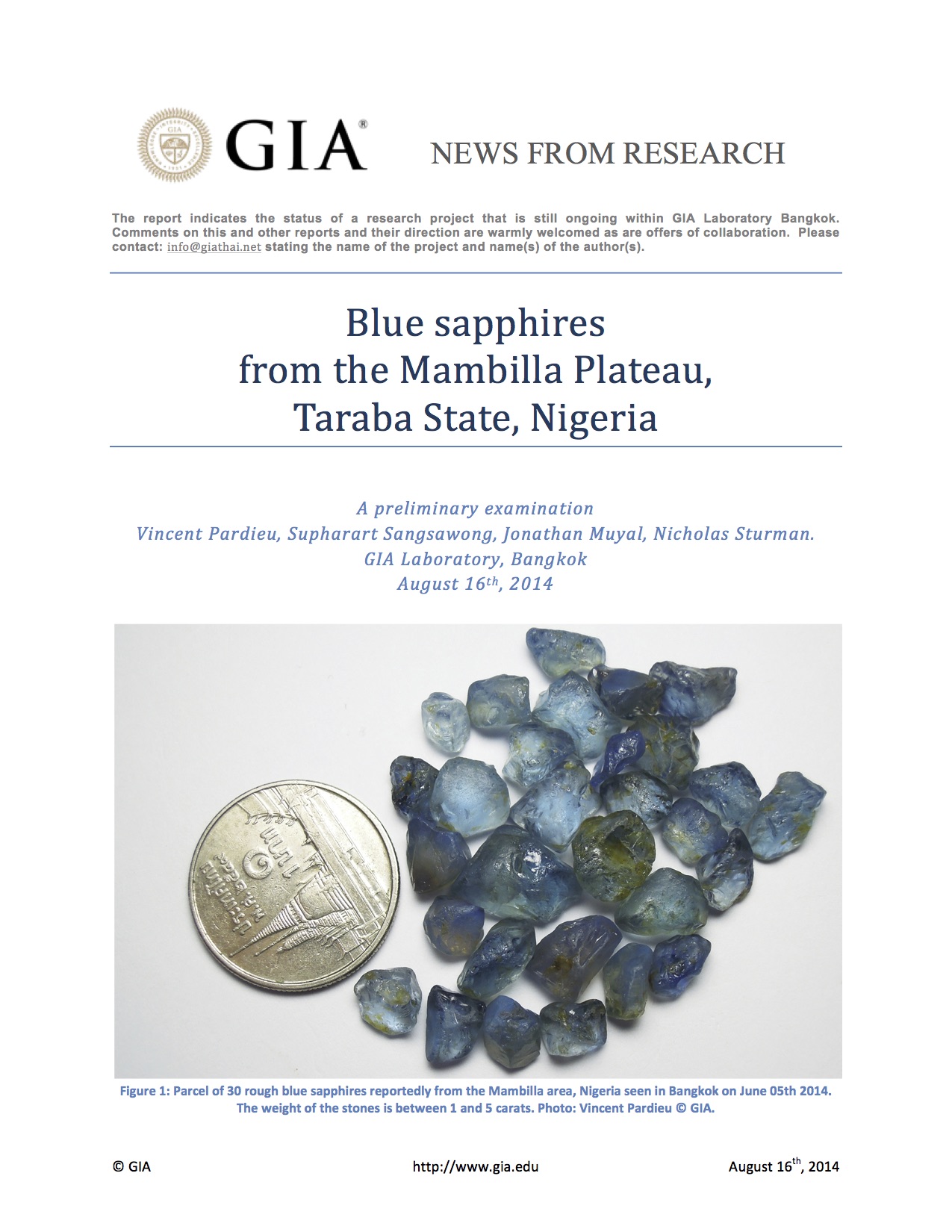
Blue sapphires from the Mambilla Plateau, Taraba State, Nigeria

Blue sapphires from the Mambilla Plateau, Taraba State, Nigeria

Pardieu, V., Sangsawong, S., Muyal, J. and Sturman, N. (2014)

Report · Source: News from Research · Publisher: Gemological Institute of America · Pages: 47 pp.

Abstract
In April 2014, one of the authors (VP) was preparing a field expedition to visit sapphire deposits in Nigeria. During the preparations he contacted several West African gem merchants in Bangkok to arrange to see some samples and seek additional details about the sapphire deposits in Nigeria. This interest was fueled by the emergence of Nigeria as an important producer of gemstones over the past few years, and the lack of publications on the sapphires and sapphire deposits from and within the country. During one of these discussions he was shown a parcel of blue sapphires reportedly from a new deposit located on the Mambilla Plateau (Taraba State) in Nigeria (Figure 1). Over the following weeks, more parcels containing stones of similar appearance showed-up in Thailand, and also in Sri Lanka, as many Sri Lankan gem merchants reportedly rushed to Nigeria. All the people we met were very excited by the quality and the size of the stones being produced. Large clean stones were reported, some weighing between 100 and 300 carats with a nice blue color. Reports emerged that stones from the new deposit were being traded at very high prices. One stone reportedly sold for more than 1 million US dollars in Thailand. Photos of such stones rapidly started to appear on social media sites (Figure 2) and were also frequently encountered on the mobile phones of some West African gem merchants visiting Thailand.
Keywords
corundum, inclusions.5, geology.11, Nigeria.12, gems
Chemical and oxygen isotopic compositions, age and origin of gem corundums in Madagascar alkali basalts

Chemical and oxygen isotopic compositions, age and origin of gem corundums in Madagascar alkali basalts

Rakotosamizanany, S., Giuliani, G., Ohnenstetter, D., Rakotondrazafy, A.F.M., Fallick, A.E., Paquette, J.-L. and Tiepolo, M. (2014)

Journal Article · Source: Journal of African Earth Sciences · Volume: Vol. 94 · Issue: 0 · Pages: pp. 156–170

Abstract
Madagascar is a major producer of gem corundum, primarily recovered from continental basaltic fields. Key mining areas include sapphire-bearing palaeoplacer deposits such as Ambondromifehy and Nosy Be in Antsiranana Province (northern Madagascar), Soamiakatra–Mandrosohasina in Antananarivo Province (central Madagascar), and the Vatomandry district in Toamasina Province (eastern Madagascar). In Antananarivo Province, Soamiakatra is a primary deposit where rubies occur in metagabbro and pyroxenite xenoliths transported to the surface by the Ankaratra volcanic activity. Petrographic evidence indicates two distinct ruby-forming conditions: near the eclogite domain (T ≈ 1100 °C, P ≈ 20 kb) and in granulite facies (T ≈ 1100 °C, P < 15 kb). In contrast, sapphires from placer and paleoplacer deposits mainly originate from two sources: (i) magmatic sapphires (90%) derived from alkaline magma differentiation in lower crust–mantle boundary chambers, associated with syenite and anorthoclasite xenoliths in alkali-basalts. These are linked to asthenospheric upwelling and lithospheric thinning during Oligocene–Quaternary times. Zircons from Mandrosohasina and Ambatomainty sapphire deposits yield U–Pb ages of 7 Ma. These sapphires have low δ¹⁸O values (4.1 ± 0.4‰, n = 8), matching those from syenitic sources. Inclusions such as columbite-(Fe), tantalite-(Mn), pyrochlore group minerals, samarskite group minerals, uraninite, and anorthoclase further confirm syenitic origins. (ii) The remaining 10% are metamorphic xenocrysts brought up by the same magmatic event. Rubies from placer deposits show δ¹⁸O values of 3.1 ± 1.1‰ (n = 6), consistent with ruby in mafic–ultramafic rocks and metasomatic ‘plumasite’ zones (δ¹⁸O = 1.25–7.5‰, n = 35). In Toamasina Province, ~85% of the sapphires from Vatomandry are metamorphic, with δ¹⁸O = 4.1 ± 0.4‰ (n = 9), overlapping the range for metasomatic sapphires from ‘plumasites’ and biotite schists in shear zones. The remaining ~15% are magmatic, with low δ¹⁸O values consistent with sapphire-bearing syenites. In Antsiranana Province, rubies are absent; sapphires are ~40% magmatic and ~60% metamorphic, with δ¹⁸O = 4.5 ± 0.5‰ (n = 11), comparable to the other provinces. Zircons yield contrasting U–Pb ages: 40.6 Ma (Ambondromifehy) and 0.7 Ma (Nosy Be). These data—corundum characteristics, isotopic signatures, and radiometric ages—demonstrate two distinct corundum sources in Madagascar’s alkali-basalts. One comprises rubies from metagabbro and garnet–pyroxenite complexes of eclogite facies, retrograded to granulite facies during the Pan-African orogeny. The other includes sapphires either magmatic, coeval with volcanic events involving differentiated alkaline magma, or metamorphic, extracted from Precambrian basement during magma ascent.
Keywords
corundum, ruby, sapphire, Madagascar.12, Placer in alkali-basalt, Gem corundum deposits, Chemical composition, Oxygen isotopes, Genetic model, gems
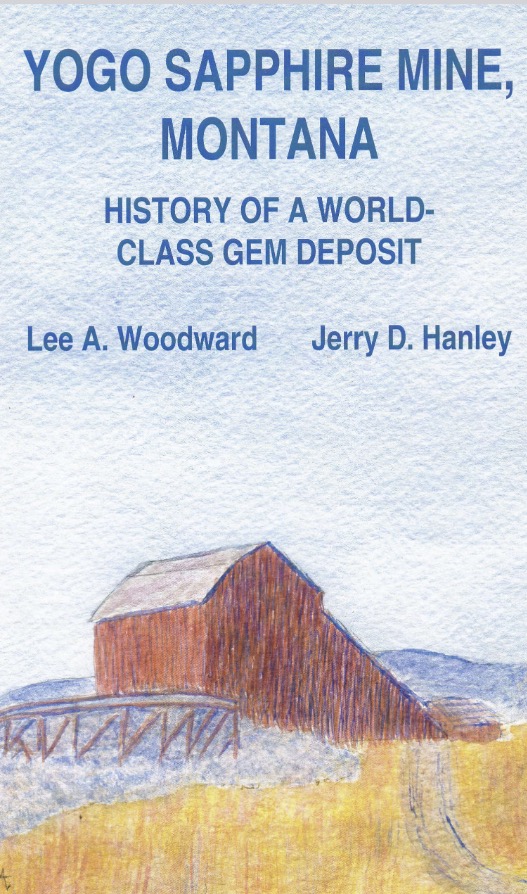
Yogo Sapphire Mine, Montana: History of a World-Class Gem Deposit

Yogo Sapphire Mine, Montana: History of a World-Class Gem Deposit

Woodward, L.A. and Hanley, J.D. (2013)

Book · Publisher: Running Wolf Press · Pages: 66 pp.

Abstract
Sapphire-bearing dikes are located in the Little Belt Mountains, Montana. This report gives an accurate and comprehensive review of the sapphire deposit and its history. Yogo sapphires constitute a world-class deposit hosted by an ultramafic ouachitite (lamprophyre) dike system of Eocene age (about 50 million years old) in central Montana. The sapphires are mostly cornflower-blue, have extremely few inclusions, and are not zoned. With high brilliance and luster in both natural and artificial light, they do not require heat treatment to enhance their color. It is estimated that since discovery in 1895 production is 18.2 million carats of rough gems with 500,000 carats of faceted sapphires. Most of the gems are less than 1 carat, platy, and relatively thin, although specimens up to 19 carats have been reported. The largest sapphire with a suitable thickness for faceting as a single gem was 12.25 carats.
Keywords
gems, corundum, USA.12, Montana.12, Yogo Gulch
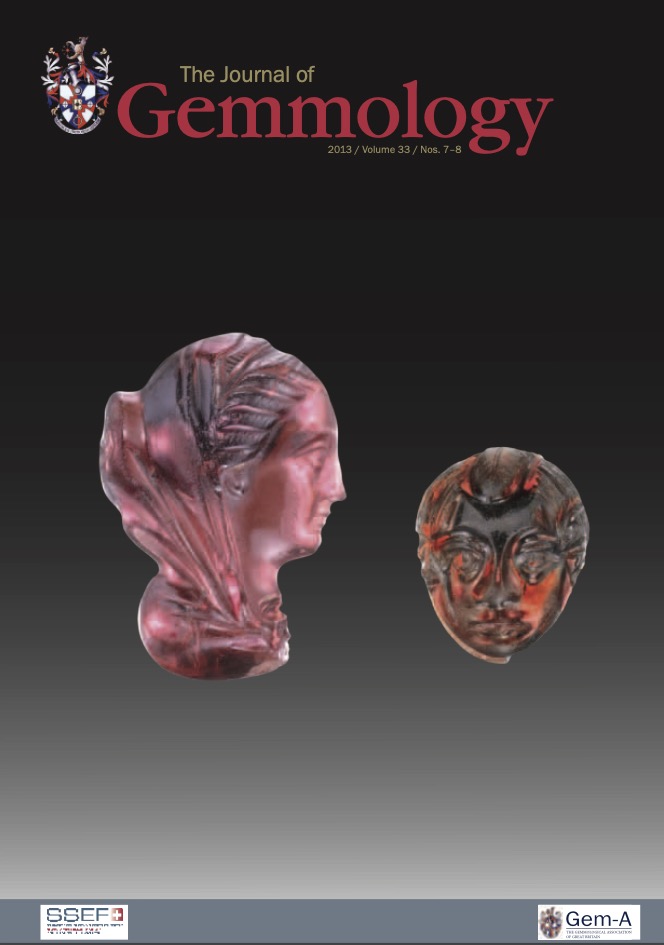
Greek, Etruscan and Roman garnets in the antiquities collection of the J. Paul Getty Museum

Greek, Etruscan and Roman garnets in the antiquities collection of the J. Paul Getty Museum

Thoresen, L. and Schmetzer, K. (2013)

Journal Article · Source: Journal of Gemmology · Volume: Vol. 33 · Issue: No. 7–8 · Pages: pp. 201–222

Abstract
The results of quantitative electron microprobe analyses, along with observations of gemmological properties and microscopic features, are presented for 11 garnets of ancient Greek, Etruscan, and Roman origin. In addition to chemical data, the gemmological properties of the Getty Museum garnets are examined, including refractive index, density, and inclusions. Based on their chemical composition and gemmological properties, the 11 garnets are categorized into four groups: Cr-poor pyrope, Mn-rich almandine, Ca-rich almandine, and intermediate pyrope-almandine. When combined with published analyses of 26 Greek and Roman garnets from ancient jewelry and glyptics, the chemical distribution pattern of all 37 garnets expanded the boundaries of the established groups, introducing a fifth group consisting of Mn-poor almandine. The compositional fields for these five groups are compared with data from Early Medieval garnets, mostly from Merovingian cloisonné jewelry. The chemical composition and physical properties of the garnets provide insights into potential sources of rough gem material, trade and transmission networks in the ancient world, and associations between finished objects now dispersed across different collections.
Keywords
gems, glyptic, engraved gems, agate, cameo, intaglio, Getty Museum, locality, species, analytical, garnet
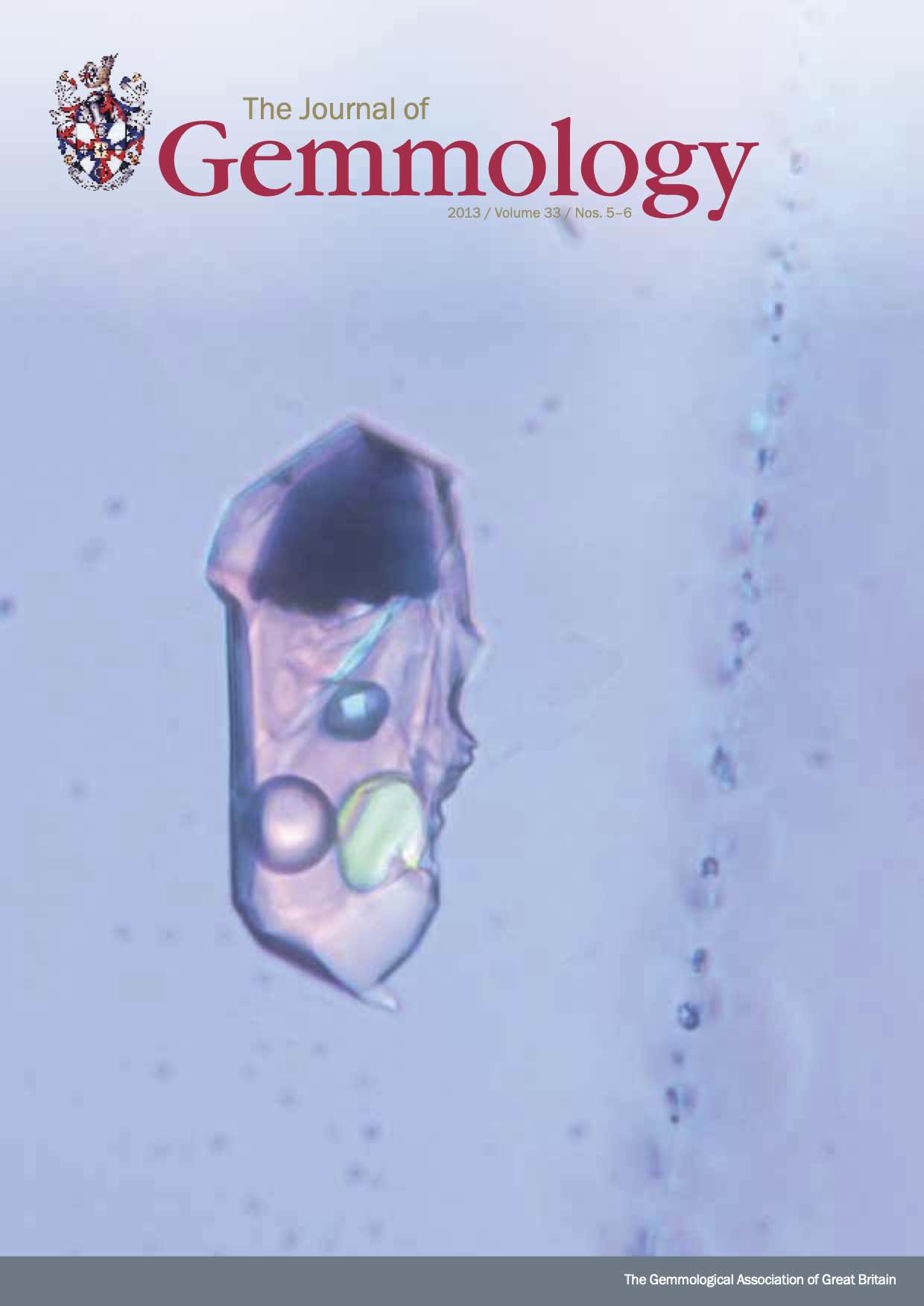
Synthetic alexandrites grown by the HOC method in Russia: Internal features related to the growth technique and colorimetric investigation

Synthetic alexandrites grown by the HOC method in Russia: Internal features related to the growth technique and colorimetric investigation

Schmetzer, K., Bernhardt, H.-J., Balmer, W. and Hainschwang, T. (2013)

Journal Article · Source: Journal of Gemmology · Volume: Vol. 33 · Issue: No. 5–6 · Pages: pp. 113–129

Abstract
Mineralogical and gemmological properties of synthetic alexandrites grown by the horizontally oriented crystallization (HOC) method are described. The method is used to grow crystal plates weighing up to 450 g. The morphology of the rough crystals is dependent on the form of the molybdenum boat used as a container for crystal growth. The most significant inclusions for gem identification are curved growth striations and flat, irregularly- shaped somewhat elongated cavities. Microprobe analyses revealed distinct amounts of chromium and vanadium but extremely low iron contents. Spectra in the UV-Vis range are consistent with published work. Six differently sized cubes were cut from an HOC alexandrite crystal and used to show pleochroism in combination with two optical phenomena: the alexandrite effect and the Usambara effect. Colorimetric parameters were calculated from the spectra of the cubes and plotted in the CIELAB colour space to demonstrate the alexandrite and Usambara effects graphically for different directions of view. The absorption bands in the infrared are polarized and assigned to structural OH-groups.
Keywords
gems, synthetic chrysoberyl, Russia, horizontally oriented crystallization

Exploring the Literature of Gemstone Inclusions

The literature of gemstone inclusions covers identification, origin determination, treatments, synthesis, mineral inclusions, fluid inclusions and other internal features of natural and synthetic gems.

For a curated selection of important sources, read Inclusions in Gemstones — Hyperion Literature Sources.

About Four Treasures

Four Treasures is Lotus Gemology's freely accessible gemological reference database. Use the full database to search by author, title or keyword and explore literature on gemology, mineralogy, jewelry and related fields. Where available, hyperlinks on titles may lead directly to the full publication.

Search the Complete Four Treasures Database