Explore books, articles and historical sources on inclusions in gemstones in Four Treasures, the Lotus Gemology reference database. This bibliography brings together matching records from the collection, with publication details, abstracts and cover images where available.
Gemstone Inclusion References
The list below matches the terms inclusion or inclusions in the database's searchable fields. Some references discuss inclusions as part of a broader subject.
901–920 of 1,165 matching references
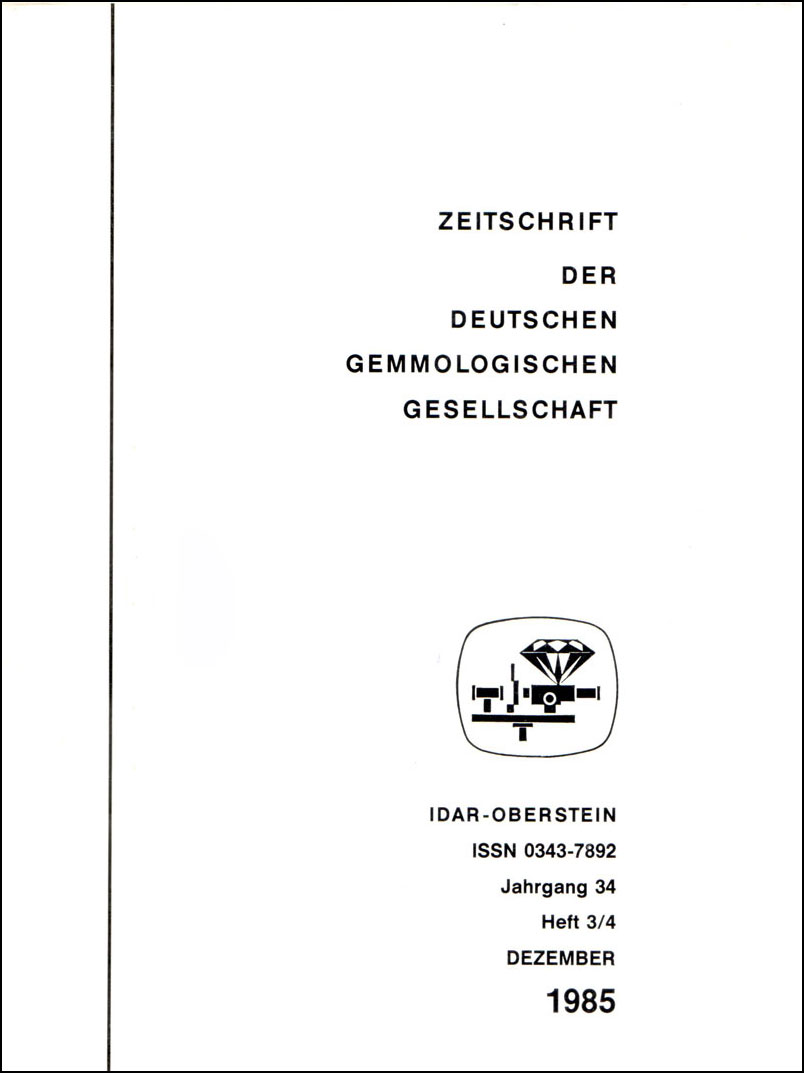
Behandelte korunde mit glasartigen füllungen
Treated corundum with glass-like fillings
Journal Article
Hänni, H.A. (1986) Behandelte korunde mit glasartigen füllungen. [Treated corundum with glass-like fillings]Zeitschrift der Deutschen Gemmologischen Gesellschaft, Vol. 35, No. 3/4, pp. 87–96.
Record No. 949 | Sinkankas/Born No.: NIS/NIB | Language: In German | RWHL
Hänni investigates corundum that has undergone high-temperature treatment in the presence of chemical additives, producing glassy coatings and fillings in surface-reaching fissures and cavities. The practice was becoming increasingly common, particularly in Thailand. Chemical analyses show that the glasses vary in their proportions of Si, Al, Mg, Ca, Na and K. Filling fractures with transparent glass can significantly improve the apparent transparency of ruby and sapphire; however, slow cooling may cause partial recrystallization of the glass, producing opaque or crystalline fillings. Hänni discusses the microscopic appearance and identification of these treatment-related features and emphasizes that they are products of the heating process rather than natural inclusions. The article contains eight figures, five in color.
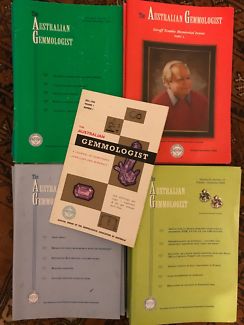
Inclusions in Australian sapphire before and after heat treatment
Journal Article
Coldham, T.S. (1986) Inclusions in Australian sapphire before and after heat treatment.Australian Gemmologist, Vol. 16, No. 3, August, pp. 122–125.
Record No. 597 | Sinkankas/Born No.: NIS/NIB | RWHL
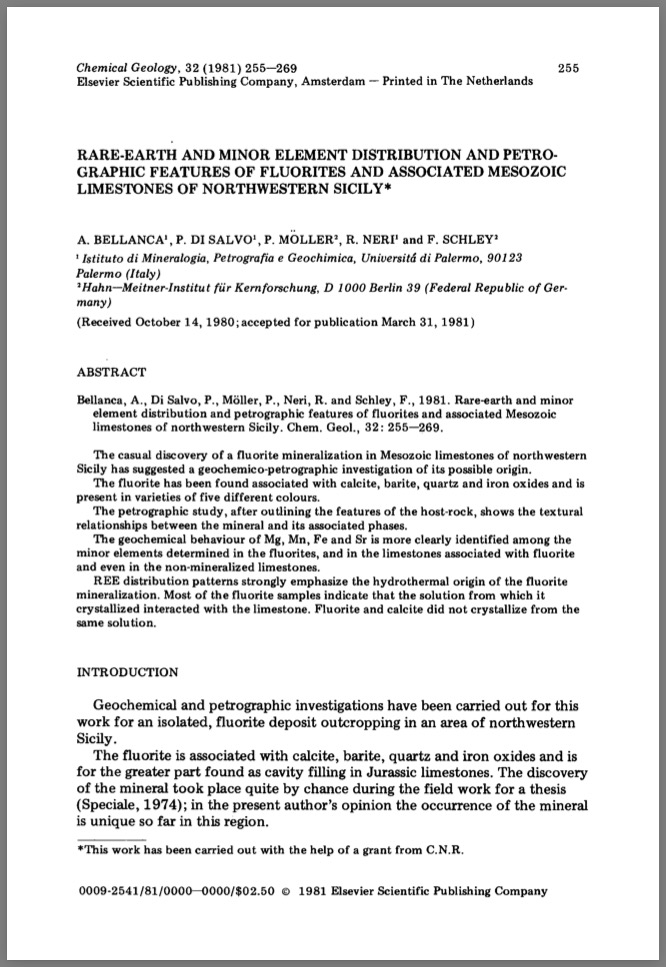
Bellanca, A., De Vito, B., Möller, P., Neri, R. and Schley, F. (1985) Rare-earth and minor element distribution and petrographic features of fluorites and associated Mesozoic limestones of northwestern Sicily.Chemical Geology, Vol. 32, Nos. 1–4, pp. 255–269.
gems, fluorite, inclusions in fluorite, fluid inclusions
The casual discovery of a fluorite mineralization in Mesozoic limestones of northwestern Sicily has suggested a geochemico-petrographic investigation of its possible origin. The fluorite has been found associated with calcite, barite, quartz and iron oxides and is present in varieties of five different colours. The petrographic study, after outlining the features of the host-rock, shows the textural relationships between the mineral and its associated phases. The geochemical behaviour of Mg, Mn, Fe and Sr is more clearly identified among the minor elements determined in the fluorites, and in the limestones associated with fluorite and even in the non-mineralized limestones. REE distribution patterns strongly emphasize the hydrothermal origin of the fluorite mineralization. Most of the fluorite samples indicate that the solution from which it crystallized interacted with the limestone. Fluorite and calcite did not crystallize from the same solution.
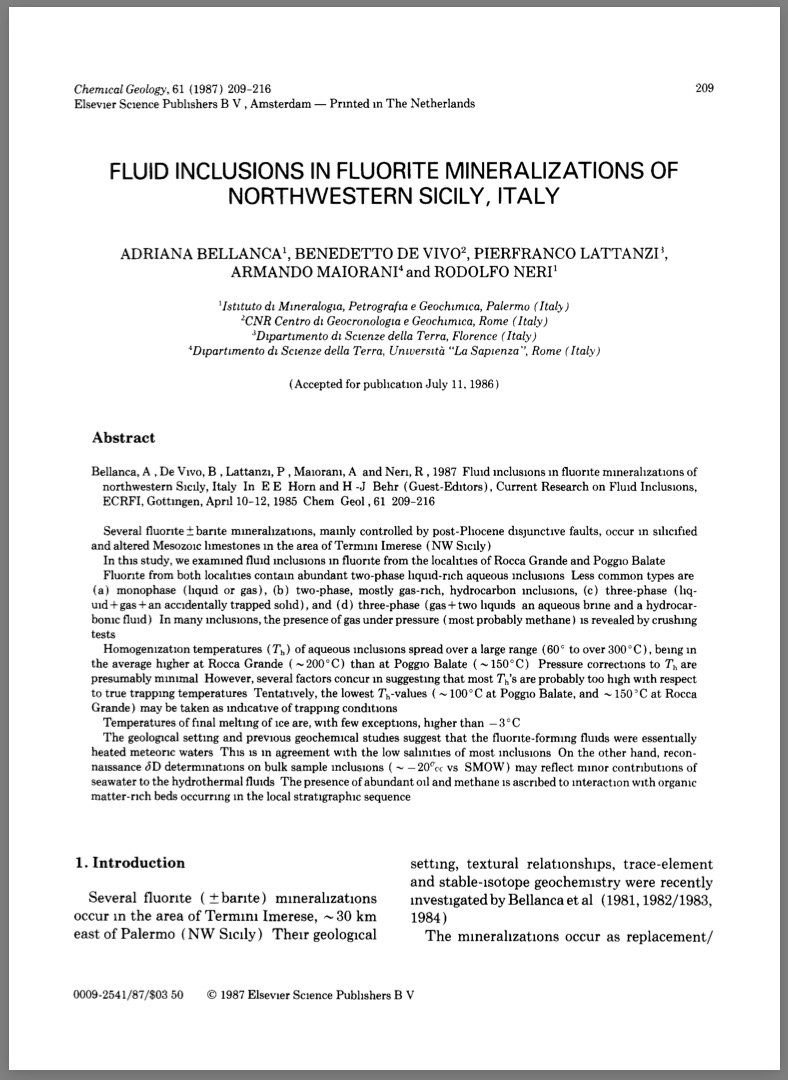
Bellanca, A., De Vito, B., Lattanzi, P., Maiorani, A. and Neri, R. (1985) Fluid inclusions in fluorite mineralizations of N-W Sicily.Chemical Geology, Vol. 32, Nos. 1–4, pp. 209–216.
gems, fluorite, inclusions in fluorite, fluid inclusions
Several fluorite ± barite mineralizations, mainly controlled by post-Pliocene disjunctive faults, occur in silicified and altered Mesozoic limestones in the area of Termini Imerese (NW Sicily). In this study, we examined fluid inclusions in fluorite from the localities of Rocca Grande and Poggio Balate. Fluorite from both localities contains abundant two-phase liquid-rich aqueous inclusions. Less common types are: (a) monophase (liquid or gas); (b) two-phase, mostly gas-rich, hydrocarbon inclusions; (c) three-phase (liquid + gas + an accidentally trapped solid); and (d) three-phase (gas + two liquids: an aqueous brine and a hydrocarbonic fluid). In many inclusions, the presence of gas under pressure (most probably methane) is revealed by crushing tests. Homogenization temperatures (Th) of aqueous inclusions spread over a large range (60° to over 300 °C), being on average higher at Rocca Grande (∼200 °C) than at Poggio Balate (∼150 °C). Pressure corrections to Th are presumably minimal. However, several factors concur in suggesting that most Th’s are probably too high with respect to true trapping temperatures. Tentatively, the lowest Th-values (∼100 °C at Poggio Balate, and ∼150 °C at Rocca Grande) may be taken as indicative of trapping conditions. Temperatures of final melting of ice are, with few exceptions, higher than −3 °C. The geological setting and previous geochemical studies suggest that the fluorite-forming fluids were essentially heated meteoric waters. This is in agreement with the low salinities of most inclusions. On the other hand, reconnaissance δD determinations on bulk sample inclusions (‰ vs. SMOW) may reflect minor contributions of seawater to the hydrothermal fluids. The presence of abundant oil and methane is ascribed to interaction with organic matter-rich beds occurring in the local stratigraphic sequence.
Some aspects of identification of Kashan synthetic rubies
Journal Article
Henn, U. and Schrader, H.-W. (1985) Some aspects of identification of Kashan synthetic rubies.Journal of Gemmology, Vol. 19, No. 6, pp. 469–478.
Synthetic rubies by Kashan are characterized by inclusions of melt residues. Cryolite was used as flux. The inclusions can be divided into four types. Even in samples looking apparently free of inclusions, these inclusions can be found by microprobe analysis (15 samples). The increased amounts of sodium found with the help of neutron activation analysis (NAA) in two analysed samples are caused by these inclusions of cryolite.
The eyepiece pointer: A useful microscope accessory
Journal Article
Fryer, C.W. and Koivula, J.I. (1985) The eyepiece pointer: A useful microscope accessory.Gems & Gemology, Vol. 21, No. 2, Summer, pp. 105–107.
The eyepiece pointer is a highly useful microscope accessory for the gemologist, as it remains in focus and consistently indicates the center of the microscope’s field of view regardless of magnification or the focal plane within the gemstone. It greatly simplifies the task of identifying and showing microscopic features in both mounted and unmounted gems, and it can be easily adapted for use with nearly any microscope.
Montana sapphires (Sapphire Mts.)
Report
Themelis, T. (1985)Montana sapphires (Sapphire Mts.). Accredited Gemologists’ Association, 4 pp.
Record No. 1694 | Sinkankas/Born No.: NIS/NIB | RWHL
Schrader, H. (1985) Inclusions in corundum from Sri Lanka.Journal of the Gemmologists Association of Sri Lanka, No. 2, pp. 37–41.
Record No. 1561 | Sinkankas/Born No.: NIS/NIB | RWHL
Reference copied to clipboard!
corundum, ruby, sapphire, Sri Lanka.12, inclusions.5, gems
Identification characteristics of flux grown synthetic orange sapphires
Journal Article
Gunawardene, M. (1985) Identification characteristics of flux grown synthetic orange sapphires.Journal of Gemmology, Vol. 19, No. 5, January, pp. 389–403.
Gunawardene examines the identification of Chatham flux-grown synthetic orange sapphire, material produced to imitate the orange-pink colour associated with Sri Lankan padparadscha sapphire. The paper documents the material’s gemmological properties and concentrates particularly on microscopic characteristics useful for separating it from natural sapphire. Diagnostic features associated with flux growth include residual flux and characteristic inclusions, together with growth features related to synthetic crystallization. The author also discusses platinum inclusions, derived from the crucibles used during growth, as an important indication of synthetic origin. The study compares these observations with natural orange sapphires and emphasizes microscopic examination as a practical means of identification.
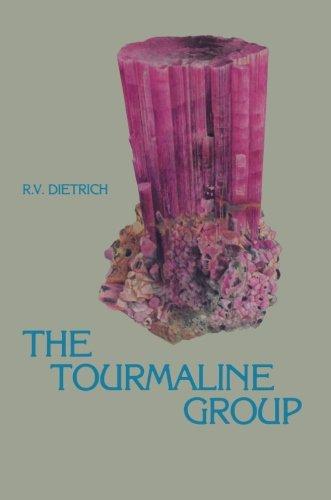
The Tourmaline Group
Book
Dietrich, R.V. (1985)The Tourmaline Group. New York, Van Nostrand Reinhold, 300 pp.
A comprehensive synthesis of tourmaline mineralogy and gemology, drawing on more than 2,500 publications and incorporating nearly 1,000 references. Dietrich examines nomenclature, crystal morphology and structure, chemical composition, and the relationships between chemistry, species classification, and physical properties. Coverage includes crystal habits, exceptionally large crystals, inclusions and intergrowths, causes of color, color patterns, pleochroism, luminescence, and the effects of heating and irradiation. Additional chapters address physical properties, laboratory synthesis, industrial applications, and recovery. The gemstone chapter discusses tourmaline’s historical use in jewelry and decorative arts, fashioning, and notable gems. Geological coverage considers occurrences and formation in igneous, metamorphic, and sedimentary environments, while an appendix lists important sources of mineral specimens and gem material worldwide. The work’s principal strength is its organized compilation and evaluation of a widely scattered literature, making it useful to mineralogists, gemologists, and collectors. Individual deposits receive limited treatment, however, and the locality appendix lacks references directing readers to detailed accounts.
Moon, A.R. and Phillips, M.R. (1984) An electron microscope study of exsolved phases in natural black Australian sapphire.Micron and Microscopica Acta, Vol. 15, No. 3, pp. 143–146.
Record No. 4918 | Sinkankas/Born No.: NIS/NIB | RWHL
Natural Australian sapphire (α-Al₂O₃ with around 1% Fe and up to 0.03% Ti) occurs in many colours, generally with an abundance of exsolved phases. Such ‘silky’ stones, cut en cabochon, exhibit the well-known phenomenon of asterism. For stones with a well-defined ‘star’ needle-like precipitate phases can be seen under an optical microscope. The needle axes are perpendicular to the star axes and generally parallel to the prism a-axes. (For artificial star sapphire the precipitate needle axes are perpendicular to the prism axes, e.g. Phillips et al., 1980.) Many authors have assumed that these precipitate phases in natural sapphire were needles of rutile (TiO₂) only, as is the case for artificial sapphire (Phillips et al., 1980). Our studies on natural Australian black sapphire, however, confirm the existence of a variety of iron/titanium rich phases, as well as rutile. Sample specimens were prepared by illuminating a polished basal plane with a He-Ne laser to obtain the star directions and then cutting slices of the stone parallel to the star axes. The polished sections were then ion-beam thinned and examined in a JEOL 100CX (S)TEM, equipped with an energy dispersive X-ray spectrometer. Precipitate phases were identified by electron diffraction and from their X-ray spectrum.
Sapphires from Kanchanaburi Province, Thailand
Journal Article
Gunawardene, M. and Chawla, S.S. (1984) Sapphires from Kanchanaburi Province, Thailand.Journal of Gemmology, Vol. 19, No. 3, July, pp. 228–239.
Thailand.12, Bo Ploi, blue sapphire, inclusions.5, corundum, gems
Gunawardene and Chawla describe the sapphire deposits of Bo Phloi, Kanchanaburi Province, western Thailand, a locality that had become an important source of commercial blue sapphire during the preceding decade. The paper gives details of the locality and its accessibility and reviews geological investigations of Kanchanaburi, comparing the occurrence with the better-known basalt-associated gemfields of Chanthaburi–Trat in eastern Thailand. The authors present chemical and physical data for the sapphires and grade their colours using the DIN colour system. Particular attention is given to microscopic examination: characteristic internal features are illustrated with photomicrographs and analyzed for their value in characterizing Kanchanaburi material. The study provides an early detailed gemmological description of sapphires from this important Thai basalt-related deposit.
Mineral inclusions in Zambian emeralds
Journal Article
Koivula, J.I. (1984) Mineral inclusions in Zambian emeralds.Australian Gemmologist, Vol. 15, No. 7, August, pp. 235–239.
Record No. 4190 | Sinkankas/Born No.: NIS/NIB | RWHL
Reference copied to clipboard!
gems, beryl, emerald, Zambia, inclusions, Kafubu
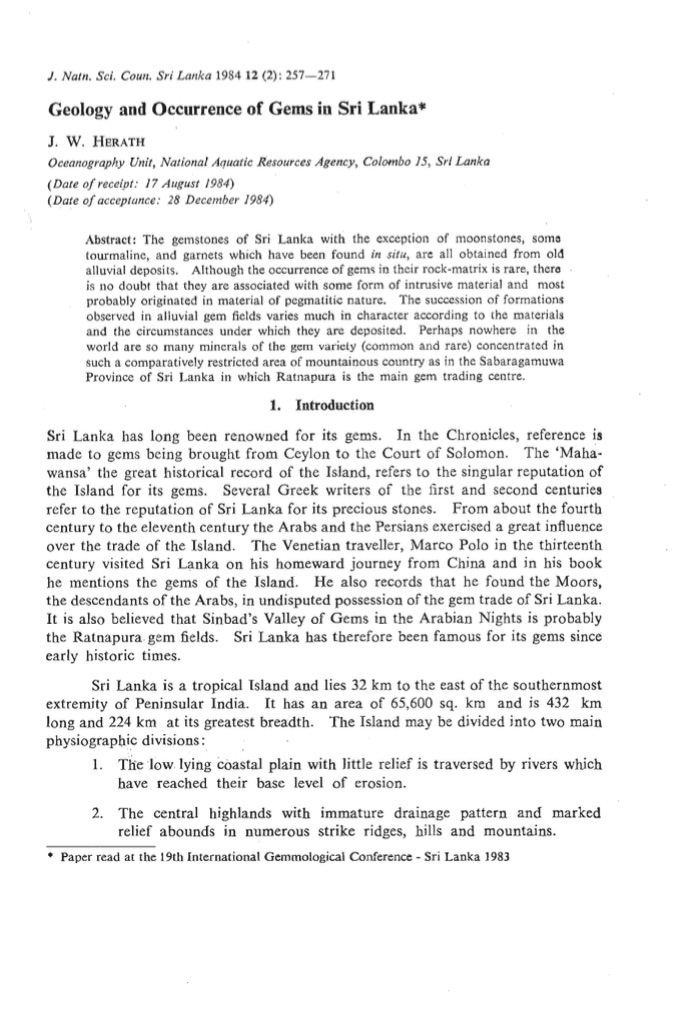
Geology and occurrence of gems in Sri Lanka
Journal Article
Herath, J.W. (1984) Geology and occurrence of gems in Sri Lanka.Journal of the Natural Science Council of Sri Lanka, Vol. 12, No. 2, pp. 257–271.
Record No. 3037 | Sinkankas/Born No.: NIS/NIB | RWHL
Reference copied to clipboard!
corundum, Sri Lanka.12, gems
As known to the gemmologist and jeweller, East Africa's famous gem locality, Tanzania, is well known not only for garnets of various colour varieties, but also for corundums of many colours and hues. The occurrence of corundum in Tanzania is reported by many researchers (Zwaan, 1974; Dolenc, 1976; Amstutz & Bank, 1977; Bank, 1978). However, these reports mainly describe the common corundum varieties such as ruby and blue and yellow sapphires. Recent observations made by the author on new occurrences of sapphires from Umba Valley revealed a reddish-brown colour variety which has often been termed as 'padparadschah* in the trade. It therefore became necessary to investigate systematically the differences between the 'real' padparadschah and this new occurrence. The chemical and physical properties of the latter are given with special emphasis on the cause of colour. Further, the inclusions are reported, which may be of help in documenting the locality.
Inclusions in Biron synthetic emeralds
Journal Article
Brown, G. and Snow, J. (1984) Inclusions in Biron synthetic emeralds.Australian Gemmologist, Vol. 15, No. 5, pp. 167–170.
Record No. 2381 | Sinkankas/Born No.: NIS/NIB | RWHL
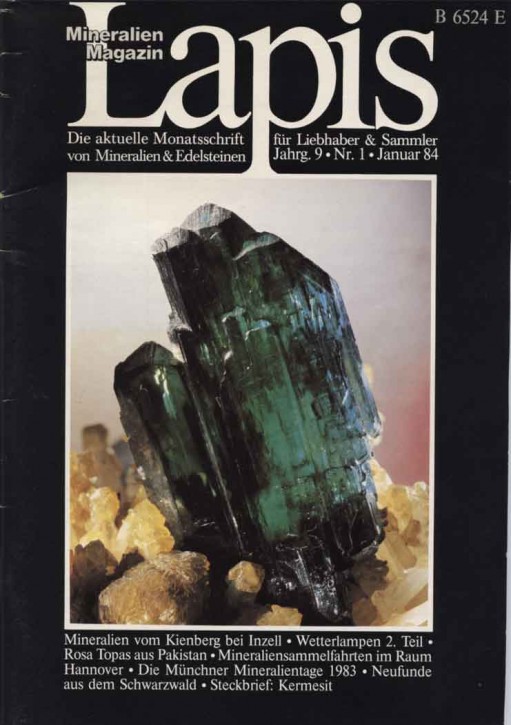
Gübelin, E.J. (1984) Rosa-Topas aus Pakistan. [Pink topaz from Pakistan]Lapis, Vol. 9, No. 1, January, pp. 23–28.
Record No. 2169 | Sinkankas/Born No.: NIS/NIB | Language: in German | RWHL
Reference copied to clipboard!
Pakistan, pink topaz, gems
Gübelin describes gem-quality rose to pink topaz from the Katlang area, northeast of Peshawar, Pakistan. The crystals are well developed and occur together with colorless and brown topaz. Gemological examination gave refractive indices of approximately 1.629–1.642, birefringence 0.009–0.011, and specific gravity 3.515–3.53. The stones show yellow, purple, and lilac-to-violet pleochroism and weak dark-red fluorescence under long-wave ultraviolet radiation. Chemical analysis showed small amounts of chromium and vanadium, with Cr³⁺ principally responsible for the pink coloration. Characteristic internal features include two-phase inclusions and parallel needle-like growth features. The article contains 17 color illustrations.
The first-order red compensator: An effective gemological tool
Journal Article
Koivula, J.I. (1984) The first-order red compensator: An effective gemological tool.Gems & Gemology, Vol. 20, No. 2, Summer, pp. 101–105.
This note deals with some gemologjcal applications for n tool well known to microscopists: the first-order red compensator. In gemological microscopy, the compensator can be useful in locating interfer-ence colors and optic figures in birefringent materials and in delipeating strain in gemstones. -Inpolarized-light photomicrography, a properly positioned com-pensator &in reduce the exposure time required and thus the risk of film reciprocity failure and of poor-quality images resulting from random vibrations of the microscope and its accessories.
Inclusions in a better light
Journal Article
Koivula, J.I. (1984) Inclusions in a better light.Zeitschrift der Deutschen Gemmologischen Gesellschaft, Vol. 33, No. 1/2, pp. 43–47.
Record No. 1116 | Sinkankas/Born No.: NIS/NIB | RWHL
Reference copied to clipboard!
corundum, inclusions.5, photomicrography, gems
“Ramaura”—A new synthetic ruby made in U.S.A.
Journal Article
Gunawardene, M. (1984) “Ramaura”—A new synthetic ruby made in U.S.A.Journal of Gemmology, Vol. 19, No. 2, April, pp. 125–138.
Gunawardene examines the gemmological properties and identification characteristics of the newly introduced Ramaura synthetic ruby, marketed by Overland Gems Inc. of California and first announced at the 1983 Tucson gem and mineral show. The material is flux-grown and was commercially available as faceted stones as well as lower-grade material, single crystals and crystal clusters. The study describes the external crystal morphology, standard gemmological properties, fluorescence and absorption characteristics, and especially the microscopic features of Ramaura ruby. Particular attention is given to flux-related inclusions and growth structures that distinguish the material from natural ruby and from other contemporary synthetic rubies. The author stresses that some specimens may be relatively straightforward to recognize, whereas cleaner stones require careful microscopic examination and comparison with the diagnostic features of other flux-grown synthetics.
As known to the gemmologist and jeweller, East Africa's famous gem locality, Tanzania, is well known not only for garnets of various colour varieties, but also for corundums of many colours and hues. The occurrence of corundum in Tanzania is reported by many researchers (Zwaan, 1974; Dolenc, 1976; Amstutz & Bank, 1977; Bank, 1978). However, these reports mainly describe the common corundum varieties such as ruby and blue and yellow sapphires. Recent observations made by the author on new occurrences of sapphires from Umba Valley revealed a reddish-brown colour variety which has often been termed as 'padparadschah* in the trade. It therefore became necessary to investigate systematically the differences between the 'real' padparadschah and this new occurrence. The chemical and physical properties of the latter are given with special emphasis on the cause of colour. Further, the inclusions are reported, which may be of help in documenting the locality.
Exploring the Literature of Gemstone Inclusions
The literature of gemstone inclusions covers identification, origin determination, treatments, synthesis, mineral inclusions, fluid inclusions and other internal features of natural and synthetic gems.
Four Treasures is Lotus Gemology's freely accessible gemological reference database. Use the full database to search by author, title or keyword and explore literature on gemology, mineralogy, jewelry and related fields. Where available, hyperlinks on titles may lead directly to the full publication.