Gemstone Inclusions Bibliography

Gemstone Inclusions Bibliography

Explore books, articles and historical sources on inclusions in gemstones in Four Treasures, the Lotus Gemology reference database. This bibliography brings together matching records from the collection, with publication details, abstracts and cover images where available.

Gemstone Inclusion References

The list below matches the terms inclusion or inclusions in the database's searchable fields. Some references discuss inclusions as part of a broader subject.
881–900 of 1,165 matching references

Structural aspects of some fingerprint inclusions in corundum
Journal Article
Tay, T.S. (1987) Structural aspects of some fingerprint inclusions in corundum. Australian Gemmologist, Vol. 16, No. 5, February, pp. 188–190.
Record No. 1686  |  Sinkankas/Born No.: NIS/NIB  |  RWHL

Dreiphaseneinschlüsse in einem gelben sapphir aus Sri Lanka
Three-phase inclusions in a yellow sapphire from Sri Lanka
Journal Article
Schmetzer, K. (1987) Dreiphaseneinschlüsse in einem gelben sapphir aus Sri Lanka. [Three-phase inclusions in a yellow sapphire from Sri Lanka] Zeitschrift der Deutschen Gemmologischen Gesellschaft, Vol. 36, pp. 79–81.
Record No. 1552  |  Sinkankas/Born No.: NIS/NIB  |  Language: In German  |  RWHL
Schmetzer describes unusual three-phase inclusions in an untreated yellow sapphire from Sri Lanka. The inclusions occur as tabular negative crystals oriented with their broad surfaces parallel to the basal plane of the host corundum. Each contains a transparent, doubly refractive solid crystal together with liquid and gas phases. At the time of this study the phases could not be identified conclusively; Schmetzer suggested that the solid might be mica, while the fluid and gaseous components were probably CO₂. Subsequent work by Schmetzer and Medenbach (1988) resolved the question. Examination of more than 300 Sri Lankan sapphires showed that comparable three-phase inclusions contain liquid and gaseous CO₂ plus needle-like to tabular crystals of diaspore, the latter identified by X-ray diffraction.

Eine neue generation synthetischer rubine von P.O. Knischka unter verwendung natürlicher nährsubstanz [A new generation of synthetic rubies from P.O. Knischka grown without the use of seeding crystals]
New generation of synthetic rubies from P.O. Knischka grown without the use of seeding crystals
Journal Article
Galia, W. (1987) Eine neue generation synthetischer rubine von P.O. Knischka unter verwendung natürlicher nährsubstanz [A new generation of synthetic rubies from P.O. Knischka grown without the use of seeding crystals]. [New generation of synthetic rubies from P.O. Knischka grown without the use of seeding crystals] Zeitschrift der Deutschen Gemmologischen Gesellschaft, Vol. 36, No. 1/2, pp. 19–31.
Record No. 804  |  Sinkankas/Born No.: NIS/NIB  |  Language: In German  |  RWHL
Describes a new generation of Knischka synthetic rubies grown by spontaneous nucleation from a flux using natural ruby as the starting material, without seed crystals. Growth periods of approximately eighteen months produced large crystals containing very few platinum inclusions. Microscopic examination revealed occasional milky or cloudy areas but no curved growth markings. Detected traces of platinum, sodium, tungsten and tantalum provide evidence of the platinum crucible and flux constituents used in production.

Gem Trade Lab Notes: Sapphire: A synthetic blue sapphire; synthetic yellow sapphire; unusual inclusions in heat-treated blue sapphire
Journal Article
Fryer, C.W. (1987) Gem Trade Lab Notes: Sapphire: A synthetic blue sapphire; synthetic yellow sapphire; unusual inclusions in heat-treated blue sapphire. Gems & Gemology, Vol. 23, No. 2, Summer, pp. 107–108.
Record No. 799  |  ISBN/ISSN: 0016626X  |  Sinkankas/Born No.: NIS/NIB  |  RWHL
The blue oval cut shown in figure 11, which was submitted to the New York lab for identification, is interesting for a number of reasons. The stone has an extremely deep pavilion and a shallow crown, with a total depth-to-width ratio of approximately 115%—so that it is actually deeper than it is wide. In addition, to the unaided eye it appears to be free of inclusions and has a pleasant light blue color. These facts suggested that the stone might be an old, “native cut,” unheated Ceylon sapphire. However, careful examination with the microscope revealed a shadow of curved color banding near the culet and suspicious stress cracks on some facets. The strong chalky blue fluorescence to short-wave UV radiation suggests that the stone either was subjected to extreme heat in treatment or is of synthetic origin. The curved color banding together with the Plato test positively identified it as a Verneuil flame-fusion synthetic sapphire. The stone is also an excellent example of how a very small color zone can produce a pleasant face-up color. Notice in the side view (figure 12) that the top of the stone is colorless; the small blue area near the culet, visible at this angle, is virtually the entire extent of color. Blue synthetic sapphire boules often have color only in a thin layer near the surface. Figure 12 also shows the extreme depth-to-width ratio of this stone.

Gem Trade Lab Notes: Heat-treated yellow sapphire
Journal Article
Fryer, C.W. (1987) Gem Trade Lab Notes: Heat-treated yellow sapphire. Gems & Gemology, Vol. 23, No. 3, Fall, p. 167.
Record No. 797  |  ISBN/ISSN: 0016626X  |  Sinkankas/Born No.: NIS/NIB  |  RWHL
A beautiful orangy yellow oval mixed-cut stone weighing 7.60 ct was submitted to the Santa Monica laboratory for identification. The refractive index, birefringence, and optic figure proved that the stone is sapphire. Microscopic examina-tion revealed natural inclusions as well as the strain discs, very fine dot-like silk," and round cotton-like inclusions that are indicative of heat treatment. Exposure to short-waveultravio-let radiation revealed three zones of chalky blue fluorescence close to the girdle, another sign of heat treat-ment. When the stone was immersed in methylene iodide, some interest-ing structural characteristics be-came visible. In addition to the straight angular yellow color zoning alternating with near-colorless areas, which is characteristic of natural origin, three straight blue zones close to the girdle (coinciding with the areas of chalky blue fluores cence] were seen. Figure 10 showo these blue areas, which could be the result of the heat treatment."

Metallic inclusions in Chatham synthetic corundums
Journal Article
Burch, C.R. (1987) Metallic inclusions in Chatham synthetic corundums. Journal of Gemmology, Vol. 20, No. 5, January, pp. 267–269.
Record No. 543  |  ISBN/ISSN: 221252  |  Sinkankas/Born No.: NIS/NIB  |  RWHL

A re-investigation of gahnospinels from Sri Lanka
Journal Article
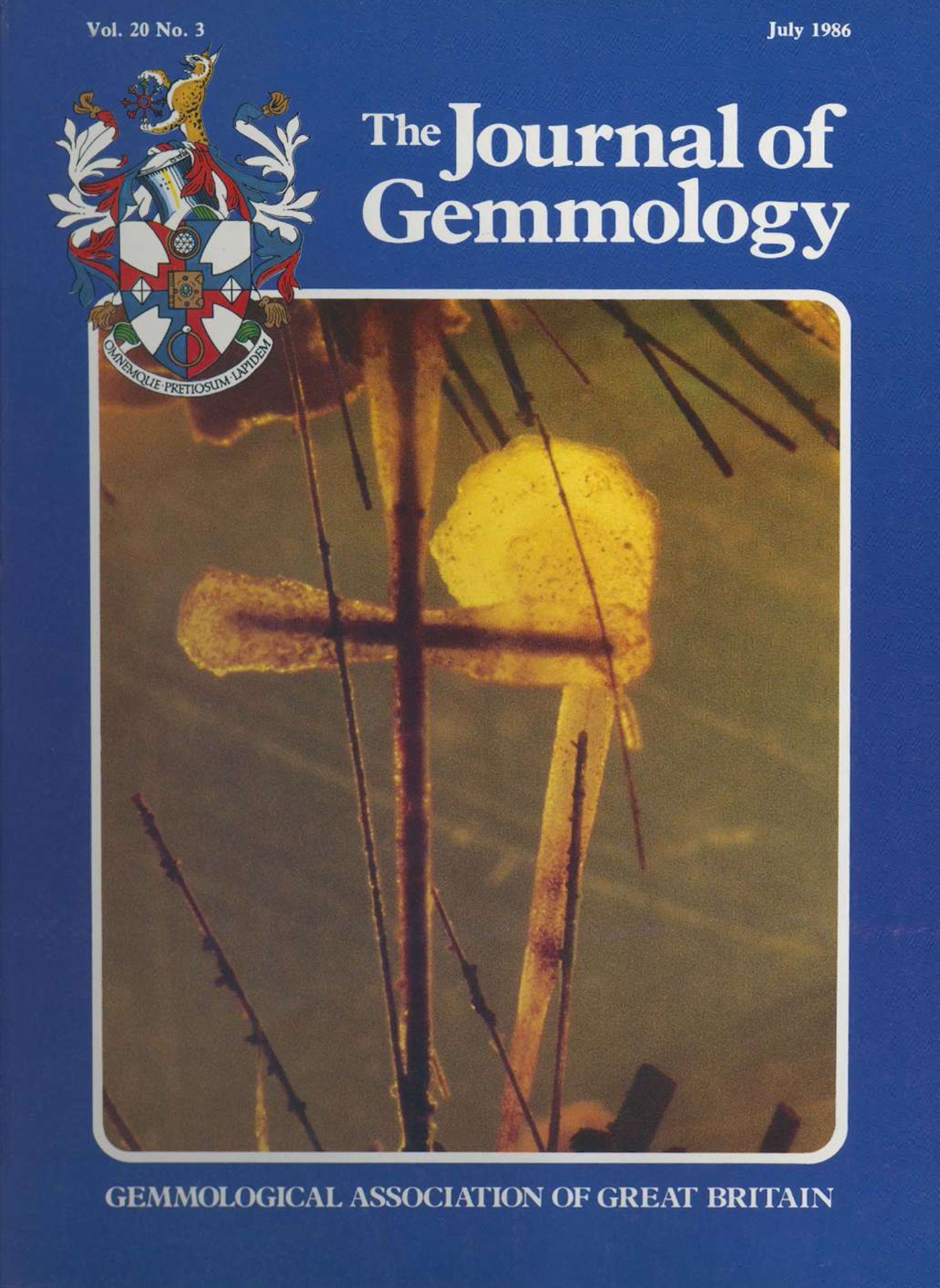
Schmetzer, K. and Bank, H. (1986) A re-investigation of gahnospinels from Sri Lanka. Journal of Gemmology, Vol. 20, No. 3, pp. 157–160.
Record No. 5994  |  ISBN/ISSN: 221252  |  Sinkankas/Born No.: NIS/NIB  |  RWHL

Inclusions in opal

Journal Article
Gübelin, E.J. and Koivula, J.I. (1986) Inclusions in opal. Journal of Gemmology, Vol. 20, No. 3, July, pp. 139–144.
Record No. 5058  |  ISBN/ISSN: 221252  |  Sinkankas/Born No.: NIS/NIB  |  RWHL

Some unusual sillimanite cat’s eyes

Journal Article
Gübelin, E.J., Weibel, M. and Woensdregt, C.F. (1986) Some unusual sillimanite cat’s eyes. Gems & Gemology, Vol. 22, No. 2, Summer, pp. 96–98.
Record No. 5056  |  ISBN/ISSN: 0016626X  |  Sinkankas/Born No.: NIS/NIB  |  RWHL
Brown-black sillimanite cat's-eyesfrom Sri Lanka present an unusually sharp band, which would make them extraordinary gems wereit not for therather un-attractive body color of the stones. A study of six of these stones found that they contain 0.5 wt.% iron oxide.Theprincipal inclusionmineralisilmenite, which occurs in elongated, submicroscopically thin lamellae. Complex thicker lamellae consist of hercy-nite spinel grown together with a member of the pyroxene group. Thesethickerinclusions werenot foundin all of the specimens investigated.

Untersuchung eines sapphir-katzenauges aus Burma
Examination of a sapphire cat's eye from Burma
Journal Article
Schmetzer, K. and Kiefert, L. (1986) Untersuchung eines sapphir-katzenauges aus Burma. [Examination of a sapphire cat's eye from Burma] Zeitschrift der Deutschen Gemmologischen Gesellschaft, Vol. 35, No. 3/4, pp. 105–111.
Record No. 4972  |  Sinkankas/Born No.: NIS/NIB  |  Language: In German  |  RWHL
Schmetzer and Kiefert examine an unusual chatoyant sapphire from Burma in order to determine the cause of its cat’s-eye effect. Microscopic examination shows numerous fine, elongated inclusions arranged in a strongly preferred crystallographic orientation. The authors study their orientation in relation to the corundum crystal structure and show that reflection and scattering from these oriented inclusions produce the sharply defined eye. The stone’s internal growth structures, inclusions, optical properties and absorption characteristics are also described and compared with those of other sapphires. The study illustrates how crystallographically oriented inclusions can produce chatoyancy in corundum and documents a relatively uncommon phenomenal variety of Burmese sapphire.

Inclusions in sapphire and heat treatment
Journal Article
Moon, A.R. and Phillips, M.R. (1986) Inclusions in sapphire and heat treatment. Australian Gemmologist, Vol. 16, pp. 163–166.
Record No. 4920  |  Sinkankas/Born No.: NIS/NIB  |  RWHL

Rosafarbene und violette sapphire aus Nepal
Pink and violet sapphires from Nepal
Journal Article
Kiefert, L. and Schmetzer, K. (1986) Rosafarbene und violette sapphire aus Nepal. [Pink and violet sapphires from Nepal] Zeitschrift der Deutschen Gemmologischen Gesellschaft, Vol. 35, No. 3/4, pp. 113–125.
Record No. 4846  |  Sinkankas/Born No.: NIS/NIB  |  Language: In German  |  RWHL
Kiefert and Schmetzer describe pink and violet sapphires from a newly recognized occurrence in Nepal. Associated minerals include calcite, phlogopite, margarite and rutile. The pink color is attributed principally to chromium, whereas the violet coloration results from a combination of Cr, Fe and Ti. The corundums commonly contain twin lamellae and dense sets of straight, parallel growth planes that separate zones differing in color and concentrations of fine mineral particles. Particularly characteristic are small, doubly refractive mica platelets, identified as margarite, some occurring as the solid component of three-phase inclusions. Numerous healed and unhealed fractures are also present and substantially reduce the gem quality of much of the material.

On the origin of blue sapphire from Elahera, Sri Lanka
Journal Article
Heilmann, G. and Henn, U. (1986) On the origin of blue sapphire from Elahera, Sri Lanka. Australian Gemmologist, Vol. 16, No. 1, pp. 2–4.
Record No. 4802  |  Sinkankas/Born No.: NIS/NIB  |  RWHL

A description of ruby from Nepal

Journal Article
Harding, R.R. and Scarratt, K. (1986) A description of ruby from Nepal. Journal of Gemmology, Vol. 20, No. 1, January, pp. 3–10.
Record No. 4797  |  ISBN/ISSN: 221252  |  Sinkankas/Born No.: NIS/NIB  |  RWHL

The Elahera gem field in central Sri Lanka
Journal Article
Gunawardene, M. and Rupasinghe, M.S. (1986) The Elahera gem field in central Sri Lanka. Gems & Gemology, Vol. 22, No. 2, Summer, pp. 80–95.
Record No. 4792  |  ISBN/ISSN: 0016626X  |  Sinkankas/Born No.: NIS/NIB  |  RWHL
Gunawardene and Rupasinghe provide a detailed account of the Elahera gem field in central Sri Lanka, historically an important gem-producing area and, by the mid-1980s, the country’s second-largest gem field after Ratnapura. They review its history, location, geology and mining methods. Gem-bearing residuum and alluvial gravels associated with highly metamorphosed Precambrian rocks yield a notably diverse assemblage, including sapphire in many colours, spinel, rhodolite and hessonite garnet, chrysoberyl (including alexandrite and cat’s-eye), zircon, tourmaline, kornerupine, sinhalite, epidote, sillimanite and taaffeite. The authors document the chemistry and gemmological properties of these materials, including refractive indices, specific gravity, pleochroism, absorption, fluorescence and characteristic inclusions; selected inclusions were investigated by microscopy, electron microprobe and X-ray diffraction. At the time of publication, Elahera was estimated to supply approximately 35% of Sri Lanka’s gemstone exports.

A peculiar inclusion in a yellow corundum from Malawi
Journal Article
Grubessi, O. and Marcon, R. (1986) A peculiar inclusion in a yellow corundum from Malawi. Journal of Gemmology, Vol. 20, No. 3, July, pp. 163–165.
Record No. 4788  |  ISBN/ISSN: 221252  |  Sinkankas/Born No.: NIS/NIB  |  RWHL

An examination of four important gems
Journal Article
Fryer, C.W. and Koivula, J.I. (1986) An examination of four important gems. Gems & Gemology, Vol. 22, No. 2, Summer, pp. 99–102.
Record No. 4781  |  ISBN/ISSN: 0016626X  |  Sinkankas/Born No.: NIS/NIB  |  RWHL
The authors report on their gemological examinations of four important gemstones: the Star of Bombay sapphire, the Portuguese diamond, and two large diamonds known as the Marie Antoinette earrings, all of which are part of the collection at the Smithsonian Institution. Brief historical information on some of the pieces is also included.

Differentiation between natural gems and synthetic minerals by laser Raman microspectrometry
Journal Article
Déle-Dubois, M.-L., Dhamelincourt, P., Poirot, J.-P. and Schubnel, H.-J. (1986) Differentiation between natural gems and synthetic minerals by laser Raman microspectrometry. Journal of Molecular Structure, Vol. 143, pp. 135–138.
Record No. 4752  |  Sinkankas/Born No.: NIS/NIB  |  RWHL
By allowing positive identification of fluid and solid inclusions inside minerals, laser Raman microspectrometry has proved to be a perfect technique for discriminating between natural gems or synthetic minerals made for jewellery (sapphire, ruby, emerald)

Die diagnostischen Eigenschaften der neusten Synthesen
The diagnostic properties of the latest syntheses
Journal Article
Gübelin, E.J. (1986) Die diagnostischen Eigenschaften der neusten Synthesen. [The diagnostic properties of the latest syntheses] Deutsche Goldschmiede-Zeitung, November, pp. 69–76.
Record No. 2180  |  Sinkankas/Born No.: NIS/NIB  |  Language: in German  |  RWHL
Gübelin reviews the diagnostic features of the latest synthetic gemstones then appearing on the market, concentrating on Lennix, Biron, Soviet and Seiko synthetic emeralds and Seiko, Lechleitner and Knischka synthetic corundums. Particular emphasis is placed on microscopic identification, especially characteristic inclusions and growth features associated with the different synthesis methods. Gübelin shows that conventional physical and optical properties may overlap substantially with those of natural stones, making internal features especially important for reliable separation. The study compares the characteristic inclusion patterns of the various products and provides practical criteria for distinguishing these increasingly sophisticated synthetics from their natural counterparts. A later English version contains 46 color figures.

Secondary matters

Journal Article
Themelis, T. (1986) Secondary matters. Lapidary Journal, Vol. 40, No. 8, November, p. 19.
Record No. 1696  |  Sinkankas/Born No.: NIS/NIB  |  RWHL

Exploring the Literature of Gemstone Inclusions

The literature of gemstone inclusions covers identification, origin determination, treatments, synthesis, mineral inclusions, fluid inclusions and other internal features of natural and synthetic gems.

For a curated selection of important sources, read Inclusions in Gemstones — Hyperion Literature Sources.

About Four Treasures

Four Treasures is Lotus Gemology's freely accessible gemological reference database. Use the full database to search by author, title or keyword and explore literature on gemology, mineralogy, jewelry and related fields. Where available, hyperlinks on titles may lead directly to the full publication.

Search the Complete Four Treasures Database