Explore books, articles and historical sources on inclusions in gemstones in Four Treasures, the Lotus Gemology reference database. This bibliography brings together matching records from the collection, with publication details, abstracts and cover images where available.
Gemstone Inclusion References
The list below matches the terms inclusion or inclusions in the database's searchable fields. Some references discuss inclusions as part of a broader subject.
861–880 of 1,165 matching references
Feldspars as host and guest minerals
Journal Article
Gübelin, E.J. (1988) Feldspars as host and guest minerals.Indian Gemmologist,
Record No. 2188 | Sinkankas/Born No.: NIS | RWHL
Reference copied to clipboard!
feldspar, inclusions, gems
Photomicrography of gemstones
Journal Article
Goutiere, A., de (1988) Photomicrography of gemstones.Gemological Digest, Vol. 2, No. 3, pp. 35–36.
Record No. 1970 | Sinkankas/Born No.: NIS/NIB | RWHL
Reference copied to clipboard!
inclusions, photomicrography, gems
The author briefly discusse s the subject of inclusion photo graphy of gemstones. He describes some of the basic tools needed to get tlze budding photographer started on his/her way and finishes with a few examples of his own work.
Modern application of gemstone inclusions: Detection of colour-enhancement potential of geuda sapphire from Sri Lanka
Journal Article
Wijesuriya, G. (1988) Modern application of gemstone inclusions: Detection of colour-enhancement potential of geuda sapphire from Sri Lanka.Journal of the Gemmologists Association of Sri Lanka, No. 5, pp. 28–30.
Record No. 1860 | Sinkankas/Born No.: NIS/NIB | RWHL
Reference copied to clipboard!
corundum, treatments.6, Sri Lanka.12, gems
Fissures in heated ruby
Journal Article
Themelis, T. (1988) Fissures in heated ruby.Lapidary Journal, Vol. 42, No. 6, September, p. 19.
Record No. 1705 | Sinkankas/Born No.: NIS/NIB | RWHL
Reference copied to clipboard!
corundum, inclusions.5, gems
Dotted silk
Journal Article
Themelis, T. (1988) Dotted silk.Lapidary Journal, Vol. 41, No. 10, January, p. 19.
Record No. 1704 | Sinkankas/Born No.: NIS/NIB | RWHL
Reference copied to clipboard!
corundum, treatments.6, inclusions.5, gems
“Diesel” in sapphire
Journal Article
Themelis, T. (1988) “Diesel” in sapphire.Lapidary Journal, Vol. 41, No. 11, February, p. 19.
Record No. 1703 | Sinkankas/Born No.: NIS/NIB | RWHL
Reference copied to clipboard!
corundum, inclusions.5, treatments.6, gems
Chromophoric impurities in grey sapphire
Journal Article
Themelis, T. (1988) Chromophoric impurities in grey sapphire.Lapidary Journal, Vol. 42, No. 3, June, p. 19.
Record No. 1702 | Sinkankas/Born No.: NIS/NIB | RWHL
Reference copied to clipboard!
corundum, inclusions.5, gems
Blue spot on ruby
Journal Article
Themelis, T. (1988) Blue spot on ruby.Lapidary Journal, Vol. 42, No. 1, April, p. 19.
Record No. 1701 | Sinkankas/Born No.: NIS/NIB | RWHL
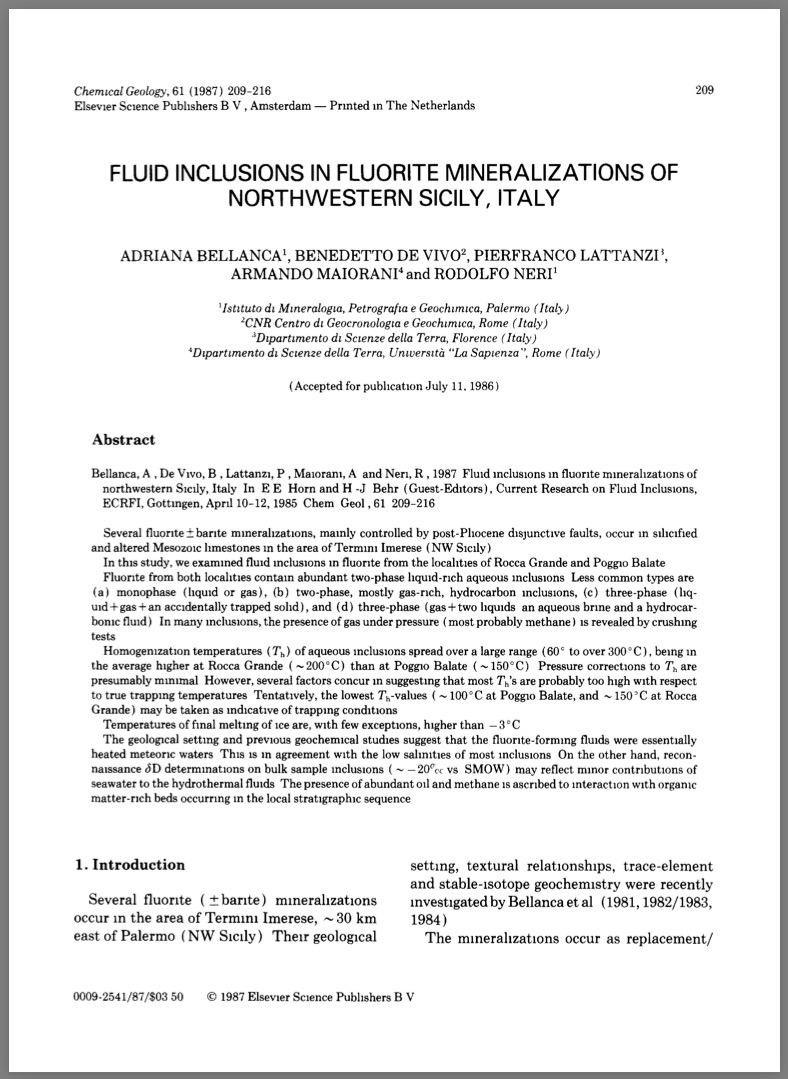
Bellanca, A., De Vito, B., Lattanzi, P., Maiorani, A. and Neri, R. (1987) Fluid inclusions in fluorite mineralizations of northwestern Sicily.Chemical Geology, Vol. 61, Nos. 1–4, pp. 209–216.
gems, fluorite, inclusions in fluorite, fluid inclusions
Several fluorite ± barite mineralizations, mainly controlled by post-Pliocene disjunctive faults, occur in silicified and altered Mesozoic limestones in the area of Termini Imerese (NW Sicily). In this study, we examined fluid inclusions in fluorite from the localities of Rocca Grande and Poggio Balate. Fluorite from both localities contains abundant two-phase liquid-rich aqueous inclusions. Less common types are: (a) monophase (liquid or gas); (b) two-phase, mostly gas-rich, hydrocarbon inclusions; (c) three-phase (liquid + gas + an accidentally trapped solid); and (d) three-phase (gas + two liquids: an aqueous brine and a hydrocarbonic fluid). In many inclusions, the presence of gas under pressure (most probably methane) is revealed by crushing tests. Homogenization temperatures (Th) of aqueous inclusions spread over a large range (60° to over 300 °C), being on average higher at Rocca Grande (∼200 °C) than at Poggio Balate (∼150 °C). Pressure corrections to Th are presumably minimal. However, several factors concur in suggesting that most Th’s are probably too high with respect to true trapping temperatures. Tentatively, the lowest Th-values (∼100 °C at Poggio Balate, and ∼150 °C at Rocca Grande) may be taken as indicative of trapping conditions. Temperatures of final melting of ice are, with few exceptions, higher than −3 °C. The geological setting and previous geochemical studies suggest that the fluorite-forming fluids were essentially heated meteoric waters. This is in agreement with the low salinities of most inclusions. On the other hand, reconnaissance δD determinations on bulk sample inclusions (‰ vs. SMOW) may reflect minor contributions of seawater to the hydrothermal fluids. The presence of abundant oil and methane is ascribed to interaction with organic matter-rich beds occurring in the local stratigraphic sequence.
Einschlüsse in Mineralen
Inclusions in Minerals
Book
Leeder, O., Thomas, R. and Klemm, W. (1987)Einschlüsse in Mineralen. [Inclusions in Minerals] Leipzig, VEB Deutscher Verlag für Grundstoffindustrie, 180 pp.
Record No. 6060 | ISBN/ISSN: 3342000880 | Sinkankas/Born No.: NIS/NIB | Language: in German | RWHL
Reference copied to clipboard!
gems, minerals, inclusions
Leeder, Thomas and Klemm provide a comprehensive introduction to the study of inclusions in minerals, described as the first German-language book devoted specifically to inclusion research. Following a historical review, they discuss the appearance, classification and genesis of inclusions and establish the physicochemical principles needed for their interpretation. Considerable attention is devoted to fluid inclusions and the H₂O, CO₂, H₂O–NaCl, H₂O–KCl–NaCl, H₂O–CO₂ and CO₂–CH₄ systems. Analytical methods include homogenization measurements, cryometry, pressure determinations and decrepitation, together with determination of solution chemistry, water content, gas composition and isotopic ratios. The authors emphasize the use of inclusions for thermobarometry and reconstruction of mineral-forming conditions, particularly in mineralogy, petrology and economic geology. The book combines theoretical treatment with specimen preparation, instrumentation, measurement procedures and interpretation of results.
Fluorite and its inclusions
Journal Article
Gübelin, E.J. and Koivula, J.I. (1987) Fluorite and its inclusions.Australian Gemmologist, Vol. 16, No. 5, February, pp. 184–185.
Record No. 5062 | Sinkankas/Born No.: NIS/NIB | RWHL
Reference copied to clipboard!
fluorite, inclusions, gems
The Lennix synthetic emerald
Journal Article
Gübelin, E.J., Graziani, G. and Martini, M. (1987) The Lennix synthetic emerald.Gems & Gemology, Vol. 23, No. 3, Fall, pp. 140–147.
The Lennix synthetic emerald, currently n~anufacturedin France, is a dark green, moderately transparent to translucent material grown by flux fusion. With the microscope, zones of lighter and darker green are evident. For the most part, the gemological properties of this synthetic emerald overlap those of natural einer-aids, although the low refractive-index and specific-gravity values are good indi-cators that this material is synthetic. The presence of wispy veil" inclusions pro-vides conclusive proof of synthetic origin, as do the chemical analyses, infrared transmission spectra, and cathodo-luminescence."
Sapphirine (not sapphire) in a ruby from Bo Rai, Thailand
Journal Article
Koivula, J.I. and Fryer, C.W. (1987) Sapphirine (not sapphire) in a ruby from Bo Rai, Thailand.Journal of Gemmology, Vol. 20, No. 6, April, pp. 369–370.
Blaue und gelbe sapphire aus der provinz Kaduna, Nigeria
Blue and yellow sapphires from Kaduna Province, Nigeria
Journal Article
Kiefert, L. and Schmetzer, K. (1987) Blaue und gelbe sapphire aus der provinz Kaduna, Nigeria. [Blue and yellow sapphires from Kaduna Province, Nigeria]Zeitschrift der Deutschen Gemmologischen Gesellschaft, Vol. 36, No. 1/2, pp. 61–78.
Record No. 4848 | Sinkankas/Born No.: NIS/NIB | Language: In German | RWHL
Kiefert and Schmetzer describe blue and yellow sapphires from a secondary weathering deposit in Kaduna Province, about 45 km northeast of Jos, Nigeria, based on examination of 38 rough crystals and 31 cut stones. The rough sapphires are tabular, barrel-shaped or prismatic and occur with quartz, kaolinite, goethite, hematite and gibbsite. Gemological properties are typical of corundum, with RI nε 1.759–1.761, nω 1.768–1.770 and SG 3.99–4.01. Spectroscopy shows that the blue coloration involves Fe³⁺, Fe²⁺/Ti⁴⁺ and Fe²⁺/Fe³⁺ absorptions, with Cr³⁺ present in some specimens, whereas the yellow sapphires show Fe³⁺ and Ti³⁺ features. Characteristic microscopic features include pronounced growth and color zoning, fissures along basal parting planes, negative crystals, pseudosecondary healed fissures and secondary inclusions in open fractures. Identified mineral inclusions include albite, uranpyrochlore and zircon, some associated with primary fluid inclusions.
A beautiful orangy yellow oval mixed-cut stone weighing 7.60 ct (figure9)was submitted to the Santa Monica laboratory for identification. The refractive index, birefringence, and optic figure proved that the stone is sapphire. Microscopic examina-tion revealed natural inclusions as well as the strain discs, very fine dot-like silk," and round cotton-like inclusions that are indicative of heat treatment. Exposure to short-waveultravio-let radiation revealed three zones of chalky blue fluorescence close to the girdle, another sign of heat treat-ment. When the stone was immersed in methylene iodide, some interest-ing structural characteristics be-came visible. In addition to the straight angular yellow color zoning alternating with near-colorless areas, which is characteristic of natural origin, three straight blue zones close to the girdle (coinciding with the areas of chalky blue fluores cence] were seen. Figure 10 showo these blue areas, which could be the result of the heat treatment."
Gübelin, E.J. (1987) Recently observed inclusions in gemstones.Transactions of the XXI International Gemmological Conference, Brazil, 1987, pp. 43–49.
Record No. 2186 | Sinkankas/Born No.: NIS/NIB | RWHL
Reference copied to clipboard!
inclusions, gems
The gemological properties of the De Beers gem-quality synthetic diamonds
Journal Article
Shigley, J.E., Fritsch, Emmanuel, Stockton, C.M., Koivula, John I., Fryer, C.W., Kane, Robert E., Hargett, D.R. and Welch, C.W. (1987) The gemological properties of the De Beers gem-quality synthetic diamonds.Gems & Gemology, Vol. 23, No. 4, Winter, pp. 187–206.
Gem-quality synthetic diamond crystals weighing up to 11 carats have been grown experimentally in limited quantities at the De Beers Diamond Research Laboratory since the 1970s, though they are not commercially available. Examination of 14 synthetic diamonds in shades of brownish yellow, yellow, and greenish yellow reveals distinctive gemological features, including uneven color distribution, geometric graining patterns, metallic inclusions, and, in most cases, fluorescence under short-wave but not long-wave ultraviolet radiation.
Idaho Geuda
Journal Article
Themelis, T. (1987) Idaho Geuda.Lapidary Journal, February, p. 57.
Record No. 1699 | Sinkankas/Born No.: NIS/NIB | RWHL
Themelis, T. (1987) Crystallines in Burmese ruby.Lapidary Journal, Vol. 41, No. 9, December, p. 19.
Record No. 1697 | Sinkankas/Born No.: NIS/NIB | RWHL
Reference copied to clipboard!
corundum, ruby, Burma.12, inclusions.5, gems
Exploring the Literature of Gemstone Inclusions
The literature of gemstone inclusions covers identification, origin determination, treatments, synthesis, mineral inclusions, fluid inclusions and other internal features of natural and synthetic gems.
Four Treasures is Lotus Gemology's freely accessible gemological reference database. Use the full database to search by author, title or keyword and explore literature on gemology, mineralogy, jewelry and related fields. Where available, hyperlinks on titles may lead directly to the full publication.