Gemstone Inclusions Bibliography

Gemstone Inclusions Bibliography

Explore books, articles and historical sources on inclusions in gemstones in Four Treasures, the Lotus Gemology reference database. This bibliography brings together matching records from the collection, with publication details, abstracts and cover images where available.

Gemstone Inclusion References

The list below matches the terms inclusion or inclusions in the database's searchable fields. Some references discuss inclusions as part of a broader subject.
841–860 of 1,165 matching references

Epiasterism and pseudoasterism

Journal Article
Themelis, T. (1989) Epiasterism and pseudoasterism. Lapidary Journal, Vol. 43, No. 1, April, p. 28.
Record No. 1709  |  Sinkankas/Born No.: NIS/NIB  |  RWHL

Film in corundum

Journal Article
Themelis, T. (1989) Film in corundum. Lapidary Journal, Vol. 43, No. 7, October, p. 19.
Record No. 1708  |  Sinkankas/Born No.: NIS/NIB  |  RWHL

Color distribution in corundum

Journal Article
Themelis, T. (1989) Color distribution in corundum. Lapidary Journal, January, p. 19.
Record No. 1707  |  Sinkankas/Born No.: NIS/NIB  |  RWHL

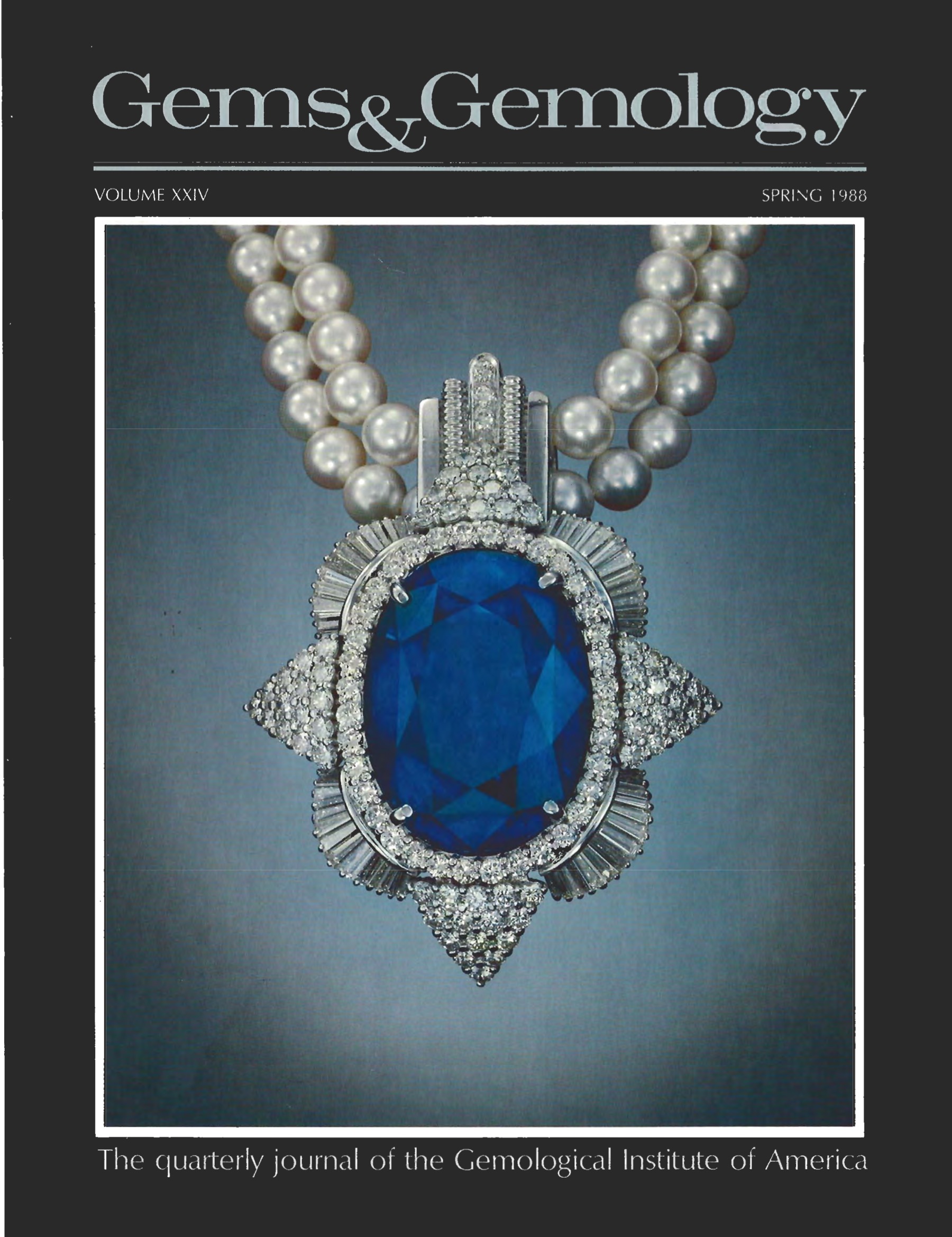
Gem Trade Lab Notes: Ruby; Verneuil synthetic with needle-like inclusions; Sapphire; A large fine-color star
Journal Article
Hargett, D. (1989) Gem Trade Lab Notes: Ruby; Verneuil synthetic with needle-like inclusions; Sapphire; A large fine-color star. Gems & Gemology, Vol. 25, No. 1, Spring, pp. 38–39.
Record No. 934  |  ISBN/ISSN: 0016626X  |  Sinkankas/Born No.: NIS/NIB  |  RWHL

The distinction of natural from synthetic alexandrite by infrared spectroscopy
Journal Article
Stockton, C.M. and Kane, R.E. (1988) The distinction of natural from synthetic alexandrite by infrared spectroscopy. Gems & Gemology, Vol. 24, No. 1, Spring, pp. 44–46.
Record No. 28100  |  Sinkankas/Born No.: NIS/NIB  |  RWHL
Infrared spectroscopy provides a means to distinguish natural from synthetic alexandrites in the range 2000–4200 cm⁻¹, as determined by a study of spectra obtained from 15 natural and 28 synthetic alexandrites from a variety of sources. The technique is nondestructive and, with Fourier transform instrumentation, extremely rapid. It is especially useful for identifying stones that contain no distinguishing inclusions.

As inclusões cristalinas e fluidas da esmeralda de Santa Terezinha de Goiás seu significado geológico
The crystalline and fluid inclusions of the emerald of Santa Terezinha de Goiás their geological meaning
Conference Paper
Mendes, J.C. and Svisero, D.P. (1988) As inclusões cristalinas e fluidas da esmeralda de Santa Terezinha de Goiás seu significado geológico. [The crystalline and fluid inclusions of the emerald of Santa Terezinha de Goiás their geological meaning] ANAIS: XXXV Congresso Brasileiro de Geologia, Belém pp. 398–412.
Record No. 7801  |  Sinkankas/Born No.: NIS/NIB  |  Language: in Spanish  |  RWHL
Emeralds from Santa Terezinha de Goiás, a major global producer, contain a diverse range of primary inclusions identified through X-ray diffraction, energy dispersive analysis, and electron microprobe techniques. These inclusions include chromite, dolomite, magnesite, talc, phlogopite, pyrite, quartz, beryl, barite, patronite, ferropargasite, anthophyllite-cummingtonite, epidote, melanterite, and dumortierite, which reflect the metamorphic nature of the host rocks. Chromite, the most characteristic inclusion, appears as isolated or clustered idiomorphic crystals that exhibit a distinctive red-brown hue under magnification. Carbonates like dolomite and magnesite occur as rhombohedral crystals, while talc is present as dispersed flakes. Other notable inclusions include yellow cubic pyrite, phlogopite (less common than in emeralds from Itabira and Socotó), idiomorphic beryl, and quartz filling fractures. Barite and patronite are rare, while epidote, cummingtonite-anthophyllite, dumortierite, and melanterite were detected only in mixtures via X-ray methods. Fluid inclusions, visible only at high magnifications, contain gas, liquid, and solid phases. The observed inclusions align with the paragenesis of the metamorphic country rocks, and chemical analysis indicates significant variations in the crystallization conditions of these emeralds.

Gem News: Inclusions identified in new Brazilian alexandrites
Journal Article
Koivula, J.I. and Kammerling, R.C. (1988) Gem News: Inclusions identified in new Brazilian alexandrites. Gems & Gemology, Vol. 24, No. 1, Spring, p. 59.
Record No. 6125  |  ISBN/ISSN: 0016626X  |  Sinkankas/Born No.: NIS/NIB  |  RWHL
Two characteristic mineral inclusions observed in the alexandrites from the recent discovery at Hematita in Minas Gerais, Brazil (see the article by K. Proctor in this issue], have been identified by means of detailed chemical analysis. Dr. Henry Hanni found inclusions of fluorite (figure 7) in one of the alexandrites, and Dr. Karl Schmetzer and Mr. Charles Schiffmann confirmed the identification of apatite (figure 8). Dr. Edward Gübelin initiated the study and followed it through to completion. This is the first time that fluorite has been recognized as a mineral inclusion in chrysoberyl.

Emeralds from Somondoco, Colombia: Chemical composition, fluid inclusions and origin
Journal Article
Kozlowski, A., Metz, P. and Jaramillo, H.A.E. (1988) Emeralds from Somondoco, Colombia: Chemical composition, fluid inclusions and origin. Neus Jahrbuch für Mineralogie – Abhandlungen, Vol. 159, No. 1, pp. 23–49.
Record No. 6074  |  Sinkankas/Born No.: NIS/NIB  |  RWHL
Emeralds from the district Somondoco (Colombia) were analyzed by electron microprobe, colorimetry (Be), emission spectrography (Li), and thermogravimetry and infrared absorption (H₂O). They typically show the following atomic substitutions (per 18 oxygens): 0.13–0.21 Al in the SiO₄ tetrahedra, 0.14–0.40 for the sum of Cr, V, Fe, Mg in the AlO₆ octahedra, and 0.02–0.06 Li plus 0.00–0.170 in the BeO₄ tetrahedra; the “channel” alkalis, mostly Na, total 0.13–0.29. Fluid inclusions in these emeralds contain liquid H₂O, liquid CO₂, daughter crystals of halite and calcite (?), and liquid and gaseous hydrocarbons. The behaviour of the fluid inclusions on freezing and heating and their frequent decrepitation, stretching, and leaking are described. Temperatures of homogenization (Th) values are ≥ 470 °C, but only those close to the lower limit seem unaffected by inclusion stretching, etc. A roughly estimated pressure (≤ 1 kbar) would require a pressure correction of about 100 °C to the Th values. The total salt concentration in fluid inclusions is close to 40 wt.%, and the dissolved salt composition inferred from the electron microprobe analyses of the precipitates from decrepitated inclusions is probably: Cl, Na > Ca, Si, Al, (C) > Fe, K, Mg > Mn, Ti. The behaviour of other possible components in the mineral-forming process is also discussed. It is calculated that beryllium fixed in emeralds makes up only 0.2 to 1 wt.% of the total Be in the emerald-bearing rocks and veins. The proposed model of the origin of emeralds involves only components mobilized from the country rocks, without recourse to a deep-seated or magmatic source.

Gem News: New evidence of treatment in Umba sapphires
Journal Article
Koivula, J.I. and Kammerling, R.C. (1988) Gem News: New evidence of treatment in Umba sapphires. Gems & Gemology, Vol. 24, No. 4, Winter, p. 251.
Record No. 5435  |  ISBN/ISSN: 0016626X  |  Sinkankas/Born No.: NIS/NIB  |  RWHL
New evidence of treatment in Umba sapphires. Any evidence that provides absolute proof that a sapphire has or has not been heat treated is always of value to gemologists. A recent investigation done by one of the Gem News editors (JIK), which was published in the Journal of Gemmology (Vol. 20, No. 7, 1987), showed just such evidence in the form of colored halos surrounding solid mineral inclusions in sapphires from Sri Lanka and Montana. The halos result from the heat-induced theft, by the sapphire host, of color-causing ions from the mineral inclusions. After reading the above-mentioned article, Dr. Henry A. Hänni of the University of Basel and the Swiss Foundation for the Research of Gemstones contacted Gem News and reported his discovery of similar internal diffusion halos surrounding tiny mineral inclusions in blue sapphire from the Umba River region in Tanzania, East Africa (figure 6). Dr. Hänni’s observation provides positive evidence that at least some of the sapphires from this locality are being heat treated.

A Verneuil sapphire with induced fractures
Journal Article
Brown, G. and Kelly, S.M.B. (1988) A Verneuil sapphire with induced fractures. Australian Gemmologist, Vol. 16, No. 11, pp. 419—421.
Record No. 5400  |  Sinkankas/Born No.: NIS/NIB  |  RWHL

Alexandrit: natürlich oder synthetisch?
Alexandrite: natural or synthetic?
Journal Article
Gübelin, E.J., Bank, H., Henn, U. and Malley, J. (1988) Alexandrit: natürlich oder synthetisch? [Alexandrite: natural or synthetic?] Zeitschrift der Deutschen Gemmologischen Gesellschaft, Vol. 37, No. 1/2, November, pp. 49–52.
Record No. 5064  |  Sinkankas/Born No.: NIS/NIB  |  Language: In German  |  RWHL
Reports the examination of an alexandrite whose internal characteristics made the determination of natural versus synthetic origin problematic. The authors describe the gemological and microscopic features used in reaching an identification, emphasizing the diagnostic significance of inclusions and growth structures and the difficulties that may arise when apparently natural-looking features occur in synthetic material. The study illustrates the need to evaluate the complete combination of internal, optical and other gemological properties rather than relying on a single diagnostic feature when separating natural alexandrite from its synthetic counterparts.

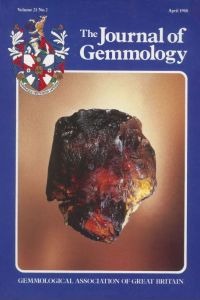
Notes on the inclusions in a greyish kyanite
Journal Article
Gübelin, E.J., Ghera, A. and Graziani, G. (1988) Notes on the inclusions in a greyish kyanite. Journal of Gemmology, Vol. 21, No. 2, April, pp. 83–87.
Record No. 5063  |  ISBN/ISSN: 221252  |  Sinkankas/Born No.: NIS/NIB  |  RWHL

Examination of three-phase inclusions in colorless, yellow, and blue sapphires from Sri Lanka
Journal Article
Schmetzer, K. and Medenbach, O. (1988) Examination of three-phase inclusions in colorless, yellow, and blue sapphires from Sri Lanka. Gems & Gemology, Vol. 24, No. 2, Summer, pp. 107–111.
Record No. 4975  |  ISBN/ISSN: 0016626X  |  Sinkankas/Born No.: NIS/NIB  |  RWHL
Three-phrase inclusions i n untreated natural color-less, yellow, and blue sapphires from Sri Lanka were found to consist of liquid and gaseous carbon diox-ide cis well as needle-like to tabular crystals of di-aspore. The identification of diaspore was accom-plished through the use of a microscope-mounted drill system and an improved version of the Gandolfi X-ray camera. Technical details for both methods are given. The conditions under which diaspore forms as a daughter mineral in corundum are briefly dis-cussed.

Rubin: natürlich oder synthetisch?

Ruby: natural or synthetic?
Journal Article
Bank, H., Gübelin, E.J., Henn, U. and Scarratt, K. (1988) Rubin: natürlich oder synthetisch? [Ruby: natural or synthetic?] Zeitschrift der Deutschen Gemmologischen Gesellschaft, Vol. 37, No. 1/2, November, pp. 27–30.
Record No. 4700  |  Sinkankas/Born No.: NIS/NIB  |  Language: In German  |  RWHL
Describes the examination of an unusual 1.288 ct faceted ruby from Nepal whose identification as natural or synthetic was initially difficult because several internal features resembled those of flux-grown synthetic ruby. Microscopy revealed dark inclusion veils, negative crystals, unusual growth structures and inclusions showing interference colors; its absorption spectrum and strong red to orange-red fluorescence also appeared compatible with synthetic material. Microprobe analysis, however, identified exposed dark inclusions as phlogopite rather than flux residue. Further examination revealed very thin fluid films, some two-phase, together with twinned mineral crystals and twin lamellae in the host ruby, establishing its natural origin. The paper illustrates the danger of relying upon individual inclusion features when distinguishing natural from synthetic ruby and demonstrates the value of combining microscopy with chemical and spectroscopic examination.

An unusual ruby from Nepal

Journal Article
Bank, H., Gübelin, E., Harding, R.R., Henn, U., Scarratt, K. and Schmetzer, K. (1988) An unusual ruby from Nepal. Journal of Gemmology, Vol. 21, No. 4, October, pp. 222–226.
Record No. 4699  |  ISBN/ISSN: 221252  |  Sinkankas/Born No.: NIS/NIB  |  RWHL

Oriented lath-like inclusions of a new type of spinel
Journal Article
Schmetzer, K. (1988) Oriented lath-like inclusions of a new type of spinel. Journal of Gemmology, Vol. 21, No. 2, pp. 69–72.
Record No. 3873  |  ISBN/ISSN: 221252  |  Sinkankas/Born No.: NIS/NIB  |  RWHL
A bluish-violet spinel from Sri Lanka with oriented inclusions was examined using microscopy, X-ray single-crystal diffraction, and electron microprobe analysis. The specimen displays four sets of lath-like, double-refracting crystal inclusions aligned parallel to the threefold axes of the host spinel. The inclusions are identified as one of the Al₂SiO₅ polymorphs, most likely sillimanite. The study also includes a general literature review on oriented inclusions and asterism in spinel.

Gem Trade Lab Notes: Synthetics and Modern" gems in period jewelry"
Journal Article
Hargett, D. (1988) Gem Trade Lab Notes: Synthetics and Modern" gems in period jewelry". Gems & Gemology, Vol. 24, No. 4, Winter, pp. 245—246.
Record No. 3019  |  ISBN/ISSN: 0016626X  |  Sinkankas/Born No.: NIS/NIB  |  RWHL
Over the years, synthetics have been set in jewelry for a variety of reasons, People who could not afford natural stones could at least enjoy the beauty of the less costly synthetics. Syn-thetics or other simulants have been used to replace more valuable stones that were either lost or removed to use the cash value when needed. At one time, synthetics were even set into fine jewelry as a proud symbol of scientific progress. The fine platinum and diamond bracelet shown in figure 17, seen in our East Coast laboratory, was probab-ly made during the 1920s. It is set with flame-fusion synthetic rubies as well as with fine natural rubies with Burma characteristics. We do not know why synthetic and natural stones were mixed in this piece, but because of the ever-present possi-bility of mixed stones, it is always necessary to test all of the stones, even in an antique setting. Evidence of tampering with a setting is the most common indica-tion that a synthetic was used as a replacement stone. The stone shown in figure 18 was set in a lady's ring that also was submitted to our East Coast laboratory. Engraved in the shank of the ring is the date Octo-ber 15, 1922. Although it is possible that this date could have been in-scribed recently, it is not likely. As indicated by the reworked prong tip, as well as the flux inclusions shown in figure 18, a modern flux-grown synthetic ruby has been reset in this period ring.

Gem Trade Lab Notes: Synthetic sapphires
Journal Article
Welch, C. (1988) Gem Trade Lab Notes: Synthetic sapphires. Gems & Gemology, Vol. 24, No. 2, Summer, p. 117.
Record No. 3016  |  ISBN/ISSN: 0016626X  |  Sinkankas/Born No.: NIS/NIB  |  RWHL
In the Lab Notes section of the Summer 1987 issue of Gems & Gemology, we reported on unusually strong curved color banding in a synthetic yellow sapphire. More recently, the East Coast laboratory had the opportunity to examine two synthetic yellow sapphires that were unusual in other ways. When no color zoning or inclusions are present in a yellow sapphire, it is standard procedure to use immersion, magnification, and crossed polarizers to look for Plato lines as proof of synthesis. One of the two stones we examined displayed such strong Plato lines that they were actually visible without magnification or immersion (figure 15). In contrast, the second stone showed no discernible Plato lines at all, which is unusual for a flame-fusion synthetic yellow sapphire. This stone was proved to be synthetic when high magnification revealed the presence of several small gas bubbles. An interesting blue synthetic sapphire, also examined in New York, showed two sets of curved color banding that intersected each other at a very shallow angle. This is clearly indicated in figure 16 by the wedge of blue with its point almost dead center in the photo. The wedge marks the boundary between the two sets of banding, which are probably a result of changes in the growth conditions while the boule was being formed.

Gem Trade Lab Notes: Sapphire, with needles
Journal Article
Welch, C. (1988) Gem Trade Lab Notes: Sapphire, with needles. Gems & Gemology, Vol. 24, No. 1, Spring, p. 51.
Record No. 3015  |  ISBN/ISSN: 0016626X  |  Sinkankas/Born No.: NIS/NIB  |  RWHL
One of the characteristics that proves that a sapphire has not been heat treated is the presence of coarse, well-formed, undisturbed needle-like inclusions and/or their shorter wedge-shaped relatives. Such inclusions often light up with spectral colors when illuminated by a strong overhead or fiber-optic light source, as seen in the approximately 40-ct sapphire shown in figure 15, which was submitted to the New York laboratory for identification. These needles produce asterism when the stone is cut en cabochon. An interesting trick is to place a small drop of methylene iodide (the 3.32 specific gravity liquid) on the surface of a faceted stone and observe the star effect in the bead of liquid.

Gem Trade Lab Notes: Sapphire, color zoned

Journal Article
Hargett, D. (1988) Gem Trade Lab Notes: Sapphire, color zoned. Gems & Gemology, Vol. 24, No. 1, Spring, pp. 50—51.
Record No. 3014  |  ISBN/ISSN: 0016626X  |  Sinkankas/Born No.: NIS/NIB  |  RWHL
A 1.06-ct blue sapphire was submitted to the New York laboratory for identification. A spall cavity, the fire-skinned surface, and discoid fractures clearly indicated that the stone had been heat treated. However, the dark blue hexagonal color zoning seen through the table (figure 14) is unusual. It appears that a “phantom crystal” within the sapphire was affected by the heat treatment, leaving the edges fuzzy and partially diffused into the stone. When the stone was viewed with a Beck handheld spectroscope, the 450-nm (iron) line was quite strong. Perhaps this was originally a very dark sapphire that had been heated to lighten the color, with the perimeter of the “phantom crystal” remaining dark in spite of the treatment.

Exploring the Literature of Gemstone Inclusions

The literature of gemstone inclusions covers identification, origin determination, treatments, synthesis, mineral inclusions, fluid inclusions and other internal features of natural and synthetic gems.

For a curated selection of important sources, read Inclusions in Gemstones — Hyperion Literature Sources.

About Four Treasures

Four Treasures is Lotus Gemology's freely accessible gemological reference database. Use the full database to search by author, title or keyword and explore literature on gemology, mineralogy, jewelry and related fields. Where available, hyperlinks on titles may lead directly to the full publication.

Search the Complete Four Treasures Database