Synthetic Sapphire Inclusions
Explore Sapphire inclusions in Hyperion, the Lotus Gemology inclusion database. Hyperion contains photomicrographs of inclusions and internal features in natural Sapphire, documented with information on geographic origin, treatment, lighting conditions, field of view, photographer and published references.
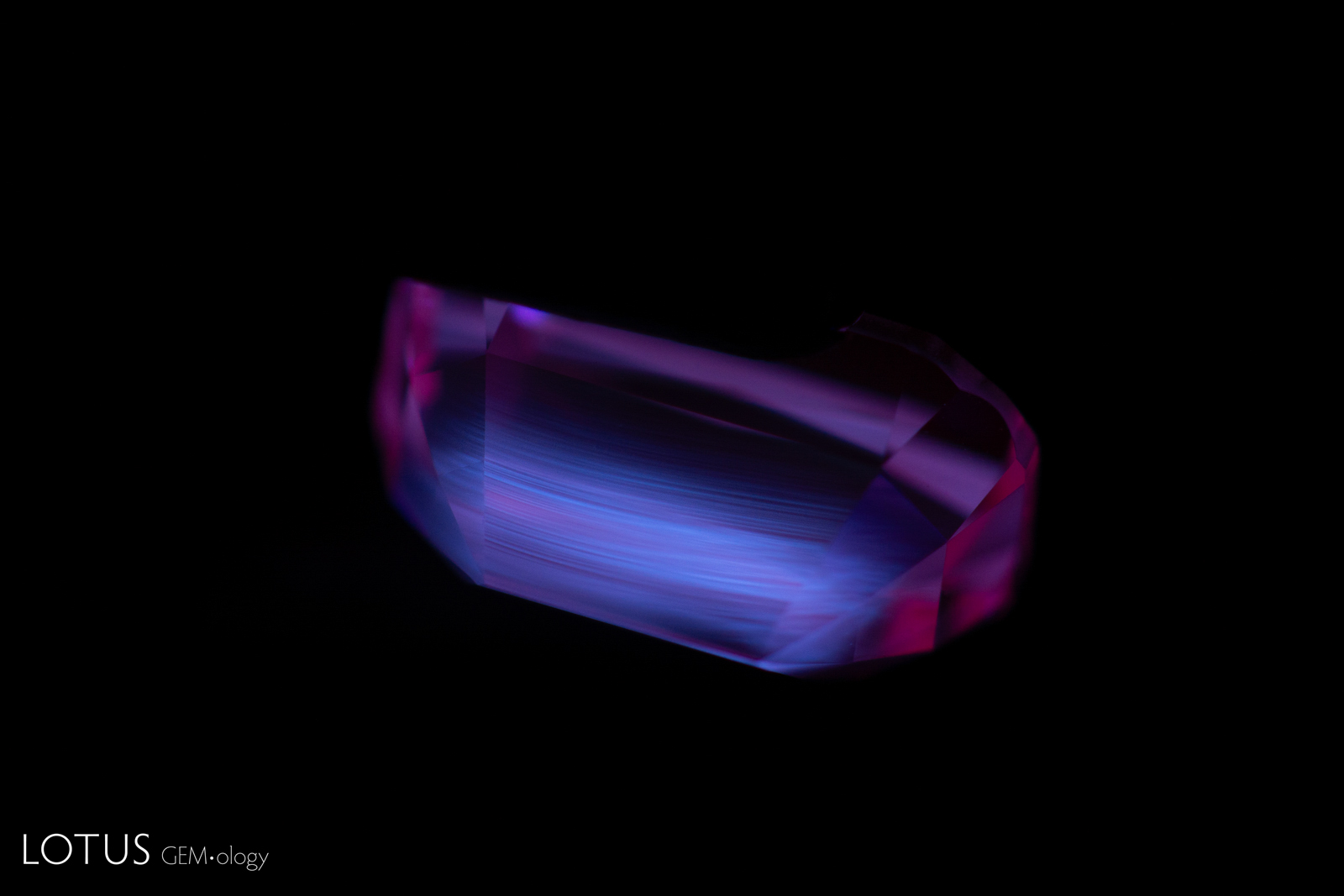
In this synthetic sapphire, curved growth zoning is difficult to observe under the microscope but is clearly visible under SWUV.
Synthetic Sapphire •
Verneuil •
Enhancements:
None Detected (None) •
Lighting Conditions:
Ultraviolet: Shortwave
Photographer:
Natcha Rattana-anan •
Image Number:
A-005-8074-1
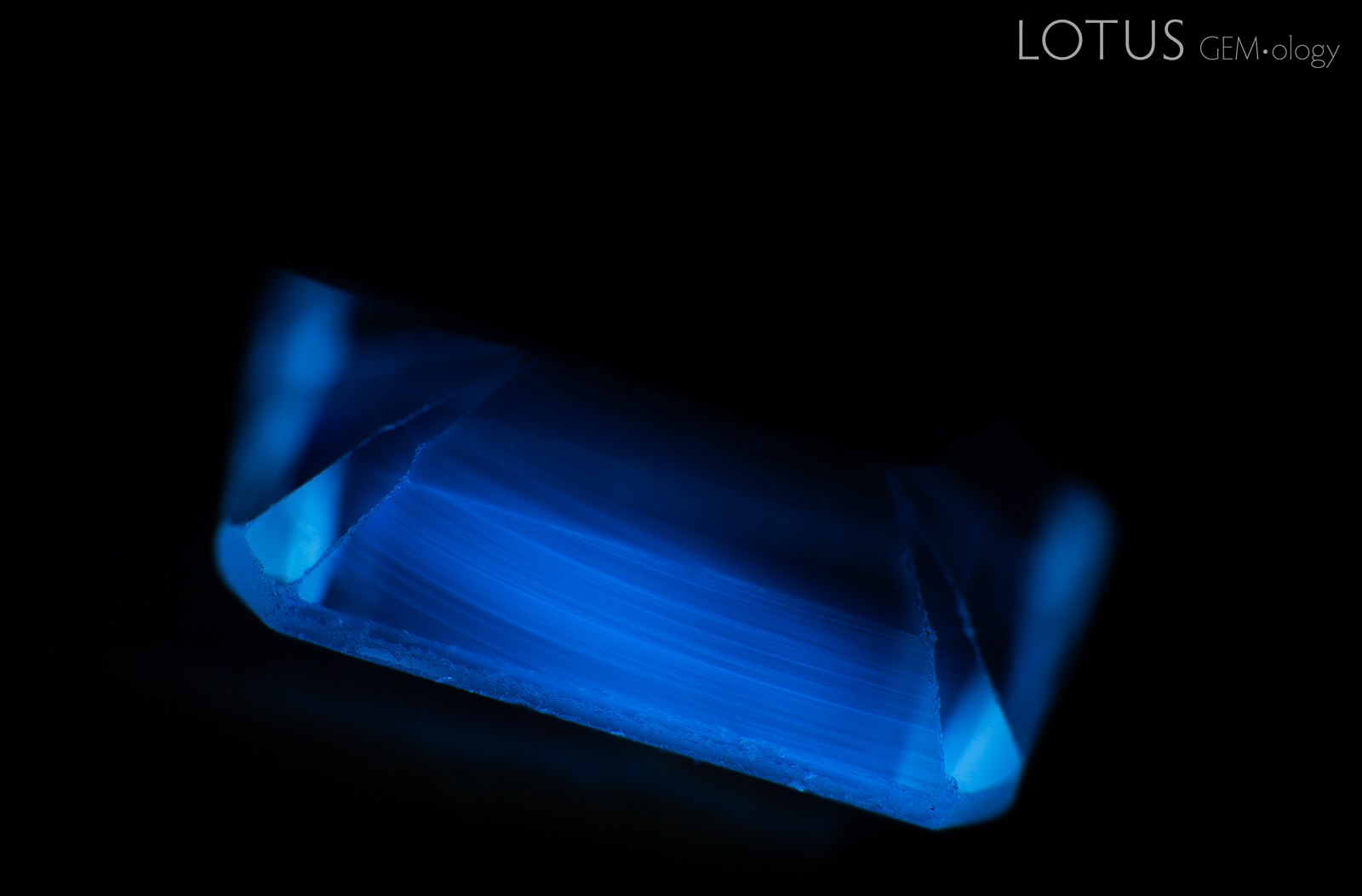
Colorless sapphires without any inclusions can sometimes be tricky to identify as natural or synthetic. Shortwave UV light can often be useful by displaying the curved banding that confirms that this stone is a flame-fusion synthetic.
Synthetic Sapphire •
Verneuil •
Enhancements:
None Detected (None) •
Lighting Conditions:
Ultraviolet: Shortwave
Photographer:
Kaylan Khourie •
Image Number:
A-005-2962-1
• Field of View = 16mm
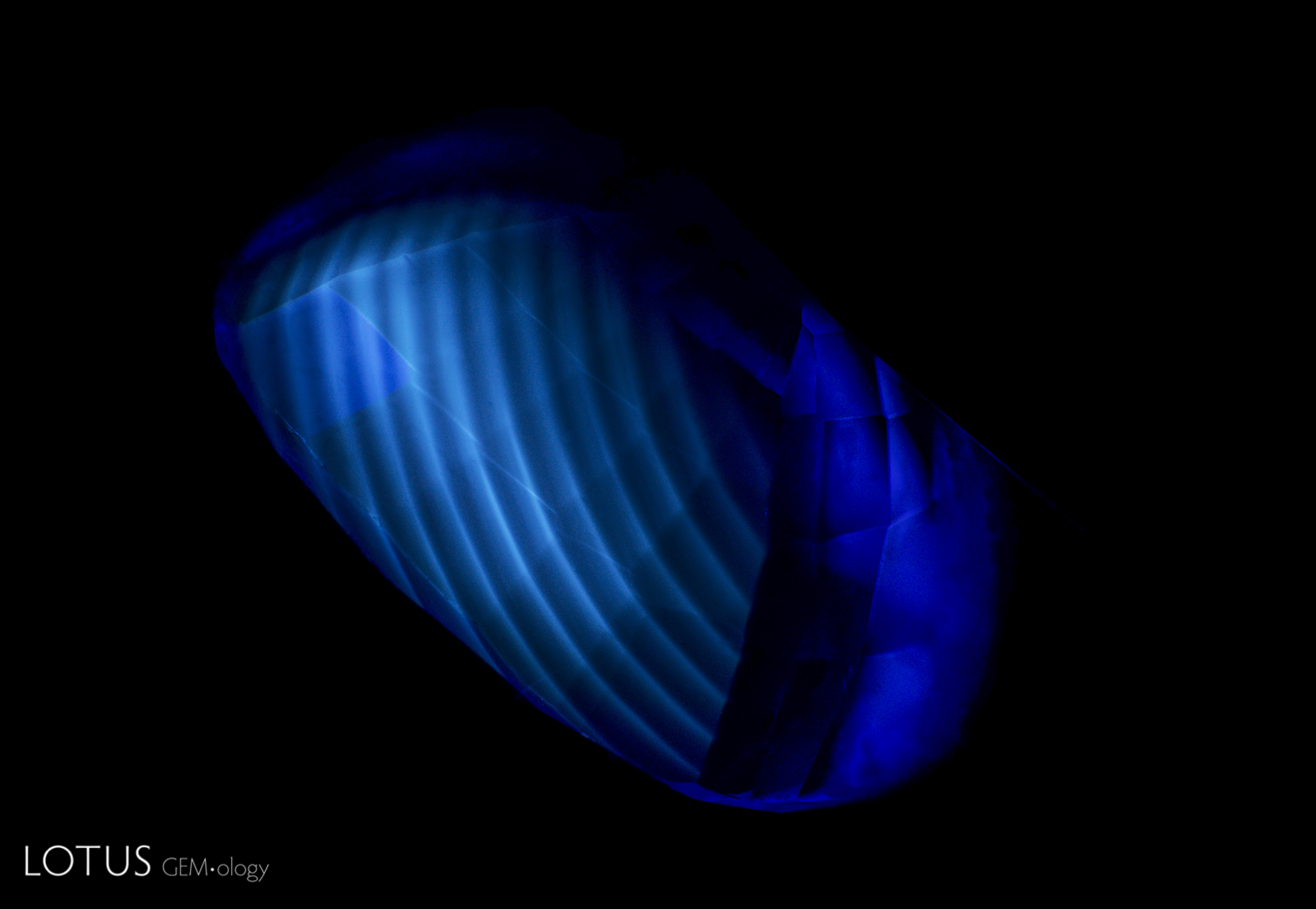
Curved banding is easily spotted in this flame-fusion blue synthetic sapphire when illuminated with the Magilabs deep-UV fluorescence system, a short-wave UV source.
Synthetic Sapphire •
Verneuil •
Enhancements:
None Detected (None) •
Lighting Conditions:
Ultraviolet: Shortwave
Photographer:
E. Billie Hughes •
Image Number:
A-002-8915-1
A strong chalky fluorescence can be observed in this titanium-diffused synthetic sapphire.
Synthetic Sapphire •
No Origin •
Enhancements:
Heat + Diffusion of external coloring agents (H-D) •
Lighting Conditions:
Ultraviolet: Shortwave
Photographer:
E. Billie Hughes •
Image Number:
A-003-9580-1
Using magnification with shortwave ultraviolet light, one can see the chalky fluorescence in curved bands, revealing the synthetic nature of the gem.
Synthetic Sapphire •
Verneuil •
Enhancements:
None Detected (None) •
Lighting Conditions:
Ultraviolet: Shortwave
Photographer:
Richard W. Hughes •
Image Number:
A-003-6363-1
The lack of contrast when a yellow stone is viewed using a yellowish incandescent light makes it difficult to see the growth zoning.
Synthetic Sapphire •
Verneuil •
Enhancements:
None Detected (None) •
Lighting Conditions:
Diffuse Light Field + Immersion
Photographer:
E. Billie Hughes •
Image Number:
A-003-6041-2
When a blue filter is used, the curved growth lines in the gem become visible.
Synthetic Sapphire •
Verneuil •
Enhancements:
None Detected (None) •
Lighting Conditions:
Diffuse Light Field + Immersion + Blue Filter
Photographer:
E. Billie Hughes •
Image Number:
A-003-6041-1
This 27+ carat sapphire came in for testing. Microscopic examination quickly revealed that it was titanium diffused, with unusual patches of blue color bleeding from inclusions. Of course a natural 27-ct sapphire of good clarity would never be used for such treatment, because the natural untreated sapphire would be worth far more. The reality was that synthetic sapphire was used for the treatment. This image shows two circular gas bubbles that were found inside the stone.
Synthetic Sapphire •
No Origin •
Enhancements:
Heat + Diffusion of external coloring agents (H-D) •
Lighting Conditions:
Dark Field
Photographer:
Richard W. Hughes •
Image Number:
A-003-4575-3
This 27+ carat sapphire came in for testing. Microscopic examination quickly revealed that it was titanium diffused, with unusual patches of blue color bleeding from inclusions. Of course a natural 27-ct sapphire of good clarity would never be used for such treatment, because the natural untreated sapphire would be worth far more. The reality was that synthetic sapphire was used for the treatment. This image shows surface pits, along with unusual metallic inclusions cut through on the surface.
Synthetic Sapphire •
No Origin •
Enhancements:
Heat + Diffusion of external coloring agents (H-D) •
Lighting Conditions:
Diffuse Overhead
Photographer:
Richard W. Hughes •
Image Number:
A-003-4575-2
This 27+ carat sapphire came in for testing. Microscopic examination quickly revealed that it was titanium diffused, with unusual patches of blue color bleeding from inclusions. Of course a natural 27-ct sapphire of good clarity would never be used for such treatment, because the natural untreated sapphire would be worth far more. The reality was that synthetic sapphire was used for the treatment.
Synthetic Sapphire •
No Origin •
Enhancements:
Heat + Diffusion of external coloring agents (H-D) •
Lighting Conditions:
Diffuse Light Field (Transmitted Light)
Photographer:
Richard W. Hughes •
Image Number:
A-003-4575-1
• Field of View = 4mm
A synthetic yellow sapphire displays strong chalky green fluorescence in shortwave illumination, helping to separate it from natural sapphire.
Synthetic Sapphire •
Verneuil •
Enhancements:
None Detected (None) •
Lighting Conditions:
Ultraviolet: Shortwave
Photographer:
E. Billie Hughes •
Image Number:
A-003-3564-1
At first glance, this piece of “rough” sapphire looks convincingly natural with abrasions and fissures on the surface. But once it’s immersed in methylene iodide, curved growth zoning become obvious and reveal that the stone is a Verneuil synthetic.
Synthetic Sapphire •
Verneuil •
Enhancements:
None Detected (None) •
Lighting Conditions:
Diffuse Light Field + Immersion
Photographer:
E. Billie Hughes •
Image Number:
A-002-3097-2
Synthetic Sapphire inclusions may include curved striae, curved color banding, gas bubbles, healed fissures, Plato lines, twinning, platinum plates, rain-like flux, primary flux and other features formed during or after crystal growth. Such features are important to gemologists because they can provide evidence useful in identifying Sapphire, understanding its geological history, recognizing treatment and, in some cases, determining geographic origin.
Synthetic Sapphire Inclusion Photomicrographs
The Hyperion natural Sapphire gallery includes microscopic features found in rubies from major deposits around the world. Each entry is accompanied by descriptive information and, where available, references to the gemological literature.
What Inclusions Can Reveal About Synthetic Sapphire
Inclusions are an important part of Sapphire identification. Their form, composition, orientation and alteration can help gemologists distinguish natural Sapphire from synthetic material, recognize evidence of heat treatment, and study the geological environment in which the Sapphire formed.
Hyperion combines inclusion photomicrography with supporting gemological information so that individual features can be compared with documented examples from known Sapphire deposits.
About Hyperion
Hyperion is the Lotus Gemology searchable inclusion database. It allows users to browse gemstone inclusions by gem type, geographic origin, treatment and keyword.