Tanzanian Ruby Inclusions
Explore Tanzanian ruby inclusions in Hyperion, the Lotus Gemology inclusion database. Hyperion contains photomicrographs of inclusions and internal features in natural rubies from Tanzania, documented with information on treatment, lighting conditions, field of view, photographer and published references.
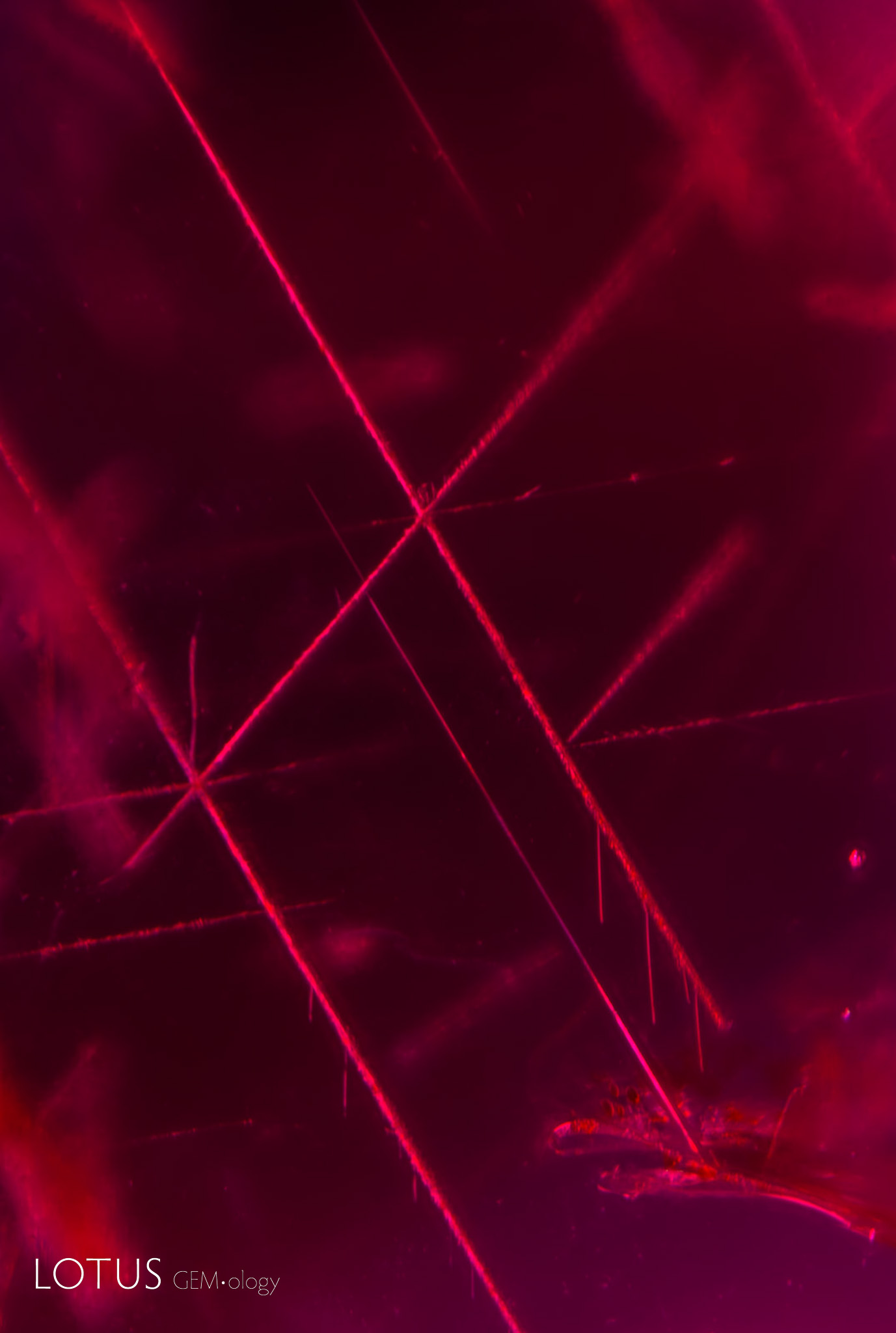
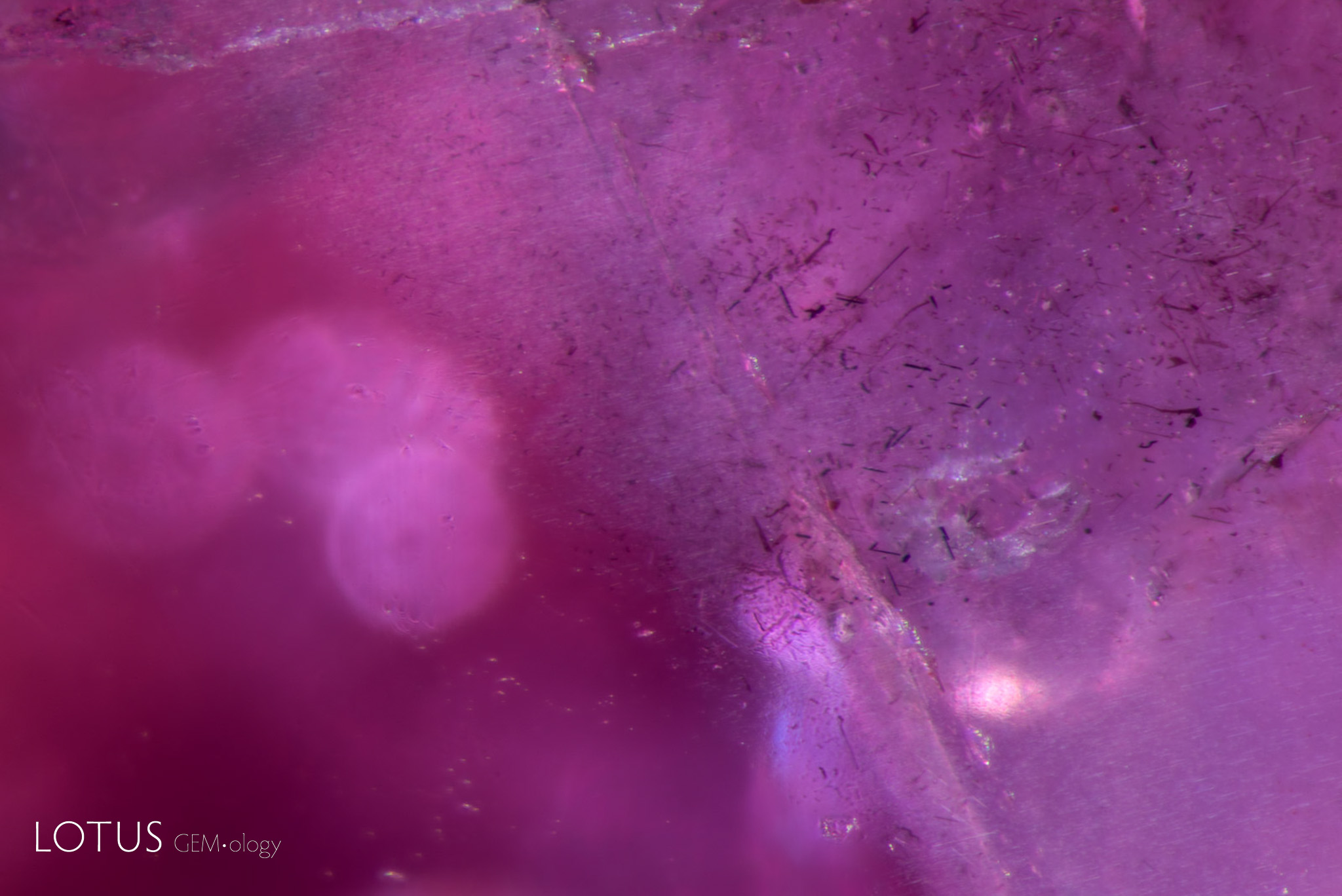
Rose channels are often confused with rutile silk in corundum, but they are easily distinguished as they run in entirely different crystallographic directions. Rutile silk unmixes in three intersecting directions (60/120°) parallel to the faces of the hexagonal prism in the plane of the basal pinacoid. In contrast, Rose channels form parallel to the edges of the rhombohedron, in three directions, but only two in the same place. They intersect at 86.1/93.9°. This ruby from Kiteto, Tanzania shows nice examples.
Natural Ruby •
Tanzania •
Enhancements:
None Detected (None) •
Lighting Conditions:
Dark Field + Diffuse Fiber Optic
Photographer:
Wimon Manorotkul •
Image Number:
R-004-9337-1
• Field of View = 1.6mm
Notari, F., Fritsch, E., Caplan, C. and Hainschwang, T. (2018) Boehmite needles in corundum are Rose channels. Gems & Gemology, Vol. 54, No. 3, Fall, p. 257; RWHL*.
Angular milky texture clouds in a ruby from Rolela, Kiteto, Tanzania.
Natural Ruby •
Tanzania •
Enhancements:
None Detected (None) •
Lighting Conditions:
Dark Field + Diffuse Fiber Optic
Photographer:
Wimon Manorotkul •
Image Number:
R-004-9334-1
• Field of View = 1.8mm
Spiral fissures amidst milky clouds in an unheated ruby from Rolela, Kiteto, Tanzania.
Natural Ruby •
Tanzania •
Enhancements:
None Detected (None) •
Lighting Conditions:
Fiber Optic: Diffuse Oblique
Photographer:
Wimon Manorotkul •
Image Number:
R-004-9331-1
• Field of View = 1.6mm
Rounded bluish crystals of what is probably amphibole in a ruby from Rolela, Kiteto, Tanzania.
Natural Ruby •
Tanzania •
Enhancements:
None Detected (None) •
Lighting Conditions:
Light Field + Oblique Fiber Optic
Photographer:
Wimon Manorotkul •
Image Number:
R-004-9330-1
• Field of View = 1.8mm
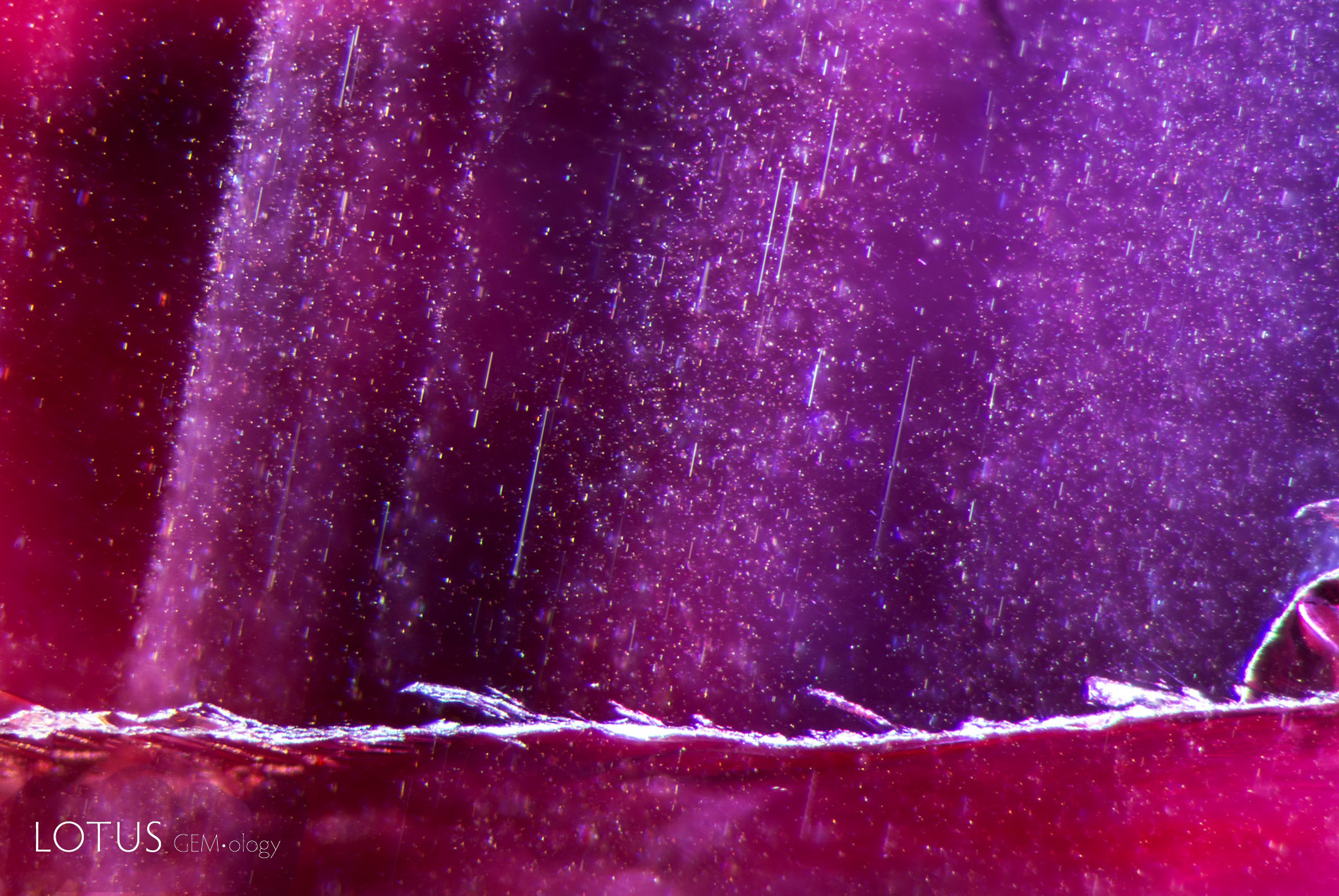
Thin exsolved needles of what is probably rutile silk in this ruby from Rolela, Kiteto, Tanzania.
Natural Ruby •
Tanzania •
Enhancements:
None Detected (None) •
Lighting Conditions:
Fiber Optic: Oblique
Photographer:
Wimon Manorotkul •
Image Number:
R-004-9329-4
• Field of View = 3.5mm
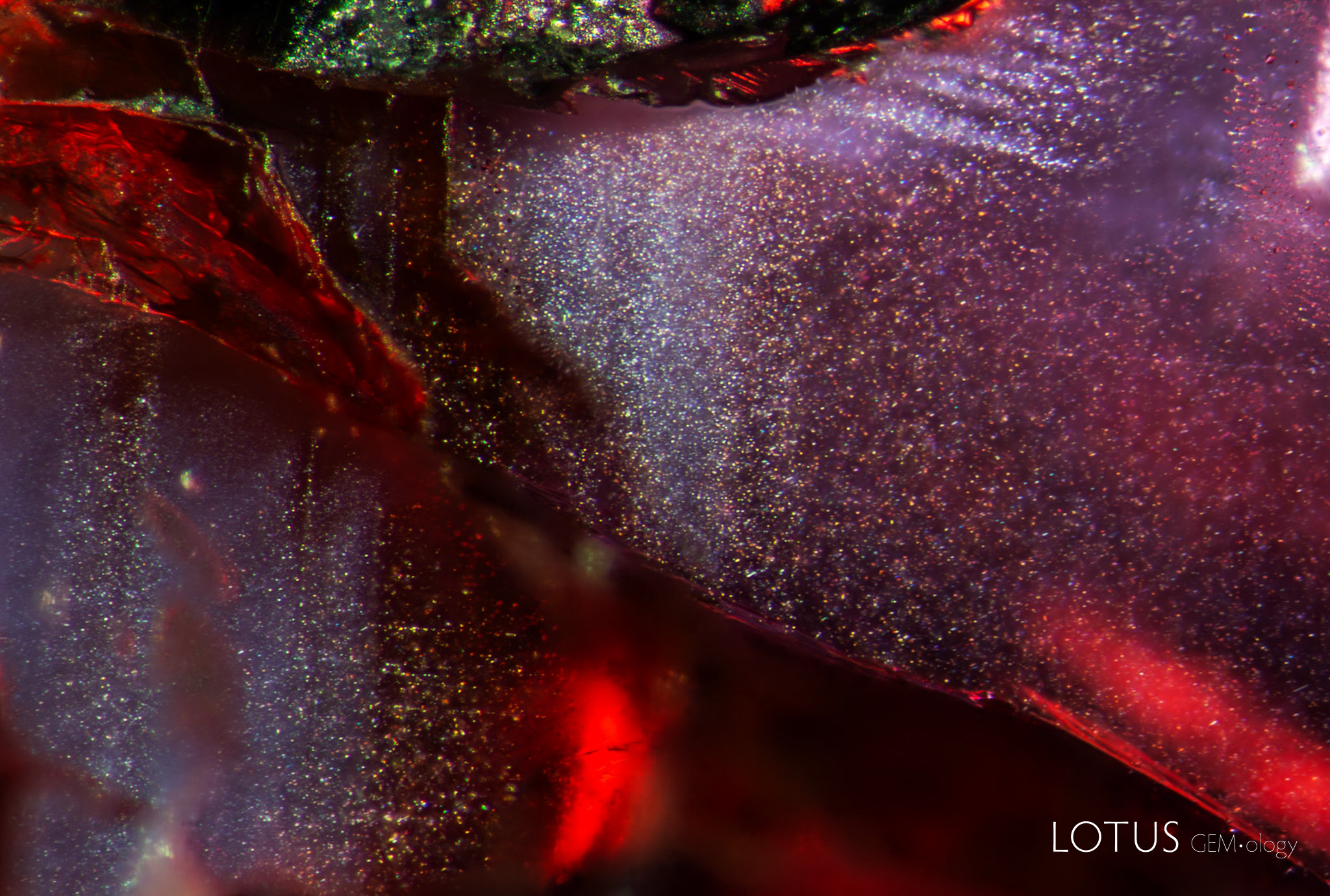
Fine exsolved particles in this ruby from Rolela, Kiteto, Tanzania.
Natural Ruby •
Tanzania •
Enhancements:
None Detected (None) •
Lighting Conditions:
Fiber Optic: Oblique
Photographer:
Wimon Manorotkul •
Image Number:
R-004-9329-3
• Field of View = 3.5mm
Thin exsolved needles of what is probably rutile silk in this ruby from Rolelo, Kiteto, Tanzania.
Natural Ruby •
Tanzania •
Enhancements:
None Detected (None) •
Lighting Conditions:
Fiber Optic: Oblique
Photographer:
Wimon Manorotkul •
Image Number:
R-004-9329-2
• Field of View = 3mm
Iron-rich silk in a ruby from Rolela, Kiteto, Tanzania.
Natural Ruby •
Tanzania •
Enhancements:
None Detected (None) •
Lighting Conditions:
Dark Field + Oblique Fiber Optic
Photographer:
Wimon Manorotkul •
Image Number:
R-004-9332-1
• Field of View = 1.6mm
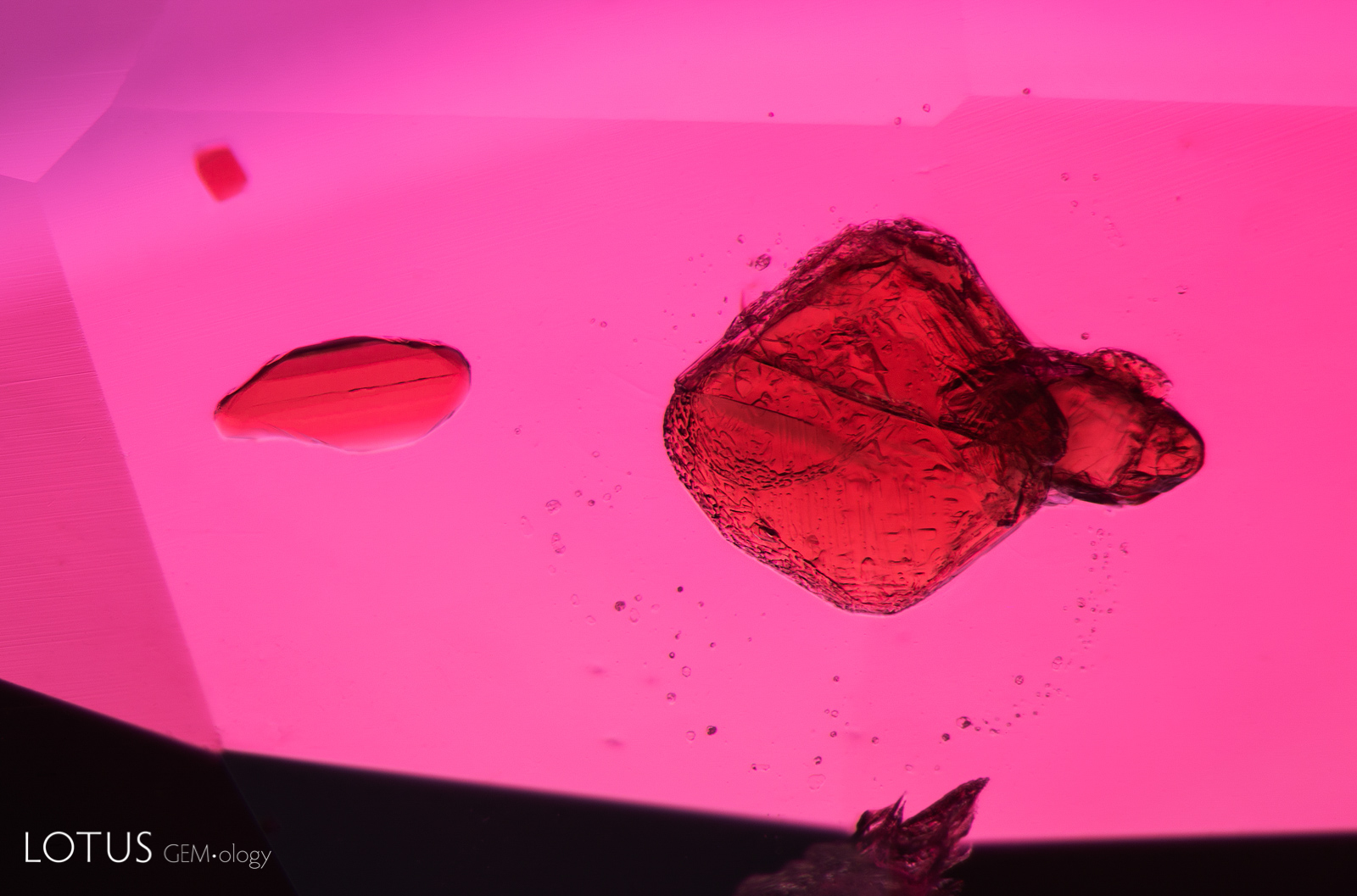
A small crystal, cut through on the surface, stood out in this ruby from Winza, Tanzania. The majority of the crystal is pargasite, while some slightly darker areas on the edges were ID’d as clinochlore with Raman spectroscopy.
Natural Ruby •
Tanzania; Winza •
Enhancements:
None Detected (None) •
Lighting Conditions:
Dark Field + Diffuse Fiber Optic
Photographer:
E. Billie Hughes •
Image Number:
A-003-6657-1
• Field of View = 2mm
Schwarz, D., Pardieu, V. et al. (2008) Rubies and sapphires from Winza, central Tanzania. Gems & Gemology, Vol. 44, No. 4, Winter, pp. 322–347; RWHL*.
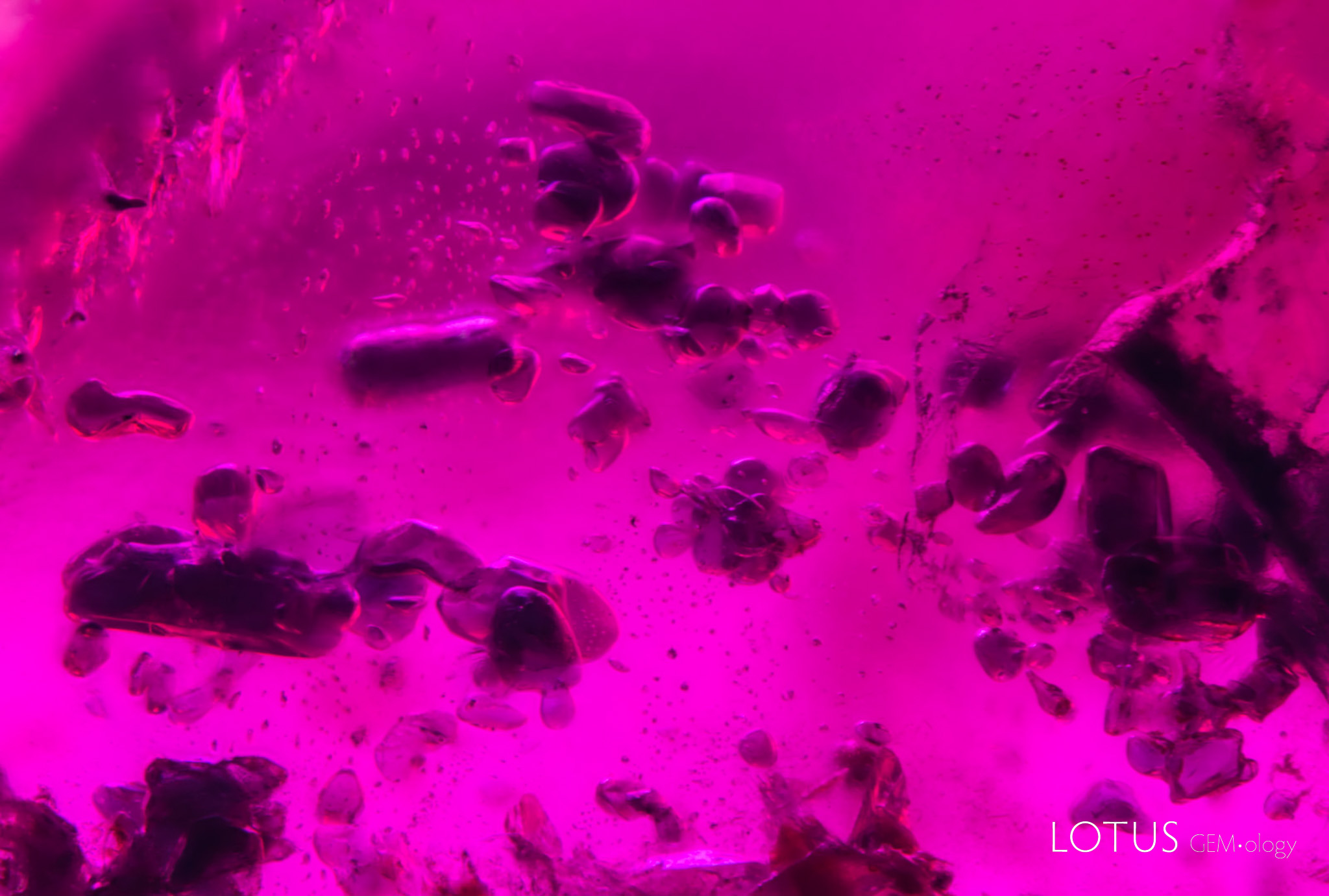
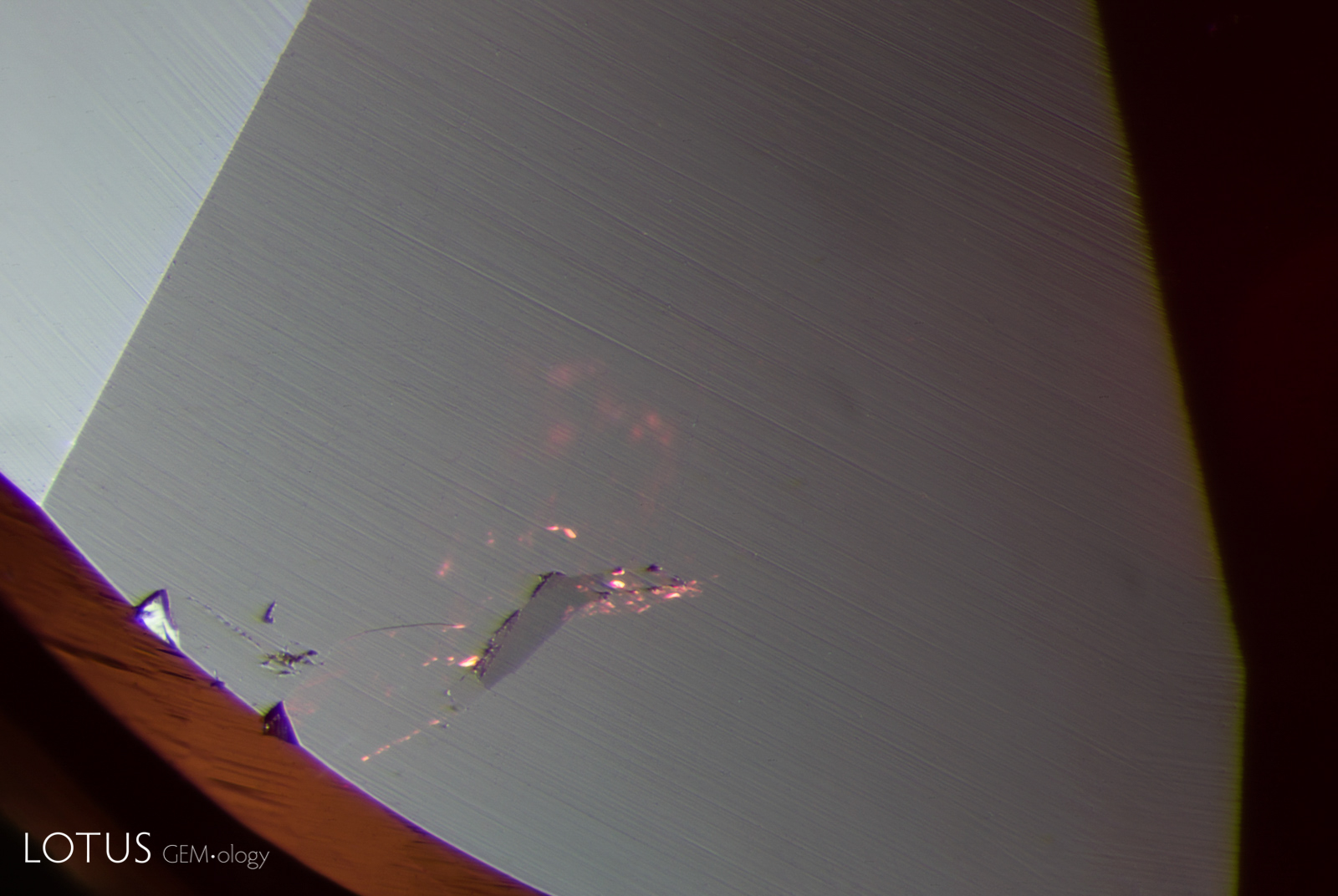
Melted crystals with frozen gas bubbles, along with titanium internal diffusion (blue areas).
Natural Ruby •
Tanzania; Songea •
Enhancements:
Heat + Diffusion of external coloring agents (H-D) •
Lighting Conditions:
Fiber Optic: Transmitted
Photographer:
Richard W. Hughes •
Image Number:
A-001-2685-2
• Field of View = 4mm
Emmett, J.L., Scarratt, K. et al. (2003) Beryllium diffusion of ruby and sapphire. Gems & Gemology, Vol. 39, No. 2, Summer, pp. 84–135; RWHL*.
Hughes, R.W. (2002) The Skin Game: Orange sapphire treatment raises controversy. The Guide, Vol. 21, No. 2, Part 1, March–April, pp. 3–7; RWHL*.
18 Total Images
Results: 1 – 12 | Page 1 of 2 Pages
Search the Complete Hyperion Database
Tanzanian ruby inclusions may include mineral crystals, healed fissures, fluid inclusions, negative crystals, growth features and other internal features formed during or after crystal growth. Such features are important to gemologists because they can provide evidence useful in identifying ruby and evaluating a possible Tanzanian origin.
Tanzanian Ruby Inclusion Photomicrographs
The Hyperion Tanzanian ruby gallery includes microscopic features documented in rubies from Tanzania. Each entry is accompanied by descriptive information and, where available, references to the gemological literature.
What Inclusions Can Reveal About Tanzanian Ruby
Inclusions are an important part of geographic origin determination in ruby. Their form, composition, orientation and associations can provide evidence that, when considered together with other gemological properties, may support or contradict a Tanzanian origin.
Hyperion combines inclusion photomicrography with supporting gemological information so that individual features can be compared with documented examples from Tanzanian rubies.
About Hyperion
Hyperion is the Lotus Gemology searchable inclusion database. It allows users to browse gemstone inclusions by gem type, geographic origin, treatment and keyword.