Basalt-Related Sapphire Inclusions
Explore basalt-related sapphire inclusions in Hyperion, the Lotus Gemology inclusion database. Hyperion contains photomicrographs of inclusions and internal features in natural basalt-related sapphires, documented with information on geographic origin, treatment, lighting conditions, field of view, photographer and published references.
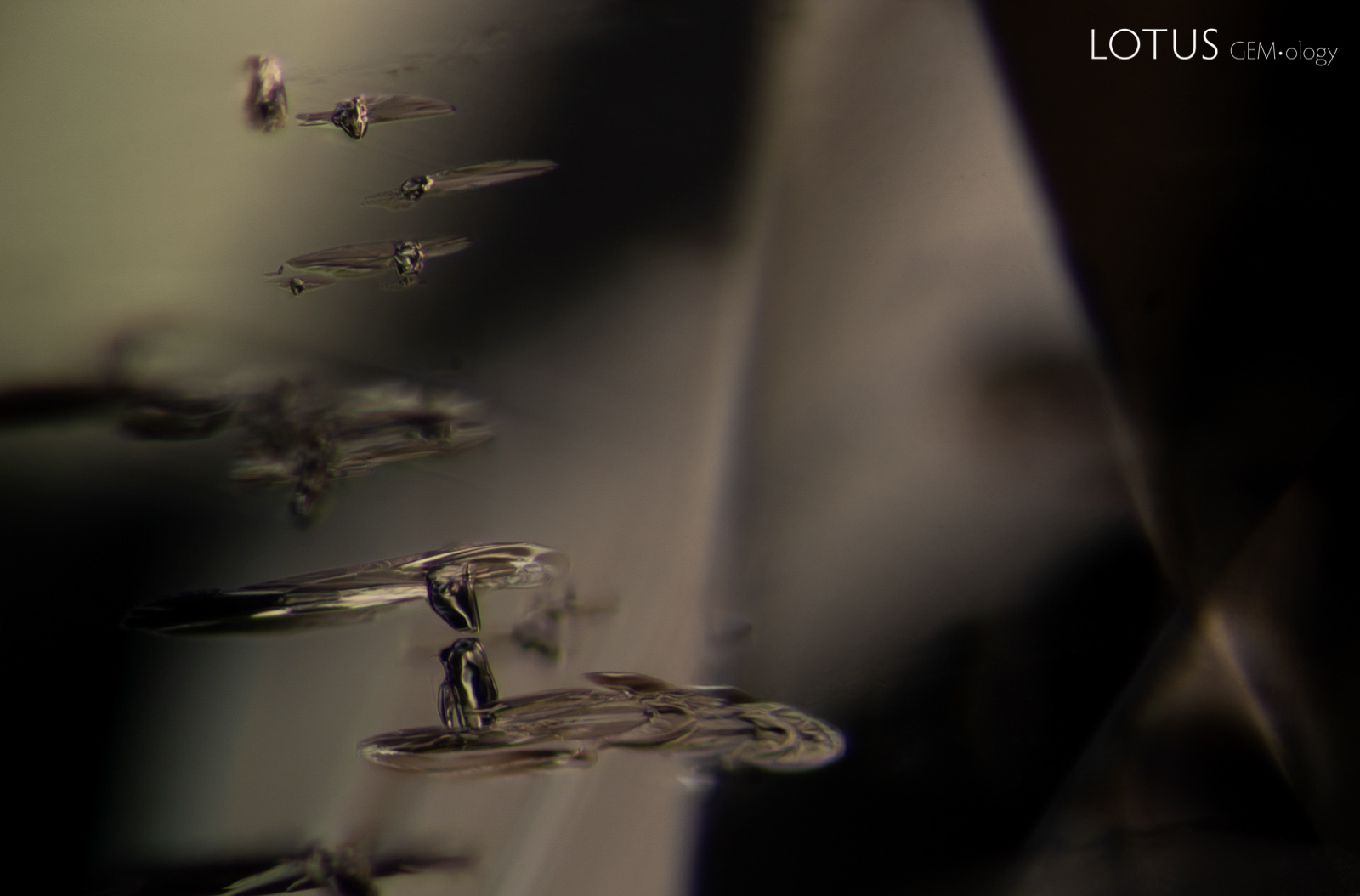
This basalt-related sapphire contained many crystal inclusions that were all oriented parallel to the basal plane. Notice how the fissures around each crystal are all aligned.
Natural Sapphire •
Basalt Related •
Enhancements:
None Detected (None) •
Lighting Conditions:
Dark Field
Photographer:
E. Billie Hughes •
Image Number:
A-003-8707-1
• Field of View = 2.5mm
Florida, 2100.
Natural Sapphire •
Basalt Related •
Enhancements:
Heat (H) •
Lighting Conditions:
Fiber Optic: Diffuse Overhead
Photographer:
Richard W. Hughes •
Image Number:
A-003-7264-2
• Field of View = 5mm
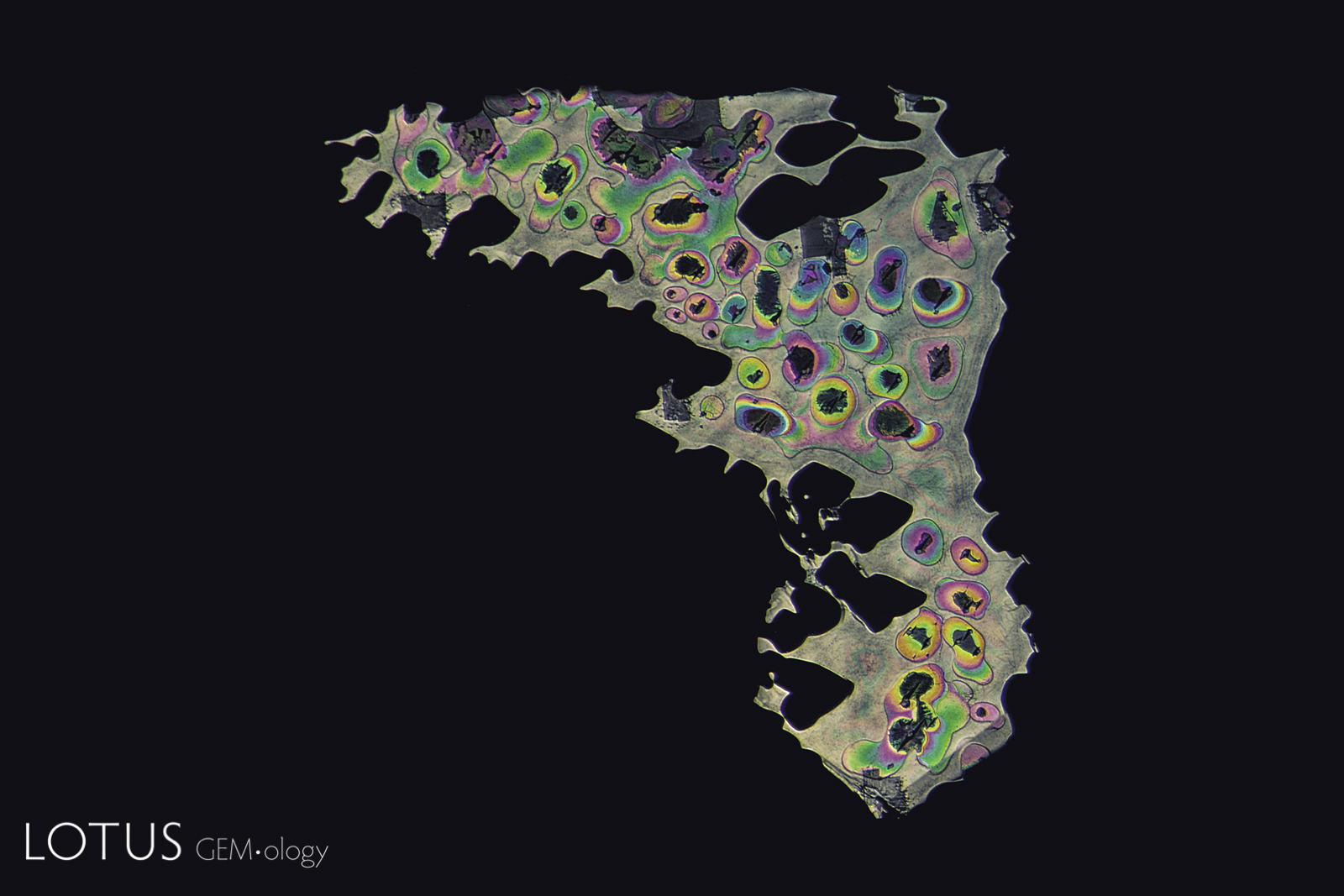
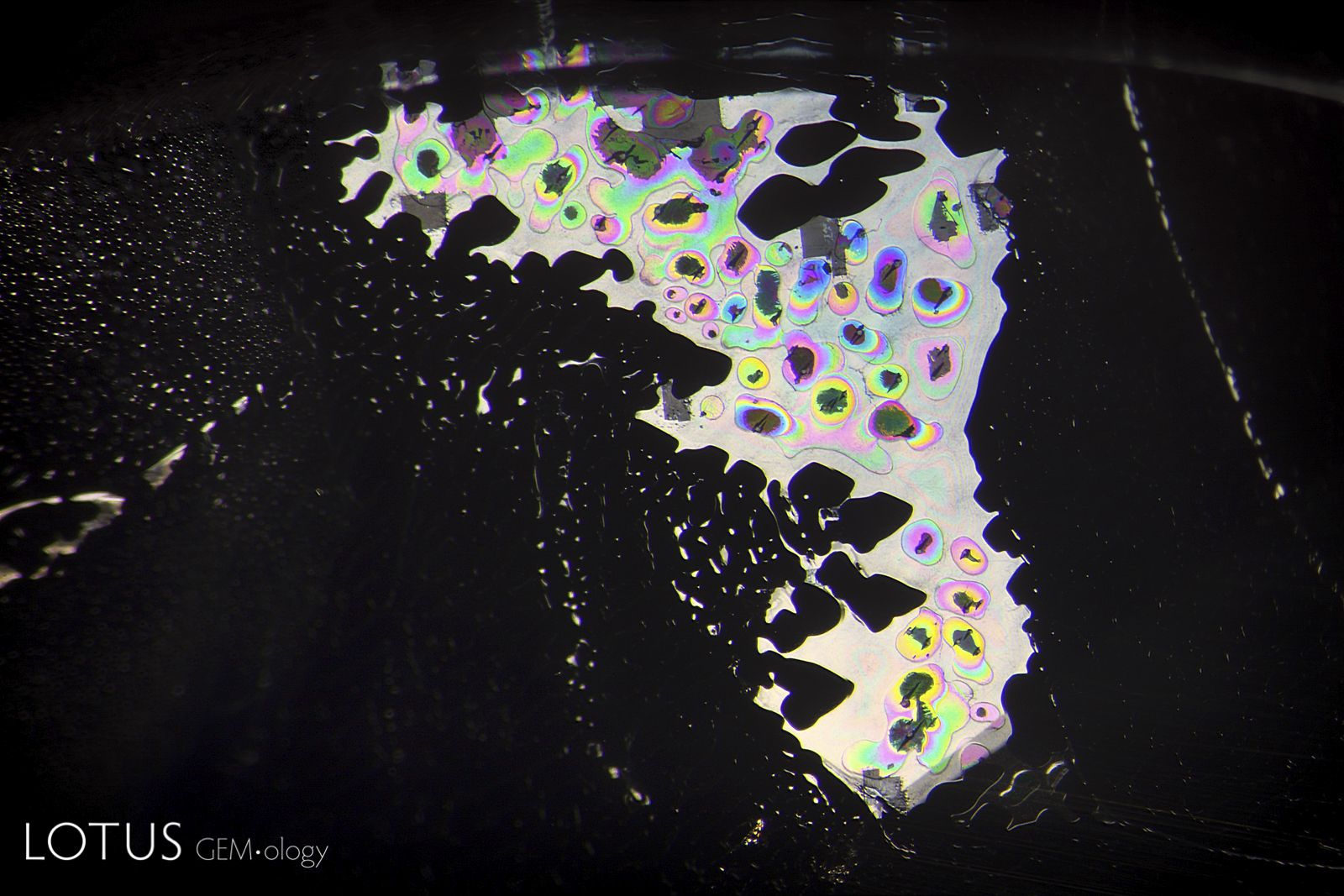
Photomicrography is no different than ordinary photography. It’s all about controlling light. In this case, a nondescript fluid inclusion in dark-field illumination morphed into a spectral spectacular when light was brought from above.
Natural Sapphire •
Basalt Related •
Enhancements:
Heat (H) •
Lighting Conditions:
Fiber Optic: Diffuse Overhead
Photographer:
Richard W. Hughes •
Image Number:
A-003-7264-1
• Field of View = 5mm
Koivula, J.I. (1982) Inclusions in a better light. Gemological Institute of America, Eash, D.M., ed., In International Gemological Symposium Proceedings, Santa Monica, CA, pp. 471–476; RWHL*.
Red pyrochlore crystals like this one, which was identified with microraman spectroscopy, are a common inclusion in basalt-related sapphire.
Natural Sapphire •
Basalt Related •
Enhancements:
Heat (H) •
Lighting Conditions:
Dark Field + Oblique Fiber Optic
Photographer:
E. Billie Hughes •
Image Number:
A-003-3933-1
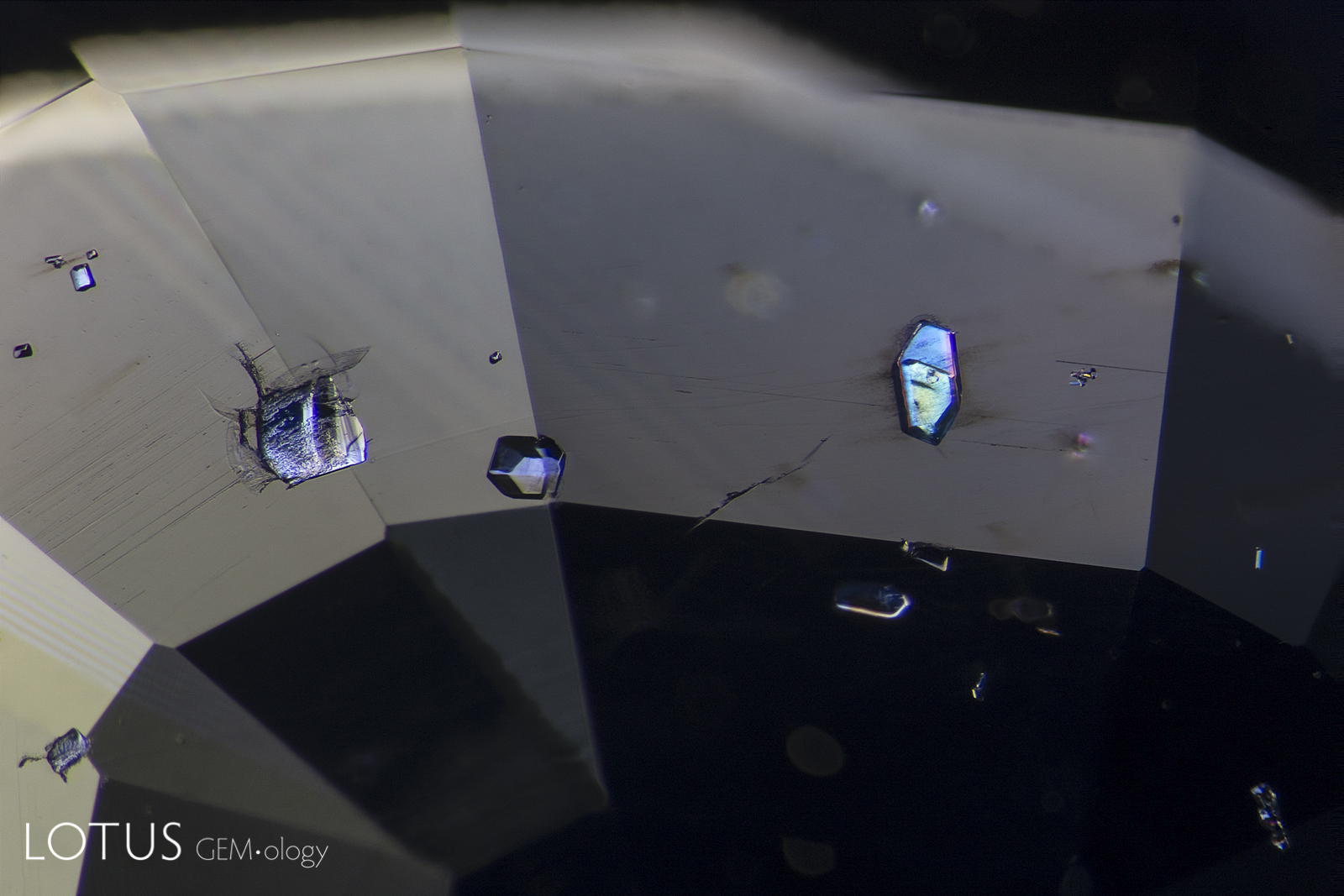
Feldspar crystals are a frequent guest of sapphires derived from basalt deposits. Thus it was no surprise when the three larger crystals show here turned out to be feldspar. The identification was made with Lotus Gemology’s micro Raman unit. Examination with crossed polars reveals the doubly refractive nature of the feldspar guest inclusions.
Natural Sapphire •
Basalt Related •
Enhancements:
None Detected (None) •
Lighting Conditions:
Light Field + Crossed Polars
Photographer:
Richard W. Hughes •
Image Number:
A-003-4383-1
• Field of View = 4.5mm
Hughes, R.W., Manorotkul, W. et al. (2017) Ruby & Sapphire: A Gemologist's Guide. Bangkok, Lotus Publishing, 816 pp.; RWHL*.
Examining the same stone with a powerful shortwave light source shows the chalky fluorescence in a similar pattern, confirming the heat treatment.
Natural Sapphire •
Basalt Related •
Enhancements:
Heat (H) •
Lighting Conditions:
Ultraviolet: Shortwave
Photographer:
E. Billie Hughes •
Image Number:
A-003-3523-1
In this heated sapphire, one can clearly see “ink spot” internal diffusion, caused when the heat treatment partially dissolves the rutile silk, sending titanium into solid solution. This is a sure sign of high-temperature heat treatment. Check the next photo for the appearance in shortwave ultraviolet light.
Natural Sapphire •
Basalt Related •
Enhancements:
Heat (H) •
Lighting Conditions:
Dark Field
Photographer:
Richard W. Hughes •
Image Number:
A-003-3523-2
Basalt-related sapphire inclusions may include mineral crystals, healed fissures, fluid inclusions, negative crystals, growth zoning and other features formed during or after crystal growth. Such features are important to gemologists because they can provide evidence useful in identifying sapphire and evaluating its geological origin.
Basalt-Related Sapphire Inclusion Photomicrographs
The Hyperion basalt-related sapphire gallery includes microscopic features documented in sapphires associated with basalt-related deposits. Each entry is accompanied by descriptive information and, where available, references to the gemological literature.
What Inclusions Can Reveal About Basalt-Related Sapphire
Inclusions are an important part of determining the geological origin of sapphire. Their form, composition, orientation and associations can provide evidence that, when considered together with other gemological properties, may support or contradict a basalt-related origin.
Hyperion combines inclusion photomicrography with supporting gemological information so that individual features can be compared with documented examples from basalt-related sapphires.
About Hyperion
Hyperion is the Lotus Gemology searchable inclusion database. It allows users to browse gemstone inclusions by gem type, geographic origin, treatment and keyword.