Treated Ruby Inclusions
Explore treated ruby inclusions in Hyperion, the Lotus Gemology inclusion database. Hyperion contains photomicrographs of inclusions and internal features in natural rubies that have undergone treatment, documented with information on geographic origin, treatment, lighting conditions, field of view, photographer and published references.
A glass filled cavity is visible on the surface of this ruby. The rounded indentation is an area where a gas bubble was cut through.
Natural Ruby •
Mozambique •
Enhancements:
Heat + Glass Cavity/Fissure Filling (H-GF1); Heat + Fissure Healing (H-FH) •
Lighting Conditions:
Dark Field + Diffuse Overhead Fiber Optic
Photographer:
E. Billie Hughes •
Image Number:
A-003-7519-1
• Field of View = 2mm
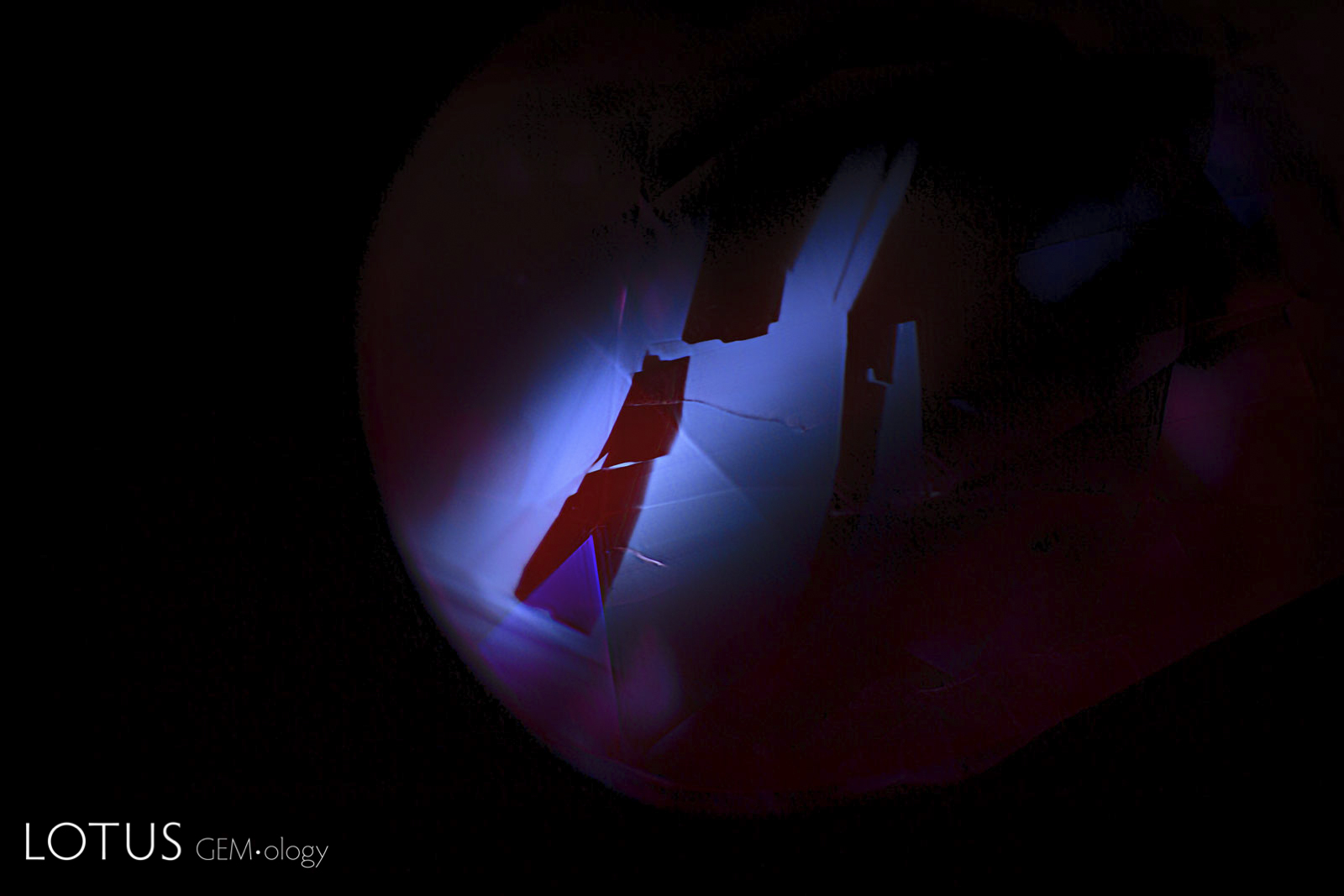
When iron-poor rubies from metamorphic deposits are heat treated, they often develop angular chalky zones when viewed in shortwave ultraviolet light. A great example of this is shown in this photograph, taken with Magilabs Deep Ultraviolet tool.
Natural Ruby •
Not Determinable •
Enhancements:
Heat (H) •
Lighting Conditions:
Ultraviolet: Shortwave
Photographer:
Richard W. Hughes •
Image Number:
A-003-6378-1
This small rounded crystal caught our attention when examining a ruby from Mong Hsu, Burma. Micro Raman analysis revealed that it is an apatite inclusion.
Natural Ruby •
Myanmar (Burma); Mong Hsu •
Enhancements:
Fissure Filling with colorless Oil/resin (FF-O1); No indications of heating (No indications of heating) •
Lighting Conditions:
Dark Field
Photographer:
E. Billie Hughes •
Image Number:
A-003-4341-1
• Field of View = 2mm
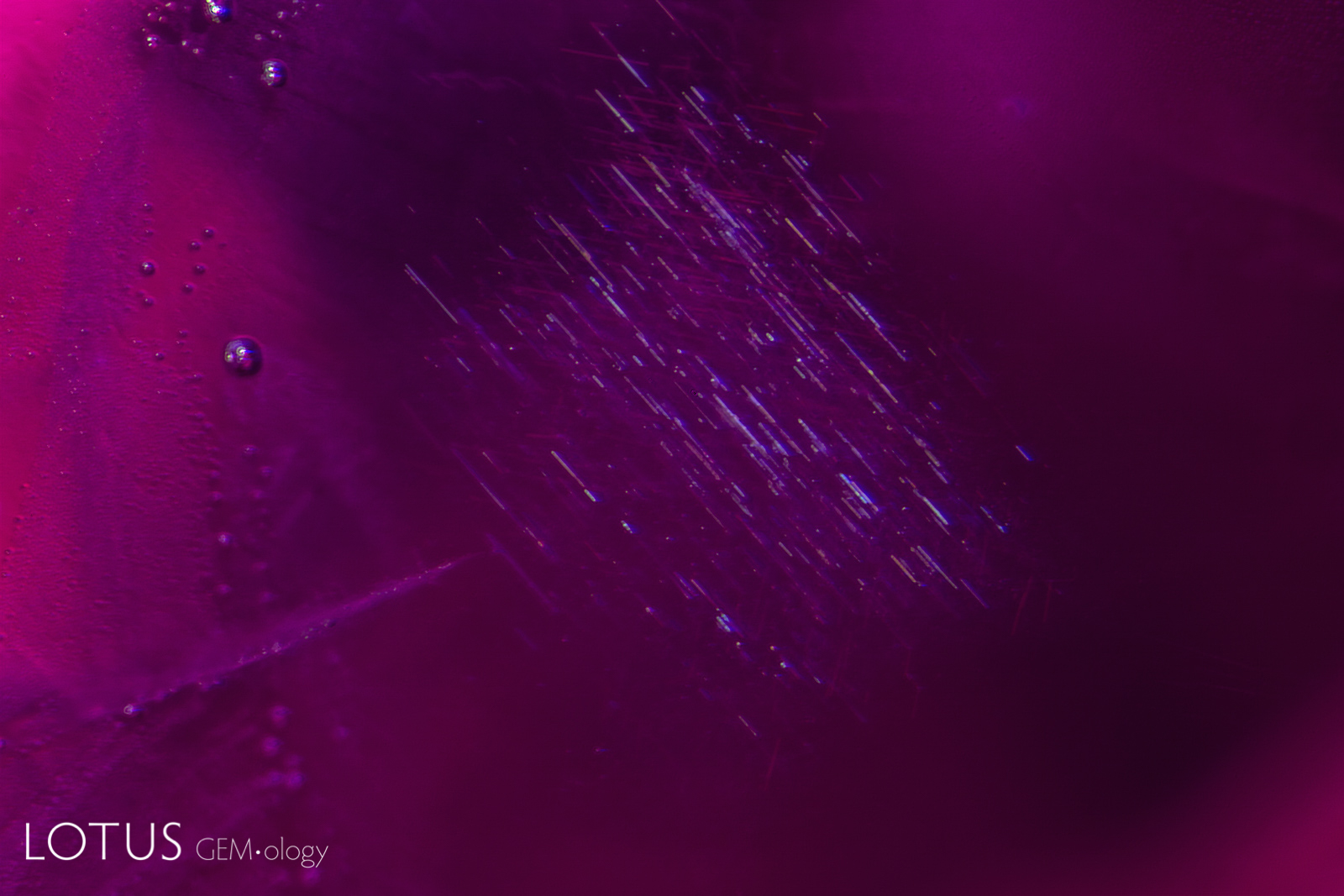
Mong Hsu rubies generally contain fluffy clouds of exsolved diaspore silk. While rutile silk is not common, it is seen on occasion, as evidenced by a cloud of rutile silk in a Mong Hsu ruby.
Natural Ruby •
Myanmar (Burma); Mong Hsu •
Enhancements:
Heat + Fissure Healing (H-FH) •
Lighting Conditions:
Dark Field + Oblique Fiber Optic
Photographer:
Richard W. Hughes •
Image Number:
A-003-4251-4
During flux healing, as the process continues, contraction bubbles form and then become larger as the void becomes more spherical. The degree of healing in flux-healed Mong Hsu rubies is so great that the flux remnants are often quite rounded, complete with contraction bubbles. Imagine a synthetic corundum crystal that has a long, thin hot-dog shaped gas bubble in it. If we heat that crystal to a high temperature, the hot dog will break up into a row of spherical bubbles, a process known as “necking down.” This image vividly illustrates the necking down of a void in a flux-healed Mong Hsu ruby.
Natural Ruby •
Myanmar (Burma); Mong Hsu •
Enhancements:
Heat + Fissure Healing (H-FH) •
Lighting Conditions:
Dark Field + Shadowing
Photographer:
Richard W. Hughes •
Image Number:
A-003-4251-1
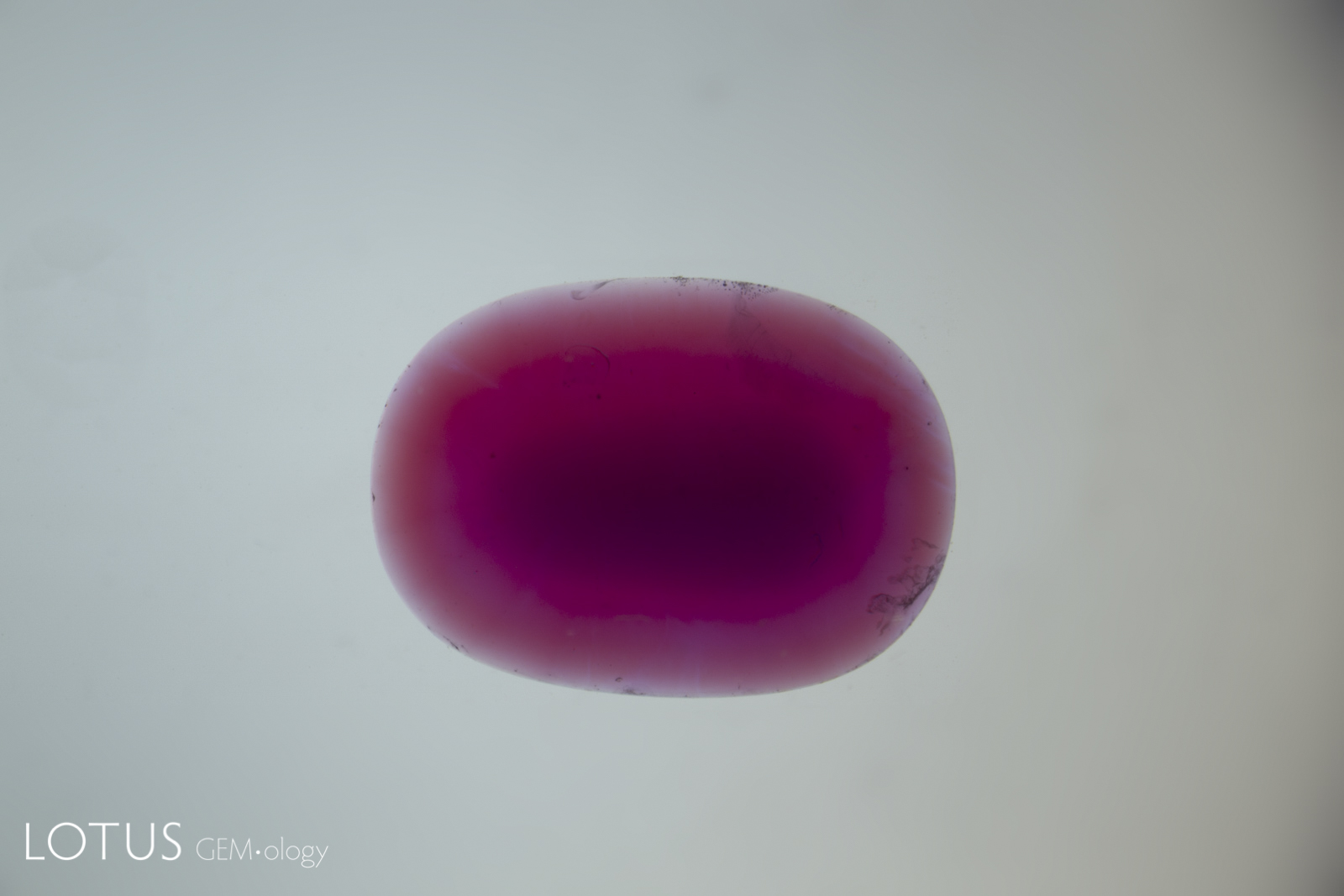
Immersion in di-iodomethane unmasked this ruby as a clever beryllium-diffused stone, probably from Songea, Tanzania. Note the faint surface-conformal orange color rim.
Natural Ruby •
No Origin •
Enhancements:
Heat + Diffusion of external coloring agents (H-D) •
Lighting Conditions:
Diffuse Light Field + Immersion + Blue Filter
Photographer:
Richard W. Hughes •
Image Number:
A-003-4082-2
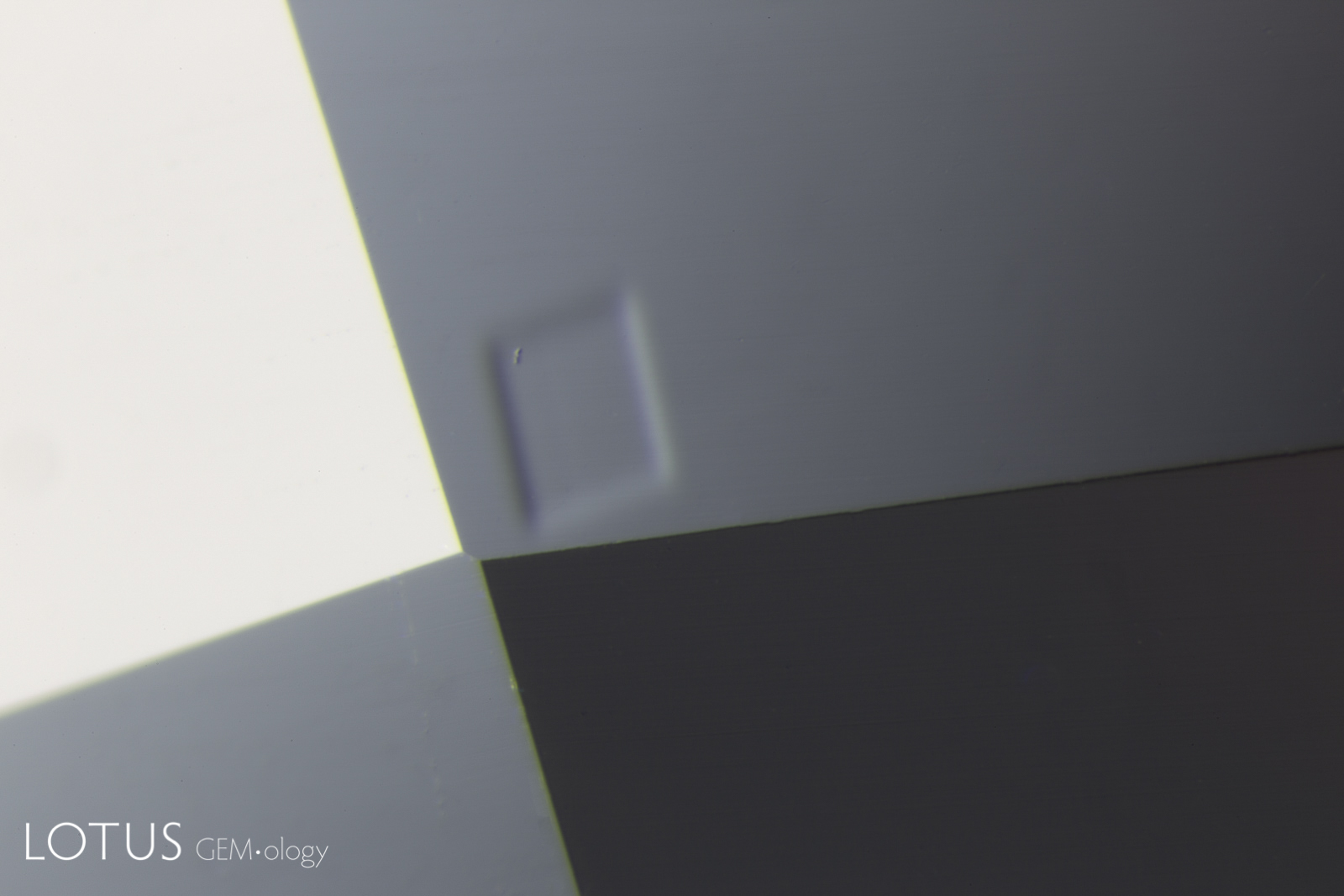
This is certainly one of the most unusual inclusions we have ever encountered, a rhomb-shaped depression divit on a polished facet, seen on a ruby (probably from Songea, Tanzania) that had been lattice-diffusion treated with beryllium.
Natural Ruby •
No Origin •
Enhancements:
Heat + Diffusion of external coloring agents (H-D) •
Lighting Conditions:
Diffuse Overhead
Photographer:
Richard W. Hughes •
Image Number:
A-003-4082-1
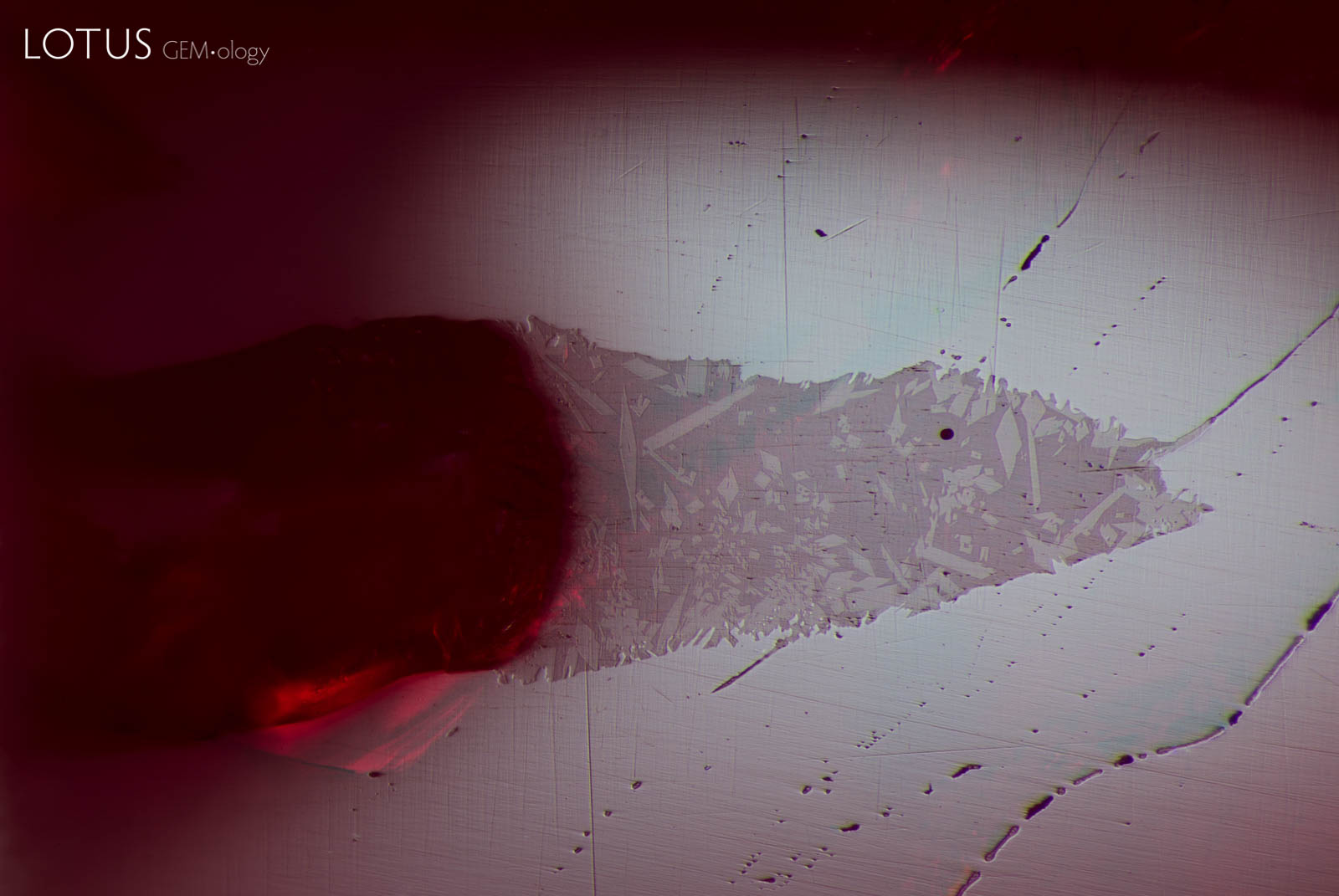
The lower luster of glass on the surface of this heated, fissure healed ruby, helps to separate the glass from the surrounding corundum, which has a higher luster.
Natural Ruby •
Myanmar (Burma); Mogok/Namya •
Enhancements:
Heat + Fissure Healing (H-FH); Heat + Glass Cavity/Fissure Filling (H-GF1) •
Lighting Conditions:
Dark Field + Diffuse Fiber Optic
Photographer:
E. Billie Hughes •
Image Number:
A-003-3635-1
In this heated and fissure-healed ruby from Myanmar, a surface cavity is filled with glass. The glass can be identified by the large gas bubble at the lower part of the cavity.
Natural Ruby •
Myanmar (Burma); Mogok/Namya •
Enhancements:
Heat + Fissure Healing (H-FH); Heat + Glass Cavity/Fissure Filling (H-GF1) •
Lighting Conditions:
Dark Field
Photographer:
Richard W. Hughes •
Image Number:
A-003-3551-1
In this heated and fissure-healed ruby from Myanmar, a surface cavity is filled with glass. The glass can be identified by its lower luster.
Natural Ruby •
Myanmar (Burma); Mogok/Namya •
Enhancements:
Heat + Fissure Healing (H-FH); Heat + Glass Cavity/Fissure Filling (H-GF1) •
Lighting Conditions:
Fiber Optic: Diffuse Overhead
Photographer:
Richard W. Hughes •
Image Number:
A-003-3551-2
Spall marks on a natural on the girdle of this Thai/Cambodian ruby reveal the heated nature of this stone.
Natural Ruby •
Thailand/Cambodia •
Enhancements:
Heat (H) •
Lighting Conditions:
Fiber Optic: Diffuse Overhead
Photographer:
Richard W. Hughes •
Image Number:
A-003-2866-1
Thai/Cambodian rubies like this often show thin film inclusions that light up under fiber optic illumination.
Natural Ruby •
Thailand/Cambodia •
Enhancements:
Heat (H) •
Lighting Conditions:
Diffuse Light Field + Diffuse Fiber Optic
Photographer:
E. Billie Hughes •
Image Number:
A-002-8599-2
Treatment can alter existing inclusions and produce new microscopic features in ruby. These may include changes to mineral inclusions, altered rutile silk, tension fractures, healed fissures, residues and other features associated with heating, fissure healing, glass filling and other treatment processes.
Treated Ruby Inclusion Photomicrographs
The Hyperion treated ruby gallery includes microscopic features documented in natural rubies subjected to treatment. Each entry identifies the recorded treatment and is accompanied by descriptive information and, where available, references to the gemological literature.
What Inclusions Can Reveal About Ruby Treatment
Microscopic examination is an important part of detecting treatment in ruby. The appearance and alteration of inclusions, fractures and growth features can provide evidence of treatment and, in some cases, information about the processes to which a ruby has been subjected.
Hyperion combines inclusion photomicrography with supporting gemological information so that treatment-related features can be compared with documented examples in natural ruby.
About Hyperion
Hyperion is the Lotus Gemology searchable inclusion database. It allows users to browse gemstone inclusions by gem type, geographic origin, treatment and keyword.