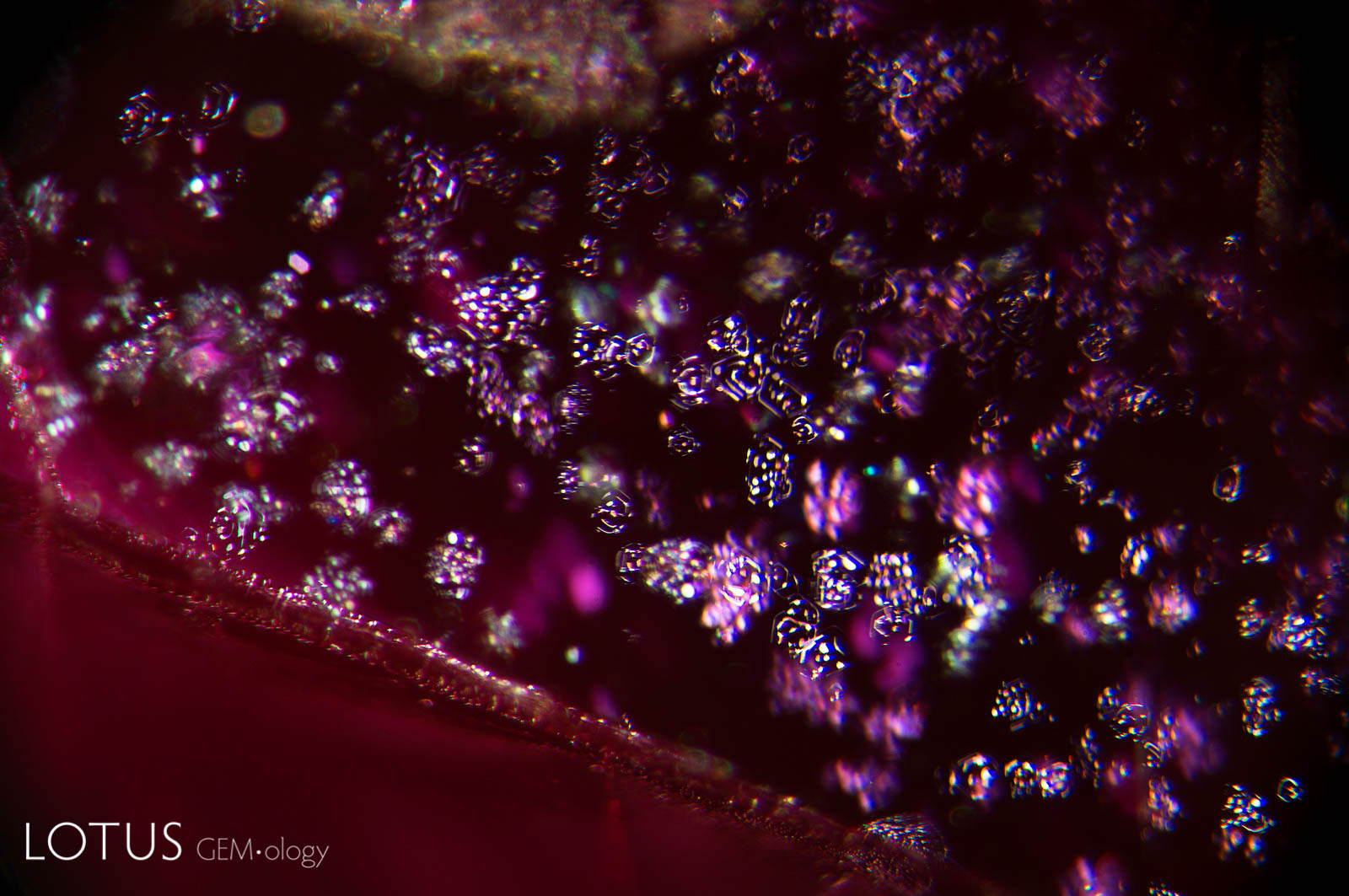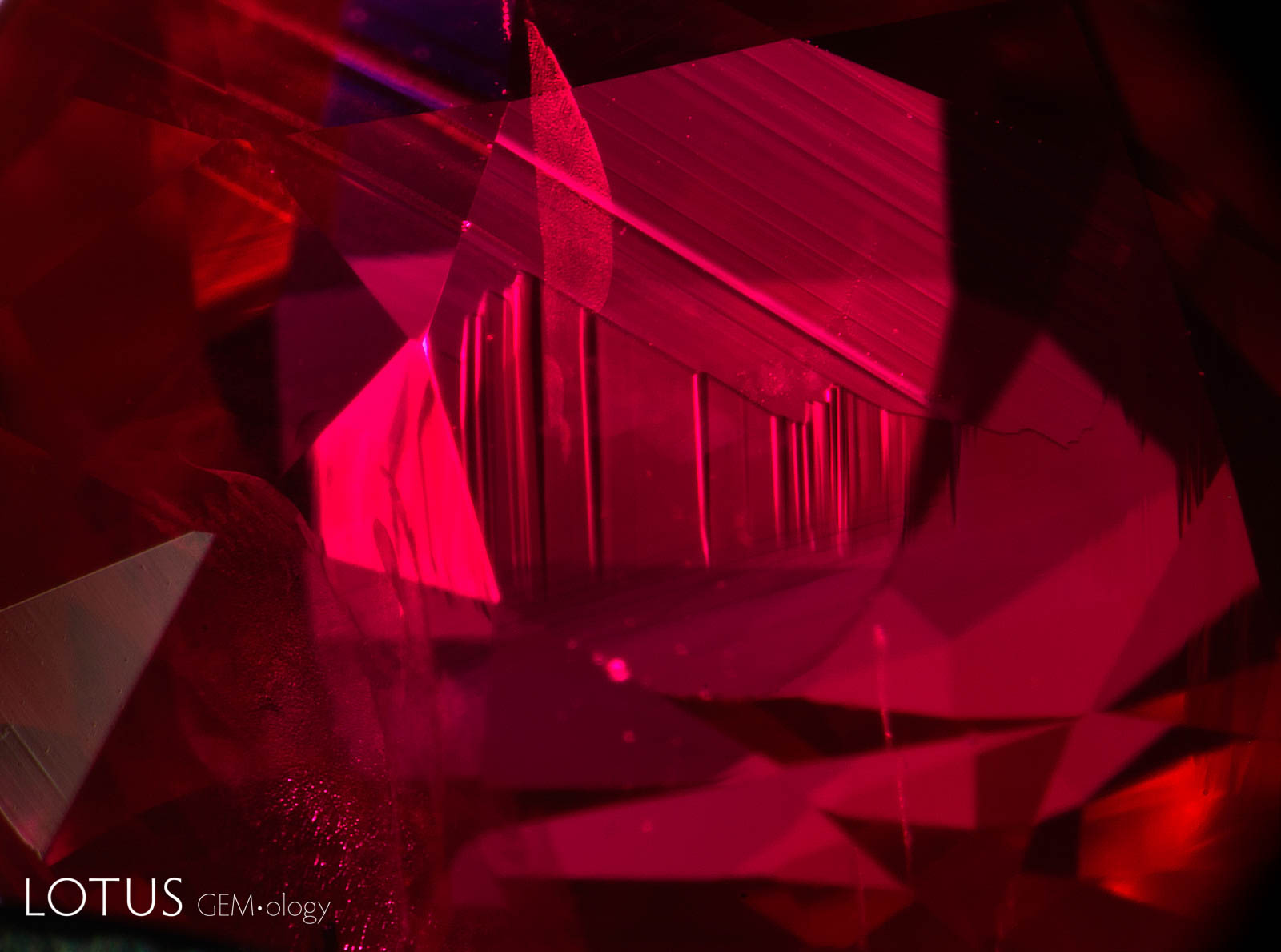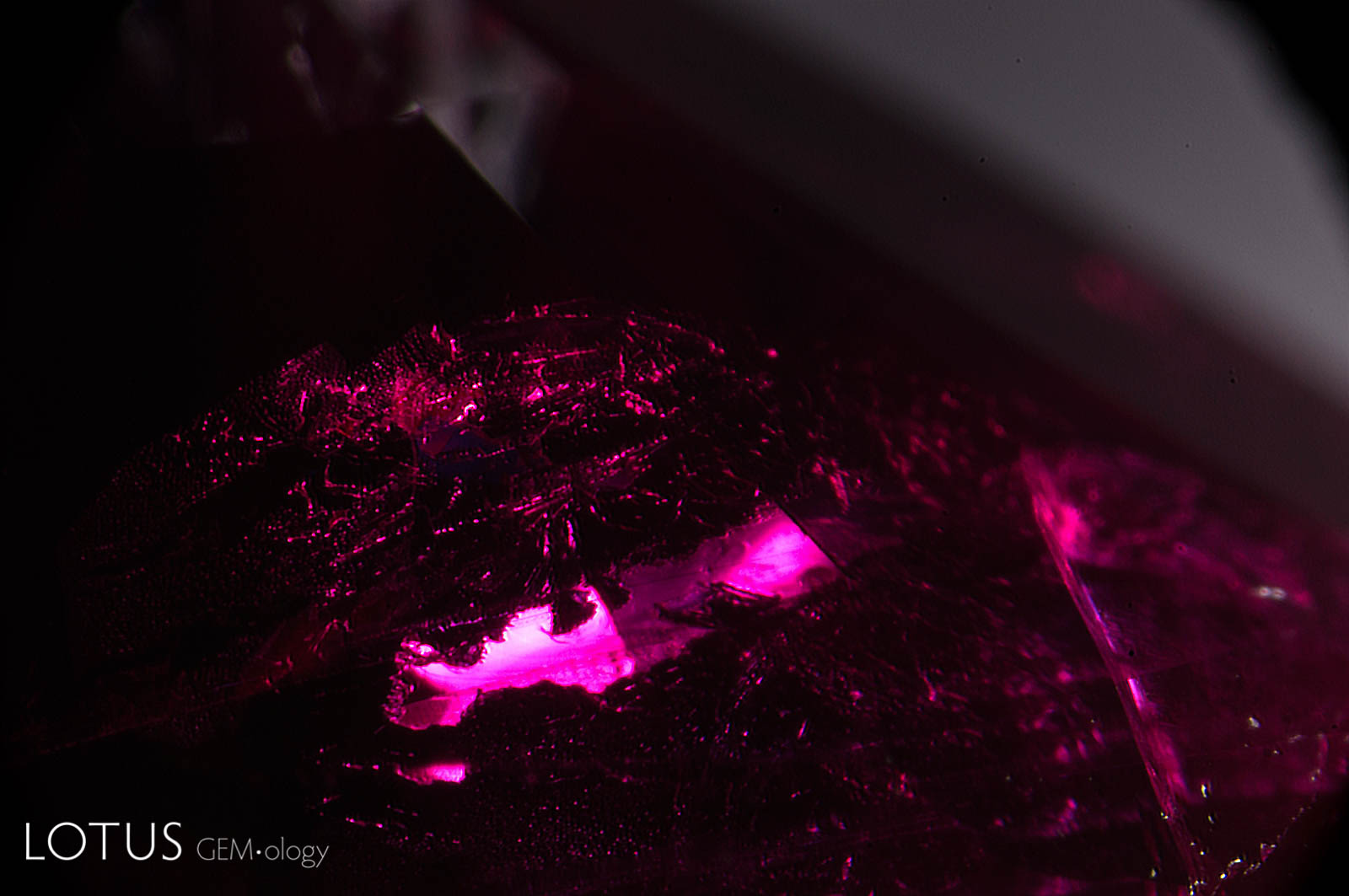
Treated Ruby Inclusions
Explore treated ruby inclusions in Hyperion, the Lotus Gemology inclusion database. Hyperion contains photomicrographs of inclusions and internal features in natural rubies that have undergone treatment, documented with information on geographic origin, treatment, lighting conditions, field of view, photographer and published references.
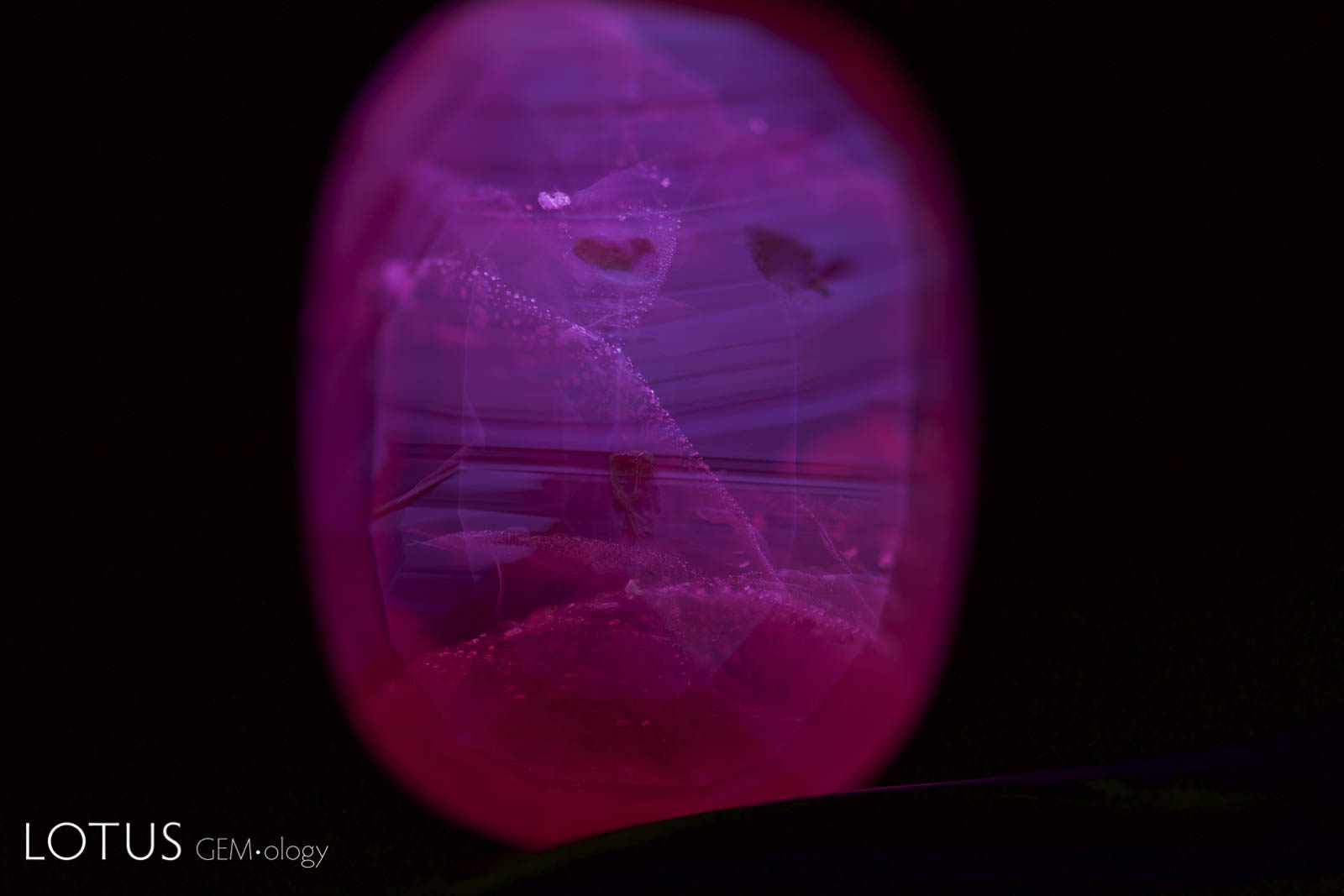
Shortwave ultraviolet can often reveal heat treatment even at relatively low temperatures. Low-iron rubies, padparadschas and blue sapphires will often display a zoned chalky fluorescence following heat treatment. It is generally the colorless areas of the stone that show this. The presence of chalky SW fluorescence is a strong indication of heat treatment.
Natural Ruby •
Myanmar (Burma); Mogok/Namya •
Enhancements:
Heat + Glass Cavity/Fissure Filling (H-GF1) •
Lighting Conditions:
Ultraviolet: Shortwave
Photographer:
Richard W. Hughes •
Image Number:
A-001-0579-2
A large glass-filled cavity on the surface of this heated ruby from Mozambique. Lower-grade ruby from Mozambique is sometimes treated by both flux healing and glass infilling.
Natural Ruby •
Mozambique •
Enhancements:
Heat + Fissure Healing (H-FH) •
Lighting Conditions:
Fiber Optic: Diffuse Overhead
Photographer:
E. Billie Hughes •
Image Number:
A-001-0836-1
Hughes, R.W. (1984) Repaired surfaces found on rubies. Jewellery News Asia, No. 6, pp. 1, 33; RWHL*.
A melted crystal of what was probably mica with a trapped gas bubble reveals this Mozambique ruby has been subjected to heat treatment.
Natural Ruby •
Mozambique •
Enhancements:
Heat (H) •
Lighting Conditions:
Fiber Optic: Transmitted
Photographer:
Richard W. Hughes •
Image Number:
A-001-1839-1
Shortwave ultraviolet can often reveal heat treatment even at relatively low temperatures. Low-iron rubies, padparadschas and blue sapphires will often display a zoned chalky fluorescence following heat treatment. It is generally the colorless areas of the stone that show this. The presence of chalky SW fluorescence is a strong indication of heat treatment.
Natural Ruby •
Myanmar (Burma); Mogok/Namya •
Enhancements:
Heat + Glass Cavity/Fissure Filling (H-GF1) •
Lighting Conditions:
Ultraviolet: Short Wave
Photographer:
E. Billie Hughes •
Image Number:
A-001-0579-1
Thin film inclusions in the basal plane are a common feature of many Thai-Cambodian rubies.
Natural Ruby •
Thailand/Cambodia •
Enhancements:
Heat (H) •
Lighting Conditions:
Fiber Optic: Overhead
Photographer:
Wimon Manorotkul •
Image Number:
P-10133-3
Hughes, R.W. (1997) Ruby & Sapphire. Boulder, CO, RWH Publishing, 512 pp.; RWHL*.
Thin film inclusions in the basal plane are a common feature of many Thai-Cambodian rubies.
Natural Ruby •
Thailand/Cambodia •
Enhancements:
Heat (H) •
Lighting Conditions:
Fiber Optic: Overhead
Photographer:
Wimon Manorotkul •
Image Number:
P-10133-2
Hughes, R.W. (1997) Ruby & Sapphire. Boulder, CO, RWH Publishing, 512 pp.; RWHL*.
Heat-altered fingerprints and melted crystals embellish the interior of this heat-treated Thai-Cambodian ruby.
Natural Ruby •
Thailand/Cambodia •
Enhancements:
Heat (H) •
Lighting Conditions:
Fiber Optic: Transmitted
Photographer:
Wimon Manorotkul •
Image Number:
P-10133-1
Hughes, R.W. (1997) Ruby & Sapphire. Boulder, CO, RWH Publishing, 512 pp.; RWHL*.
Angular growth zoning is a common feature in rubies from Mong Hsu, Burma. Growth zoning reveals the shape of a crystal at an earlier point in its development.
Natural Ruby •
Myanmar (Burma); Mong Hsu •
Enhancements:
Heat + Fissure Healing (H-FH) •
Lighting Conditions:
Dark Field
Photographer:
Wimon Manorotkul •
Image Number:
P-10035-1
Flux-healed fissure in a heat-treated ruby from Myanmar’s Mong Hsu mines.
Natural Ruby •
Myanmar (Burma); Mong Hsu •
Enhancements:
Heat + Fissure Healing (H-FH) •
Lighting Conditions:
Fiber Optic: Oblique
Photographer:
Wimon Manorotkul •
Image Number:
P-10019-2
Peretti, A. (1993) Foreign substances in Mong Hsu rubies. JewelSiam, Vol. 4, No. 5, p. 42; RWHL.
Flux-healed fissure in a heat-treated ruby from Myanmar’s Mong Hsu mines.
Natural Ruby •
Myanmar (Burma); Mong Hsu •
Enhancements:
Heat + Fissure Healing (H-FH) •
Lighting Conditions:
Fiber Optic: Oblique
Photographer:
Wimon Manorotkul •
Image Number:
P-10019-1
Treatment can alter existing inclusions and produce new microscopic features in ruby. These may include changes to mineral inclusions, altered rutile silk, tension fractures, healed fissures, residues and other features associated with heating, fissure healing, glass filling and other treatment processes.
Treated Ruby Inclusion Photomicrographs
The Hyperion treated ruby gallery includes microscopic features documented in natural rubies subjected to treatment. Each entry identifies the recorded treatment and is accompanied by descriptive information and, where available, references to the gemological literature.
What Inclusions Can Reveal About Ruby Treatment
Microscopic examination is an important part of detecting treatment in ruby. The appearance and alteration of inclusions, fractures and growth features can provide evidence of treatment and, in some cases, information about the processes to which a ruby has been subjected.
Hyperion combines inclusion photomicrography with supporting gemological information so that treatment-related features can be compared with documented examples in natural ruby.
About Hyperion
Hyperion is the Lotus Gemology searchable inclusion database. It allows users to browse gemstone inclusions by gem type, geographic origin, treatment and keyword.