Treated Spinel Inclusions
Explore treated spinel inclusions in Hyperion, the Lotus Gemology inclusion database. Hyperion contains photomicrographs of inclusions and internal features in natural spinels that have undergone treatment, documented with information on geographic origin, treatment, lighting conditions, field of view, photographer and published references.
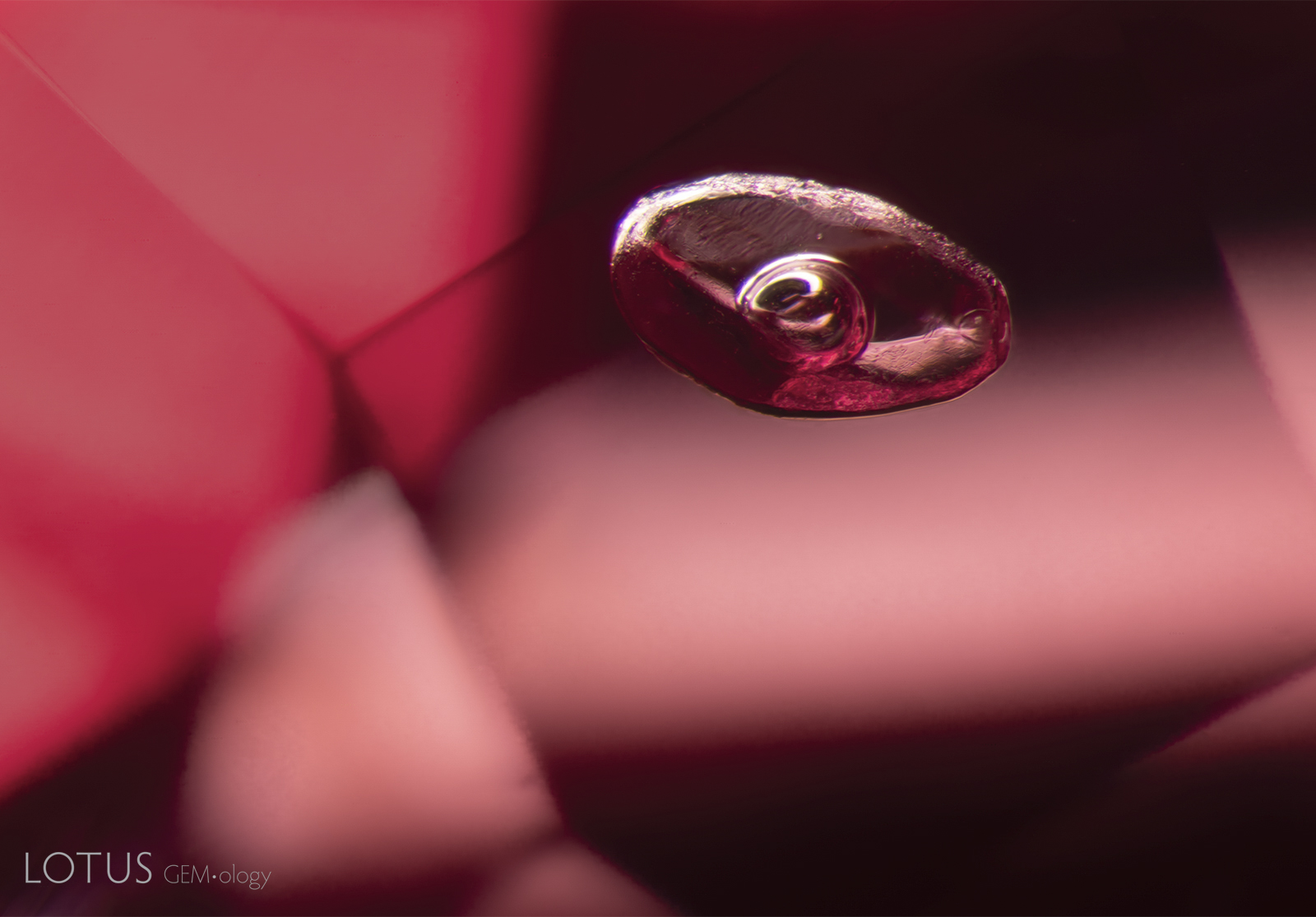
A large negative crystal with a mobile gas bubble resides in this unheated Burmese spinel. Analyses with microRaman spectroscopy were inconclusive. However, a near-invisible fissure extends through this negative crystal to the surface. By using a hot point, oil leaked out of this fissure and others around the stone. Therefore, the cavity may be filled with oil.
Natural Spinel •
Myanmar (Burma); Mogok/Namya •
Enhancements:
Fissure Filling with colorless Oil/resin (FF-O3); No indications of heating (No indications of heating) •
Lighting Conditions:
Dark Field + Oblique Fiber Optic
Photographer:
Kaylan Khourie •
Image Number:
A-005-9145-1
• Field of View = 2.7mm
• Magnification = 6.5x
Hughes, R.W. (2020) Oiled spinel & tanzanite — shocking revelations.
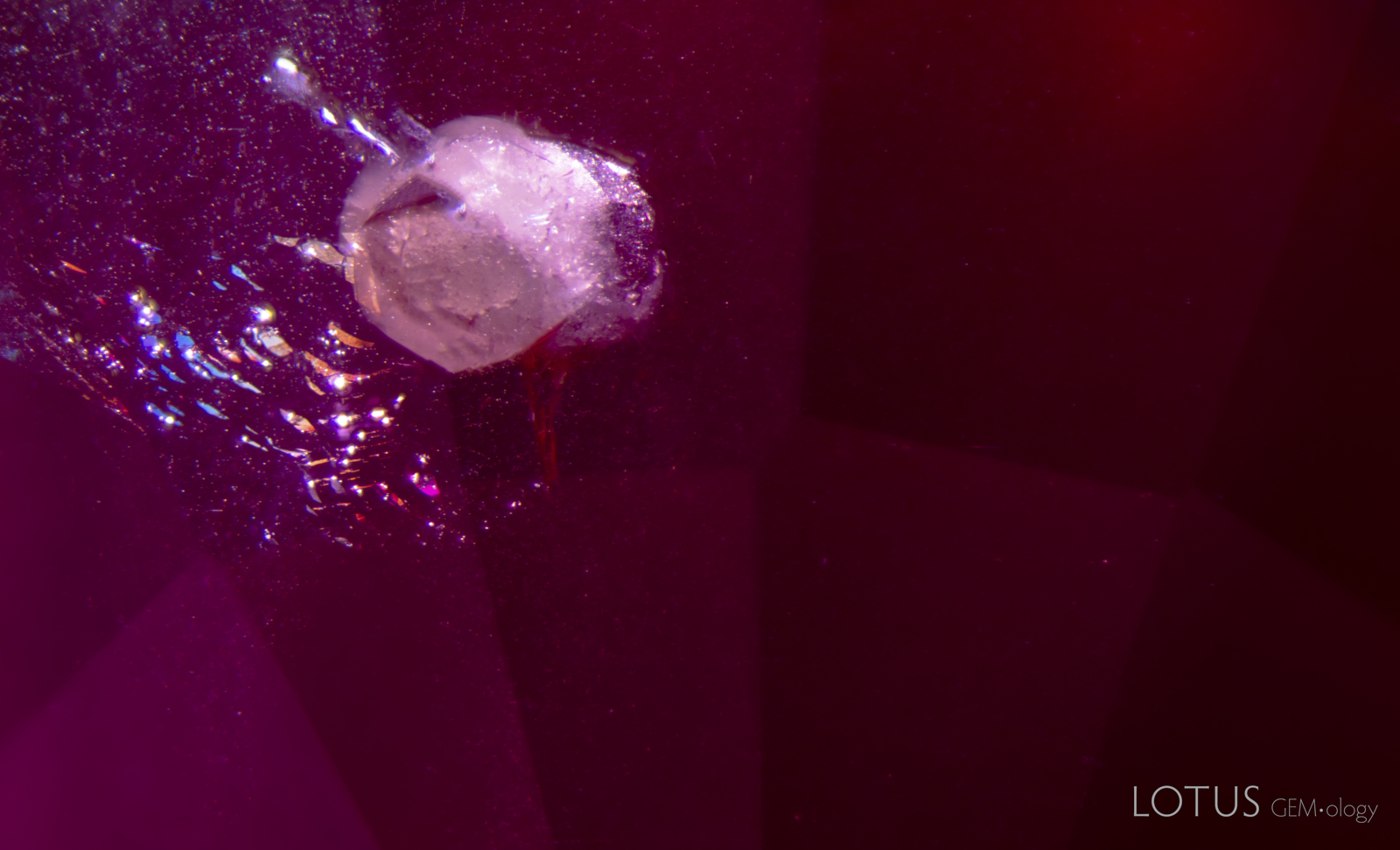
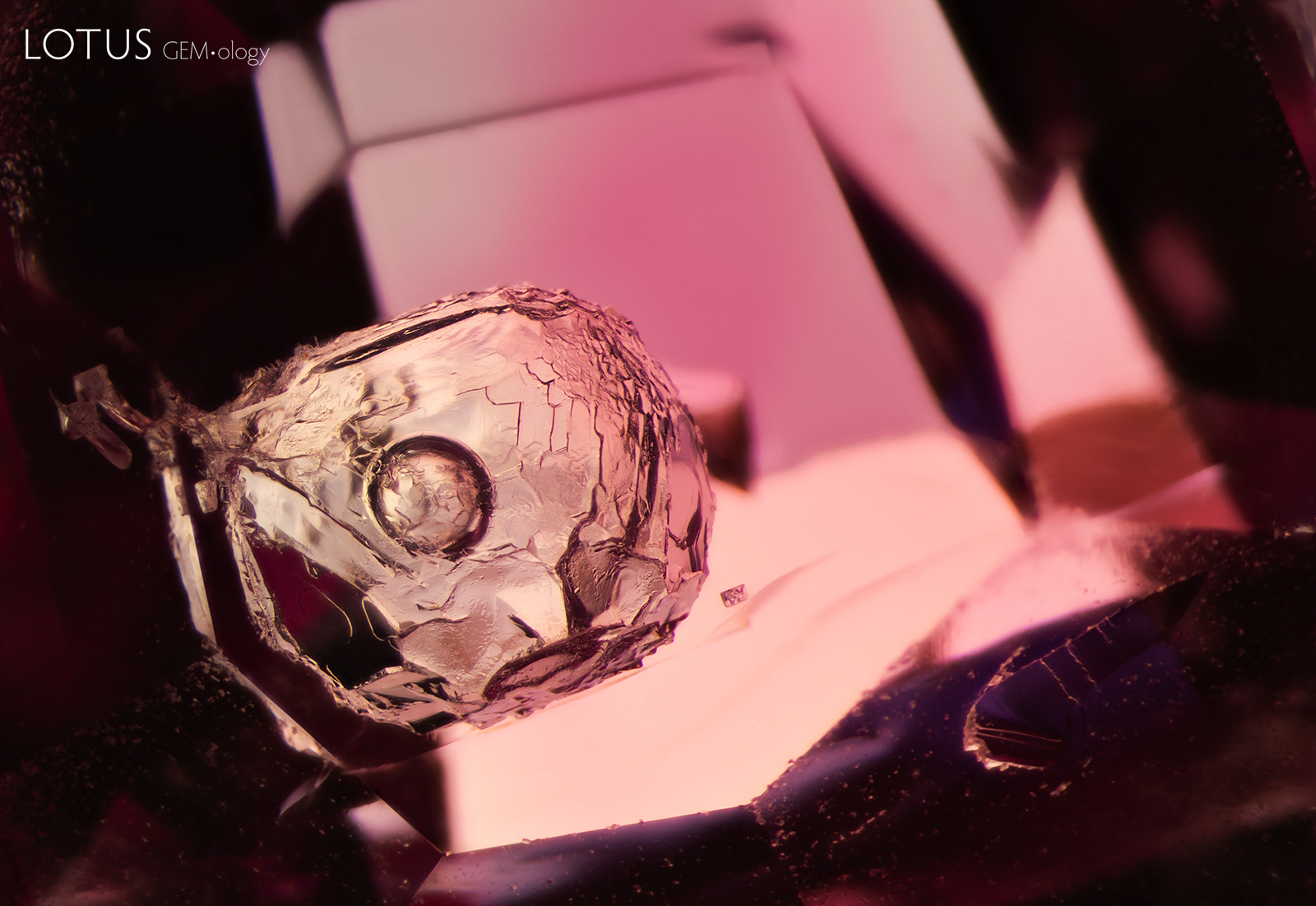
Within this heated red spinel from the Mahenge region of Tanzania, lies a large crystal (possibly apatite or a carbonate) that exhibits signs of heat damage, specifically the frosted appearance; attached to the crystal is an iridescent plane of thin-films. Additionally, fine remnants of partially dissolved silk (likely högbomite) are scattered across the stone.
Natural Spinel •
Tanzania •
Enhancements:
Heat (H) •
Lighting Conditions:
Fiber Optic: Oblique
Photographer:
Kaylan Khourie •
Image Number:
A-005-6953-1
• Field of View = 3.1mm
• Magnification = 5.8x
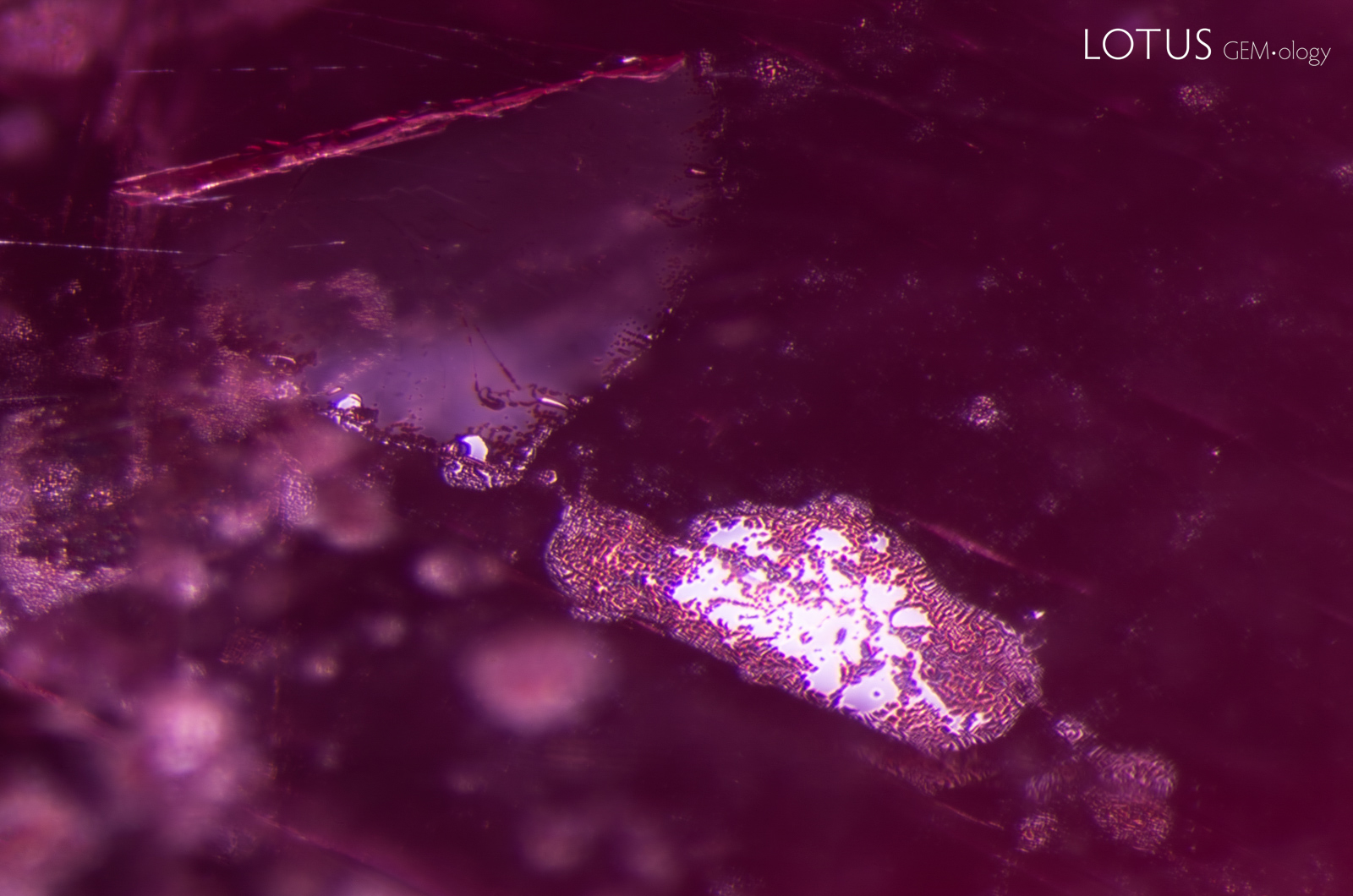
The heat treatment of spinel is quite rare, but not unknown and most of the stones are of a purplish red color. Here we see heat-damaged crystals in a Burma spinel. The best way to identify heat treatment in spinel is generally via the photoluminescence (PL) spectrum, rather than inclusions.
Natural Spinel •
Myanmar (Burma); Mogok/Namya •
Enhancements:
Heat (H) •
Lighting Conditions:
Diffuse Light Field + Fiber Optic
Photographer:
Wimon Manorotkul •
Image Number:
A-005-3207-1
• Field of View = 3.6mm
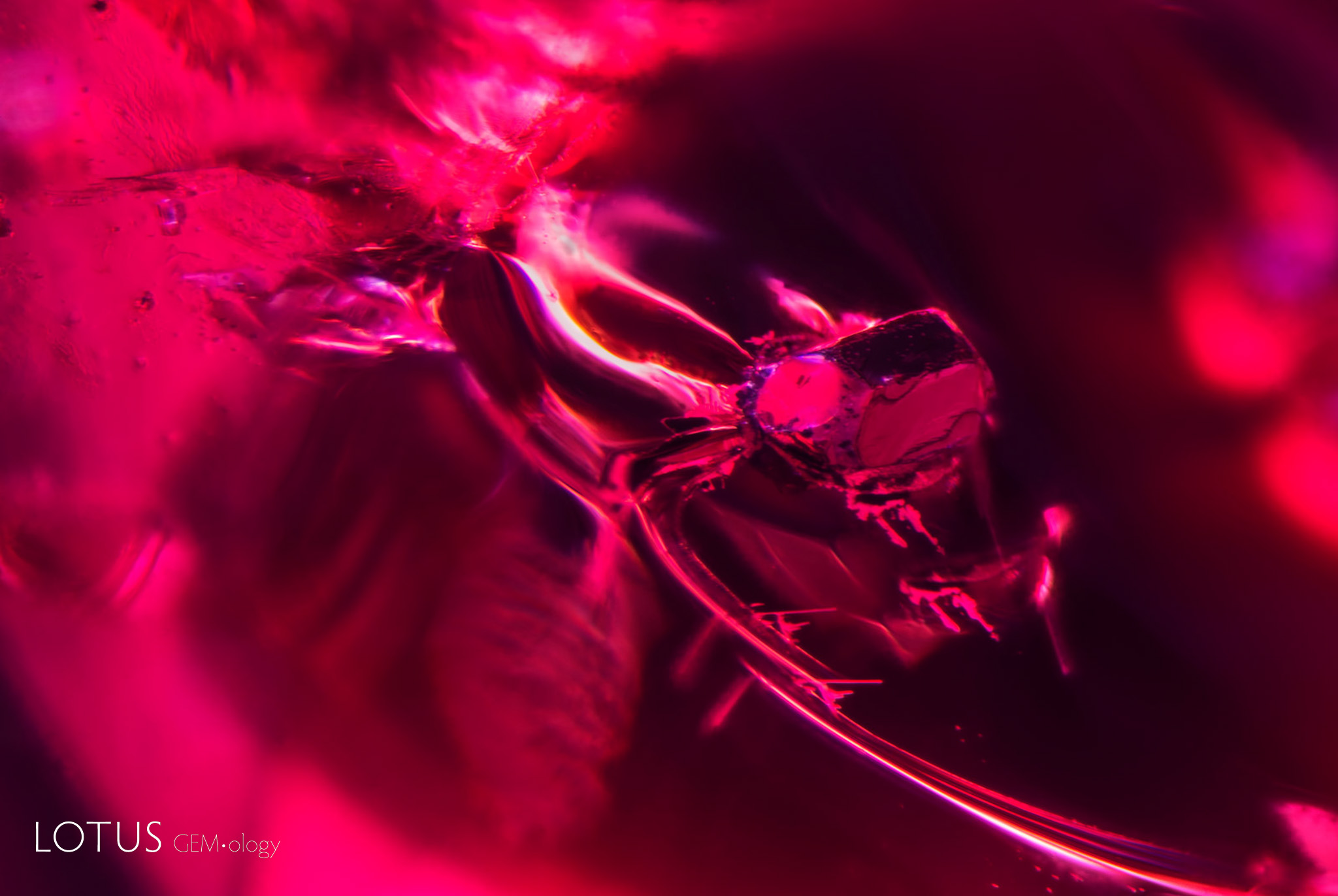
When a gem is heated, it and everything contained in it expands, governed by each material’s coefficient of thermal expansion. Should an included crystal expand more than the host, the result is a tension fissure, such as this around a heated apatite crystal in Burma red spinel.
Natural Spinel •
Myanmar (Burma); Mogok/Namya •
Enhancements:
Heat (H) •
Lighting Conditions:
Fiber Optic: Oblique
Photographer:
Wimon Manorotkul •
Image Number:
A-005-0051-2
• Field of View = 1.4mm
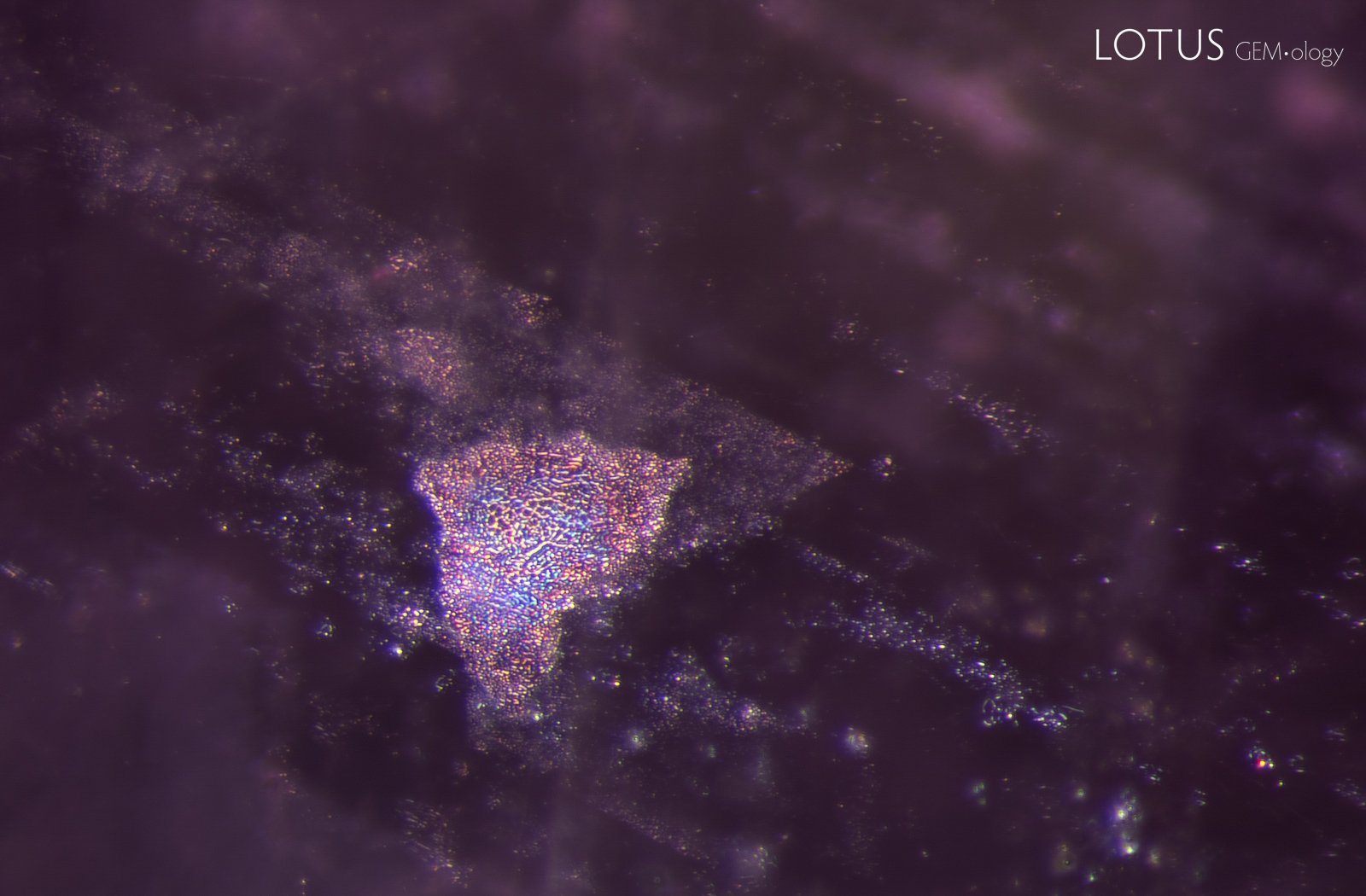
While still rare in the market, some spinels are heat treated. We identified that this stone was heated through a combination of the PL (photoluminescence) spectrum and the inclusions, which show signs of melting.
Natural Spinel •
Tanzania •
Enhancements:
Heat (H) •
Lighting Conditions:
Dark Field + Diffuse Fiber Optic
Photographer:
E. Billie Hughes •
Image Number:
A-005-6687-2
• Field of View = 1.9mm
While still rare in the market, some spinels are heat treated. We identified that this stone was heated through a combination of the PL (photoluminescence) spectrum and the inclusions. In this case, the dotted planes that we see may be remnants of the oriented lamellae sometimes seen in Tanzanian spinel.
Natural Spinel •
Tanzania •
Enhancements:
Heat (H) •
Lighting Conditions:
Fiber Optic: Diffuse Oblique
Photographer:
E. Billie Hughes •
Image Number:
A-005-6687-1
• Field of View = 1.6mm
A gas bubble floats inside this cavity in a spinel from Burma. To date, we have not been able to verify whether this is a natural or man-made feature. Specimen courtesy Gil Yuda.
Natural Spinel •
No Origin •
Enhancements:
() •
Lighting Conditions:
Diffuse Light Field (Transmitted Light)
Photographer:
E. Billie Hughes •
Image Number:
R-005-2683-1
• Field of View = 3.5mm
This spinel was treated with cobalt diffusion. Signs of the treatment can be seen in the drippy appearance of the fingerprint and slightly melted, rounded edges of the crystal seen here.
Natural Spinel •
Not Determinable •
Enhancements:
Heat + Diffusion of external coloring agents (H-D) •
Lighting Conditions:
Dark Field
Photographer:
E. Billie Hughes •
Image Number:
A-004-3658-1
• Field of View = 4mm
The bright, glassy discoid depicted here provides evidence that its spinel host was heated. Raman spectroscopy confirmed this suspicion.
Natural Spinel •
Myanmar (Burma); Mogok/Namya •
Enhancements:
Heat (H) •
Lighting Conditions:
Dark Field
Photographer:
E. Billie Hughes •
Image Number:
A-004-0696-1
• Field of View = 3mm
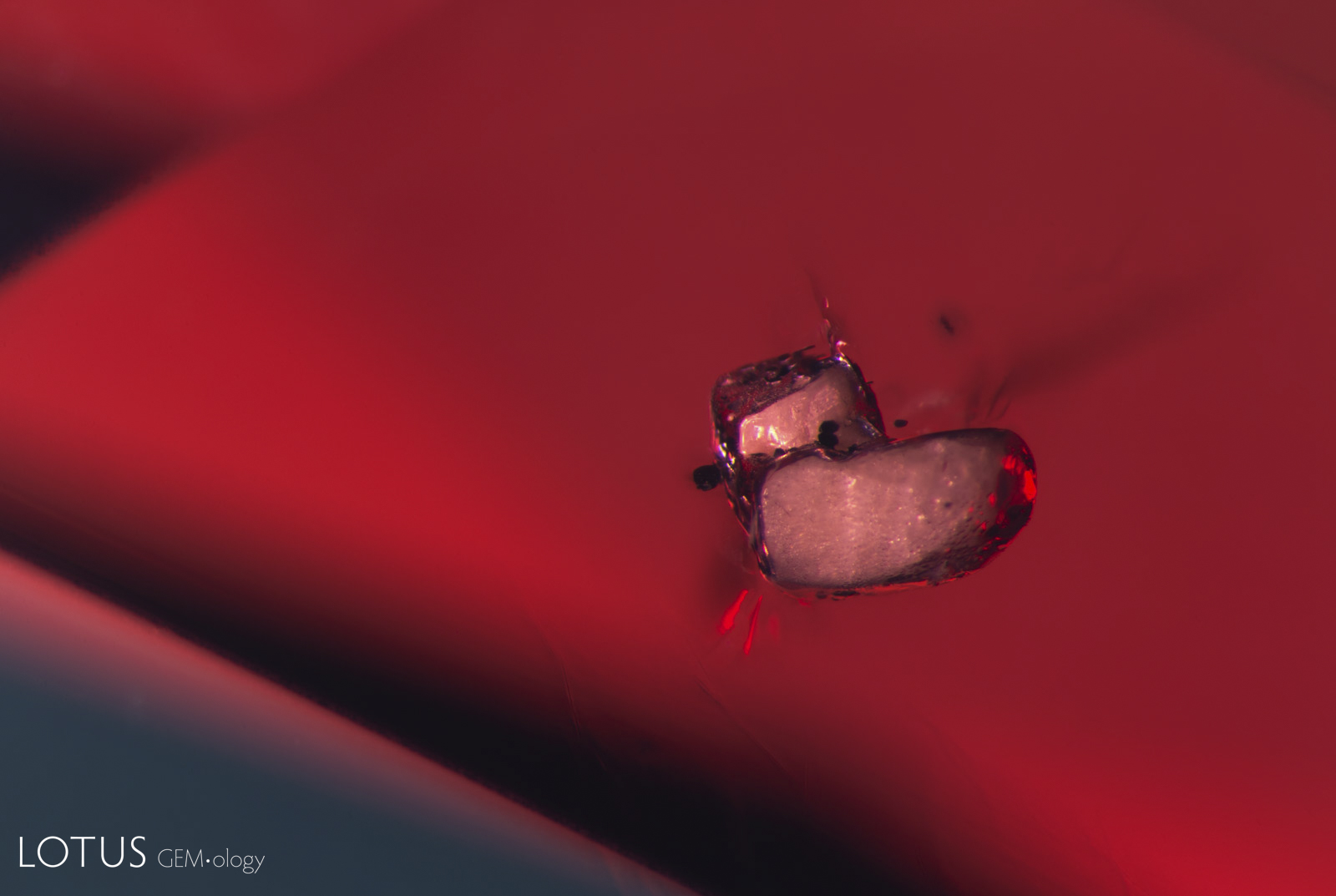
Two solid crystals of unknown identity perch inside this red spinel from Myanmar’s Mogok Stone Tract.
Natural Spinel •
Myanmar (Burma); Mogok/Namya •
Enhancements:
Fissure Filling with colorless Oil/resin (FF-O1); No indications of heating (No indications of heating) •
Lighting Conditions:
Fiber Optic: Diffuse Oblique
Photographer:
Wimon Manorotkul •
Image Number:
A-003-2431-1
This red spinel from Tanzania’s Mahenge mines showed an unusual orange coloration surrounding a fingerprint inclusion. But when examined in oblique fiber-optic lighting, the orange area displayed milky bluish clouds. This unmasked the orange color as a function of scattering, the same phenomena that creates a blue sky and orange sunset.
Natural Spinel •
Tanzania; Mahenge •
Enhancements:
Fissure Filling with colorless Oil/resin (FF-O1); No indications of heating (No indications of heating) •
Lighting Conditions:
Fiber Optic: Oblique
Photographer:
Richard W. Hughes •
Image Number:
A-003-3576-1
This red spinel from Tanzania’s Mahenge mines showed an unusual orange coloration surrounding a fingerprint inclusion. But when examined in oblique fiber-optic lighting, the orange area displayed milky bluish clouds. This unmasked the orange color as a function of scattering, the same phenomena that creates a blue sky and orange sunset.
Natural Spinel •
Tanzania; Mahenge •
Enhancements:
Fissure Filling with colorless Oil/resin (FF-O1); No indications of heating (No indications of heating) •
Lighting Conditions:
Diffuse Light Field + Immersion + Blue Filter
Photographer:
Richard W. Hughes •
Image Number:
A-003-3576-2
Treatment can alter existing inclusions and produce new microscopic features in spinel. These may include changes to mineral inclusions, tension fractures, healed fissures, residues and other features associated with heating and other treatment processes.
Treated Spinel Inclusion Photomicrographs
The Hyperion treated spinel gallery includes microscopic features documented in natural spinels subjected to treatment. Each entry identifies the recorded treatment and is accompanied by descriptive information and, where available, references to the gemological literature.
What Inclusions Can Reveal About Spinel Treatment
Microscopic examination is an important part of detecting treatment in spinel. The appearance and alteration of inclusions, fractures and growth features can provide evidence of treatment and, in some cases, information about the processes to which a spinel has been subjected.
Hyperion combines inclusion photomicrography with supporting gemological information so that treatment-related features can be compared with documented examples in natural spinel.
About Hyperion
Hyperion is the Lotus Gemology searchable inclusion database. It allows users to browse gemstone inclusions by gem type, geographic origin, treatment and keyword.