Emerald Bibliography

Emerald Bibliography

Explore books, articles and historical sources on emerald in Four Treasures, the Lotus Gemology reference database. This bibliography brings together matching records from the collection, with publication details, abstracts and cover images where available.

Emerald References

The list below matches the terms emerald or emeralds in the database's searchable fields. Some references discuss emeralds as part of a broader subject.
1–20 of 851 matching references

G&G Micro-World: Blooming bouquet—Thin films in Russian emerald
Journal Article
Hughes, E.B. (2025) G&G Micro-World: Blooming bouquet—Thin films in Russian emerald. Gems & Gemology, Vol. 61, No. 4, Winter, pp. 400–401.
Record No. 28173  |  Sinkankas/Born No.: NIS/NIB  |  RWHL
Some gems are enchanting both outside and in. Recently, the Lotus Gemology laboratory received an interesting submission of a 78.01 ct carved Russian emerald. According to the client, the emerald was carved by gemstone engraver Michael Peuster and inspired by art nouveau artist Alphonse Mucha. The woman depicted holds blooming flowers, symbolizing the arrival of spring (figure 1). Microscopic examination revealed delicate, bouquet-like thin film inclusions on the back of the carving (figure 2). Iridescent thin films are frequently observed in emeralds from Russia, and this specimen showcased several striking examples. It was a delightful coincidence to find that the inclusion scene in this stone echoed the floral motif carved into its exterior.

‘Accurate Improv’ — A bit of ChatGPT gold
Journal Article
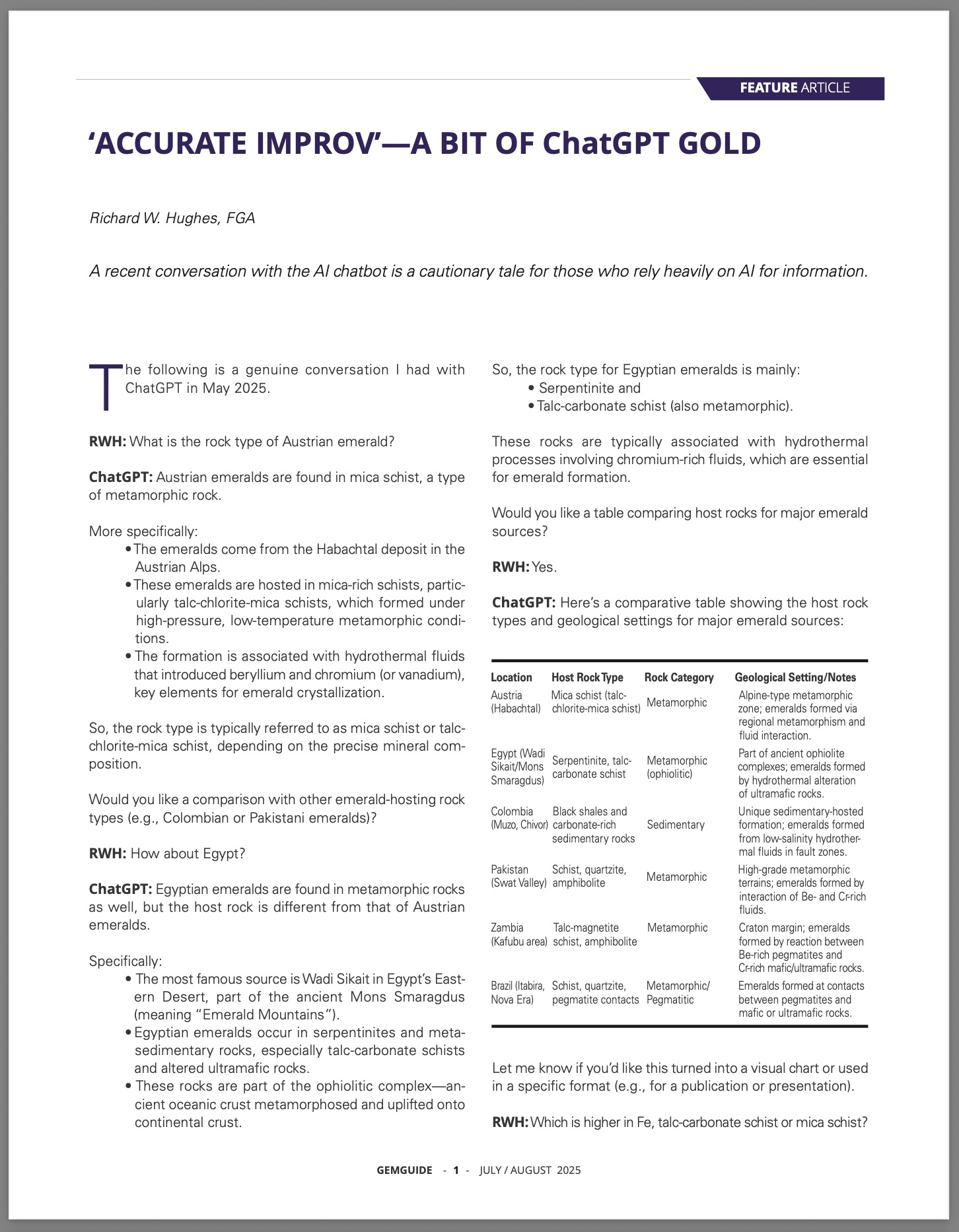
Hughes, R.W. (2025) ‘Accurate Improv’ — A bit of ChatGPT gold. GemGuide, July/August, pp. 1–4.
Record No. 28066  |  Sinkankas/Born No.: NIS/NIB  |  RWHL
A recent conversation with the AI chatbot is a cautionary tale for those who rely heavily on AI for information.

Treatment disclosure and other notes from the Eastern front
Journal Article
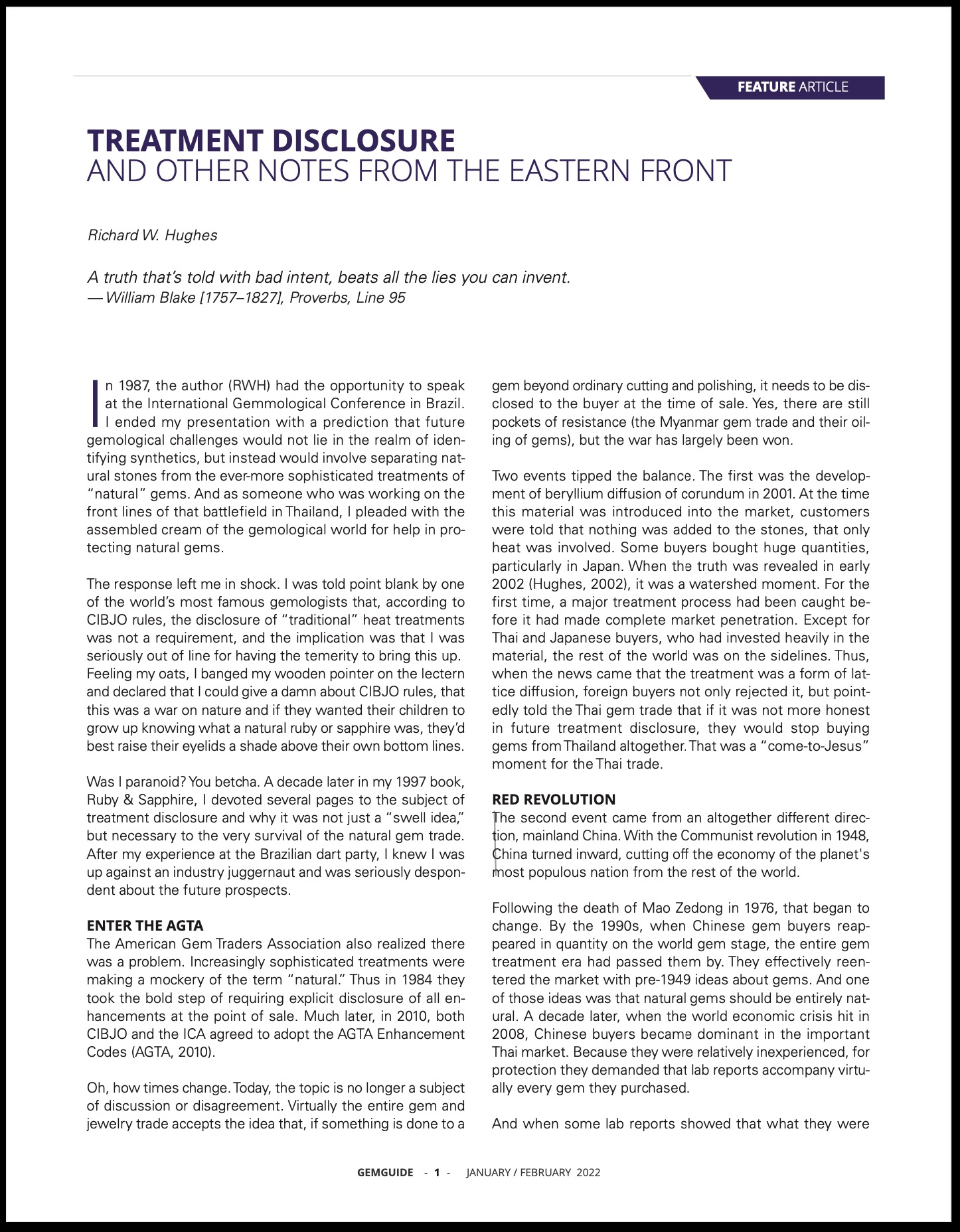
Hughes, R.W. (2022) Treatment disclosure and other notes from the Eastern front. GemGuide, January/February, pp. 1–4.
Record No. 6438  |  Sinkankas/Born No.: NIS/NIB  |  RWHL*
Reviews the history and ethics of gemstone treatment disclosure from the perspective of the colored-stone trade, tracing the shift from resistance to disclosure of “traditional” treatments toward widespread acceptance of explicit disclosure. Hughes identifies the introduction of beryllium diffusion treatment of corundum and the growing influence of Chinese buyers seeking untreated stones as important forces behind this change. He discusses continuing problems, including attempts to evade laboratory detection through increasingly subtle treatments, the use of obscure enhancement codes rather than plain-language disclosure, and the fissure filling of colored stones other than emerald with oils or resins. Examples of oiled spinel and tanzanite demonstrate how such fillers can dramatically improve apparent clarity and conceal significant fissures. The author argues that laboratories and dealers have an obligation to identify and clearly disclose all treatments, emphasizing that transparent disclosure is essential to maintaining consumer confidence and protecting the market for genuinely untreated gemstones.

G&G Micro-world: Apatite in blue sapphire
Journal Article
Hughes, E.B. (2021) G&G Micro-world: Apatite in blue sapphire. Gems & Gemology, Vol. 57, No. 3, Fall, p. 268.
Record No. 4567  |  ISBN/ISSN: 0016626X  |  RWHL
One of the beauties of working with gemstones is that each time you peer into a stone, you get a glimpse of the universe held within. When we first examined the scene in a star sapphire (see above), we were delighted with the view. A feature that immediately stands out is the triangular crystal, which displays terraced growth features and iridescence on the surface when illuminated with a fiber-optic light. Analysis with micro Raman revealed that this crystal is apatite. What makes the scene even more stunning is the way the crystal seems to float over a cloud of rutile silk. This same silk is what creates asterism in the stone. While in this case the apatite crystal resides in a sapphire from Sri Lanka, apatite has also been reported in corundum from a variety of sources, including Afghanistan, Cambodia, Madagascar, Myanmar, Nigeria, Pakistan, Tanzania, Thailand, the United States, and Vietnam. Apatite can be found not only in ruby and sapphire from different origins, but also in many other types of gems. In our laboratory, we have encountered apatite inclusions in emerald, spinel, and garnet. Apatite is a relatively common mineral, so it is not surprising to find it so often as an inclusion. Although it may occur frequently, in this instance it is anything but mundane.

Gem News International: Oiled tanzanite
Journal Article
Hughes, R.W. (2020) Gem News International: Oiled tanzanite. Gems & Gemology, Vol. 56, No. 4, Winter, pp. 552–553.
Record No. 4506  |  ISBN/ISSN: 0016626X  |  RWHL
Over the past five years, gemologists at Bangkok’s Lotus Gemology have seen increasing numbers of what we might call “non-traditionally” oiled gems. This is particularly true of, but not limited to, Burmese gems such as ruby, sapphire, and spinel. But it is important to note that any gem with surface-reaching fissures can be oiled, often with dramatic improvements in apparent clarity. Cuprian and rubellite tourmalines are also frequently enhanced in this way. Recently we received a faceted tanzanite weighing more than 100 carats for testing. As is our practice for non- emeralds exhibiting fissure-filling clarity enhancement, we photograph the gem and then allow the client to re-submit the stone after filler removal. Figure 18 clearly shows the dramatic effect that fissure filling with oil/resin can have on gems such as tanzanite, even where the refractive index of the filler does not closely match that of the gem.

G&G Microworld: Unmasking emerald filler
Journal Article
Hughes, E.B. (2020) G&G Microworld: Unmasking emerald filler. Gems & Gemology, Vol. 56, No. 4, Winter, pp. 527–528.
Record No. 4505  |  ISBN/ISSN: 0016626X  |  RWHL
Of the treatments we see in the laboratory, fissure filling has become one of the most ubiquitous. We have observed this treatment in a variety of stones, including emerald, ruby, sapphire, spinel, tourmaline, tanzanite, and more. The filling of fractures minimizes their appearance, making the gems appear cleaner. Fissure filling can be detected with a variety of methods. One way is to examine the infrared spectrum, where some fillers display distinctive peaks. Another is the hot point method, where oils can be observed leaking out in droplets. Some fillers are unmasked with simple observation in the microscope, because they display flashes of color or because they include visible dyes.

Long-wave ultraviolet torches • A gemmologist’s new best friend
Journal Article
Hughes, E.B. (2020) Long-wave ultraviolet torches • A gemmologist’s new best friend. Journal of the Gemmological Association of Hong Kong, Vol. 41, pp. 57–59.
Record No. 4288  |  RWHL
As laboratory gemmologists, we are frequently asked by friends and colleagues for recommendations on lab equipment. Often the focus is based around the most modern and advanced instrumentation, much of which is out of reach for what my grandfather likes to call the “great unwashed.” One piece of equipment that is often overlooked is the humble ultraviolet (UV) lamp. Although it is an older and relatively affordable tool, it is an essential test in our laboratory, and we examine all submitted stones under UV light. Often used in diamond testing, it can also be a tremendous help with coloured gems, in detecting treatments and synthetics, as well as a capable tool to screen pieces of jewellery with many smaller stones.

Tsavorite: An untamed beauty

Journal Article
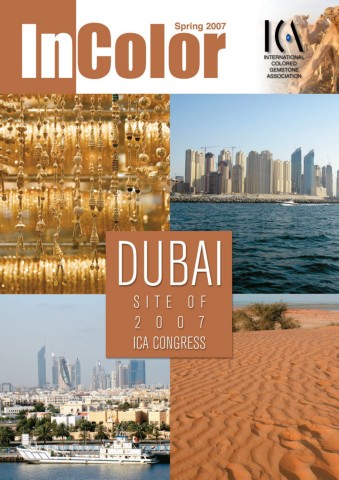
Pardieu, V. and Hughes, R.W. (2008) Tsavorite: An untamed beauty. InColor, Fall, pp. 36–45.
Record No. 5486  |  RWHL*
On October 22, 2007, TanzaniteOne, the world leader in tanzanite mining, announced the acquisition of a tsavorite project through its subsidiary, TsavoriteOne Mining Ltd. The move was not surprising to people familiar with these gems given that tanzanite is a gem geologically linked with tsavorite. More recently, in September 2008, the TsavoriteOne project was again in the news when Gemfields, a group involved in emerald mining in Zambia, made a surprise offer for TanzaniteOne. This article presents an update on tsavorite, along with studying its potential as one of the coming century's major gemstones.

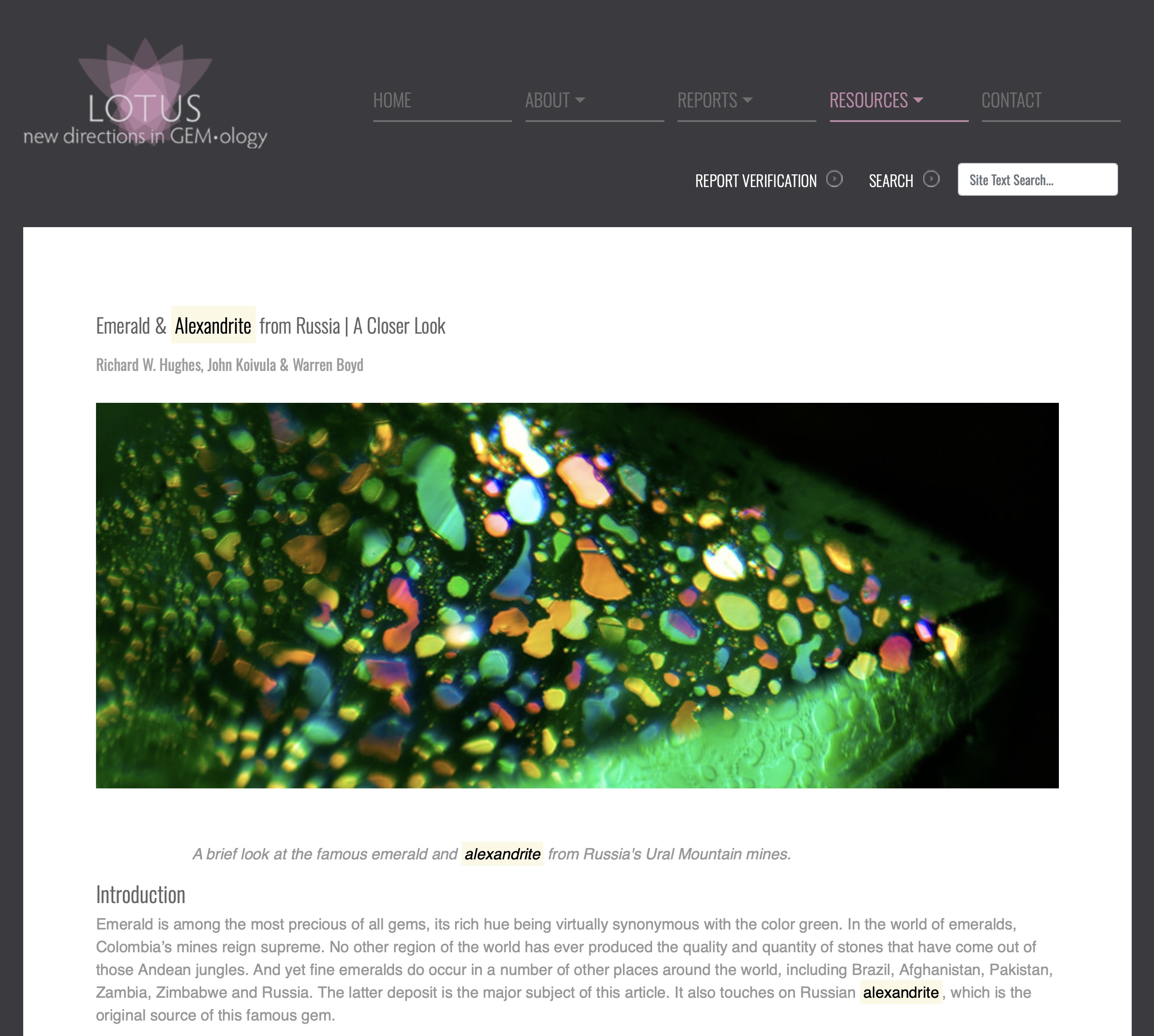
Emerald and alexandrite from Russia • A closer look
Web Page
Hughes, R.W., Koivula, J.I. and Boyd, W. (2006) Emerald and alexandrite from Russia • A closer look. LotusGemology.com, <https://lotusgemology.com/resources/articles/298-emeralds-from-russia-a-closer-look>
Record No. 7808  |  RWHL*
A brief look at the famous emerald and alexandrite from Russia's Ural Mountain mines.

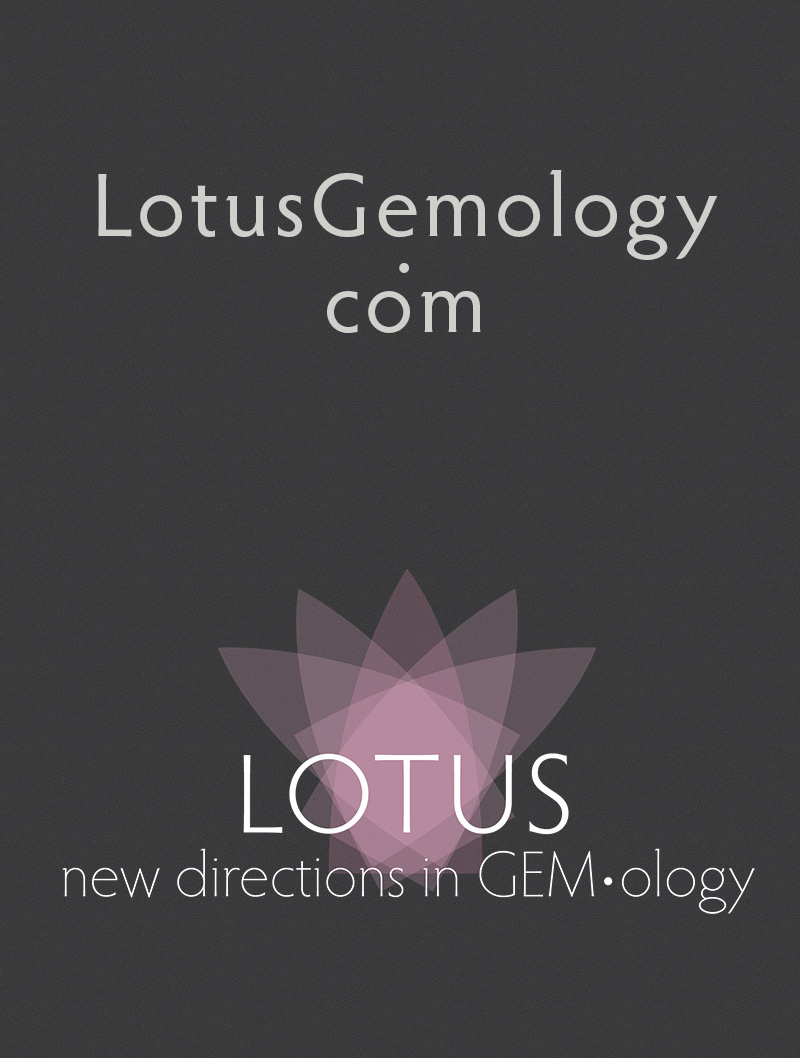
Heat Seeker: UV fluorescence as a gemological tool
Journal Article
Hughes, R.W. and Emmett, J.L. (2005) Heat Seeker: UV fluorescence as a gemological tool. Gem Market News [The Guide], Vol. 24, No. 5, Part 1, Sept.–Oct., pp. 1, 4–7.
Record No. 5557  |  RWHL*
One of the greatest gemological challenges is determining if a ruby or sapphire has been heat treated. UV fluorescence can assist in that identification, as well as detecting fillers in emerald.

Seeing red: A guide to ruby connoisseurship
Journal Article
Hughes, R.W. (2001) Seeing red: A guide to ruby connoisseurship. The Guide, Vol. 20, No. 6, Part 1, Nov.–Dec., pp. 4–7, 16.
Record No. 2529  |  RWHL*
Blue, green and red – sapphire, emerald and ruby – the colored-stone trinity. There is something primal about our attraction to these gems. Each relates to a familiar part of life. Blue is ocean/sky. Green – verdant soothing. And red? Red is fire, blood, the very life-giver itself – passion. Women do not paint their lips green, nor do men send their love blue valentines. No, for thoughts of love and passion, only one color will do – red. And no more passionate gem exists than the ruby.

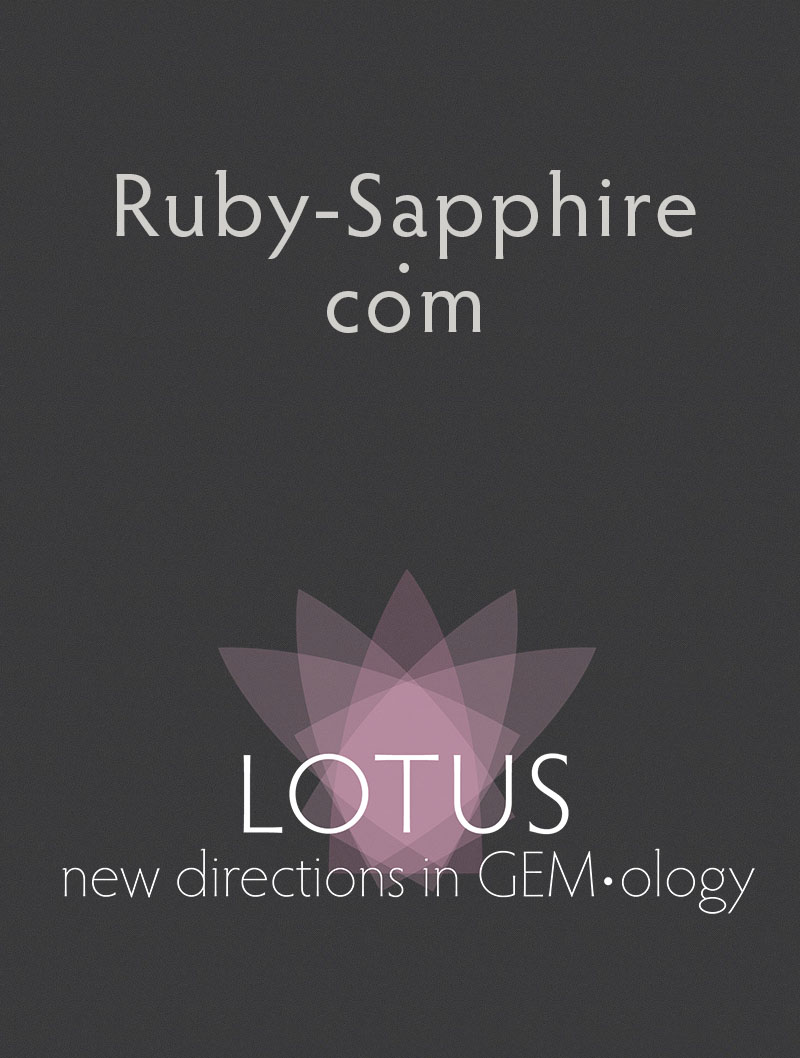
Digital Devil: Check Your Gut Instincts at the Door
Journal Article
Hughes, R.W. (2000) Digital Devil: Check Your Gut Instincts at the Door. Gemkey Magazine, Vol. 2, No. 3, March-April, pp. 62–63, 104.
Record No. 2459  |  RWHL
An examination of gemological dogma relating to emerald enhancements… It started small. Probably a joke at the office water cooler. Rumor was that the US Postal Service was lobbying to put a tax on e-mail. Next thing you know, angry messages are flying around the world and I'm dusting off my bazooka for an assault on the Capital building. That is until I found out it wasn't true. It mighta been true, it coulda been true, oh it shoulda been true, but alas, it simply wasn't. Damn! Beliefs. We guard 'em closely. We bow down to them, defend them to the death. We are Pope Paul V railing against Galileo's Copernican astronomy. Don't know if you're like me, but once I get an idea in my head, it takes over like some kinda virus. All of a sudden, it's down with the godless commies, pox on the infidels and the next thing you know, I'm whistling the David Koresh death march…

Cloak and dagger: The politics of Opticon
Journal Article
Hughes, R.W. (1998) Cloak and dagger: The politics of Opticon. GQ Eye, Vol. 1, No. 1, Fall, pp. 3, 6.
Record No. 2376  |  RWHL
For those new to the news, in the past few years, emerald traders have become the pariahs of our business, ranking right down there with terrorists, child pornographers and those who propose an increase in the minimum wage. If one reads the reports correctly, they tend to lurk in trench coats outside of playgrounds, ever ready to corrupt the morals of the nation's youth. Their weapon of choice: Opticon. By slipping a treated emerald from beneath their cloaks, they induce in their victims a permanent state of moral turpitude, leading them across to the dark side, a state of total and utter depravity. Extreme rhetoric? Perhaps, but the mere mention of Opticon today seems to induce a type of collective hysteria that borders on paranoid schizophrenia. Just why is a mystery to this writer.

Catfights—Enhancement Codes and Trade Wars
Journal Article
Hughes, R.W. and Zajicek, R. (1997) Catfights—Enhancement Codes and Trade Wars. ICA Gazette, June, pp. 7–9.
Record No. 5107  |  RWHL
IT is ICA Congress time and that means once again it's time for the biannual cat-fight over enhancements. For this year's main event, we nominate emerald and ruby. This article will deal primarily with emerald.

Devil’s Advocate: On and on and on

Journal Article
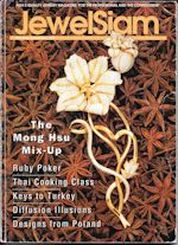
Hughes, R.W. (1995) Devil’s Advocate: On and on and on. JewelSiam, Vol. 6, No. 2, April/May, pp. 81–83.
Record No. 2359  |  RWHL*

I had a dream

Journal Article
Hughes, R.W. (1991) I had a dream. JewelSiam, Vol. 2, No. 4, p. 99.
Record No. 1987  |  seen

The Rose of Tibet

Book
Davidson, L. (1962) The Rose of Tibet. New York, Harper & Row, 330 pp.
Record No. 111  |  Sinkankas/Born No.: NIS/NIB  |  RWHL**
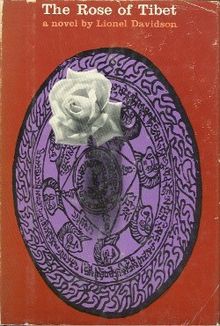
Hugh Whittington has gone missing - reported dead while filming near Mount Everest. Determined to find him, his brother Charles embarks on a perilous and illegal journey from India into the forbidden land of Tibet, all the way to the monastery of Yamdring. There awaits a woman with a deadly and ghostly secret, an emerald treasure to guard and the invading Chinese Red Army. The Rose of Tibet (1962) is Lionel Davidson's second novel. His extraordinary and thrilling tale of a haunted land is among the very finest of its kind and prompted Graham Greene to remark: 'I hadn't realised how much I had missed the genuine adventure story until I read The Rose of Tibet.' Its combination of adventure and travelogue is further proof of Davidson's great variety as a writer, and caused Daphne du Maurier to say: 'It has all the excitement of King Solomon's Mines.'

Records from a luxurious past: Gem inventory of a seventeenth-century Armenian merchant
Journal Article
Tajiryan, S. (2026) Records from a luxurious past: Gem inventory of a seventeenth-century Armenian merchant. Gems & Gemology, Vol. 62, No. 1, Spring, pp. 38–66.
Record No. 29116  |  DOI: https://doi.org/10.5741/GEMS.62.1.38  |  Sinkankas/Born No.: NIS/NIB  |  RWHL*
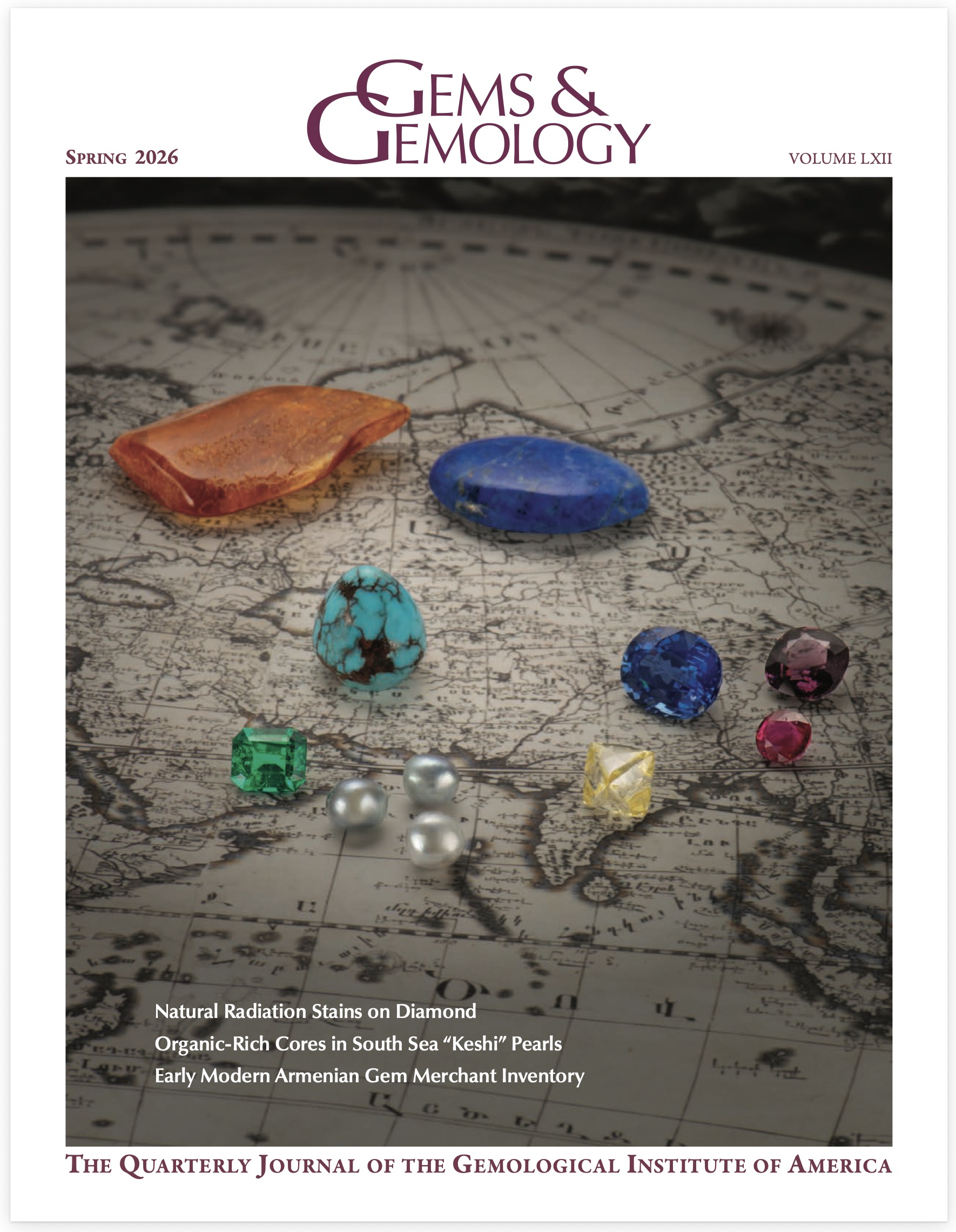
A rare 1688 probate inventory documents the extensive gem collection of Gregorio di Girach-Mirman (1612–1688), a prominent Armenian merchant active in Venice and Livorno, Italy. Originally written in Armenian and later translated into Italian, this archival record lists more than 100,000 gemstones, including diamonds, sapphires, emeralds, and pearls, as well as more than 1,700 kilograms of rough amber, garnet, lapis lazuli, and turquoise. Housed in the State Archives of Venice, the inventory offers a uniquely detailed window into the early modern luxury trade and highlights the global commercial reach of Armenian merchant families like the Girach-Mirmans. Drawing on this previously unstudied source, along with a broader set of archival documents from across Europe and Armenia, the present article reconstructs the world of seventeenth-century gem dealing and collecting. It argues that Armenian merchants were central figures in the global trade of luxury goods, operating alongside and sometimes in competition with better-known European contemporaries. The provenance and diversity of Gregorio’s gem holdings, likely sourced from as far as modern-day Colombia, Sri Lanka, Iran, and Myanmar, attest to the geographic reach of Armenian trading networks and the sophistication of their market knowledge. By placing this inventory in its global and material context, the article contributes to ongoing discussions around early modern economic history, material culture, and global commodity flows across Eurasia and the New World. It demonstrates that gem inventories, often overlooked as solely bureaucratic and estate documents, can illuminate the complexity of merchant strategies, the transcontinental mobility of luxury goods, and the dynamics of status and prestige in the early modern period. Finally, one of the central aims of this article is to illuminate the inner workings of gem dealing in this period, including practices of sourcing and collecting, through a rare body of obscure commercial correspondence. These materials offer an exceptional view into a dimension of the trade that remains largely inaccessible and nearly absent from existing historiography.

Evidence for an ‘uncommon’ geographic origin (Pakistan) of emeralds in two rings of historical significance
Journal Article
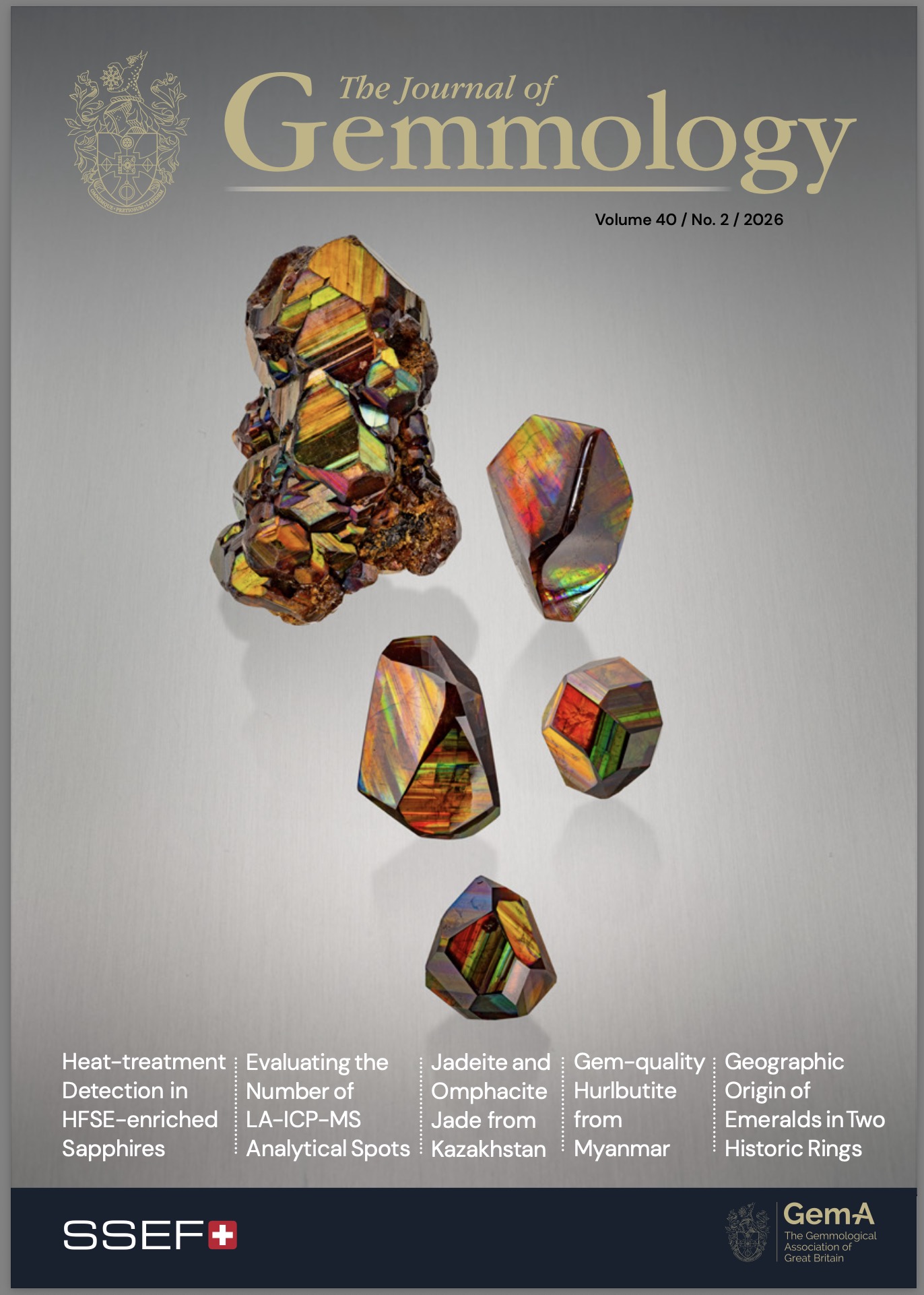
Karampelas, S., Hennebois, U., Delaunay, A., Herreweghe, A. and Cassius-Duranton, M.-L. (2026) Evidence for an ‘uncommon’ geographic origin (Pakistan) of emeralds in two rings of historical significance. Journal of Gemmology, Vol. 40, No. 2, pp. 188–194.
Record No. 28988  |  DOI: https://doi.org/10.15506/JoG.2026.40.2.188  |  Sinkankas/Born No.: NIS/NIB  |  RWHL*
An emerald from the late Hellenistic (or early Roman) period and another emerald from the end of the Middle Ages, both set in small rings, were studied using non-destructive methods. Their microscopic, spectroscopic and chemical characteristics are consistent with those of emeralds from the Swat Valley, Pakistan. This suggests that Swat Valley emeralds may have been more common in ancient jewellery than previously thought. This study highlights the importance of combining gemmological analytical techniques with archaeology to draw more reliable conclusions about the origins of historical gemstones.

Emeralds from the Silk Roads: From myth to reality

Journal Article
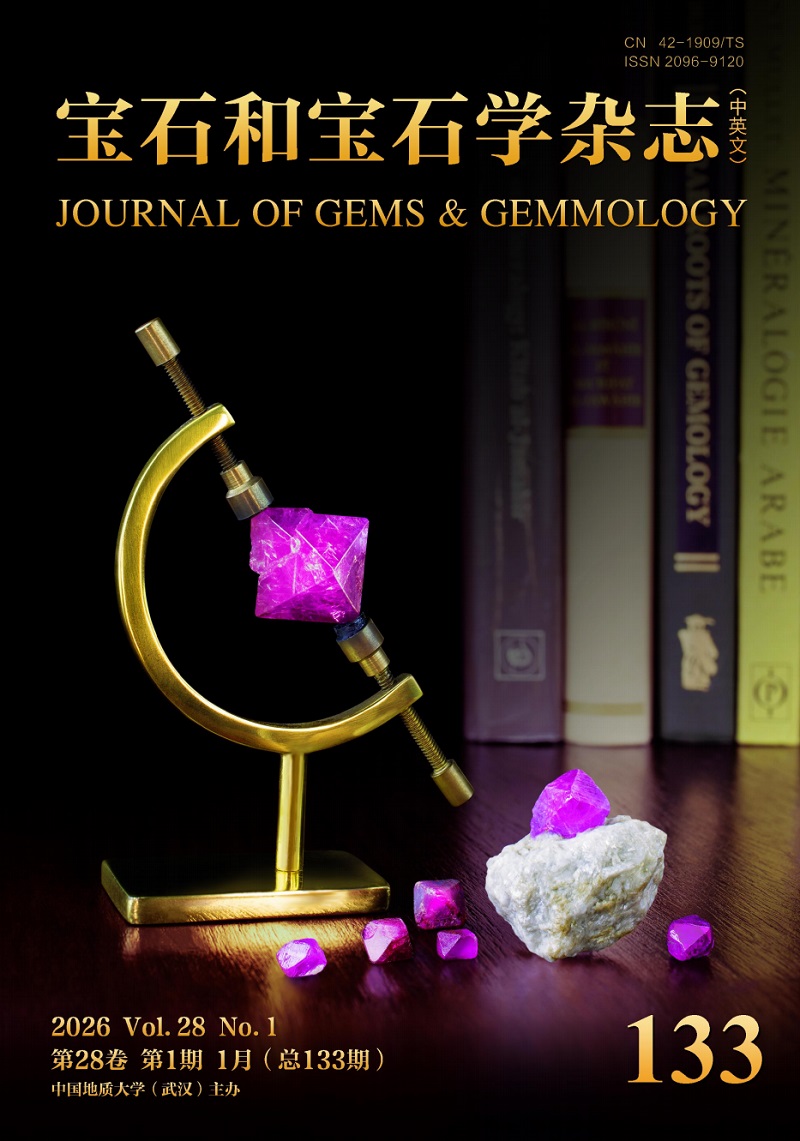
Cassius-Duranton, M.-L., Pardieu, V. and Karampelas, S. (2026) Emeralds from the Silk Roads: From myth to reality. Journal of Gems & Gemmology, Vol. 28, No. 1, pp. 39–54.
Record No. 28538  |  DOI: https://dx.doi.org/10.15964/j.cnki.027jgg.2026.01.004  |  Sinkankas/Born No.: NIS/NIB  |  RWHL*
Although the emerald deposits in India and the Himalayas were not officially discovered before the 20th century, recent gemological analyses conducted by the LFG (French Gemological Laboratory) on emeralds from historical jewelry dating back to the 16th century have shown that they correspond to the characteristics of the Swat deposits (Pakistan). This discovery is consistent with ancient gemological literature, which, since Theophrastus (4th century BCE), mentions the Himalayas as a source of emeralds. This interdisciplinary article explores the methodological difficulties inherent in historical gemology and highlights the importance of scientific gemology for art history and archaeology.

Exploring the Literature of Emerald

Emerald literature spans gemology, mineralogy, deposits, identification, treatments, synthesis, history and the gem trade, with important sources covering deposits around the world.

For a curated guide to this subject, read Green Fire — Lotus Gemology's Guide to the Literature of Emerald.

About Four Treasures

Four Treasures is Lotus Gemology's freely accessible gemological reference database. Use the full database to search by author, title or keyword and explore literature on gemology, mineralogy, jewelry and related fields. Where available, hyperlinks on titles may lead directly to the full publication.

Search the Complete Four Treasures Database