Emerald Bibliography

Emerald Bibliography

Explore books, articles and historical sources on emerald in Four Treasures, the Lotus Gemology reference database. This bibliography brings together matching records from the collection, with publication details, abstracts and cover images where available.

Emerald References

The list below matches the terms emerald or emeralds in the database's searchable fields. Some references discuss emeralds as part of a broader subject.
621–640 of 851 matching references

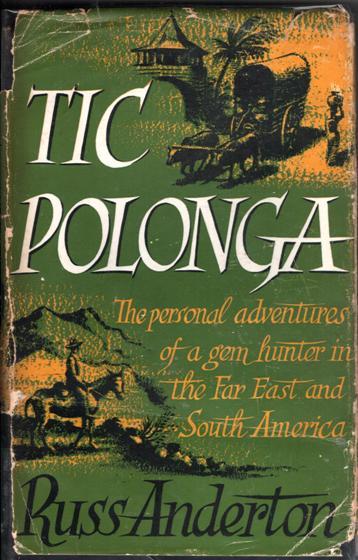
Tic-Polanga

Book
Anderton, R. (1953) Tic-Polanga. Garden City, NY, Doubleday, 254 pp.
Record No. 253  |  RWHL
For those who crave adventure, this book is chock full of it, a ride through various gem localities visited by the author. Although Anderton will come across to many modern readers as a bit of a Neanderthal in terms of his social sensibility, nevertheless this is a fun read.

Some additional data on Indian emeralds
Journal Article
Gübelin, E.J. (1951) Some additional data on Indian emeralds. Gems & Gemology, Vol. 7, No. 1, Spring, pp. 13–22, map.
Record No. 2038  |  ISBN/ISSN: 0016626X  |  RWHL

Ratna Dipika and Ratna Sastram

Edited Book
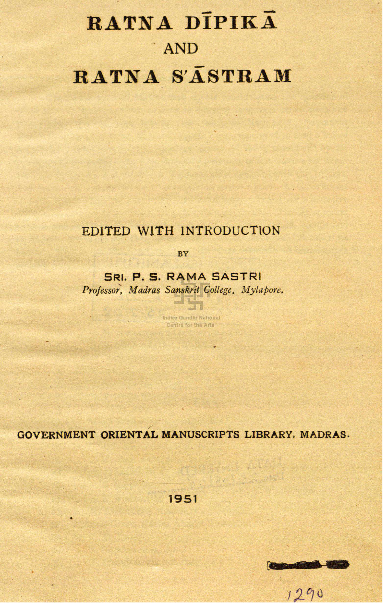
Sastri, P.S.R., editor (1951) Ratna Dipika and Ratna Sastram.. Madras, Government Oriental Manuscripts Library, [in Sanskrit] , 15, 54 pp..
Record No. 550  |  Sinkankas/Born No.: NIS/NIB  |  Language: in Sanskrit  |  RWHL
This volume presents two Sanskrit treatises on gemstones, the Ratnadīpikā of Caṇḍeśvara and the Ratnaśāstra of Buddhabhaṭṭa, edited with an introduction by P.S. Rama Sastri. The works describe the traditional Indian classification and examination of precious stones, including diamonds, pearls, ruby, emerald, sapphire, cat’s-eye, topaz, coral, hessonite, rock crystal, and other gems. They discuss sources and varieties, colors, desirable qualities and defects, grading and valuation, methods of testing and purification, and means of distinguishing natural from artificial material. Pearls receive particularly detailed treatment, including their traditionally recognized origins, quality factors, defects, weights, prices, and tests for imitation. Gemstones are also classified according to traditional social and sexual categories and associated with astrological and medicinal effects, including longevity, protection from disease or poison, removal of misfortune, and propitiation of the nine planets. The edition was prepared from two Devanagari manuscripts in the Government Oriental Manuscripts Library, Madras; the editor notes numerous lacunae and textual corruptions that could not be resolved because additional manuscripts were unavailable for collation.

Emeralds

Journal Article
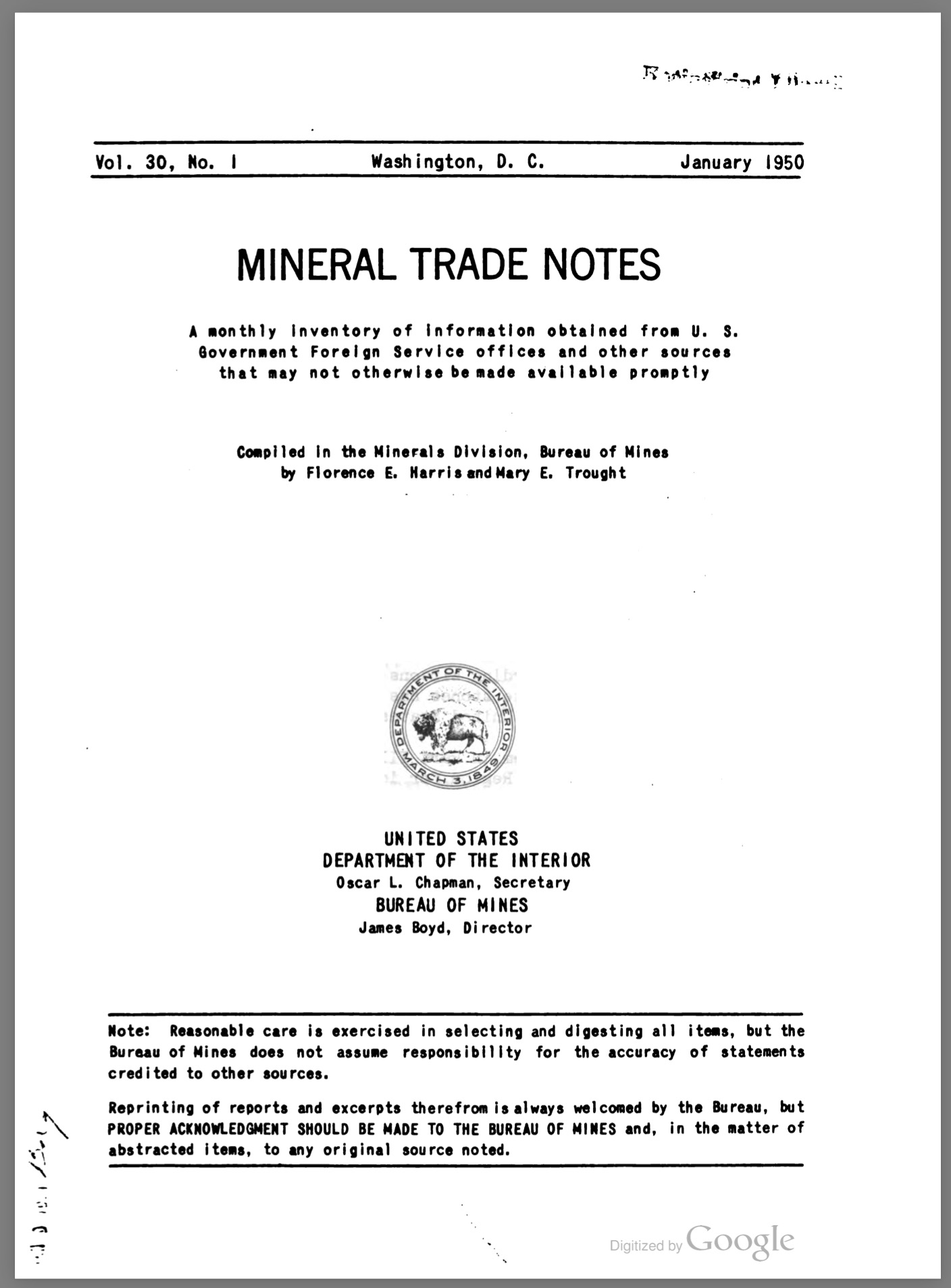
Mueller, C.G. (1950) Emeralds. U.S. Bureau of Mines Mineral Trade Notes, Vol. 30, No. 1, pp. 29–37.
Record No. 1957  |  RWHL
Nice description of the emerald mines in Colombia, particularly at Chivor.

India: Part III—Advanced Economic Geography of India and Pakistan
Book
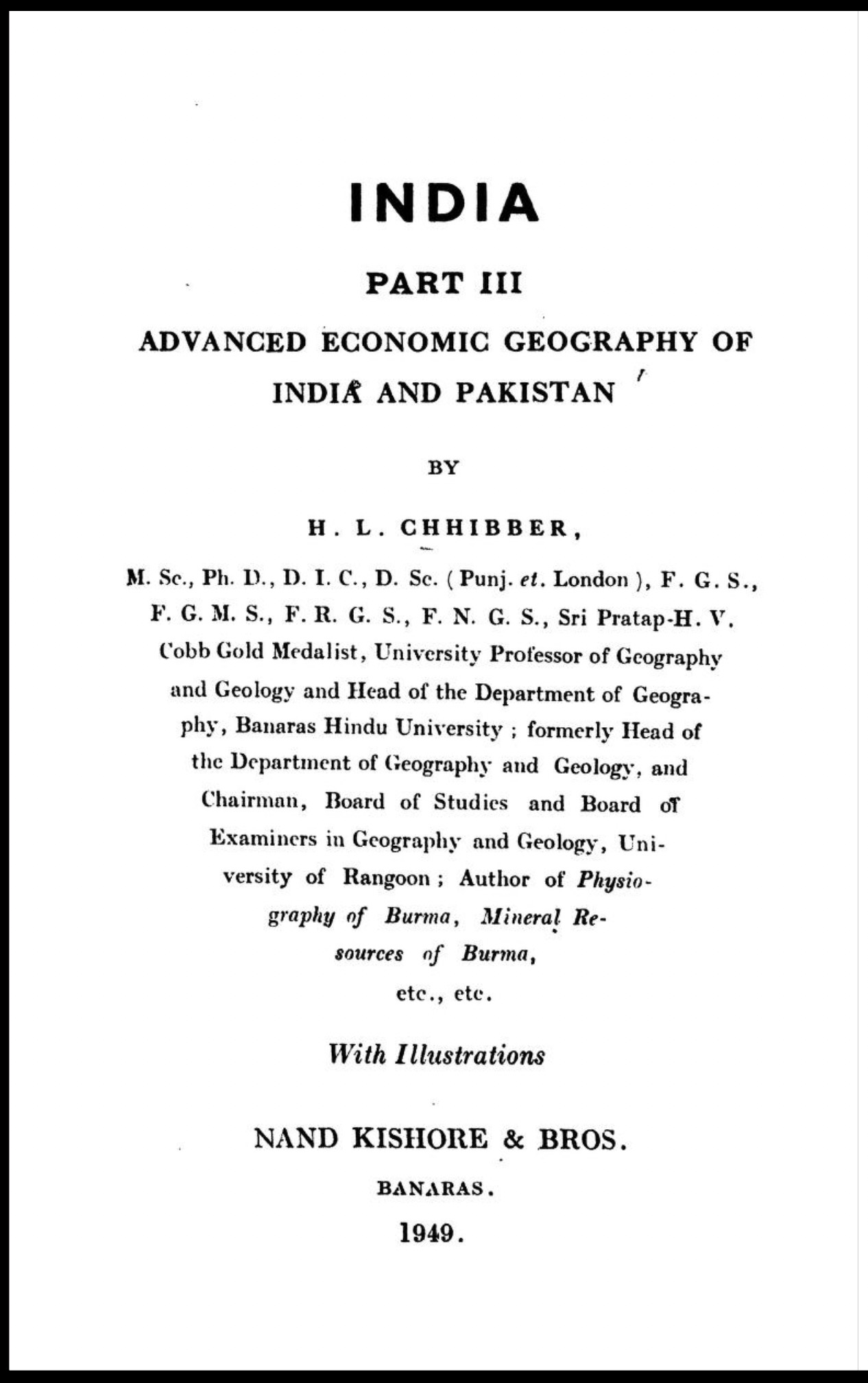
Chhibber, H.L. (1949) India: Part III—Advanced Economic Geography of India and Pakistan. Banaras, Nand Kishore & Bros., 419 pp. (precious stones, see pp. 223–231)
Record No. 505  |  RWHL
India had a reputation for gem-stones from very early times. She had the proud privilege of having produced the best diamonds in the world, but her production has now considerably dwindled. However, Kashmir is noted for its sapphires, Rajputana for its emeralds, and Central India for its diamonds. Besides, a number of semi-precious stones also occur. The beauty and value of a gem-stone are determined by its colour, lustre, play of colours, and brilliancy. Cutting and polishing bring out these properties in a remarkable manner.

The Muzo emerald zone, Colombia, S.A.
Journal Article
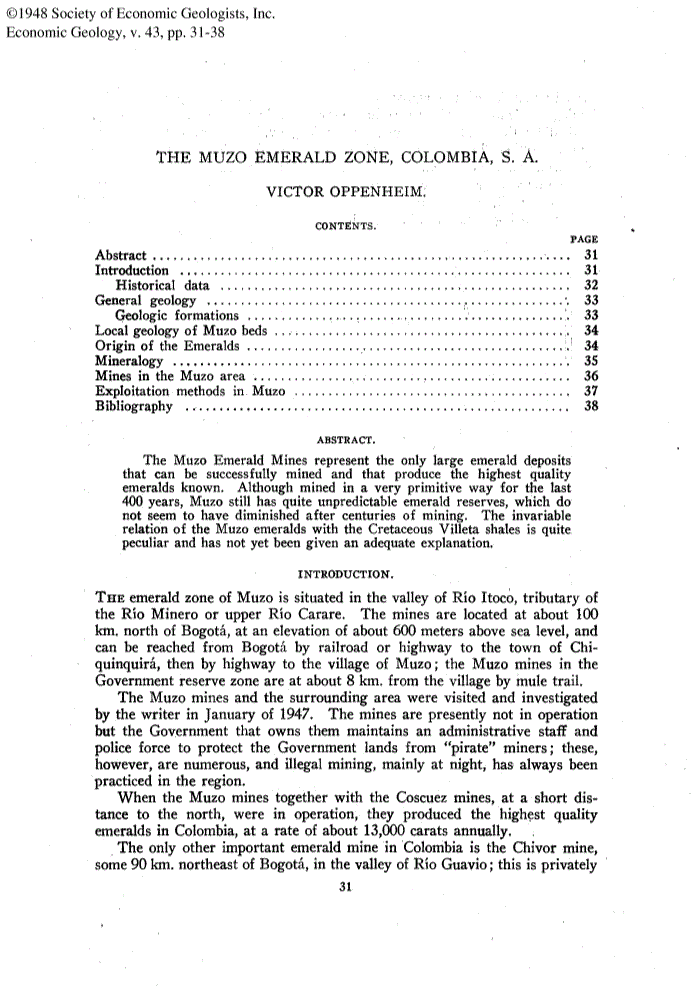
Oppenheim, V. (1948) The Muzo emerald zone, Colombia, S.A. Economic Geology, Vol. 43, No. 1, pp. 31–38.
Record No. 4249  |  DOI: https://doi.org/10.2113/gsecongeo.43.1.31  |  RWHL
The Muzo Emerald Mines represent the only large emerald deposits that can be successfully mined and that produce the highest quality emeralds known. Although mined in a very primitive way for the last 400 years, Muzo still has quite unpredictable emerald reserves, which do not seem to have diminished after centuries of mining. The invariable relation of the Muzo emeralds with the Cretaceous Villeta shales is quite peculiar and has not yet been given an adequate explanation.

Identification of synthetic gems, parts I–III
Journal Article
Gübelin, E.J. and Liddicoat, R.T. (1946–7) Identification of synthetic gems, parts I–III. Gems & Gemology, Vol. 5, No. 7, Fall, pp. 349–353 (corundum); No. 9, Spring, pp. 399–402 (corundum); No. 10, Summer, pp. 421–427 (spinel & emerald).
Record No. 5040  |  ISBN/ISSN: 0016626X  |  RWHL

Pliny on the smaragdus

Journal Article
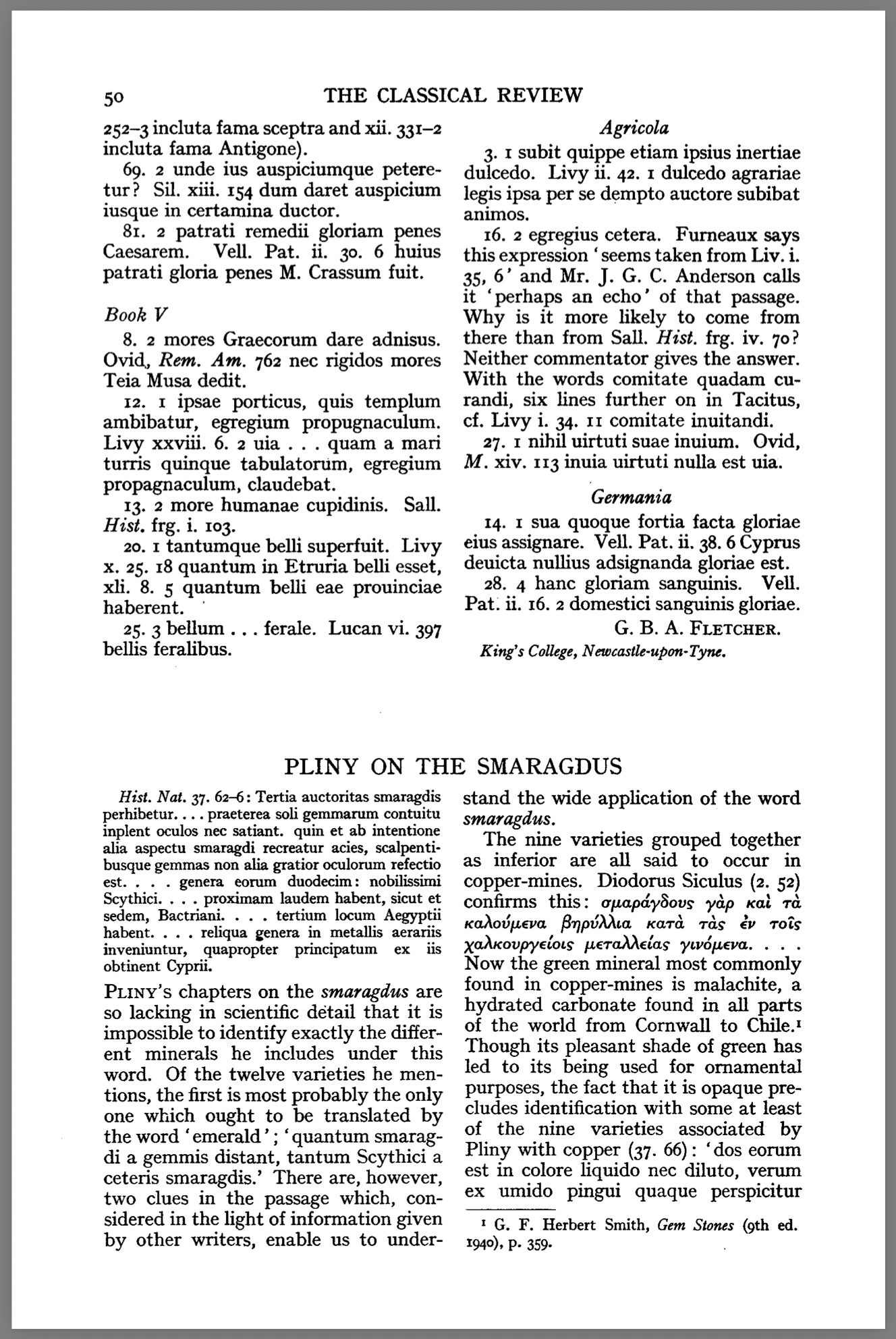
Meadows, J.W. (1945) Pliny on the smaragdus. Classical Review, Vol. 59, pp. 50–51.
Record No. 28817  |  Sinkankas/Born No.: NIS/NIB  |  RWHL
Pliny the Elder’s chapters on the smaragdus are so lacking in scientific detail that it is impossible to identify exactly the different minerals he includes under this term. Of the twelve varieties he mentions, the first is most probably the only one that ought properly to be translated as “emerald”: quantum smaragdi a gemmis distant, tantum Scythici a ceteris smaragdis. There are, however, two clues in the passage which, considered in light of information provided by other writers, help explain the broad application of the word smaragdus. The mineral in question may have been a hydrated carbonate found in many parts of the world, from Cornwall to Chile. Although its pleasing green color led to its use for ornamental purposes, its opacity excludes identification with at least some of the nine varieties associated by Pliny with copper (37.66): dos eorum est in colore liquido nec diluto, verum ex umido pingui quaque perspicitur.

Gemstone inclusions

Journal Article
Gübelin, E.J. (1944–46) Gemstone inclusions. Gems & Gemology, Vol. 4–5, Vol. 4, No. 10, Summer, pp. 142–149 (sapphire); No. 11, Fall, pp. 158–163 (ruby); No. 12, Winter, pp. 174–179 (emerald); Vol. 5, No. 1, Spring, pp. 205–210 (diamond); No. 5, Spring, p. 294; No. 6, Summer, pp. 318–323 (various gems).
Record No. 2027  |  ISBN/ISSN: 0016626X  |  RWHL

The synthetic emerald

Journal Article
Gübelin, E.J. (1941) The synthetic emerald. Gems & Gemology, Vol. 3, No. 10, Summer, pp. 146–150.
Record No. 2020  |  ISBN/ISSN: 0016626X  |  RWHL

Differentiation between Russian and Colombian emerald
Journal Article
Gübelin, E.J. (1940) Differentiation between Russian and Colombian emerald. Gems & Gemology, Vol. 3, No. 6, Summer, pp. 89–92.
Record No. 2018  |  ISBN/ISSN: 0016626X  |  RWHL

The Choice of Treasures on the Conditions of Gemstones
Nukhab al-dhakhair fi ahwal al-jawahir
Book
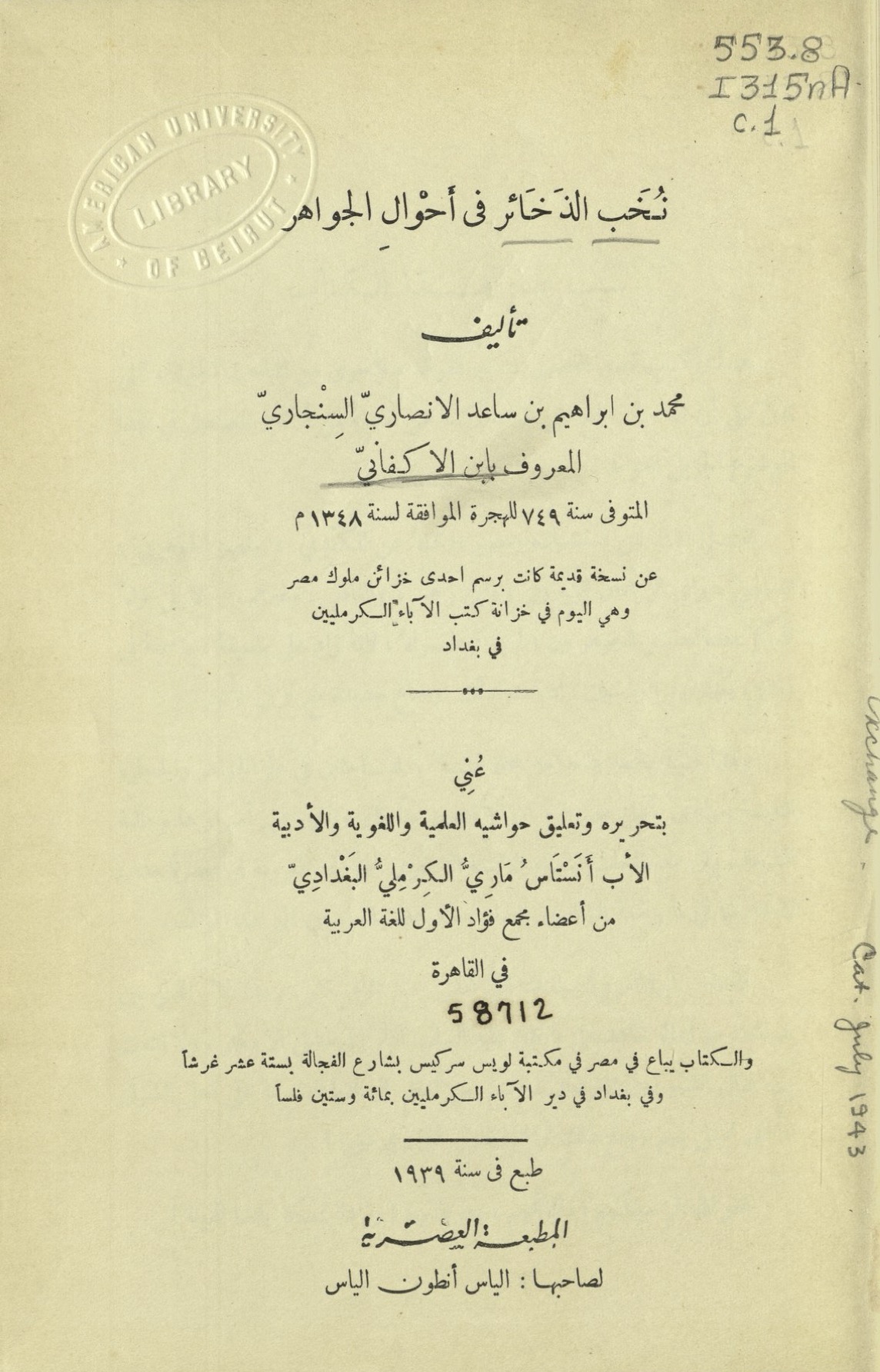
Ibn al-Akfānī, M.i.M.i.a.-ʿ. (1939) The Choice of Treasures on the Conditions of Gemstones. [Nukhab al-dhakhair fi ahwal al-jawahir] [al-Qahirah], al-Matbaah al-Asriyah, 188 pp.
Record No. 221  |  Sinkankas/Born No.: NIS/NIB  |  Language: in Arabic  |  RWHL
Ibn al-Akfānī presents a concise medieval Arabic treatise on precious stones, summarizing earlier authorities while adding observations of his own. He treats ruby (yāqūt), balas ruby, garnet, diamond, pearl, emerald, peridot, turquoise, rock crystal, agate, malachite, jasper, bezoar, and other materials, describing their varieties, colors and qualities, principal sources, methods of testing and working, relative values, and reputed medicinal or talismanic properties. Commercial information is particularly valuable, including distinctions of quality and contemporary systems of valuation; diamonds are also discussed as tools for drilling other gemstones. Although traditional lore is repeated, Ibn al-Akfānī sometimes tests inherited claims critically—for example, he reports experimenting with the supposed effect of emerald on snakes and finding it untrue. The work thus combines mineralogical and gemological observation, trade knowledge, lapidary practice, medicine, and traditional stone lore, providing an important account of gemstone knowledge and commerce in the fourteenth-century Islamic world.

Crown of the Andes: A History of the Oldest and Largest Collection of Emeralds in the World
Book
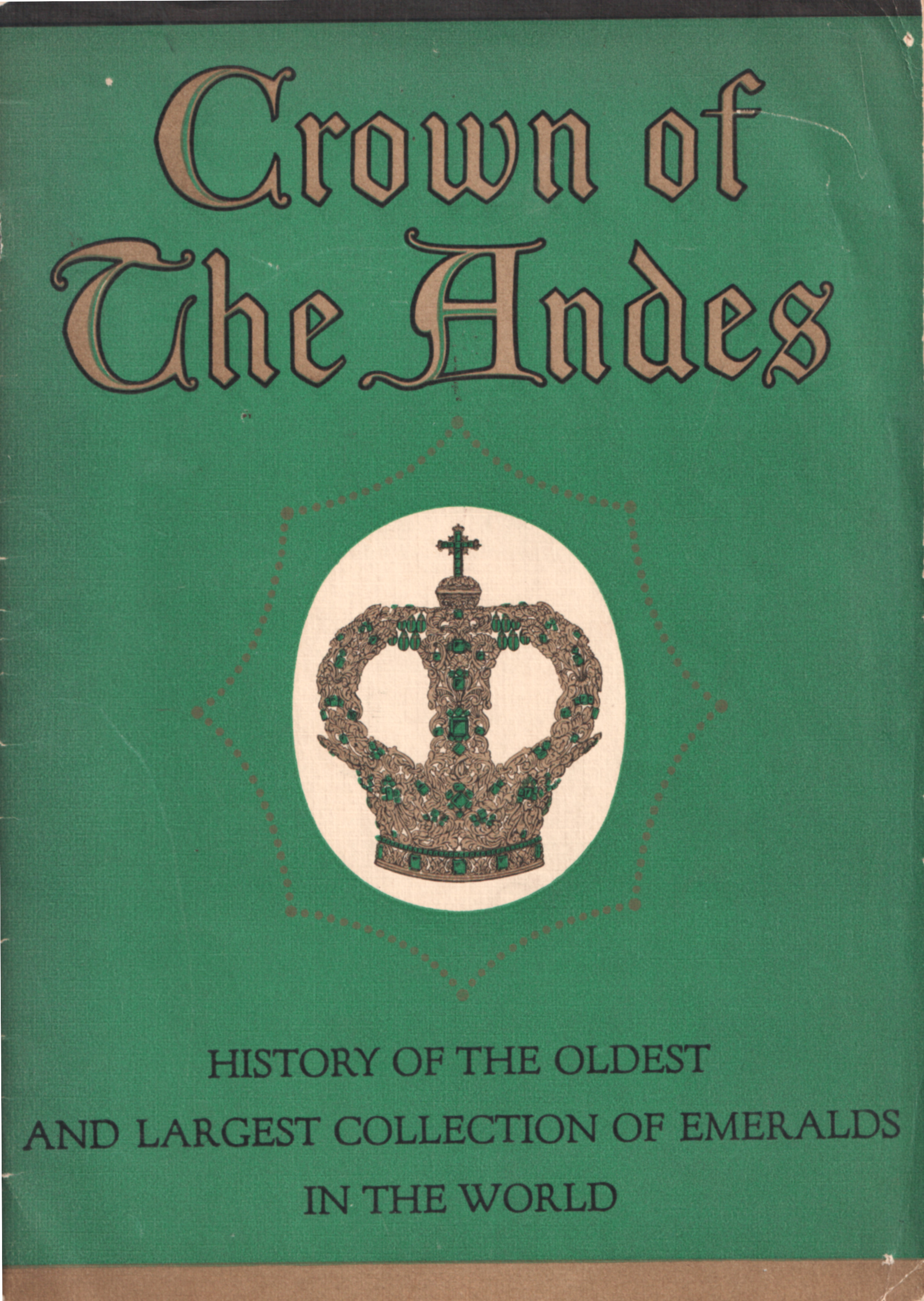
Stewart, F. and Crown of the Andes Company Chicago. (1936) Crown of the Andes: A History of the Oldest and Largest Collection of Emeralds in the World. Chicago, Crown of the Andes Co., 29 pp.
Record No. 7400  |  Sinkankas/Born No.: 6355  |  RWHL
Sinkankas: Describes the famous Crown of the Andes, made from gold and set with numerous emeralds, and donated to the Catholic Church of the city of Popayan, Colombia by grateful citizens when they were spared from an attack of the plague which affected other communities in the year 1590 . The crown was begun in 1593 and finished in 1599. The text gives its history up to the time when dire need impelled the city to sell the crown, for which purpose a Papal dispensation was obtained in 1914 to sell it to Czar Nicholas II of Russia. However, events in Europe halted the sale and after many years it was finally sold to a syndicate of buyers from the United States. This handsome and rare pamphlet is richly illustrated and contains much useful information.

The Story of the Emerald

Book
Marcus and Co. (1936) The Story of the Emerald. New York, Marcus and Co., unpaginated; 22 pp.
Record No. 4076  |  Sinkankas/Born No.: 4201  |  RWHL
Tastefully-designed, all in same format, and distinguished by use of Rockwell Kent's characteristic drawings as vignettes on each title page in addition to a tipped-in color plate of high quality. The text is in popular vein, with a few technical facts and more on lore and legend. A second printing issued on thinner, whiter paper, and enclosed in a wrap of white, silver-flecked paper, which also used for endpapers. [from Sinkankas]

Septuaginta: Id est Vetus Testamentum Graece iuxta LXX Interpretes
The Septuagint: That is, the Old Testament in Greek according to the seventy translators
Book
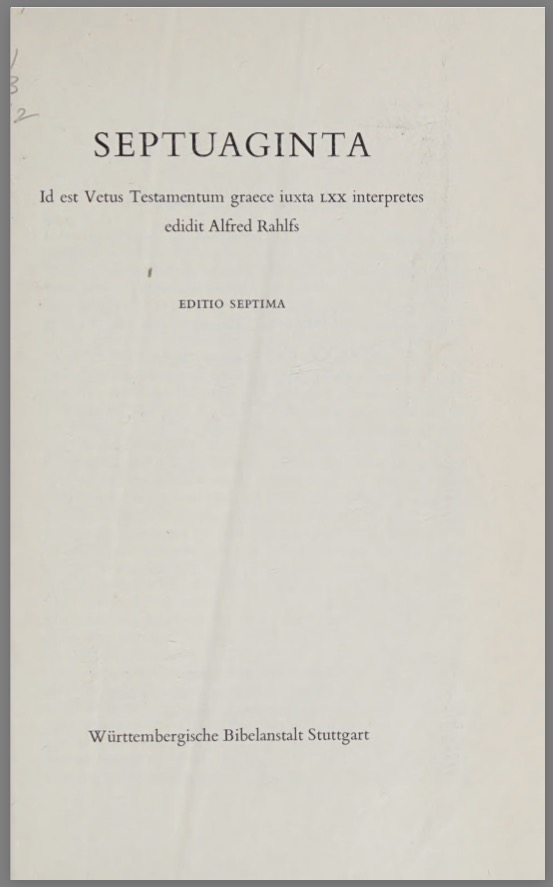
Rahlfs, A. and Hanhart, R. (1935) Septuaginta: Id est Vetus Testamentum Graece iuxta LXX Interpretes. [The Septuagint: That is, the Old Testament in Greek according to the seventy translators] Stuttgart, Privilegierte württembergische Bibelanstalt, 2 Vols., Vol. 1: Leges et historiae; Vol. 2: Libri poetici et prophetic , 1184, 941 pp.
Record No. 26370  |  ISBN/ISSN: 3438051206  |  Sinkankas/Born No.: NIS/NIB  |  Language: in Greek and German  |  RWHL
The Septuagint, or Vetus Testamentum Graece iuxta LXX Interpretes, is the ancient Greek translation of the Hebrew Scriptures, traditionally attributed to seventy (or seventy-two) Jewish scholars in the 3rd to 2nd centuries BCE. This edition presents the Old Testament text in its Greek form, preserving the linguistic and textual heritage that significantly influenced early Jewish and Christian traditions. It is a foundational text for biblical studies, particularly for understanding the development of the Hebrew Bible, its reception in the Hellenistic world, and its use in early Christianity, where it often served as the primary scriptural source.

Epiphanius De Gemmis: The Old Georgian Version and the Fragments of the Armenian Version
Book
Epiphanius (1934) Epiphanius De Gemmis: The Old Georgian Version and the Fragments of the Armenian Version. London, Christophers, 335 pp.
Record No. 4768  |  Sinkankas/Born No.: 1915  |  RWHL

Il Libro’ Dell Arte

The Craftman’s Handbook
Book
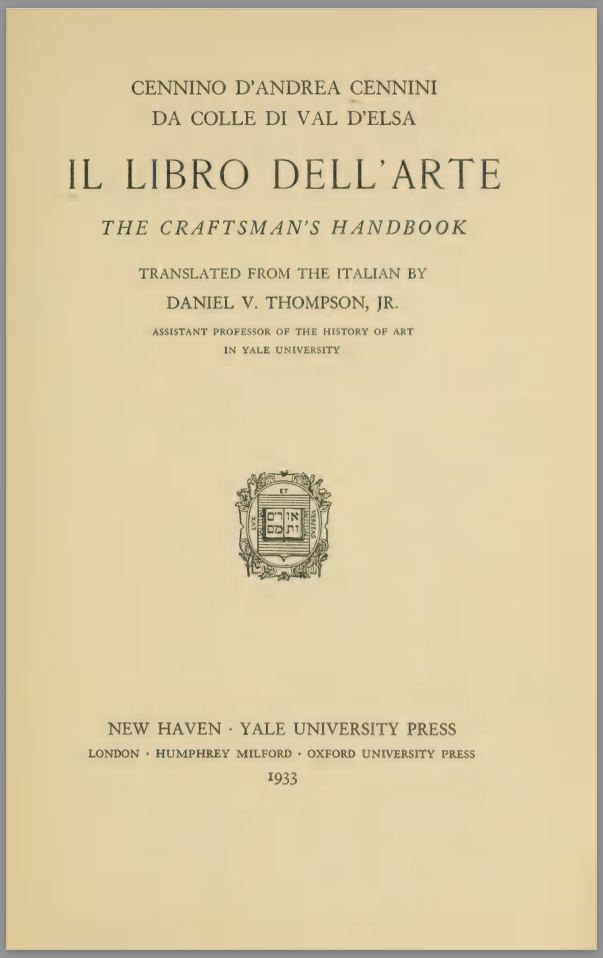
Cennini, C.D.A. and Thompson, D.V. (1933) Il Libro’ Dell Arte. [The Craftman’s Handbook] New Haven, Yale Univeristy Press, Vol. 2 , 142 pp.
Record No. 28064  |  Sinkankas/Born No.: NIS/NIB  |  Language: in English  |  RWHL
Cennini’s practical handbook presents detailed instructions for the materials and techniques of the painter and craftsman, including drawing, preparation and use of colors, fresco and oil painting, glues and cements, panel painting, gilding, illumination, work on cloth and glass, mosaic, and casting. Particular attention is given to mineral pigments, including azurite, malachite, vermilion, and ultramarine, with descriptions of their preparation, grinding, properties, and appropriate uses. Ultramarine is praised as the finest of colors and its preparation is described in considerable detail. Of particular gemological interest is Cennini’s discussion of stones used for burnishing gold: hematite is recommended, but sapphire, emerald, balas ruby, topaz, ruby, and garnet are said to be even better, with the choicer stones preferred. Thompson’s translation is based on his revised Italian text and attempts to render Cennini’s technical vocabulary in terminology useful to modern practicing artists and craftsmen.

On the use of greenstone (jadeite, callais, etc.) in the megalithic culture of Brittany
Journal Article
Forde, C.D. (1930) On the use of greenstone (jadeite, callais, etc.) in the megalithic culture of Brittany. Journal of the Royal Anthropological Institute, Vol. 60, pp. 211–234.
Record No. 4317  |  DOI: https://dx.doi.org/10.2307/2843867  |  Sinkankas/Born No.: 2179; NIB  |  RWHL
Forde examines the unusually rich occurrence of greenstone axes and green beads in the megalithic tombs of Brittany, particularly southern Morbihan, and considers their mineralogy, geological sources, archaeological associations, and relationship to the wider megalithic cultures of western Europe. He distinguishes large, finely polished, often point-butted “ceremonial” axes of jadeite, chloromelanite, diorite, and related rocks from the smaller fibrolite axes used more generally, noting that the former frequently show no evidence of practical use and occur prominently in such important tombs as Mané-er-Hroëk, St. Michel, and Tumiac. Reviewing earlier mineralogical analyses, he stresses that objects loosely described as “jadeite” comprise several different materials; genuine jadeite and chloromelanite occur, occasional nephrite axes have been reported, and other specimens are pyroxenites or related rocks. Forde rejects the assumption that their green color necessarily indicates exotic material and argues from the geology of Brittany—including abundant pyroxenites and metamorphic rocks capable of producing jadeite-, actinolite-, and nephrite-bearing differentiates—that the greenstone used for the Breton axes was probably local. He separately examines “callais,” the apple- to emerald-green, sometimes translucent material extensively employed for beads and pendants. Earlier analyses had shown callais to be a hydrous aluminum phosphate related chemically to turquoise but differing in appearance and proportions, its green color being attributed to iron rather than copper. More than 500 callais objects were known from Brittany, while particularly large numbers also occurred in Portugal and smaller quantities elsewhere in France and Iberia. Its geological source remained uncertain, and Forde considers both a Breton source with export southward and an Iberian origin with introduction into Brittany plausible. He interprets the shared occurrence of callais, greenstone axes, bell beakers, and other elements as evidence for close cultural connections between Brittany and Iberia within the western European megalithic tradition, while emphasizing that the Breton ceremonial axes represent a distinctive local development of exceptional craftsmanship. Sinkankas: Describes axes and other objects made from a variety of stones which in some cases are jadeite but in others are some kind of fine-grained greenish rock; callais, however, may be turquoise.

Turquoise mosaics from northern Mexico
Journal Article
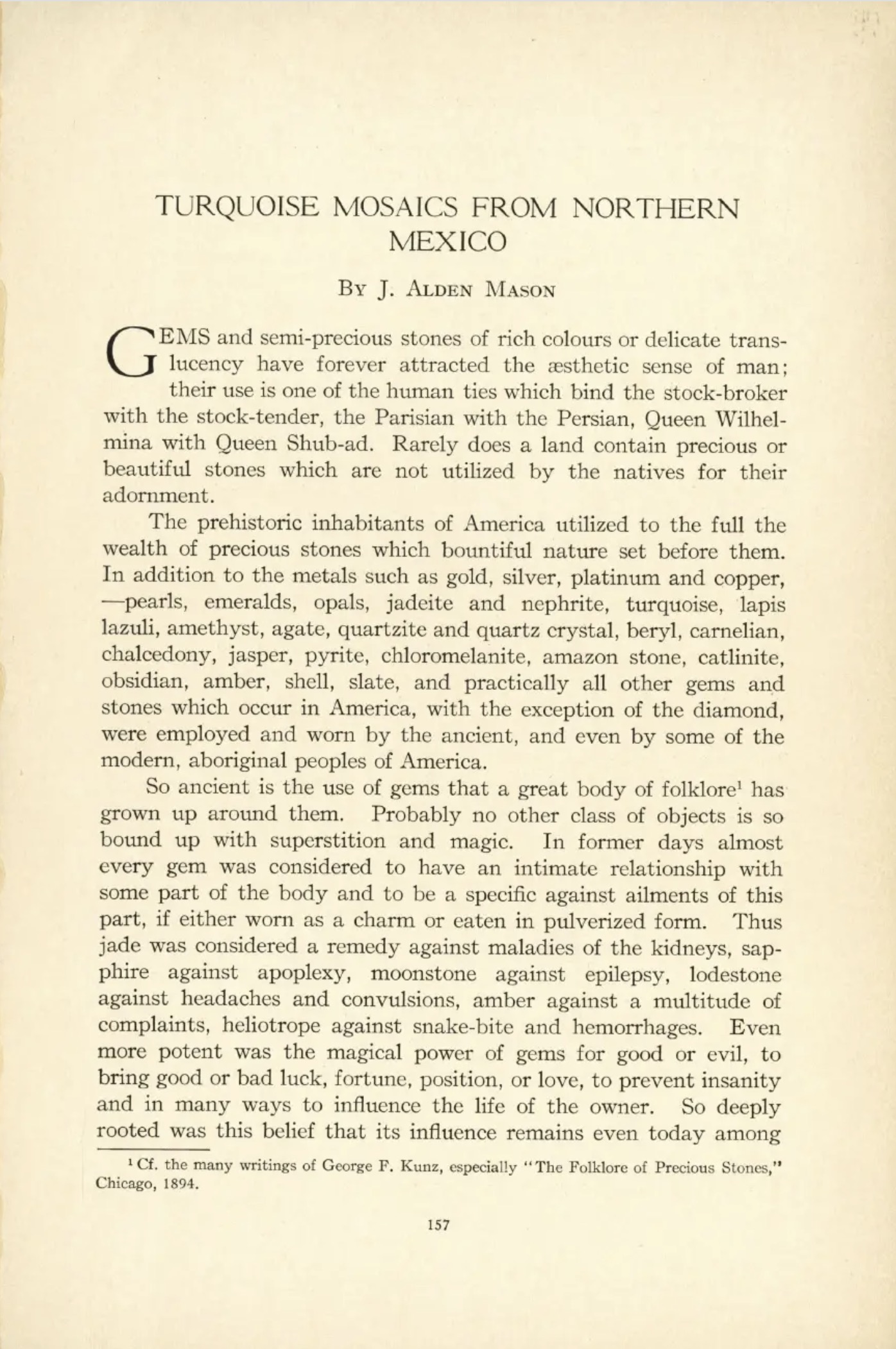
Mason, J.A. (1929) Turquoise mosaics from northern Mexico. Museum Journal, Vol. 20, No. 2, pp. 157–175.
Record No. 28694  |  Sinkankas/Born No.: 4245; NIB  |  RWHL
Gems and semi-precious stones of rich colours or delicate translucency have always appealed to the aesthetic sense of humanity; their use is one of the cultural threads that links the stockbroker with the shepherd, the Parisian with the Persian, Queen Wilhelmina with Queen Shub-ad. Few lands possess precious or beautiful stones that are not used by their inhabitants for personal adornment. The prehistoric peoples of the Americas made full use of the wealth of gemstones that nature provided. In addition to metals such as gold, silver, platinum, and copper, pearls, emeralds, opals, jadeite and nephrite, turquoise, lapis lazuli, amethyst, agate, quartzite and rock crystal, beryl, carnelian, chalcedony, jasper, pyrite, chloromelanite, amazonite, catlinite, obsidian, amber, shell, slate, and virtually every other gem material and ornamental stone found in the Americas—except the diamond—were used and worn by the ancient inhabitants and, in some cases, continue to be used by Indigenous peoples today.

Synthetische Edelsteine

Synthetic Gemstones
Book
Krauss, F.H. (1929) Synthetische Edelsteine. [Synthetic Gemstones] Berlin, Verlag von Georg Stilke, 133 pp.
Record No. 1131  |  Sinkankas/Born No.: 3573; NIB  |  Language: in German  |  RWHL
Sinkankas: The first chapter introduces the book, treating the history of gemstones in general and reviewing previous attempts to imitate and synthesize gemstones. Ch. 2, problems of nomenclature; 3 summarizes specific features and properties of gemstones; 4, considerable detail on past attempts to synthesize diamond, corundum, spinel, quartz, chalcedony, opal, alexandrite, phenakite, emerald, aquamarine, euclase, topaz, spodumene, zircon, diopside; distinctions between natural and synthetic gemstones. Regarded favorably by L.J. Spencer, Min. Mag., 22, 125, 1929, 67: “useful and concise review of the results that have been obtained in the artificial production of gem minerals, more particularly diamond and corundum … the author believes that H. Moissan succeeded in preparing diamond, but that the results of other experimenters are doubtful.”

Exploring the Literature of Emerald

Emerald literature spans gemology, mineralogy, deposits, identification, treatments, synthesis, history and the gem trade, with important sources covering deposits around the world.

For a curated guide to this subject, read Green Fire — Lotus Gemology's Guide to the Literature of Emerald.

About Four Treasures

Four Treasures is Lotus Gemology's freely accessible gemological reference database. Use the full database to search by author, title or keyword and explore literature on gemology, mineralogy, jewelry and related fields. Where available, hyperlinks on titles may lead directly to the full publication.

Search the Complete Four Treasures Database