Emerald Bibliography

Emerald Bibliography

Explore books, articles and historical sources on emerald in Four Treasures, the Lotus Gemology reference database. This bibliography brings together matching records from the collection, with publication details, abstracts and cover images where available.

Emerald References

The list below matches the terms emerald or emeralds in the database's searchable fields. Some references discuss emeralds as part of a broader subject.
601–620 of 851 matching references

Emerald mining in Colombia: History and geology
Journal Article
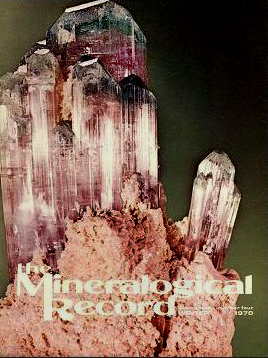
Feininger, T. (1970) Emerald mining in Colombia: History and geology. Mineralogical Record, Vol. 1, No. 4, Winter, pp. 142–149.
Record No. 4250  |  RWHL
Nice article reviewing the history of the various Colombian emerald mines.

The largest gems in the crown jewels of Iran
Journal Article
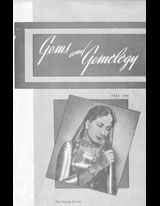
Meen, V.B. (1969) The largest gems in the crown jewels of Iran. Gems & Gemology, Vol. 13, No. 1, Spring, pp. 2–14.
Record No. 1250  |  ISBN/ISSN: 0016626X  |  Sinkankas/Born No.: NIS/NIB  |  RWHL
Meen describes and documents the largest and most important gemstones in the Iranian Crown Jewels, drawing upon his examination of the collection in Tehran. Particular attention is given to exceptional diamonds, emeralds, rubies, sapphires, spinels, and other large gems, with discussion of their weights, dimensions, colors, forms, and settings. The article places these stones within the extraordinary accumulation of loose gems and jeweled objects assembled by successive Persian rulers and comments on problems of identification and nomenclature among historically celebrated stones. Illustrated with photographs of major specimens, the paper provides an important gemological record of outstanding stones in the Iranian treasury and complements the broader historical documentation of the Crown Jewels of Iran.

La Esmeralda: Las Gemas Y Otras Materias Preciosas
The Emerald: Gems And Other Precious Materials
Book
Santos Munsuri, A. (1968) La Esmeralda: Las Gemas Y Otras Materias Preciosas. [The Emerald: Gems And Other Precious Materials] Madrid, Instituto Gemológico Español, 123 pp.
Record No. 4281  |  Sinkankas/Born No.: 5723; NIB  |  Language: in Spanish  |  RWHL
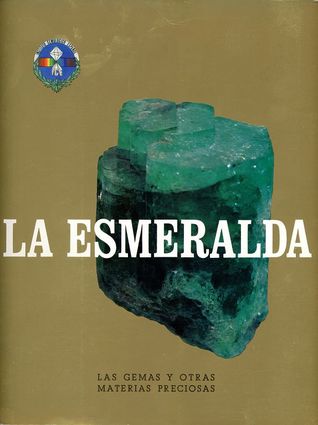
Sinkankas: Very handsome, imaginatively designed book, with the unusual feature of the title being spread over three pages. Apparently this work was meant to be the first of a series of monographs on gemstone families but up to date (1988) no others have appeared. The first part treats emerald history, in the East, as known to Pliny, origin of the name, curious lore surrounding, famous emeralds, and the color and causes. The second part describes world emerald deposits with most space naturally devoted to the Colombian mines, type crystals, and a discussion of trapiche crystals. The third part provides property data, considerable detail on inclusions in emerald, doublets & imitations, and the methods of gemological investigation . Next appear four tables of constants of natural & synthetic emeralds, comparisons of emerald to other similarly-colored stones or imitations, and fluorescence of emeralds from various deposits. The bibliography, unfortunately, is replete with errors in contrast to the text which is relatively free of defects. The mostly high quality illustrations show natural specimens, minerals that could be mistaken for emerald, cut stones, a Russian postage stamp depicting Siberian emerald, jewelry set with emeralds, absorption spectra, and many photographs of inclusions but these last lack the quality of the other illustrations. Rev R K Mitchell, J Gemm, 11, 7, 1969, 272–3, notes errors in biblio & elsewhere.

Infrared spectra of foreign molecules in beryl
Journal Article
Wood, D.L. and Nassau, K. (1967) Infrared spectra of foreign molecules in beryl. Journal of Chemical Physics, Vol. 47, pp. 2220–2228.
Record No. 2392  |  RWHL
Thirty infrared absorption lines in beryl between 1500 and 11,000 cm⁻¹ are assigned to vibrations of two types of water and to CO₂, all in the axial voids of the structure. The spectrum of Type-I water arises from molecules which are capable of libration and are located between the silicate rings which make up the crystal. The spectrum of Type-II water arises from molecules in the same sites, but with alkali ions nearby. These molecules are also capable of libration, but at a higher frequency. The Type-I molecules have their C₂ symmetry axes perpendicular to the crystal C₆ axis, while the Type-II molecules have their symmetry axes aligned parallel to the crystal C₆ axis. The CO₂ molecules are oriented with their long axes perpendicular to the crystal C₆ axis. Modification of the spectra by heat and hydrothermal treatments was not feasible, and the identity of the alkali ions apparently does not influence the Type-II spectrum.

Greek, Roman, and Etruscan jewelry

Journal Article
Oliver, A., Jr. (1966) Greek, Roman, and Etruscan jewelry. Metropolitan Museum of Art Bulletin, Vol. 24, No. 9, pp. 269–284.
Record No. 27250  |  Sinkankas/Born No.: NIS/NIB  |  RWHL
Modern jewelry is prized for its pearls and precious stones—for the fine cutting of the stones and for their elaborate setting; this was not the case in antiquity, when diamonds and rubies were virtually unknown, and when emeralds and sapphires were extremely rare, and the pearls and the precious and semiprecious stones that were sparingly used in Hellenistic and Roman jewelry were usually left rough or, if cut, cut cabochon—that is, in a smooth rounded form; ancient jewelry was treasured for its gold and, to a much lesser extent, its silver, for gold had been valued since remote antiquity on account of its rarity and incorruptibility, and the survival of Greek and Roman gold coins and gold jewelry, as well as the reports of gold vessels and statues once deposited in ancient treasuries but now lost, reveal the value placed on this metal and the special uses to which it was put, whereas silver, though far more common than gold, corrodes, and the vast numbers of ancient silver coins and vessels that we have today owe their survival to their relatively substantial form, since delicate jewelry of that metal cannot be expected to have survived in quantity—and indeed, little has—but the real reason may be that little was made, as tarnishing would soon render it unsightly, and when in contact with skin for repeated periods, silver can cause infection, so the ancients surely discovered, for instance, that silver earrings were not suitable for pierced ears.

Gîtes minéraux de Madagascar

Mineral Deposits of Madagascar
Journal Article
Besairie, H. (1966) Gîtes minéraux de Madagascar. [Mineral Deposits of Madagascar] Annales géologiques de Madagascar, Vol. 1, No. 34, 437 pp..
Record No. 462  |  Sinkankas/Born No.: NIS/NIB  |  Language: in French  |  RWHL
Besairie presents a comprehensive survey of the mineral deposits and mineral resources of Madagascar, synthesizing geological investigations, mining records, and exploration carried out throughout the island. The work describes metallic and non-metallic deposits according to their geological setting, mineralogy, distribution, and economic importance, with attention to gold, chromite, iron and manganese ores, copper, nickel, lead, zinc, uranium and radioactive minerals, graphite, mica, quartz, feldspar, beryl, and numerous other mineral substances. Considerable attention is given to Madagascar’s pegmatites and their exceptionally diverse mineral assemblages, including beryl, tourmaline, spodumene and other lithium minerals, and associated rare-element minerals. Gem materials are treated within the discussion of individual deposits and mineralized districts, including beryl and emerald, corundum and sapphire, tourmaline, garnet, quartz, and other ornamental stones. Besairie relates the deposits to Madagascar’s regional geology and discusses their occurrence in the Precambrian crystalline basement, pegmatites, metamorphic rocks, intrusive complexes, and younger formations. Numerous locality descriptions and references to earlier exploration and exploitation make the volume both a synthesis of Madagascar’s economic geology as understood in the mid-twentieth century and an extensive geographical reference to the island’s known mineral occurrences.

Ureyite, NaCrSi₂O₆: A new meteoric pyroxene

Journal Article
Frondel, C. and Klein, C. (1965) Ureyite, NaCrSi₂O₆: A new meteoric pyroxene. Science, Vol. 149, pp. 742–744.
Record No. 6753  |  RWHL
The new mineral NaCrSi₂O₆ (ureyite) has been found as rare emerald green grains in the iron meteorites Coahuila, Toluca, and Hex River Mountains. X-ray studies of both the natural and synthetic material have established that the mineral is isostructural with jadeite, NaAlSi₂O₆. Indexed data for powder patterns obtained by X-ray diffraction and precise cell dimensions are given for the Cr, Fe, and Al members of the jadeite group. Unlike jadeite, a high-pressure phase, ureyite can be synthesized from melts at 1-atmosphere pressure.

The French synthetic emerald [Gilson]

Gilson
Journal Article
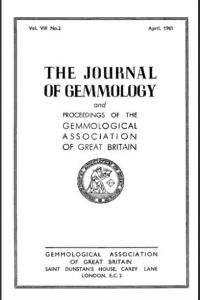
Webster, R. (1964) The French synthetic emerald [Gilson]. Journal of Gemmology, Vol. 9, No. 6, April, pp. 191–196.
Record No. 4285  |  ISBN/ISSN: 221252  |  RWHL
Description of Gilson synthetic emeralds.

Two new synthetic emeralds

Journal Article
Gübelin, E.J. (1964) Two new synthetic emeralds. Gems & Gemology, Vol. 11, No. 5, Spring, pp. 139–148.
Record No. 2078  |  ISBN/ISSN: 0016626X  |  RWHL

The gemstones of Brazil

Journal Article
Bastos, F.M. (1961) The gemstones of Brazil. Gems & Gemology, Vol. 10, pp. 195–201.
Record No. 29378  |  Sinkankas/Born No.: NIS/NIB  |  RWHL
Review of the gem deposits of Brazil.

Hydrothermal rubies and emerald-coated beryl
Journal Article
Gübelin, E.J. (1961) Hydrothermal rubies and emerald-coated beryl. Journal of Gemmology, Vol. 8, No. 2, April, pp. 49–63.
Record No. 881  |  ISBN/ISSN: 221252  |  Sinkankas/Born No.: 2568  |  RWHL

Emeralds from Sandawana

Journal Article
Gübelin, E.J. (1958) Emeralds from Sandawana. Journal of Gemmology, Vol. 6, No. 8, October, pp. 340–354.
Record No. 2055  |  ISBN/ISSN: 221252  |  Sinkankas/Born No.: 2566  |  RWHL

Notes on the new emeralds from Sandawana
Journal Article
Gübelin, E.J. (1958) Notes on the new emeralds from Sandawana. Gems & Gemology, Vol. 9, No. 7, Fall, pp. 195–203.
Record No. 2054  |  ISBN/ISSN: 0016626X  |  RWHL

Beryl studies 3BeO•Al₂O₃•6SiO₂

Conference Paper
Van Valkenburg, A. and Weir, C.E. (1957) Beryl studies 3BeO•Al₂O₃•6SiO₂. November 1–3, Atlantic City, NJ: Bulletin of the Geological Society of America, pp. 1808–1809.
Record No. 28134  |  DOI: https://doi.org/10.1130/GSAB-68-1817  |  Sinkankas/Born No.: NIS/NIB  |  RWHL
First report of beryl synthesis using hydrothermal growth method.

Echt oder synthetisch?

Genuine or Synthetic?
Book
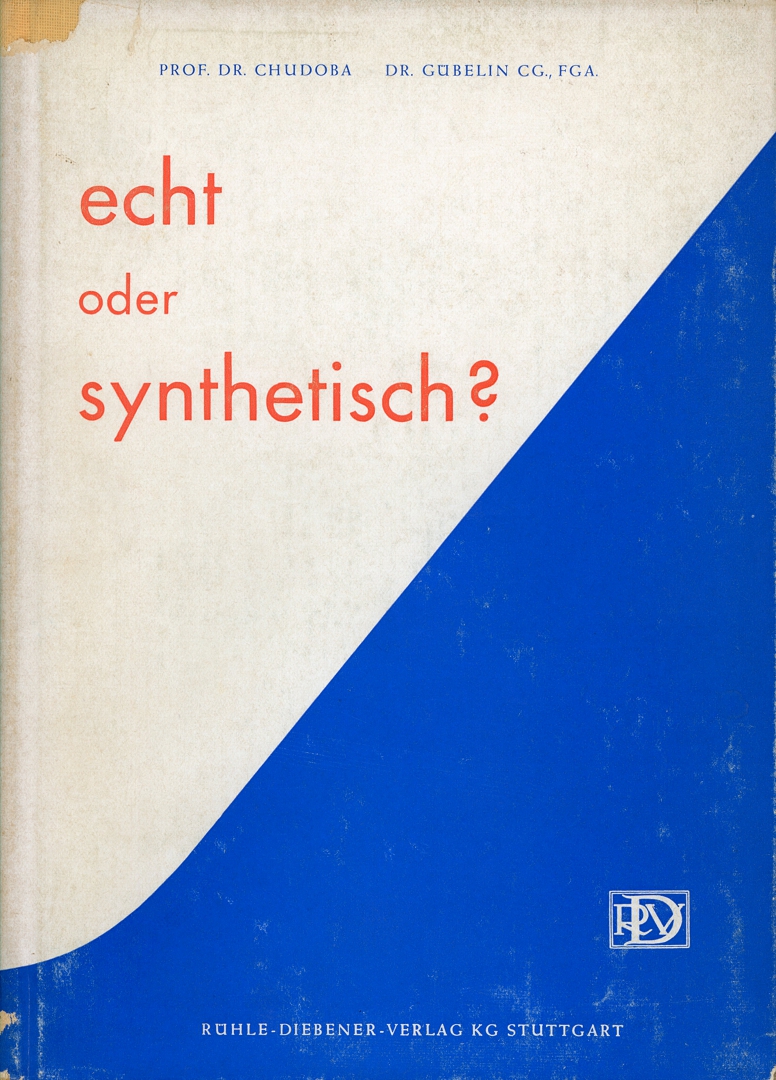
Chudoba, K. and Gübelin, E. (1956) Echt oder synthetisch? [Genuine or Synthetic?] Stuttgart, Rühle-Diebener-Verlag, 156 pp.
Record No. 4735  |  Sinkankas/Born No.: 1349; NIB  |  Language: in German  |  RWHL
Chudoba and Gübelin provide a practical guide to distinguishing natural gemstones from synthetic counterparts, combining a short history of artificial gem production with detailed discussion of the principal manufacturing methods and their diagnostic consequences. The Verneuil flame-fusion process, flux growth, and hydrothermal synthesis are described, together with the characteristic structures and inclusions they produce. Particular attention is given to synthetic ruby and sapphire, spinel, emerald, and other important gem materials, with comparisons between natural and laboratory-grown stones based on growth zoning, curved striae, gas bubbles, mineral inclusions, refractive properties, fluorescence, and other microscopic and physical features. The authors emphasize examination with the gemological microscope as one of the most powerful means of separation, supported by numerous photomicrographs illustrating inclusions and growth phenomena in both natural and synthetic gems. Conceived as a concise working manual for gemologists and jewelers, the book brought together the principal identification criteria then available at a time when synthetic gemstones were becoming increasingly sophisticated and commercially important.

Theophrastus on Stones

Book
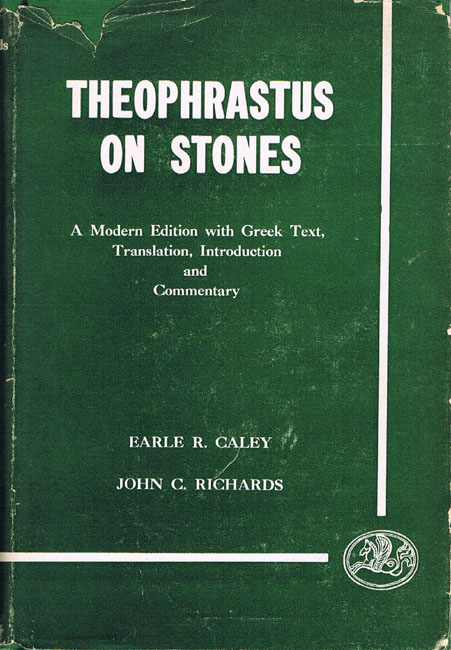
Theophrastus, Caley, E.R. and Richards, J.C. (1956) Theophrastus on Stones. Columbus, OH, Ohio State University, 238 pp.
Record No. 4731  |  Sinkankas/Born No.: 6602; NIB  |  RWHL
According to Caley and Richards (ibid., 4), the treatise is a set of notes, possibly taken down by a student listening to lectures delivered by Theophrastus, but “safely assumed to represent the actual views of Theophrastus, and he may reasonably be considered the author.” On the other hand, Eichholz (ibid.) is firmly of the view that the treatise is Theophrastus himself, and that it is not a fragment, as has been suggested numerous times, but a complete, though short, work. Theophrastus’ treatise, commonly called the Peri Lithon, or “Concerning Stones,” commences with speculations as to the origins of stones and discusses their distinctive properties as well as the means by which differences among them may be elucidated. This is followed by a rather rambling description of numerous gemstones and earths, excepting metallic minerals and metals, which are stated to have been described elsewhere in a treatise now lost. All of the matter is presented tersely and is almost entirely free of superstitious lore, except for the emerald, for which it claims that it refreshes the eyesight upon gazing and that an emerald placed in water colors it green. F. D. Adams (Birth and Development of Geological Sciences, 1938, 19) notes that “it differs entirely in its style and content from any other work upon this subject written in classical times—in fact, no other work at all resembling it appeared until later on in the Middle Ages. It remained for 1800 years a most valuable and authoritative work on minerals, referred to and quoted by all, and shows that even at this early time there existed, probably among miners, quarrymen and other men engaged in the technical trades and industries, a body of knowledge of mineralogy, especially on its practical side, which had been drawn upon by Theophrastus in the compilation of his work.” Adams further notes that Pliny must have had a more complete version of the treatise because of mentions of stones that are not now in the Peri Lithon, but this is refuted by Eichholz as noted above. H. Tertsch (Das Geheimnis der Kristallwelt, 1947, 31–4) also provides illuminating remarks on the treatise, suggesting that it reflects the views of Aristotle, his mentor. The gemstone content of Peri Lithon is not large but important for those ornamental and precious materials that it does name—namely, marbles and calcite onyx, lapis lazuli, obsidian, and other massives, and also emerald, sard, garnet, adamas (probably corundum), amber, rock crystal, and others—all of which are carefully examined by Caley & Richards and by Eichholz, who make identifications where possible. Both authorities offer much ancillary material which makes rewarding reading as well as providing lists of printed editions of Peri Lithon from which I have freely drawn much of the information below on not personally examined.

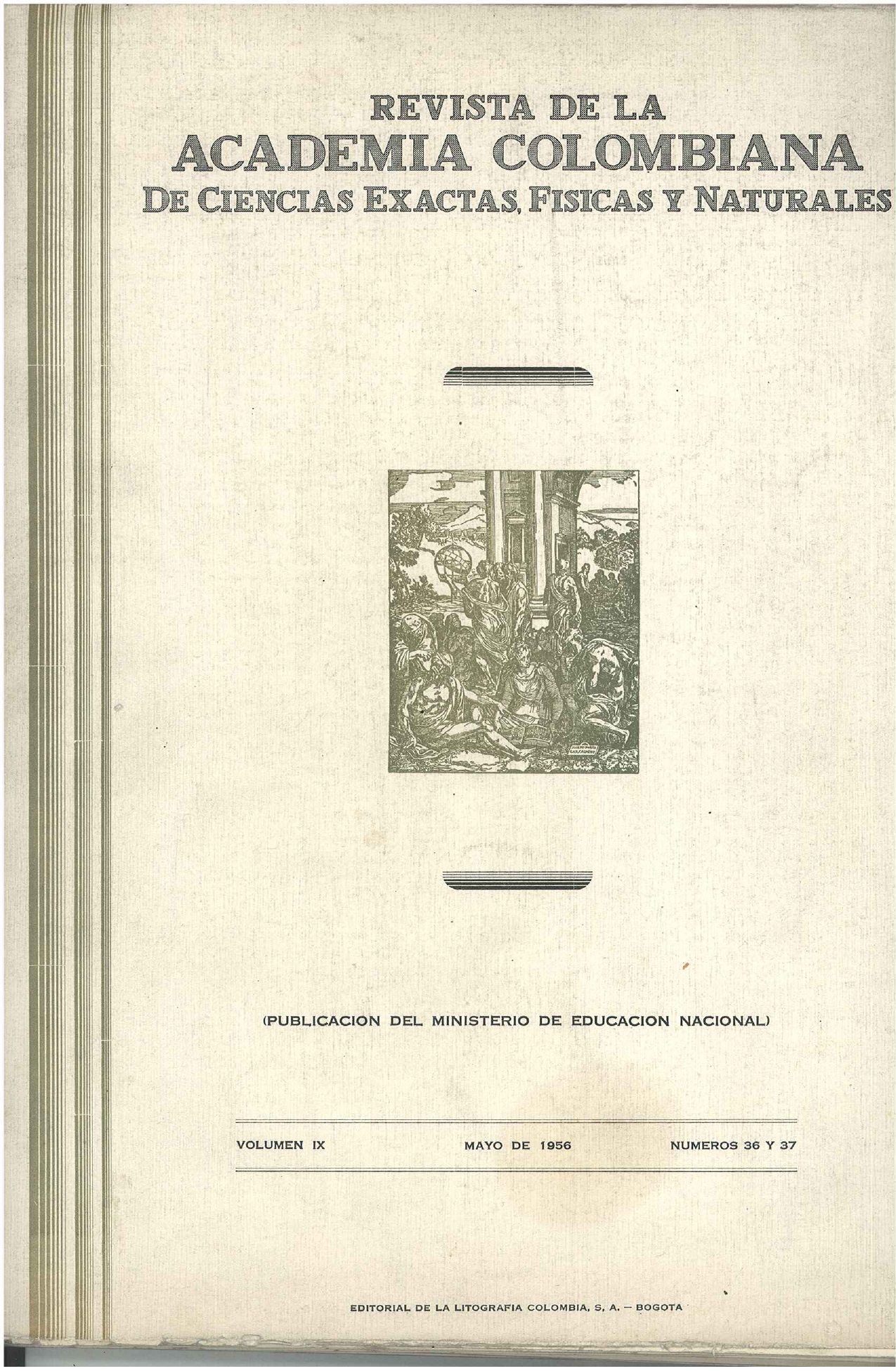
Situación geológica de las minas de esmeraldas de Muzo: Bogotá
Geological conditions of the emerald mines of Muzo: Bogotá
Journal Article
Bürgl, H. (1956) Situación geológica de las minas de esmeraldas de Muzo: Bogotá. [Geological conditions of the emerald mines of Muzo: Bogotá] Revista de la Academia Colombiana, Vol. 9, No. 36–37, pp. 381–388.
Record No. 4251  |  Language: in Spanish  |  RWHL
Bürgl examines the regional geology and structural setting of the Muzo emerald mines in Boyacá, which occur within a thick and relatively uniform sequence of black Cretaceous shales complicated by numerous faults, folds, and local structural disturbances. Using fossil evidence, he establishes a stratigraphic succession extending from the Hauterivian through the Upper Albian and shows that the emerald mines lie within Lower Middle Albian strata in the broad Itoco anticline west of the Río Minero. The eastern and western successions are separated by a major NNE–SSW fault, probably reverse, with an estimated vertical displacement of about 5,000 m, while smaller NW–SE faults also affect the mine area. Bürgl emphasizes that the relative roles of stratigraphy and tectonics in emerald formation could not yet be determined, but notes the unusually strong subsidence of the region during deposition of the emerald-bearing beds and subsequent Albian time as a potentially significant geological factor.

L’Empire des Perles et des Pierres Précieuses
The Empire of Pearls and Gemstones
Book
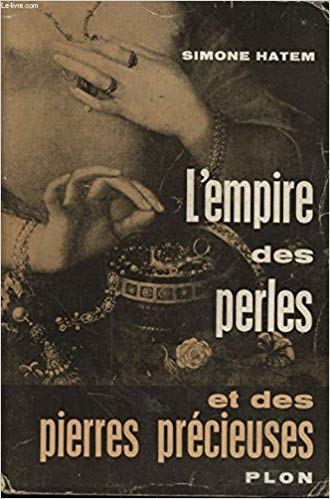
Hatem, S. (1956) L’Empire des Perles et des Pierres Précieuses. [The Empire of Pearls and Gemstones] Paris, Librairie Plon, 260 pp.
Record No. 4052  |  Sinkankas/Born No.: 2801; NIB  |  Language: in French  |  RWHL
Hatem presents a popular but substantial survey of pearls and precious stones, combining gemological information with history, geography, mining, trade, and famous gems. She discusses the principal gemstones, including diamond, ruby, sapphire, emerald, and pearl, describing their formation, physical characteristics, important producing regions, methods of recovery and cutting, and their place in commerce and jewelry. Historical accounts and anecdotes trace the fascination with precious stones from antiquity to the modern period, including celebrated jewels, royal treasures, discoveries, and the development of major gem-producing districts. Synthetic gemstones and attempts to manufacture diamond are also treated, including Moissan’s experiments. Pearls receive extensive attention, with discussion of natural pearl fisheries, cultured pearls, mollusks, formation, grading, and important producing regions. Written for the general reader rather than as a technical gemological manual, the volume brings together scientific explanations and historical material and is extensively illustrated, with 78 figures and a map in the text and 103 illustrations on plates.

Emerald from Habachtal

Journal Article
Gübelin, E.J. (1956) Emerald from Habachtal. Journal of Gemmology, Vol. 5, No. 7, July, pp. 342–361.
Record No. 2046  |  ISBN/ISSN: 221252  |  Sinkankas/Born No.: 2564  |  RWHL

Commercial synthesis of star sapphires and star rubies

Journal Article
Frondel, C. (1954) Commercial synthesis of star sapphires and star rubies. Transactions, AIME, January, pp. 78–80.
Record No. 787  |  RWHL
THE aluminum oxide known as corundum has several varieties that have been used as gem materials since ancient times. These include the red variety called ruby, the blue variety sapphire, and the asteriated types of ruby and sapphire. Asteriated sapphire was known to the ancients under the name of astrios, and descriptions of this gem were given by Pliny and other early writers. The relation of these gem materials to each other as varieties of a single species, corundum, was first clearly established by Haüy in 1805 and J. M. Güthe1 in 1809. Natural gem corundum is obtained principally in Ceylon, Siam, Burma, India, and Australia. Star sapphires and rubies always have been highly prized and in recent years have become particularly popular in the United States. Natural star rubies of large size and fine quality are extremely rare and rank with large and fine emeralds and diamonds as the most valuable of gem stones. Interest thus attaches to the recent success in commercially synthesizing star sapphires and rubies of a size and perfection unmatched by nature.

Exploring the Literature of Emerald

Emerald literature spans gemology, mineralogy, deposits, identification, treatments, synthesis, history and the gem trade, with important sources covering deposits around the world.

For a curated guide to this subject, read Green Fire — Lotus Gemology's Guide to the Literature of Emerald.

About Four Treasures

Four Treasures is Lotus Gemology's freely accessible gemological reference database. Use the full database to search by author, title or keyword and explore literature on gemology, mineralogy, jewelry and related fields. Where available, hyperlinks on titles may lead directly to the full publication.

Search the Complete Four Treasures Database