Emerald Bibliography

Emerald Bibliography

Explore books, articles and historical sources on emerald in Four Treasures, the Lotus Gemology reference database. This bibliography brings together matching records from the collection, with publication details, abstracts and cover images where available.

Emerald References

The list below matches the terms emerald or emeralds in the database's searchable fields. Some references discuss emeralds as part of a broader subject.
581–600 of 851 matching references

Green Ice

Book
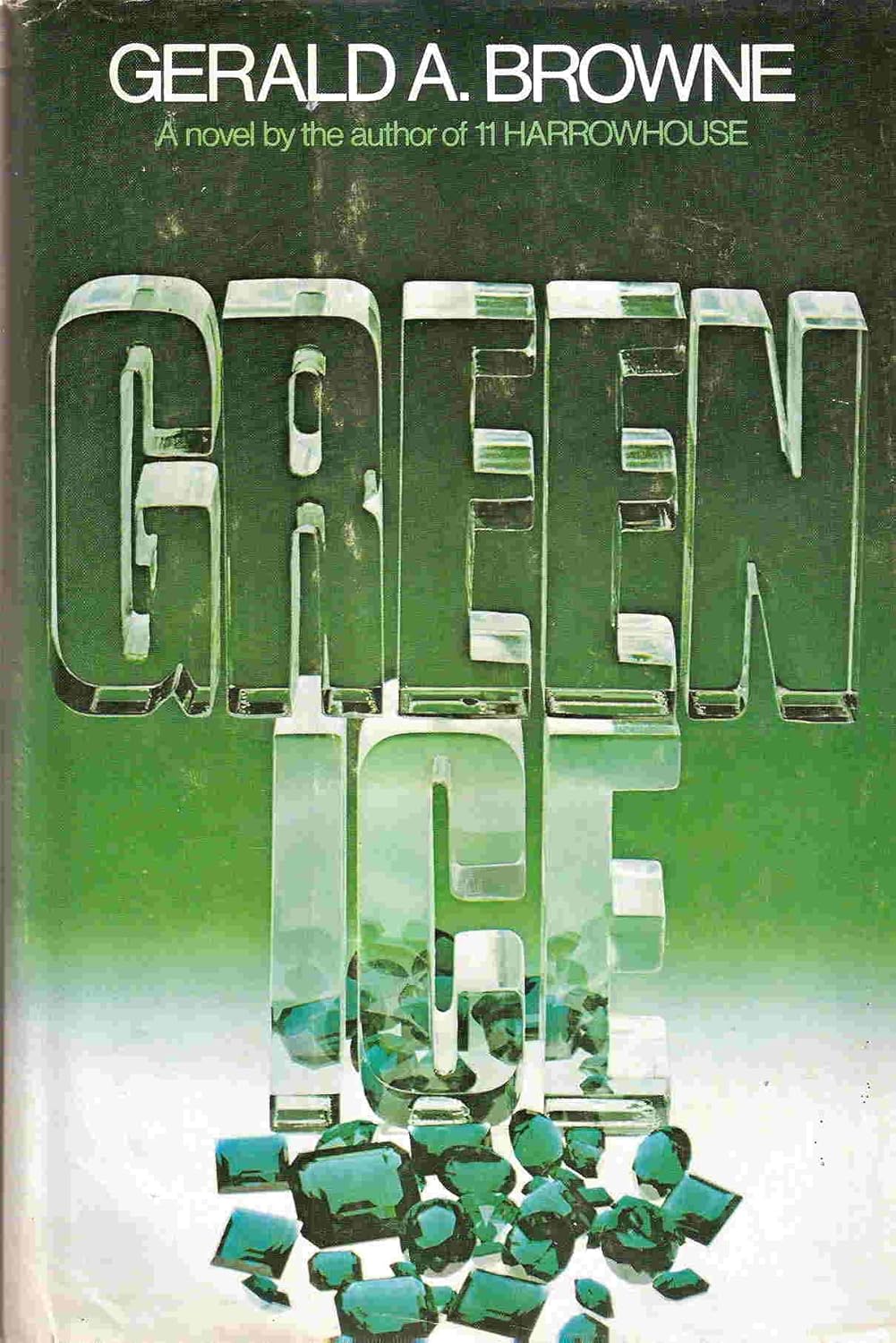
Browne, G.A. (1979) Green Ice. New York, Delacorte Press, 413 pp.
Record No. 16821  |  RWHL
In New York Times–bestselling author Gerald A. Browne’s riveting thriller, a down-on-his-luck American makes one last gamble to reap a fortune in the Colombian emerald business After years of stultifying office work, Joseph Wiley will try anything to get rich in a hurry. He’s hustled all kinds of products, but each venture has left him deeper in debt, chained tighter to his office desk. When his latest moneymaker goes up in smoke, Wiley doesn’t even bother to quit his job. He takes every cent he has to the airport and flies south, landing in Colombia, where he will make his millions—or lose his life. In the mountains of Colombia, even an amateur can make a mint digging for emeralds, but an all-powerful syndicate, the Concession, controls the gems. Wiley and his new partner, heiress Lillian Holbrook, play a dangerous, double-crossing game with the Concession and its watchdogs because, for different reasons, they’re both willing to risk everything for the brilliant green stones.

Characteristics of synthetic hydrothermal emeralds from USA and USSR
米国およびソ連の水熱合成エメラルドの特徴
Journal Article
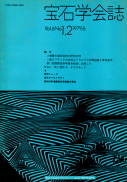
Takubo, H. (1979) Characteristics of synthetic hydrothermal emeralds from USA and USSR. [米国およびソ連の水熱合成エメラルドの特徴] Journal of The Gemmological Society of Japan [宝石学会誌], Vol. 6, No. 4, pp. 3–18.
Record No. 2391  |  Sinkankas/Born No.: NIS/NIB  |  Language: in Japanese with English abstract  |  RWHL
As-grown and faceted crystals of synthetic hydrothermal emeralds from the USA and USSR were compared in terms of morphology, internal features, and physical properties. The USSR emeralds are notably closer to natural emeralds in physical and optical properties, although both types differ from natural stones primarily in their internal features. USA emeralds (SG: 2.67–2.68, RI: ω 1.572–1.574, ε 1.568–1.569) display bright red fluorescence under 365 nm UV, show Chelsea filter reactions (red), and often contain optical strain, “earthworm” cracks, phenacite, and 2- or 3-phase inclusions—often originating from natural beryl seed plates. USSR emeralds (SG: 2.70–2.71, RI: ω 1.583–1.586, ε 1.577–1.579) are slightly softer (H 7–7.5), show weaker UV fluorescence and pleochroism closer to natural emeralds, and lack spikes or strong zonation. Their inclusions include more naturalistic features like “wheat-head” textures, 2- and 3-phase inclusions, and reddish-brown plates. Growth habits differ slightly, with the USSR stones typically showing multiple growth planes ({112̅1} and {112̅0}) and shorter estimated growth times. Overall, USSR hydrothermal emeralds reach ~90% similarity to natural emeralds, versus ~80% for USA stones and 40–60% for flux-grown emeralds.

Graveyard of the quicksilver galleons
Journal Article
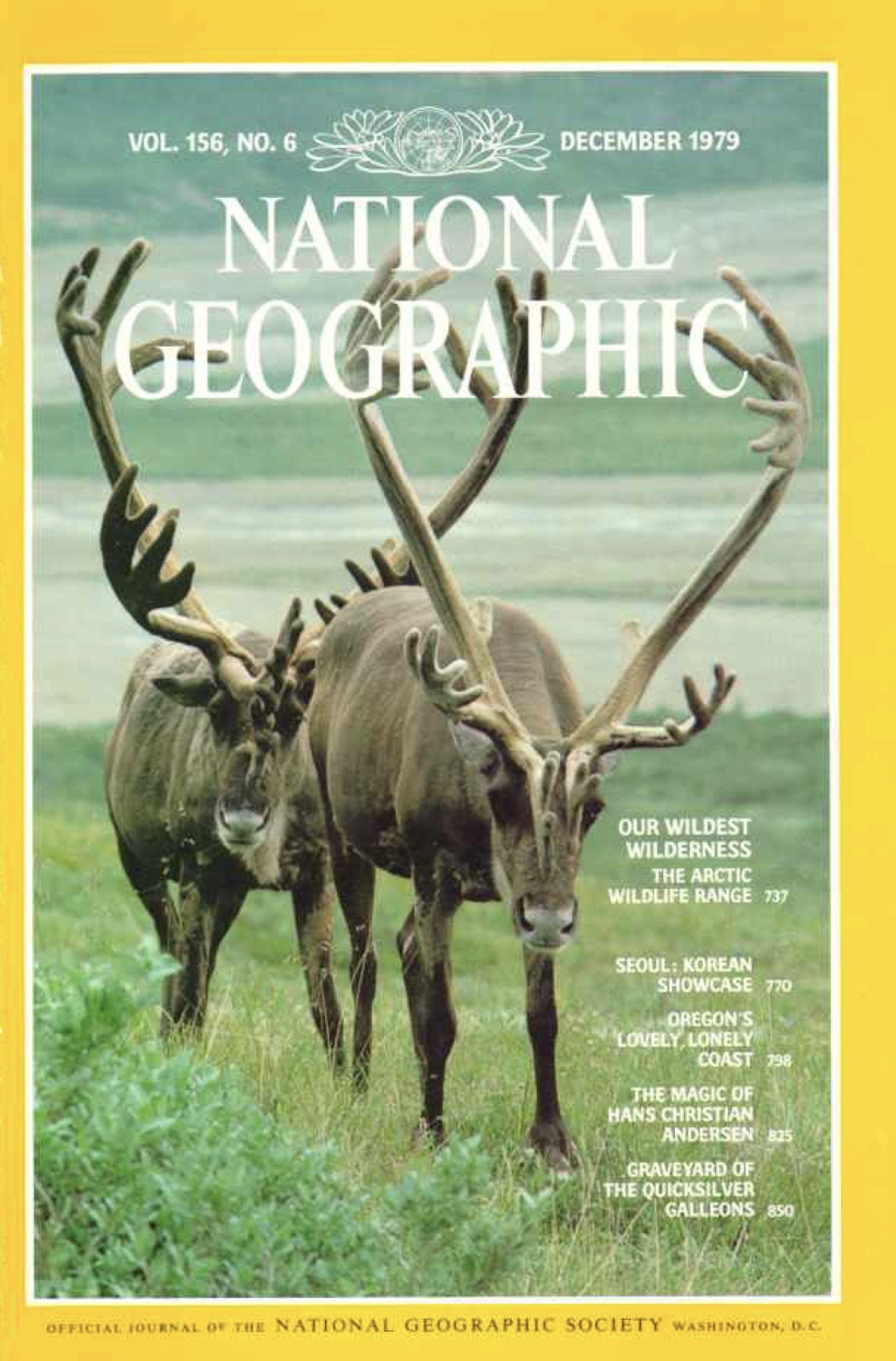
Peterson, M. (1979) Graveyard of the quicksilver galleons. National Geographic, Vol. 156, No. 6, December, pp. 850–876.
Record No. 2002  |  RWHL
FORTY FEET below the surface I hovered weightless above the somber skeleton of a ship, a Spanish galleon lost two and a half centuries ago. As I drifted lower, a pinpoint of light caught my eye, a silver droplet gleaming from among the ship’s timbers. Reaching down with one finger, I touched the droplet. It gave under pressure, then suddenly burst into a dozen smaller beads. Mercury. That magical, fluid metal known to the ancients as quicksilver, for its brilliance and its curiously elusive properties. As the tiny beads scattered under my touch, I noticed other droplets of mercury lodged among the remains of small wooden casks stored in rows near the bottom of the ship’s hull (preceding pages). I glanced at my diving partner, Tracy Bowden, and he nodded. Clearly the droplets were no leftover sample of mercury carried aboard ship by some long-ago crewman or passenger. They were the remains of cargo—a major consignment of mercury bound from the Old World to the New for a vital purpose—the recovery of gold and silver. As surely as if each cask bore an imprint of the ship’s name, the droplets identified the sunken vessel: Conde de Tolosa, pride of Spain, tomb of nearly 600 souls. Turning from the wreck, Tracy and I slowly began our ascent. Above us the surface of the sea heaved and rippled in the sun like some vast crucible of molten silver. It was a poignant image, for silver and gold had cost Tolosa her life. The year was 1724, and her grave an obscure West Indian bay. She had sailed from Cádiz, Spain, in July of that year with a companion vessel, Nuestra Señora de Guadalupe. The two ships were bound for Veracruz, Mexico, via Havana on a royal mission: to deliver a consignment of mercury for refining purposes to the Spanish Empire’s extensive gold and silver mines in Mexico.

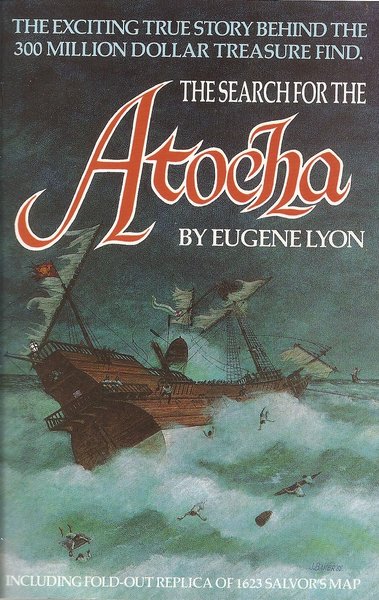
The Search for the Atocha

Book
Lyon, E. (1979) The Search for the Atocha. New York, NY
Record No. 1995  |  RWHL
In 1622 the Spanish Galleon Nuestra Senora de Atocha sank off the Florida Keys on its way from Havana to Spain. Since then men have dreamed of salvaging her amazing treasure of gold an silver. For more than three centuries, however, their dreams have ended in bitter, often tragic, failure. In the 1960s a man with an overwhelming will committed his life to the search. His name is Mel Fisher, and his own story has become a fascinating part of the Atocha saga. Raising money, developing new equipment, Fisher and his associates have also discovered the location of the sunken ship and her treasure. Most important, however, Fisher has never wavered in his quest, even when he has confronted with economic ruin, government challenges, legal setbacks and the tragic deaths of two members of his family as they tried to reach the dream. Author Dr. Eugene Lyon's research at the Archives of the Indies in Seville Spain played a major role in the successful conclusion of a 16 year search for the Spanish galleon Atocha. 416 pages. Illustrated.

How to Buy and Sell Gems: Everyone’s Guide to Rubies, Sapphires, Emeralds and Diamonds
Book
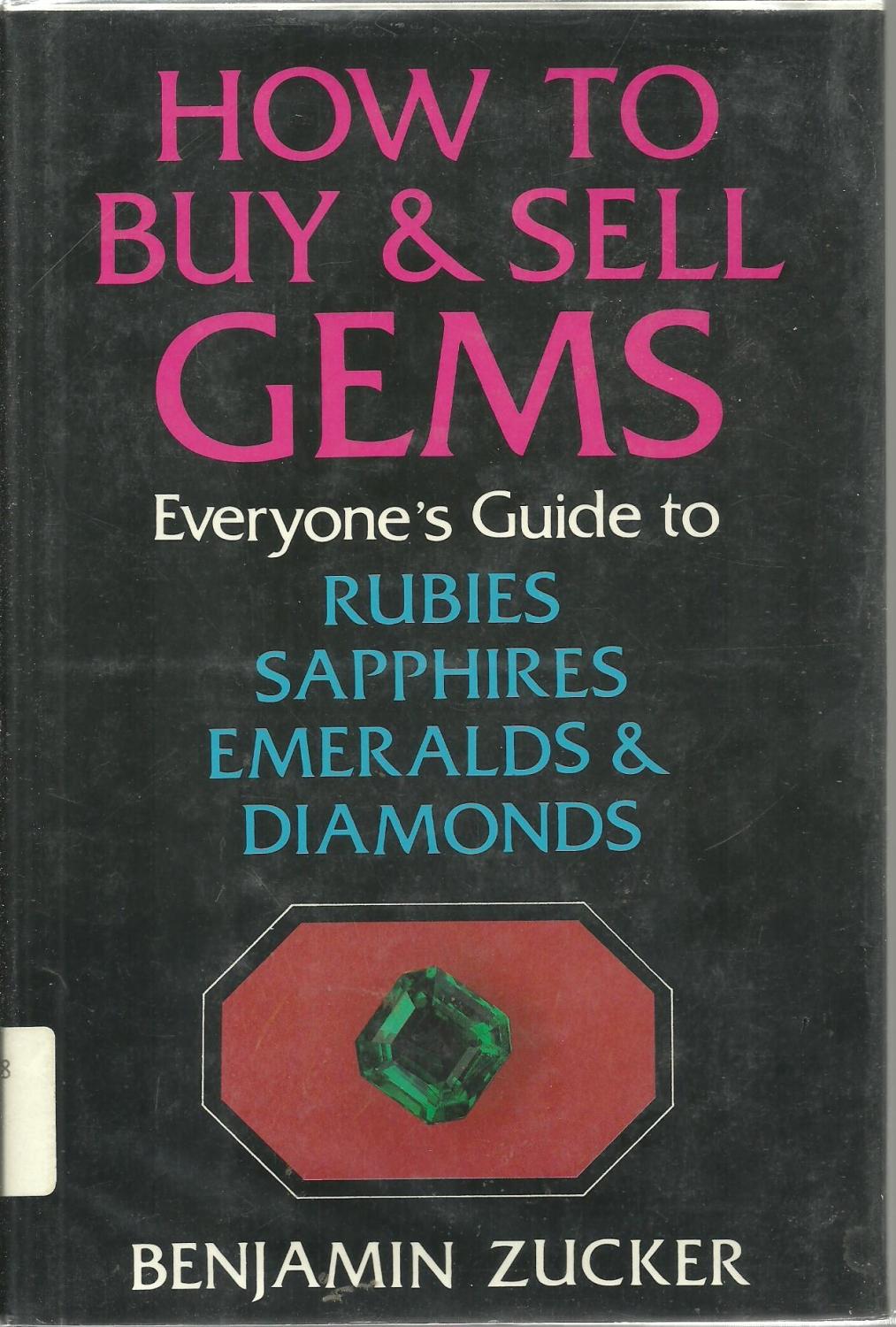
Zucker, B. (1979) How to Buy and Sell Gems: Everyone’s Guide to Rubies, Sapphires, Emeralds and Diamonds. New York, Times Books, 117 pp.
Record No. 1921  |  RWHL

Refractive indices and specific gravities of beryls
緑柱石の屈折率と比重
Journal Article
Takubo, H. (1977) Refractive indices and specific gravities of beryls. [緑柱石の屈折率と比重] Journal of The Gemmological Society of Japan [宝石学会誌], Vol. 4, No. 3, pp. 3–8.
Record No. 2390  |  Sinkankas/Born No.: NIS/NIB  |  Language: in Japanese with English abstract  |  RWHL
Studies on the refractive indices and specific gravities of natural and synthetic beryls are reviewed. Effects of impurities, temperature and pressure on these propertles are discussed. For synthetic beryls, refractive indices and specific gravity are strongly affected by the water pressure applied during synthesis. The emerald with refractive indices as high as natural emeralds can be synthesized by using the high pressure technique.

Beryl occurrences in Egypt

Journal Article
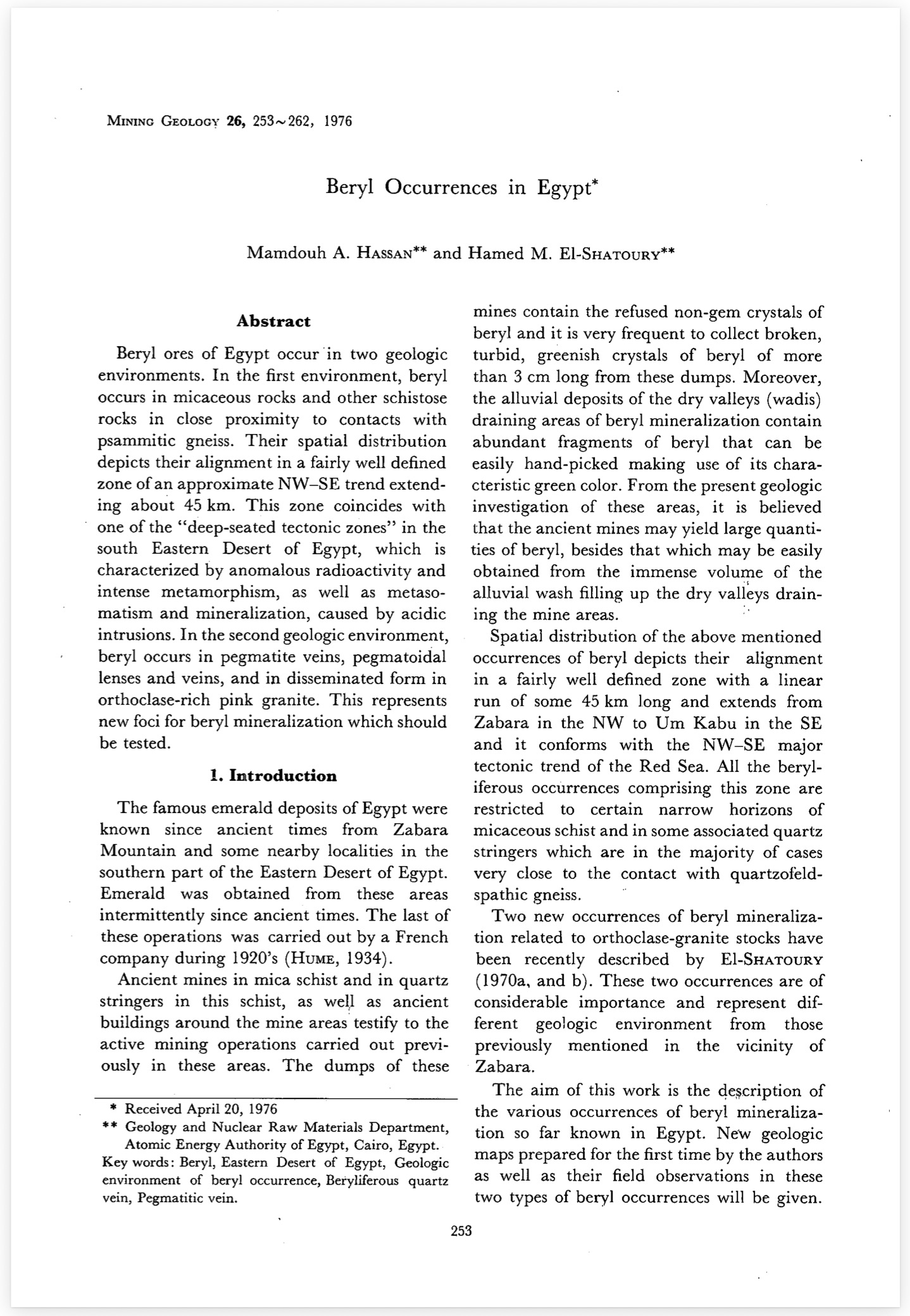
Hassan, M.A. and Shatoury, H.M.E. (1976) Beryl occurrences in Egypt. Mining Geology, Vol. 26, No. 138, pp. 253–262.
Record No. 29950  |  DOI: https://doi.org/10.11456/shigenchishitsu1951.26.253  |  Sinkankas/Born No.: NIS/NIB  |  RWHL
Beryl ores of Egypt occur in two geologic environments. In the first environment, beryl occurs in micaceous rocks and other schistose rocks in close proximity to contacts with psammitic gneiss. Their spatial distribution depicts their alignment in a fairly well defined zone of an approximate NW-SE trend extend-ing about 45 km. This zone coincides with one of the deep-seated tectonic zones" in the south Eastern Desert of Egypt, which is characterized by anomalous radioactivity and intense metamorphism, as well as metasomatism and mineralization, caused by acidic intrusions. In the second geologic environment, beryl occurs in pegmatite veins, pegmatoidal lenses and veins, and in disseminated form in orthoclase-rich pink granite. This represents new foci for beryl mineralization which should be tested."

Mossbauer effect studies of beryl

Journal Article
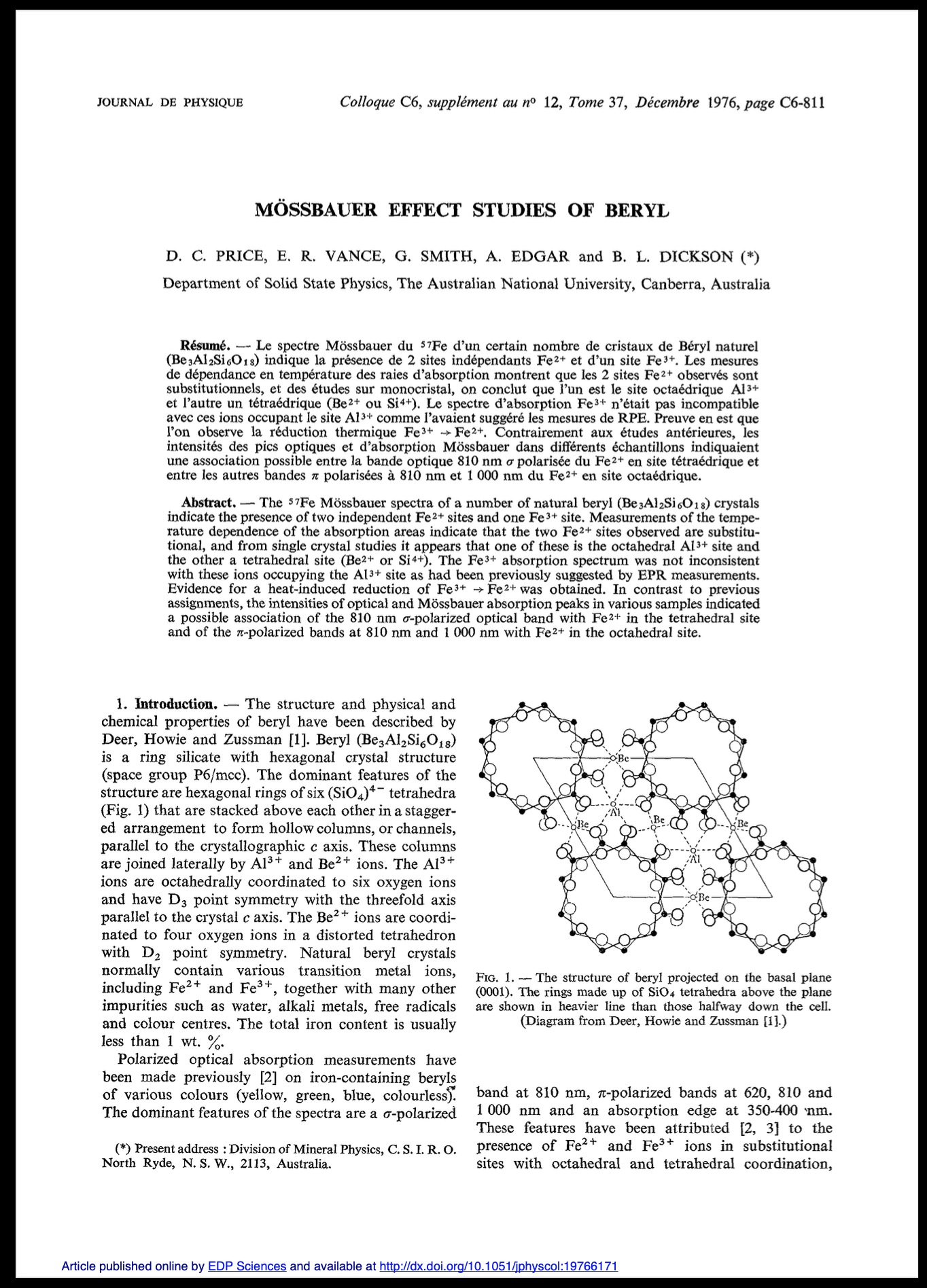
Price, D.C., Vance, E.R., Smith, G., Edgar, A. and Dicson, B.L. (1976) Mossbauer effect studies of beryl. Journal de Physique, Colloque C6, Vol. 37, Supplement 12, pp. 811–817.
Record No. 2387  |  RWHL

Contribution à l’étude des lapidaires anonymes en prose française (fin du XIIIᵉ–fin du XVᵉ siècle)
Contribution to the study of anonymous lapidaries in French prose (late 13th–late 15th century)
Thesis
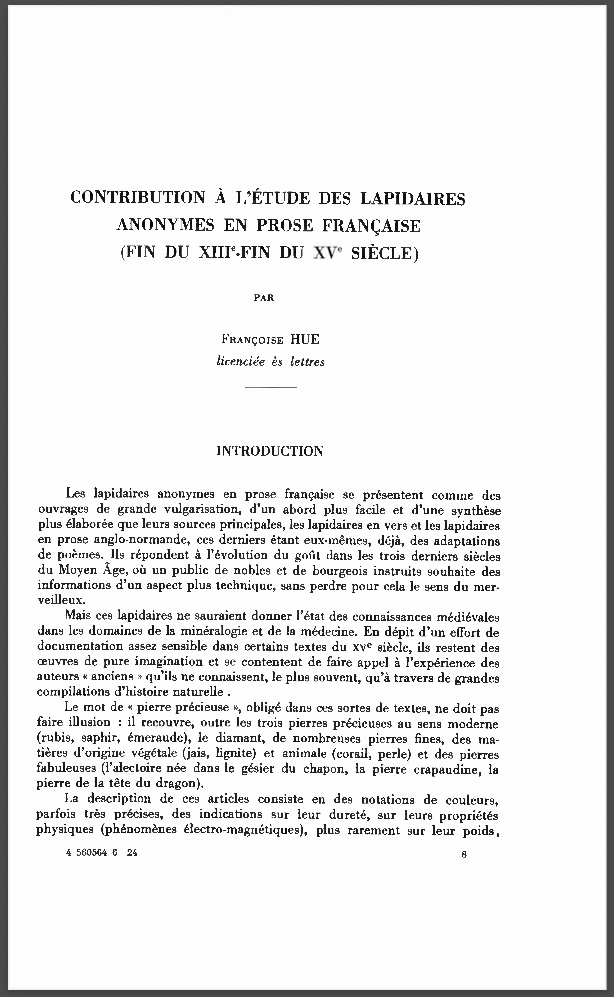
Hue, F. (1975) Contribution à l’étude des lapidaires anonymes en prose française (fin du XIIIᵉ–fin du XVᵉ siècle). [Contribution to the study of anonymous lapidaries in French prose (late 13th–late 15th century)]., Paris: École nationale des chartes, pp. 113–121.
Record No. 28025  |  Sinkankas/Born No.: NIS/NIB  |  Language: in French  |  RWHL
The anonymous lapidaries in French prose present themselves as works of wide dissemination, more accessible and offering a more developed synthesis than their principal sources: the lapidaries in verse and those in Anglo-Norman prose, the latter already being adaptations of poems. They reflect the evolving tastes of the final three centuries of the Middle Ages, when a readership of educated nobles and bourgeois sought information of a more technical nature—without, however, relinquishing a sense of wonder. Yet these lapidaries cannot be taken as accurate representations of medieval knowledge in the fields of mineralogy and medicine. Despite a noticeable effort at documentation in some 15th-century texts, they remain works of pure imagination and draw chiefly on the experience of “ancient” authors, whom they most often knew only through large compilations of natural history. The term “precious stone,” obligatory in such texts, should not be misleading; it includes, beyond the three precious stones in the modern sense (ruby, sapphire, emerald), the diamond, many semi-precious stones, materials of plant origin (jet, lignite), animal origin (coral, pearl), and fabulous stones (the alectoria born in the gizzard of a capon, the toadstone, the stone from the head of a dragon).

La couronne du sacre des reines de France
The crown of the coronation of the queens of France
Journal Article
Morel, B. (1975) La couronne du sacre des reines de France. [The crown of the coronation of the queens of France] Revue de Gemmologie A.F.G., No. 43, June, pp. 4–5.
Record No. 3188  |  Sinkankas/Born No.: NIS/NIB  |  Language: in French  |  RWHL
Morel reconstructs the French queens’ coronation crown from early inventories and illustrations, arguing that its history was closely intertwined with that of the crown traditionally attributed to Charlemagne. He notes that the queen’s crown weighed about 2.5 kg and was set with numerous pearls and precious stones, including ten rubies, eight sapphires, sixteen balas rubies (spinels), sixteen emeralds, and sixteen sapphires, arranged in settings comparable to those of the king’s crown. The 1534 inventory records a bonnet associated with the crown, while a new crimson-velvet bonnet decorated with pearls, gold, silver, and gemstones was made for the coronation of Louis XIII. Morel traces the crown through successive French coronations and inventories, describing alterations, reuse of gemstones, and the eventual disappearance of the crown during the revolutionary period; the article includes a reconstruction drawing based on the documentary evidence.

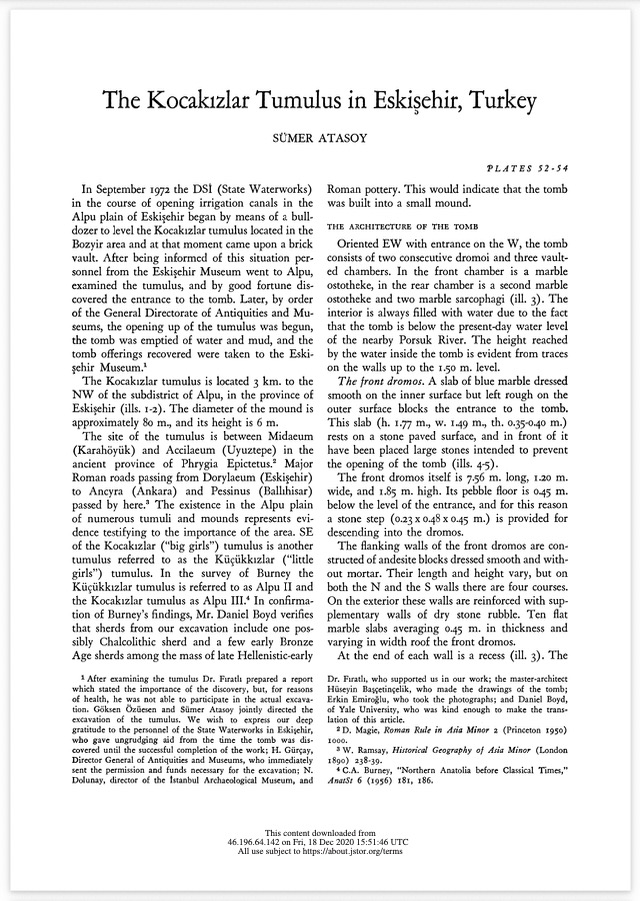
The Kocakizlar Tumulus in Eskişehir, Turkey
Journal Article
Atasoy, Y.S. (1974) The Kocakizlar Tumulus in Eskişehir, Turkey. American Journal of Archaeology, Vol. 78, No. 3, July, pp. 255–263.
Record No. 27327  |  Sinkankas/Born No.: NIS/NIB  |  RWHL
The Kocakizlar Tumulus in Eskisehir, Turkey, is an important archaeological site excavated in 1972 during irrigation canal construction. The site features a brick vault tomb with significant findings including various gold, gem and ivory artifacts, underscoring the historical significance of the area known for its ancient tumuli and Roman roads. The excavated items provide insights into the cultural practices and craftsmanship of the period.

Le mythe de « l'Émeraude des Garamantes »
The Myth of the Emerald of the Garamantes (Libya)
Journal Article
Monod, T. (1974) Le mythe de « l'Émeraude des Garamantes ». [The Myth of the Emerald of the Garamantes (Libya)] Antiquités africaines, Vol. 8, pp. 51–66.
Record No. 17071  |  Language: in French  |  RWHL
Discusses the “Libyan” emeralds of the ancient world. Monod critically examines the tradition of the supposed “Emerald of the Garamantes,” associated with the ancient Garamantes of the central Sahara. Drawing on classical texts and later interpretations, he traces the development of the story and questions the identification of the material described in ancient sources as true emerald. The study considers the geographical, historical, and mineralogical evidence behind the tradition and illustrates the difficulties created by applying modern gemstone names to ancient terminology. Monod concludes that the celebrated “emerald” tradition cannot be accepted straightforwardly as evidence for an ancient Libyan source of true emerald.

The Treasure Hunter

Book
Moore, R. and Jennings, H. (1974) The Treasure Hunter. Englewood Cliffs, NJ, Prentice-Hall, 261 pp.
Record No. 5035  |  RWHL
Gold, the glowing sacred metal of the ancient Incas, the elusive prize so many men have dreamed of and for which so many have died. Howard Jennings, real-life treasure hunter and long-time friend of author Robin Moore, have joined to tell Jenning's story in this romantic adventure fiction. It is an incredible tale, one that tells of rivers of emeralds in snake-filled jungles; of desert gun duels fought in the shadow on ancient Inca pyramids; of hairbreadth escapes from bandits in the mist-shrouded Andes; of love, courage and obsession. Most of all, it is absolutely true. It is also a compendium of treasure hunting lore, in which Howard Jennings not only discloses the secrets that have made him wealthy, but actually pinpoints the location of several still-undiscovered (and in some cases, never-before-discussed) treasure hoards.

La couronne royale de France dite de Charlemagne
The royal crown of France known as Charlemagne's crown
Journal Article
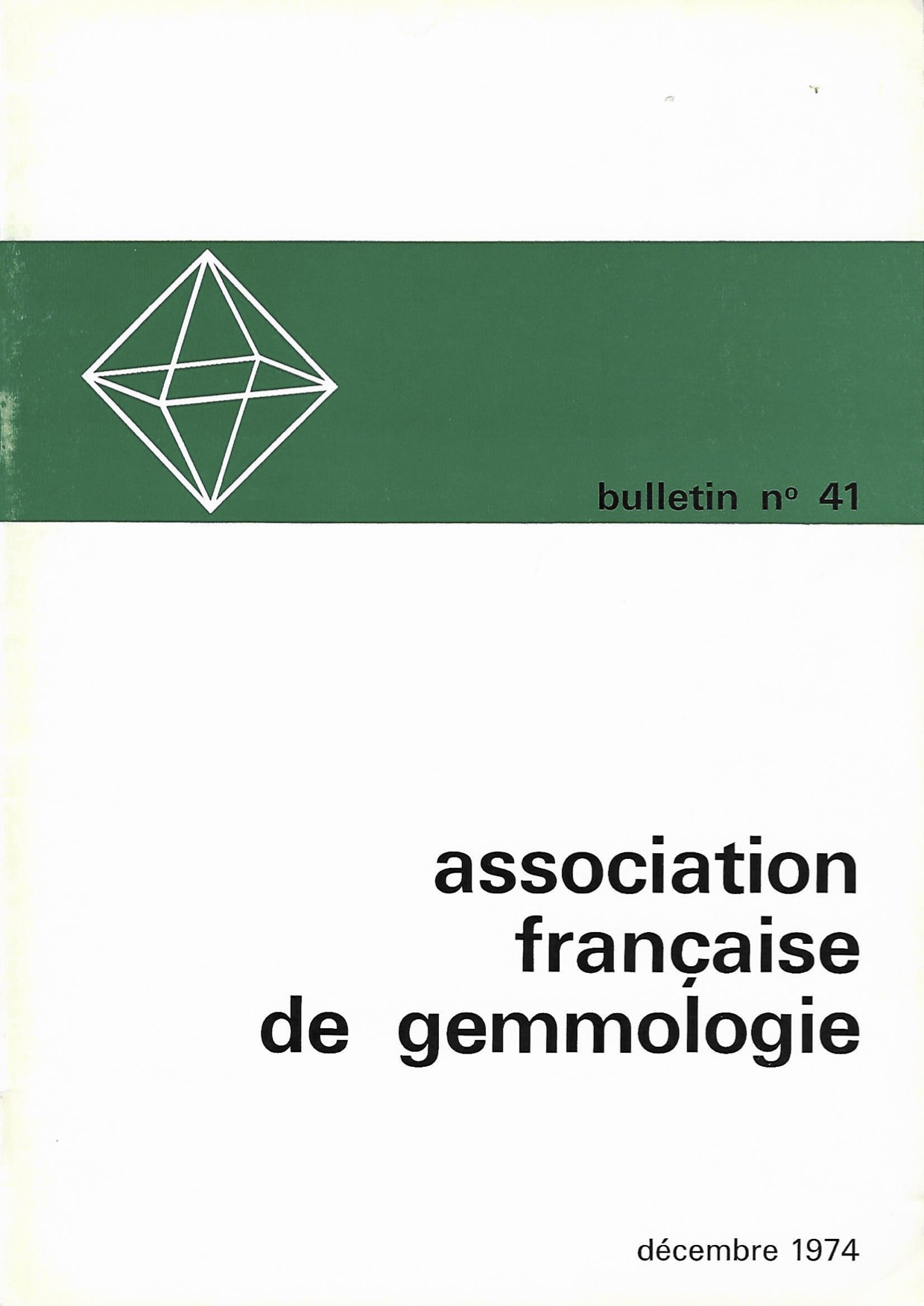
Morel, B. (1974) La couronne royale de France dite de Charlemagne. [The royal crown of France known as Charlemagne's crown] Revue de Gemmologie A.F.G., No. 41, December, pp. 10–12.
Record No. 1297  |  Sinkankas/Born No.: NIS/NIB  |  Language: in French  |  RWHL
Morel reconstructs the appearance and history of the French royal crown traditionally called the Crown of Charlemagne, destroyed with the other French crown jewels during the Revolution. Using the detailed inventories of 1505 and 1534 and comparison with Montfaucon’s 1766 engraving, he argues that the crown described in 1534 was essentially the same crown later illustrated and that it had replaced an earlier royal crown by 1634. The crown comprised a gold bonnet surrounded by four fleurs-de-lis and four arches, richly set with pearls and gemstones: sixteen ruby balais (spinels), sixteen emeralds, sixteen sapphires, and numerous pearls, with a large ruby balais cabochon at the center of each fleur-de-lis and another crowning the summit. Morel discusses the arrangement and estimated weights of individual stones, including a central spinel of approximately 260 carats, and notes that several gems were believed to have belonged to earlier French rulers, including Jean le Bon. He also traces changes in the crown’s monetary valuation between the inventories of 1505 and 1534 and attributes its declining value largely to the fall in gemstone prices following the expansion of commercial exchanges and discovery of new sources, particularly emerald mines in the Americas.

Smaragd, Alexandrit und Rubin als Komponenten einer Paragenese vom Lake Manyara in Tansania
Emerald, alexandrite, and ruby as components of a paragenesis from Lake Manyara in Tanzania
Journal Article
Bank, H. (1974) Smaragd, Alexandrit und Rubin als Komponenten einer Paragenese vom Lake Manyara in Tansania. [Emerald, alexandrite, and ruby as components of a paragenesis from Lake Manyara in Tanzania] Zeitschrift der Deutschen Gemmologischen Gesellschaft, Vol. 23, No. 1, März, pp. 62–63.
Record No. 423  |  Language: In German  |  RWHL
Bank describes an unusual mineral assemblage from the Lake Manyara area of Tanzania in which emerald, alexandrite, and ruby occur as components of the same paragenesis. The brief report records the association of three important gem varieties—chromium-bearing beryl, chrysoberyl, and corundum—and discusses their occurrence and mineralogical relationships within the deposit. The association is noteworthy because minerals of three different gem species, all capable of deriving their characteristic colors from chromium, occur together in a single geological environment.

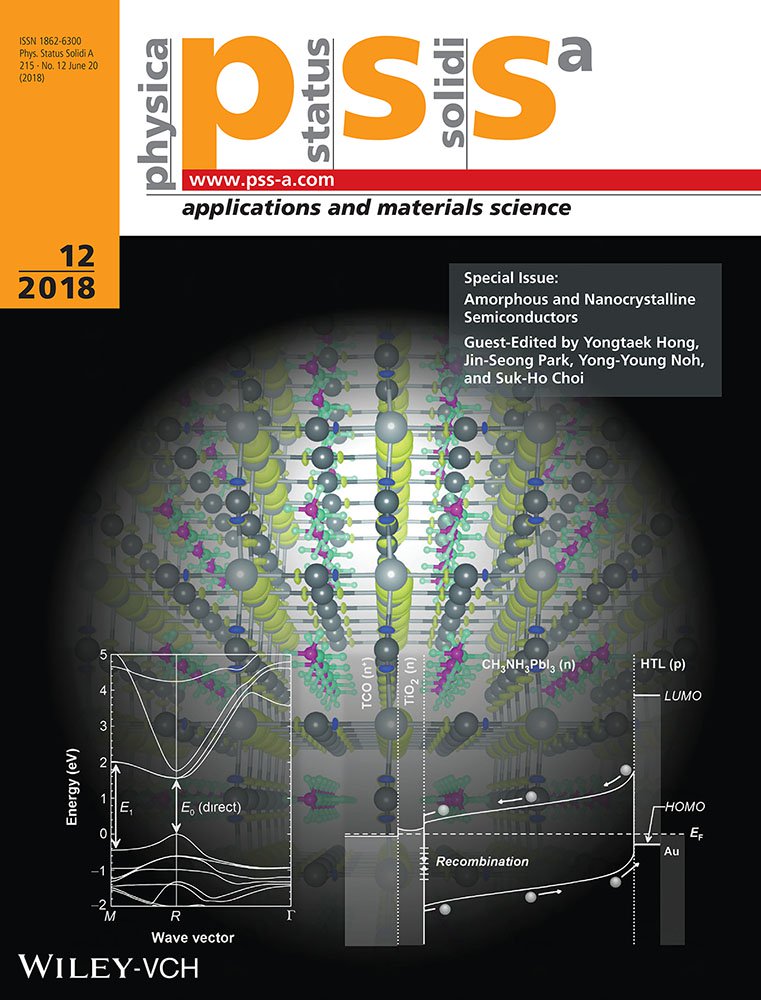
The optical and infrared absorption of V³⁺ in Beryl (Be₃Al₂Si₆O₁₈)
Journal Article
Beckwith, P.J.a.T., G.J. (1973) The optical and infrared absorption of V³⁺ in Beryl (Be₃Al₂Si₆O₁₈). Phys. Stat. Sol., Vol. 16, pp. 181–186.
Record No. 2380  |  RWHL
The absorption spectra of Be₃Al₂Si₆O₁₈ [V³⁺] have been measured over the wavelength range 350 to 2600 nm, with the observed transitions fitted by the crystal field parameters Δ = 16600, B = 590, C = 2950, ν = 1780, and ν′ = 340, and the theoretical energy levels calculated accordingly; an unexplained complex of lines in the region 16500 to 18400 cm⁻¹ may be due to interactions between V³⁺ and Fe ions.

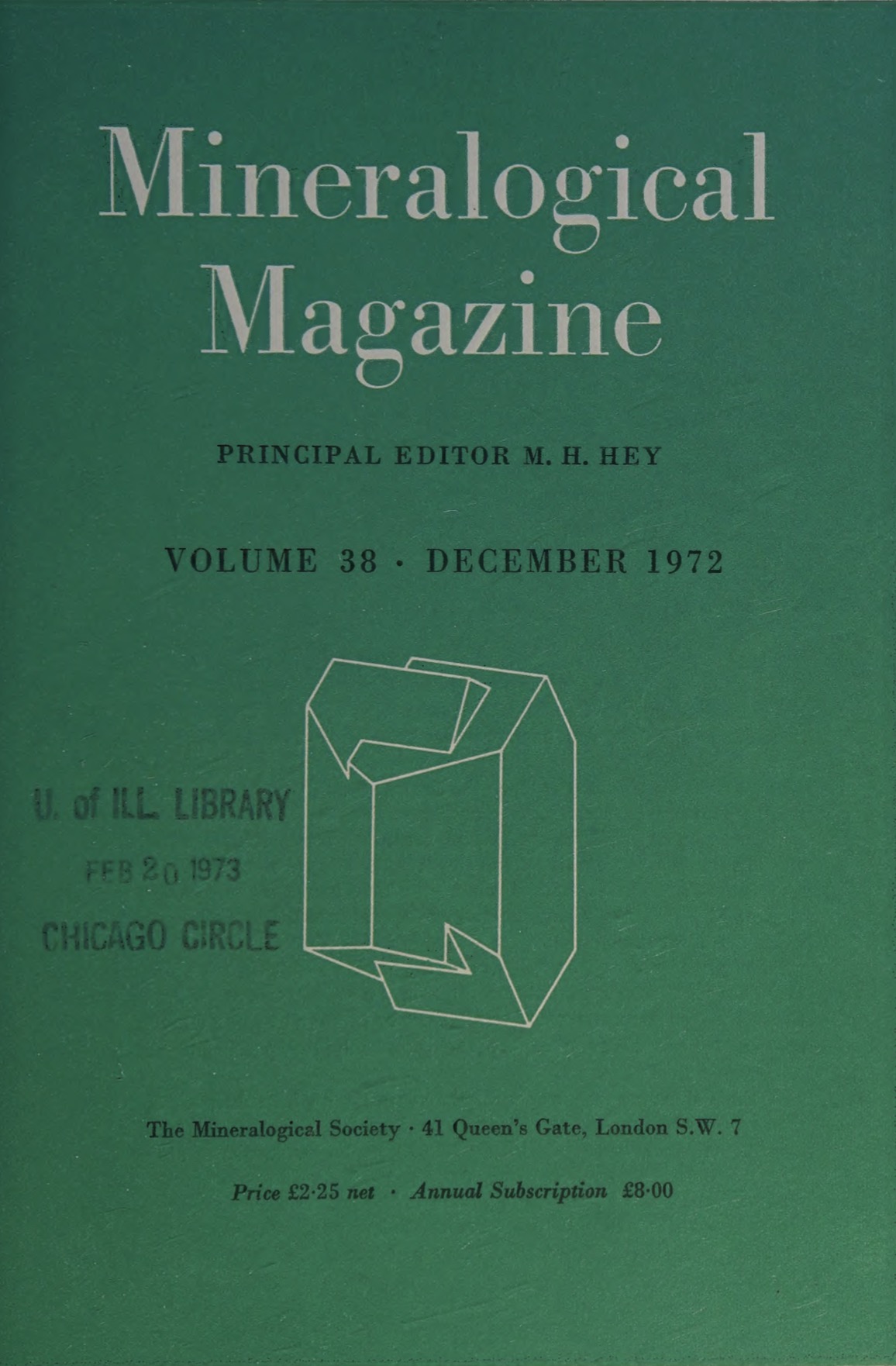
On the occurrence of Chlorapatite at the Emerald Mine, Rajagarh village, Ajmer
Journal Article
Babu, S.K. (1972) On the occurrence of Chlorapatite at the Emerald Mine, Rajagarh village, Ajmer. Mineralogical Magazine, Vol. 38, No. 300, December, pp. 972–974.
Record No. 27262  |  ISBN/ISSN: 0026461X  |  DOI: https://doi.org/10.1180/minmag.1972.038.300.10  |  Sinkankas/Born No.: NIS/NIB  |  RWHL

Indian Gemmology

Book
Tank, R.R. (1971) Indian Gemmology. Jaipur, Dulichand Tank, 171 pp.
Record No. 1679  |  Sinkankas/Born No.: 6484; NIB  |  RWHL
Sinkankas: Gemstones as viewed by an Indian author steeped in traditional lore presents a perspective deeply rooted in India’s enduring cultural relationship with gems, much of which remains seriously regarded today. As noted in a review in Gems & Gemology (Vol. 14, No. 2, 1972, pp. 61–63), the work is a unique combination of Indian culture and gemology." The lengthy and valuable introduction offers insights into Indian gem lore, tracing its origins to ancient texts as well as to more recent sources, many of which are cited by the author, Tank, along with the names of their authors. Topics discussed include the critical importance of imperfections in gems, distinctions between synthetics and naturals, and traditional Indian classifications, listing 84 gemstones in total. At the heart of the book is a focus on the nine traditional gems—emerald, diamond, pearl, coral, zircon, blue sapphire, sapphire, ruby, and cat’s-eye—shown on the color plate preceding the text. These are described using both traditional beliefs and modern scientific knowledge, with an emphasis on the qualities a gem must possess to be considered protective or influential. Tank also explores various gem varieties, their sources, and recommendations for when and where they should be worn for their protective powers. For instance, in the case of pearls, shape is crucial, and over 20 forms are illustrated with their Indian names. The book also includes synonyms for gems in different Indian languages and covers additional stones such as garnet, feldspar, quartz, opal, topaz, tourmaline, and beryl. It concludes with short notes on lapidary treatments and birthstones. Monochrome plates primarily depict cutting styles and one plate on inclusions. Unfortunately, and typically of much modern bookbinding in India, the physical binding is very poor—the spine is unrounded and the inner hinges tend to break upon opening. As noted in Rev/Gemm (Vol. 13, No. 6, 1973, p. 239), the book is not a scientific treatise."

Über einige Edelsteine aus Tansania und ihre Vorkommen
On some gemstones from Tanzania and their occurrences
Journal Article
Bank, H. (1971) Über einige Edelsteine aus Tansania und ihre Vorkommen. [On some gemstones from Tanzania and their occurrences] Hessisches-Landesamt für Bodenforschung, Abhandlungen, Vol. 60, pp. 203–215.
Record No. 420  |  Sinkankas/Born No.: NIS/NIB  |  Language: in German  |  RWHL
Bank surveys the principal gemstones then known from Tanzania and relates them to their geological occurrences and mineralogical properties. Following an outline of Tanzanian geology, he treats diamond, garnet, corundum, zoisite, prase opal, diopside, and chromium-bearing tourmaline. Garnets include pyrope–almandine “rhodolite,” hessonite, yellow-green and colorless grossular, and rare emerald-green Cr-bearing grossular from the Mirarani Hills. Corundum is described from the Longido zoisite-amphibolite, where large ruby porphyroblasts show pronounced zoning, parting, rutile needles, and other inclusions; additional Tanzanian deposits yield ruby, sapphire, padparadscha, and fancy-colored corundum. Particular attention is given to transparent blue zoisite from the Mirarani Hills, discovered in 1967, including its pleochroism, optical properties, trace elements, heat-induced color modification, color change, and occasional chatoyancy; its occurrence is described in pegmatitic-hydrothermal veins or fracture fillings with quartz, feldspar, grossular, and diopside. The paper also records nickel-colored green prase opal from Hanety Hill, yellowish-green gem diopside, and emerald-green Cr-tourmaline from the Lelatema Hills, providing refractive indices, densities, lattice constants, trace-element data, and other mineralogical properties for many of the materials.

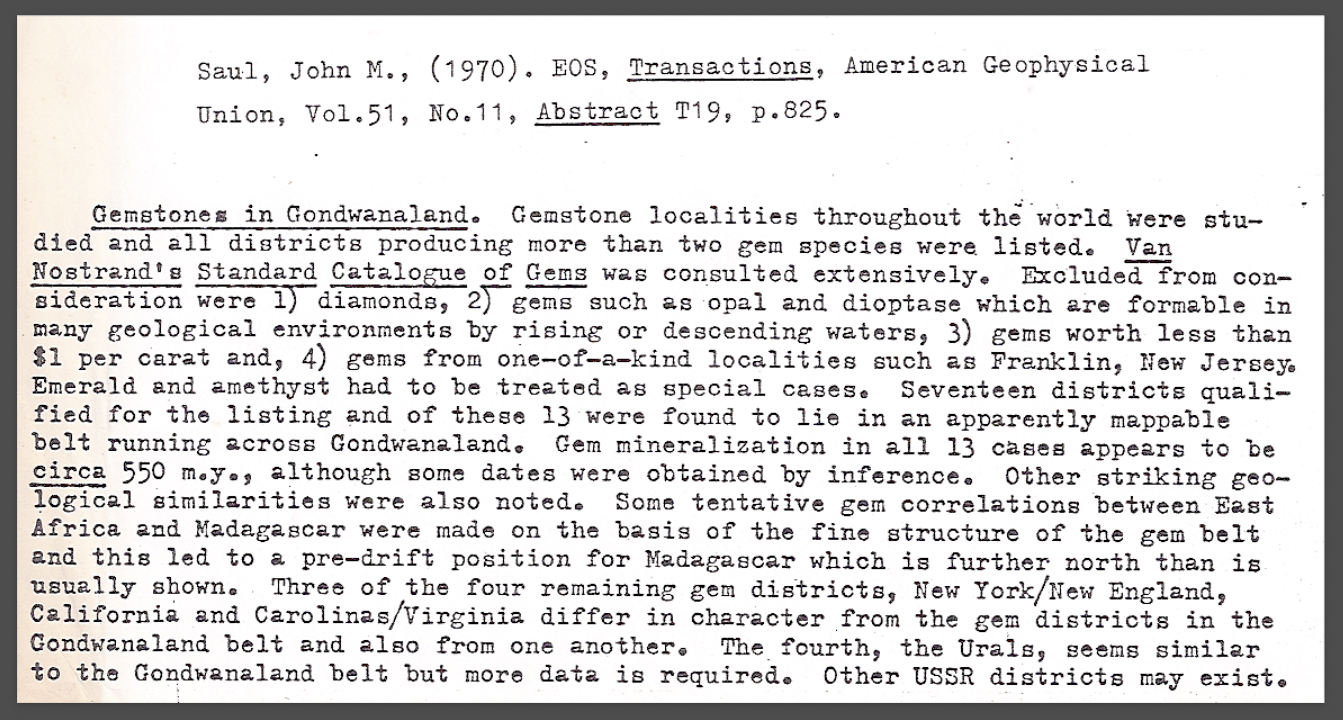
Gemstones in Gondwanaland

Journal Article
Saul, J.M. (1970) Gemstones in Gondwanaland. EOS: Transactions of the American Geophysical Union, Vol. 51, No. 11, Abstract T19, p. 825.
Record No. 27911  |  Sinkankas/Born No.: NIS/NIB  |  RWHL
Gemstones in Gondwanaland. Gemstone localities throughout the world were studied and all districts producing more than two gem species were listed. Van Nostrand’s Standard Catalogue of Gems was consulted extensively. Excluded from consideration were: 1) diamonds; 2) gems such as opal and dioptase which can form in many geological environments via rising or descending waters; 3) gems worth less than $1 per carat; and 4) gems from one-of-a-kind localities such as Franklin, New Jersey. Emerald and amethyst had to be treated as special cases. Seventeen districts qualified for the listing, and of these, 13 were found to lie in an apparently mappable belt running across Gondwanaland. Gem mineralization in all 13 cases appears to be circa 550 million years, although some dates were obtained by inference. Other striking geological similarities were also noted. Some tentative gem correlations between East Africa and Madagascar were made based on the fine structure of the gem belt, leading to a proposed pre-drift position for Madagascar farther north than usually shown. Three of the four remaining gem districts—New York/New England, California, and Carolinas/Virginia—differ in character from the Gondwanaland belt districts and from one another. The fourth, the Urals, seems similar to the Gondwanaland belt but more data is required. Other USSR districts may exist.

Exploring the Literature of Emerald

Emerald literature spans gemology, mineralogy, deposits, identification, treatments, synthesis, history and the gem trade, with important sources covering deposits around the world.

For a curated guide to this subject, read Green Fire — Lotus Gemology's Guide to the Literature of Emerald.

About Four Treasures

Four Treasures is Lotus Gemology's freely accessible gemological reference database. Use the full database to search by author, title or keyword and explore literature on gemology, mineralogy, jewelry and related fields. Where available, hyperlinks on titles may lead directly to the full publication.

Search the Complete Four Treasures Database