Emerald Bibliography

Emerald Bibliography

Explore books, articles and historical sources on emerald in Four Treasures, the Lotus Gemology reference database. This bibliography brings together matching records from the collection, with publication details, abstracts and cover images where available.

Emerald References

The list below matches the terms emerald or emeralds in the database's searchable fields. Some references discuss emeralds as part of a broader subject.
701–720 of 851 matching references

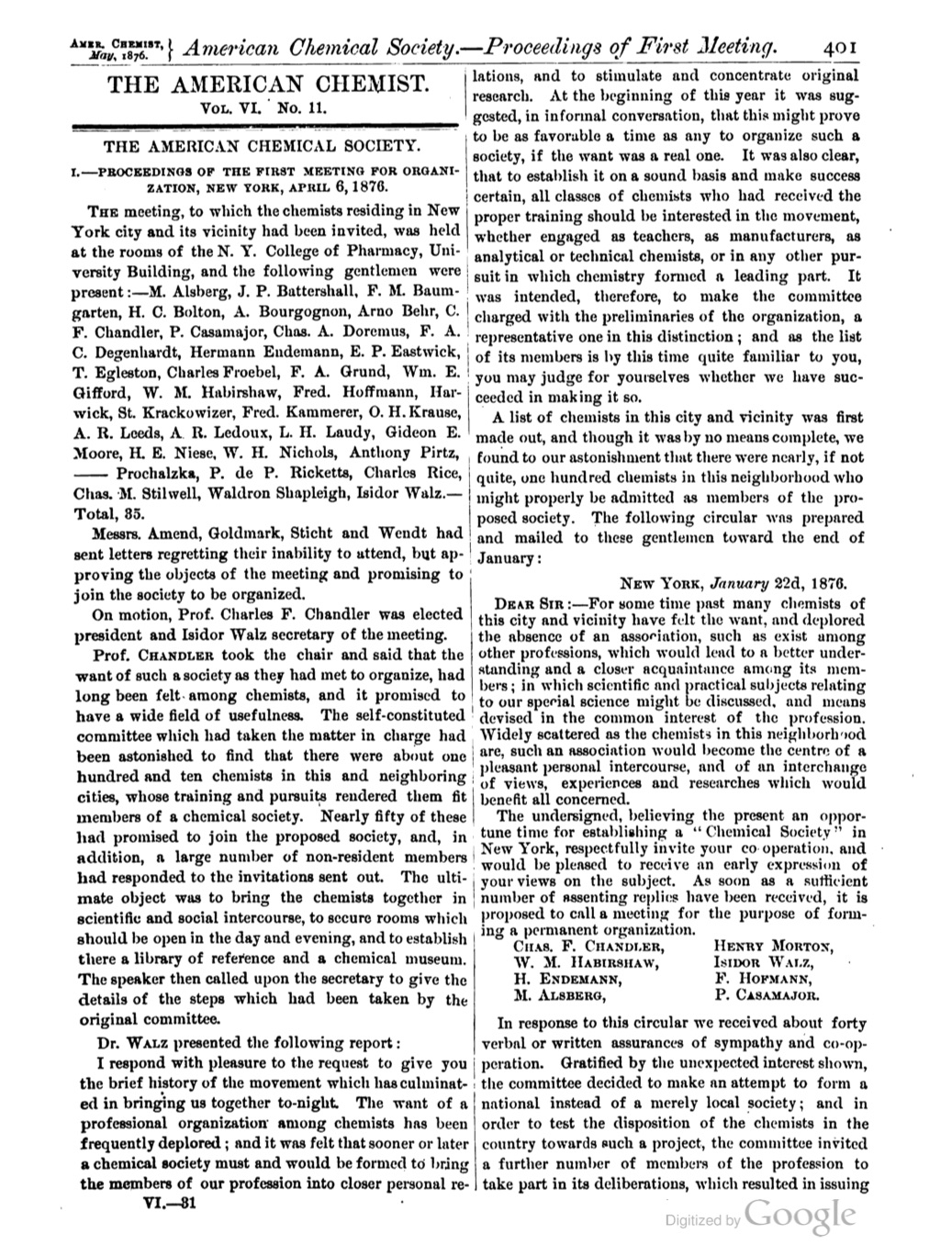
Notes on the early literature of chemistry: The book of the balance of wisdom
Journal Article
Bolton, H.C. (1876) Notes on the early literature of chemistry: The book of the balance of wisdom. American Chemist, Vol. 6, May, pp. 413–422.
Record No. 478  |  Sinkankas/Born No.: NIS/NIB  |  RWHL
A historical study by Henry Carrington Bolton of the twelfth-century Arabic scientific treatise The Book of the Balance of Wisdom (Kitāb Mīzān al-Ḥikma), attributed to al-Khāzinī. Bolton examines the work’s treatment of the balance, hydrostatic weighing and the determination of specific gravity, drawing on the Arabic text and earlier translations and studies. Of particular gemological interest are the tables and discussions of the specific gravities of precious stones and minerals, including such materials as emerald, rock crystal, cornelian, lapis lazuli and pearl. Bolton emphasizes the sophistication and accuracy of medieval Islamic experimental methods and shows that the treatise represents an important early contribution to quantitative mineralogy and the measurement of density. The paper was subsequently reprinted in expanded form as The Book of the Balance of Wisdom: An Essay on Determinations of Specific Gravity by the Arabians of the XIIth Century.

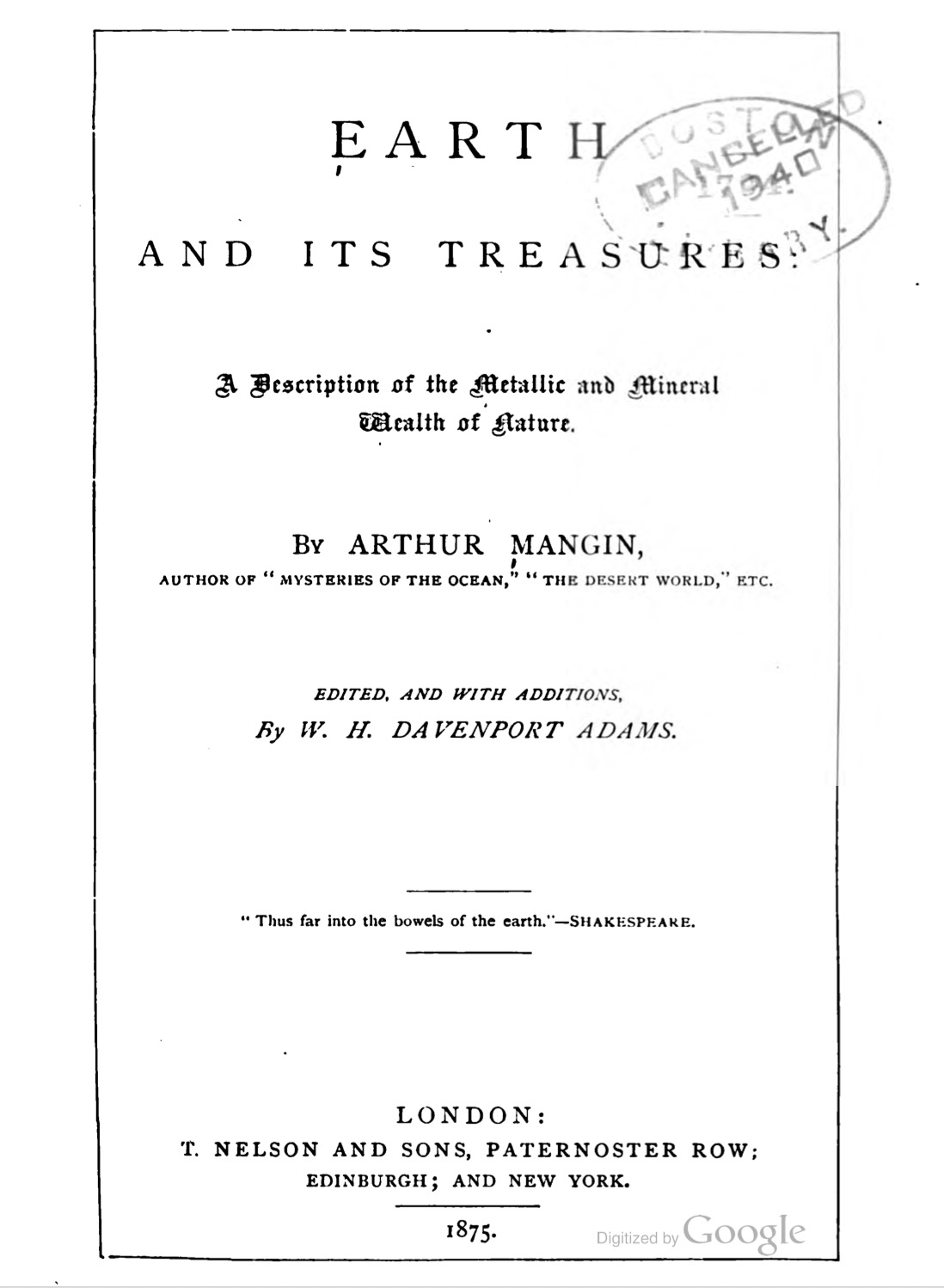
Earth and Its Treasures: A Description of the Metallic and Mineral Wealth of Nature
Book
Mangin, A. and Adams, W.H.D. (1875) Earth and Its Treasures: A Description of the Metallic and Mineral Wealth of Nature. London, T. Nelson and Sons, 405 pp.
Record No. 29948  |  Sinkankas/Born No.: NIS/NIB  |  RWHL
A popular survey of the earth’s mineral and metallic resources, including a substantial chapter on emerald and beryl. The emerald section opens with ancient traditions concerning the gem, including Marbodus, Pliny, and the legendary griffins and Arimaspians, before discussing evidence that true emerald was known in antiquity. Particular attention is given to the Egyptian emerald mines between the Nile and Red Sea and Cailliaud’s exploration of the ancient workings at Mount Zaharah, including his descent into the mines and discovery of emerald crystals in mica-bearing rocks. The authors then discuss the physical properties, varieties, value, cutting, and notable specimens of emerald, together with ancient accounts of its supposed beneficial effect on eyesight and Nero’s reputed use of an emerald to view gladiatorial contests. Colombian (“Peruvian”) emeralds from near Santa Fé de Bogotá are described as the most highly regarded contemporary material, with additional occurrences noted in the Urals, Salzburg, and Ceylon. The chapter concludes with a discussion of beryl and its relationship to emerald, including aquamarine and blue, greenish-yellow, yellow, and colorless varieties, their properties, sources, historical uses, and notable specimens.

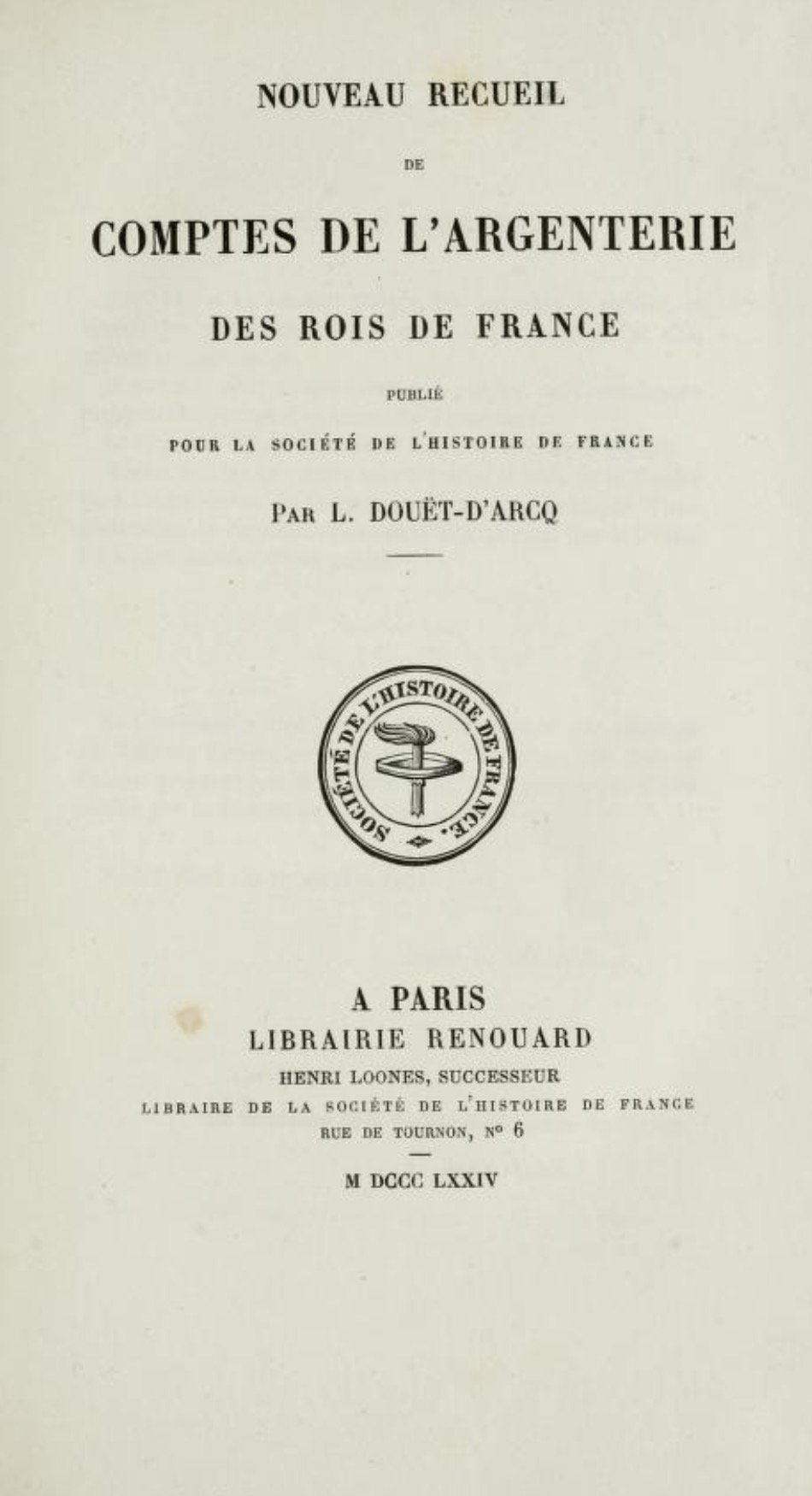
Nouveau recueil de comptes de l’argenterie des rois de France
New Collection of Accounts of the Silver Treasury of the Kings of France
Book
Douët-d’Arq, L. (1874) Nouveau recueil de comptes de l’argenterie des rois de France. [New Collection of Accounts of the Silver Treasury of the Kings of France] Paris, Renouard, 430 pp.
Record No. 17066  |  Sinkankas/Born No.: NIS/NIB  |  Language: in French  |  RWHL
Douët-d’Arcq publishes a collection of medieval accounts relating to the argenterie of the kings of France, providing documentary evidence for royal expenditure on precious objects, jewelry, plate, clothing, and ceremonial furnishings. Drawn from archival records, the accounts record payments to goldsmiths, jewelers, craftsmen, and merchants and describe objects made or acquired for the royal household, often specifying materials, weights, workmanship, and costs. Of particular gemological interest are references to diamonds, rubies, sapphires, emeralds, pearls, and other precious stones employed in royal jewels and ornaments, together with information on their valuation, setting, purchase, and reuse. The work is an important primary source for the history of medieval French jewelry, precious stones, goldsmithing, and the organization and expenditure of the royal treasury.

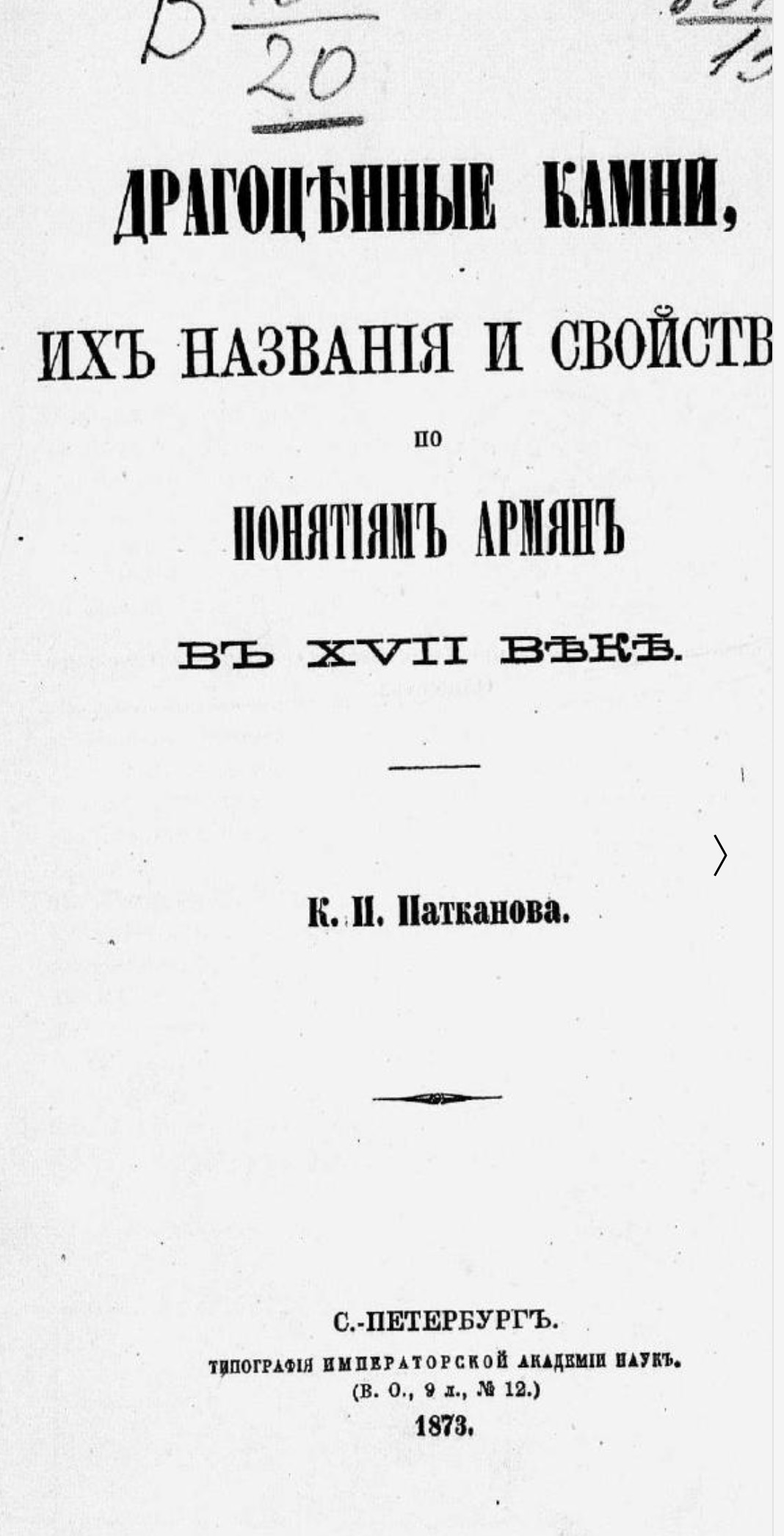
Драгоценные камни, их названия и свойства по понятиям армян в XVII веке
Precious Stones, their Names and Properties among Armenians of Seventeenth Century
Journal Article
Patkanov, K.P. (1873) Драгоценные камни, их названия и свойства по понятиям армян в XVII веке. [Precious Stones, their Names and Properties among Armenians of Seventeenth Century] Труды Восточно-Сибирского отделения Русского археологического общества [Trudy Vostochnogo-Sibirskogo Otdelenie Russkom Arkbeologicbeskikh Obshchestva], Vol. 17, pp. 1–92.
Record No. 29129  |  Sinkankas/Born No.: 5005 (not seen)  |  Language: in Russian  |  RWHL
The book written on behalf of the Imperial Academy of Sciences contains a brief historical introduction dedicated to ancient medieval and oriental collections of lapidary stones a translation of three fragments of works on gems found by the author in the manuscript of the famous Armenian historian of the seventeenth century Arakel Tavrizhetsi (1590–1670) as well as the Armenian text of these fragments. Patkanov examines Armenian knowledge and terminology concerning precious stones in the seventeenth century, drawing upon Armenian manuscripts and lapidary traditions. He discusses the Armenian names of numerous gemstones and minerals, their supposed physical characteristics, colors, sources, varieties, values, and methods of identification, together with the medicinal, magical, and talismanic properties traditionally attributed to them. The study compares and explains terminology and preserves information derived from earlier Near Eastern and Armenian traditions concerning diamonds, rubies, sapphires, emeralds, pearls, turquoise, and other precious and ornamental materials. The work is an important source for the history of Armenian gemology and lapidary literature and for tracing the transmission of mineralogical and gemstone knowledge through the medieval and early modern Near East.

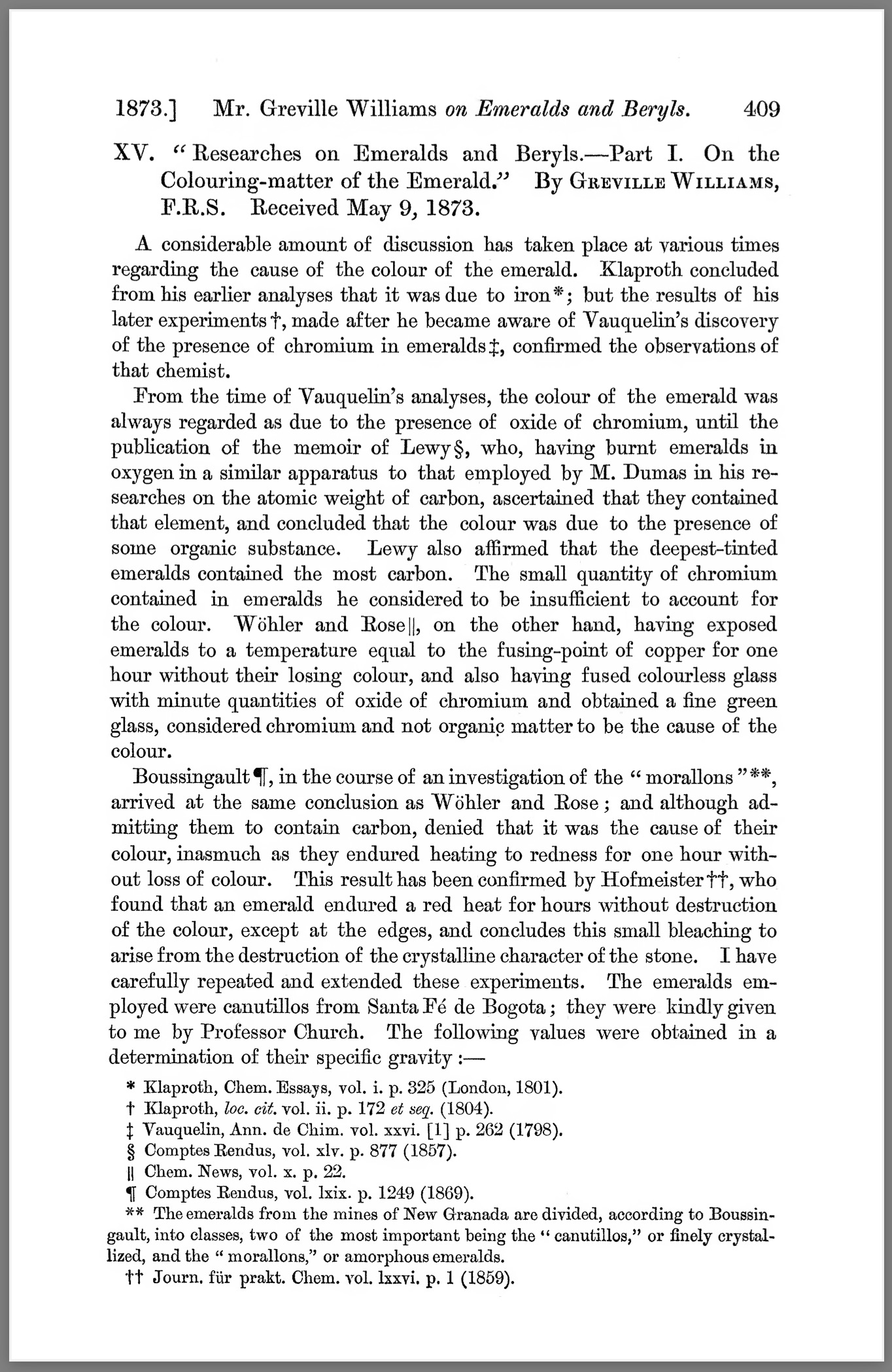
Researchs on emeralds and beryls.—Part I. On the colouring-matter of the emerald
Journal Article
Williams, G. (1873) Researchs on emeralds and beryls.—Part I. On the colouring-matter of the emerald. Proceedings of the Royal Society of London, Vol. 21, pp. 409–421.
Record No. 16699  |  DOI: https://doi.org/10.1098/rspl.1872.0084  |  Sinkankas/Born No.: NIS/NIB  |  RWHL
Williams investigates the cause of the green color of emerald through chemical examination of emeralds and related beryls. He reviews earlier explanations of emerald coloration and analyzes specimens to determine the nature and quantity of the coloring constituent. Particular attention is given to chromium, whose presence he identifies as responsible for the characteristic green color of emerald, countering earlier claims that organic matter might be the principal coloring agent. Williams compares emerald with differently colored and colorless beryls and discusses the relationship between small quantities of chromic oxide and color intensity. The paper is an important nineteenth-century contribution to the chemistry of gemstones and to establishing chromium as the principal chromophore of emerald.

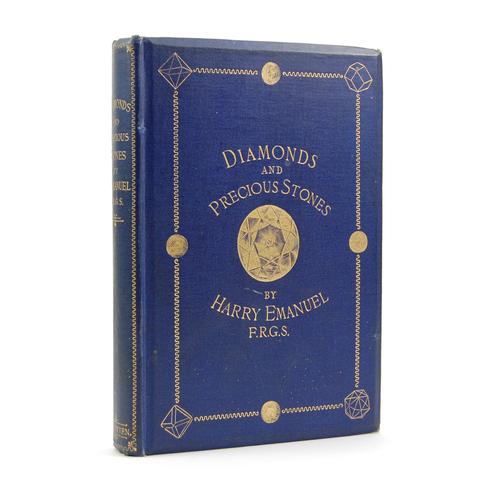
Diamonds and Precious Stones

Book
Emanuel, H. (1873) Diamonds and Precious Stones. New York, G.P. Putnam’s Sons, 266 pp.
Record No. 2752  |  Sinkankas/Born No.: 1888; NIB  |  RWHL
Emanuel presents a practical and historical survey of diamonds and other precious stones, intended particularly for jewelers, merchants, collectors, and general readers. He discusses the physical properties, colors, qualities, sources, cutting, polishing, valuation, and commercial classification of diamonds, rubies, sapphires, emeralds, pearls, opals, turquoise, garnets, and numerous other gem materials. Considerable attention is given to famous diamonds and other celebrated jewels, historic gem-producing localities, methods of distinguishing genuine stones from imitations, and contemporary practices in the gem and jewelry trade. The work provides a useful nineteenth-century account of gemstones from the perspective of the commercial jeweler, combining contemporary gemological knowledge with historical anecdotes and practical information on identification and value.

Antique Gems and Rings

Book
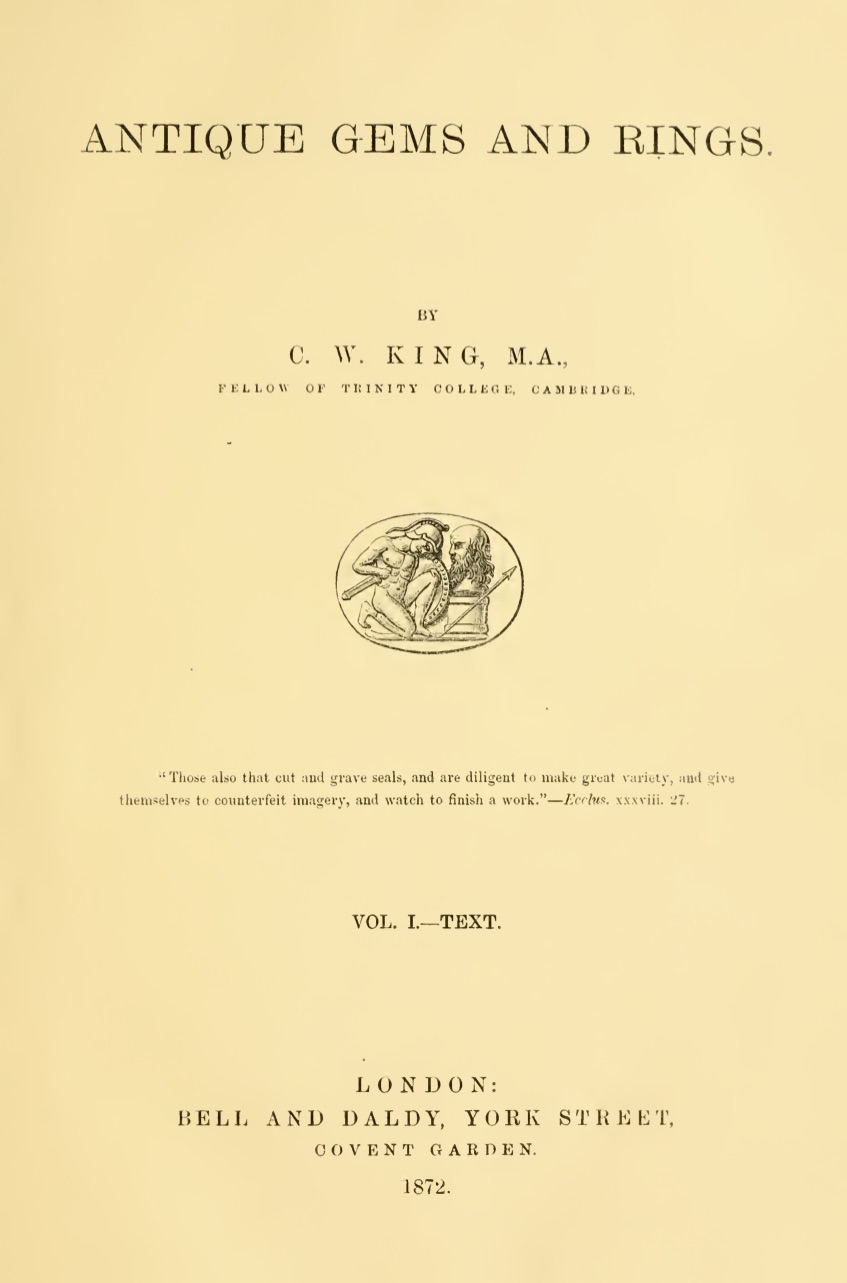
King, C.W. (1872) Antique Gems and Rings. London, Bell and Daldy, 2 Vols., 483 pp.
Record No. 2802  |  Sinkankas/Born No.: 3411; NIB  |  RWHL
King presents an extensive study of ancient engraved gems and finger rings, principally of Greek, Etruscan, and Roman origin, combining archaeological, historical, artistic, and gemological information. He discusses the materials used by ancient engravers—including carnelian, sard, chalcedony, jasper, agate, amethyst, garnet, emerald, sapphire, and other stones—the techniques of engraving and polishing, forms and construction of rings, and the identification and dating of intaglios and cameos. Considerable attention is given to subjects represented on gems, including deities, portraits, mythological scenes, animals, symbols, inscriptions, and magical devices, as well as to their use as seals, ornaments, amulets, and signet rings. King also examines ancient literary sources concerning precious stones, notable collections and individual gems, later imitations and forgeries, and the reuse of classical gems in subsequent periods. The work is an important nineteenth-century synthesis of glyptic art and remains valuable for its detailed observations on engraved gemstones, their materials, manufacture, iconography, and historical use.

The emerald vernicle of the Vatican

Journal Article
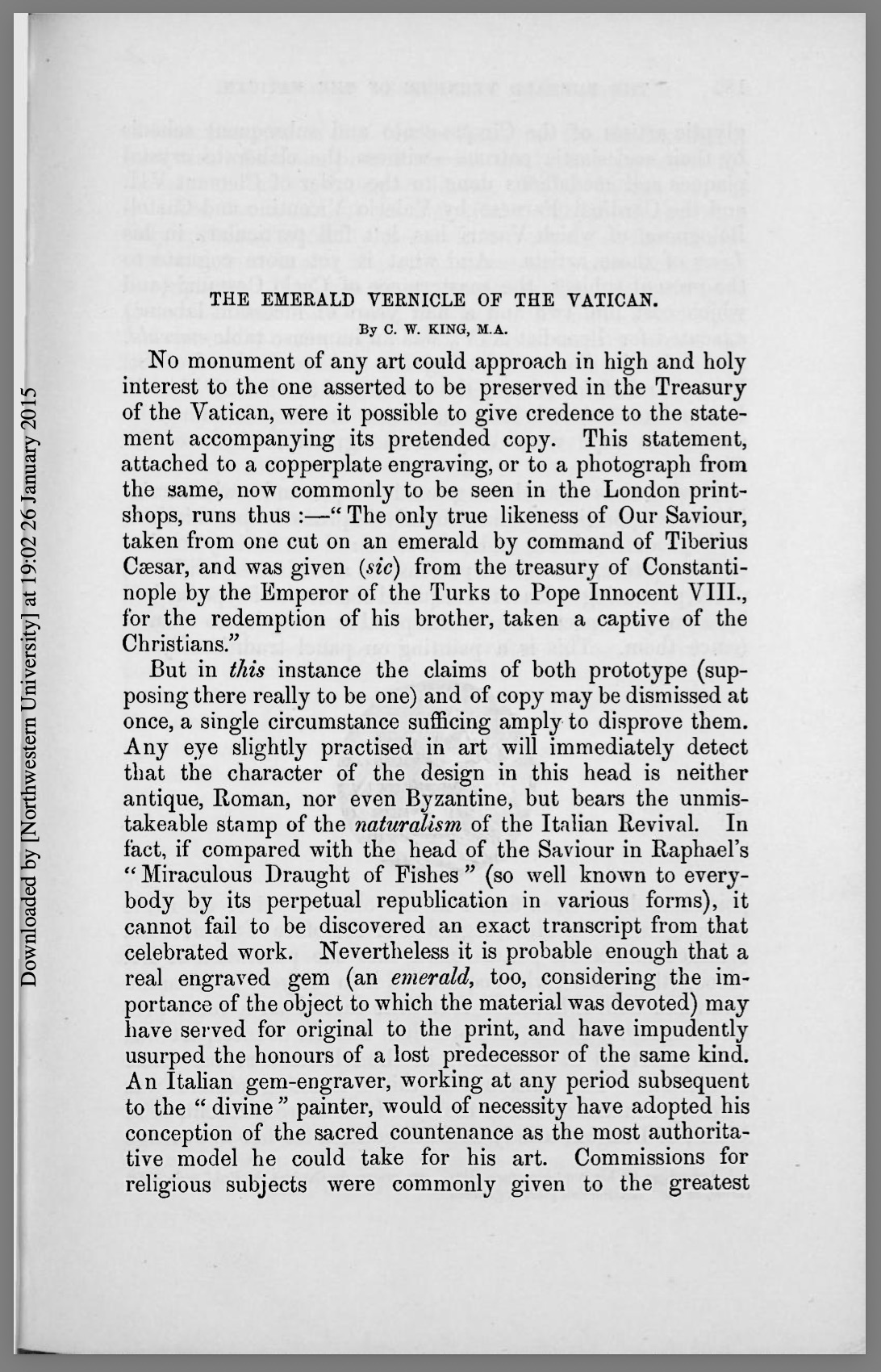
King, C.W. (1870) The emerald vernicle of the Vatican. Archaeological Journal, Vol. 27, No. 1, pp. 181–190.
Record No. 28889  |  ISBN/ISSN: 0066-5983  |  DOI: https://doi.org/10.1080/00665983.1870.10851483  |  Sinkankas/Born No.: NIS/NIB  |  RWHL
No monument of any art could approach in high and holy interest to the one asserted to be preserved in the Treasury of the Vatican, were it possible to give credence to the statement accompanying its pretended copy. This statement, attached to a copperplate engraving, or to a photograph from the same, now commonly to be seen in the London print-shops, runs thus:—“The only true likeness of Our Saviour, taken from one cut on an emerald by command of Tiberius Cæsar, and was given from the treasury of Constantinople by the Emperor of the Turks to Pope Innocent VIII., for the redemption of his brother, taken a captive of the Christians.” But in this instance the claims of both prototype (supposing there really to be one) and of copy may be dismissed at once, a single circumstance sufficing amply to disprove them. Any eye slightly practised in art will immediately detect that the character of the design in this head is neither antique, Roman, nor even Byzantine, but bears the unmistakable stamp of the naturalism of the Italian Revival. In fact, if compared with the head of the Saviour in Raphael’s Miraculous Draught of Fishes (so well known to everybody by its perpetual republication in various forms), it cannot fail to be discovered an exact transcript from that celebrated work. Nevertheless it is probable enough that a real engraved gem (an emerald, too, considering the importance of the object to which the material was devoted) may have served for original to the print, and have impudently usurped the honours of a lost predecessor of the same kind. An Italian gem-engraver, working at any period subsequent to the “divine” painter, would of necessity have adopted his conception of the sacred countenance as the most authoritative model he could take for his art. Commissions for religious subjects were commonly given to the greatest glyptic artists of the Cinquecento and subsequent schools by their ecclesiastic patrons—witness the elaborate crystal plaques and medallions done to the order of Clement VII. and the Cardinal Farnese by Valerio Vicentino and Castel Bolognese, of which Vasari has left full particulars in his Lives of those artists. And what is yet more cognate to the present subject, the masterpiece of Carlo Costanzi (and which cost him two and a half years of incessant labour) executed for Benedict XIV., was an immense table emerald, two inches in diameter, having for obverse the head of St. Peter in relief, for reverse the portrait of the Pontiff himself. It was intended to adorn the morse or clasp fastening the sumptuous cope worn only at the grand festivals of the Church.

Les Pierres Précieuses et les Principaux Ornements
Precious Stones and the Main Ornaments
Book
Rambosson, J. (1870) Les Pierres Précieuses et les Principaux Ornements. [Precious Stones and the Main Ornaments] Paris, Librairie de Firmin Didot Frères, Fils et Cie, 298 pp.
Record No. 2991  |  Sinkankas/Born No.: 5334–5335; NIB  |  Language: in French  |  RWHL
Rambosson presents a popular account of precious stones and the principal ornamental materials, combining mineralogical description with information on their history, sources, cutting, commerce, uses, and cultural significance. He discusses diamonds, rubies, sapphires (sapphires du Puy), emeralds, topaz, garnet, turquoise, opal, pearls, coral, and numerous other gem materials, describing their physical characteristics, colors, principal localities, celebrated specimens, and employment in jewelry and decorative objects. The work also treats methods of cutting and polishing, imitation and artificial stones, and the historical and legendary properties attributed to gems. Intended for a general readership rather than as a strictly technical mineralogical treatise, it provides a broad nineteenth-century survey of contemporary knowledge and popular beliefs concerning gemstones and personal ornament.

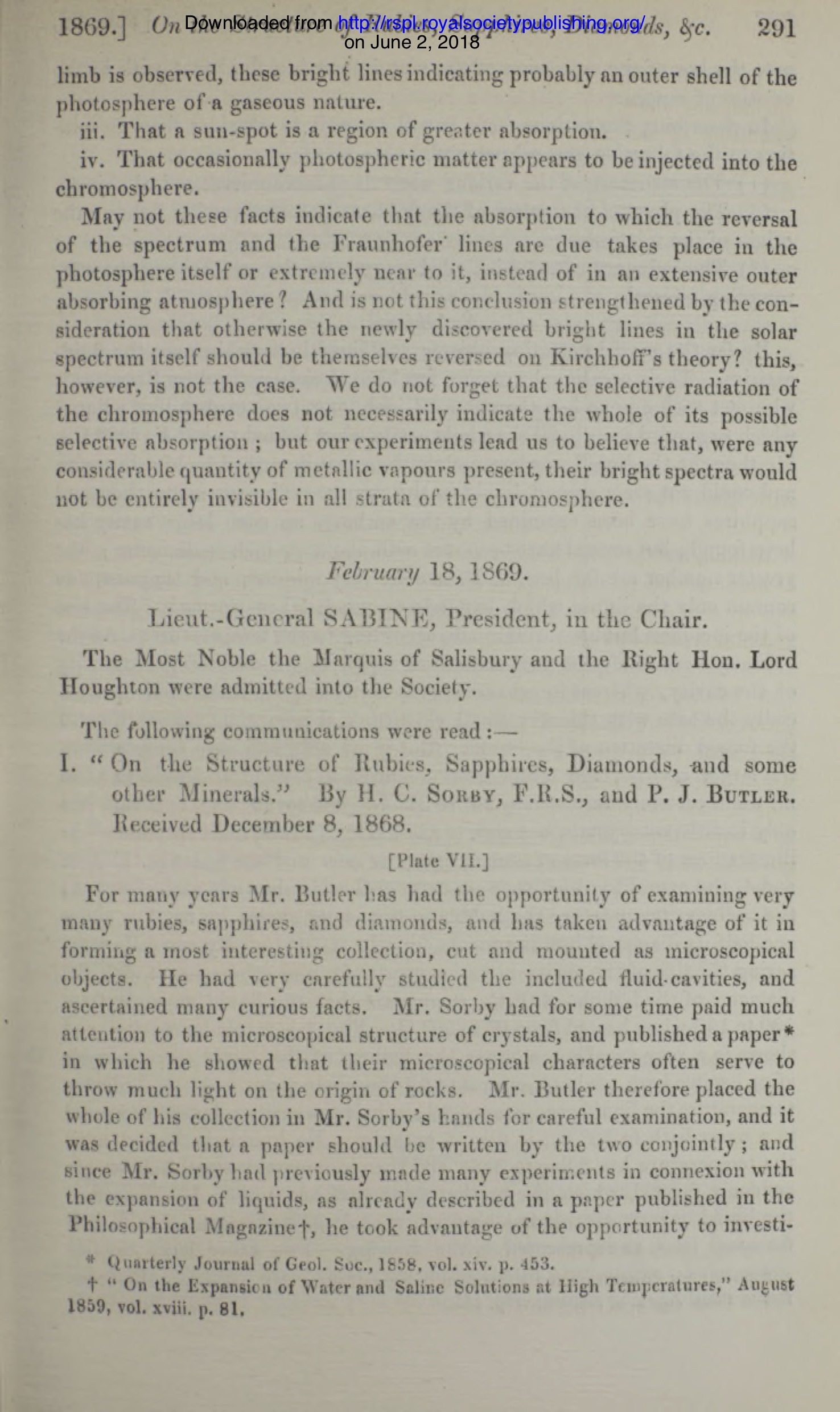
On the structure of rubies, sapphires, diamonds, and some other minerals
Journal Article
Sorby, H.C. and Butler, P.J. (1869) On the structure of rubies, sapphires, diamonds, and some other minerals. Proceedings of the Royal Society of London, Vol. 17, No. 109, pp. 291–302, 1 plate.
Record No. 4995  |  Sinkankas/Born No.: NIS/NIB  |  RWHL
Sorby and Butler investigate the internal structure of rubies, sapphires, diamonds, and other minerals by microscopic examination, using inclusions and growth features to interpret the conditions under which the crystals formed. They describe minute cavities, enclosed crystals, and structural irregularities visible within transparent specimens and compare their character and distribution in different minerals. Particular attention is given to rubies and sapphires, whose internal features provide evidence of successive stages of crystal growth, and to diamonds, in which inclusions and structural characteristics are likewise examined. The authors argue that microscopic features preserved within crystals can provide important evidence concerning their origin and formation. The paper is an important early contribution to the systematic microscopy of gemstones and helped establish the study of inclusions and internal growth structures as a means of investigating mineral genesis.

The Blacas Gems, Part 3

Journal Article
King, C.W. (1867) The Blacas Gems, Part 3. Archaeological Journal, Vol. 24, No. 1, pp. 300–14.
Record No. 28902  |  ISBN/ISSN: 0066-5983  |  DOI: https://doi.org/10.1080/00665983.1867.10851378  |  Sinkankas/Born No.: NIS/NIB  |  RWHL
King concludes his examination of the Blacas collection with a survey of figures and groups on ancient and later engraved gems, followed by sections on Gnostic stones, cameos, and modern intagli. He discusses a wide range of mythological and religious subjects, including Bacchantes, Silenus and Bacchus, Hercules, Omphale, Diomedes, Prometheus, Apollo, Ceres, Cupid and Psyche, Medusa, and scenes connected with the Trojan cycle, assessing each according to style, workmanship, material, iconography, and probable date. Particular attention is given to the gemstones themselves, including sard, sardonyx, amethyst, plasma, jasper, jacinth, agate, emerald, turquoise, and antique glass pastes; notable examples include a deep-green plasma resembling emerald, an actual emerald engraved with Jupiter and Antiope, a pale-green antique paste imitating peridot, a Medusa carved from a large Peruvian emerald, and a rare green turquoise cameo depicting the Indian Bacchus. King also examines Gnostic and magical gems combining Egyptian, Mithraic, and astrological imagery, while noting the relatively poor representation of Assyrian, Persian, and Sasanian glyptic art in the collection. A substantial portion of the article is devoted to cameos, particularly imperial portraits, whose traditional identifications King frequently challenges through comparison of physiognomy, style, technique, and historical evidence. Most notably, he reidentifies the celebrated cameo traditionally called Constantine Junior as Augustus, arguing that its jeweled diadem was a Byzantine modification replacing an original laurel wreath. He likewise questions identifications of Livia, Licinius, Ptolemaic rulers, and other portraits and repeatedly distinguishes genuine ancient works from Renaissance and modern imitations. The final section treats Renaissance and later glyptic masterpieces associated with Matteo del Nassaro, Giovanni dal Castel Bolognese, Valerio Vicentino, Pichler, and other engravers, including the celebrated rock-crystal intaglio of Tityus and the Vulture, engraved by Giovanni from a design by Michelangelo. Throughout, King combines description with critical connoisseurship, using stone type, cutting technique, inscriptions, iconography, provenance, literary testimony, and comparison with coins and other works of art to assess attribution, date, and authenticity.

Precious stones, their prestige chiefly due to fashion
Journal Article
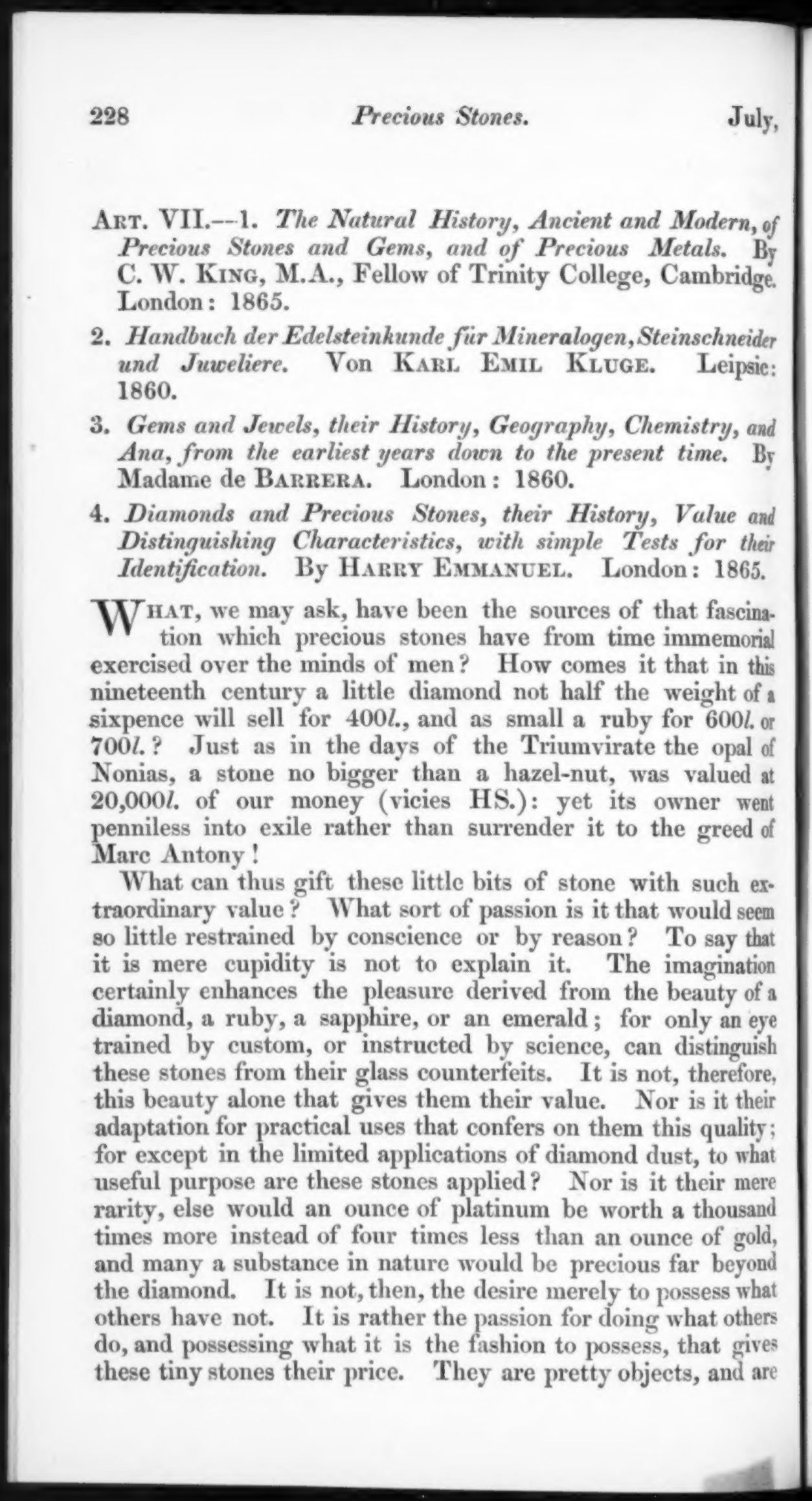
Anonymous (1866) Precious stones, their prestige chiefly due to fashion. Edinburgh Review, Vol. 124, No. 253, July, pp. 228–260.
Record No. 29105  |  Sinkankas/Born No.: 3401  |  RWHL
The anonymous author surveys precious stones from historical, mineralogical, commercial, and social perspectives, arguing that much of their exceptional monetary value and prestige derives from fashion, rarity, and human convention rather than intrinsic usefulness. The article discusses diamonds and the principal colored gemstones, their celebrated historical examples, sources, physical properties, cutting, valuation, and use in personal ornament, while examining changing preferences for particular gems in different periods and societies. Considerable attention is given to famous jewels and royal collections and to the influence of new discoveries and changing supplies upon prices. The author contrasts the enormous sums paid for certain stones with their limited practical utility and emphasizes the roles of taste, scarcity, fashion, and social display in creating demand. The article provides a broad mid-nineteenth-century view of the gem trade and of contemporary attitudes toward the economic and cultural value of precious stones.

Analysis and extracts of كتاب ميزان الحكمة Book of the Balance of Wisdom, an Arabic work on the water-balance written by al-Khâzinî in the Twelfth Century
Journal Article
Khanikoff, N. (1860) Analysis and extracts of كتاب ميزان الحكمة Book of the Balance of Wisdom, an Arabic work on the water-balance written by al-Khâzinî in the Twelfth Century. Journal of the American Oriental Society, Vol. 6, pp. 1–128.
Record No. 4577  |  Sinkankas/Born No.: NIS/NIB  |  RWHL
Khanikoff presents an extensive analysis and extracts from al-Khāzinī’s twelfth-century Arabic Kitāb Mīzān al-Ḥikma [Book of the Balance of Wisdom], an important medieval treatise on balances, hydrostatics, and the determination of specific gravity. The work describes the construction and operation of highly sensitive balances, methods of weighing substances in air and water, and procedures for determining the specific gravities of metals, minerals, precious stones, and liquids. Of particular gemological importance are numerical data for precious stones and minerals—including ruby, emerald, diamond, sapphire, and quartz—and discussions of their identification by density. Khanikoff also examines al-Khāzinī’s reliance on earlier Greek and Islamic scientific traditions, particularly Archimedes and al-Bīrūnī, whose experimental determinations of specific gravity are preserved in the treatise. The paper provides an important nineteenth-century Western account of medieval Islamic achievements in quantitative mineralogy and demonstrates the sophisticated application of hydrostatic weighing to the examination and identification of gemstones centuries before the development of modern gemology.

Gems and Jewels: Their History, Geography, Chemistry, and Ana
Book
Barrera, A., de (1860) Gems and Jewels: Their History, Geography, Chemistry, and Ana. London, Richard Bentley, 382 pp.
Record No. 2707  |  Sinkankas/Born No.: 409; NIB  |  RWHL
De Barrera presents a popular but wide-ranging survey of gemstones and jewelry, combining their history, geographical sources, physical and chemical properties, valuation, cutting, trade, and use in personal ornament. Individual sections treat the principal gems—including diamond, ruby, sapphire, emerald, topaz, garnet, amethyst, turquoise, opal, pearl, and other ornamental materials—with accounts of famous specimens, historical traditions, mining localities, and contemporary commercial practices. The book also discusses methods of distinguishing gems, their hardness, specific gravity, color, and composition, together with imitation stones and aspects of lapidary work and jewelry manufacture. Drawing extensively on earlier mineralogical, historical, and travel literature, the volume provides a useful picture of popular and commercial gemological knowledge in Britain around the middle of the nineteenth century, before gemology emerged as a distinct scientific discipline.

Analysis and extracts of ﺘﺎﺏ ﻣﻴﺰﺍﻥ ﺍﻟﺤﻜﻤﺔ – Book of the Balance of Wisdom, an Arabic work on the water-balance, written by al-Khazini in the twelfth century
Journal Article
Khanykov, N.V. (1858) Analysis and extracts of ﺘﺎﺏ ﻣﻴﺰﺍﻥ ﺍﻟﺤﻜﻤﺔ – Book of the Balance of Wisdom, an Arabic work on the water-balance, written by al-Khazini in the twelfth century. Journal of the American Oriental Society, Vol. 6, pp. 1–128.
Record No. 28391  |  Sinkankas/Born No.: NIS/NIB  |  RWHL
Khanykov presents an extensive analysis, translation, and series of extracts from al-Khāzinī’s twelfth-century Arabic Kitāb Mīzān al-Ḥikma [Book of the Balance of Wisdom], a major medieval treatise on hydrostatics, specific gravity, and the construction and use of balances. The work describes sophisticated balances designed for determining the relative weights and specific gravities of substances in air and water, discusses principles derived from Archimedes and earlier Greek and Islamic scholars, and preserves information from works otherwise lost or imperfectly known. Of particular gemological importance are tables and discussions of the specific gravities of minerals, metals, and precious stones, including ruby, sapphire, emerald, diamond, quartz, and other materials, together with methods for distinguishing substances through quantitative measurement. Khanykov compares al-Khāzinī’s results with those attributed to earlier investigators, notably al-Bīrūnī, demonstrating the high level of experimental precision achieved by medieval Islamic scientists. The paper provides one of the earliest substantial European-language accounts of The Book of the Balance of Wisdom and is an important source for the history of hydrostatics, mineralogy, and quantitative gem testing.

Recherches sur la formation et al composition des émeraudes
Studies of the formation and composition of emeralds
Journal Article
Lewy, B. (1857) Recherches sur la formation et al composition des émeraudes. [Studies of the formation and composition of emeralds] Comptes Rendus Hebdomadaires des Séances de l’Académie des Sciences, Vol. 45, pp. 877–881.
Record No. 29398  |  Sinkankas/Born No.: NIS/NIB  |  Language: in French  |  RWHL
Lewy reports chemical and geological investigations of emeralds from the Muzo deposits of New Granada (Colombia). From analyses of several emerald specimens, he found silica, alumina, glucina (beryllia), and small quantities of other constituents, but was unable to detect sufficient chromium to account for their green color. Instead, he identified a small amount of organic matter whose abundance appeared to vary with the intensity of the green coloration and proposed that this organic substance, rather than chromium oxide, was responsible for the color. Drawing on observations of the Muzo occurrence, where emeralds occur in association with fossiliferous limestone, Lewy further argued that the crystals had formed by a “wet” process, through deposition from aqueous solutions. His conclusions concerning both emerald coloration and formation were controversial and were subsequently challenged, particularly his rejection of chromium as the principal cause of color. A more extensive version of the study appeared in Annales de Chimie et de Physique in 1858.

Historiadores Primitivos de Indias

Early Historians of the Indies
Edited Book
Vedia, E., de, editor (1853) Historiadores Primitivos de Indias. [Early Historians of the Indies]. Madrid, M. Rivadeneyra, 574 pp..
Record No. 8168  |  Sinkankas/Born No.: NIS/NIB  |  Language: in Spanish  |  RWHL
Edited by Enrique de Vedia, this volume brings together Spanish accounts of the discovery, conquest, and early colonial history of the Americas, reprinting works by several of the principal sixteenth-century chroniclers of the Indies. Published as part of the Biblioteca de Autores Españoles, it preserves important early descriptions of the peoples, geography, natural resources, customs, and material culture encountered by the Spaniards in the New World. Of particular relevance to gemological and historical research are references in the collected chronicles to indigenous goldwork, pearls, emeralds, precious and ornamental stones, and the valuables obtained through trade, tribute, and conquest. As a nineteenth-century compilation of otherwise difficult-to-consult early texts, the volume became a useful source for the study of Spanish-American history and early European accounts of New World mineral and gem resources.

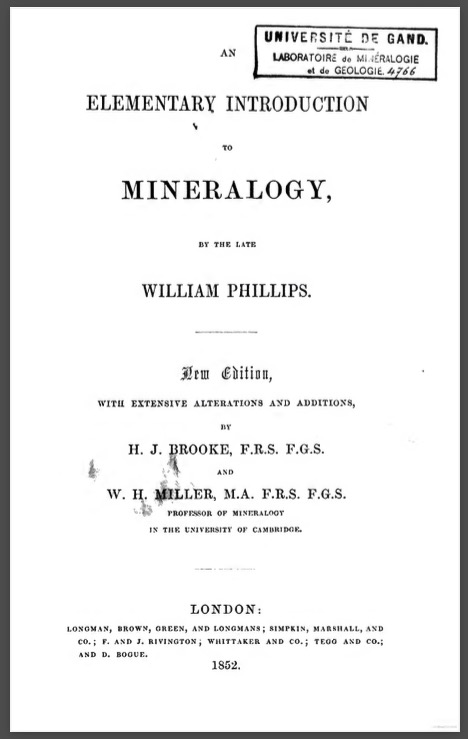
An Elementary Introduction to Mineralogy
Book
Phillips, W., Brooke, H.J. and Miller, W.H. (1852) An Elementary Introduction to Mineralogy. London, Longman, Brown, Green, and Longmans, 700 pp.
Record No. 7468  |  Sinkankas/Born No.: NIS/NIB  |  RWHL
This substantially revised edition of William Phillips’s classic mineralogical textbook presents a systematic introduction to mineralogy based principally on crystallographic form, physical properties, chemical composition, and geological occurrence. Revised and enlarged by Henry James Brooke and William Hallowes Miller, it incorporates the major advances in crystallography and mineral chemistry made since Phillips’s earlier editions, with Miller’s crystallographic expertise giving the work particular scientific importance. Individual mineral species are described with their characteristic crystal forms, cleavage, hardness, specific gravity, lustre, colour, composition, localities, and varieties, including numerous minerals of gemological interest such as diamond, corundum (ruby and sapphire), spinel, beryl (emerald), topaz, tourmaline, garnet, quartz, zircon, and feldspar. The volume provides a useful mid-nineteenth-century record of mineral classification and nomenclature at a period when crystallography and chemical analysis were becoming firmly established as the foundations of systematic mineralogy.

Travels in the Mogul Empire: AD 1656–1668
Book
Bernier, F. (1826) Travels in the Mogul Empire: AD 1656–1668. London, William Pickering, 2 Vols., 280, 280 pp.
Record No. 460  |  Sinkankas/Born No.: NIS/NIB  |  RWHL
Bernier recounts his travels and experiences in the Mughal Empire between 1656 and 1668, during which he served for several years as a physician at the imperial court and observed at close hand the reigns of Shah Jahan and Aurangzeb. He gives a detailed eyewitness account of the struggle for succession among Shah Jahan’s sons, the defeat of Dara Shikoh, and Aurangzeb’s accession, together with descriptions of the imperial court, army, administration, taxation, landholding, cities, commerce, crafts, and social and religious customs. His journeys include extensive observations on Delhi, Agra, Bengal, and Kashmir, whose landscape and products he describes at length. Of particular gemological interest are Bernier’s observations on the enormous wealth of the Mughal court, including diamonds, pearls, rubies, emeralds, and other precious stones displayed in imperial regalia and the celebrated Peacock Throne, as well as his discussion of the diamond mines and trade of Golconda. The work provides an important seventeenth-century European eyewitness account of the production, commerce, valuation, and conspicuous consumption of gems within the Mughal Empire.

Turquoise of Persia

Journal Article
Anonymous (1823) Turquoise of Persia. Edinburgh Philosophical Journal, Vol. 8, No. 16, pp. 404–405.
Record No. 29054  |  Sinkankas/Born No.: NIS/NIB  |  RWHL
In the Bazar, at Bushehr, and at every large town in Persia, a multiplicity of small turquoises, and sometimes garnets, rubies, and other coloured stones, might be purchased, set in silver as rings; the Mahommedans, at least the men, not wearing such ornaments set in gold. The turquoise is an universal favourite, called firuzeh, or more properly firuzelj by the Persians, who believe that to look on it, when first awake in the morning, ensures prosperity, and highly strengthens and preserves the sight during the whole day. To look on the emerald also, is considered by the Persians as good for the eyes. It appears from Theophrastus, that the ancient Greeks entertained this opinion; ἡ σμάραγδος πρὸς τὰ ὄμματα, ὑγιεινή [Greek badly garbled in the original scan; rendered here as a best-effort reconstruction]. In the Classical Journal, No. I. p. 65, March 1810, some observations on the emerald may be found, which I derived chiefly from the Juaher Namah, a Persian manuscript in my own collection, and below more fully quoted. These observations, from motives of secrecy which no longer exist, I communicated under a borrowed character, and the signature of Philosmaragdos. The efficacy of the turquoise, however, in this respect, does not altogether depend on magnitude; and, to the lower classes, a firuzeh, not so large as a grain of wheat, (but seldom perfect), is sold with the silver setting for about one shilling. Such rings are daily seen on the coarse fingers of the muleteers, grooms, and tent-pitchers; but when large, of a fine uniform colour, and free from blemish, their price is considerable, and I found at Cazvin that it was no longer possible to purchase for half a crown, like Olearius when there in 1637, turquoises equal in bigness to pease or beans. This ingenious traveller, and after him Chardin, Tavernier and others, mention Nishapur and Firuzkuh, as yielding turquoises most abundantly; but I could not learn whilst at Firuzkuh in 1812, that it was then remarkable for such a production. The Firuzehs of Nishapur were more excellent than any others, as all accounts agree in stating. A manuscript treatise on precious stones, entitled the Juaher Namah, enumerates three places besides, which furnish mines of turquoises. Hamdallah Cazwini says, that the Firuzeh, when he lived, (between four and five hundred years ago), was chiefly worn by women, and considered (as it is now) inferior in value to the zumrad or emerald. Sehem-ad-Dín, an author of the eleventh century, tells us that, “Piruzeh,” (for so he writes it according to the original Persian orthography), “being a stone without brilliancy, was not reckoned fit for the decoration of kings; but, on account of the name, (which signifies Victories or Fortunate), it was regarded as auspicious and lucky.” Eastern mineralogists always rank the turquoise among stones; late experiments have cast some doubt on the propriety of such a classification. —Sir William Gore Ouseley's Travels, vol. i. p. 210

Exploring the Literature of Emerald

Emerald literature spans gemology, mineralogy, deposits, identification, treatments, synthesis, history and the gem trade, with important sources covering deposits around the world.

For a curated guide to this subject, read Green Fire — Lotus Gemology's Guide to the Literature of Emerald.

About Four Treasures

Four Treasures is Lotus Gemology's freely accessible gemological reference database. Use the full database to search by author, title or keyword and explore literature on gemology, mineralogy, jewelry and related fields. Where available, hyperlinks on titles may lead directly to the full publication.

Search the Complete Four Treasures Database