Gemology Books Bibliography

Gemology Books Bibliography

Explore books on gems, gemology, jewelry and mineralogy in Four Treasures, the Lotus Gemology reference database. This bibliography brings together matching book records from the collection, with publication details, abstracts and cover images where available.

Gemology Book References

The list below matches books concerning gemology and related subjects in the database's searchable fields. Some works cover several branches of gems, jewelry or mineralogy.
2,641–2,660 of 3,454 matching references

Leucite: A gem of volcanic origin

Journal Article
Gübelin, E.J. (1959) Leucite: A gem of volcanic origin. Gems & Gemology, Vol. 9, No. 11, Fall, pp. 333–335, 350.
Record No. 2058  |  ISBN/ISSN: 0016626X  |  RWHL

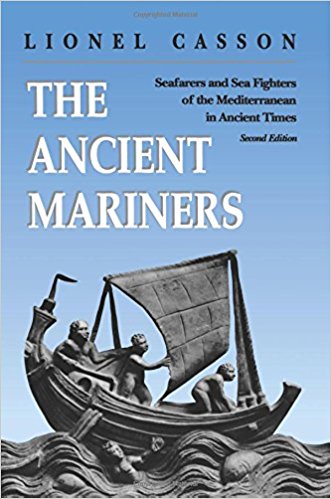
The Ancient Mariners

Book
Casson, L. (1959) The Ancient Mariners. London, Victor Gollancz Ltd., 286 pp.
Record No. 43  |  RWHL
Written by the renowned authority on ancient ships and seafaring Lionel Casson, The Ancient Mariners has long served the needs of all who are interested in the sea, from the casual reader to the professional historian. This completely revised edition takes into account the fresh information that has appeared since the book was first published in 1959, especially that from archaeology's newest branch, marine archaeology. Casson does what no other author has done: he has put in a single volume the story of all that the ancients accomplished on the sea from the earliest times to the end of the Roman Empire. He explains how they perfected trading vessels from mere rowboats into huge freighters that could carry over a thousand tons, how they transformed warships from simple oared transports into complex rowing machines holding hundreds of marines and even heavy artillery, and how their maritime commerce progressed from short cautious voyages to a network that reached from Spain to India.

The Powder Method in X-ray Crystallography
Book
Azaroff, L.V. and Bueger, M.J. (1958) The Powder Method in X-ray Crystallography. New York, MacGraw-Hill, 342 pp.
Record No. 26929  |  Sinkankas/Born No.: NIS/NIB  |  RWHL
Instruction in the various laboratory methods for investigating crystals has long been part of the mineralogy and geology curriculum at the Massachusetts Institute of Technology, encompassing both optical and x-ray techniques. While suitable texts exist for optical methods, there has been no adequate textbook on the x-ray powder method. To support lectures and prepare students for laboratory work, the authors initially wrote a set of notes on the theory and practice of this method, which eventually evolved into this book. The expanded format allowed for more detailed discussion and the inclusion of advanced material beyond what could be covered in a short course. The powder method is inherently simple yet widely valuable across science and industry, often used by individuals with no formal training in crystallography. This book is written with such users in mind, maintaining a fundamental approach while assuming only limited prior knowledge. It omits detailed coverage of general crystallography, x-ray generation, and equipment beyond powder cameras, as these are addressed in other sources. Detection methods using photographic film are emphasized, given their simplicity and permanence, despite the growing use of ionization-type detectors. The principles outlined apply regardless of detection technique, but film is expected to remain relevant in routine applications for the foreseeable future.

Ascertaining the nature and extent of damage or inherent flaws in gemstones
Journal Article
Crowningshield, G.R. (1958) Ascertaining the nature and extent of damage or inherent flaws in gemstones. Gems & Gemology, Vol. 9, No. 5, Spring, pp. 131–133, 159.
Record No. 26766  |  Sinkankas/Born No.: NIS/NIB  |  RWHL
The Gem Trade Laboratories of the Gemological Institute of America are frequently called on to render opinions regarding the nature of cracks and flaws in many varieties of stones. Most often, the question is whether a crack is inherent, partly inherent and extended, or due to damage that occurred after the stone was polished. It is my purpose here to set forth the methods used by the staff of the Laboratories in arriving at an opinion based on careful microscopic observations. It is common knowledge that insurance companies do not require very much information about jewelry before issuing policies and collecting premiums. Most jewelers have experienced cases where this practice has been troublesome, if not embarrassing. Few jewelers make a detailed diagram of inherent flaws in stones they sell or appraise, other than perhaps in diamonds, since insurance companies do not demand it. Therefore, stones with inherent fractures are frequently insured that may later be mistaken for damage, causing an unnecessary and time-consuming settlement. Let us reconstruct a hypothetical case in which an insured customer first believes he has damaged a stone. One day the insured trips and falls and believes that he has struck his star sapphire on the concrete floor. His first thought, after seeing that no bones are broken, is to inspect his star sapphire. For the first time the stone is examined carefully, perhaps with strong transmitted light. Sure enough, there is a crack! The insurance company and an adjuster are notified, and he sees the crack. The jeweler is notified. He inspects the stone with his loupe and admits that he sees a crack too. All too often the insurance company pays off, but not before considerable time and effort have been expended.

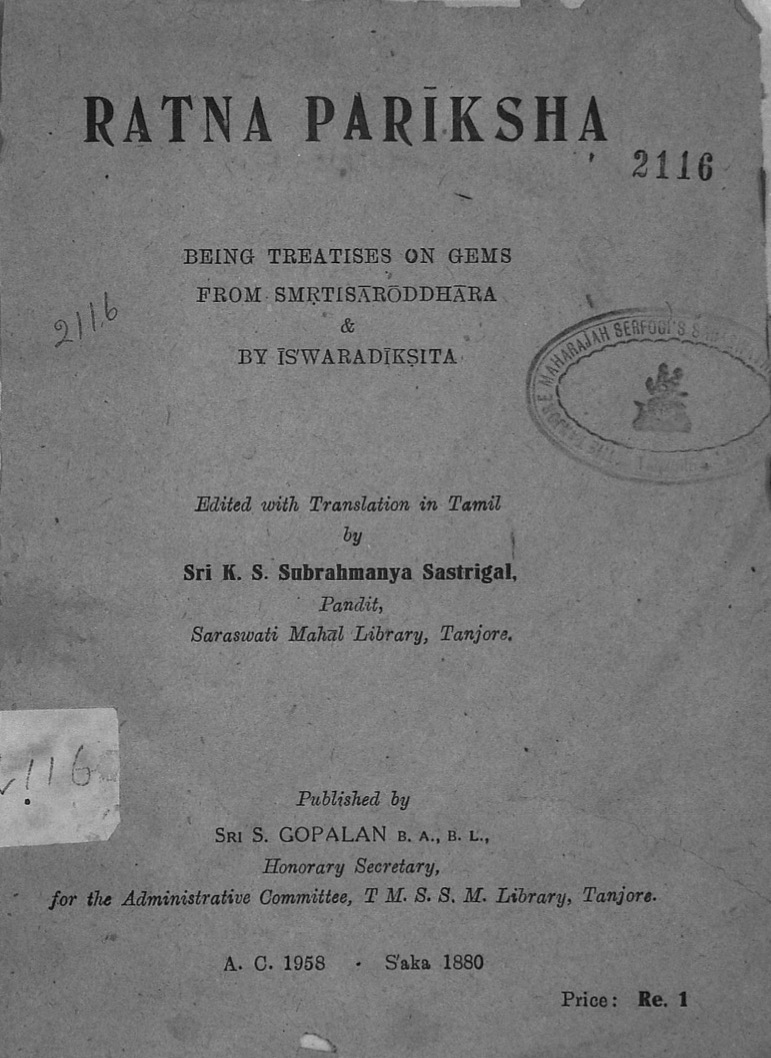
Ratna Pariksha | Being Treatises on Gems from Smrtisaarooddhaara & by Iswaradiiksita
Book
Smrtisaarooddhaara and Iswaradiksita (1958) Ratna Pariksha | Being Treatises on Gems from Smrtisaarooddhaara & by Iswaradiiksita. Srirangam, Sri Vani Vilas Press, 62 pp.
Record No. 16848  |  Sinkankas/Born No.: NIS/NIB  |  Language: in Sanskrit/Tamil  |  RWHL
This small volume brings together two Sanskrit treatises on the traditional Indian examination of gemstones, one extracted from the Smṛtisāroddhāra and the other attributed to Īśvaradīkṣita, with the Sanskrit text in Devanagari accompanied by a Tamil translation by K. S. Subramanya Sastri. The works belong to the Indian ratna-parīkṣā tradition, in which precious stones are classified and assessed according to their appearance, physical characteristics, desirable qualities, defects, provenance, and suitability for use. Attention is given to the recognition and valuation of gems and to traditional ideas concerning the beneficial or harmful effects associated with stones of particular qualities. The volume is valuable for preserving relatively short Sanskrit sources on practical gem knowledge and for illustrating the close relationship in traditional Indian gemology between observation and commercial evaluation on the one hand and religious, astrological, and cultural concepts on the other. The two texts were originally issued in 1958 in the journal of the Tanjore Maharaja Serfoji’s Sarasvati Mahal Library.

Emeralds from Sandawana

Journal Article
Gübelin, E.J. (1958) Emeralds from Sandawana. Journal of Gemmology, Vol. 6, No. 8, October, pp. 340–354.
Record No. 2055  |  ISBN/ISSN: 221252  |  Sinkankas/Born No.: 2566  |  RWHL

Notes on the new emeralds from Sandawana
Journal Article
Gübelin, E.J. (1958) Notes on the new emeralds from Sandawana. Gems & Gemology, Vol. 9, No. 7, Fall, pp. 195–203.
Record No. 2054  |  ISBN/ISSN: 0016626X  |  RWHL

Notes on asterism in corundum, rose quartz and almandine garnet and chatoyancy in beryl
Journal Article
Eppler, W.F. (1958) Notes on asterism in corundum, rose quartz and almandine garnet and chatoyancy in beryl. Journal of Gemmology, Vol. 6, No. 5, January, pp. 195–212.
Record No. 715  |  ISBN/ISSN: 221252  |  RWHL

Color changes in irradiated gemstones
Journal Article
Burbage, E. and Jones, T.G. (1957) Color changes in irradiated gemstones. Journal of Gemmology, Vol. 6, No. 2; April, pp. 74–77.
Record No. 4727  |  ISBN/ISSN: 221252  |  RWHL

Application of phase contrast microscopy in gemmology
Journal Article
Gübelin, E.J. (1957) Application of phase contrast microscopy in gemmology. Journal of Gemmology, Vol. 6, No. 4, October, pp. 151–165.
Record No. 2051  |  ISBN/ISSN: 221252  |  RWHL

The phase-contrast method

Journal Article
Gübelin, E.J. (1957) The phase-contrast method. Gems & Gemology, Vol. 9, No. 3, Fall, pp. 67–79.
Record No. 2050  |  ISBN/ISSN: 0016626X  |  RWHL

Gem mining in Burma

Journal Article
Ehrmann, M.L. (1957) Gem mining in Burma. Gems & Gemology, Vol. 9, No. 1, Spring, pp. 3–30.
Record No. 694  |  ISBN/ISSN: 0016626X  |  Sinkankas/Born No.: 1870  |  RWHL
Sinkankas: Both articles based on author’s many gem-buying trips and with photos taken by himself; describes geography, transport, the people, mining of gemstones, geology of deposits, mineralogy, history, recovery of jade and amber, mines, and gem trading. Obit. American Mineralogist, 59, 1974, p. 1870. Mining. [414].

Structure & inclusions of synthetic star-stones
Journal Article
Breebaart, A.J. (1957) Structure & inclusions of synthetic star-stones. Journal of Gemmology, Vol. 6, No. 2, April, pp. 72–74.
Record No. 489  |  ISBN/ISSN: 221252  |  RWHL

Echt oder synthetisch?

Genuine or Synthetic?
Book
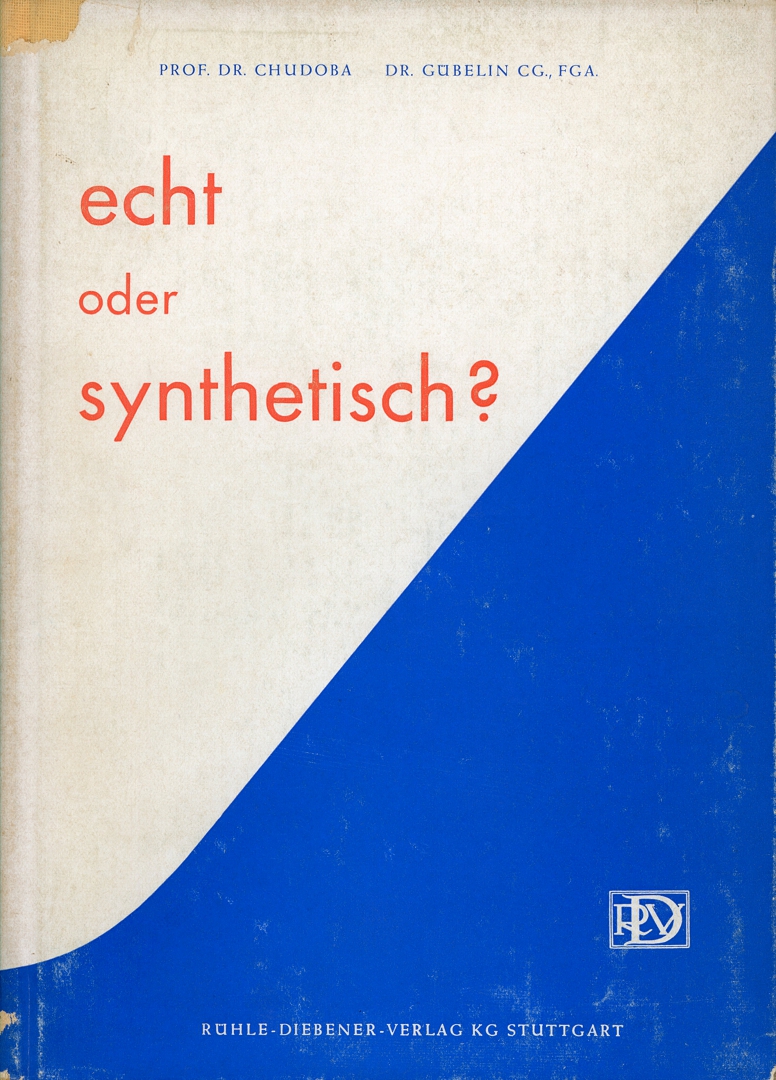
Chudoba, K. and Gübelin, E. (1956) Echt oder synthetisch? [Genuine or Synthetic?] Stuttgart, Rühle-Diebener-Verlag, 156 pp.
Record No. 4735  |  Sinkankas/Born No.: 1349; NIB  |  Language: in German  |  RWHL
Chudoba and Gübelin provide a practical guide to distinguishing natural gemstones from synthetic counterparts, combining a short history of artificial gem production with detailed discussion of the principal manufacturing methods and their diagnostic consequences. The Verneuil flame-fusion process, flux growth, and hydrothermal synthesis are described, together with the characteristic structures and inclusions they produce. Particular attention is given to synthetic ruby and sapphire, spinel, emerald, and other important gem materials, with comparisons between natural and laboratory-grown stones based on growth zoning, curved striae, gas bubbles, mineral inclusions, refractive properties, fluorescence, and other microscopic and physical features. The authors emphasize examination with the gemological microscope as one of the most powerful means of separation, supported by numerous photomicrographs illustrating inclusions and growth phenomena in both natural and synthetic gems. Conceived as a concise working manual for gemologists and jewelers, the book brought together the principal identification criteria then available at a time when synthetic gemstones were becoming increasingly sophisticated and commercially important.

L’Empire des Perles et des Pierres Précieuses
The Empire of Pearls and Gemstones
Book
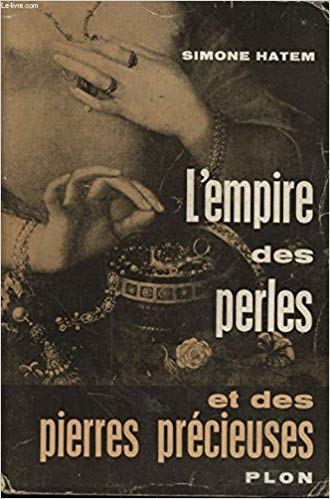
Hatem, S. (1956) L’Empire des Perles et des Pierres Précieuses. [The Empire of Pearls and Gemstones] Paris, Librairie Plon, 260 pp.
Record No. 4052  |  Sinkankas/Born No.: 2801; NIB  |  Language: in French  |  RWHL
Hatem presents a popular but substantial survey of pearls and precious stones, combining gemological information with history, geography, mining, trade, and famous gems. She discusses the principal gemstones, including diamond, ruby, sapphire, emerald, and pearl, describing their formation, physical characteristics, important producing regions, methods of recovery and cutting, and their place in commerce and jewelry. Historical accounts and anecdotes trace the fascination with precious stones from antiquity to the modern period, including celebrated jewels, royal treasures, discoveries, and the development of major gem-producing districts. Synthetic gemstones and attempts to manufacture diamond are also treated, including Moissan’s experiments. Pearls receive extensive attention, with discussion of natural pearl fisheries, cultured pearls, mollusks, formation, grading, and important producing regions. Written for the general reader rather than as a technical gemological manual, the volume brings together scientific explanations and historical material and is extensively illustrated, with 78 figures and a map in the text and 103 illustrations on plates.

Jadeite from San Benito County, California
Journal Article
Coleman, R.G. (1956) Jadeite from San Benito County, California. Gems & Gemology, Vol. 8, No. 11, Fall, pp. 331–334.
Record No. 3639  |  ISBN/ISSN: 0016626X  |  RWHL

Emerald from Habachtal

Journal Article
Gübelin, E.J. (1956) Emerald from Habachtal. Journal of Gemmology, Vol. 5, No. 7, July, pp. 342–361.
Record No. 2046  |  ISBN/ISSN: 221252  |  Sinkankas/Born No.: 2564  |  RWHL

The ruby mines of Mogok, Burma

Journal Article
Spaulding, D.L. (1956) The ruby mines of Mogok, Burma. Gems & Gemology, Vol. 8, No. 11, Fall, pp. 335–342.
Record No. 1634  |  ISBN/ISSN: 0016626X  |  RWHL

The Yogo sapphire mine

Journal Article
Crocker, R.C. (1956) The Yogo sapphire mine. Gems & Gemology, Vol. 8, No. 11, Fall, pp. 323–330.
Record No. 622  |  ISBN/ISSN: 0016626X  |  RWHL

Gemstones of New South Wales

Journal Article
Chalmers, R.O. (1956) Gemstones of New South Wales. Gems & Gemology, Vol. 8, No. 11, Fall, pp. 343–349.
Record No. 494  |  ISBN/ISSN: 0016626X  |  RWHL

Building a Gemological Library

Gemological books range from general identification manuals and textbooks to specialized works on individual gems, mineralogy, jewelry, treatments, synthesis, history and gem-producing regions.

For a curated selection of particularly useful books, read The Gemologist's Core Library — Classic Books on Gemology, Jewelry and Mineralogy.

About Four Treasures

Four Treasures is Lotus Gemology's freely accessible gemological reference database. Use the full database to search by author, title or keyword and explore literature on gemology, mineralogy, jewelry and related fields. Where available, hyperlinks on titles may lead directly to the full publication.

Search the Complete Four Treasures Database