Explore books on gems, gemology, jewelry and mineralogy in Four Treasures, the Lotus Gemology reference database. This bibliography brings together matching book records from the collection, with publication details, abstracts and cover images where available.
Gemology Book References
The list below matches books concerning gemology and related subjects in the database's searchable fields. Some works cover several branches of gems, jewelry or mineralogy.
2,661–2,680 of 3,454 matching references
Star spinel showing four six-rayed stars
Journal Article
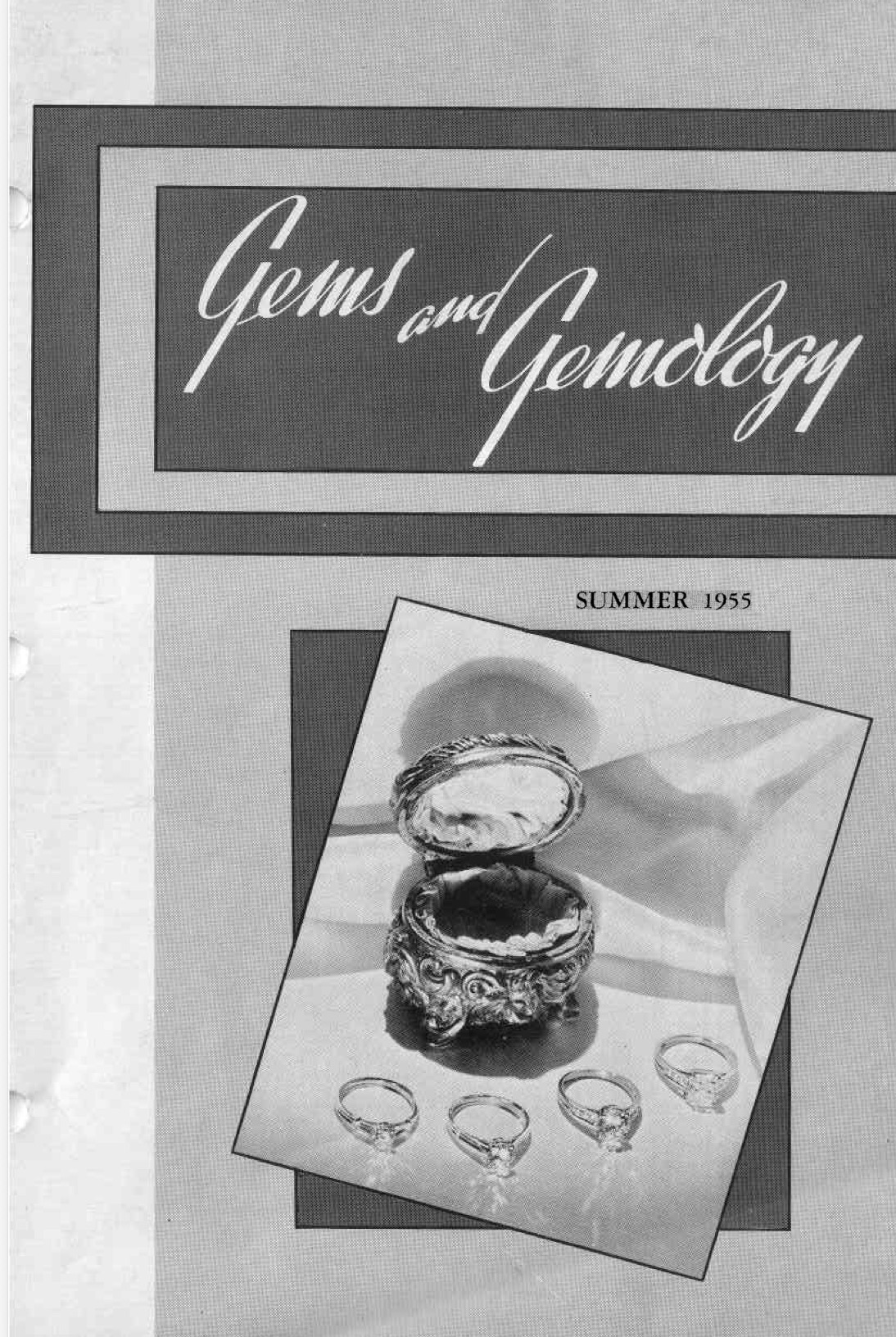
Switzer, G.S. (1955) Star spinel showing four six-rayed stars.Gems & Gemology, Vol. 8, No. 6, Summer, pp. 163–164, 190.
Record No. 29916 | Sinkankas/Born No.: NIS/NIB | RWHL
Reference copied to clipboard!
gems, Ceylon, Sri Lanka, spinel, asterism, star spinel, phenomena
Switzer describes an 11.80 ct black oval cabochon from the Ratnapura District displaying four separate six-rayed stars. X-ray diffraction confirmed spinel; the stone had a specific gravity of 3.550, and its unusual multiple asterism is the central subject of the report.
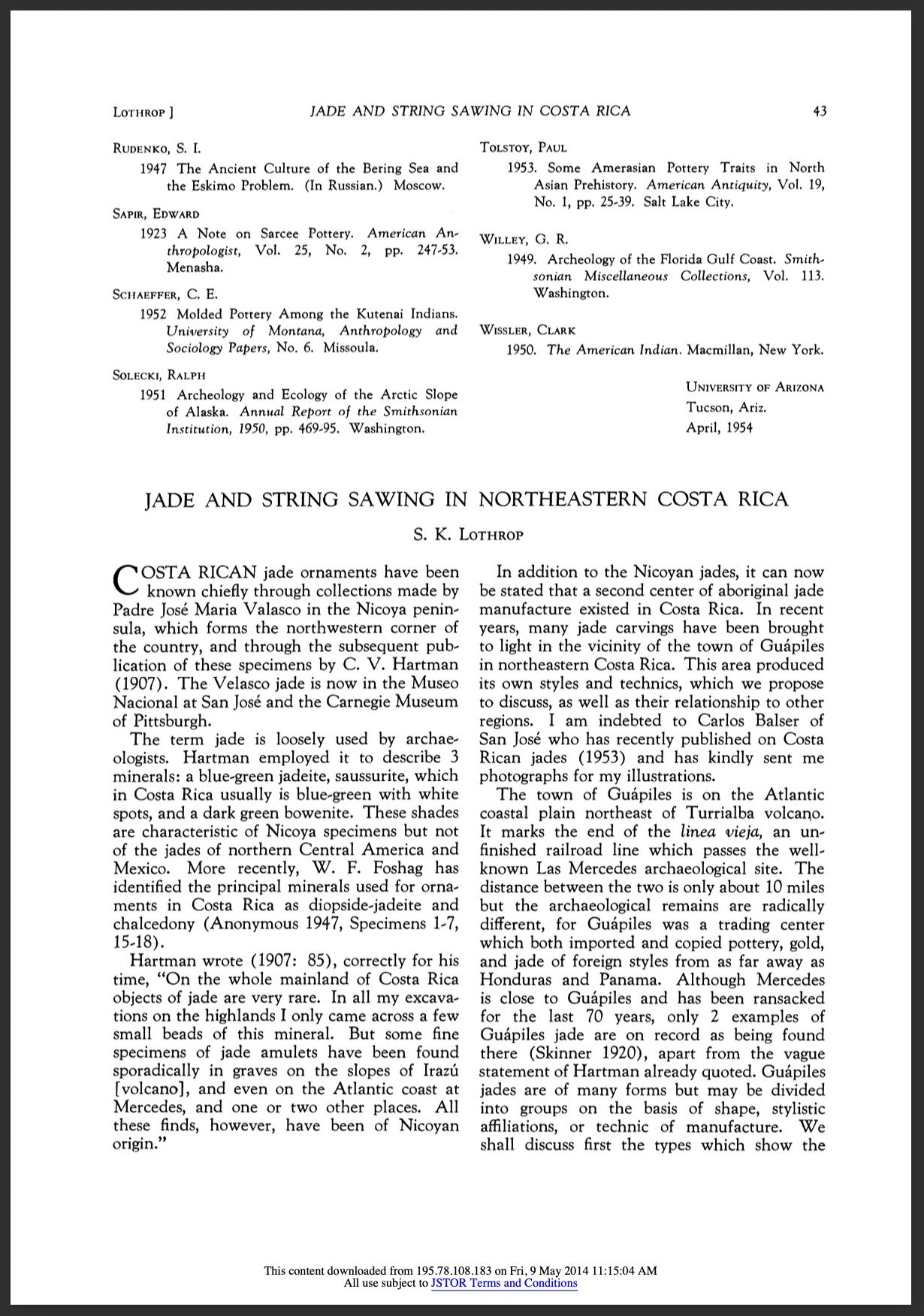
Costa Rican jade ornaments have been known chiefly through collections made by Padre José Maria Valasco in the Nicoya peninsula, which forms the northwestern corner of the country, and through the subsequent publication of these specimens by C. V. Hartman (1907). The Velasco jade is now in the Museo Nacional at San José and the Carnegie Museum of Pittsburgh.The term jade is loosely used by archaeologists. Hartman employed it to describe 3 minerals: a blue-green jadeite, saussurite, which in Costa Rica usually is blue-green with white spots, and a dark green bowenite. These shades are characteristic of Nicoya specimens but not of the jades of northern Central America and Mexico. More recently, W. F. Foshag has identified the principal minerals used for ornaments in Costa Rica as diopside-jadeite and chalcedony (Anonymous 1947, Specimens 1-7, 15-18).
The Road to Samarcand
Book
O’Brien, P. (1955)The Road to Samarcand. London, Rupert Hart-Davis, 255 pp.
Record No. 7415 | RWHL
Reference copied to clipboard!
gems, jade, nephrite, China, fiction
Amblygonite: Old mineral—new gem
Journal Article
Gübelin, E.J. (1955) Amblygonite: Old mineral—new gem.Gems & Gemology, Vol. 8, No. 7, Fall, pp. 208–214.
Record No. 2043 | ISBN/ISSN: 0016626X | RWHL
Reference copied to clipboard!
gems, amblygonite
Famous Diamonds of the World
Book
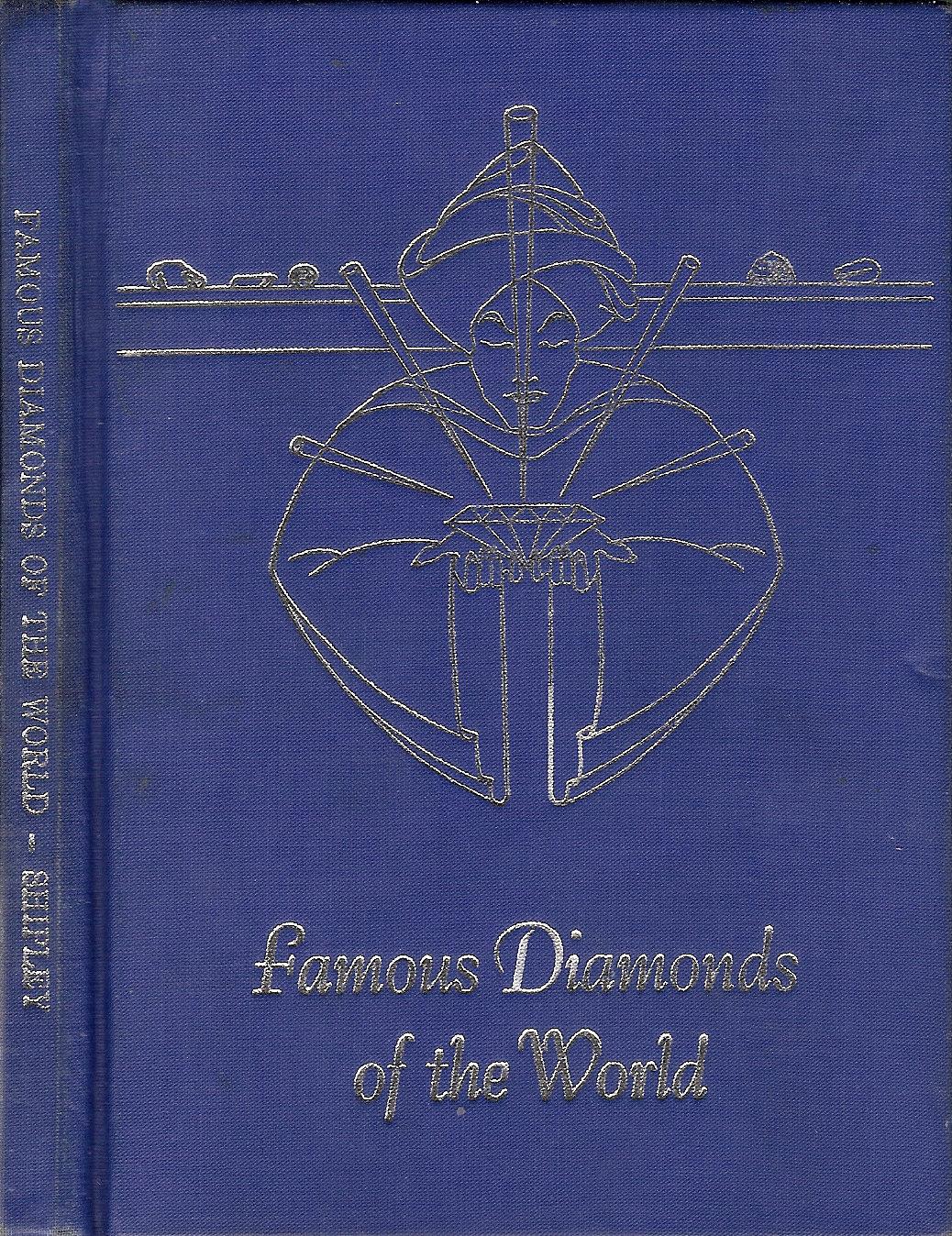
Shipley, R.M. (1955)Famous Diamonds of the World. Los Angeles, Gemological Institute of America, 62 pp.
Record No. 1946 | Sinkankas/Born No.: 6024 | RWHL
Reference copied to clipboard!
famous diamonds, gems
Asterism in corundum
Journal Article
Tait, A.S. (1955) Asterism in corundum.Journal of Gemmology, Vol. 5, No. 2, April, pp. 65–72.
Easby, E.K. and Easby, D., T. (1953) Apuntes sobre la tecnica de taller jade en Mesoamerica. [Notes on Jade Workshop Techniques in Mesoamerica]Anales del Instituto de Arte Americano e Investigaciones Esteticas, Vol. 6, pp. 9–38.
Record No. 28756 | Sinkankas/Born No.: 1840A; NIB | Language: in Spanish | RWHL
Studied numerous smaller jade carvings in order to establish lapidary methods, as illustrated by the pen-and-ink drawings. Discusses the jades of the Maya culture and those of the Valley of Mexico and Oaxaca, together with excellent Olmec objects from the La Venta culture. Features excellent drawings; photographic plates consist mainly of jade carvings.
Jade: A problem in nomenclature
Journal Article
Hardinge, C.E. (1953) Jade: A problem in nomenclature.Journal of Gemmology, Vol. 4, No. 3, July, pp. 112–117.
IN the Journal" for April, 1952, I described an easy photo-Igraphic method whereby the refractive index of faceted gemstones could b e closely estimated and their size, shape, and facet distribution permanently recorded, without the use of a camera. Briefly, the process consisted in immersing the stones in a glass cell containing a suitable liquid, then, in the dark, sliding under the cell a sheet of printing paper or flat film, and exposing for a few seconds to light from a n overhead lamp. After development, the contact print so produced showed very clear, indeed one might say spectacular, differences in the appearance of the stones according to their refractive indices in relation to that of the liquid."
“Reconstructed rubies” found to be synthetic corundum
Journal Article
Benson, L.B. (1953) “Reconstructed rubies” found to be synthetic corundum.Journal of Gemmology, Vol. 4, No. 1, January, pp. 1–10.
Record No. 456 | ISBN/ISSN: 221252 | RWHL
Reference copied to clipboard!
synthetic corundum.7, gems
Recently a number of stones have appeared on the market that were thought to be reconstructed ruby. Although the exact process used for the commercial production of synthetic corundum has been known for many years, the degree to which synthetic material may overlap in appearance the reconstructed stone is given little attention in present text books. In fact, little information has been published concerning the exact method used to produce reconstructed ruby.
Augustine to Galileo | The History of Science | A.D. 400–1650
Book
Crombie, A.C. (1952)Augustine to Galileo | The History of Science | A.D. 400–1650. London, Heinemann, 2 Vols.
gems, history of gemology, history of mineralogy, Arabic mineralogy, history of science, Egypt, Rome, Greek science, astronomy
On its first publication in 1952, Augustine to Galileo was widely welcomed as having ‘removed for ever any excuse there may have been for ignorance of medieval scientific thought’. The book has since become a standard work, and the second (revised and enlarged) edition is now reissued with further corrections. Medieval scientific thought is deceptive both in its similarities to and in its differences from modern science. It was a series of actions in the great adventure of philosophical reformation that separates the classical world from our own. In the course of that adventure, as at all times in the history of science, one system of scientific thought gave place to another not merely because new facts were discovered, but more significantly because men began to ask new questions, to look at long-familiar evidence in a new way. Not only the origins but the nature of modern science can scarcely be understood without a knowledge of the period covered by this book. Dr. Crombie begins with an account of the remains of those Greek scientific conceptions found in the West after the fall of Rome, and of the new ideas about the natural world introduced with Christianity. He then traces the process of the recovery of Greek science from Byzantium and Islam, the assimilation of the new knowledge in the Latin West, the parallel development of technology, and the new conception of experimental science that was formed in the thirteenth and fourteenth centuries. The shifts in scientific thinking in the later Middle Ages emerge as a product of the empiricism of technology married to the methods of rational abstraction of mathematics and philosophy. These shifts prepared the ground for the final revolution brought about by Galileo and his contemporaries. A consideration of their work brings the author to his conclusion. Dr. Crombie is one of the most outstanding historians of science, and is University Lecturer in the History of Science at Oxford.
Jade in Mexico
Journal Article
Barber, R.J. (1952) Jade in Mexico.Gems & Gemology, Vol. 7, No. 5, Spring, pp. 147–150.
Gübelin, E.J. (1952–53) More news of synthetic red spinel.Gems & Gemology, Vol. 7, No. 8, Winter, pp. 236–247.
Record No. 2041 | ISBN/ISSN: 0016626X | RWHL
Reference copied to clipboard!
synthetic spinel, gems
Unusual two and three phase inclusions in Ceylon sapphire
Journal Article
Hoagland, L.P. (1952) Unusual two and three phase inclusions in Ceylon sapphire.Journal of Gemmology, Vol. 3, No. 8, Oct., pp. 330–336.
Record No. 995 | ISBN/ISSN: 221252 | RWHL
Reference copied to clipboard!
corundum, Sri Lanka.12, inclusions.5, gems
At a meeting of the Mineralogical Society held on 24ᵗʰ January, 1952, for the second time within a year a new gem mineral was described. On the former occasion only two small cut specimens of the mineral (taaffeite) were on view, these representing the whole of the world’s known supply; whereas in describing sinhalite Dr. G. F. Claringbull was able to produce a score of cut examples, some of them of considerable size. There was also one small pebble of rough, recovered by Dr. E. H. Rutland from samples of illam held by the lapidaries, Charles Mathews & Son.
Many reconstructed rubies found to be synthetic corundum
Journal Article
Benson, L.B. (1952) Many reconstructed rubies found to be synthetic corundum.Gems & Gemology, Vol. 7, No. 5, Spring, pp. 139–145.
Record No. 455 | ISBN/ISSN: 0016626X | RWHL
Reference copied to clipboard!
synthetic corundum.7, gems
Some additional data on Indian emeralds
Journal Article
Gübelin, E.J. (1951) Some additional data on Indian emeralds.Gems & Gemology, Vol. 7, No. 1, Spring, pp. 13–22, map.
Record No. 2038 | ISBN/ISSN: 0016626X | RWHL
Reference copied to clipboard!
beryl, emerald, inclusions, India, gems
Australian sapphire fields not fully exploited
Journal Article
Stratton, V. (1951) Australian sapphire fields not fully exploited.Gems & Gemology, Vol. 7, No. 4, Winter, pp. 125–128.
Record No. 1656 | ISBN/ISSN: 0016626X | RWHL
Reference copied to clipboard!
corundum, sapphire, Australia.12, gems
Gemological Digests: Repeated twinning lines seen in synthetic corundum
Journal Article
Anonymous (1951) Gemological Digests: Repeated twinning lines seen in synthetic corundum.Gems & Gemology, Vol. 7, No. 1, Spring, p. 25.
Record No. 292 | ISBN/ISSN: 0016626X | RWHL
Reference copied to clipboard!
synthetic corundum.7, gems, inclusions
A Study of Classic Maya Sculpture
Book
Proskouriakoff, T. (1950)A Study of Classic Maya Sculpture. Washington, DC, Carnegie Institution, 209 pp.
Record No. 28711 | Sinkankas/Born No.: NIS/NIB | RWHL
Two important studies in Maya archaeology form the foundation of this book: A Study of Maya Art: Its Subject Matter and Development, by Herbert J. Spinden (1913); and The Inscriptions of Peten, by Sylvanus G. Morley (1937–38). The first established, with notable success, a series of stylistic changes in sculpture at a number of the larger Maya sites; the second provided epigraphic decipherments which permitted the dating of many more monuments in the Peten than was formerly possible. With this much more substantial body of dated material than was available at the time of Spinden’s study, we are now able to confirm many of his findings and to elaborate the basis of stylistic appraisal, extending it to all Classic Maya sites. It is because so much reliance has been placed on Morley’s epigraphic work that disagreements between his stylistic appraisals and mine have been stressed in this book. This, however, should not be construed as a derogation of his conclusions, which rest primarily on epigraphic sources. Our differences serve only to indicate the need to establish definite and significant style characteristics on which future discussion can be based. This is the principal aim of this study; it would have been futile to pursue it without the collection of epigraphic data and interpretation which Morley’s work makes available.
Introduction to the Mayan writing system, including many mentions of jade.
Building a Gemological Library
Gemological books range from general identification manuals and textbooks to specialized works on individual gems, mineralogy, jewelry, treatments, synthesis, history and gem-producing regions.
Four Treasures is Lotus Gemology's freely accessible gemological reference database. Use the full database to search by author, title or keyword and explore literature on gemology, mineralogy, jewelry and related fields. Where available, hyperlinks on titles may lead directly to the full publication.